MOC: Multi-Order Communication in LLM-based Multi-Agent Systems
Pith reviewed 2026-06-28 14:28 UTC · model grok-4.3
The pith
Multi-order communication in LLM multi-agent systems captures multi-hop dependencies to raise task performance while lowering costs.
A machine-rendered reading of the paper's core claim, the machinery that carries it, and where it could break.
Core claim
The paper claims that formalizing a structured multi-order evidence stream and pairing it with a Semantic-Topological Merging algorithm overcomes the restricted receptive field and insight dilution of direct first-order concatenation, producing consistent gains in task performance together with lower communication costs across six datasets and multiple LLM scales.
What carries the argument
The Multi-Order Communication (MOC) scheme that constructs a structured multi-order evidence stream and applies Semantic-Topological Merging to preserve semantic fidelity inside token limits.
If this is right
- Task success rates rise when agents can draw on evidence from second- and higher-order neighbors.
- Total tokens exchanged fall because the merging algorithm consolidates messages while keeping key content.
- The same gains appear across LLMs that differ in parameter count.
- Coordination topology design can be paired with improved message transmission for additive benefits.
- The evidence receptive field expands without a matching increase in communication volume.
Where Pith is reading between the lines
- The same multi-order construction could be tested in non-LLM agent systems such as symbolic planners or reinforcement-learning teams.
- If dilution proves widespread, analogous merging steps might reduce information loss in sensor networks or distributed databases.
- Dynamic topologies or tasks with real-time constraints would be natural next settings to measure whether the token savings persist.
- Interaction between MOC and existing prompt-compression techniques remains untested and could compound the reported efficiency gains.
Load-bearing premise
Dilution of insights across multi-hop paths is the dominant bottleneck of concatenation schemes, and the multi-order stream plus merging step will recover those dependencies without creating offsetting losses in meaning or efficiency.
What would settle it
Re-running the six-dataset experiments and finding that MOC produces no accuracy gain or higher token counts than standard concatenation on any dataset would falsify the central claim.
Figures
read the original abstract
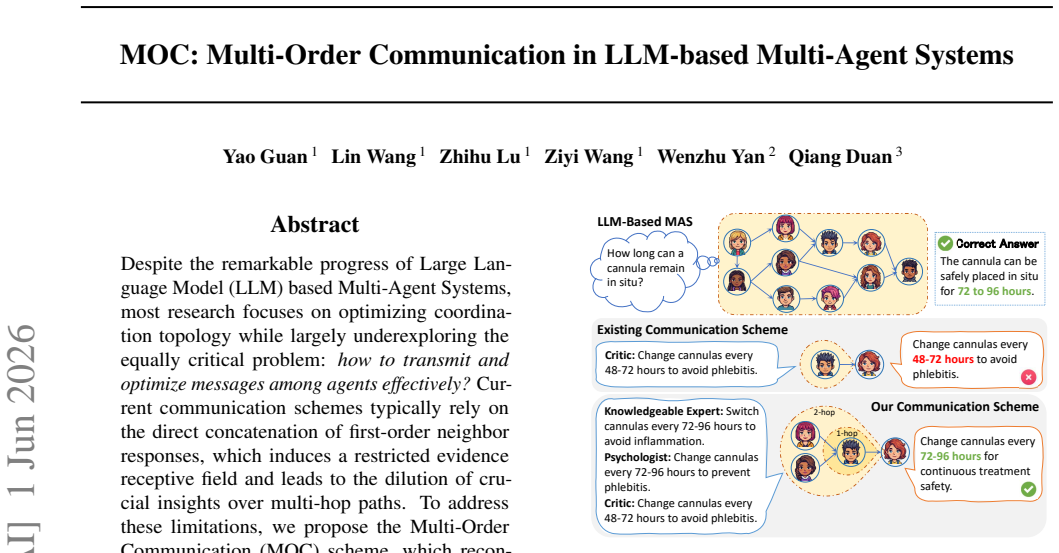
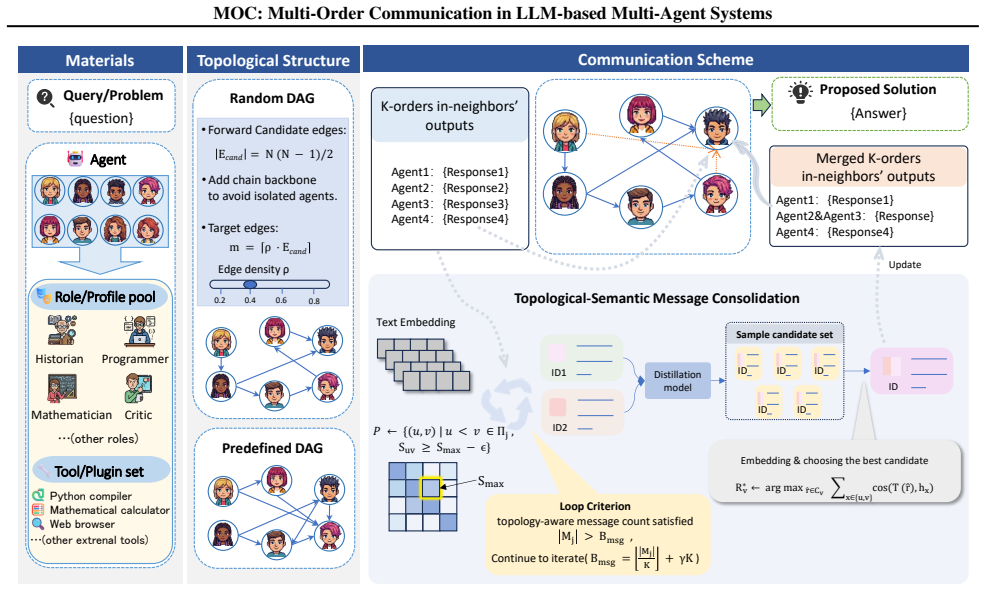
Despite the remarkable progress of Large Language Model (LLM) based Multi-Agent Systems, most research focuses on optimizing coordination topology while largely underexploring the equally critical problem: how to transmit and optimize messages among agents effectively? Current communication schemes typically rely on the direct concatenation of first-order neighbor responses, which induces a restricted evidence receptive field and leads to the dilution of crucial insights over multi-hop paths. To address these limitations, we propose the Multi-Order Communication (MOC) scheme, which reconstructs the inter-agent communication to capture multi-hop dependencies and incorporates a structural message consolidation strategy to ensure efficiency. Specifically, we formalize the communication mechanism to construct a structured multi-order evidence stream, and subsequently design a Semantic-Topological Merging algorithm to optimize semantic fidelity within token constraints. Extensive experiments across six diverse datasets and LLM backbones of varying parameter scales demonstrate that MOC consistently improves task performance and reduces communication costs. The code is available at https://github.com/yao-guan/MOC.
Editorial analysis
A structured set of objections, weighed in public.
Referee Report
Summary. The manuscript proposes Multi-Order Communication (MOC) for LLM-based multi-agent systems. It identifies limitations in existing concatenation-based schemes, which restrict the evidence receptive field and dilute insights across multi-hop paths. MOC reconstructs communication via structured multi-order evidence streams and introduces a Semantic-Topological Merging algorithm to consolidate messages while respecting token limits. Experiments on six datasets with LLMs of varying scales report consistent gains in task performance alongside reduced communication costs. Code is released at the provided GitHub repository.
Significance. If the empirical gains prove robust under full scrutiny of the experimental protocol, the contribution is meaningful because it shifts attention from topology optimization to the mechanics of inter-agent message transmission—an area the abstract correctly notes has received less attention. The explicit code release is a positive factor for reproducibility in an empirical domain.
minor comments (2)
- [Abstract] The abstract states results across 'six diverse datasets' without naming them or indicating their characteristics (e.g., task type, size). Adding the dataset names and a one-sentence justification for diversity would strengthen the claim of generality.
- [Method] The description of the Semantic-Topological Merging algorithm would benefit from an explicit statement of its computational complexity or token-budget allocation rule, even if only in prose, to allow readers to assess scalability before reaching the experiments.
Simulated Author's Rebuttal
We thank the referee for the positive review, the recognition of our focus on inter-agent message transmission, and the recommendation for minor revision. The explicit acknowledgment of the code release for reproducibility is appreciated.
Circularity Check
No significant circularity; empirical proposal with external validation
full rationale
The paper proposes the MOC scheme via formalization of multi-order evidence streams and a Semantic-Topological Merging algorithm, then reports empirical gains on six datasets across LLM scales. No derivation chain, equations, fitted parameters presented as predictions, or self-citation load-bearing steps appear in the abstract or description. The central claim is an empirical result on external benchmarks rather than a self-referential reduction; the method is described as a reconstruction of communication, not derived from its own outputs by construction.
Axiom & Free-Parameter Ledger
Reference graph
Works this paper leans on
-
[2]
ACM Transactions on Intelligent Systems and Technology , volume=
A survey on evaluation of large language models , author=. ACM Transactions on Intelligent Systems and Technology , volume=. 2024 , publisher=
2024
-
[3]
ACM Transactions on Intelligent Systems and Technology , volume=
A comprehensive overview of large language models , author=. ACM Transactions on Intelligent Systems and Technology , volume=. 2025 , publisher=
2025
-
[4]
Proceedings of the Thirty-Third International Joint Conference on Artificial Intelligence , pages=
Large language model based multi-agents: a survey of progress and challenges , author=. Proceedings of the Thirty-Third International Joint Conference on Artificial Intelligence , pages=
-
[5]
ACM Transactions on Software Engineering and Methodology , volume=
LLM-Based Multi-Agent Systems for Software Engineering: Literature Review, Vision, and the Road Ahead , author=. ACM Transactions on Software Engineering and Methodology , volume=. 2025 , publisher=
2025
-
[7]
Advances in Neural Information Processing Systems , volume=
Camel: Communicative agents for" mind" exploration of large language model society , author=. Advances in Neural Information Processing Systems , volume=
-
[8]
AutoGen: Enabling Next-Gen
Qingyun Wu and Gagan Bansal and Jieyu Zhang and Yiran Wu and Beibin Li and Erkang Zhu and Li Jiang and Xiaoyun Zhang and Shaokun Zhang and Jiale Liu and Ahmed Hassan Awadallah and Ryen W White and Doug Burger and Chi Wang , booktitle=. AutoGen: Enabling Next-Gen
-
[9]
Sirui Hong and Mingchen Zhuge and Jonathan Chen and Xiawu Zheng and Yuheng Cheng and Jinlin Wang and Ceyao Zhang and Zili Wang and Steven Ka Shing Yau and Zijuan Lin and Liyang Zhou and Chenyu Ran and Lingfeng Xiao and Chenglin Wu and J. Meta. The Twelfth International Conference on Learning Representations , year=
-
[10]
Forty-first International Conference on Machine Learning , year=
Gptswarm: Language agents as optimizable graphs , author=. Forty-first International Conference on Machine Learning , year=
-
[11]
A Dynamic
Zijun Liu and Yanzhe Zhang and Peng Li and Yang Liu and Diyi Yang , booktitle=. A Dynamic
-
[12]
Forty-second International Conference on Machine Learning , year=
G-Designer: Architecting Multi-agent Communication Topologies via Graph Neural Networks , author=. Forty-second International Conference on Machine Learning , year=
-
[13]
The Thirteenth International Conference on Learning Representations , year=
Scaling Large Language Model-based Multi-Agent Collaboration , author=. The Thirteenth International Conference on Learning Representations , year=
-
[15]
Science China Information Sciences , volume=
The rise and potential of large language model based agents: A survey , author=. Science China Information Sciences , volume=. 2025 , publisher=
2025
-
[16]
Proceedings of the 63rd Annual Meeting of the Association for Computational Linguistics (Volume 1: Long Papers) , pages=
Agentic reasoning: A streamlined framework for enhancing llm reasoning with agentic tools , author=. Proceedings of the 63rd Annual Meeting of the Association for Computational Linguistics (Volume 1: Long Papers) , pages=
-
[17]
The Twelfth International Conference on Learning Representations , year=
AgentVerse: Facilitating Multi-Agent Collaboration and Exploring Emergent Behaviors , author=. The Twelfth International Conference on Learning Representations , year=
-
[18]
Forty-first International Conference on Machine Learning , year=
Improving factuality and reasoning in language models through multiagent debate , author=. Forty-first International Conference on Machine Learning , year=
-
[19]
Forty-first International Conference on Machine Learning , year=
Agent Instructs Large Language Models to be General Zero-Shot Reasoners , author=. Forty-first International Conference on Machine Learning , year=
-
[20]
The Eleventh International Conference on Learning Representations , year=
ReAct: Synergizing Reasoning and Acting in Language Models , author=. The Eleventh International Conference on Learning Representations , year=
-
[21]
Vicinagearth , volume=
A survey on LLM-based multi-agent systems: workflow, infrastructure, and challenges , author=. Vicinagearth , volume=. 2024 , publisher=
2024
-
[22]
Proceedings of the 20th International Conference on Autonomous Agents and MultiAgent Systems , pages=
Multi-Agent Graph-Attention Communication and Teaming , author=. Proceedings of the 20th International Conference on Autonomous Agents and MultiAgent Systems , pages=
-
[23]
The Twelfth International Conference on Learning Representations , year=
Learning Multi-Agent Communication from Graph Modeling Perspective , author=. The Twelfth International Conference on Learning Representations , year=
-
[25]
Proceedings of the 36th annual acm symposium on user interface software and technology , pages=
Generative agents: Interactive simulacra of human behavior , author=. Proceedings of the 36th annual acm symposium on user interface software and technology , pages=
-
[26]
The Thirteenth International Conference on Learning Representations , year=
Cut the Crap: An Economical Communication Pipeline for LLM-based Multi-Agent Systems , author=. The Thirteenth International Conference on Learning Representations , year=
-
[27]
Proceedings of the 63rd Annual Meeting of the Association for Computational Linguistics (Volume 1: Long Papers) , pages=
Agentdropout: Dynamic agent elimination for token-efficient and high-performance llm-based multi-agent collaboration , author=. Proceedings of the 63rd Annual Meeting of the Association for Computational Linguistics (Volume 1: Long Papers) , pages=
-
[28]
Proceedings of the 63rd Annual Meeting of the Association for Computational Linguistics (Volume 1: Long Papers) , pages=
G-safeguard: A topology-guided security lens and treatment on llm-based multi-agent systems , author=. Proceedings of the 63rd Annual Meeting of the Association for Computational Linguistics (Volume 1: Long Papers) , pages=
-
[29]
International Conference on Machine Learning , pages=
Simplifying graph convolutional networks , author=. International Conference on Machine Learning , pages=. 2019 , organization=
2019
-
[30]
International Conference on Learning Representations , year=
Semi-Supervised Classification with Graph Convolutional Networks , author=. International Conference on Learning Representations , year=
-
[31]
International Conference on Learning Representations , year=
Graph Attention Networks , author=. International Conference on Learning Representations , year=
-
[32]
Advances in Neural Information Processing Systems , volume=
Inductive representation learning on large graphs , author=. Advances in Neural Information Processing Systems , volume=
-
[33]
Sentence-BERT: Sentence Embeddings using Siamese BERT-Networks , author=. Proceedings of the 2019 Conference on Empirical Methods in Natural Language Processing and the 9th International Joint Conference on Natural Language Processing (EMNLP-IJCNLP) , pages=
2019
-
[34]
Advances in Neural Information Processing Systems , volume=
Minilm: Deep self-attention distillation for task-agnostic compression of pre-trained transformers , author=. Advances in Neural Information Processing Systems , volume=
-
[36]
2024 , eprint=
Phi-3 Technical Report: A Highly Capable Language Model Locally on Your Phone , author=. 2024 , eprint=
2024
-
[38]
2025 , eprint=
Qwen2.5 Technical Report , author=. 2025 , eprint=
2025
-
[39]
2025 , eprint=
DeepSeek-V3.2: Pushing the Frontier of Open Large Language Models , author=. 2025 , eprint=
2025
-
[40]
International Conference on Learning Representations , year=
Measuring Massive Multitask Language Understanding , author=. International Conference on Learning Representations , year=
-
[41]
Advances in Neural Information Processing Systems , volume=
MMLU-Pro: A More Robust and Challenging Multi-Task Language Understanding Benchmark , author=. Advances in Neural Information Processing Systems , volume=
-
[42]
Advances in Neural Information Processing Systems , volume=
Are emergent abilities of large language models a mirage? , author=. Advances in Neural Information Processing Systems , volume=
-
[43]
Proceedings of the AAAI conference on artificial intelligence , volume=
Deeper insights into graph convolutional networks for semi-supervised learning , author=. Proceedings of the AAAI conference on artificial intelligence , volume=
-
[45]
Proceedings of the 2021 conference of the North American chapter of the association for computational linguistics: human language technologies , pages=
Are NLP models really able to solve simple math word problems? , author=. Proceedings of the 2021 conference of the North American chapter of the association for computational linguistics: human language technologies , pages=
2021
-
[46]
Proceedings of the 55th Annual Meeting of the Association for Computational Linguistics (volume 1: Long papers) , pages=
Program induction by rationale generation: Learning to solve and explain algebraic word problems , author=. Proceedings of the 55th Annual Meeting of the Association for Computational Linguistics (volume 1: Long papers) , pages=
-
[47]
2021 , eprint=
Evaluating Large Language Models Trained on Code , author=. 2021 , eprint=
2021
-
[48]
International Conference on Machine Learning , pages=
Mixhop: Higher-order graph convolutional architectures via sparsified neighborhood mixing , author=. International Conference on Machine Learning , pages=. 2019 , organization=
2019
-
[49]
Proceedings of the 62nd Annual Meeting of the Association for Computational Linguistics (Volume 1: Long Papers) , pages=
Longllmlingua: Accelerating and enhancing llms in long context scenarios via prompt compression , author=. Proceedings of the 62nd Annual Meeting of the Association for Computational Linguistics (Volume 1: Long Papers) , pages=
-
[50]
International Conference on Learning Representations , year=
Representation Degeneration Problem in Training Natural Language Generation Models , author=. International Conference on Learning Representations , year=
-
[51]
Advances in Neural Information Processing Systems , volume=
Language models are few-shot learners , author=. Advances in Neural Information Processing Systems , volume=
-
[52]
Advances in Neural Information Processing Systems , volume=
Chain-of-thought prompting elicits reasoning in large language models , author=. Advances in Neural Information Processing Systems , volume=
-
[53]
Transactions of the Association for Computational Linguistics , volume=
Lost in the middle: How language models use long contexts , author=. Transactions of the Association for Computational Linguistics , volume=
-
[54]
International Conference on Machine Learning , pages=
Large language models can be easily distracted by irrelevant context , author=. International Conference on Machine Learning , pages=. 2023 , organization=
2023
-
[55]
Proceedings of the 41st International Conference on Machine Learning , pages=
How language model hallucinations can snowball , author=. Proceedings of the 41st International Conference on Machine Learning , pages=
-
[56]
Advances in Neural Information Processing Systems , volume=
Can language models perform robust reasoning in chain-of-thought prompting with noisy rationales? , author=. Advances in Neural Information Processing Systems , volume=
-
[57]
Abdin, M., Aneja, J., Awadalla, H., Awadallah, A., Awan, A. A., Bach, N., Bahree, A., Bakhtiari, A., Bao, J., Behl, H., Benhaim, A., Bilenko, M., Bjorck, J., Bubeck, S., Cai, M., Cai, Q., Chaudhary, V., Chen, D., Chen, D., Chen, W., Chen, Y.-C., Chen, Y.-L., Cheng, H., Chopra, P., Dai, X., Dixon, M., Eldan, R., Fragoso, V., Gao, J., Gao, M., Gao, M., Garg...
Pith/arXiv arXiv 2024
-
[58]
Mixhop: Higher-order graph convolutional architectures via sparsified neighborhood mixing
Abu-El-Haija, S., Perozzi, B., Kapoor, A., Alipourfard, N., Lerman, K., Harutyunyan, H., Ver Steeg, G., and Galstyan, A. Mixhop: Higher-order graph convolutional architectures via sparsified neighborhood mixing. In International Conference on Machine Learning, pp.\ 21--29. PMLR, 2019
2019
-
[59]
Graphs meet ai agents: Taxonomy, progress, and future opportunities
Bei, Y., Zhang, W., Wang, S., Chen, W., Zhou, S., Chen, H., Li, Y., Bu, J., Pan, S., Yu, Y., et al. Graphs meet ai agents: Taxonomy, progress, and future opportunities. arXiv preprint arXiv:2506.18019, 2025
arXiv 2025
-
[60]
S., Yang, Q., and Xie, X
Chang, Y., Wang, X., Wang, J., Wu, Y., Yang, L., Zhu, K., Chen, H., Yi, X., Wang, C., Wang, Y., Ye, W., Zhang, Y., Chang, Y., Yu, P. S., Yang, Q., and Xie, X. A survey on evaluation of large language models. ACM Transactions on Intelligent Systems and Technology, 15 0 (3): 0 1--45, 2024
2024
-
[61]
Chen, M., Tworek, J., Jun, H., Yuan, Q., de Oliveira Pinto, H. P., Kaplan, J., Edwards, H., Burda, Y., Joseph, N., Brockman, G., Ray, A., Puri, R., Krueger, G., Petrov, M., Khlaaf, H., Sastry, G., Mishkin, P., Chan, B., Gray, S., Ryder, N., Pavlov, M., Power, A., Kaiser, L., Bavarian, M., Winter, C., Tillet, P., Such, F. P., Cummings, D., Plappert, M., Ch...
2021
-
[62]
A survey on llm-based multi-agent system: Recent advances and new frontiers in application
Chen, S., Liu, Y., Han, W., Zhang, W., and Liu, T. A survey on llm-based multi-agent system: Recent advances and new frontiers in application. arXiv preprint arXiv:2412.17481, 2024 a
arXiv 2024
-
[63]
Agentverse: Facilitating multi-agent collaboration and exploring emergent behaviors
Chen, W., Su, Y., Zuo, J., Yang, C., Yuan, C., Chan, C.-M., Yu, H., Lu, Y., Hung, Y.-H., Qian, C., Qin, Y., Cong, X., Xie, R., Liu, Z., Sun, M., and Zhou, J. Agentverse: Facilitating multi-agent collaboration and exploring emergent behaviors. In The Twelfth International Conference on Learning Representations, 2024 b
2024
-
[64]
Training verifiers to solve math word problems
Cobbe, K., Kosaraju, V., Bavarian, M., Chen, M., Jun, H., Kaiser, L., Plappert, M., Tworek, J., Hilton, J., Nakano, R., Hesse, C., and Schulman, J. Training verifiers to solve math word problems. arXiv preprint arXiv:2110.14168, 2021
Pith/arXiv arXiv 2021
-
[65]
Agent instructs large language models to be general zero-shot reasoners
Crispino, N., Montgomery, K., Zeng, F., Song, D., and Wang, C. Agent instructs large language models to be general zero-shot reasoners. In Forty-first International Conference on Machine Learning, 2024
2024
-
[66]
DeepSeek-AI, Liu, A., Mei, A., Lin, B., Xue, B., Wang, B., Xu, B., Wu, B., Zhang, B., Lin, C., Dong, C., Lu, C., Zhao, C., Deng, C., Xu, C., Ruan, C., Dai, D., Guo, D., Yang, D., Chen, D., Li, E., Zhou, F., Lin, F., Dai, F., Hao, G., Chen, G., Li, G., Zhang, H., Xu, H., Li, H., Liang, H., Wei, H., Zhang, H., Luo, H., Ji, H., Ding, H., Tang, H., Cao, H., G...
Pith/arXiv arXiv 2025
-
[67]
B., and Mordatch, I
Du, Y., Li, S., Torralba, A., Tenenbaum, J. B., and Mordatch, I. Improving factuality and reasoning in language models through multiagent debate. In Forty-first International Conference on Machine Learning, 2024
2024
-
[68]
V., Wiest, O., and Zhang, X
Guo, T., Chen, X., Wang, Y., Chang, R., Pei, S., Chawla, N. V., Wiest, O., and Zhang, X. Large language model based multi-agents: a survey of progress and challenges. In Proceedings of the Thirty-Third International Joint Conference on Artificial Intelligence, pp.\ 8048--8057, 2024
2024
-
[69]
Inductive representation learning on large graphs
Hamilton, W., Ying, Z., and Leskovec, J. Inductive representation learning on large graphs. Advances in Neural Information Processing Systems, 30, 2017
2017
-
[70]
Llm-based multi-agent systems for software engineering: Literature review, vision, and the road ahead
He, J., Treude, C., and Lo, D. Llm-based multi-agent systems for software engineering: Literature review, vision, and the road ahead. ACM Transactions on Software Engineering and Methodology, 34 0 (5): 0 1--30, 2025
2025
-
[71]
Measuring massive multitask language understanding
Hendrycks, D., Burns, C., Basart, S., Zou, A., Mazeika, M., Song, D., and Steinhardt, J. Measuring massive multitask language understanding. In International Conference on Learning Representations, 2021
2021
-
[72]
Hong, S., Zhuge, M., Chen, J., Zheng, X., Cheng, Y., Wang, J., Zhang, C., Wang, Z., Yau, S. K. S., Lin, Z., Zhou, L., Ran, C., Xiao, L., Wu, C., and Schmidhuber, J. Meta GPT : Meta programming for a multi-agent collaborative framework. In The Twelfth International Conference on Learning Representations, 2024
2024
-
[73]
Learning multi-agent communication from graph modeling perspective
Hu, S., Shen, L., Zhang, Y., and Tao, D. Learning multi-agent communication from graph modeling perspective. In The Twelfth International Conference on Learning Representations, 2024
2024
-
[74]
Longllmlingua: Accelerating and enhancing llms in long context scenarios via prompt compression
Jiang, H., Wu, Q., Luo, X., Li, D., Lin, C.-Y., Yang, Y., and Qiu, L. Longllmlingua: Accelerating and enhancing llms in long context scenarios via prompt compression. In Proceedings of the 62nd Annual Meeting of the Association for Computational Linguistics (Volume 1: Long Papers), pp.\ 1658--1677, 2024
2024
-
[75]
Kipf, T. N. and Welling, M. Semi-supervised classification with graph convolutional networks. In International Conference on Learning Representations, 2017
2017
-
[76]
Camel: Communicative agents for" mind" exploration of large language model society
Li, G., Hammoud, H., Itani, H., Khizbullin, D., and Ghanem, B. Camel: Communicative agents for" mind" exploration of large language model society. In Advances in Neural Information Processing Systems, volume 36, pp.\ 51991--52008, 2023
2023
-
[77]
Deeper insights into graph convolutional networks for semi-supervised learning
Li, Q., Han, Z., and Wu, X.-M. Deeper insights into graph convolutional networks for semi-supervised learning. In Proceedings of the AAAI conference on artificial intelligence, volume 32, 2018
2018
-
[78]
A survey on llm-based multi-agent systems: workflow, infrastructure, and challenges
Li, X., Wang, S., Zeng, S., Wu, Y., and Yang, Y. A survey on llm-based multi-agent systems: workflow, infrastructure, and challenges. Vicinagearth, 1 0 (1): 0 9, 2024
2024
-
[79]
Program induction by rationale generation: Learning to solve and explain algebraic word problems
Ling, W., Yogatama, D., Dyer, C., and Blunsom, P. Program induction by rationale generation: Learning to solve and explain algebraic word problems. In Proceedings of the 55th Annual Meeting of the Association for Computational Linguistics (volume 1: Long papers), pp.\ 158--167, 2017
2017
-
[80]
F., Lin, K., Hewitt, J., Paranjape, A., Bevilacqua, M., Petroni, F., and Liang, P
Liu, N. F., Lin, K., Hewitt, J., Paranjape, A., Bevilacqua, M., Petroni, F., and Liang, P. Lost in the middle: How language models use long contexts. Transactions of the Association for Computational Linguistics, 12: 0 157--173, 2024 a
2024
-
[81]
A dynamic LLM -powered agent network for task-oriented agent collaboration
Liu, Z., Zhang, Y., Li, P., Liu, Y., and Yang, D. A dynamic LLM -powered agent network for task-oriented agent collaboration. In First Conference on Language Modeling, 2024 b
2024
-
[82]
U., Qiu, S., Saqib, M., Anwar, S., Usman, M., Akhtar, N., Barnes, N., and Mian, A
Naveed, H., Khan, A. U., Qiu, S., Saqib, M., Anwar, S., Usman, M., Akhtar, N., Barnes, N., and Mian, A. A comprehensive overview of large language models. ACM Transactions on Intelligent Systems and Technology, 16 0 (5): 0 1--72, 2025
2025
-
[83]
Multi-agent graph-attention communication and teaming
Niu, Y., Paleja, R., and Gombolay, M. Multi-agent graph-attention communication and teaming. In Proceedings of the 20th International Conference on Autonomous Agents and MultiAgent Systems, pp.\ 964--973, 2021
2021
-
[84]
S., O'Brien, J., Cai, C
Park, J. S., O'Brien, J., Cai, C. J., Morris, M. R., Liang, P., and Bernstein, M. S. Generative agents: Interactive simulacra of human behavior. In Proceedings of the 36th annual acm symposium on user interface software and technology, pp.\ 1--22, 2023
2023
-
[85]
Patel, A., Bhattamishra, S., and Goyal, N. Are nlp models really able to solve simple math word problems? In Proceedings of the 2021 conference of the North American chapter of the association for computational linguistics: human language technologies, pp.\ 2080--2094, 2021
2021
-
[86]
Scaling large language model-based multi-agent collaboration
Qian, C., Xie, Z., Wang, Y., Liu, W., Zhu, K., Xia, H., Dang, Y., Du, Z., Chen, W., Yang, C., et al. Scaling large language model-based multi-agent collaboration. In The Thirteenth International Conference on Learning Representations, 2025
2025
-
[87]
Qwen2.5 technical report, 2025
Qwen, :, Yang, A., Yang, B., Zhang, B., Hui, B., Zheng, B., Yu, B., Li, C., Liu, D., Huang, F., Wei, H., Lin, H., Yang, J., Tu, J., Zhang, J., Yang, J., Yang, J., Zhou, J., Lin, J., Dang, K., Lu, K., Bao, K., Yang, K., Yu, L., Li, M., Xue, M., Zhang, P., Zhu, Q., Men, R., Lin, R., Li, T., Tang, T., Xia, T., Ren, X., Ren, X., Fan, Y., Su, Y., Zhang, Y., Wa...
Pith/arXiv arXiv 2025
discussion (0)
Sign in with ORCID, Apple, or X to comment. Anyone can read and Pith papers without signing in.