Leveraging structural disorder to enhance topological phases
Pith reviewed 2026-06-28 13:02 UTC · model grok-4.3
The pith
Structural disorder that keeps sites apart sustains topological phases in 2D up to strong disorder.
A machine-rendered reading of the paper's core claim, the machinery that carries it, and where it could break.
Core claim
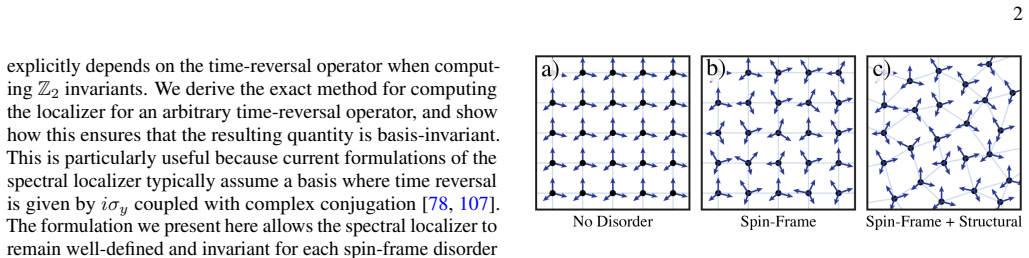
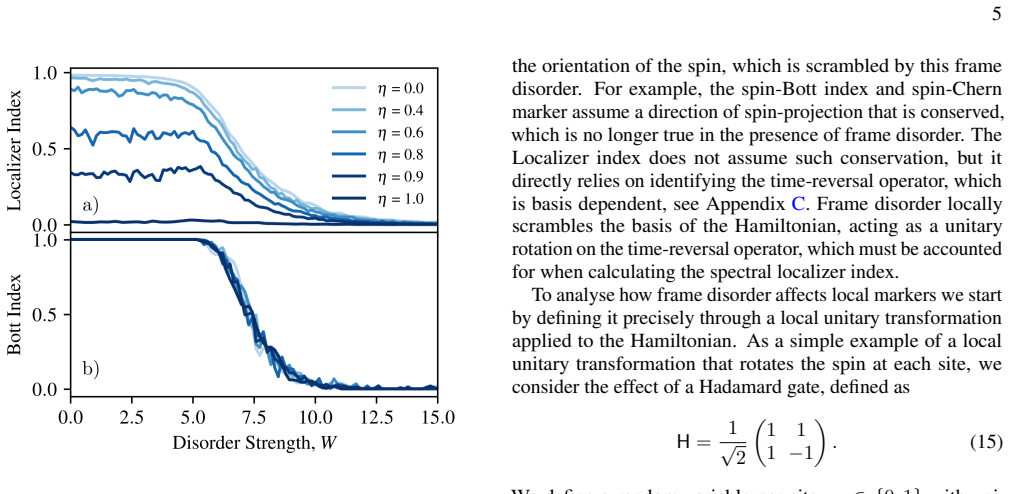
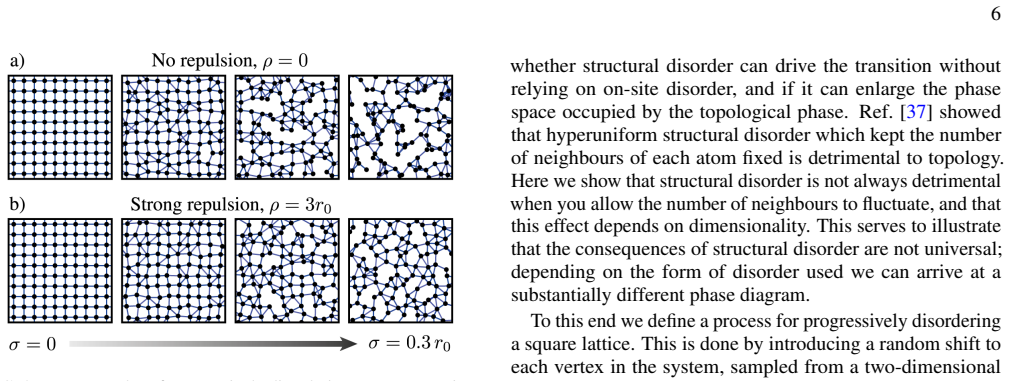
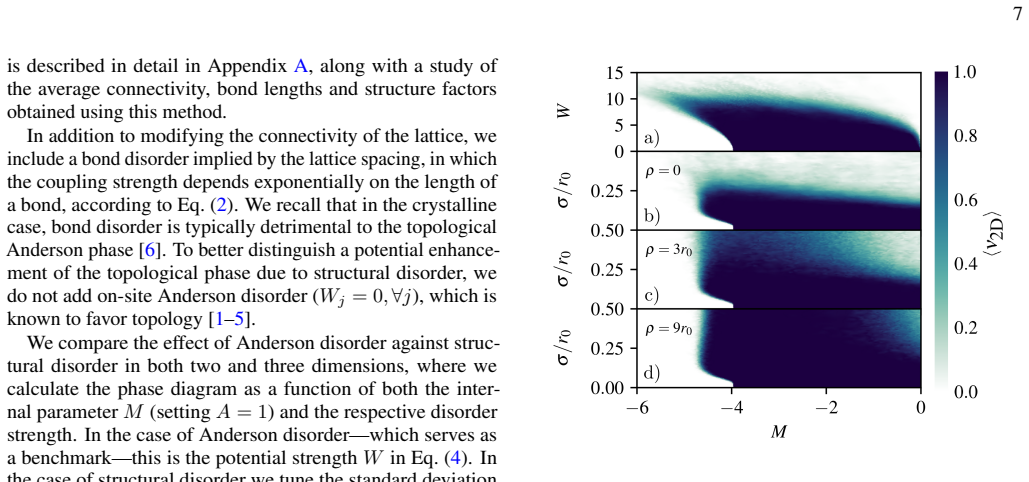
Structural disorder with a minimum-distance penalty between sites enhances and sustains the Z2 topological phase in two-dimensional lattice models up to strong disorder strengths, while generic structural disorder is detrimental in three dimensions; the spectral localizer, defined from the time-reversal symmetry operator, correctly diagnoses the invariant even when disorder scrambles the spin frame.
What carries the argument
The spectral localizer, a local marker constructed directly from the time-reversal symmetry operator rather than a spin projection, which remains well-defined when disorder eliminates a global spin reference frame.
If this is right
- In two dimensions the topological phase can survive stronger structural disorder than models without the distance penalty predict.
- Spin-Chern and spin-Bott markers become unreliable once disorder scrambles the global spin frame, while the spectral localizer remains usable.
- Three-dimensional topological phases are generically more fragile to structural disorder than their two-dimensional counterparts.
- Metamaterial or solid-state samples can be engineered with controlled minimum inter-site distances to stabilize two-dimensional topology.
Where Pith is reading between the lines
- Materials with built-in repulsive interactions between neighboring sites could be designed to favor two-dimensional topological order.
- The same distance-penalty idea might be tested in artificial lattices or photonic systems where structural disorder is easier to control.
- The spectral localizer could be applied to other symmetry-protected phases whose conventional markers rely on a fixed basis that disorder can scramble.
Load-bearing premise
The chosen lattice models with purely structural disorder represent realistic situations and the spectral localizer still identifies the correct Z2 invariant when spins are scrambled.
What would settle it
A direct numerical check showing that the topological phase collapses at weaker disorder than predicted when the minimum-distance penalty is enforced in two dimensions, or that the spectral localizer disagrees with an independent invariant calculation in a scrambled-spin system.
Figures
read the original abstract
On-site disorder can be leveraged to induce a transition from a trivial to a topological insulator. However it is unclear if structural disorder in the absence of on-site disorder can aid a similar transition and, if so, which kind of structural disorder is more favourable. We numerically show that structural disorder can enhance and sustain a topological phase up to strong disorder in two dimensions provided that one penalises atomic sites from being close to one another. However, we find this effect is absent in three dimensions, where structural disorder appears generically detrimental to the phase. In our calculations we include disorder that can scramble the global spin-reference frame, an overlooked type of disorder expected to exist in strongly disordered solids. This disorder fatally scrambles the information necessary for the spin-Bott and the spin-Chern marker to correctly diagnose a topological phase. By using the spectral localizer, a local marker directly defined using the time-reversal symmetry operator rather than a spin-projection, we show how one can circumvent this limitation, providing a basis-indifferent theory for calculating Z2 invariants. Our work showcases that not all structural disorders are equally beneficial to topology, and highlights guiding principles to enhance and detect topological phases in both solid-state and metamaterial realisations.
Editorial analysis
A structured set of objections, weighed in public.
Referee Report
Summary. The paper claims that structural disorder (specifically, penalizing close atomic sites) can enhance and sustain a 2D topological phase up to strong disorder, while the same effect is absent in 3D where structural disorder is generically detrimental. The authors introduce spin-scrambling disorder that invalidates spin-Bott and spin-Chern markers and instead employ the spectral localizer (defined from the time-reversal operator) to diagnose the Z2 invariant in a basis-independent manner, supported by numerical simulations.
Significance. If the numerical evidence is robust and the localizer is shown to be faithful, the result would demonstrate that specific forms of structural disorder can stabilize topology in 2D (but not 3D) and would supply a practical, spin-basis-independent diagnostic for Z2 phases in disordered systems relevant to both solid-state and metamaterial realizations.
major comments (2)
- [Section describing the spectral localizer and its application to disordered systems] The central claim that the spectral localizer correctly identifies the Z2 invariant when disorder scrambles the global spin reference frame rests on an unbenchmarked assumption. No explicit validation against exactly solvable limits (clean TI with artificial per-site spin rotations, or models where Z2 is independently known) is described, leaving open whether the localizer remains faithful once the spin frame is lost.
- [Numerical methods and results sections] The numerical evidence for 2D enhancement versus 3D detriment is presented without visible details on lattice sizes, number of disorder realizations, convergence criteria, or the precise implementation of the 'penalize close sites' structural disorder (e.g., the functional form of the penalty or how it is sampled). These omissions make it impossible to assess whether the reported phase stability is robust or an artifact of finite-size or sampling effects.
minor comments (1)
- [Abstract] The abstract states that 'structural disorder appears generically detrimental' in 3D but does not quantify what 'generically' means or contrast it explicitly with the 2D penalization protocol.
Simulated Author's Rebuttal
We thank the referee for their constructive comments, which highlight areas where additional detail and validation will strengthen the manuscript. We address each major comment below.
read point-by-point responses
-
Referee: [Section describing the spectral localizer and its application to disordered systems] The central claim that the spectral localizer correctly identifies the Z2 invariant when disorder scrambles the global spin reference frame rests on an unbenchmarked assumption. No explicit validation against exactly solvable limits (clean TI with artificial per-site spin rotations, or models where Z2 is independently known) is described, leaving open whether the localizer remains faithful once the spin frame is lost.
Authors: We agree that explicit benchmarks against solvable limits would strengthen the claim. While the spectral localizer is defined directly from the time-reversal operator (rather than any spin projection) and is therefore basis-independent by construction, we will add in the revised manuscript explicit validations using clean topological insulators subjected to artificial per-site spin rotations as well as comparisons against models with independently known Z2 invariants. These additions will confirm faithfulness under spin-frame scrambling. revision: yes
-
Referee: [Numerical methods and results sections] The numerical evidence for 2D enhancement versus 3D detriment is presented without visible details on lattice sizes, number of disorder realizations, convergence criteria, or the precise implementation of the 'penalize close sites' structural disorder (e.g., the functional form of the penalty or how it is sampled). These omissions make it impossible to assess whether the reported phase stability is robust or an artifact of finite-size or sampling effects.
Authors: We agree that these methodological details are essential for assessing robustness. In the revised manuscript we will explicitly report the lattice sizes employed, the number of disorder realizations averaged, the convergence criteria used, and the precise implementation of the structural disorder, including the functional form of the site-separation penalty and the sampling procedure. revision: yes
Circularity Check
Numerical results on structural disorder and Z2 invariants are direct simulation outputs with no reduction to inputs by construction
full rationale
The paper reports numerical lattice simulations showing that certain structural disorder (penalizing close sites) sustains 2D topological phases to strong disorder while being detrimental in 3D. The spectral localizer is introduced as a marker defined directly from the time-reversal operator to handle spin-scrambling disorder where spin-Bott and spin-Chern fail. No equations, definitions, or self-citations reduce the reported phase diagrams or invariant values to fitted parameters or tautological quantities. The chain consists of model construction, disorder generation, and direct computation of the localizer; it does not match any enumerated circularity pattern. The work is self-contained against external benchmarks in the sense required by the guidelines.
Axiom & Free-Parameter Ledger
Reference graph
Works this paper leans on
-
[1]
4 (a), we find a familiar story [1, 2, 4, 5, 54, 95, 115]
Two-dimensional quantum-spin Hall In the case of Anderson disorder, shown in Fig. 4 (a), we find a familiar story [1, 2, 4, 5, 54, 95, 115]. Here, provided that we start with M approximately ∈[−5.4,−4] , the system can be driven into a topological phase by increasing the Anderson disorder coefficientW. In contrast, in the case of structural disorder we fi...
-
[2]
5 (a), is 8 in good agreement with previous studies of disordered three- dimensional Z2 topological insulators [3, 91, 115, 143]
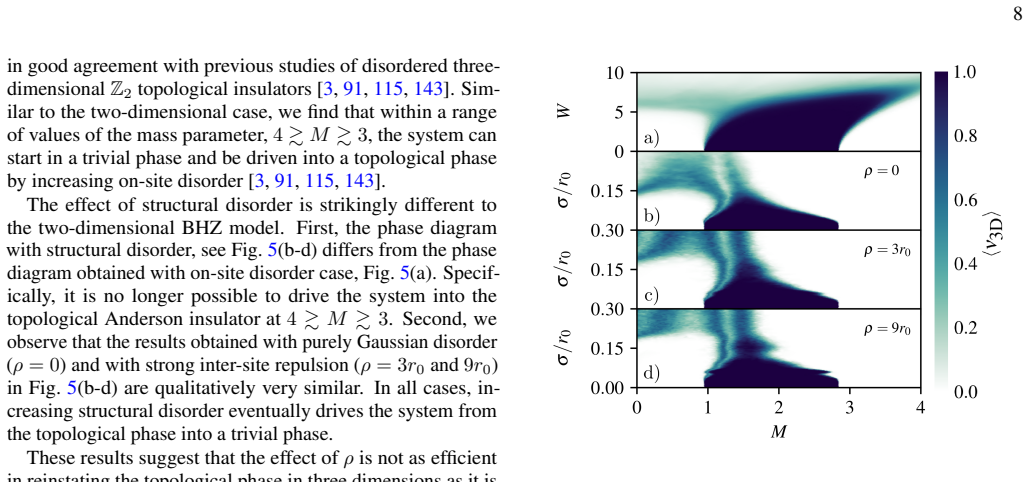
Three-dimensionalZ 2 topological insulator In the three-dimensional case with on-site disorder, the phase diagram obtained from the localizer, shown in Fig. 5 (a), is 8 in good agreement with previous studies of disordered three- dimensional Z2 topological insulators [3, 91, 115, 143]. Sim- ilar to the two-dimensional case, we find that within a range of ...
-
[3]
Li, R.-L
J. Li, R.-L. Chu, J. K. Jain, and S.-Q. Shen, Physical Review Letters102, 136806 (2009)
2009
-
[4]
C. W. Groth, M. Wimmer, A. R. Akhmerov, J. Tworzydło, and C. W. J. Beenakker, Physical Review Letters103, 196805 (2009)
2009
-
[5]
H.-M. Guo, G. Rosenberg, G. Refael, and M. Franz, Phys. Rev. Lett.105, 216601 (2010)
2010
-
[6]
Prodan, Phys
E. Prodan, Phys. Rev. B83, 195119 (2011)
2011
-
[7]
Yamakage, K
A. Yamakage, K. Nomura, K.-I. Imura, and Y . Kuramoto, Jour- nal of Physics: Conference Series400, 042070 (2012)
2012
-
[8]
J. Song, H. Liu, H. Jiang, Q.-f. Sun, and X. C. Xie, Phys. Rev. B85, 195125 (2012)
2012
-
[9]
Prodan, J
E. Prodan, J. Phys. A44, 113001 (2011)
2011
-
[10]
Ringel, Y
Z. Ringel, Y . E. Kraus, and A. Stern, Phys. Rev. B86, 045102 (2012)
2012
-
[11]
S.-H. Lv, J. Song, and Y .-X. Li, Journal of Applied Physics 114, 183710 (2013)
2013
-
[12]
I. C. Fulga, B. van Heck, J. M. Edge, and A. R. Akhmerov, Physical Review B89, 155424 (2014)
2014
-
[13]
X. Ni, H. Huang, and F. Liu, Phys. Rev. B101, 125114 (2020)
2020
-
[14]
J. a. S. Silva, E. V . Castro, R. Mondaini, M. A. H. V ozmediano, and M. P. L´opez-Sancho, Phys. Rev. B109, 125145 (2024)
2024
-
[15]
A. Y . Chaou, M. Moreno-Gonzalez, A. Altland, and P. W. Brouwer, Phys. Rev. B112, 035167 (2025)
2025
-
[16]
Agarwala and V
A. Agarwala and V . B. Shenoy, Physical Review Letters118, 236402 (2017)
2017
-
[17]
Mansha and Y
S. Mansha and Y . D. Chong, Physical Review B96, 121405 (2017)
2017
-
[18]
Xiao and S
M. Xiao and S. Fan, Physical Review B96, 100202 (2017)
2017
-
[19]
N. P. Mitchell, L. M. Nash, D. Hexner, A. M. Turner, and W. T. M. Irvine, Nature Physics14, 380 (2018)
2018
-
[20]
Bourne and E
C. Bourne and E. Prodan, Journal of Physics A: Mathematical and Theoretical51, 235202 (2018)
2018
-
[21]
P¨oyh¨onen, I
K. P¨oyh¨onen, I. Sahlberg, A. Weststr¨om, and T. Ojanen, Nature Communications9, 2103 (2018)
2018
-
[22]
E. L. Minarelli, K. P ¨oyh¨onen, G. A. R. van Dalum, T. Ojanen, and L. Fritz, Physical Review B99, 165413 (2019)
2019
-
[23]
Chern, Europhysics Letters126, 37002 (2019)
G.-W. Chern, Europhysics Letters126, 37002 (2019)
2019
-
[24]
Mano and T
T. Mano and T. Ohtsuki, Journal of the Physical Society of Japan88, 123704 (2019)
2019
-
[25]
Costa, G
M. Costa, G. R. Schleder, M. Buongiorno Nardelli, C. Lewenkopf, and A. Fazzio, Nano Letters19, 8941 (2019)
2019
-
[26]
Marsal, D
Q. Marsal, D. Varjas, and A. G. Grushin, Proceedings of the National Academy of Sciences117, 30260 (2020)
2020
-
[27]
Mukati, A
P. Mukati, A. Agarwala, and S. Bhattacharjee, Physical Review B101, 035142 (2020)
2020
-
[28]
Sahlberg, A
I. Sahlberg, A. Weststr¨om, K. P¨oyh¨onen, and T. Ojanen, Physi- cal Review Research2, 013053 (2020)
2020
-
[29]
M. N. Ivaki, I. Sahlberg, and T. Ojanen, Physical Review Re- search2, 043301 (2020)
2020
-
[30]
Agarwala, V
A. Agarwala, V . Juriˇci´c, and B. Roy, Physical Review Research 2, 012067 (2020)
2020
-
[31]
A. G. Grushin, inLow-Temperature Thermal and Vibrational Properties of Disordered Solids, edited by M. A. Ramos (World Scientific, 2022) Chap. 11
2022
-
[32]
H. Huang and F. Liu, Research 2020, 10.34133/2020/7832610 (2020), https://spj.science.org/doi/pdf/10.34133/2020/7832610
-
[33]
Wang, Y .-B
J.-H. Wang, Y .-B. Yang, N. Dai, and Y . Xu, Physical Review Letters126, 206404 (2021)
2021
-
[34]
Focassio, G
B. Focassio, G. R. Schleder, M. Costa, A. Fazzio, and C. Lewenkopf, 2D Materials8, 025032 (2021)
2021
-
[35]
Focassio, G
B. Focassio, G. R. Schleder, F. C. d. Lima, C. Lewenkopf, and A. Fazzio, Physical Review B104, 214206 (2021)
2021
-
[36]
N. P. Mitchell, A. M. Turner, and W. T. M. Irvine, Physical Review E104, 025007 (2021)
2021
-
[37]
Spring, A
H. Spring, A. Akhmerov, and D. Varjas, SciPost Physics11, 022 (2021)
2021
-
[38]
C. Wang, T. Cheng, Z. Liu, F. Liu, and H. Huang, Physical Review Letters128, 056401 (2022)
2022
-
[39]
Ma and H
J. Ma and H. Huang, Physical Review B106, 195150 (2022)
2022
-
[40]
Peng, C.-B
T. Peng, C.-B. Hua, R. Chen, Z.-R. Liu, H.-M. Huang, and B. Zhou, Phys. Rev. B106, 125310 (2022)
2022
-
[41]
A. J. Ur´ıa-´Alvarez, D. Molpeceres-Mingo, and J. J. Palacios, Phys. Rev. B105, 155128 (2022)
2022
-
[42]
Guzm´an, D
M. Guzm´an, D. Bartolo, and D. Carpentier, SciPost Physics12, 038 (2022)
2022
-
[43]
Mu ˜noz Segovia, P
D. Mu ˜noz Segovia, P. Corbae, D. Varjas, F. Hellman, S. M. Griffin, and A. G. Grushin, Phys. Rev. Res.5, L042011 (2023)
2023
-
[44]
G. Cassella, P. d’Ornellas, T. Hodson, W. M. H. Natori, and J. Knolle, Nature Communications14, 10.1038/s41467-023- 42105-9 (2023)
-
[45]
A. G. Grushin and C. Repellin, Phys. Rev. Lett.130, 186702 (2023). 10
2023
-
[46]
Cheng, T
X. Cheng, T. Qu, L. Xiao, S. Jia, J. Chen, and L. Zhang, Phys. Rev. B108, L081110 (2023)
2023
-
[47]
Z. Zhang, P. Delplace, and R. Fleury, Science Advances9, 10.1126/sciadv.adg3186 (2023)
-
[48]
Manna, S
S. Manna, S. K. Das, and B. Roy, Phys. Rev. B109, 174512 (2024)
2024
-
[49]
D. Li, C. Wang, and H. Huang, SciPost Phys.17, 086 (2024)
2024
-
[50]
Marsal, D
Q. Marsal, D. Varjas, and A. G. Grushin, Phys. Rev. B107, 045119 (2023)
2023
-
[51]
A. J. Ur´ıa-´Alvarez and J. J. Palacios, Phys. Rev. Res.7, 043263 (2025)
2025
-
[52]
Y . E. Kraus, Y . Lahini, Z. Ringel, M. Verbin, and O. Zilberberg, Phys. Rev. Lett.109, 106402 (2012)
2012
-
[53]
D. T. Tran, A. Dauphin, N. Goldman, and P. Gaspard, Phys. Rev. B91, 085125 (2015)
2015
-
[54]
M. A. Bandres, M. C. Rechtsman, and M. Segev, Phys. Rev. X 6, 011016 (2016)
2016
-
[55]
Fuchs and J
J.-N. Fuchs and J. Vidal, Phys. Rev. B94, 205437 (2016)
2016
-
[56]
Huang and F
H. Huang and F. Liu, Phys. Rev. B98, 125130 (2018)
2018
-
[57]
Fuchs, R
J.-N. Fuchs, R. Mosseri, and J. Vidal, Phys. Rev. B98, 145 (2018)
2018
-
[58]
T. A. Loring, Journal of Mathematical Physics60, 081903 (2019)
2019
-
[59]
Varjas, A
D. Varjas, A. Lau, K. P¨oyh¨onen, A. R. Akhmerov, D. I. Pikulin, and I. C. Fulga, Phys. Rev. Lett.123, 196401 (2019)
2019
-
[60]
Huang and F
H. Huang and F. Liu, Phys. Rev. B100, 085119 (2019)
2019
-
[61]
Chen, D.-H
R. Chen, D.-H. Xu, and B. Zhou, Phys. Rev. B100, 115311 (2019)
2019
-
[62]
He, L.-R
A.-L. He, L.-R. Ding, Y . Zhou, Y .-F. Wang, and C.-D. Gong, Phys. Rev. B100, 214109 (2019)
2019
-
[63]
C. W. Duncan, S. Manna, and A. E. B. Nielsen, Phys. Rev. B 101, 115413 (2020)
2020
-
[64]
Fan and H
J. Fan and H. Huang, Frontiers of Physics17, 13203 (2021)
2021
-
[65]
Zilberberg, Opt
O. Zilberberg, Opt. Mater. Express11, 1143 (2021)
2021
-
[66]
D. V . Else, S.-J. Huang, A. Prem, and A. Gromov, Phys. Rev. X11, 041051 (2021)
2021
-
[67]
Hua, Z.-R
C.-B. Hua, Z.-R. Liu, T. Peng, R. Chen, D.-H. Xu, and B. Zhou, Phys. Rev. B104, 155304 (2021)
2021
-
[68]
J. Jeon, M. J. Park, and S. Lee, Phys. Rev. B105, 045146 (2022)
2022
-
[69]
Schirmann, S
J. Schirmann, S. Franca, F. Flicker, and A. G. Grushin, Phys. Rev. Lett.132, 086402 (2024)
2024
-
[70]
Roche Carrasco, J
H. Roche Carrasco, J. Schirmann, A. Mordret, and A. G. Grushin, Phys. Rev. Lett.135, 236603 (2025)
2025
- [71]
-
[72]
Brzezi´nska, A
M. Brzezi´nska, A. M. Cook, and T. Neupert, Phys. Rev. B98, 205116 (2018)
2018
-
[73]
S. Manna and B. Roy, Communications Physics6, 10.1038/s42005-023-01130-2 (2023)
-
[74]
D. M. Urwyler, P. M. Lenggenhager, I. Boettcher, R. Thomale, T. Neupert, and T. c. v. Bzduˇsek, Phys. Rev. Lett.129, 246402 (2022)
2022
-
[75]
Liu, C.-B
Z.-R. Liu, C.-B. Hua, T. Peng, and B. Zhou, Phys. Rev. B105, 245301 (2022)
2022
-
[76]
P. M. Lenggenhager, A. Stegmaier, L. K. Upreti, T. Hofmann, T. Helbig, A. V ollhardt, M. Greiter, C. H. Lee, S. Imhof, H. Brand, T. Kießling, I. Boettcher, T. Neupert, R. Thomale, and T. Bzduˇsek, Nature Communications13, 4373 (2022)
2022
-
[77]
Kitaev, Ann
A. Kitaev, Ann. Phys.321, 2 (2006), january Special Issue
2006
-
[78]
Bianco and R
R. Bianco and R. Resta, Phys. Rev. B84, 241106 (2011)
2011
-
[79]
Marrazzo and R
A. Marrazzo and R. Resta, Phys. Rev. B95, 121114 (2017), publisher: American Physical Society
2017
-
[80]
T. A. Loring and M. B. Hastings, EPL92, 67004 (2010)
2010
discussion (0)
Sign in with ORCID, Apple, or X to comment. Anyone can read and Pith papers without signing in.