Theory of Quantum Phase Space: Foundations and Applications
Pith reviewed 2026-06-28 14:18 UTC · model grok-4.3
The pith
The quantum Wannier basis establishes a unitary mapping between Hilbert space and discretized phase space that produces a genuine probability distribution for pure quantum states.
A machine-rendered reading of the paper's core claim, the machinery that carries it, and where it could break.
Core claim
The quantum Wannier basis establishes a unitary mapping between the Hilbert space and a discretized phase space, yielding a genuine probability distribution in phase space and thereby providing a basis-dependent entropy for pure quantum states. Bourgain's nonperiodic variant supplies a theoretical route around the localization limits imposed by the Balian-Low theorem.
What carries the argument
The quantum Wannier basis, which supplies the unitary mapping from Hilbert space to a discretized phase space grid while preserving orthonormality.
If this is right
- Numerical studies of quantum systems can now use the quantum Wannier basis directly for phase-space calculations.
- The basis supplies concrete benchmarks for the localization limits of orthonormal phase-space representations.
- Bourgain's nonperiodic basis offers a practical workaround for systems where periodic Wannier functions are constrained.
- Pure quantum states acquire a well-defined phase-space entropy that depends on the chosen basis.
Where Pith is reading between the lines
- The basis-dependent entropy may be compared with von Neumann entropy to quantify how different bases capture state localization.
- The mapping could be tested in finite-dimensional systems such as spin chains to check whether the probability distribution reproduces known expectation values.
- Extensions to time-dependent or driven systems would show whether the entropy remains conserved under unitary evolution.
Load-bearing premise
A quantum Wannier basis can be constructed that achieves the unitary mapping to discretized phase space while satisfying orthonormality and sidestepping the localization constraints of the Balian-Low theorem.
What would settle it
An explicit construction of a quantum Wannier basis for a concrete Hilbert space that either fails to remain unitary or produces negative values in the resulting distribution would falsify the central claim.
Figures
read the original abstract
This article provides a concise review of quantum phase space theory, beginning with its foundational principles and the properties of standard quantum quasi-probability distributions, specifically the Wigner, Husimi Q, and Glauber--Sudarshan P functions. We discuss the intrinsic limitations of these distributions, such as the appearance of negative values and phase-space blurring. A significant portion of this review highlights recent theoretical developments, particularly the quantum Wannier basis. This approach establishes a unitary mapping between the Hilbert space and a discretized phase space, yielding a genuine probability distribution in phase space and thereby providing a basis-dependent entropy for pure quantum states. Furthermore, we examine Bourgain's nonperiodic basis as a theoretical framework to circumvent the constraints imposed by the Balian--Low theorem. These developments provide practical tools for numerical studies based on the quantum Wannier basis, as well as conceptual benchmarks for understanding the localization limits of orthonormal phase-space representations.
Editorial analysis
A structured set of objections, weighed in public.
Referee Report
Summary. This review article summarizes foundational principles of quantum phase space, including properties and limitations (negativity, blurring) of the Wigner, Husimi Q, and Glauber-Sudarshan P functions. It then highlights recent developments on the quantum Wannier basis, which is claimed to establish a unitary mapping from Hilbert space to a discretized phase space yielding a genuine (non-negative) probability distribution and a basis-dependent entropy even for pure states; Bourgain's nonperiodic basis is invoked to circumvent the Balian-Low theorem, with the developments positioned as providing practical numerical tools and conceptual benchmarks.
Significance. If the claimed properties of the quantum Wannier basis hold, the work would be significant by supplying an orthonormal phase-space representation that permits a probability interpretation and entropy measure for pure states, offering both numerical utility and a way to quantify localization limits beyond standard quasi-probability distributions.
major comments (2)
- [section on recent theoretical developments (quantum Wannier basis)] Discussion of quantum Wannier basis and Bourgain nonperiodic variant: the review states that these constructions yield a unitary mapping and genuine probability distribution (non-negative for arbitrary pure states), but provides neither an explicit verification of unitarity of the overlap kernel nor a demonstration (or citation of a specific theorem/result) that the squared coefficients remain non-negative for general pure states rather than only for the basis vectors themselves. This verification is load-bearing for the central claim of a basis-dependent entropy.
- [discussion of Bourgain's nonperiodic basis] Abstract and discussion of Bourgain's nonperiodic basis: the claim that this basis circumvents the Balian-Low theorem while achieving exact orthonormality on the lattice is asserted without reproducing or citing a concrete check that the resulting representation satisfies both orthonormality and the non-negativity condition simultaneously for the full Hilbert space.
minor comments (2)
- [abstract] The abstract refers to 'Glauber--Sudarshan P functions' (plural); standardize to the conventional singular usage 'Glauber-Sudarshan P function' for consistency with the literature.
- [section on quantum Wannier basis] Notation for the quantum Wannier basis functions and the discretized phase-space lattice is introduced without an explicit equation defining the overlap kernel or the mapping operator; adding a compact defining equation would improve clarity for readers.
Simulated Author's Rebuttal
We thank the referee for their careful reading and constructive comments on our review. We address the major comments point by point below, agreeing that additional explicit citations will strengthen the presentation of the quantum Wannier basis and Bourgain construction.
read point-by-point responses
-
Referee: Discussion of quantum Wannier basis and Bourgain nonperiodic variant: the review states that these constructions yield a unitary mapping and genuine probability distribution (non-negative for arbitrary pure states), but provides neither an explicit verification of unitarity of the overlap kernel nor a demonstration (or citation of a specific theorem/result) that the squared coefficients remain non-negative for general pure states rather than only for the basis vectors themselves. This verification is load-bearing for the central claim of a basis-dependent entropy.
Authors: We thank the referee for this observation. The quantum Wannier basis is constructed via a unitary overlap kernel between the continuous Hilbert space and the discrete phase-space lattice, with the squared coefficients serving as probabilities by definition for any state. The non-negativity holds for arbitrary pure states because the representation is a true orthonormal basis expansion. To make this explicit, we will add citations to the original theorems establishing unitarity of the kernel and positivity of the squared moduli in the foundational works on the quantum Wannier basis. This will directly support the basis-dependent entropy claim. revision: yes
-
Referee: Abstract and discussion of Bourgain's nonperiodic basis: the claim that this basis circumvents the Balian-Low theorem while achieving exact orthonormality on the lattice is asserted without reproducing or citing a concrete check that the resulting representation satisfies both orthonormality and the non-negativity condition simultaneously for the full Hilbert space.
Authors: We agree that a specific citation is warranted. Bourgain's nonperiodic basis is shown in the literature to evade the Balian-Low theorem while maintaining exact orthonormality on the lattice; the resulting phase-space coefficients remain non-negative for the full space because they arise from the unitary mapping to a probability distribution. We will insert a targeted citation to the relevant theorem in Bourgain's work that simultaneously verifies orthonormality and the non-negativity property, without reproducing the full proof in this review article. revision: yes
Circularity Check
Review paper with no original derivations or load-bearing self-referential steps
full rationale
This is a concise review summarizing foundational quasi-probability distributions and recent external developments on the quantum Wannier basis and Bourgain's nonperiodic construction. The text attributes the unitary mapping and probability interpretation to cited prior work rather than deriving or fitting them within the manuscript. No equations, predictions, or uniqueness claims reduce by construction to the paper's own inputs or self-citations. The central claims rest on external theoretical results, satisfying the criteria for a self-contained review with no circularity.
Axiom & Free-Parameter Ledger
Reference graph
Works this paper leans on
-
[1]
The Qfunctionisobtainedbythecorresponding Fourier transform: Q(α) = 1 π2 Z d2β e−βα∗+β∗αCA(β).(III.60)
The Q Function (Antinormal Ordering) The Q function is generated from the antinormally ordered characteristic function: CA(β) = Tr h ˆρe−β∗ˆaeβˆa†i ,(III.59) where the annihilation operator precedes the creation operator. The Qfunctionisobtainedbythecorresponding Fourier transform: Q(α) = 1 π2 Z d2β e−βα∗+β∗αCA(β).(III.60)
-
[2]
The Wigner function is generated by: W(α) = 1 π2 Z d2β e−βα∗+β∗αCW(β).(III.62) For a detailed derivation of these relations, one may re- fer to Ref
The Wigner Function (Weyl/Symmetric Ordering) The Wigner function corresponds to the Weyl (sym- metric) ordered characteristic function: CW(β) = Tr ˆρexp(−β∗ˆa+βˆa†) ,(III.61) where ˆaand ˆa† appear symmetrically in the exponent (related to the displacement operatorˆD(β)). The Wigner function is generated by: W(α) = 1 π2 Z d2β e−βα∗+β∗αCW(β).(III.62) For ...
-
[3]
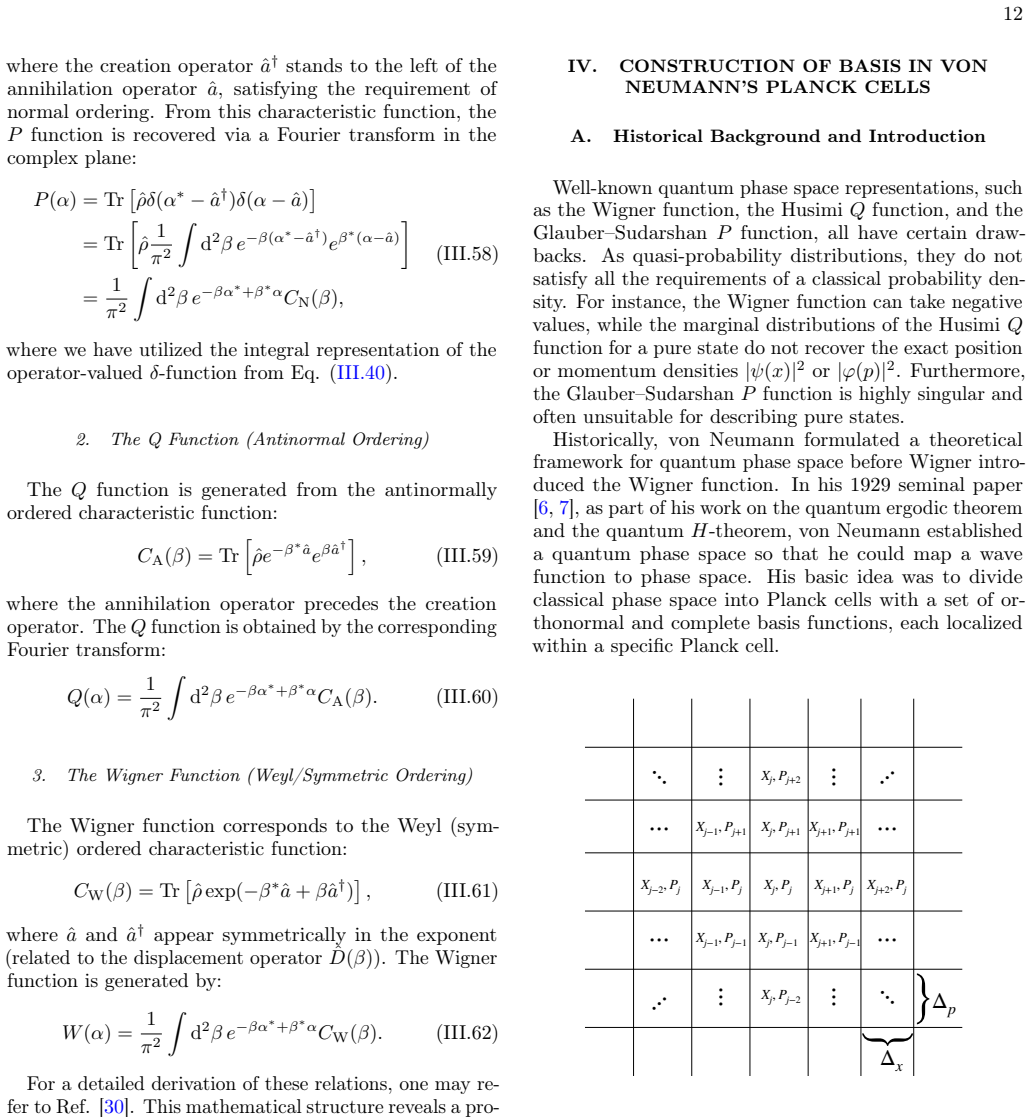
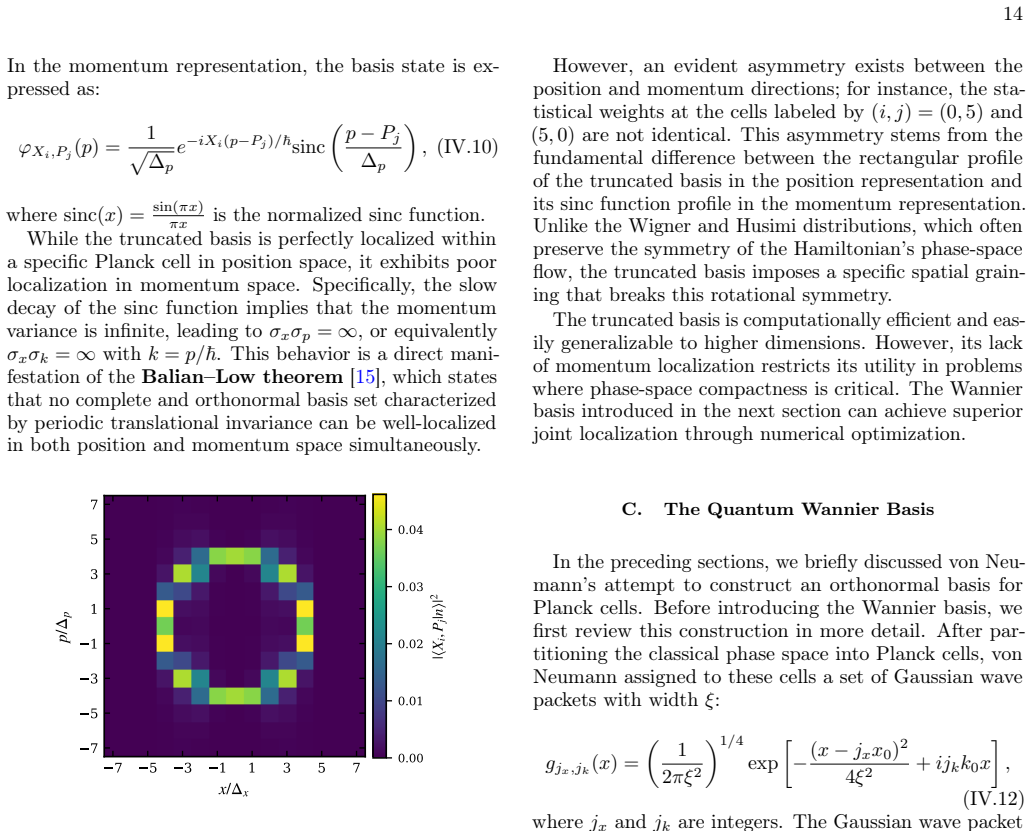
Summary of Quasi-Probability Distributions To conclude this section, we summarize the key prop- erties of the three distributions in Table I. IV. CONSTRUCTION OF BASIS IN VON NEUMANN’S PLANCK CELLS A. Historical Background and Introduction Well-known quantum phase space representations, such as the Wigner function, the HusimiQ function, and the Glauber–Su...
1929
-
[4]
Numerical instability: The error tends to accumu- late and increase during the orthogonalization pro- cess. 15
-
[5]
For a spatially uniform system, one ex- pects the basis to behave identically across cells, which the Gram–Schmidt procedure destroys
Lack of translational symmetry: The resulting ba- sis functions do not preserve spatial translational invariance. For a spatially uniform system, one ex- pects the basis to behave identically across cells, which the Gram–Schmidt procedure destroys
-
[6]
It has been shown recently [1, 2] that these drawbacks can be overcome by combining Kohn’s orthogonalization
Ordering sensitivity: The outcome depends heavily on the order in which functions are orthogonalized, and the resulting functions often bear little resem- blance to the original Gaussian packets. It has been shown recently [1, 2] that these drawbacks can be overcome by combining Kohn’s orthogonalization
-
[7]
The result is a complete orthonormal Wannier basis{|wjx,jk ⟩}, which is transla- tionally invariant along thex direction
and Löwdin’s method [14]. The result is a complete orthonormal Wannier basis{|wjx,jk ⟩}, which is transla- tionally invariant along thex direction. These Wannier functions |wjx,jk ⟩ are centered and well localized at their respective cells( jxx0, jkk0), and satisfy the orthonormal- ity condition D wj′x,j′ k wjx,jk E =δ j′xjx δj′ kjk .(IV.15) As a result, ...
-
[8]
Set jx = 0 and define gjk(x) ≡g 0,jk(x)
Initialization: Choose a set of local wave functions, such as the Gaussian packets{gjx,jk(x)}. Set jx = 0 and define gjk(x) ≡g 0,jk(x). Compute its Fourier transform ˜gjk(k). Choosing x0 = 1, k0 = 2π, and ξ = 1/k0, we obtain, up to a common normalization factor, ˜gjk(k)∝exp " − k k0 −j k 2# .(IV.28) 2.Vector construction: To apply Kohn’s orthogonal- izati...
-
[9]
Finally, perform the inverse Fourier transform to obtain wjk(x)in real space
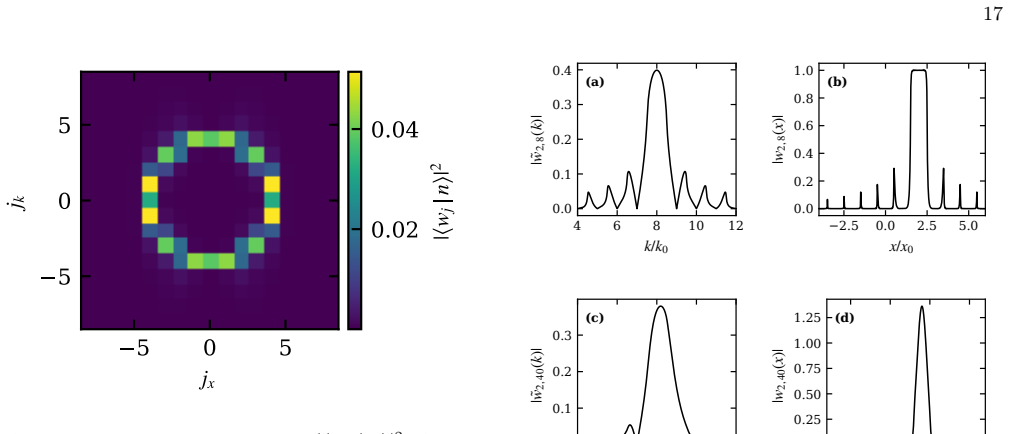
Reconstruction: Repeat steps 2 and 3 for every k∈ [0, k0), discretized into Nk points. Finally, perform the inverse Fourier transform to obtain wjk(x)in real space. The full Wannier basis is generated by spatial translation: wjx,jk(x) =w jk(x−j xx0).(IV.35) We denote |wjx,jk ⟩ as |wj⟩ for brevity, wherej≡ (jx, jk)is a composite cell index. The resulting b...
-
[10]
The Model The quantum kicked rotor (QKR) is a paradigmatic model for investigating quantum chaos and the transition from integrable to ergodic dynamics. Its Hamiltonian can be obtained from the classical counterpart (II.5) by replacingxwithˆxandpwithˆp: ˆH= ˆp2 2 +Kcos ˆx ∞X n=−∞ δ(t−n).(V.1) In this dimensionless representation, the commutation relation ...
-
[11]
We divide this square into anL×L lattice, with L being a large in- teger and NH = L2
The Truncated Basis for QKR For the torus representation used here, we impose peri- odic boundary conditions in both thex and p directions and take the phase space to be[0, 2π) ×[0, 2π). We divide this square into anL×L lattice, with L being a large in- teger and NH = L2. These small cells can be equivalently taken as Planck cells. To establish a quantum ...
-
[12]
computed from the perspective of an observer who can carry out all measure- ments that are possible in principle
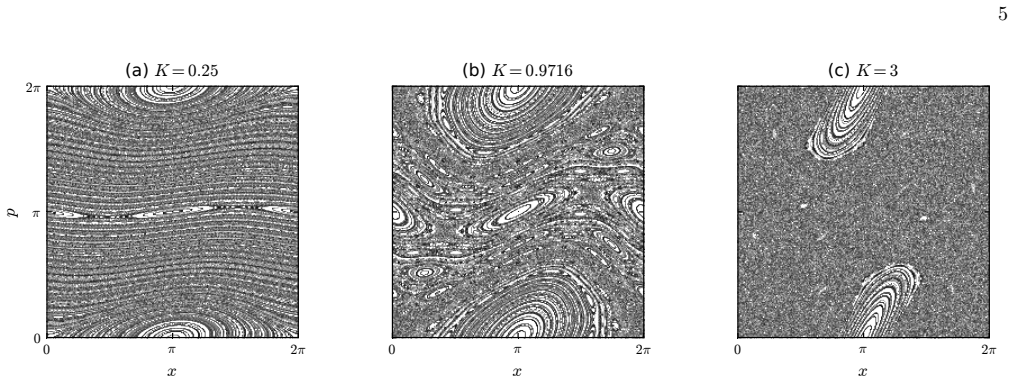
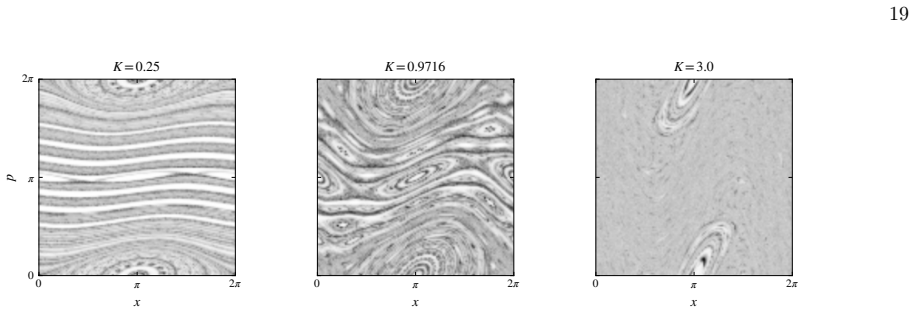
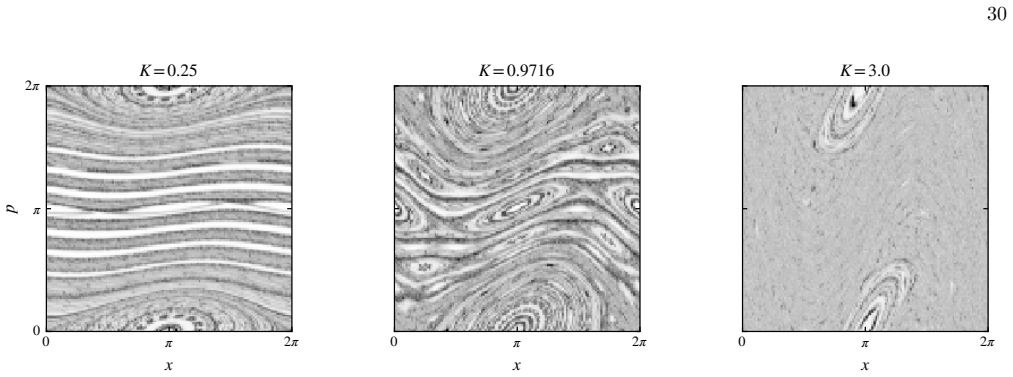
Quantum Poincaré Sections of Kicked Rotor In Section II, we have shown that the classical phase space can be used to illustrate the overall dynamical 19 0 π 2π x 0 π 2π p K = 0.25 0 π 2π x K = 0.9716 0 π 2π x K = 3.0 FIG. 10: Quantum Poincaré sections of the kicked rotor for different kicking strengths. From left to right:K = 0.25, K= 0.9716, andK= 3.0. T...
1929
-
[13]
As described above, we construct the orthonormal familyS (j+1) on this block
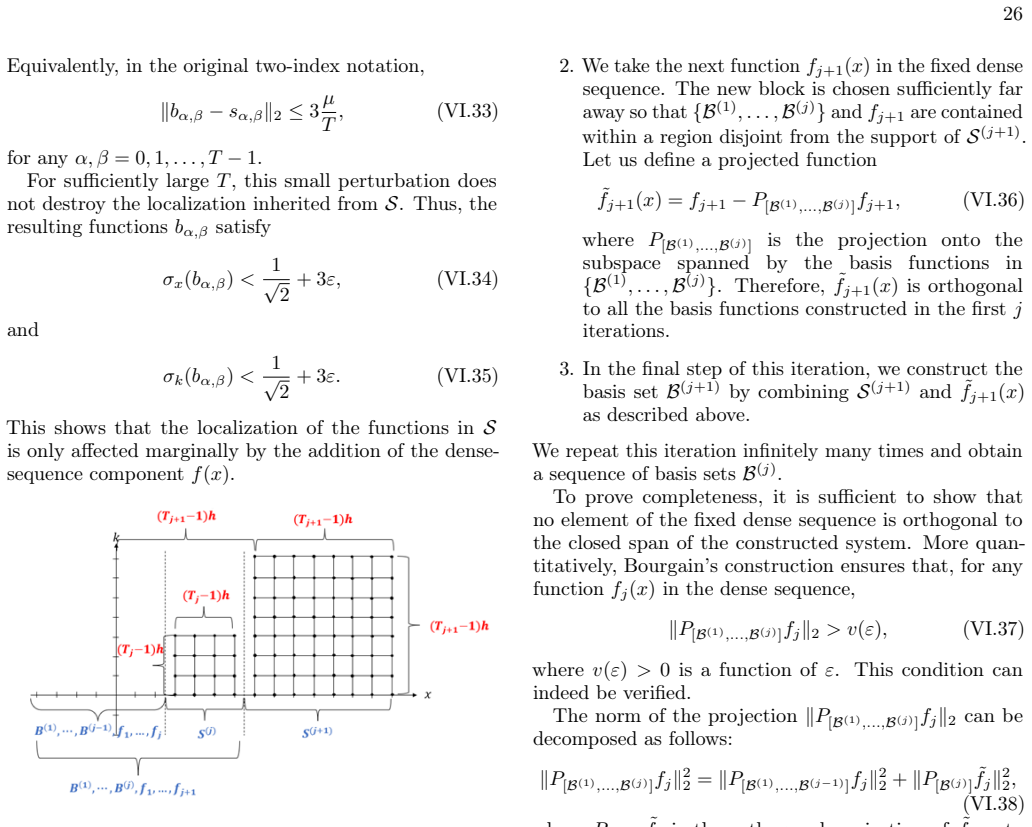
We set up a new lattice blockTj+1 ×T j+1 suffi- ciently far from the previously constructed blocks. As described above, we construct the orthonormal familyS (j+1) on this block
-
[14]
The new block is chosen sufficiently far away so that{B(1),
We take the next functionfj+1(x)in the fixed dense sequence. The new block is chosen sufficiently far away so that{B(1), . . . ,B(j)}and fj+1 are contained within a region disjoint from the support ofS(j+1). Let us define a projected function ˜fj+1(x) =f j+1 −P [B(1),...,B(j)]fj+1,(VI.36) where P[B(1),...,B(j)] is the projection onto the subspace spanned ...
-
[15]
We repeat this iteration infinitely many times and obtain a sequence of basis setsB(j)
In the final step of this iteration, we construct the basis set B(j+1) by combining S(j+1) and ˜fj+1(x) as described above. We repeat this iteration infinitely many times and obtain a sequence of basis setsB(j). To prove completeness, it is sufficient to show that no element of the fixed dense sequence is orthogonal to the closed span of the constructed s...
-
[16]
Han and B
X. Han and B. Wu, Physical Review E91, 062106 (2015)
2015
-
[17]
Y. Fang, F. Wu, and B. Wu, Journal of Statistical Me- chanics: Theory and Experiment2018, 023113 (2018)
2018
-
[18]
J.Liouville,Journaldemathématiquespuresetappliquées 3, 342 (1838)
-
[19]
D. D. Nolte, Physics Today63, 33 (2010)
2010
-
[20]
J. W. Gibbs,Elementary Principles in Statistical Mechan- ics(Scribner’s, New York, 1902)
1902
-
[21]
von Neumann, Zeitschrift für Physik57, 30 (1929)
J. von Neumann, Zeitschrift für Physik57, 30 (1929)
1929
-
[22]
von Neumann, The European Physical Journal H35, 201 (2010)
J. von Neumann, The European Physical Journal H35, 201 (2010)
2010
-
[23]
Goldstein, J
S. Goldstein, J. L. Lebowitz, R. Tumulka, and N. Zanghi, The European Physical Journal H35, 173 (2010)
2010
-
[24]
Wigner, Physical Review40, 749 (1932)
E. Wigner, Physical Review40, 749 (1932)
1932
-
[25]
Husimi, Proceedings of the Physico-Mathematical So- ciety of Japan22, 264 (1940)
K. Husimi, Proceedings of the Physico-Mathematical So- ciety of Japan22, 264 (1940)
1940
-
[26]
R. J. Glauber, Physical Review131, 2766 (1963)
1963
-
[27]
E. C. G. Sudarshan, Physical Review Letters10, 277 (1963)
1963
-
[28]
Kohn, Physical Review B7, 4388 (1973)
W. Kohn, Physical Review B7, 4388 (1973)
1973
-
[29]
Löwdin, The Journal of Chemical Physics18, 365 (1950)
P.-O. Löwdin, The Journal of Chemical Physics18, 365 (1950)
1950
-
[30]
Balian, CR Acad
R. Balian, CR Acad. Sci. Paris292, 1357 (1981)
1981
-
[31]
Bourgain, J
J. Bourgain, J. Funct. Anal.79, 136 (1988)
1988
-
[32]
Poincaré, Journal de mathématiques pures et ap- pliquées2, 151 (1886)
H. Poincaré, Journal de mathématiques pures et ap- pliquées2, 151 (1886)
-
[33]
S. H. Strogatz,Nonlinear dynamics and chaos(Chapman and Hall/CRC, 2024)
2024
-
[34]
Casati, B
G. Casati, B. Chirikov, J. Ford, and F. Izrailev, inLecture Notes in Physics, Vol. 93 (Springer-Verlag, New York, 1979)
1979
-
[35]
Chirikov and D
B. Chirikov and D. Shepelyansky, Scholarpedia3, 3550 (2008)
2008
-
[36]
M. S. Santhanam, S. Paul, and J. B. Kannan, Physics Reports956, 1 (2022)
2022
-
[37]
45 (1949) pp
J.E.Moyal,inMathematical Proceedings of the Cambridge Philosophical Society, Vol. 45 (1949) pp. 99–124
1949
-
[38]
W. B. Case, American Journal of Physics76, 937 (2008)
2008
-
[39]
A. I. Zayed,Handbook of function and generalized function transformations(CRC press, 1996)
1996
-
[40]
R. W. Davies and K. T. R. Davies, Annals of Physics89, 261 (1975)
1975
-
[41]
R. L. Hudson, Reports on Mathematical Physics6, 249 (1974)
1974
-
[42]
Hillery, R
M. Hillery, R. F. O’Connell, M. O. Scully, and E. P. Wigner, Physics Reports106, 121 (1984)
1984
-
[43]
Schrödinger, Naturwissenschaften14, 664 (1926)
E. Schrödinger, Naturwissenschaften14, 664 (1926)
1926
-
[44]
J. R. Klauder, Annals of Physics11, 123 (1960). 32
1960
-
[45]
M. O. Scully and M. S. Zubairy,Quantum Optics(Cam- bridge University Press, 1997)
1997
-
[46]
Emamirad and P
H. Emamirad and P. Rogeon, Discrete Contin. Dyn. Syst. Ser. S6, 669 (2013)
2013
-
[47]
Z. Wang, J. Feng, and B. Wu, Physical Review Research 3, 033239 (2021)
2021
-
[48]
Gabor, Journal of the Institution of Electrical Engineers-part III: radio and communication engineering 93, 429 (1946)
D. Gabor, Journal of the Institution of Electrical Engineers-part III: radio and communication engineering 93, 429 (1946)
1946
-
[49]
J. G. Aiken, J. A. Erdos, and J. A. Goldstein, Interna- tional Journal of Quantum Chemistry18, 1101 (1980)
1980
-
[50]
Balan, P
R. Balan, P. G. Casazza, C. Heil, and Z. Landau, Journal of Fourier Analysis and Applications12, 307 (2006)
2006
- [51]
-
[52]
Z. Wang, Y. Wang, and B. Wu, Physical Review E103, 042209 (2021)
2021
-
[53]
von Neumann, inCollected Work, Göttinger Nachrichten 273-291 (1927), Vol
J. von Neumann, inCollected Work, Göttinger Nachrichten 273-291 (1927), Vol. 1, edited by A. H. Taub (Pergomon, New York, 1961)
1927
-
[54]
Z. Hu, Z. Wang, and B. Wu, Phys. Rev. E99, 052117 (2019)
2019
-
[55]
F. E. Low, inA PASSION FOR PHYSICS: Essays in Honor of Geoffrey Chew Including an Interview with Chew (World Scientific, 1985) pp. 17–22
1985
-
[56]
Daubechies,Ten lectures on wavelets(SIAM, 1992)
I. Daubechies,Ten lectures on wavelets(SIAM, 1992)
1992
-
[57]
Battle, Letters in Mathematical Physics15, 175 (1988)
G. Battle, Letters in Mathematical Physics15, 175 (1988)
1988
-
[58]
S. A. Gershgorin, Izv. Akad. Nauk SSSR, Ser. Fiz.-Mat. , 749 (1931)
1931
discussion (0)
Sign in with ORCID, Apple, or X to comment. Anyone can read and Pith papers without signing in.