A Novel Detection Method for Single-RF MIMO-OFDM Systems
Pith reviewed 2026-06-28 08:27 UTC · model grok-4.3
The pith
A Mahalanobis-distance-adjusted maximum-likelihood detector removes the error floor in single-RF MIMO-OFDM systems.
A machine-rendered reading of the paper's core claim, the machinery that carries it, and where it could break.
Core claim
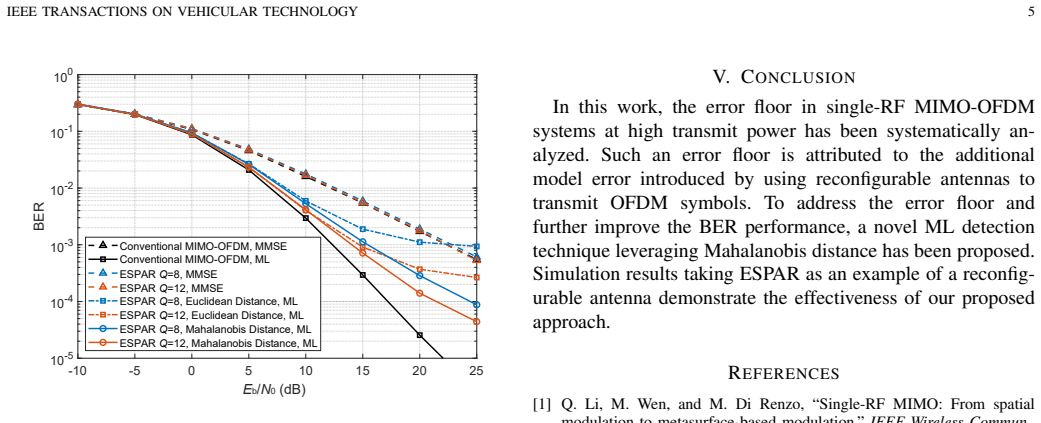
When reconfigurable antennas create a single-RF MIMO-OFDM link they introduce modeling errors that produce an irreducible BER at high SNRs; an enhanced ML detector that uses Mahalanobis distance to incorporate the structure of those errors removes the floor and lowers BER at high transmit SNRs.
What carries the argument
The Mahalanobis-distance-modified maximum-likelihood detector that replaces the Euclidean metric with a covariance-weighted distance to capture antenna modeling errors.
If this is right
- BER continues to decline with rising SNR rather than leveling off.
- The method applies directly to ESPAR realizations of single-RF MIMO-OFDM.
- Error-floor analysis is validated by the same simulations that test the detector.
Where Pith is reading between the lines
- The same covariance adjustment could be tried with other reconfigurable-antenna architectures that produce analogous modeling mismatches.
- Estimating the error covariance in real time would be needed for deployment; the paper leaves that step open.
- The approach might combine with existing OFDM channel-estimation or coding methods without changing the RF hardware.
Load-bearing premise
The modeling errors from the reconfigurable antennas have a known covariance structure that can be measured and inserted into the detection metric.
What would settle it
Running the proposed detector on the same ESPAR-based system and still observing a BER floor at high SNR would falsify the claim.
Figures
read the original abstract
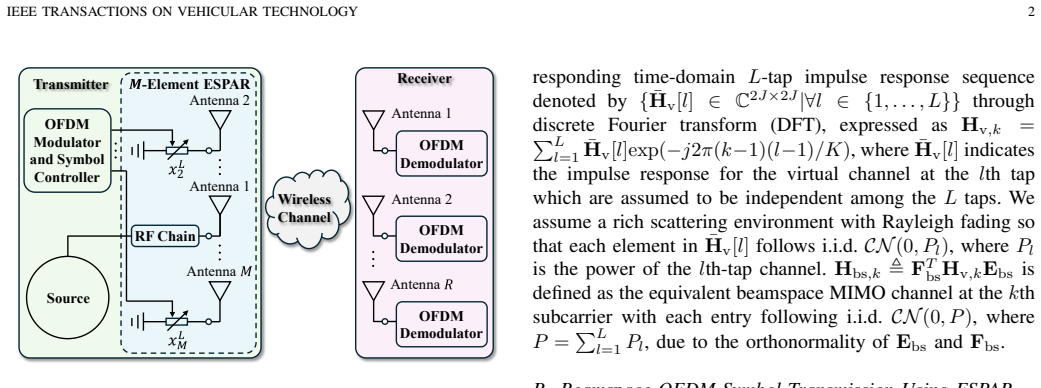
A novel detection method based on maximum-likelihood (ML) detection leveraging Mahalanobis distance is proposed for single-radio-frequency (RF) multiple-input multiple-output (MIMO) orthogonal frequency division multiplexing (OFDM) systems. It can enhance bit error rate (BER) performance and is based on the observation that when using reconfigurable antennas (such as electronically steerable parasitic array radiators (ESPARs) to create a single-RF MIMO system, an additional model error arising from the reconfigurable antennas is introduced. These modeling errors produce an irreducible BER (error floor) at high signal-to-noise ratios (SNRs). Simulation results, using ESPAR as an example, validate our error floor analysis and demonstrate that our proposed enhanced detection method can effectively address the error floor and reduce the BER at high transmit SNRs.
Editorial analysis
A structured set of objections, weighed in public.
Referee Report
Summary. The paper proposes a novel maximum-likelihood (ML) detection method that incorporates the Mahalanobis distance for single-RF MIMO-OFDM systems that employ reconfigurable antennas (e.g., ESPARs). The central claim is that modeling errors introduced by the reconfigurable antennas produce an irreducible error floor at high SNRs, and that adjusting the ML detector with the Mahalanobis metric removes this floor and lowers BER, as demonstrated by simulations.
Significance. If the simulation results hold under the stated error model, the method supplies a practical, covariance-aware refinement to standard ML detection that could improve reliability in hardware-constrained single-RF MIMO-OFDM links without requiring additional RF chains.
minor comments (3)
- [Abstract] The abstract states that simulation results validate the error-floor analysis, yet no simulation parameters (antenna count, modulation order, channel model, or number of Monte-Carlo trials) are supplied; these details should appear in a dedicated simulation section or table.
- The manuscript would benefit from an explicit statement of the modified ML metric (i.e., the precise form of the Mahalanobis distance term) together with a short derivation showing how it differs from conventional Euclidean ML under the modeled antenna error.
- Figure captions and axis labels should explicitly indicate whether the plotted curves include the proposed Mahalanobis adjustment or the baseline detector.
Simulated Author's Rebuttal
We thank the referee for the constructive summary, significance assessment, and recommendation of minor revision. No specific major comments were enumerated in the report.
Circularity Check
No significant circularity; derivation is self-contained via standard detector adjustment and simulation validation
full rationale
The paper proposes an ML detector adjusted by Mahalanobis distance to address modeling error from reconfigurable antennas (ESPARs) that induces an error floor at high SNR. The error model is granted as input, the adjustment is a standard covariance-aware modification, and performance is demonstrated via simulation rather than any fitted parameter renamed as prediction or self-referential definition. No equations reduce to their own inputs by construction, no load-bearing self-citations appear, and the central claim does not invoke uniqueness theorems or ansatzes from prior author work. The derivation chain is therefore independent of the target result.
Axiom & Free-Parameter Ledger
Reference graph
Works this paper leans on
-
[1]
Single-RF MIMO: From spatial modulation to metasurface-based modulation,
Q. Li, M. Wen, and M. Di Renzo, “Single-RF MIMO: From spatial modulation to metasurface-based modulation,”IEEE Wireless Commun., vol. 28, no. 4, pp. 88-95, 2021
2021
-
[2]
Single RF front-end MIMO transceivers,
A. Mohammadi and F. M. Ghannouchi, “Single RF front-end MIMO transceivers,”IEEE Commun. Mag., vol. 49, no. 12, pp. 104-109, 2011
2011
-
[3]
Efficient MIMO transmission of PSK signals with a single-radio reconfigurable antenna,
M. Yousefbeiki, O. N. Alrabadi, and J. Perruisseau-Carrier, “Efficient MIMO transmission of PSK signals with a single-radio reconfigurable antenna,”IEEE Trans. Commun., vol. 62, no. 2, pp. 567-577, 2014
2014
-
[4]
Towards compact and frequency-tunable antenna solutions for MIMO transmission with a single RF chain,
M. Yousefbeiki and J. Perruisseau-Carrier, “Towards compact and frequency-tunable antenna solutions for MIMO transmission with a single RF chain,”IEEE Trans. Antennas Propag., vol. 62, no. 3, pp. 1065-1073, 2014
2014
-
[5]
Electrically steerable passive array radiator (ESPAR) antennas,
H. Kawakami and T. Ohira, “Electrically steerable passive array radiator (ESPAR) antennas,”IEEE Antennas Propag. Mag., vol. 47, no. 2, pp. 43–50, Apr. 2005
2005
-
[6]
MIMO transmission for single- fed ESPAR with quantized loads,
A. Li, C. Masouros, and C. B. Papadias, “MIMO transmission for single- fed ESPAR with quantized loads,”IEEE Trans. Commun., vol. 65, no. 7, pp. 2863-2876, 2017
2017
-
[7]
Single- RF MIMO-OFDM using ESPAR,
Z. Han, S. Shen, Y . Zhang, S. Tang, C.-Y . Chiu, and R. Murch, “Single- RF MIMO-OFDM using ESPAR,”IEEE Trans. V eh. Technol., vol. 72, no. 5, pp. 6080-6089, 2023
2023
-
[8]
Achieving arbitrary signals transmission using a single radio frequency chain,
L. Zhou, F. A. Khan, T. Ratnarajah, and C. B. Papadias, “Achieving arbitrary signals transmission using a single radio frequency chain,”IEEE Trans. Commun., vol. 63, no. 12, pp. 4865–4878, 2015
2015
-
[9]
Beamspace-domain analysis of single-RF front-end MIMO systems,
V . I. Barousis, A. G. Kanatas, and A. Kalis, “Beamspace-domain analysis of single-RF front-end MIMO systems,”IEEE Trans. V eh. Technol., vol. 60, no. 3, pp. 1195-1199, 2011
2011
-
[10]
MIMO over ESPAR with 16-QAM modulation,
B. Han, V . I. Barousis, C. B. Papadias, A. Kalis, and R. Prasad, “MIMO over ESPAR with 16-QAM modulation,”IEEE Wirel. Commun. Lett., vol. 2, no. 6, pp. 687–690, 2013
2013
-
[11]
Spatial multiplexing of OFDM signals with QPSK modulation over ESPAR,
J. Lee, J. Y . Lee, and Y . H. Lee, “Spatial multiplexing of OFDM signals with QPSK modulation over ESPAR,”IEEE Trans. V eh. Technol., vol. 66, no. 6, pp. 4914-4923, 2017
2017
-
[12]
Mahalanobis distance,
G. J. McLachlan, “Mahalanobis distance,”Resonance, vol. 4, no. 6, pp. 20–26, 1999
1999
-
[13]
Mahalanobis distance and its application for detecting multivariate outliers,
H. Ghorbani, “Mahalanobis distance and its application for detecting multivariate outliers,”Facta Universitatis, Ser ., Math. Informat., vol. 4, no. 3, pp. 583–595, 2019
2019
-
[14]
Antenna coding empowered by pixel antennas,
S. Shen, K.-K. Wong, and R. Murch, “Antenna coding empowered by pixel antennas,”IEEE Trans. Commun., vol. 74, pp. 446-460, 2026
2026
-
[15]
Optimizing antenna coding for pixel antenna empowered SISO-OFDM systems,
T. Qiao, S. Shen, Y . Chen, and R. Murch, “Optimizing antenna coding for pixel antenna empowered SISO-OFDM systems,” arXiv:2603.17658, 2026
-
[16]
A pattern correlation decomposition method for analysis of ESPAR in single-RF MIMO systems,
Z. Han, S. Shen, Y . Zhang, C.-Y . Chiu, and R. Murch, “A pattern correlation decomposition method for analysis of ESPAR in single-RF MIMO systems,”IEEE Trans. Wireless Commun., vol. 21, no. 7, pp. 4654–4668, 2022
2022
-
[17]
Beamspace MIMO for millimeter-wave communications: System architecture, modeling, anal- ysis, and measurements,
J. Brady, N. Behdad, and A. M. Sayeed, “Beamspace MIMO for millimeter-wave communications: System architecture, modeling, anal- ysis, and measurements,”IEEE Trans. Antennas Propag., vol. 61, no. 7, pp. 3814-3827, 2013
2013
-
[18]
Aerial degrees of freedom of parasitic arrays for single RF front-end MIMO transceivers,
V . Barousis and A. G. Kanatas, “Aerial degrees of freedom of parasitic arrays for single RF front-end MIMO transceivers,”Prog. Electromagn. Res., vol. 35, pp. 287–306, 2011
2011
-
[19]
[Online]
CST Microwave Studio 2019. [Online]. Available: http://www.cst.com
2019
discussion (0)
Sign in with ORCID, Apple, or X to comment. Anyone can read and Pith papers without signing in.