Characterizing Detectability in 3DGS Poisoning: A Stage-wise Benchmark
Pith reviewed 2026-06-28 10:25 UTC · model grok-4.3
The pith
Poisoning attacks on 3D Gaussian Splatting leave stage-dependent forensic signals that require evaluating detection at each pipeline stage separately.
A machine-rendered reading of the paper's core claim, the machinery that carries it, and where it could break.
Core claim
The multi-stage 3DGS pipeline produces heterogeneous representations, so forensic signals for poisoning are stage-dependent; a benchmark exposing signals at image, geometry, training, and parameter stages shows that detectability varies across stages with no single stage dominating, that attacks produce distinct stage-specific signals, and that later-stage cues like training dynamics and Gaussian statistics supply strong evidence unavailable at earlier stages.
What carries the argument
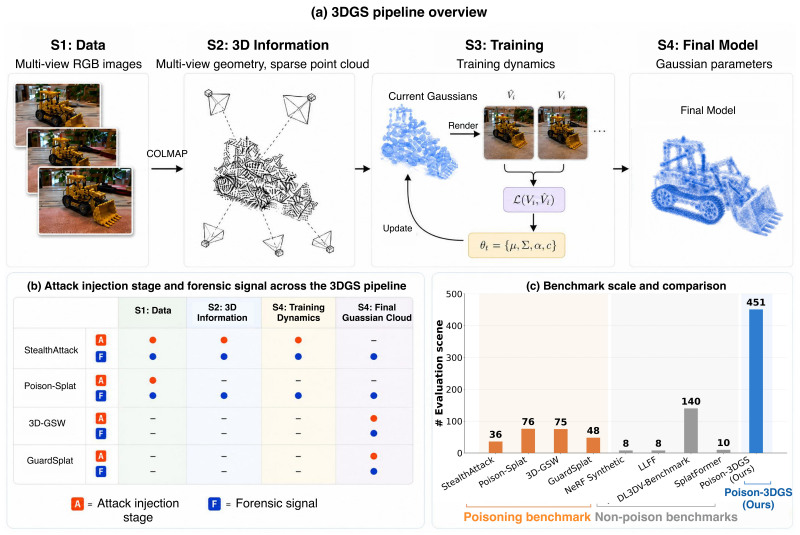
The Poison-3DGS benchmark that systematically exposes stage-specific artifacts (multi-view images, geometry, training dynamics, Gaussian parameters) across scenes and attack types.
If this is right
- Detection effectiveness depends on the stage at which signals are observed rather than on a universal detector.
- Later stages such as training dynamics and Gaussian parameter statistics provide cues unavailable at earlier stages.
- Different attack types exhibit distinct stage-specific forensic signals, so the best observation point varies with the attack.
- No single stage can be assumed to dominate detection performance across all attacks.
Where Pith is reading between the lines
- A combined multi-stage detector could be built by fusing signals that only appear at different points in the pipeline.
- The same stage-wise lens could be applied to other reconstruction pipelines that produce sequential heterogeneous outputs.
- Benchmark results could guide the design of attacks that deliberately hide signals until late stages.
- Extending the benchmark to additional attack variants would test whether the observed stage dependence holds more broadly.
Load-bearing premise
The multi-stage nature of the 3DGS reconstruction pipeline produces heterogeneous intermediate representations from which forensic signals for detecting poisoning are inherently stage dependent.
What would settle it
An experiment in which a detector relying only on early-stage signals (images or geometry) achieves consistently high accuracy across every tested attack type and scene would show that stage dependence is not required.
Figures
read the original abstract
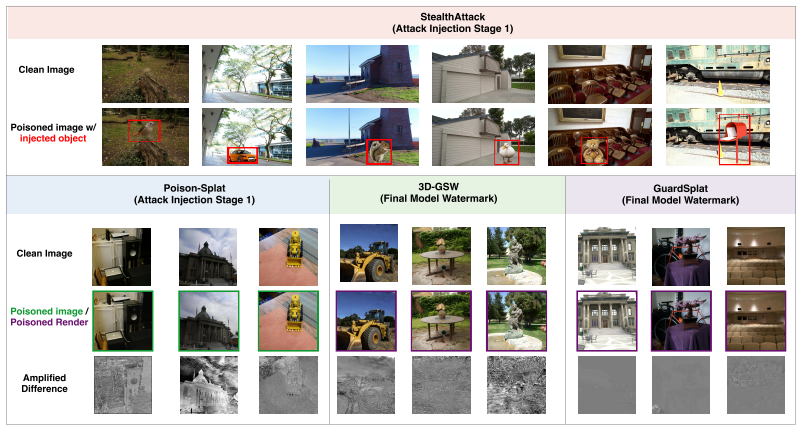
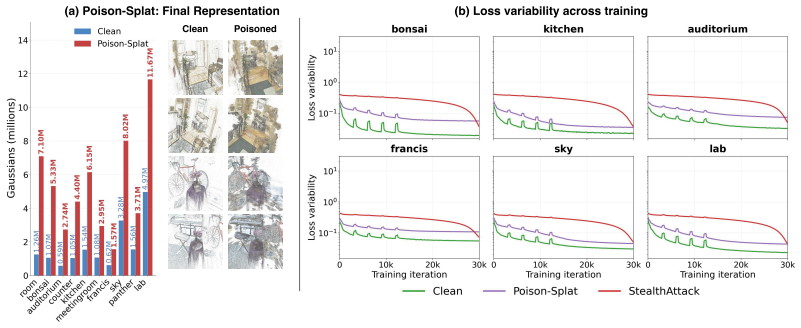
3D Gaussian Splatting (3DGS) has rapidly emerged as a leading representation for real-time novel view synthesis, but recent work shows it is vulnerable to diverse poisoning attacks, including illusory object injection, computation cost amplification, and post hoc model watermarking. Despite this expanding threat surface, existing studies focus mainly on attack success, while defense and detection remain underexplored. From a detection perspective, a key challenge and opportunity arise from the multi-stage nature of the 3DGS reconstruction pipeline, which produces heterogeneous intermediate representations. Forensic signals for detecting poisoning are inherently stage dependent: an attack introduced at one stage may produce signals that emerge only at later stages. This motivates a stage-wise view of detectability that goes beyond single-stage evaluation. We introduce Poison-3DGS, a benchmark for stage-wise characterization of poisoning detection in 3DGS. It exposes stage-specific artifacts, including multi-view images, geometry, training dynamics, and Gaussian parameters, across a diverse set of scenes and attacks. Using it, we conduct a systematic study of detectability across pipeline stages. Our analysis reveals several insights. First, detectability varies significantly across stages, and no single stage consistently dominates across attack types. Second, different attacks exhibit distinct stage-specific forensic signals, so detection effectiveness depends critically on where signals are observed. Third, later-stage signals such as training dynamics and Gaussian parameter statistics provide strong cues not observable at earlier stages. Overall, our work provides a principled benchmark and the first systematic characterization of stage-dependent detectability in 3DGS, offering a foundation for future research on robust and reliable 3DGS systems.
Editorial analysis
A structured set of objections, weighed in public.
Referee Report
Summary. The manuscript introduces Poison-3DGS, a benchmark for stage-wise characterization of detectability of poisoning attacks (illusory object injection, computation cost amplification, post-hoc watermarking) in 3D Gaussian Splatting pipelines. It exposes stage-specific artifacts across multi-view images, geometry, training dynamics, and Gaussian parameters, and reports three empirical observations from experiments on diverse scenes and attacks: detectability varies significantly across stages with no single stage dominating; attacks produce distinct stage-specific forensic signals; and later stages (training dynamics, Gaussian statistics) yield strong cues absent at earlier stages.
Significance. If the experimental results hold, the work supplies a reusable benchmark and the first systematic stage-wise analysis of poisoning detectability in 3DGS. The explicit focus on heterogeneous intermediate representations and the finding that later-stage signals are often stronger constitute a concrete foundation for subsequent detection research. The empirical nature of the study (new experiments rather than parameter fitting) is a strength.
minor comments (2)
- [Abstract] Abstract and §1: the claims about 'strong cues' and 'no single stage dominating' would be more persuasive if the abstract or introduction stated the number of scenes, attack variants, detection methods, and quantitative metrics (e.g., AUC, precision-recall) used to reach these conclusions.
- The manuscript should clarify whether the benchmark release includes code, trained models, and exact attack implementations so that the reported stage-wise differences can be reproduced.
Simulated Author's Rebuttal
We thank the referee for their positive evaluation of our manuscript and the recommendation of minor revision. The referee's summary correctly reflects the core contributions of Poison-3DGS as a stage-wise benchmark for poisoning detectability in 3D Gaussian Splatting. No major comments were provided in the report.
Circularity Check
Empirical benchmark study with no circular derivations
full rationale
This is an empirical benchmark paper that introduces Poison-3DGS and reports experimental observations on stage-wise detectability. The central claims consist of three factual findings from new experiments (detectability varies by stage, attacks produce distinct signals, later stages yield unique cues). No equations, fitted parameters, predictions, or self-citation chains are present in the provided text. The stage-dependence follows directly from the documented multi-stage structure of 3DGS pipelines and the new benchmark data, with no reduction to prior fitted quantities or self-referential definitions.
Axiom & Free-Parameter Ledger
axioms (1)
- domain assumption The 3DGS reconstruction pipeline produces heterogeneous intermediate representations at different stages, making forensic signals stage dependent.
Reference graph
Works this paper leans on
-
[1]
Met3r: Measuring multi-view consistency in generated images
Mohammad Asim, Christopher Wewer, Thomas Wimmer, Bernt Schiele, and Jan Eric Lenssen. Met3r: Measuring multi-view consistency in generated images. InProceedings of the IEEE/CVF Conference on Computer Vision and Pattern Recognition (CVPR), pages 6034–6044, June 2025
2025
-
[2]
Mip- nerf 360: Unbounded anti-aliased neural radiance fields
Jonathan T Barron, Ben Mildenhall, Dor Verbin, Pratul P Srinivasan, and Peter Hedman. Mip- nerf 360: Unbounded anti-aliased neural radiance fields. InProceedings of the IEEE/CVF conference on computer vision and pattern recognition, pages 5470–5479, 2022
2022
-
[3]
A survey on 3d gaussian splatting.ACM Computing Surveys, 2024
Guikun Chen and Wenguan Wang. A survey on 3d gaussian splatting.ACM Computing Surveys, 2024
2024
-
[4]
Yang Chen, Yi Yu, Jiaming He, Yueqi Duan, Zheng Zhu, and Yap-Peng Tan. Spectral defense against resource-targeting attack in 3d gaussian splatting.arXiv preprint arXiv:2603.12796, 2026
arXiv 2026
-
[5]
Gaussianeditor: Swift and controllable 3d editing with gaussian splatting
Yiwen Chen, Zilong Chen, Chi Zhang, Feng Wang, Xiaofeng Yang, Yikai Wang, Zhongang Cai, Lei Yang, Huaping Liu, and Guosheng Lin. Gaussianeditor: Swift and controllable 3d editing with gaussian splatting. InProceedings of the IEEE/CVF conference on computer vision and pattern recognition, pages 21476–21485, 2024
2024
-
[6]
Splatformer: Point transformer for robust 3d gaussian splatting, 2025
Yutong Chen, Marko Mihajlovic, Xiyi Chen, Yiming Wang, Sergey Prokudin, and Siyu Tang. Splatformer: Point transformer for robust 3d gaussian splatting, 2025
2025
-
[7]
Guardsplat: efficient and robust watermarking for 3d gaussian splatting
Zixuan Chen, Guangcong Wang, Jiahao Zhu, Jianhuang Lai, and Xiaohua Xie. Guardsplat: efficient and robust watermarking for 3d gaussian splatting. InProceedings of the Computer Vision and Pattern Recognition Conference, pages 16325–16335, 2025
2025
-
[8]
Mvss-net: Multi-view multi-scale supervised networks for image manipulation detection.IEEE Transactions on Pattern Analysis and Machine Intelligence, 45(3):3539–3553, 2022
Chengbo Dong, Xinru Chen, Ruohan Hu, Juan Cao, and Xirong Li. Mvss-net: Multi-view multi-scale supervised networks for image manipulation detection.IEEE Transactions on Pattern Analysis and Machine Intelligence, 45(3):3539–3553, 2022
2022
-
[9]
Dan Hendrycks and Kevin Gimpel. A baseline for detecting misclassified and out-of-distribution examples in neural networks.arXiv preprint arXiv:1610.02136, 2016
Pith/arXiv arXiv 2016
-
[10]
Gausstrap: Stealthy poisoning attacks on 3d gaussian splatting for targeted scene confusion, 2025
Jiaxin Hong, Sixu Chen, Shuoyang Sun, Hongyao Yu, Hao Fang, Yuqi Tan, Bin Chen, Shuhan Qi, and Jiawei Li. Gausstrap: Stealthy poisoning attacks on 3d gaussian splatting for targeted scene confusion, 2025. URLhttps://arxiv.org/abs/2504.20829
arXiv 2025
-
[11]
Deep learning advancements in anomaly detection: A comprehensive survey.IEEE Internet of Things Journal, 2025
Haoqi Huang, Ping Wang, Jianhua Pei, Jiacheng Wang, Shahen Alexanian, and Dusit Niyato. Deep learning advancements in anomaly detection: A comprehensive survey.IEEE Internet of Things Journal, 2025
2025
-
[12]
On the importance of gradients for detecting distributional shifts in the wild
Rui Huang, Andrew Geng, and Yixuan Li. On the importance of gradients for detecting distributional shifts in the wild. InProceedings of the 35th International Conference on Neural Information Processing Systems, NIPS ’21, Red Hook, NY , USA, 2021. Curran Associates Inc. ISBN 9781713845393
2021
-
[13]
3d-gsw: 3d gaussian splatting for robust watermarking
Youngdong Jang, Hyunje Park, Feng Yang, Heeju Ko, Euijin Choo, and Sangpil Kim. 3d-gsw: 3d gaussian splatting for robust watermarking. InProceedings of the Computer Vision and Pattern Recognition Conference, pages 5938–5948, 2025. 10
2025
-
[14]
Unravelling digital forgeries: A systematic survey on image manipulation detection and localization.ACM Computing Surveys, 57(12):1–36, 2025
VijayaKumar Kadha, Sambit Bakshi, and Santos Kumar Das. Unravelling digital forgeries: A systematic survey on image manipulation detection and localization.ACM Computing Surveys, 57(12):1–36, 2025
2025
-
[15]
Stealthattack: Robust 3d gaussian splatting poisoning via density-guided illusions
Bo-Hsu Ke, You-Zhe Xie, Yu-Lun Liu, and Wei-Chen Chiu. Stealthattack: Robust 3d gaussian splatting poisoning via density-guided illusions. InProceedings of the IEEE/CVF International Conference on Computer Vision, pages 27400–27411, 2025
2025
-
[16]
3d gaussian splatting for real-time radiance field rendering.ACM Trans
Bernhard Kerbl, Georgios Kopanas, Thomas Leimkühler, George Drettakis, et al. 3d gaussian splatting for real-time radiance field rendering.ACM Trans. Graph., 42(4):139–1, 2023
2023
-
[17]
Tanks and temples: Bench- marking large-scale scene reconstruction.ACM Transactions on Graphics (ToG), 36(4):1–13, 2017
Arno Knapitsch, Jaesik Park, Qian-Yi Zhou, and Vladlen Koltun. Tanks and temples: Bench- marking large-scale scene reconstruction.ACM Transactions on Graphics (ToG), 36(4):1–13, 2017
2017
-
[18]
A simple unified framework for detecting out-of-distribution samples and adversarial attacks.Advances in neural information processing systems, 31, 2018
Kimin Lee, Kibok Lee, Honglak Lee, and Jinwoo Shin. A simple unified framework for detecting out-of-distribution samples and adversarial attacks.Advances in neural information processing systems, 31, 2018
2018
-
[19]
Yanping Li, Zhening Liu, Zijian Li, Zehong Lin, and Jun Zhang. Remedygs: Defend 3d gaussian splatting against computation cost attacks.arXiv preprint arXiv:2511.22147, 2025
arXiv 2025
-
[20]
Backdoor learning: A survey, 2022
Yiming Li, Yong Jiang, Zhifeng Li, and Shu-Tao Xia. Backdoor learning: A survey, 2022. URL https://arxiv.org/abs/2007.08745
arXiv 2022
-
[21]
Oswald, and Danda Pani Paudel
Yue Li, Qi Ma, Runyi Yang, Huapeng Li, Mengjiao Ma, Bin Ren, Nikola Popovic, Nicu Sebe, Ender Konukoglu, Theo Gevers, Luc Van Gool, Martin R. Oswald, and Danda Pani Paudel. Scenesplat: Gaussian splatting-based scene understanding with vision-language pretraining. In Proceedings of the IEEE/CVF International Conference on Computer Vision (ICCV), pages 4961...
2025
-
[22]
Isolation forest
Fei Tony Liu, Kai Ming Ting, and Zhi-Hua Zhou. Isolation forest. In2008 eighth ieee international conference on data mining, pages 413–422. IEEE, 2008
2008
-
[23]
Multi-view feature extraction via tunable prompts is enough for image manipulation localization
Xuntao Liu, Yuzhou Yang, Haoyue Wang, Qichao Ying, Zhenxing Qian, Xinpeng Zhang, and Sheng Li. Multi-view feature extraction via tunable prompts is enough for image manipulation localization. InProceedings of the 32nd ACM International Conference on Multimedia, pages 9999–10007, 2024
2024
-
[24]
Poison-splat: Computation cost attack on 3d gaussian splatting.arXiv preprint arXiv:2410.08190, 2024
Jiahao Lu, Yifan Zhang, Qiuhong Shen, Xinchao Wang, and Shuicheng Yan. Poison-splat: Computation cost attack on 3d gaussian splatting.arXiv preprint arXiv:2410.08190, 2024
arXiv 2024
-
[25]
A large-scale dataset of gaussian splats and their self-supervised pretraining
Qi Ma, Yue Li, Bin Ren, Nicu Sebe, Ender Konukoglu, Theo Gevers, Luc Van Gool, and Danda Pani Paudel. A large-scale dataset of gaussian splats and their self-supervised pretraining. In2025 International Conference on 3D Vision (3DV), pages 145–155. IEEE, 2025
2025
-
[26]
Xiaochen Ma, Bo Du, Zhuohang Jiang, Xia Du, Ahmed Y . Al Hammadi, and Jizhe Zhou. Iml-vit: Benchmarking image manipulation localization by vision transformer, 2024. URL https://arxiv.org/abs/2307.14863
arXiv 2024
-
[27]
Gaussian splatting slam
Hidenobu Matsuki, Riku Murai, Paul HJ Kelly, and Andrew J Davison. Gaussian splatting slam. InProceedings of the IEEE/CVF conference on computer vision and pattern recognition, pages 18039–18048, 2024
2024
-
[28]
Structure-from-motion revisited
Johannes Lutz Schönberger and Jan-Michael Frahm. Structure-from-motion revisited. In Conference on Computer Vision and Pattern Recognition (CVPR), 2016
2016
-
[29]
Can we get rid of handcrafted feature extractors? sparsevit: Nonsemantics-centered, parameter-efficient image manipulation localization through spare-coding transformer
Lei Su, Xiaochen Ma, Xuekang Zhu, Chaoqun Niu, Zeyu Lei, and Ji-Zhe Zhou. Can we get rid of handcrafted feature extractors? sparsevit: Nonsemantics-centered, parameter-efficient image manipulation localization through spare-coding transformer. InProceedings of the AAAI conference on artificial intelligence, volume 39, pages 7024–7032, 2025. 11
2025
-
[30]
Mv-dust3r+: Single-stage scene reconstruction from sparse views in 2 seconds
Zhenggang Tang, Yuchen Fan, Dilin Wang, Hongyu Xu, Rakesh Ranjan, Alexander Schwing, and Zhicheng Yan. Mv-dust3r+: Single-stage scene reconstruction from sparse views in 2 seconds. InProceedings of the IEEE/CVF Conference on Computer Vision and Pattern Recognition (CVPR), pages 5283–5293, June 2025
2025
-
[31]
Spectral signatures in backdoor attacks
Brandon Tran, Jerry Li, and Aleksander Madry. Spectral signatures in backdoor attacks. Advances in neural information processing systems, 31, 2018
2018
-
[32]
Chengjie Wang, Xi Jiang, Bin-Bin Gao, Zhenye Gan, Yong Liu, Feng Zheng, and Lizhuang Ma. Softpatch+: Fully unsupervised anomaly classification and segmentation.Pattern Recognition, 161:111295, 2025. ISSN 0031-3203. doi: https://doi.org/10.1016/j.patcog.2024.111295. URL https://www.sciencedirect.com/science/article/pii/S003132032401046X
-
[33]
Vggt: Visual geometry grounded transformer
Jianyuan Wang, Minghao Chen, Nikita Karaev, Andrea Vedaldi, Christian Rupprecht, and David Novotny. Vggt: Visual geometry grounded transformer. InProceedings of the IEEE/CVF Conference on Computer Vision and Pattern Recognition (CVPR), pages 5294–5306, June 2025
2025
-
[34]
F2-nerf: Fast neural radiance field training with free camera trajectories
Peng Wang, Yuan Liu, Zhaoxi Chen, Lingjie Liu, Ziwei Liu, Taku Komura, Christian Theobalt, and Wenping Wang. F2-nerf: Fast neural radiance field training with free camera trajectories. In Proceedings of the IEEE/CVF Conference on Computer Vision and Pattern Recognition, pages 4150–4159, 2023
2023
-
[35]
Zhibo Wang, Jingjing Ma, Xue Wang, Jiahui Hu, Zhan Qin, and Kui Ren. Threats to training: A survey of poisoning attacks and defenses on machine learning systems.ACM Comput. Surv., 55(7), December 2022. ISSN 0360-0300. doi: 10.1145/3538707. URL https://doi.org/ 10.1145/3538707
-
[36]
Sonata: Self-supervised learning of reliable point representations
Xiaoyang Wu, Daniel DeTone, Duncan Frost, Tianwei Shen, Chris Xie, Nan Yang, Jakob Engel, Richard Newcombe, Hengshuang Zhao, and Julian Straub. Sonata: Self-supervised learning of reliable point representations. InProceedings of the IEEE/CVF Conference on Computer Vision and Pattern Recognition (CVPR), pages 22193–22204, June 2025
2025
-
[37]
Openood: Benchmarking generalized out-of- distribution detection.Advances in Neural Information Processing Systems, 35:32598–32611, 2022
Jingkang Yang, Pengyun Wang, Dejian Zou, Zitang Zhou, Kunyuan Ding, Wenxuan Peng, Haoqi Wang, Guangyao Chen, Bo Li, Yiyou Sun, et al. Openood: Benchmarking generalized out-of- distribution detection.Advances in Neural Information Processing Systems, 35:32598–32611, 2022
2022
-
[38]
No pose, no problem: Surprisingly simple 3d gaussian splats from sparse unposed images,
Botao Ye, Sifei Liu, Haofei Xu, Xueting Li, Marc Pollefeys, Ming-Hsuan Yang, and Songyou Peng. No pose, no problem: Surprisingly simple 3d gaussian splats from sparse unposed images,
-
[39]
URLhttps://arxiv.org/abs/2410.24207
-
[40]
Splatloc: 3d gaussian splatting-based visual localization for augmented reality
Hongjia Zhai, Xiyu Zhang, Boming Zhao, Hai Li, Yijia He, Zhaopeng Cui, Hujun Bao, and Guofeng Zhang. Splatloc: 3d gaussian splatting-based visual localization for augmented reality. IEEE Transactions on Visualization and Computer Graphics, 2025
2025
-
[41]
Concerto: Joint 2d-3d self-supervised learning emerges spatial representa- tions
Yujia Zhang, Xiaoyang Wu, Yixing Lao, Chengyao Wang, Zhuotao Tian, Naiyan Wang, and Hengshuang Zhao. Concerto: Joint 2d-3d self-supervised learning emerges spatial representa- tions. InNeurIPS, 2025
2025
-
[42]
R3d-ad: Reconstruction via diffusion for 3d anomaly detection
Zheyuan Zhou, Le Wang, Naiyu Fang, Zili Wang, Lemiao Qiu, and Shuyou Zhang. R3d-ad: Reconstruction via diffusion for 3d anomaly detection. InEuropean conference on computer vision, pages 91–107. Springer, 2024. 12
2024
discussion (0)
Sign in with ORCID, Apple, or X to comment. Anyone can read and Pith papers without signing in.