FPGA Based Feedforward System for Photonic Quantum Computing Applications
Pith reviewed 2026-06-28 09:34 UTC · model grok-4.3
The pith
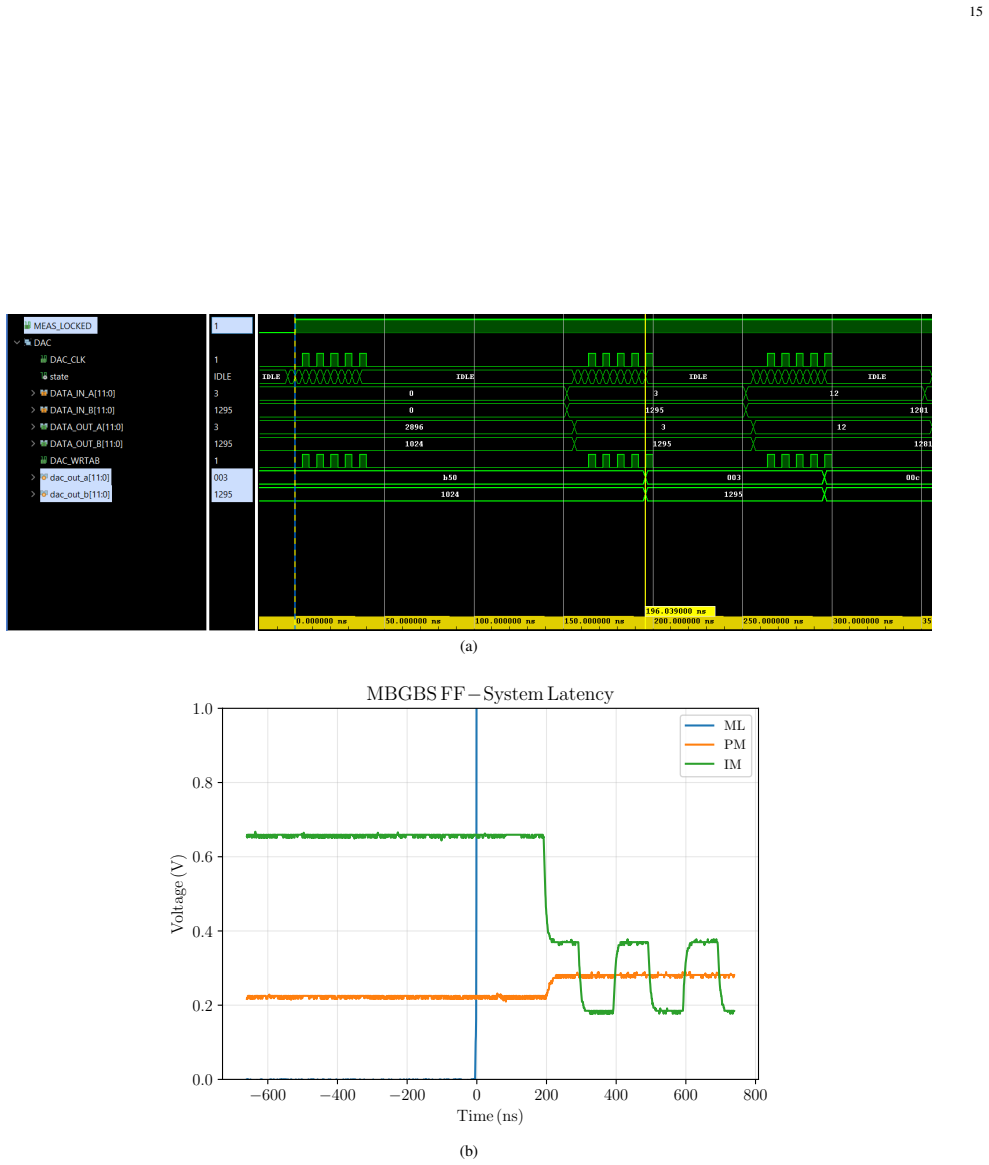
FPGA-based system achieves 196 ns end-to-end latency for real-time feedforward in photonic quantum protocols.
A machine-rendered reading of the paper's core claim, the machinery that carries it, and where it could break.
Core claim
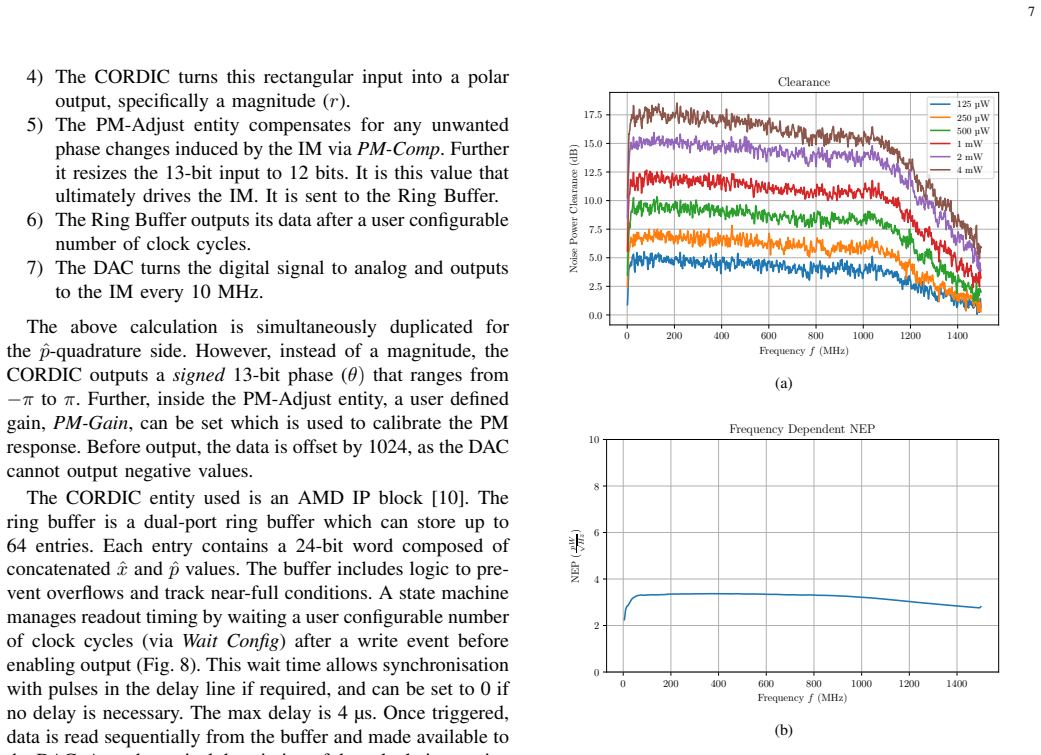
Our system performs signal acquisition, conditioning, and logic operations in real-time, meeting the tight latency requirements of photonic quantum computing protocols. The detector exhibits a large clearance of 15 dB at 1 GHz with 4 mW linear oscillator and quantum efficiencies of >95% with a total system latency of 196 ns.
What carries the argument
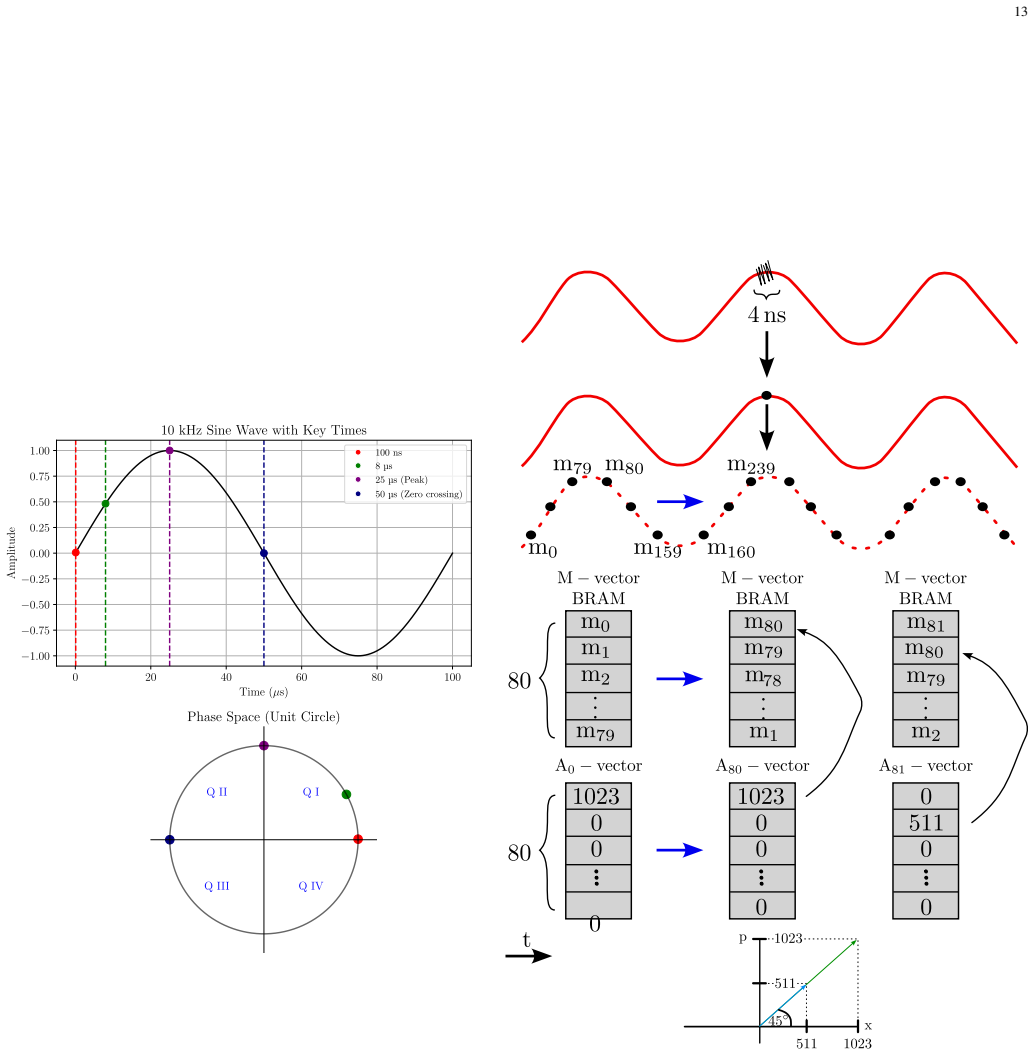
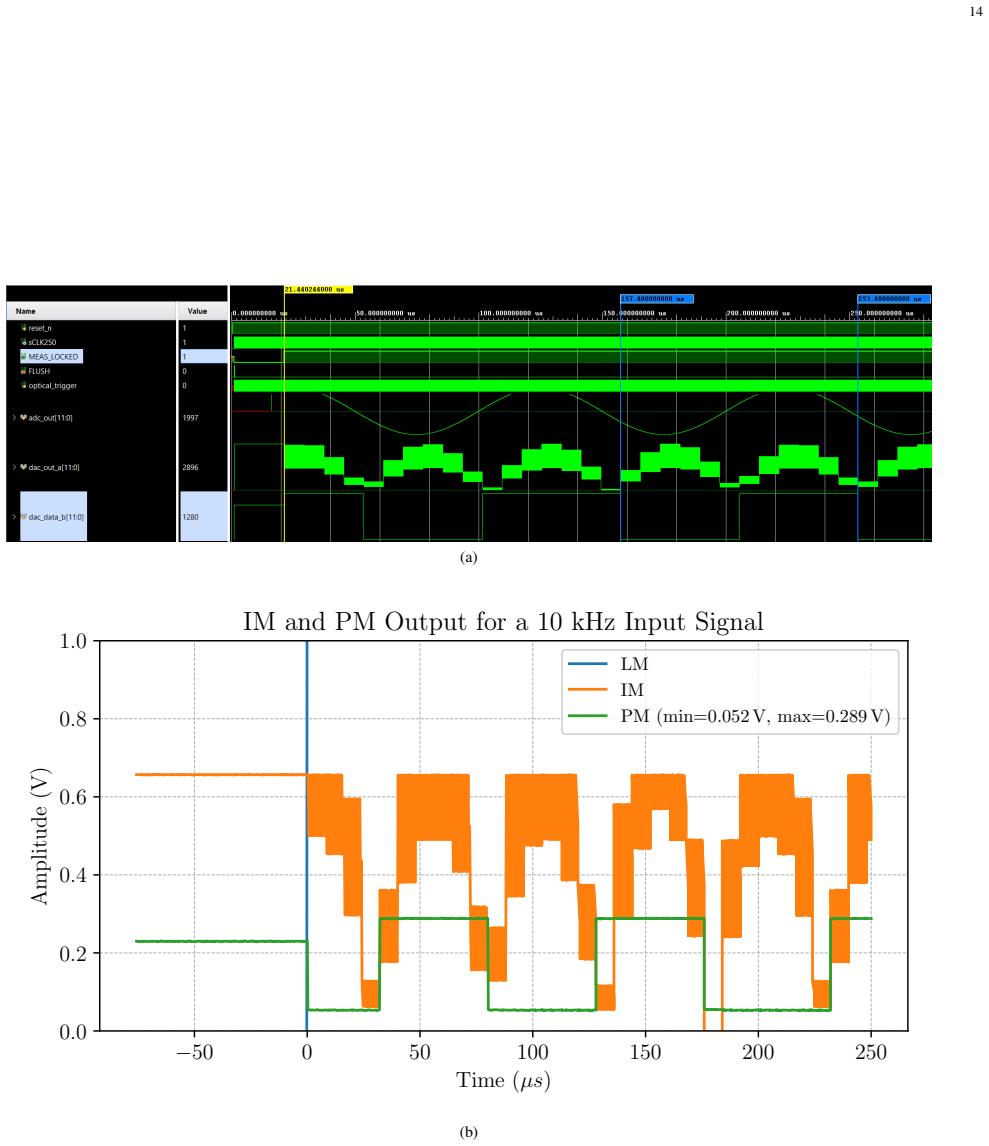
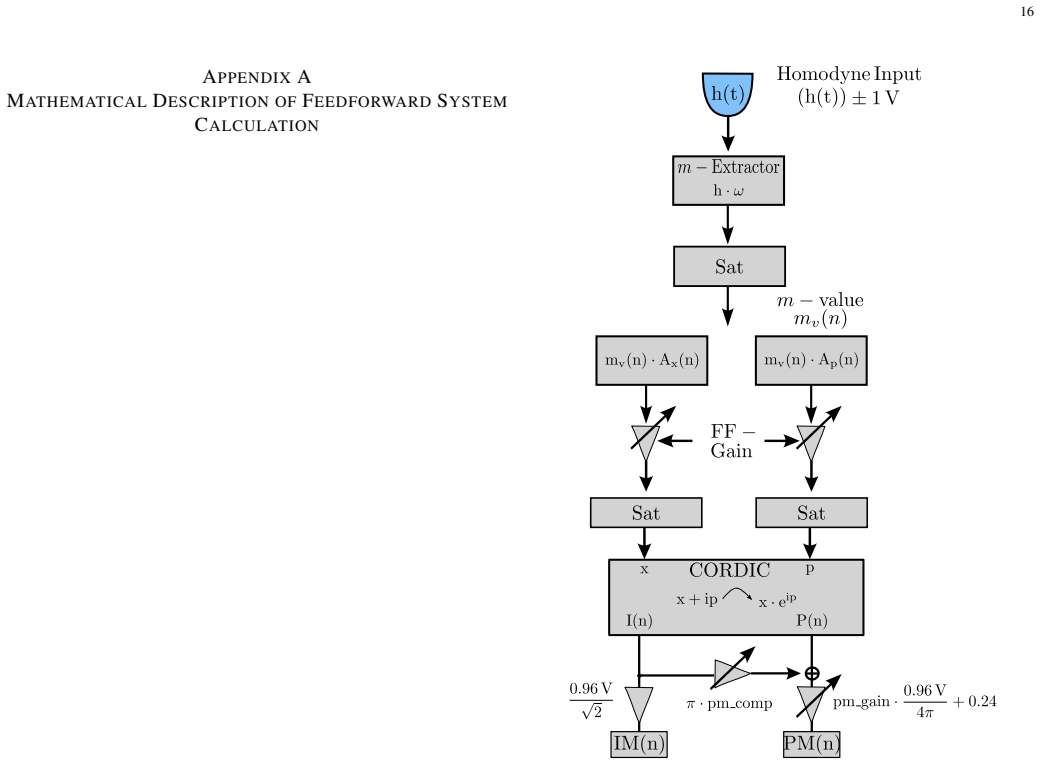
FPGA-based fast feedforward system with a fully fibre-based homodyne detector that carries out real-time acquisition, conditioning, and logic for CV MB-QIP.
Load-bearing premise
The measured 196 ns latency is low enough to satisfy the timing constraints of the CV MB-QIP protocols without any demonstration of closed-loop operation inside an actual quantum protocol.
What would settle it
A direct measurement showing that the required latency for a target CV MB-QIP protocol is shorter than 196 ns, or a closed-loop test in which the 196 ns delay prevents successful protocol execution.
Figures

read the original abstract
Field-programmable gate arrays provide a high-performance solution for real-time signal processing in emerging quantum and photonic technologies. We present an FPGA-based fast feedforward system, that incorporates a high quantum efficiency fully fibre based homodyne detector, to enable low-latency signal processing critical for continuous variables (CV) measurement-based quantum information processing (MB-QIP) protocols. CV MB-QIP typically relies on adaptive measurements and/or displacements via feedforward to achieve scalability and universality, but existing implementations typically handle these operations in post-processing, limiting real-time applicability. Our system performs signal acquisition, conditioning, and logic operations in real-time, meeting the tight latency requirements of photonic quantum computing protocols. The detector exhibits a large clearance of 15 dB at 1 GHz with 4 mW linear oscillator and quantum efficiencies of >95% with a total system latency of 196 ns. This work highlights the role of FPGAs in bridging the gap between theoretical models and physical implementations in photonics-based technologies
Editorial analysis
A structured set of objections, weighed in public.
Referee Report
Summary. The manuscript presents an FPGA-based feedforward system integrated with a high-quantum-efficiency fibre-based homodyne detector for real-time signal acquisition, conditioning, and logic operations in continuous-variable measurement-based quantum information processing (CV MB-QIP). It reports concrete hardware performance metrics: 15 dB clearance at 1 GHz with 4 mW local oscillator, quantum efficiency >95%, and end-to-end system latency of 196 ns, asserting that these meet the requirements for adaptive measurements and displacements in photonic quantum computing protocols.
Significance. If the reported latency and detector performance are shown to satisfy the timing constraints of specific CV MB-QIP protocols and demonstrated in closed-loop operation, the work would provide a practical hardware bridge between theoretical feedforward requirements and physical implementations, enabling real-time rather than post-processed adaptive operations.
major comments (2)
- [Abstract] Abstract: The central claim that the system 'meets the tight latency requirements of photonic quantum computing protocols' lacks any explicit comparison between the measured 196 ns end-to-end latency and the numerical timing bounds required by the cited CV MB-QIP protocols, nor does it include a closed-loop demonstration inside an actual quantum circuit. This assumption is load-bearing for the paper's primary assertion.
- [Abstract] Abstract: Concrete performance figures (196 ns latency, 15 dB clearance, >95% QE) are stated without reference to a methods section, error analysis, uncertainty quantification, or raw data, preventing verification that the numbers support the protocol-requirement claim.
Simulated Author's Rebuttal
We thank the referee for their constructive comments. We address each major comment below and indicate where revisions will be made to the manuscript.
read point-by-point responses
-
Referee: [Abstract] Abstract: The central claim that the system 'meets the tight latency requirements of photonic quantum computing protocols' lacks any explicit comparison between the measured 196 ns end-to-end latency and the numerical timing bounds required by the cited CV MB-QIP protocols, nor does it include a closed-loop demonstration inside an actual quantum circuit. This assumption is load-bearing for the paper's primary assertion.
Authors: We agree an explicit comparison strengthens the abstract. The full manuscript (Introduction and Results) cites specific CV MB-QIP protocols with timing bounds typically in the 200-1000 ns range for real-time adaptive operations; our 196 ns end-to-end latency falls at the lower end of these bounds. We will revise the abstract to include a concise comparison phrase. A closed-loop demonstration within a full quantum circuit is outside the scope of this hardware characterization paper, which reports system-level metrics rather than an integrated quantum experiment; the latency comparison alone supports the claim for the stated purpose. revision: partial
-
Referee: [Abstract] Abstract: Concrete performance figures (196 ns latency, 15 dB clearance, >95% QE) are stated without reference to a methods section, error analysis, uncertainty quantification, or raw data, preventing verification that the numbers support the protocol-requirement claim.
Authors: The abstract is a concise summary; the Methods section details the measurement procedures for latency, clearance (at 1 GHz with 4 mW LO), and quantum efficiency (>95%), including error analysis and uncertainty quantification. Raw datasets are provided in the supplementary information. We will revise the abstract to add a brief reference to the Methods section for these figures. revision: yes
Circularity Check
No circularity: paper reports direct hardware measurements without derivations or fitted predictions
full rationale
The manuscript presents an FPGA-based feedforward system and reports empirical measurements (15 dB clearance at 1 GHz, >95% QE, 196 ns latency) obtained from hardware characterization. No equations, parameter fitting, self-citations used as load-bearing uniqueness theorems, or ansatzes appear in the provided text. The central claim that the measured latency meets CV MB-QIP requirements is an engineering assertion resting on external protocol literature rather than any internal derivation that reduces to the paper's own inputs by construction. The work is therefore self-contained against external benchmarks.
Axiom & Free-Parameter Ledger
Reference graph
Works this paper leans on
-
[1]
Briegel (2001):A One-Way Quantum Computer.Physical Review Letters 86(22), pp
R. Raussendorf and H. J. Briegel, “A one-way quantum computer,” Phys. Rev. Lett., vol. 86, pp. 5188–5191, 05 2001. [Online]. Available: https://link.aps.org/doi/10.1103/PhysRevLett.86.5188
-
[2]
and Guo, Xueshi and Breum, Casper R
M. V . Larsen, X. Guo, C. R. Breum, J. S. Neergaard-Nielsen, and U. L. Andersen, “Deterministic generation of a two-dimensional cluster state,”Science, vol. 366, no. 6463, pp. 369–372, 2019. [Online]. Available: https://www.science.org/doi/abs/10.1126/science.aay4354
-
[3]
and Takeda, Shuntaro and Yoshikawa, Jun-ichi and Menicucci, Nicolas C
W. Asavanant, Y . Shiozawa, S. Yokoyama, B. Charoensombutamon, H. Emura, R. N. Alexander, S. Takeda, J. ichi Yoshikawa, N. C. Menicucci, H. Yonezawa, and A. Furusawa, “Generation of time-domain-multiplexed two-dimensional cluster state,”Science, vol. 366, no. 6463, pp. 373–376, 2019. [Online]. Available: https://www.science.org/doi/abs/10.1126/science.aay2645
-
[4]
Sequential generation of linear cluster states from a single photon emitter,
D. Istrati, Y . Pilnyak, J. C. Loredoet al., “Sequential generation of linear cluster states from a single photon emitter,”Nature Communications, vol. 11, p. 5501, 2020. [Online]. Available: https://doi.org/10.1038/s41467-020-19341-4
-
[5]
J. R. Scott and K. Coimbatore Balram, “Timing constraints imposed by classical digital control systems on photonic implementations of measurement-based quantum computing,”IEEE Transactions on Quantum Engineering, vol. 3, pp. 1–20, May 2022. [Online]. Available: https://doi.org/10.1109/TQE.2022.3175587
-
[6]
C. C. Gerry and P. L. Knight,Introductory Quantum Optics. Cambridge, UK: Cambridge University Press, 2005, cambridge Books Online. [Online]. Available: https://doi.org/10.1017/CBO9780511791239
-
[7]
Wigner, On the quantum correction for thermodynamic equilibrium, Phys
E. Wigner, “On the quantum correction for thermodynamic equilibrium,” Physical Review, vol. 40, no. 5, pp. 749–759, 1932. [Online]. Available: https://doi.org/10.1103/PhysRev.40.749
-
[8]
Gaussian states and operations – a quick reference,
J. B. Brask, “Gaussian states and operations – a quick reference,” arXiv preprint arXiv:2102.05748, 2021, v2 revised 30 Mar 2022. [Online]. Available: https://arxiv.org/abs/2102.05748
arXiv 2021
-
[9]
R. Raussendorf and T.-C. Wei, “Quantum computation by local measurement,”Annual Review of Condensed Matter Physics, vol. 3, pp. 239–261, 2012. [Online]. Available: https://doi.org/10.1146/annurev- conmatphys-020911-125041
-
[10]
[Online]
AMD (Xilinx),CORDIC v6.0 LogiCORE IP Product Guide, Vivado Design Suite, AMD/Vivado Design Suite, August 6 2021. [Online]. Available: https://docs.amd.com/v/u/en-US/pg105-cordic [11]UltraScale FPGAs Transceivers Wizard LogiCORE IP Product Guide, AMD/Vivado Design Suite, May 6 2023. [Online]. Available: https: //docs.amd.com/r/en-US/pg182-gtwizard-ultrasca...
2021
-
[11]
Quantum communication with non-gaussian states,
C. R. k. Breum, “Quantum communication with non-gaussian states,” Ph.D. dissertation, Technical University of Denmark, Department of Physics, Kgs. Lyngby, Denmark, 2020. [Online]. Available: https://backend.orbit.dtu.dk/ws/portalfiles/portal/258642112/ PhD_thesis_Casper_Rub_k_Breum.pdf
arXiv 2020
-
[12]
Laser phase and frequency stabilization using an optical resonator,
R. W. P. Drever, J. L. Hall, F. V . Kowalski, J. Hough, G. M. Ford, A. J. Munley, and H. Ward, “Laser phase and frequency stabilization using an optical resonator,”Applied Physics B: Photophysics and Laser Chemistry, vol. 31, no. 2, pp. 97–105, 1983. [Online]. Available: https://doi.org/10.1007/BF00702605
-
[13]
Photon temporal modes: A complete framework for quantum information science,
B. Brecht, D. V . Reddy, C. Silberhorn, and M. G. Raymer, “Photon temporal modes: A complete framework for quantum information science,”Physical Review X, vol. 5, no. 4, p. 041017, 2015. [Online]. Available: https://doi.org/10.1103/PhysRevX.5.041017 [15]AXI DMA LogiCORE IP Product Guide (PG021), Version 7.1, AMD, June 2025, document ID: PG021; Release Dat...
discussion (0)
Sign in with ORCID, Apple, or X to comment. Anyone can read and Pith papers without signing in.