Secrecy Sum Rate Maximization for OIRS-Aided Visible Light Communications with Confidential Messages
Pith reviewed 2026-06-28 08:14 UTC · model grok-4.3
The pith
Joint precoder and OIRS assignment optimization maximizes secrecy sum rate in blocked VLC systems.
A machine-rendered reading of the paper's core claim, the machinery that carries it, and where it could break.
Core claim
The central claim is that a joint optimization problem formulated to maximize the secrecy sum rate through the co-design of the transmission precoder and OIRS units assignment can be solved efficiently by an alternating optimization framework integrating the concave-convex procedure and first-order Taylor approximations, despite the binary constraints and coupled variables that make the problem highly non-convex.
What carries the argument
Alternating optimization framework integrating the concave-convex procedure (CCCP) and first-order Taylor approximations to handle binary OIRS unit assignment constraints and coupled variables in the secrecy sum rate maximization problem.
If this is right
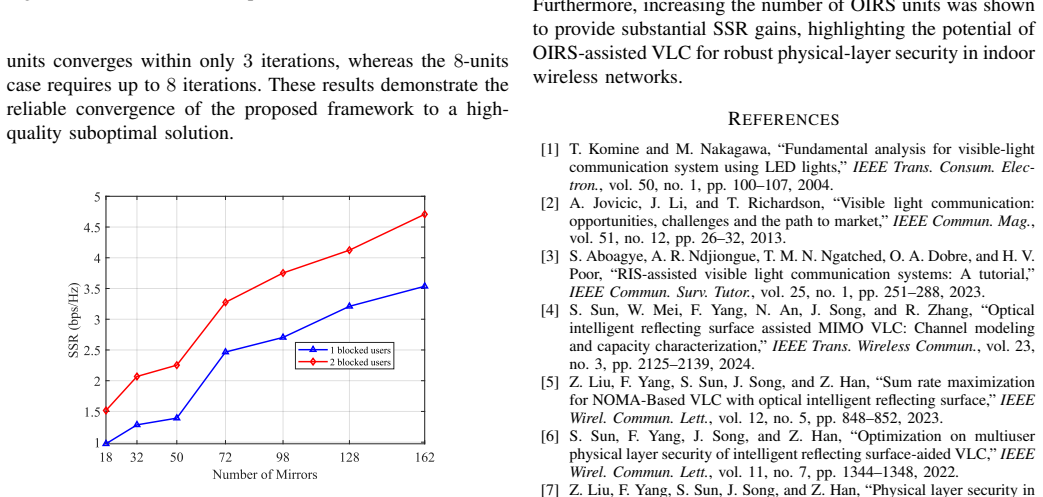
- Increasing the number of OIRS reflecting units yields significant secrecy sum rate gains.
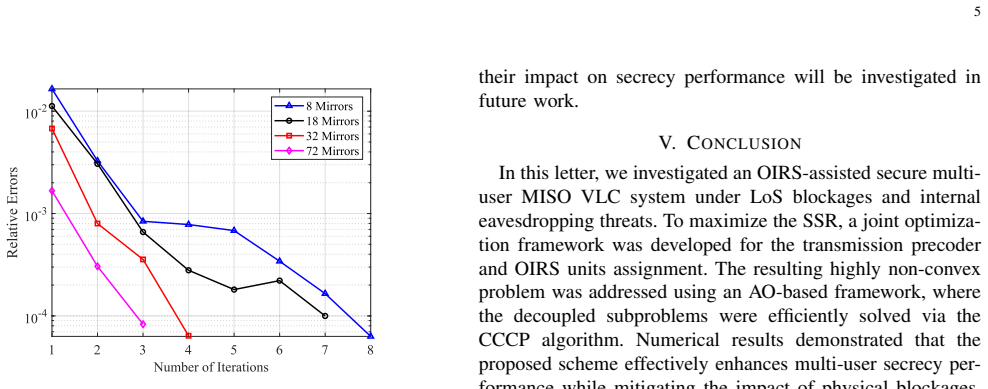
- The proposed algorithm converges under the simulated conditions.
- The co-design mitigates the effects of line-of-sight blockages and internal eavesdropping in multi-user VLC.
Where Pith is reading between the lines
- The same alternating-optimization structure could be tested in other reflective-surface-aided systems beyond visible light.
- Performance under imperfect channel knowledge would be a direct next measurement to check robustness.
- Hardware constraints on phase or amplitude control per OIRS unit could be added as an extension without changing the core formulation.
Load-bearing premise
The binary constraints on OIRS unit assignment and the coupled variables can be handled by the proposed alternating optimization without significant loss of optimality or convergence failure in practical VLC channel conditions.
What would settle it
A simulation or measurement on a concrete VLC channel realization in which the alternating optimization algorithm either fails to converge or produces a secrecy sum rate no higher than a baseline without joint precoder and assignment optimization.
Figures
read the original abstract
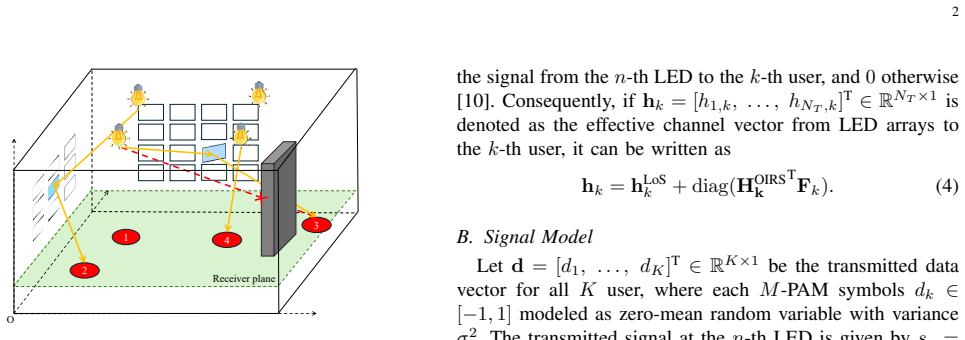
This paper investigates the secrecy sum-rate (SSR) performance of optical intelligent reflecting surface (OIRS)-assisted multi-user visible light communication (VLC) systems under line-of-sight (LoS) blockages. To mitigate physical obstructions and internal eavesdropping, a joint optimization problem is formulated to maximize the SSR through the co-design of the transmission precoder and OIRS units assignment. Due to the binary constraints and coupled variables, the problem is highly non-convex. To solve it efficiently, an alternating optimization (AO) framework integrating the concave-convex procedure (CCCP) and first-order Taylor approximations is developed. Simulation results demonstrate the convergence of the proposed algorithm and show that increasing the number of OIRS reflecting units yields significant SSR gains.
Editorial analysis
A structured set of objections, weighed in public.
Referee Report
Summary. The paper investigates secrecy sum-rate (SSR) maximization in OIRS-assisted multi-user VLC systems under LoS blockages. It formulates a joint non-convex optimization problem over the transmission precoder and binary OIRS unit assignments, then proposes an alternating optimization (AO) framework that applies the concave-convex procedure (CCCP) together with first-order Taylor approximations to obtain an efficient solution. Simulation results are presented to demonstrate convergence of the algorithm and SSR gains as the number of OIRS reflecting units increases.
Significance. If the AO framework is shown to converge reliably with quantifiable approximation error and to produce SSR values that are competitive against standard benchmarks, the work would supply a concrete algorithmic tool for physical-layer security design in obstructed VLC environments. The emphasis on joint precoder and discrete OIRS assignment is a natural extension of existing IRS/VLC secrecy literature.
major comments (2)
- [Abstract (and the algorithm description section)] The central claim that the AO+CCCP+Taylor procedure solves the non-convex problem efficiently lacks any convergence proof, stationarity guarantee, or bound on the linearization error. This is load-bearing for the algorithmic contribution.
- [Problem formulation and algorithm sections] The handling of the binary OIRS-unit assignment variables is described only at the level of the AO framework; no explicit statement appears on whether a continuous relaxation, penalty term, or rounding step is used, nor on the resulting optimality gap under realistic VLC channel conditions.
minor comments (2)
- [Simulation results] The abstract states that simulations demonstrate convergence, but no figure or table reference is given; a dedicated convergence plot and iteration count table would strengthen the presentation.
- [System model] Notation for the secrecy sum-rate objective and the OIRS phase/amplitude model should be introduced with explicit equation numbers at first use.
Simulated Author's Rebuttal
We thank the referee for the constructive feedback. We address the two major comments below and will revise the manuscript accordingly to strengthen the algorithmic presentation.
read point-by-point responses
-
Referee: [Abstract (and the algorithm description section)] The central claim that the AO+CCCP+Taylor procedure solves the non-convex problem efficiently lacks any convergence proof, stationarity guarantee, or bound on the linearization error. This is load-bearing for the algorithmic contribution.
Authors: We acknowledge that the current manuscript provides only empirical evidence of convergence through simulations and does not include a formal proof of convergence, stationarity guarantee, or explicit bound on the Taylor linearization error. While the AO framework leverages standard CCCP properties for the non-convex parts, we agree this is a substantive gap. In the revision we will add a dedicated subsection in the algorithm section that (i) recalls the relevant convergence results for CCCP under the problem structure, (ii) discusses the effect of the first-order Taylor approximations, and (iii) explicitly states the absence of a strict stationarity guarantee, thereby qualifying the efficiency claim. revision: yes
-
Referee: [Problem formulation and algorithm sections] The handling of the binary OIRS-unit assignment variables is described only at the level of the AO framework; no explicit statement appears on whether a continuous relaxation, penalty term, or rounding step is used, nor on the resulting optimality gap under realistic VLC channel conditions.
Authors: The manuscript states that the problem is solved via an AO framework that alternates between precoder and OIRS assignment subproblems, but it does not detail the exact mechanism used to enforce the binary constraints on the OIRS variables. We agree that this omission leaves the optimality gap unclear. In the revised version we will explicitly describe the continuous relaxation employed for the assignment variables, the subsequent rounding procedure, and any penalty terms if used, together with a brief discussion of the resulting sub-optimality under the considered VLC channel model. revision: yes
Circularity Check
No significant circularity
full rationale
The paper formulates a joint non-convex SSR maximization problem over precoder and binary OIRS assignment, then applies a standard AO framework with CCCP and first-order Taylor approximations to obtain a locally optimal solution. No equation or step reduces by construction to its own inputs; the algorithm is an iterative numerical procedure whose outputs are validated against external simulation benchmarks rather than being tautological. No self-citation chain, uniqueness theorem, or ansatz smuggling is invoked in the provided text. The performance claims rest on convergence plots and SSR gains versus baselines, which are independent of the derivation itself.
Axiom & Free-Parameter Ledger
axioms (2)
- domain assumption VLC channels follow deterministic LoS models with binary blockage indicators
- ad hoc to paper The non-convex problem admits an efficient AO solution via CCCP and first-order approximations
Reference graph
Works this paper leans on
-
[1]
Fundamental analysis for visible-light communication system using LED lights,
T. Komine and M. Nakagawa, “Fundamental analysis for visible-light communication system using LED lights,”IEEE Trans. Consum. Elec- tron., vol. 50, no. 1, pp. 100–107, 2004
2004
-
[2]
Visible light communication: opportunities, challenges and the path to market,
A. Jovicic, J. Li, and T. Richardson, “Visible light communication: opportunities, challenges and the path to market,”IEEE Commun. Mag., vol. 51, no. 12, pp. 26–32, 2013
2013
-
[3]
RIS-assisted visible light communication systems: A tutorial,
S. Aboagye, A. R. Ndjiongue, T. M. N. Ngatched, O. A. Dobre, and H. V . Poor, “RIS-assisted visible light communication systems: A tutorial,” IEEE Commun. Surv. Tutor ., vol. 25, no. 1, pp. 251–288, 2023
2023
-
[4]
Optical intelligent reflecting surface assisted MIMO VLC: Channel modeling and capacity characterization,
S. Sun, W. Mei, F. Yang, N. An, J. Song, and R. Zhang, “Optical intelligent reflecting surface assisted MIMO VLC: Channel modeling and capacity characterization,”IEEE Trans. Wireless Commun., vol. 23, no. 3, pp. 2125–2139, 2024
2024
-
[5]
Sum rate maximization for NOMA-Based VLC with optical intelligent reflecting surface,
Z. Liu, F. Yang, S. Sun, J. Song, and Z. Han, “Sum rate maximization for NOMA-Based VLC with optical intelligent reflecting surface,”IEEE Wirel. Commun. Lett., vol. 12, no. 5, pp. 848–852, 2023
2023
-
[7]
Physical layer security in NOMA-Based VLC systems with optical intelligent reflecting surface: A max-min secrecy data rate perspective,
Z. Liu, F. Yang, S. Sun, J. Song, and Z. Han, “Physical layer security in NOMA-Based VLC systems with optical intelligent reflecting surface: A max-min secrecy data rate perspective,”IEEE Internet Things J., vol. 12, no. 6, pp. 7180–7194, 2025
2025
-
[8]
Visible light communications via intelligent reflecting surfaces: Metasurfaces vs mirror arrays,
A. M. Abdelhady, A. K. S. Salem, O. Amin, B. Shihada, and M.- S. Alouini, “Visible light communications via intelligent reflecting surfaces: Metasurfaces vs mirror arrays,”IEEE Open J. Commun. Soc., vol. 2, pp. 1–20, 2020
2020
-
[9]
Optimization on multiuser physical layer security of intelligent reflecting surface-aided VLC,
S. Sun, F. Yang, J. Song, and Z. Han, “Optimization on multiuser physical layer security of intelligent reflecting surface-aided VLC,”IEEE Wirel. Commun. Lett., vol. 11, no. 7, pp. 1344–1348, 2022
2022
-
[10]
Sum rate maximization for intelligent reflecting surface-aided visible light communications,
S. Sun, F. Yang, and J. Song, “Sum rate maximization for intelligent reflecting surface-aided visible light communications,”IEEE Commun. Lett, vol. 25, no. 11, pp. 3619–3623, 2021
2021
-
[11]
A study of LED nonlinearity effects on optical wireless transmission using OFDM,
H. Elgala, R. Mesleh, and H. Haas, “A study of LED nonlinearity effects on optical wireless transmission using OFDM,” in2009 IFIP International Conference on Wireless and Optical Communications Networks, 2009, pp. 1–5
2009
-
[12]
High data rate multiple input multiple output (MIMO) optical wireless communications using white LED lighting,
L. Zenget al., “High data rate multiple input multiple output (MIMO) optical wireless communications using white LED lighting,”IEEE J. Sel. Areas Commun., vol. 27, no. 9, pp. 1654–1662, 2009
2009
-
[13]
Secrecy performance of multi-user MISO VLC broadcast channels with confidential messages,
M. A. Arfaoui, A. Ghrayeb, and C. M. Assi, “Secrecy performance of multi-user MISO VLC broadcast channels with confidential messages,” IEEE Trans. Wireless Commun., vol. 17, no. 11, pp. 7789–7800, 2018
2018
-
[14]
Joint LED selection and precoding optimization for multiple-user multiple-cell VLC systems,
Y . Yanget al., “Joint LED selection and precoding optimization for multiple-user multiple-cell VLC systems,”IEEE Internet Things J., vol. 9, no. 8, pp. 6003–6017, 2022
2022
-
[15]
Energy- efficient precoding designs for multi-user visible light communication systems with confidential messages,
S. T. Duong, T. V . Pham, C. T. Nguyen, and A. T. Pham, “Energy- efficient precoding designs for multi-user visible light communication systems with confidential messages,”IEEE Trans. Green Commun. Netw., vol. 5, no. 4, pp. 1974–1987, 2021
1974
discussion (0)
Sign in with ORCID, Apple, or X to comment. Anyone can read and Pith papers without signing in.