Robust Multi-view Clustering against Imperfect Information
Pith reviewed 2026-06-28 07:20 UTC · model grok-4.3
The pith
PLCI treats cross-view counterparts as latent variables to jointly solve incomplete views and noisy correspondences in multi-view clustering.
A machine-rendered reading of the paper's core claim, the machinery that carries it, and where it could break.
Core claim
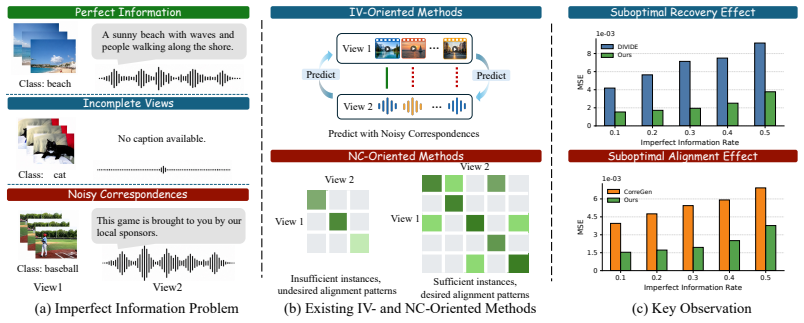
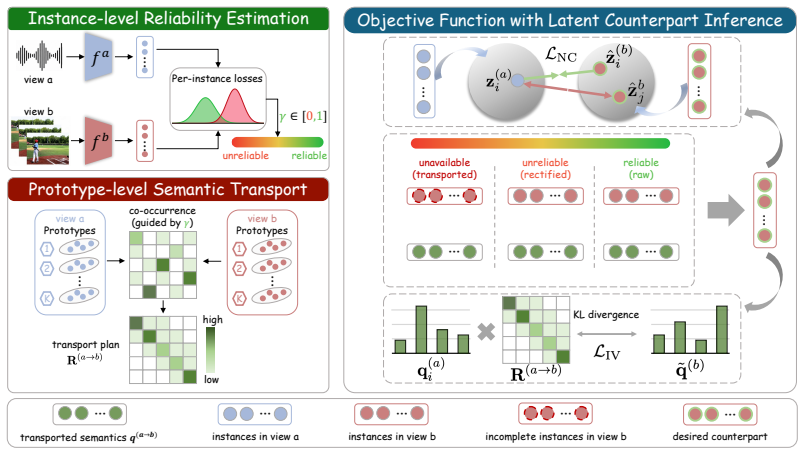
PLCI formulates the desired cross-view counterpart of each anchor instance as a latent variable, and integrates both instance-level reliability and prototype-level semantic transport to infer the posterior distribution of the latent counterpart, thereby handling both IV and NC in a unified manner.
What carries the argument
Posterior-guided Latent Counterpart Inference (PLCI), which treats each anchor instance's cross-view counterpart as a latent variable and infers its posterior from instance reliability and prototype semantic transport.
If this is right
- Both incomplete views and noisy correspondences can be managed inside one inference procedure without requiring reliable matches or fully observed instances.
- The posterior over latent counterparts supplies a soft assignment that can be used directly for clustering even when some views are absent.
- Prototype-level semantic transport supplies global structure that compensates for local unreliability in individual correspondences.
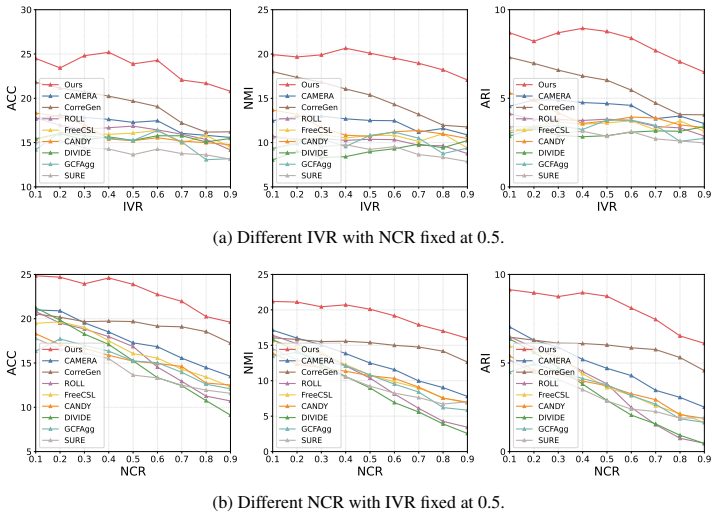
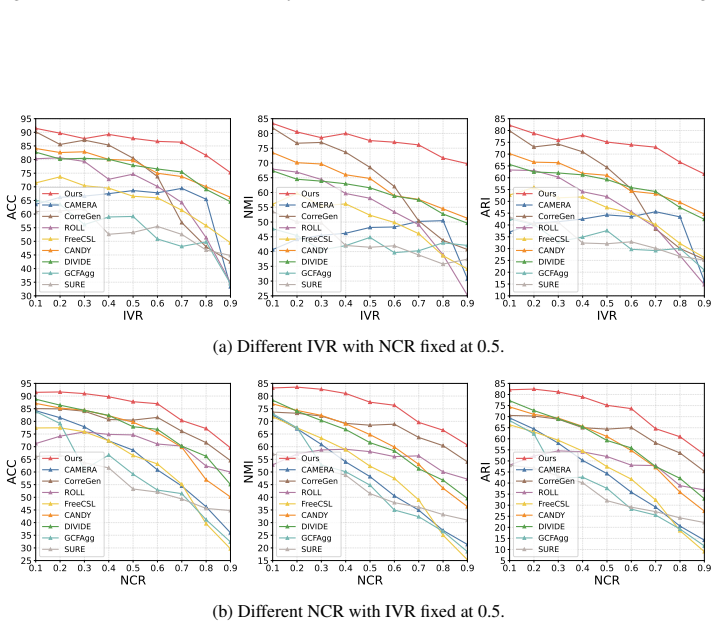
- The framework is evaluated on six standard multi-view datasets against ten prior methods that each target only one of the two defects.
Where Pith is reading between the lines
- If the latent-counterpart posterior works, the same modeling step could be inserted into other multi-view tasks such as retrieval or classification that also suffer from mismatched pairs.
- The separation of instance reliability from prototype transport might be relaxed to a joint objective, which could be tested by ablating each term on the same datasets.
- The approach could be applied to streaming multi-view data where new instances arrive with unknown completeness and correspondence quality.
Load-bearing premise
Both incomplete views and noisy correspondences arise from the same imperfect cross-view counterpart information, so a single latent-variable posterior model can address both at once.
What would settle it
Run PLCI and separate IV-only plus NC-only methods on a dataset engineered with controlled levels of both missing views and mismatched correspondences; if the unified model does not produce higher clustering accuracy than the separate approaches, the claim is falsified.
Figures
read the original abstract
Real-world multi-view data always suffer from imperfect information problem, where the view-specific observations are absent (i.e., Incomplete Views, IV) and cross-view correspondences are mismatched (i.e., Noisy Correspondences, NC) for certain instances. As a remedy, numerous IV- and NC-oriented multi-view clustering (MvC) methods have been proposed, which however require either reliable correspondences or sufficiently complete instances, thus stopping short of addressing the imperfect information problem. In contrast, we observe that both IV and NC challenges originate from the same issue of imperfect cross-view counterpart information, where the counterpart of an anchor instance in another view might be either unavailable or unreliable. Based on the observation, we propose a novel robust MvC framework, termed Posterior-guided Latent Counterpart Inference (PLCI), which could handle both IV and NC in a unified manner. Specifically, PLCI formulates the desired cross-view counterpart of each anchor instance as a latent variable, and integrates both instance-level reliability and prototype-level semantic transport to infer the posterior distribution of the latent counterpart. Extensive experiments on six widely-used multi-view datasets against 10 state-of-the-art MvC methods demonstrate the effectiveness of PLCI for tackling the imperfect information problem. The code will be released upon acceptance.
Editorial analysis
A structured set of objections, weighed in public.
Referee Report
Summary. The manuscript observes that incomplete views (IV) and noisy correspondences (NC) in multi-view clustering both originate from imperfect cross-view counterpart information. It proposes Posterior-guided Latent Counterpart Inference (PLCI), which formulates the desired cross-view counterpart of each anchor instance as a latent variable and infers its posterior by integrating instance-level reliability and prototype-level semantic transport, thereby addressing both IV and NC in a unified manner. Experiments on six standard multi-view datasets against ten state-of-the-art methods are reported to demonstrate effectiveness.
Significance. If the posterior inference is sound and the unification holds without hidden circularity, the work provides a conceptually coherent framework for imperfect-information multi-view clustering that could reduce the need for separate IV- and NC-specific pipelines. The planned code release supports reproducibility.
minor comments (3)
- [Abstract] The abstract states that PLCI 'integrates both instance-level reliability and prototype-level semantic transport' but does not name the concrete loss terms or inference procedure; adding one sentence with the key equation numbers would improve clarity for readers.
- [§4] Section 4 (experiments) should explicitly state whether the noisy-correspondence ratios and missing-view ratios are applied independently or jointly in the same runs, to confirm the unified setting is tested as claimed.
- [§3] Notation for the latent counterpart variable and its posterior should be introduced once with a clear definition before being used in multiple subsections.
Simulated Author's Rebuttal
We thank the referee for their positive summary of the manuscript, recognition of the unified framework, and recommendation for minor revision. No specific major comments were raised in the report.
Circularity Check
No significant circularity detected
full rationale
The paper presents PLCI as a modeling framework that treats the cross-view counterpart as a latent variable whose posterior is inferred from instance-level reliability and prototype-level semantic transport, based on the observation that IV and NC share the root cause of imperfect counterpart information. No equations or derivation steps are visible in the provided text that reduce a claimed prediction or result to a fitted input by construction, self-definition, or load-bearing self-citation. The central claim is an internally consistent modeling choice rather than a mathematical derivation that loops back to its inputs. Experiments are described as external empirical validation on standard datasets. This is the common case of a self-contained proposal without detectable circularity in the derivation chain.
Axiom & Free-Parameter Ledger
Reference graph
Works this paper leans on
-
[1]
Amini, Nicolas Usunier, and Cyril Goutte
Massih R. Amini, Nicolas Usunier, and Cyril Goutte. Learning from multiple partially observed views: An application to multilingual text categorization. InAdvances in Neural Information Processing Systems, volume 22, 2009
2009
-
[2]
Kanwal, Tegan Maharaj, Asja Fischer, Aaron Courville, Yoshua Bengio, and Simon Lacoste-Julien
Devansh Arpit, Stanisław Jastrz˛ ebski, Nicolas Ballas, David Krueger, Emmanuel Bengio, Maxinder S. Kanwal, Tegan Maharaj, Asja Fischer, Aaron Courville, Yoshua Bengio, and Simon Lacoste-Julien. A closer look at memorization in deep networks. InProceedings of the 34th International Conference on Machine Learning, volume 70 ofProceedings of Machine Learnin...
2017
-
[3]
Multi-view clustering in latent embedding space
Man-Sheng Chen, Ling Huang, Chang-Dong Wang, and Dong Huang. Multi-view clustering in latent embedding space. InProceedings of the AAAI conference on artificial intelligence, volume 34, pages 3513–3520, 2020
2020
-
[4]
Efficient orthogonal multi-view subspace clustering
Man-Sheng Chen, Chang-Dong Wang, Dong Huang, Jian-Huang Lai, and Philip S Yu. Efficient orthogonal multi-view subspace clustering. InProceedings of the 28th ACM SIGKDD conference on knowledge discovery and data mining, pages 127–135, 2022
2022
-
[5]
Ting Chen, Simon Kornblith, Mohammad Norouzi, and Geoffrey Hinton. A simple framework for contrastive learning of visual representations.arXiv preprint arXiv:2002.05709, 2020
Pith/arXiv arXiv 2002
-
[6]
Imputation-free and alignment-free: Incomplete multi-view clustering driven 9 by consensus semantic learning
Yuzhuo Dai, Jiaqi Jin, Zhibin Dong, Siwei Wang, Xinwang Liu, En Zhu, Xihong Yang, Xinbiao Gan, and Yu Feng. Imputation-free and alignment-free: Incomplete multi-view clustering driven 9 by consensus semantic learning. InProceedings of the IEEE/CVF Conference on Computer Vision and Pattern Recognition, pages 5071–5081, 2025
2025
-
[7]
Openviewer: Openness-aware multi-view learning
Shide Du, Zihan Fang, Yanchao Tan, Changwei Wang, Shiping Wang, and Wenzhong Guo. Openviewer: Openness-aware multi-view learning. InProceedings of the AAAI conference on artificial intelligence, volume 39, pages 16389–16397, 2025
2025
-
[8]
Multiple features
Robert Duin. Multiple features. UCI Machine Learning Repository, 1998
1998
-
[9]
Representation learning meets optimization-derived networks: From single-view to multi-view.IEEE Transactions on Multimedia, 26:8889–8901, 2024
Zihan Fang, Shide Du, Zhiling Cai, Shiyang Lan, Chunming Wu, Yanchao Tan, and Shiping Wang. Representation learning meets optimization-derived networks: From single-view to multi-view.IEEE Transactions on Multimedia, 26:8889–8901, 2024
2024
-
[10]
A bayesian hierarchical model for learning natural scene categories
Li Fei-Fei and Pietro Perona. A bayesian hierarchical model for learning natural scene categories. InProceedings of the IEEE Computer Society Conference on Computer Vision and Pattern Recognition, pages 524–531, 2005
2005
-
[11]
Unified low-rank tensor learning and spectral embedding for multi-view subspace clustering.IEEE Transactions on Multimedia, 25:4972–4985, 2022
Lele Fu, Zhaoliang Chen, Yongyong Chen, and Shiping Wang. Unified low-rank tensor learning and spectral embedding for multi-view subspace clustering.IEEE Transactions on Multimedia, 25:4972–4985, 2022
2022
-
[12]
Robust contrastive multi-view clustering against dual noisy correspondence.Advances in Neural Information Processing Systems, 37, 2024
Ruiming Guo, Mouxing Yang, Yijie Lin, Xi Peng, and Peng Hu. Robust contrastive multi-view clustering against dual noisy correspondence.Advances in Neural Information Processing Systems, 37, 2024
2024
-
[13]
Bootstrapping multi-view learning for test-time noisy correspondence
Changhao He, Di Xue, Shuxian Li, Yanji Hao, Xi Peng, and Peng Hu. Bootstrapping multi-view learning for test-time noisy correspondence. InProceedings of the Computer Vision and Pattern Recognition Conference (CVPR), June 2026
2026
-
[14]
Momentum contrast for unsupervised visual representation learning
Kaiming He, Haoqi Fan, Yuxin Wu, Saining Xie, and Ross Girshick. Momentum contrast for unsupervised visual representation learning. InProceedings of the IEEE/CVF Conference on Computer Vision and Pattern Recognition, pages 9729–9738, 2020
2020
-
[15]
Doubly aligned incomplete multi-view clustering
Menglei Hu and Songcan Chen. Doubly aligned incomplete multi-view clustering. InProceed- ings of the Twenty-Seventh International Joint Conference on Artificial Intelligence, IJCAI-18, pages 2262–2268. International Joint Conferences on Artificial Intelligence Organization, 2018
2018
-
[16]
Multi-view spectral clustering network
Zhenyu Huang, Joey Tianyi Zhou, Xi Peng, Changqing Zhang, Hongyuan Zhu, and Jiancheng Lv. Multi-view spectral clustering network. InProceedings of the International Joint Conference on Artificial Intelligence, pages 2563–2569, 2019
2019
-
[17]
Yu-Gang Jiang, Guangnan Ye, Shih-Fu Chang, Daniel P. W. Ellis, and Alexander C. Loui. Consumer video understanding: A benchmark database and an evaluation of human and machine performance. InProceedings of the ACM International Conference on Multimedia Retrieval, page 29, 2011
2011
-
[18]
Kingma and Jimmy Ba
Diederik P. Kingma and Jimmy Ba. Adam: A method for stochastic optimization. InProceedings of the International Conference on Learning Representations, 2015
2015
-
[19]
Community-aware multi-view representation learning with incomplete information.IEEE Transactions on Pattern Analysis and Machine Intelligence, 2026
Haobin Li, Yijie Lin, Peng Hu, Mouxing Yang, and Xi Peng. Community-aware multi-view representation learning with incomplete information.IEEE Transactions on Pattern Analysis and Machine Intelligence, 2026
2026
-
[20]
Junnan Li, Richard Socher, and Steven C.H. Hoi. Dividemix: Learning with noisy labels as semi-supervised learning. InInternational Conference on Learning Representations, 2020
2020
-
[21]
Large-scale multi-view spectral clustering via bipartite graph
Yeqing Li, Feiping Nie, Heng Huang, and Junzhou Huang. Large-scale multi-view spectral clustering via bipartite graph. InProceedings of the AAAI Conference on Artificial Intelligence, pages 2750–2756, 2015
2015
-
[22]
From concrete to abstract: Multi-view clustering on relational knowledge
Ke Liang, Lingyuan Meng, Hao Li, Jun Wang, Long Lan, Miaomiao Li, Xinwang Liu, and Huaimin Wang. From concrete to abstract: Multi-view clustering on relational knowledge. IEEE Transactions on Pattern Analysis and Machine Intelligence, 47(10):9043–9060, 2025. 10
2025
-
[23]
Completer: Incomplete multi-view clustering via contrastive prediction
Yijie Lin, Yuanbiao Gou, Zitao Liu, Boyun Li, Jiancheng Lv, and Xi Peng. Completer: Incomplete multi-view clustering via contrastive prediction. InProceedings of the IEEE/CVF Conference on Computer Vision and Pattern Recognition (CVPR), June 2021
2021
-
[24]
Dual contrastive prediction for incomplete multi-view representation learning.IEEE Transactions on Pattern Analysis and Machine Intelligence, 45(4):4447–4461, 2023
Yijie Lin, Yuanbiao Gou, Xiaotian Liu, Jinfeng Bai, Jiancheng Lv, and Xi Peng. Dual contrastive prediction for incomplete multi-view representation learning.IEEE Transactions on Pattern Analysis and Machine Intelligence, 45(4):4447–4461, 2023
2023
-
[25]
One-pass multi-view clustering for large-scale data
Jiyuan Liu, Xinwang Liu, Yuexiang Yang, Li Liu, Siqi Wang, Weixuan Liang, and Jiangyong Shi. One-pass multi-view clustering for large-scale data. InProceedings of the IEEE/CVF International Conference on Computer Vision, pages 12344–12353, 2021
2021
-
[26]
Contrastive multi- view kernel learning.IEEE Transactions on Pattern Analysis and Machine Intelligence, 45(8): 9552–9566, 2023
Jiyuan Liu, Xinwang Liu, Yuexiang Yang, Qing Liao, and Yuanqing Xia. Contrastive multi- view kernel learning.IEEE Transactions on Pattern Analysis and Machine Intelligence, 45(8): 9552–9566, 2023
2023
-
[27]
Learn from view correlation: An anchor enhancement strategy for multi-view clustering
Suyuan Liu, Ke Liang, Zhibin Dong, Siwei Wang, Xihong Yang, Sihang Zhou, En Zhu, and Xinwang Liu. Learn from view correlation: An anchor enhancement strategy for multi-view clustering. InProceedings of the IEEE/CVF Conference on Computer Vision and Pattern Recognition, pages 26151–26161, 2024
2024
-
[28]
Efficient and effective regularized incomplete multi-view clustering.IEEE Transactions on Pattern Analysis and Machine Intelligence, 43(8):2634–2646, 2021
Xinwang Liu, Miaomiao Li, Chang Tang, Jingyuan Xia, Jian Xiong, Li Liu, Marius Kloft, and En Zhu. Efficient and effective regularized incomplete multi-view clustering.IEEE Transactions on Pattern Analysis and Machine Intelligence, 43(8):2634–2646, 2021
2021
-
[29]
One pass late fusion multi-view clustering
Xinwang Liu, Li Liu, Qing Liao, Siwei Wang, Yi Zhang, Wenxuan Tu, Chang Tang, Jiyuan Liu, and En Zhu. One pass late fusion multi-view clustering. InProceedings of the International Conference on Machine Learning, volume 139, pages 6850–6859, 2021
2021
-
[30]
Decoupled contrastive multi-view clustering with high-order random walks.Thirty-Eighth AAAI Conference on Artificial Intelligence, 2024
Yiding Lu, Yijie Lin, Mouxing Yang, Dezhong Peng, Peng Hu, and Xi Peng. Decoupled contrastive multi-view clustering with high-order random walks.Thirty-Eighth AAAI Conference on Artificial Intelligence, 2024
2024
-
[31]
NIM-nets: Noise-aware incomplete multi-view learning networks.IEEE Transactions on Image Processing, 32:175–189, 2023
Yalan Qin, Chuan Qin, Xinpeng Zhang, and Guorui Feng. NIM-nets: Noise-aware incomplete multi-view learning networks.IEEE Transactions on Image Processing, 32:175–189, 2023
2023
-
[32]
Dual consensus anchor learning for fast multi-view clustering.IEEE Transactions on Image Processing, 33:5298–5311, 2024
Yalan Qin, Chuan Qin, Xinpeng Zhang, and Guorui Feng. Dual consensus anchor learning for fast multi-view clustering.IEEE Transactions on Image Processing, 33:5298–5311, 2024
2024
-
[33]
Robust multi-view clustering with noisy correspondence.IEEE Transactions on Knowledge and Data Engineering, 36(12):9150–9162, 2024
Yuan Sun, Yang Qin, Yongxiang Li, Dezhong Peng, Xi Peng, and Peng Hu. Robust multi-view clustering with noisy correspondence.IEEE Transactions on Knowledge and Data Engineering, 36(12):9150–9162, 2024
2024
-
[34]
Roll: Robust noisy pseudo-label learning for multi-view clustering with noisy correspondence
Yuan Sun, Yongxiang Li, Zhenwen Ren, Guiduo Duan, Dezhong Peng, and Peng Hu. Roll: Robust noisy pseudo-label learning for multi-view clustering with noisy correspondence. In Proceedings of the Computer Vision and Pattern Recognition Conference, pages 30732–30741, 2025
2025
-
[35]
Representation learning with contrastive predictive coding.arXiv preprint arXiv:1807.03748, 2018
Aaron van den Oord, Yazhe Li, and Oriol Vinyals. Representation learning with contrastive predictive coding.arXiv preprint arXiv:1807.03748, 2018
Pith/arXiv arXiv 2018
-
[36]
Multi-view clustering via late fusion alignment maximization
Siwei Wang, Xinwang Liu, En Zhu, Chang Tang, Jiyuan Liu, Jingtao Hu, Jingyuan Xia, and Jianping Yin. Multi-view clustering via late fusion alignment maximization. InProceedings of the International Joint Conference on Artificial Intelligence, pages 3778–3784, 2019
2019
-
[37]
Highly-efficient incomplete large-scale multi-view clustering with consensus bipartite graph
Siwei Wang, Xinwang Liu, Li Liu, Wenxuan Tu, Xinzhong Zhu, Jiyuan Liu, Sihang Zhou, and En Zhu. Highly-efficient incomplete large-scale multi-view clustering with consensus bipartite graph. InProceedings of the IEEE/CVF Conference on Computer Vision and Pattern Recognition, pages 9776–9785, 2022
2022
-
[38]
Incomplete multiview spectral clustering with adaptive graph learning.IEEE transactions on cybernetics, 50(4):1418–1429, 2018
Jie Wen, Yong Xu, and Hong Liu. Incomplete multiview spectral clustering with adaptive graph learning.IEEE transactions on cybernetics, 50(4):1418–1429, 2018. 11
2018
-
[39]
Dimc-net: Deep incomplete multi-view clustering network
Jie Wen, Zheng Zhang, Zhao Zhang, Zhihao Wu, Lunke Fei, Yong Xu, and Bob Zhang. Dimc-net: Deep incomplete multi-view clustering network. InProceedings of the 28th ACM international conference on multimedia, pages 3753–3761, 2020
2020
-
[40]
Adaptive feature projection with distribution alignment for deep incomplete multi-view clustering.IEEE Transactions on Image Processing, 32:1354–1366, 2023
Jie Xu, Chao Li, Liang Peng, Yazhou Ren, Xiaoshuang Shi, Heng Tao Shen, and Xiaofeng Zhu. Adaptive feature projection with distribution alignment for deep incomplete multi-view clustering.IEEE Transactions on Image Processing, 32:1354–1366, 2023
2023
-
[41]
Gcfagg: Global and cross-view feature aggregation for multi-view clustering
Weiqing Yan, Yuanyang Zhang, Chenlei Lv, Chang Tang, Guanghui Yue, Liang Liao, and Weisi Lin. Gcfagg: Global and cross-view feature aggregation for multi-view clustering. In Proceedings of the IEEE/CVF Conference on Computer Vision and Pattern Recognition (CVPR), pages 19863–19872, June 2023
2023
-
[42]
Robust multi- view clustering with incomplete information.IEEE Transactions on Pattern Analysis and Machine Intelligence, 2022
Mouxing Yang, Yunfan Li, Peng Hu, Jinfeng Bai, Jian Cheng Lv, and Xi Peng. Robust multi- view clustering with incomplete information.IEEE Transactions on Pattern Analysis and Machine Intelligence, 2022
2022
-
[43]
DealMVC: Dual contrastive calibration for multi-view clustering
Xihong Yang, Jiaqi Jin, Siwei Wang, Ke Liang, Yue Liu, Yi Wen, Suyuan Liu, Sihang Zhou, Xinwang Liu, and En Zhu. DealMVC: Dual contrastive calibration for multi-view clustering. InProceedings of the ACM International Conference on Multimedia, pages 337–346, 2023
2023
-
[44]
Generalized deep multi-view clustering via causal learning with partially aligned cross-view correspondence
Xihong Yang, Siwei Wang, Jiaqi Jin, Fangdi Wang, Tianrui Liu, Yueming Jin, Xinwang Liu, En Zhu, and Kunlun He. Generalized deep multi-view clustering via causal learning with partially aligned cross-view correspondence. InProceedings of the IEEE/CVF International Conference on Computer Vision, pages 1990–1999, 2025
1990
-
[45]
Uncover underlying correspondence for robust multi-view clustering
Haochen Zhou, Guofeng Ding, Mouxing Yang, Peng Hu, Yijie Lin, and Xi Peng. Uncover underlying correspondence for robust multi-view clustering. InThe Fourteenth International Conference on Learning Representations, 2026. A Related Work In this section, we briefly review two most related topics to this work,i.e., multi-view clustering with incomplete views ...
arXiv 2026
discussion (0)
Sign in with ORCID, Apple, or X to comment. Anyone can read and Pith papers without signing in.