An 800-Million-Year-Old Impact Shower on the Terrestrial Planets from the Breakup of the Eulalia Parent Body
Pith reviewed 2026-06-28 03:46 UTC · model grok-4.3
The pith
The breakup of the Eulalia asteroid family ~800 million years ago sent fragments that explain the observed surge in lunar impacts.
A machine-rendered reading of the paper's core claim, the machinery that carries it, and where it could break.
Core claim
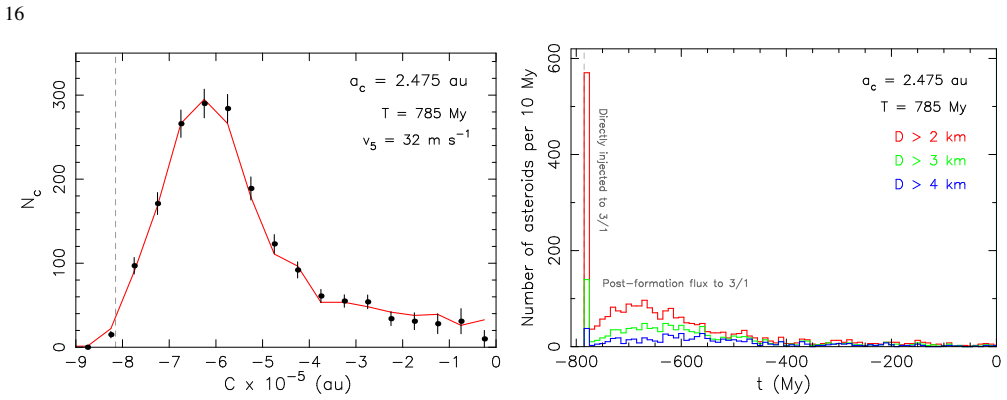
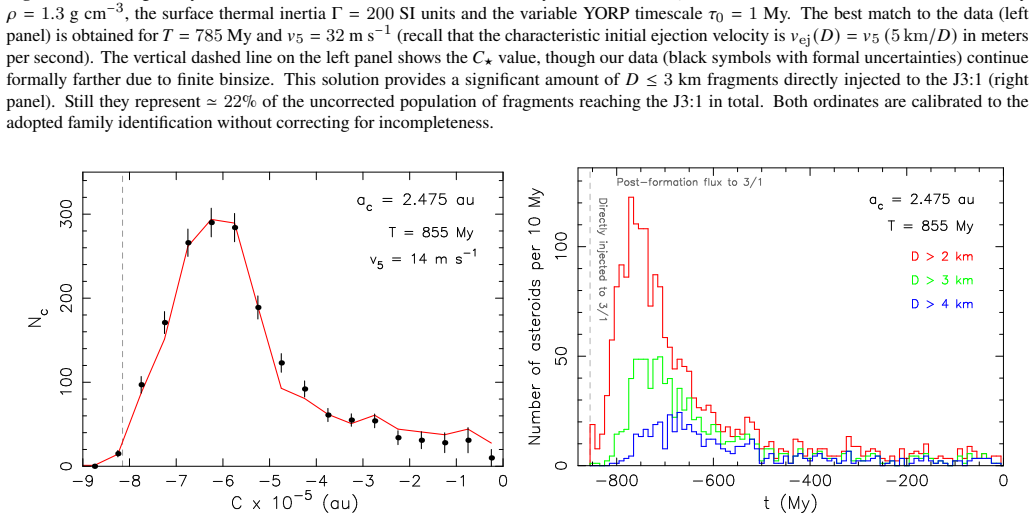
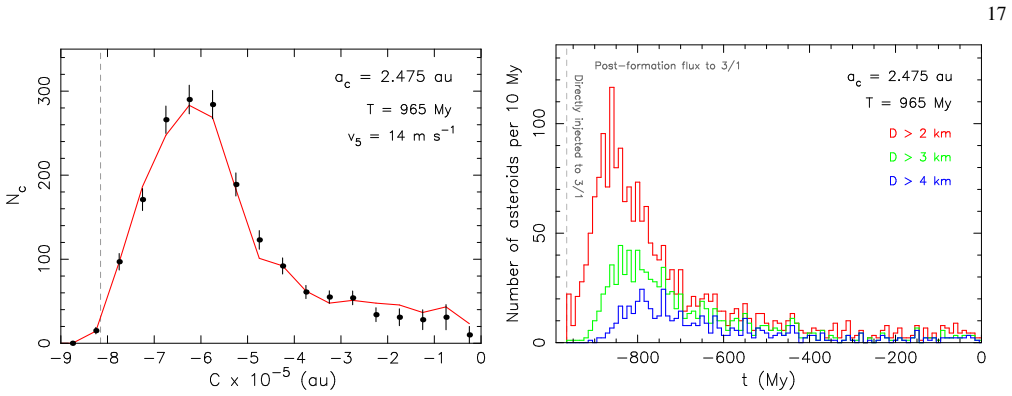
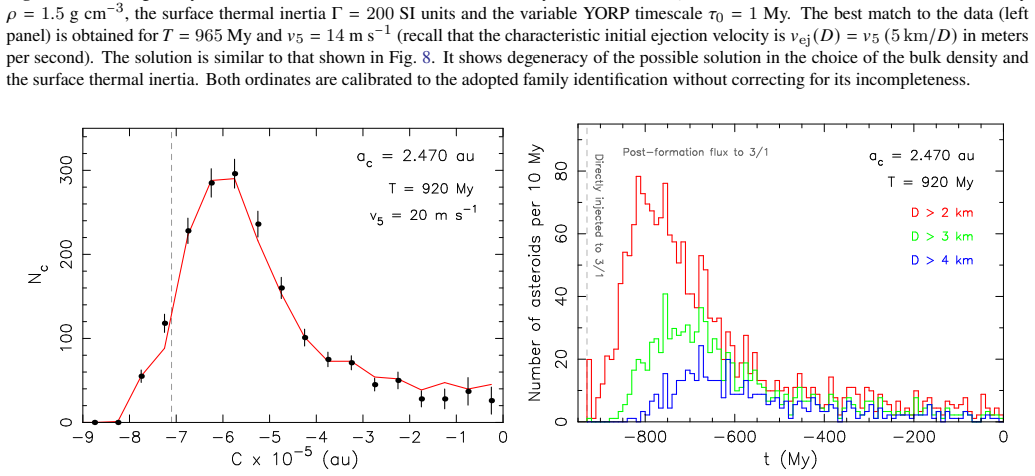
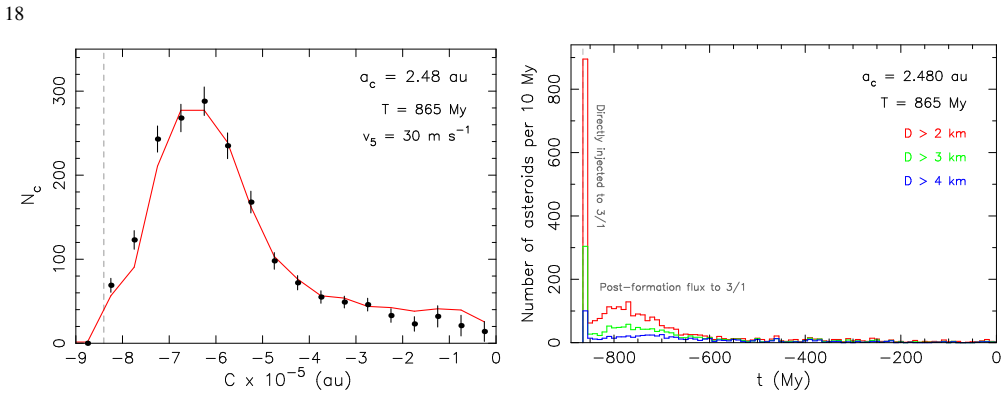
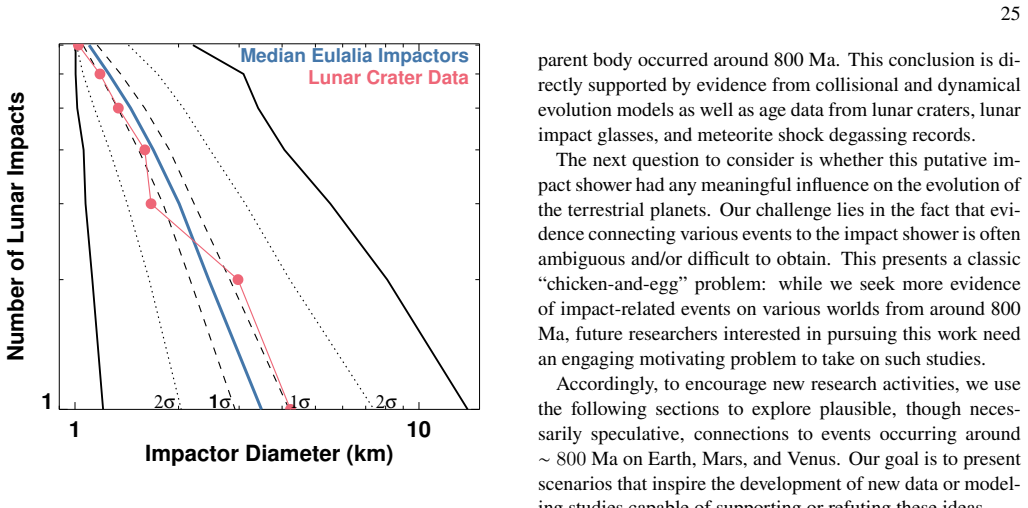
Our collisional and dynamical models link the Eulalia family formation ~800 Ma to the injection of about three-quarters of its fragments into the J3:1 resonance over ~150 Myr. These fragments were then transported to the terrestrial planet region, producing an elevated bombardment rate that plausibly matches the observed lunar craters and impact glasses from that era.
What carries the argument
Collisional and dynamical models of fragment delivery from the Eulalia breakup into the J3:1 mean motion resonance with Jupiter via Yarkovsky thermal forces.
Load-bearing premise
The collisional and dynamical models correctly predict the fraction of fragments injected into the J3:1 resonance and their delivery to planet-crossing orbits on the observed ~150 Myr timescale.
What would settle it
A mismatch between the predicted impact timing from Eulalia fragments and the actual age distribution of large lunar craters or returned impact glasses.
Figures
read the original abstract
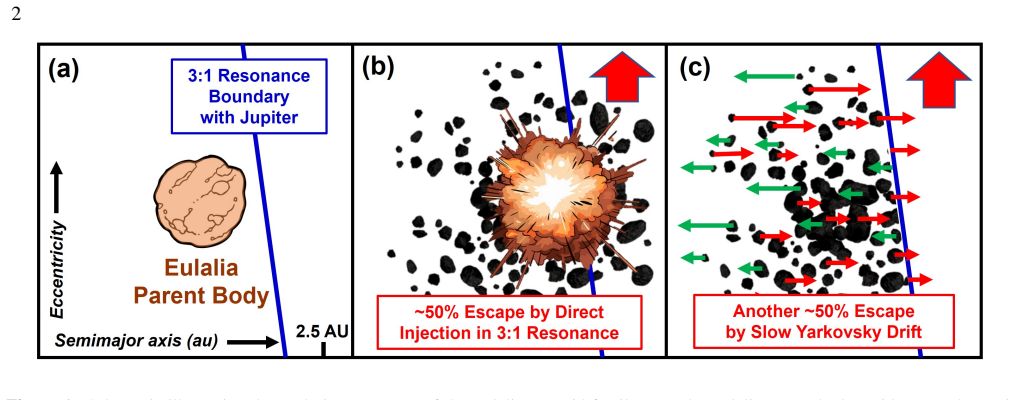
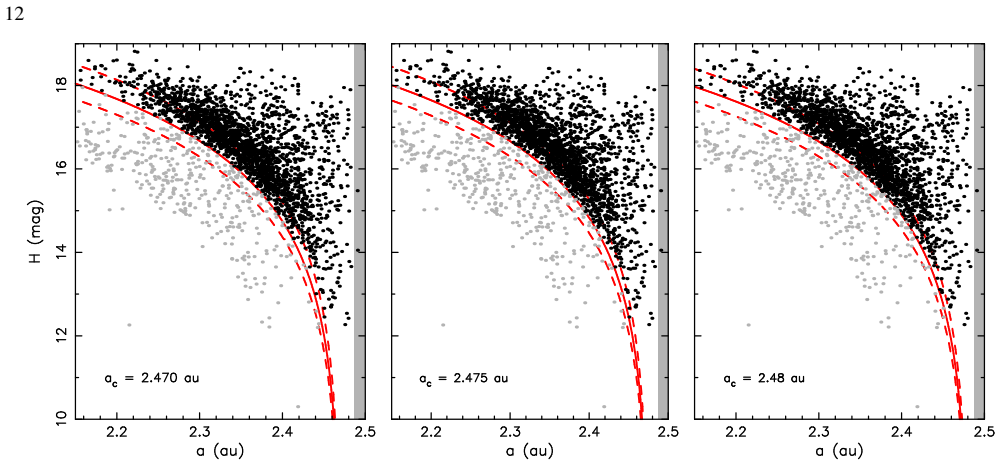
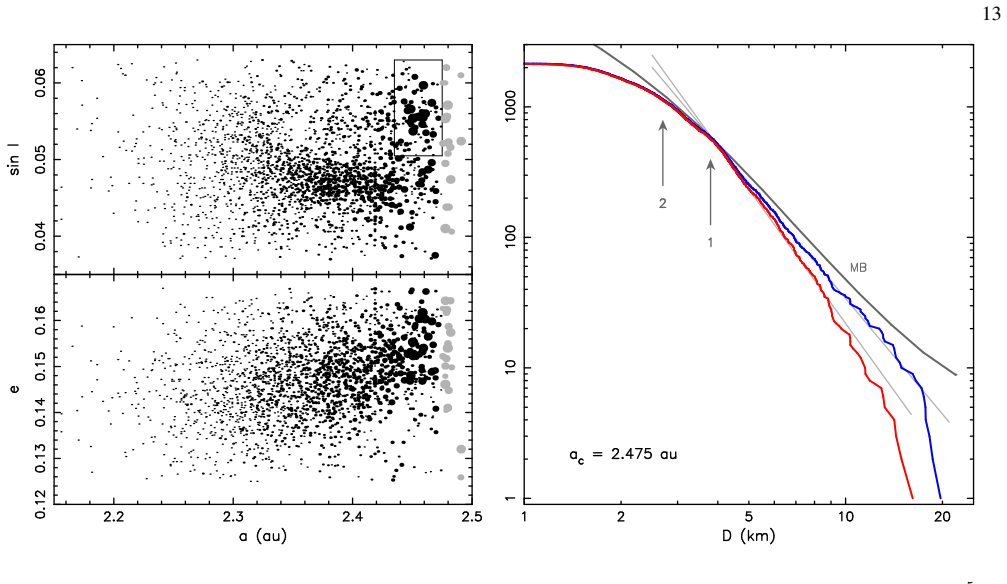
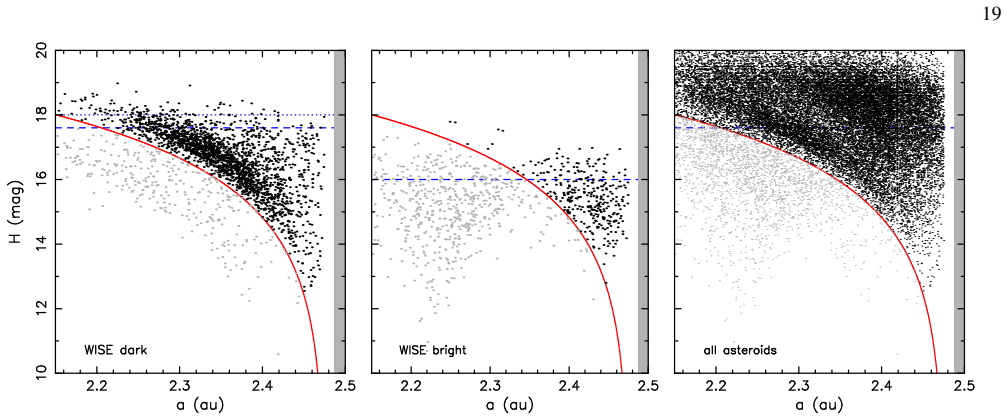
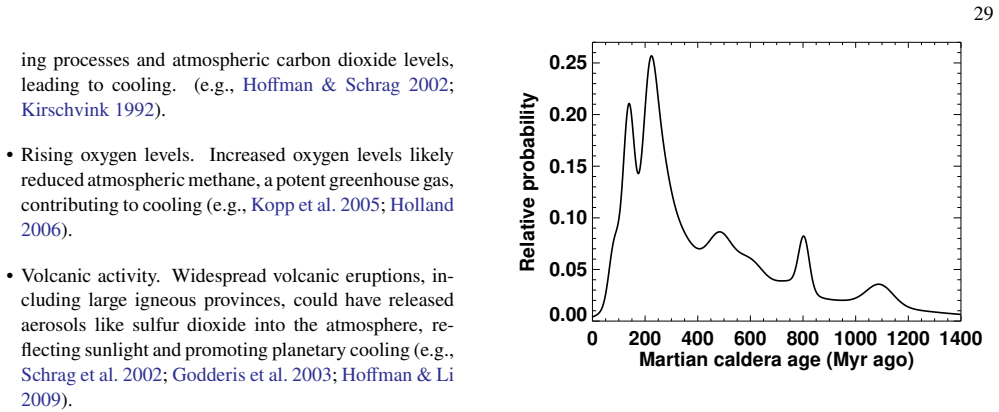
Multiple studies have proposed a substantial surge in large lunar impacts approximately $800$ million years ago (Ma). Some are based on analyses of the ages of large lunar craters, such as the $93$ km Copernicus crater. Others focus on the age distributions of impact glasses returned by lunar missions. A key challenge has been identifying and testing a plausible source for this putative impact spike. Here we use collisional and dynamical models to link this event to the formation of the Eulalia asteroid family, whose primitive carbonaceous chondrite-like parent body disrupted $\sim 800$ Ma near the 3:1 mean motion resonance with Jupiter (J3:1). Our simulations indicate that approximately three-quarters of the family's fragments eventually entered the J3:1 over a $\sim 150$-million year interval. While some fragments were injected into the resonance immediately after the disruption, others migrated more gradually via non-gravitational (Yarkovsky) thermal forces. Once in the J3:1, the fragments were dynamically transported into the planet-crossing region, leading to an elevated rate of bombardment on the Moon and terrestrial planets. Our results demonstrate that the Eulalia breakup can plausibly account for the observed lunar craters formed near $800$ Ma. Intriguingly, this event may also have had widespread repercussions across the inner Solar System. On Earth, its timing coincides with significant shifts in the biosphere, possibly linked to large impacts. On Mars, these impacts might have triggered a pulse of volcanic activity. Together, they showcase how certain catastrophic collisions in the main belt can have far-reaching consequences for the history of the terrestrial planets.
Editorial analysis
A structured set of objections, weighed in public.
Referee Report
Summary. The manuscript claims that the ~800 Ma breakup of the Eulalia asteroid family near the J3:1 resonance produced an impact shower on the terrestrial planets. Collisional and dynamical simulations show that ~3/4 of fragments entered the resonance over ~150 Myr (via immediate capture plus Yarkovsky drift), dynamically delivering an elevated bombardment rate that plausibly explains the observed lunar crater ages (e.g., Copernicus) and impact-glass distributions, with possible links to terrestrial biosphere shifts and Martian volcanism.
Significance. If the simulated delivery flux quantitatively reproduces the observed ~800 Ma surge magnitude, the work would supply a specific, testable source for a proposed late impact spike and illustrate how main-belt family formation can affect inner-planet surfaces and biology. The absence of reported flux numbers, however, leaves the match unverified.
major comments (2)
- [Abstract (simulation outcomes paragraph)] Abstract, paragraph on simulation outcomes: the claim that the Eulalia breakup 'plausibly account[s] for the observed lunar craters formed near 800 Ma' is load-bearing, yet no predicted impactor numbers, size-frequency distribution of delivered projectiles, or direct comparison to crater production rates or glass-age histograms is supplied. Without these, it is impossible to determine whether the simulated flux lies within a factor of ~2 of the documented surge or is discrepant by orders of magnitude.
- [Abstract (dynamical modeling paragraph)] Abstract, dynamical-model description: the weakest assumption—that the models correctly predict both the ~3/4 injection fraction into the J3:1 and the subsequent ~150 Myr delivery timescale—is presented without validation, error bars, or sensitivity tests against observed flux. This quantitative gap prevents assessment of whether the mechanism reproduces the surge magnitude rather than merely its timing.
minor comments (1)
- [Abstract] Abstract: the phrase 'primitive carbonaceous chondrite-like parent body' is used without citing the spectral or meteoritic evidence that associates Eulalia with this composition.
Simulated Author's Rebuttal
We thank the referee for the careful and constructive review. The two major comments correctly identify that the abstract's plausibility claim rests on simulation outputs without accompanying quantitative flux estimates or sensitivity analyses. We respond point-by-point below and indicate planned revisions.
read point-by-point responses
-
Referee: [Abstract (simulation outcomes paragraph)] Abstract, paragraph on simulation outcomes: the claim that the Eulalia breakup 'plausibly account[s] for the observed lunar craters formed near 800 Ma' is load-bearing, yet no predicted impactor numbers, size-frequency distribution of delivered projectiles, or direct comparison to crater production rates or glass-age histograms is supplied. Without these, it is impossible to determine whether the simulated flux lies within a factor of ~2 of the documented surge or is discrepant by orders of magnitude.
Authors: We agree that the manuscript supplies neither explicit impactor counts nor a direct comparison of delivered SFD or flux to crater-production rates or glass-age histograms. The simulations report only the injection fraction (~3/4) and delivery window (~150 Myr); the word 'plausibly' is therefore an inference from the existence of an elevated delivery rate at the correct epoch rather than a calibrated match. Because the paper does not contain these quantitative comparisons, we cannot presently demonstrate that the flux lies within a factor of two. We will add an order-of-magnitude flux estimate (based on the known family size and resonance delivery efficiency) to the discussion section and will revise the abstract wording to avoid implying a calibrated match. revision: yes
-
Referee: [Abstract (dynamical modeling paragraph)] Abstract, dynamical-model description: the weakest assumption—that the models correctly predict both the ~3/4 injection fraction into the J3:1 and the subsequent ~150 Myr delivery timescale—is presented without validation, error bars, or sensitivity tests against observed flux. This quantitative gap prevents assessment of whether the mechanism reproduces the surge magnitude rather than merely its timing.
Authors: The reported ~3/4 fraction and ~150 Myr timescale are direct outputs of the collisional-plus-N-body runs that include both prompt capture and Yarkovsky drift; these runs were checked for consistency with the present-day Eulalia orbital distribution. However, the abstract and main text do not report formal error bars, parameter-sensitivity tests, or a comparison of the delivered flux to the observed surge magnitude. We will therefore expand the methods section with results from additional runs that vary Yarkovsky parameters and initial conditions, and we will quote the resulting range on the injection fraction. We note that a full magnitude comparison still requires the flux calculation mentioned in the first comment and is therefore only partially addressable without new modeling. revision: partial
Circularity Check
Dynamical simulations of Eulalia family fragments provide independent timing and delivery estimates without reducing to fitted inputs or self-citation chains.
full rationale
The paper's central claim rests on collisional and dynamical modeling outputs (fraction of fragments entering J3:1 over ~150 Myr via immediate capture plus Yarkovsky drift, followed by planet-crossing delivery) that are presented as simulation results rather than definitions or renamings of inputs. No equations, fitted parameters, or load-bearing self-citations are quoted that would make the ~800 Ma impact surge equivalent to the model setup by construction. The link to observed lunar craters is framed as a plausible match to external timing data, not a statistical forcing from the same dataset. This qualifies as self-contained against external benchmarks.
Axiom & Free-Parameter Ledger
axioms (1)
- domain assumption The Eulalia family formed ~800 Ma near the J3:1 resonance
Reference graph
Works this paper leans on
-
[1]
W., Alvarez, W., Asaro, F., & Michel, H
Alvarez, L. W., Alvarez, W., Asaro, F., & Michel, H. V. 1980, Science, 208, 1095, 10.1126/science.208.4448.1095
-
[2]
D., Clemens , W
Archibald , J. D., Clemens , W. A., Padian , K., et al. 2010, Science, 328, 973
2010
-
[3]
Arens , N. C., & Jahren , A. H. 2000, Palaios, 15, 314, 10.1669/0883-1351(2000)015<0314:CIEIAC>2.0.CO;2
-
[4]
Arinobu , T., Ishiwatari , R., Kaiho , K., & Lamolda , M. A. 1999, Geology, 27, 723, 10.1130/0091-7613(1999)027<0723:SOPPAH>2.3.CO;2
-
[5]
Arredondo , A., Becker , T. M., McAdam , M. M., et al. 2025, , 6, 195, 10.3847/PSJ/ade395
-
[6]
2021, , 368, 114619, 10.1016/j.icarus.2021.114619
Arredondo , A., Campins , H., Pinilla-Alonso , N., et al. 2021, , 368, 114619, 10.1016/j.icarus.2021.114619
-
[7]
Bandermann , L. W., & Singer , S. F. 1973, , 19, 108, 10.1016/0019-1035(73)90142-5
-
[8]
Barra , F., Swindle , T. D., Korotev , R. L., et al. 2006, , 70, 6016, 10.1016/j.gca.2006.09.013
-
[9]
Blackburn , T. J., Bowring , S. A., Perron , J. T., et al. 2012, Science, 335, 73, 10.1126/science.1213496
-
[10]
Bodiselitsch , B., Koeberl , C., Master , S., & Reimold , W. U. 2005, Science, 308, 239, 10.1126/science.1104657
-
[11]
T., Delb \'o , M., Morbidelli , A., & Walsh , K
Bolin , B. T., Delb \'o , M., Morbidelli , A., & Walsh , K. J. 2017, , 282, 290, 10.1016/j.icarus.2016.09.029
-
[12]
T., Morbidelli , A., & Walsh , K
Bolin , B. T., Morbidelli , A., & Walsh , K. J. 2018, , 611, A82, 10.1051/0004-6361/201732079
-
[13]
F., Bro z , M., O'Brien , D
Bottke , W. F., Bro z , M., O'Brien , D. P., et al. 2015 a , in Asteroids IV, ed. P. Michel , F. E. DeMeo , & W. F. Bottke , 701--724
2015
-
[14]
Bottke , W. F., Durda , D. D., Nesvorn \'y , D., et al. 2005 a , , 175, 111, 10.1016/j.icarus.2004.10.026
-
[15]
2005 b , , 179, 63, 10.1016/j.icarus.2005.05.017
---. 2005 b , , 179, 63, 10.1016/j.icarus.2005.05.017
-
[16]
F., Morbidelli , A., Jedicke , R., et al
Bottke , W. F., Morbidelli , A., Jedicke , R., et al. 2002, , 156, 399, 10.1006/icar.2001.6788
-
[17]
F., Nesvorn \'y , D., Grimm , R
Bottke , W. F., Nesvorn \'y , D., Grimm , R. E., Morbidelli , A., & O'Brien , D. P. 2006 a , , 439, 821, 10.1038/nature04536
-
[18]
Bottke , W. F., Nolan , M. C., Greenberg , R., & Kolvoord , R. A. 1994, , 107, 255, 10.1006/icar.1994.1021
-
[19]
F., Vokrouhlick \'y , D., & Nesvorn \'y , D
Bottke , W. F., Vokrouhlick \'y , D., & Nesvorn \'y , D. 2007, , 449, 48, 10.1038/nature06070
-
[20]
F., Vokrouhlick \'y , D., Rubincam , D
Bottke , W. F., Vokrouhlick \'y , D., Rubincam , D. P., & Nesvorn \'y , D. 2006 b , Annual Review of Earth and Planetary Sciences, 34, 157, 10.1146/annurev.earth.34.031405.125154
-
[21]
F., Vokrouhlick \'y , D., Walsh , K
Bottke , W. F., Vokrouhlick \'y , D., Walsh , K. J., et al. 2015 b , , 247, 191, 10.1016/j.icarus.2014.09.046
-
[22]
F., Vokrouhlick \'y , D., Ballouz , R
Bottke , W. F., Vokrouhlick \'y , D., Ballouz , R. L., et al. 2020, , 160, 14, 10.3847/1538-3881/ab88d3
-
[23]
Bottke , Jr., W. F., Nolan , M. C., Melosh , H. J., Vickery , A. M., & Greenberg , R. 1996, , 122, 406, 10.1006/icar.1996.0133
-
[24]
Bourque , R. D., Douglas , P. M. J., & Larsson , H. C. E. 2021, Palaeogeography Palaeoclimatology Palaeoecology, 562, 110081, 10.1016/j.palaeo.2020.110081
-
[25]
E., Sturtevant , B., & Kanamori , H
Brodsky , E. E., Sturtevant , B., & Kanamori , H. 1998, , 103, 23,827, 10.1029/98JB02130
-
[26]
2024, , 689, A183, 10.1051/0004-6361/202450532
Bro z , M., Vernazza , P., Marsset , M., et al. 2024, , 689, A183, 10.1051/0004-6361/202450532
-
[27]
2013, , 146, 26, 10.1088/0004-6256/146/2/26
Campins , H., de Le \'o n , J., Morbidelli , A., et al. 2013, , 146, 26, 10.1088/0004-6256/146/2/26
-
[28]
2010, , 721, L53, 10.1088/2041-8205/721/1/L53
Campins , H., Morbidelli , A., Tsiganis , K., et al. 2010, , 721, L53, 10.1088/2041-8205/721/1/L53
-
[29]
J., Doressoundiram , A., & Lazzaro , D
Cellino , A., Bus , S. J., Doressoundiram , A., & Lazzaro , D. 2002, in Asteroids III, ed. W. F. Bottke , Jr., A. Cellino , P. Paolicchi , & R. P. Binzel , 633--643
2002
-
[30]
2001, , 152, 225, 10.1006/icar.2001.6634
Cellino , A., Zappal \`a , V., Doressoundiram , A., et al. 2001, , 152, 225, 10.1006/icar.2001.6634
-
[31]
2025, Nature Astronomy, 9, 1455, 10.1038/s41550-025-02615-6
Ciocco , M., Roskosz , M., Doisneau , B., et al. 2025, Nature Astronomy, 9, 1455, 10.1038/s41550-025-02615-6
-
[32]
Cohen , P. A., MacDonald , F. A., Pruss , S., Matys , E., & Bosak , T. 2015, Palaios, 30, 238, 10.2110/palo.2014.069
-
[33]
Cole , D. B., Reinhard , C. T., Wang , X., et al. 2016, Geology, 44, 555, 10.1130/G37787.1
-
[34]
W., Kunzmann , M., Bekker , A., et al
Crockford , P. W., Kunzmann , M., Bekker , A., et al. 2019, Chemical Geology, 513, 200, 10.1016/j.chemgeo.2019.02.030
-
[35]
Culler , T. S., Becker , T. A., Muller , R. A., & Renne , P. R. 2000, Science, 287, 1785, 10.1126/science.287.5459.1785
-
[36]
2004, , 172, 526, 10.1016/j.icarus.2004.07.003
C apek , D., & Vokrouhlick \'y , D. 2004, , 172, 526, 10.1016/j.icarus.2004.07.003
-
[37]
1840, Transactions of the Geological Society of London, Series 2, 5, 601
Darwin, C. 1840, Transactions of the Geological Society of London, Series 2, 5, 601
-
[38]
2016, , 266, 57, 10.1016/j.icarus.2015.11.014
de Le \'o n , J., Pinilla-Alonso , N., Delb \'o , M., et al. 2016, , 266, 57, 10.1016/j.icarus.2015.11.014
-
[39]
2018, , 313, 25, 10.1016/j.icarus.2018.05.009
de Le \'o n , J., Campins , H., Morate , D., et al. 2018, , 313, 25, 10.1016/j.icarus.2018.05.009
-
[40]
2019, , 624, A69, 10.1051/0004-6361/201834745
Delb \'o , M., Avdellidou , C., & Morbidelli , A. 2019, , 624, A69, 10.1051/0004-6361/201834745
-
[41]
Delb \'o , M., Avdellidou , C., & Walsh , K. J. 2023, , 680, A10, 10.1051/0004-6361/202346452
-
[42]
2017, Science, 357, 1026, 10.1126/science.aam6036
Delb \'o , M., Walsh , K., Bolin , B., Avdellidou , C., & Morbidelli , A. 2017, Science, 357, 1026, 10.1126/science.aam6036
-
[43]
2021, Earth Science Reviews, 220, 103743, 10.1016/j.earscirev.2021.103743
Deng , Y., Fan , J., Zhang , S., et al. 2021, Earth Science Reviews, 220, 103743, 10.1016/j.earscirev.2021.103743
-
[45]
2015 b , , 252, 199, 10.1016/j.icarus.2015.01.012
---. 2015 b , , 252, 199, 10.1016/j.icarus.2015.01.012
-
[46]
2023, , 675, A24, 10.1051/0004-6361/202345889
D urech , J., & Hanu s , J. 2023, , 675, A24, 10.1051/0004-6361/202345889
-
[47]
Eggert , S., & Walter , T. R. 2009, Tectonophysics, 471, 14, 10.1016/j.tecto.2008.10.003
-
[48]
Farinella , P., Vokrouhlick \'y , D., & Hartmann , W. K. 1998, , 132, 378, 10.1006/icar.1997.5872
-
[49]
A., Vokrouhlick \'y , D., Bottke , W
Farley , K. A., Vokrouhlick \'y , D., Bottke , W. F., & Nesvorn \'y , D. 2006, , 439, 295, 10.1038/nature04391
-
[50]
M., Delb \'o , M., Avdellidou, C., et al
Ferrone, S. M., Delb \'o , M., Avdellidou, C., et al. 2023, Astronomy & Astrophysics, 674, A139, 10.1051/0004-6361/202245594
-
[51]
Filippelli , G. M. 2008, Elements, 4, 89, 10.2113/GSELEMENTS.4.2.89
-
[52]
S., Koeberl , C., & Fedorov , A
Fu , M., Abbot , D. S., Koeberl , C., & Fedorov , A. 2024, Science Advances, 10, eadk5489, 10.1126/sciadv.adk5489
-
[53]
, archivePrefix = "arXiv", eprint =
Gayon-Markt , J., Delb \'o , M., Morbidelli , A., & Marchi , S. 2012, , 424, 508, 10.1111/j.1365-2966.2012.21220.x
-
[54]
Ghent , R., Zellner , N. E. B., Costello , E. S., et al. 2021, in Bulletin of the American Astronomical Society, Vol. 53, 185, 10.3847/25c2cfeb.0d1e1c93
-
[55]
B., & Domingo, L
Godderis, Y., Donnadieu, Y., Lefebvre, V., Keller, C. B., & Domingo, L. 2003, Geochimica et Cosmochimica Acta, 67, A132
2003
-
[56]
2021, Scientifc Reports, 11, 22417, 10.1038/s41598-021-01725-1
Gonz \'a lez , G., Fujita , E., Shibazaki , B., et al. 2021, Scientifc Reports, 11, 22417, 10.1038/s41598-021-01725-1
-
[57]
2013, Palaeogeography Palaeoclimatology Palaeoecology, 381, 67, 10.1016/j.palaeo.2013.04.015
Grandpre , R., Schauer , A., Samek , K., et al. 2013, Palaeogeography Palaeoclimatology Palaeoecology, 381, 67, 10.1016/j.palaeo.2013.04.015
-
[58]
Grange , M. L., Nemchin , A. A., & Pidgeon , R. T. 2013, Journal of Geophysical Research (Planets), 118, 2180, 10.1002/jgre.20167
-
[59]
2018, , 312, 181, 10.1016/j.icarus.2018.04.018
Granvik , M., Morbidelli , A., Jedicke , R., et al. 2018, , 312, 181, 10.1016/j.icarus.2018.04.018
-
[60]
Grieve , R. A. F. 2001, in Accretion of Extraterrestrial Matter Throughout Earth's History, ed. B. Peucker-Ehrenbrink & B. Schmitz , 379--402, 10.1007/978-1-4419-8694-8_19
-
[61]
Haack , H., Farinella , P., Scott , E. R. D., & Keil , K. 1996, , 119, 182, 10.1006/icar.1996.0010
-
[62]
Harper , D. A. T. 2023, National Science Review, 11, nwad319, 10.1093/nsr/nwad319
-
[63]
Harper , D. A. T., Hammarlund , E. U., & Rasmussen , C. M. . 2014, Gondwana Research, 25, 1294, 10.1016/j.gr.2012.12.021
-
[64]
Harris , A. W. 1998, , 131, 291, 10.1006/icar.1997.5865
-
[65]
1981, in Basaltic Volcanism on the Terrestrial Planets (Basaltic Volcanism Study Project) (New York: Pergamon Press), 1049--1129
Hartmann, W., Strom, R., Grieve, R., et al. 1981, in Basaltic Volcanism on the Terrestrial Planets (Basaltic Volcanism Study Project) (New York: Pergamon Press), 1049--1129
1981
-
[66]
Hartmann , W. K. 2005, , 174, 294, 10.1016/j.icarus.2004.11.023
-
[67]
R., Schmitz, B., Baur, H., Halliday, A
Heck, P. R., Schmitz, B., Baur, H., Halliday, A. N., & Wieler, R. 2004, Nature, 430, 323, 10.1038/nature02736
-
[68]
Hendler , N. P., & Malhotra , R. 2020, , 1, 75, 10.3847/PSJ/abbe25
-
[69]
R., Sharpton , V
Herrick , R. R., Sharpton , V. L., Malin , M. C., Lyons , S. N., & Feely , K. 1997, in Venus II: Geology, Geophysics, Atmosphere, and Solar Wind Environment, ed. S. W. Bougher , D. M. Hunten , & R. J. Phillips , 1015
1997
-
[70]
Hoffman , P. F., & Li , Z.-X. 2009, Palaeogeography Palaeoclimatology Palaeoecology, 277, 158, 10.1016/j.palaeo.2009.03.013
-
[71]
Hoffman, P. F., & Schrag, D. P. 2002, Terra Nova, 14, 129, 10.1046/j.1365-3121.2002.00408.x
-
[72]
Holland, H. D. 2006, Philosophical Transactions of the Royal Society B: Biological Sciences, 361, 903, 10.1098/rstb.2006.1838
-
[73]
Horvath, D. G., Hamilton, C. W., Craddock, R. A., & Lang, N. P. 2021, Nature Astronomy, 5, 666, 10.1038/s41550-021-01312-2
-
[74]
Huang , Y.-H., Minton , D. A., Zellner , N. E. B., et al. 2018, , 45, 6805, 10.1029/2018GL077254
-
[75]
M., Bornemann , A., Penman , D
Hull , P. M., Bornemann , A., Penman , D. E., et al. 2020, Science, 367, 266, 10.1126/science.aay5055
-
[76]
A., Neukum , G., Bottke , Jr., W
Ivanov , B. A., Neukum , G., Bottke , Jr., W. F., & Hartmann , W. K. 2002, in Asteroids III, ed. W. F. Bottke , Jr., A. Cellino , P. Paolicchi , & R. P. Binzel , 89--101
2002
-
[77]
A., Neukum, G., & Wagner, R
Ivanov, B. A., Neukum, G., & Wagner, R. 2001, in Astrophysics and Space Science Library, Vol. 261, 1--34
2001
-
[78]
Ivezi \'c , Z ., Lupton , R. H., Juri \'c , M., et al. 2002, , 124, 2943, 10.1086/344077
-
[79]
2002, in Asteroids III, ed
Jedicke , R., Larsen , J., & Spahr , T. 2002, in Asteroids III, ed. J. Bottke , W. F., A. Cellino , P. Paolicchi , & R. P. Binzel , 71--87
2002
-
[80]
Keil , K., St \"o ffler , D., Love , S. G., & Scott , E. R. D. 1997, , 32, 349, 10.1111/j.1945-5100.1997.tb01278.x
-
[81]
Keller , C. B., Husson , J. M., Mitchell , R. N., et al. 2019, Proceedings of the National Academy of Science, 116, 1136, 10.1073/pnas.1804350116
discussion (0)
Sign in with ORCID, Apple, or X to comment. Anyone can read and Pith papers without signing in.