GITCO: Gated Inference-Time Context Optimization in TSFMs
Pith reviewed 2026-06-28 06:13 UTC · model grok-4.3
The pith
GITCO improves TSFM forecast accuracy by suppressing anomalous patches at inference time without model updates.
A machine-rendered reading of the paper's core claim, the machinery that carries it, and where it could break.
Core claim
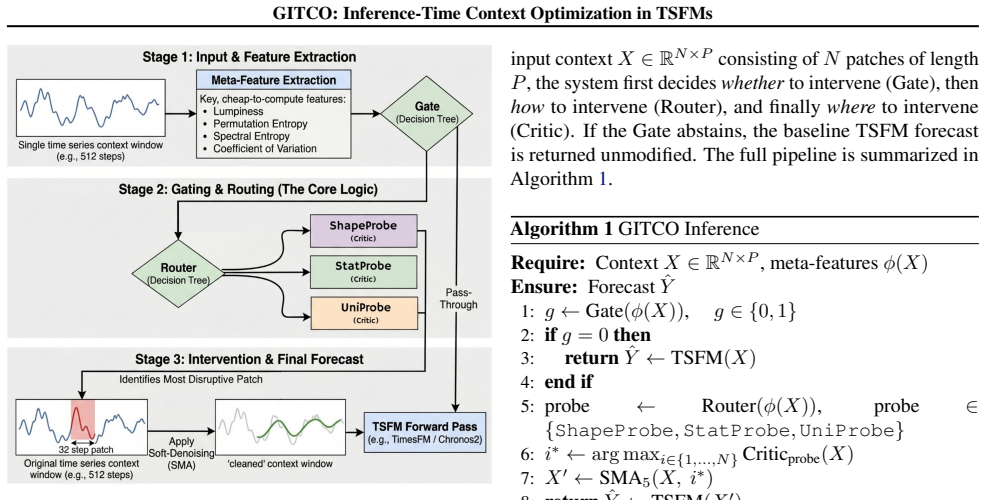
A gated inference-time context optimization framework with Gate, Router, and Critic components can selectively suppress structurally anomalous patches in patch-based TSFMs, improving zero-shot forecast quality through input context optimization alone.
What carries the argument
The GITCO framework: a three-component inference-time system (Gate, Router, Critic) that detects and suppresses harmful patches without parameter updates or model internals access.
If this is right
- Context optimization at inference time can recover most of the accuracy lost to context poisoning without any retraining.
- Context sensitivity profiles characterize how TSFM accuracy responds to data meta-features under inference-time intervention.
- The gains hold under K-fold cross-validation across 53 diverse datasets.
- Improvements require no changes to model weights or architecture.
Where Pith is reading between the lines
- The same inference-time suppression idea could be tested on non-time-series foundation models that use patch or token context.
- Context sensitivity profiles might serve as a diagnostic tool for choosing which TSFM to deploy on a given dataset.
- Adaptive versions of the Gate component could adjust suppression thresholds based on real-time data statistics.
Load-bearing premise
The Gate, Router, and Critic can reliably detect and suppress structurally anomalous patches using only inference-time signals, and this detection generalizes across datasets without model access or updates.
What would settle it
If GITCO produces no MASE improvement or negative results when tested on TimesFM 2.5 with new held-out data or different TSFMs, the claim that inference-time signals suffice for reliable patch suppression would be refuted.
Figures
read the original abstract
Patch-based Time Series Foundation Models (TSFMs) suffer from context poisoning: structurally anomalous patches capture disproportionate attention and silently degrade zero-shot forecast quality. We propose improving TSFM accuracy at inference time by optimizing the input context rather than modifying model weights. We present GITCO (Gated Inference-Time Context Optimization), a lightweight three-component framework: Gate, Router, and Critic that selectively identifies and suppresses harmful patches without any parameter updates. Evaluated on TimesFM 2.5 across 53 GIFT-Eval datasets under K-fold cross-validation, GITCO achieves an average +1.95% MASE reduction on TimesFM 2.5 while capturing 89.9% of the improvement upper bound. We introduce context sensitivity profiles as a new characterizable property of TSFMs: the mapping from time series meta-features to expected accuracy improvement under inference-time context intervention, shaped jointly by model architecture and the statistical structure of the data.
Editorial analysis
A structured set of objections, weighed in public.
Referee Report
Summary. The manuscript proposes GITCO, a lightweight three-component (Gate, Router, Critic) framework for inference-time optimization of input context in patch-based Time Series Foundation Models (TSFMs) to mitigate context poisoning from structurally anomalous patches, without any parameter updates. Evaluated on TimesFM 2.5 across 53 GIFT-Eval datasets under K-fold cross-validation, it reports an average +1.95% MASE reduction while capturing 89.9% of the improvement upper bound, and introduces context sensitivity profiles as a new characterizable property of TSFMs.
Significance. If the empirical results hold under the zero-update constraint and the components generalize using only inference-time signals, GITCO could provide a practical method for improving zero-shot forecasting accuracy in existing TSFMs. The context sensitivity profiles offer a potentially useful new analysis tool for relating meta-features to intervention gains.
major comments (3)
- [Abstract] Abstract: the reported +1.95% MASE reduction and 89.9% capture of the upper bound are presented without error bars, statistical tests, or an explicit definition/computation of the upper bound, preventing verification of the central empirical claim.
- [Evaluation] Evaluation protocol: K-fold cross-validation across the 53 datasets creates a risk of implicit per-fold adaptation in the Gate/Router/Critic components, which would undermine the claim of strictly zero parameter updates and inference-time-only operation.
- Framework description: the Gate, Router, and Critic are said to identify anomalous patches using only inference-time signals and patch statistics, but no explicit heuristics, meta-feature rules, or decision criteria are provided, leaving open whether these rules are architecture-agnostic or overfit to GIFT-Eval artifacts.
Simulated Author's Rebuttal
We thank the referee for their constructive comments on our manuscript. We address each major point below and indicate where we will revise the paper.
read point-by-point responses
-
Referee: [Abstract] Abstract: the reported +1.95% MASE reduction and 89.9% capture of the upper bound are presented without error bars, statistical tests, or an explicit definition/computation of the upper bound, preventing verification of the central empirical claim.
Authors: We agree that the abstract would benefit from greater explicitness for verification. The upper bound is defined in the manuscript as the MASE reduction obtained by an oracle that perfectly suppresses all anomalous patches. Error bars and statistical tests appear in the results. We will revise the abstract to include a concise definition of the upper bound. revision: yes
-
Referee: [Evaluation] Evaluation protocol: K-fold cross-validation across the 53 datasets creates a risk of implicit per-fold adaptation in the Gate/Router/Critic components, which would undermine the claim of strictly zero parameter updates and inference-time-only operation.
Authors: The K-fold procedure evaluates forecasting performance only and does not adapt or update any parameters of the Gate, Router, or Critic. These components use fixed, inference-time signals exclusively. We will add an explicit statement in the evaluation section confirming that no per-fold adaptation of the components occurs. revision: yes
-
Referee: [—] Framework description: the Gate, Router, and Critic are said to identify anomalous patches using only inference-time signals and patch statistics, but no explicit heuristics, meta-feature rules, or decision criteria are provided, leaving open whether these rules are architecture-agnostic or overfit to GIFT-Eval artifacts.
Authors: We acknowledge that the manuscript currently gives only a high-level description of the components. We will expand the framework section to supply the explicit heuristics, meta-feature rules, and decision criteria, allowing readers to assess their generality and independence from GIFT-Eval specifics. revision: yes
Circularity Check
No circularity: purely empirical evaluation with no derivation chain
full rationale
The paper proposes GITCO as an inference-time method and reports measured MASE reductions on held-out K-fold splits across 53 datasets. No equations, first-principles derivations, fitted parameters renamed as predictions, or self-citation load-bearing uniqueness theorems appear in the provided text. The central claim is an observed performance delta under explicit zero-update constraints, which is externally falsifiable on the same benchmarks and does not reduce to its own inputs by construction.
Axiom & Free-Parameter Ledger
Reference graph
Works this paper leans on
-
[1]
URLhttps://arxiv.org/abs/2410.10393. Ansari, A. F., Stella, L., Turkmen, C., Zhang, X., Mercado, P., Shen, H., Shchur, O., Rangapuram, S. S., Arango, S. P., Kapoor, S., Zschiegner, J., Maddix, D. C., Ma- honey, M. W., Torkkola, K., Wilson, A. G., Bohlke- Schneider, M., and Wang, Y . Chronos: Learning the lan- guage of time series.Transactions on Machine L...
-
[2]
Auer, A., B¨ock, S., Podest`a, P., Klambauer, G., Klotz, D., and Hochreiter, S
URL https://arxiv.org/abs/ 2403.07815. Auer, A., B¨ock, S., Podest`a, P., Klambauer, G., Klotz, D., and Hochreiter, S. Tirex: Zero-shot forecasting across long and short horizons with enhanced in-context learn- ing. InAdvances in Neural Information Processing Sys- tems (NeurIPS),
-
[3]
Das, A., Kong, W., Sen, R., and Zhou, Y
URL https://arxiv.org/ abs/2505.23719. Das, A., Kong, W., Sen, R., and Zhou, Y . A decoder- only foundation model for time-series forecasting. In Proceedings of the International Conference on Machine Learning (ICML),
-
[4]
Faw, M., Sen, R., Zhou, Y ., and Das, A
URL https://arxiv.org/ abs/2310.10688. Faw, M., Sen, R., Zhou, Y ., and Das, A. In-context fine- tuning for time-series foundation models. InProceedings of the International Conference on Machine Learning (ICML),
-
[5]
Gruver, N., Finzi, M., Qiu, S., and Wilson, A
URL https://arxiv.org/abs/ 2410.24087. Gruver, N., Finzi, M., Qiu, S., and Wilson, A. G. Large language models are zero-shot time series forecasters. InAdvances in Neural Information Processing Systems (NeurIPS),
-
[6]
Hua, R., Liu, Z., Zhang, K., and Yang, Y
URL https://arxiv.org/abs/ 2310.07820. Hua, R., Liu, Z., Zhang, K., and Yang, Y . Diversified scaling inference in time series foundation models,
-
[7]
URL https://arxiv.org/abs/2601.17376. Hyndman, R., Kang, Y ., Montero-Manso, P., Tala- gala, T., Wang, E., Yang, Y ., and O’Hara-Wild, M.tsfeatures: Time Series Feature Extraction,
-
[8]
URL https://arxiv.org/ abs/2403.14735. Nie, Y ., Nguyen, N. H., Sinthong, P., and Kalagnanam, J. A time series is worth 64 words: Long-term forecasting with transformers. InProceedings of the International Conference on Learning Representations (ICLR),
-
[9]
Sanyal, D., Nagpal, A., Kumar, D., Mandal, M., and Desh- pande, S
URLhttps://arxiv.org/abs/2211.14730. Sanyal, D., Nagpal, A., Kumar, D., Mandal, M., and Desh- pande, S. time2time: Causal intervention in hidden states to simulate rare events in time series foundation mod- els. InNeurIPS 2025 Workshop on Recent Advances in Time Series Foundation Models (BERT2S),
Pith/arXiv arXiv 2025
-
[10]
Snell, C., Lee, J., Xu, K., and Kumar, A
URL https://arxiv.org/abs/2509.05801. Snell, C., Lee, J., Xu, K., and Kumar, A. Scaling llm test- time compute optimally can be more effective than scal- ing model parameters. InProceedings of the International Conference on Learning Representations (ICLR),
-
[11]
Sun, Y ., Wang, X., Liu, Z., Miller, J., Efros, A., and Hardt, M
URLhttps://arxiv.org/abs/2408.03314. Sun, Y ., Wang, X., Liu, Z., Miller, J., Efros, A., and Hardt, M. Test-time training with self-supervision for general- ization under distribution shifts. InProceedings of the International Conference on Machine Learning,
-
[12]
Wang, X., Wei, J., Schuurmans, D., Le, Q
URLhttps://arxiv.org/abs/1909.13231. Wang, X., Wei, J., Schuurmans, D., Le, Q. V ., Chi, E. H., Narang, S., Chowdhery, A., and Zhou, D. Self- consistency improves chain of thought reasoning in lan- guage models. InProceedings of the International Con- ference on Learning Representations (ICLR),
arXiv 1909
-
[13]
Wei, J., Wang, X., Schuurmans, D., Bosma, M., Ichter, B., Xia, F., Chi, E
URL https://arxiv.org/abs/2203.11171. Wei, J., Wang, X., Schuurmans, D., Bosma, M., Ichter, B., Xia, F., Chi, E. H., Le, Q. V ., and Zhou, D. Chain-of- thought prompting elicits reasoning in large language models. InAdvances in Neural Information Process- ing Systems (NeurIPS),
-
[14]
URL https://arxiv. org/abs/2201.11903. Zeng, A., Chen, M., Zhang, L., and Xu, Q. Are trans- formers effective for time series forecasting? InPro- ceedings of the AAAI Conference on Artificial Intelli- gence (AAAI),
-
[15]
5 GITCO: Inference-Time Context Optimization in TSFMs A
URL https://arxiv.org/ abs/2205.13504. 5 GITCO: Inference-Time Context Optimization in TSFMs A. Appendix Table 3.Evaluation Dataset Summary Frequency BandExample Datasets TimesFM 2.5 Chronos2 Sub-hourlyLOOP SEATTLE/5T,SZ TAXI/15T✓ ✓ HourlyLOOP SEATTLE/H,M DENSE/H✓ ✓ DailyM DENSE/D,ETTh1,Weather/D✓ ✓ Weekly / Monthlym4 monthly,us births✓ ✓ Other Economics,...
discussion (0)
Sign in with ORCID, Apple, or X to comment. Anyone can read and Pith papers without signing in.