REVIEW 3 major objections 1 minor 25 references
Horse Eye Blink Detection and Classification for Equine Affective State Assessment
T0 review · 3 major / 1 minor · reviewed 2026-06-28 · grok-4.3
Pith's one-line read Three computer vision methods detect and classify horse eye blinks at macro-F1 scores of 0.898 and 0.926 from video.
desk verdict Solid F1 numbers on public horse video data for blink detection, but the affective state claim rests on an unbacked assertion about what the blinks mean. read the letter →
The pith
A machine-rendered reading of the paper's core claim, the machinery that carries it, and where it could break.
The reading
What carries the argument
Evaluation of YOLOv12, optical flow thresholding, and VideoMAE on subtle half and full eye blinks treated as facial action units for affective state monitoring.
What would settle it
Expert re-annotation of the same videos for affective state under controlled conditions that would show whether the automated scores align with actual welfare outcomes.
Extended reading notes
Core claim
A frame-based YOLOv12 detector, an optical flow magnitude thresholding approach, and a fine-tuned VideoMAE model were applied to horse videos, producing a macro-F1 score of 0.898 for classifying blinks and 0.926 for binary blink detection on a publicly available dataset.
Load-bearing premise
The public dataset reflects real-world horse video variation and the blink categories match established pain and stress indicators without extra validation.
Editorial extensions
If this is right
- Automated detection reduces the need for manual frame-by-frame inspection in equine welfare monitoring.
- Binary detection outperforms multi-class classification, indicating simpler tasks may be more immediately practical.
- The results point to both feasibility and ongoing challenges for fine-grained facial action unit detection in horses.
- Such methods could extend to continuous monitoring in veterinary or farm environments.
Reading between the lines
- Combining blink detection with other facial action units could build a broader automated system for horse state assessment.
- Real-time implementation on farm cameras would allow immediate alerts for potential pain or stress.
- The same video techniques might adapt to detect similar subtle expressions in other large animals.
Signed reviews
Editorial analysis
A structured set of objections, weighed in public.
Referee Report
Summary. The manuscript develops and evaluates three methods for automated detection and classification of half and full eye blinks in horse videos (YOLOv12 frame-based detector, optical flow magnitude thresholding, and fine-tuned VideoMAE) on a publicly available dataset. It reports macro-F1 scores of 0.898 for blink classification and 0.926 for binary detection, positioning the work as a step toward automated equine affective state assessment via facial action units.
Significance. If the evaluation details and category validation were provided, the results could offer a practical contribution to fine-grained AU detection in animal videos. The work highlights challenges in micro-expression detection but its significance for welfare applications is limited by the unvalidated link between the specific blink categories and pain/stress indicators.
major comments (3)
- [Abstract] Abstract: the claim that half and full blinks are 'recognised indicators of pain and stress' is stated without any citations to equine welfare literature or validation studies, which is load-bearing for the paper's application to affective state assessment.
- [Methods] Methods/Results: the abstract reports F1 scores of 0.898 and 0.926 but supplies no dataset size, class distribution, train/test split, cross-validation procedure, or per-class error analysis, preventing assessment of whether the scores are supported by rigorous evaluation.
- [Introduction] Introduction/Results: the central application claim requires that the chosen blink categories align with established pain/stress indicators, yet the manuscript provides no independent validation or references for this alignment on the public dataset.
minor comments (1)
- [Abstract] Abstract: the three methods are listed but it is unclear which achieves the headline scores or how they compare in the reported results.
Simulated Author's Rebuttal
We thank the referee for their constructive comments. We address each major comment point by point below, indicating where revisions will be made.
read point-by-point responses
-
Referee: [Abstract] Abstract: the claim that half and full blinks are 'recognised indicators of pain and stress' is stated without any citations to equine welfare literature or validation studies, which is load-bearing for the paper's application to affective state assessment.
Authors: We agree that citations are required to support this claim. We will add relevant references from equine welfare literature in the revised abstract and introduction to substantiate the statement. revision: yes
-
Referee: [Methods] Methods/Results: the abstract reports F1 scores of 0.898 and 0.926 but supplies no dataset size, class distribution, train/test split, cross-validation procedure, or per-class error analysis, preventing assessment of whether the scores are supported by rigorous evaluation.
Authors: The full manuscript provides these details in the Methods and Results sections. To address the concern, we will revise the abstract to include key information on dataset size, split, and evaluation procedure while maintaining conciseness. revision: yes
-
Referee: [Introduction] Introduction/Results: the central application claim requires that the chosen blink categories align with established pain/stress indicators, yet the manuscript provides no independent validation or references for this alignment on the public dataset.
Authors: We will add references supporting the alignment of half and full blinks with established pain/stress indicators. Independent validation on the public dataset is not included, as the work focuses on detection methods rather than clinical validation. revision: partial
- Independent validation of the blink categories as pain/stress indicators on the public dataset (beyond adding references), as this is outside the scope of the detection-focused study.
Circularity Check
No circularity: empirical results on external dataset
full rationale
The paper reports macro-F1 scores from three methods (YOLOv12, optical flow, VideoMAE) evaluated on a publicly available dataset. No equations, derivations, fitted parameters renamed as predictions, or self-citation chains appear in the provided text. The central claims are direct performance measurements rather than reductions to inputs by construction. The assumption about blink categories aligning with affective states is an external validation gap, not a circularity issue per the defined patterns.
Assumptions & free parameters
assumptions (1)
- domain assumption Standard assumptions in computer vision for object detection and video analysis hold for equine videos.
Cite this review
Pith. "Pith review of Horse Eye Blink Detection and Classification for Equine Affective State Assessment." pith.science (2026). https://pith.science/paper/Z43MDGDE
@misc{pith2026260605458,
  author       = {Pith},
  title        = {Pith review of: Horse Eye Blink Detection and Classification for Equine Affective State Assessment},
  year         = {2026},
  howpublished = {\url{https://pith.science/paper/Z43MDGDE}},
  note         = {Machine review of arXiv:2606.05458}
}
read the original abstract
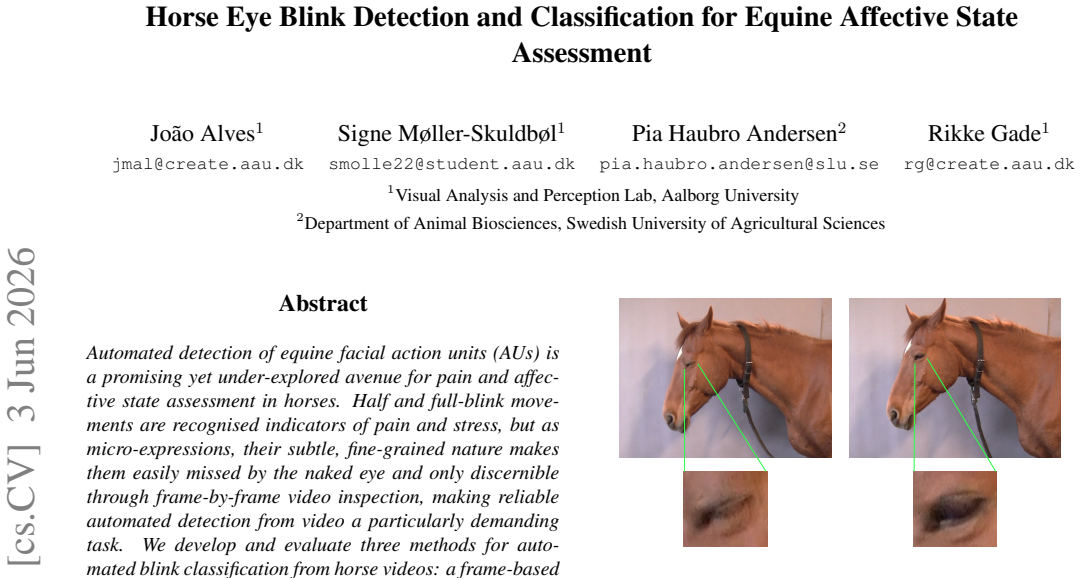
Automated detection of equine facial action units (AUs) is a promising yet under-explored avenue for pain and affective state assessment in horses. Half and full-blink movements are recognised indicators of pain and stress, but as micro-expressions, their subtle, fine-grained nature makes them easily missed by the naked eye and only discernible through frame-by-frame video inspection, making reliable automated detection from video a particularly demanding task. We develop and evaluate three methods for automated blink classification from horse videos: a frame-based YOLOv12 detector, an optical flow magnitude thresholding approach, and a fine-tuned VideoMAE model, tested on a publicly available dataset. We achieve a macro-F1 score of 0.898 when doing blink classification and 0.926 on binary blink detection. Our results highlight both the potential and the inherent challenges of fine-grained AU detection for equine welfare monitoring.
Figures


Figures from the paper (8 more)


Reference graph
Works this paper leans on
-
[1]
Emanuela Dalla Costa, Michela Minero, Dirk Lebelt, Diana Stucke, Elisabetta Canali, and Matthew C. Leach. Develop- ment of the Horse Grimace Scale (HGS) as a Pain Assess- ment Tool in Horses Undergoing Routine Castration.PLoS ONE, 9(3):e92281, March 2014. 1
2014
-
[2]
Burrows, Bridget M
Jen Wathan, Anne M. Burrows, Bridget M. Waller, and Karen McComb. EquiFACS: The Equine Facial Action Cod- ing System.PLOS ONE, 10(8):e0131738, August 2015. 1
2015
-
[3]
Ekman, W
P. Ekman, W. V . Friesen, and J. C. Hager. Facial action cod- ing system (FACS).Research Nexus, 2002. 1
2002
-
[4]
Going Deeper than Tracking: A Sur- vey of Computer-Vision Based Recognition of Animal Pain and Emotions.International Journal of Computer Vision, 131(2):572–590, February 2023
Sofia Broom ´e, Marcelo Feighelstein, Anna Zamansky, Gabriel Carreira Lencioni, Pia Haubro Andersen, Francisca Pessanha, Marwa Mahmoud, Hedvig Kjellstr ¨om, and Al- bert Ali Salah. Going Deeper than Tracking: A Sur- vey of Computer-Vision Based Recognition of Animal Pain and Emotions.International Journal of Computer Vision, 131(2):572–590, February 2023. 1
2023
-
[5]
Towards Machine Recognition of Facial Expressions of Pain in Horses.Ani- mals, 11(6):1643, June 2021
Pia Haubro Andersen, Sofia Broom ´e, Maheen Rashid, Jo- han Lundblad, Katrina Ask, Zhenghong Li, Elin Hernlund, Marie Rhodin, and Hedvig Kjellstr ¨om. Towards Machine Recognition of Facial Expressions of Pain in Horses.Ani- mals, 11(6):1643, June 2021. 1, 2
2021
-
[6]
Equine Facial Action Coding System for determination of pain-related facial responses in videos of horses.PLOS ONE, 15(11):e0231608, November
Maheen Rashid, Alina Silventoinen, Karina Bech Gleerup, and Pia Haubro Andersen. Equine Facial Action Coding System for determination of pain-related facial responses in videos of horses.PLOS ONE, 15(11):e0231608, November
-
[7]
Swedish University of Agricultural Sciences, 2024
Johan Lundblad.Exploring Facial Expressions in Horses : Biological and Methodological Approaches, volume 2024:38 ofActa Universitatis Agriculturae Sueciae. Swedish University of Agricultural Sciences, 2024. 1
2024
-
[8]
An equine pain face.Veterinary Anaes- thesia and Analgesia, 42(1):103–114, January 2015
Karina B Gleerup, Bj ¨orn Forkman, Casper Lindegaard, and Pia H Andersen. An equine pain face.Veterinary Anaes- thesia and Analgesia, 42(1):103–114, January 2015. 1, 2, 4
2015
Show all 25 references
-
[9]
Changes in the equine facial repertoire during different orthopedic pain intensities
Katrina Ask, Marie Rhodin, Maheen Rashid-Engstr ¨om, Elin Hernlund, and Pia Haubro Andersen. Changes in the equine facial repertoire during different orthopedic pain intensities. Scientific Reports, 14(1):129, January 2024. 1
2024
-
[10]
Automated Detection of Equine Facial Action Units, 2021
Zhenghong Li, Sofia Broom ´e, Pia Haubro Andersen, and Hedvig Kjellstr ¨om. Automated Detection of Equine Facial Action Units, 2021. 2
2021
-
[11]
Read my ears! horse ear movement detection for equine affective state assessment
Jo ˜ao Moreira Alves, Pia Haubro Andersen, and Rikke Gade. Read my ears! horse ear movement detection for equine affective state assessment. 2025 IEEE/CVF Conference on Computer Vision and Pattern Recognition Workshops (CVPRW). 2
2025
-
[12]
Auto- matic horse blink detection using computer vision and deep nets
Stefani Dimitrova, Emily Orchard, Bishnu Paudel, Sebastian McBride, Andrew Hemmings, and Otar Akanyeti. Auto- matic horse blink detection using computer vision and deep nets. In George Panoutsos, Mahdi Mahfouf, and Lyud- mila S Mihaylova, editors,Advances in Computational In- ...
2024
-
[13]
Eye-LRCN: A long-term recurrent con- volutional network for eye blink completeness detection
Gonzalo De La Cruz, Madalena Lira, Oscar Luaces, and Beatriz Remeseiro. Eye-LRCN: A long-term recurrent con- volutional network for eye blink completeness detection. IEEE Transactions on Neural Networks and Learning Sys- tems, 35(4):5130–5140, 2024. 2
2024
-
[14]
Blin- kLinMulT: Transformer-based eye blink detection.Journal of Imaging, 9(10):196, 2023
´Ad´am Fodor, Kristian Fenech, and Andr ´as L ˝orincz. Blin- kLinMulT: Transformer-based eye blink detection.Journal of Imaging, 9(10):196, 2023. 2
2023
-
[15]
Robust eye blink detection using dual embedding video vi- sion transformer
Jeongmin Hong, Joseph Shin, Juhee Choi, and Minsam Ko. Robust eye blink detection using dual embedding video vi- sion transformer. In2024 IEEE/CVF Winter Conference on Applications of Computer Vision (WACV), pages 6362–6372. IEEE, 2024. 2
2024
-
[16]
Eyes closeness detection from still images with multi-scale histograms of principal oriented gradients.Pattern Recogni- tion, 47(9):2825–2838, 2014
Fengyi Song, Xiaoyang Tan, Xue Liu, and Songcan Chen. Eyes closeness detection from still images with multi-scale histograms of principal oriented gradients.Pattern Recogni- tion, 47(9):2825–2838, 2014. 2
2014
-
[17]
Eyeblink-based anti-spoofing in face recognition from a generic webcamera
Gang Pan, Lin Sun, Zhaohui Wu, and Shihong Lao. Eyeblink-based anti-spoofing in face recognition from a generic webcamera. In2007 IEEE 11th International Con- ference on Computer Vision, pages 1–8. IEEE, 2007. 2
2007
-
[18]
Pupil localization using geodesic dis- tance
Radovan Fusek. Pupil localization using geodesic dis- tance. In George Bebis, Richard Boyle, Bahram Parvin, Darko Koracin, Matt Turek, Srikumar Ramalingam, Kai Xu, Stephen Lin, Bilal Alsallakh, Jing Yang, Eduardo Cuervo, and Jonathan Ventura, editors,Advances in Visual Comput-...
2018
-
[19]
RT- BENE: A dataset and baselines for real-time blink estimation in natural environments
Kevin Cortacero, Tobias Fischer, and Yiannis Demiris. RT- BENE: A dataset and baselines for real-time blink estimation in natural environments. In2019 IEEE/CVF International Conference on Computer Vision Workshop (ICCVW), pages 1159–1168. IEEE, 2019. 2
2019
-
[20]
Eye blink complete- ness detection.Computer Vision and Image Understanding, 176-177:78–85, 2018
Andrej Fogelton and Wanda Benesova. Eye blink complete- ness detection.Computer Vision and Image Understanding, 176-177:78–85, 2018. 2
2018
-
[21]
Two-Frame Motion Estimation Based on Polynomial Expansion
Gunnar Farneb ¨ack. Two-Frame Motion Estimation Based on Polynomial Expansion. In Gerhard Goos, Juris Hartmanis, Jan Van Leeuwen, Josef Bigun, and Tomas Gustavsson, edi- tors,Image Analysis, volume 2749, pages 363–370. Springer Berlin Heidelberg, Berlin, Heidelberg, 2003. 2
2003
-
[22]
Horse Eye Blink Detection and Classification for Equine Affective State Assessment
Zhan Tong, Yibing Song, Jue Wang, and Limin Wang. VideoMAE: Masked Autoencoders are Data-Efficient Learn- ers for Self-Supervised Video Pre-Training.NeurIPS, 2022. 3 Horse Eye Blink Detection and Classification for Equine Affective State Assessment Supplementary Material This ...
2022
-
[23]
Dataset subjects sample data To provide further insight into the dataset used, we provide sample frames of each of the 12 test videos from [6] in this supplementary material (see Figure 8)
-
[24]
Human baseline study Additional results of the human baseline study are presented in Table 3
-
[25]
Figure 8
Supplementary qualitative results In this section we show the qualitative results obtained from using each method on the original full length dataset videos (see Figures 10, 11 and 12). Figure 8. Sample frames for each of the 12 videos [8] in the test dataset in row-major orde...
Reviewed June 28, 2026 · model on record in the stance chip above.
Discussion (0). Continue with ORCID to comment.