Non-equilibrium quantum thermodynamics of a memory-bearing open-system process
Pith reviewed 2026-06-28 01:06 UTC · model grok-4.3
The pith
A finite composite environment produces memory effects that change work, heat, and entropy production in a driven two-level quantum system.
A machine-rendered reading of the paper's core claim, the machinery that carries it, and where it could break.
Core claim
Memory effects emerge in the dynamics of a driven two-level system interacting with a composite environment. These effects influence work, heat and entropy production. The interplay between driving, dissipation and memory effects from the finiteness of the environment shapes the thermodynamic response of the system.
What carries the argument
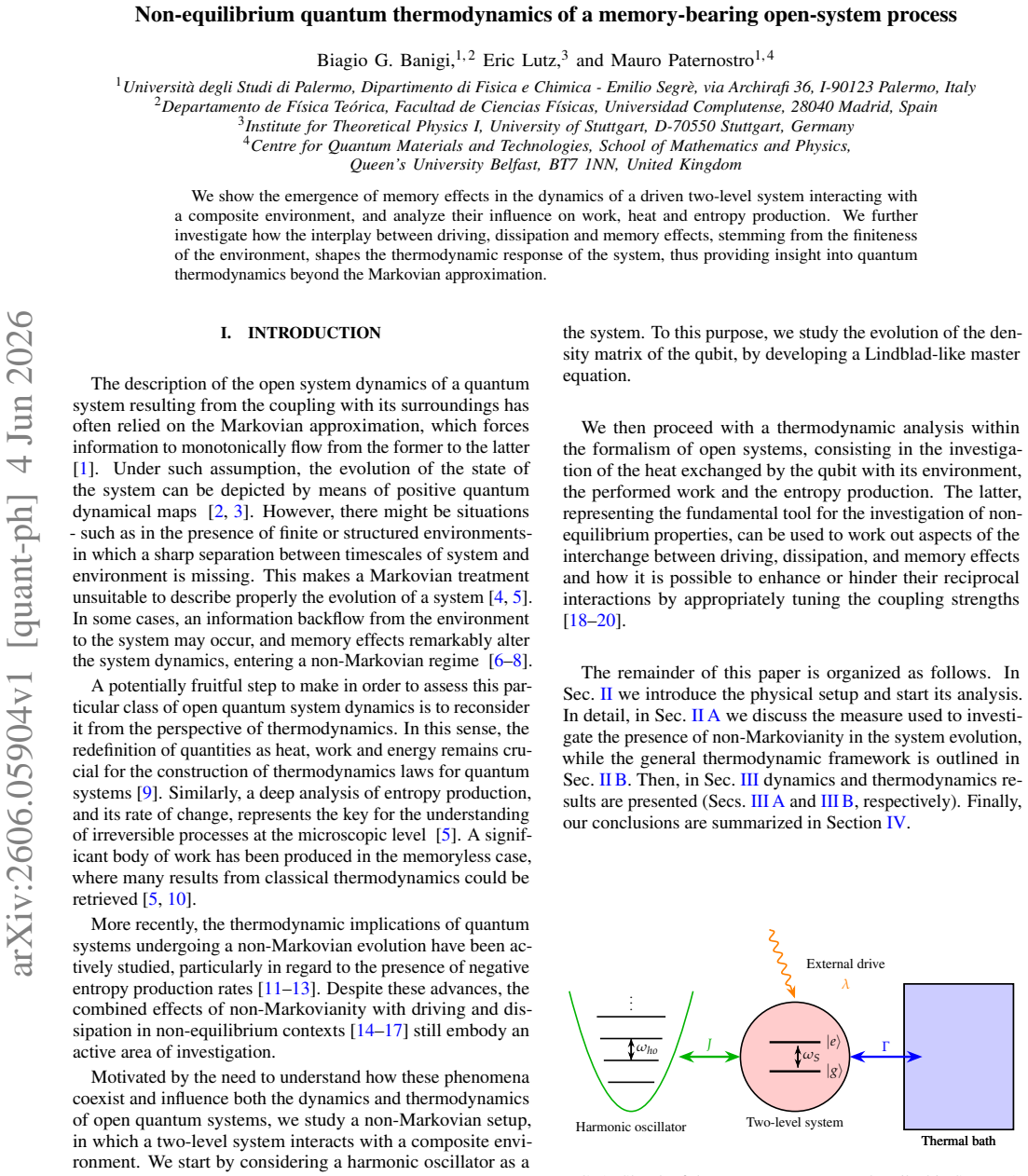
The driven two-level system coupled to a finite composite environment, which generates memory effects in the open-system dynamics that affect thermodynamic quantities.
If this is right
- Thermodynamic quantities like work and heat are modified by memory effects.
- Entropy production analysis requires accounting for non-Markovian dynamics.
- The system response depends on the interplay of driving and dissipation with memory.
Where Pith is reading between the lines
- Similar memory effects could appear in other open quantum systems with finite baths.
- This could lead to new ways to control thermodynamic processes by engineering environment size.
- Testable predictions for entropy production in finite versus infinite bath limits.
Load-bearing premise
The finiteness of the composite environment is what produces the memory effects that shape the thermodynamic response.
What would settle it
A numerical simulation or experiment showing no difference in work, heat, and entropy production between finite and infinite environment cases would falsify the claim.
Figures
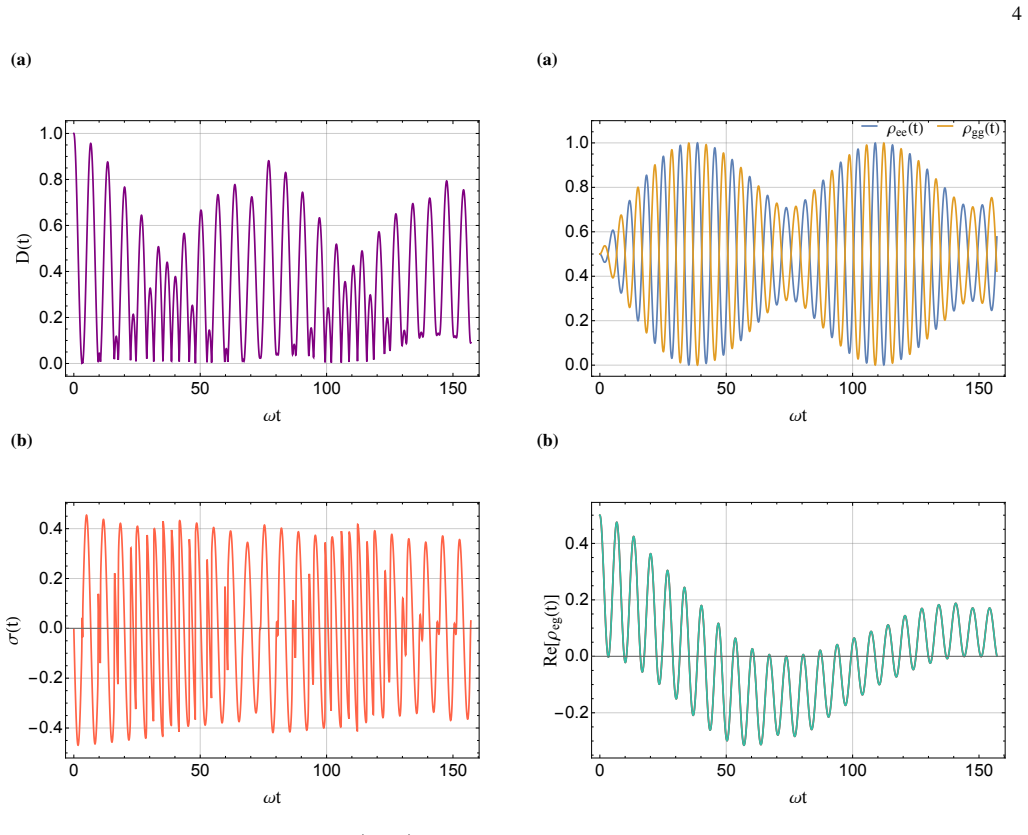
read the original abstract
We show the emergence of memory effects in the dynamics of a driven two-level system interacting with a composite environment, and analyze their influence on work, heat and entropy production. We further investigate how the interplay between driving, dissipation and memory effects, stemming from the finiteness of the environment, shapes the thermodynamic response of the system, thus providing insight into quantum thermodynamics beyond the Markovian approximation.
Editorial analysis
A structured set of objections, weighed in public.
Referee Report
Summary. The paper examines the dynamics of a driven two-level system coupled to a finite composite environment. It reports the emergence of memory effects arising from the environment's finiteness and analyzes their effects on work, heat, and entropy production, exploring the interplay of driving, dissipation, and non-Markovianity in shaping the system's thermodynamic response beyond the Markovian limit.
Significance. If the central results hold after addressing controls, the work would contribute to quantum thermodynamics by linking finite-environment memory effects to thermodynamic quantities in a driven open system. This could offer concrete insight into non-Markovian regimes, provided the attribution to finiteness is rigorously isolated.
major comments (1)
- [Model description and results sections] The central claim ties memory effects and their thermodynamic consequences explicitly to the finiteness of the composite environment (abstract; model description). However, no control comparison to the infinite-bath limit is presented (e.g., by increasing the number of discrete modes while holding the spectral density fixed). Without this or an equivalent analytic argument, alternative sources of non-Markovianity (structured spectral density, initial correlations, or the particular composite construction) cannot be ruled out, undermining the attribution that is load-bearing for the thermodynamic analysis.
Simulated Author's Rebuttal
We thank the referee for their thorough review and constructive criticism. We address the major comment below and outline the revisions we plan to make to strengthen the manuscript.
read point-by-point responses
-
Referee: The central claim ties memory effects and their thermodynamic consequences explicitly to the finiteness of the composite environment (abstract; model description). However, no control comparison to the infinite-bath limit is presented (e.g., by increasing the number of discrete modes while holding the spectral density fixed). Without this or an equivalent analytic argument, alternative sources of non-Markovianity (structured spectral density, initial correlations, or the particular composite construction) cannot be ruled out, undermining the attribution that is load-bearing for the thermodynamic analysis.
Authors: We agree that a direct control comparison to the infinite-bath limit would strengthen the attribution of memory effects specifically to the finiteness of the environment. In the revised manuscript, we will include additional numerical simulations in which the number of discrete modes is systematically increased while the spectral density is held fixed, demonstrating convergence toward the Markovian limit. This will help isolate the contribution of finiteness and address potential alternative sources of non-Markovianity. revision: yes
Circularity Check
No significant circularity; derivation self-contained against external benchmarks
full rationale
The provided abstract and model description frame memory effects as arising from the explicit assumption of a finite composite environment, with thermodynamic quantities (work, heat, entropy production) analyzed as consequences. No equations, self-citations, or fitted parameters are quoted that reduce any prediction to its own inputs by construction. The central claim is an assumption about environment size rather than a self-definitional loop or renamed known result. Absent any load-bearing step that collapses to a fit or prior self-citation chain, the paper's derivation chain is independent and externally falsifiable via comparison to infinite-bath limits.
Axiom & Free-Parameter Ledger
axioms (1)
- domain assumption Memory effects stem from the finiteness of the environment
Reference graph
Works this paper leans on
-
[1]
(11) and Eq
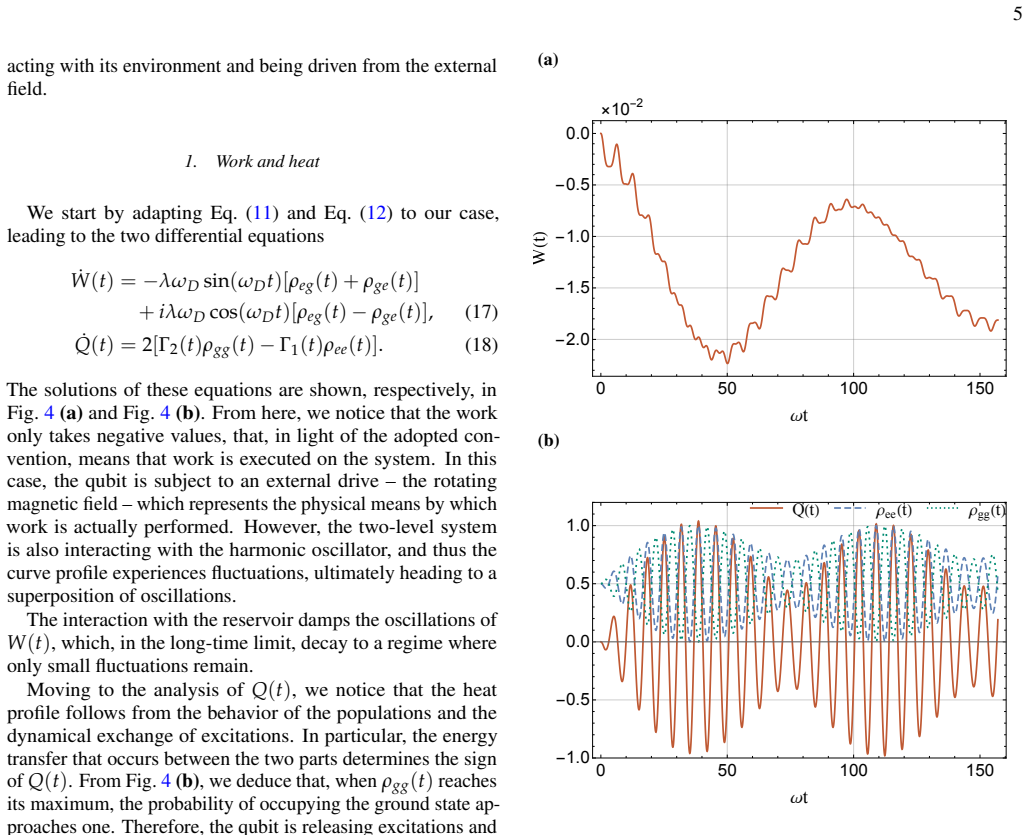
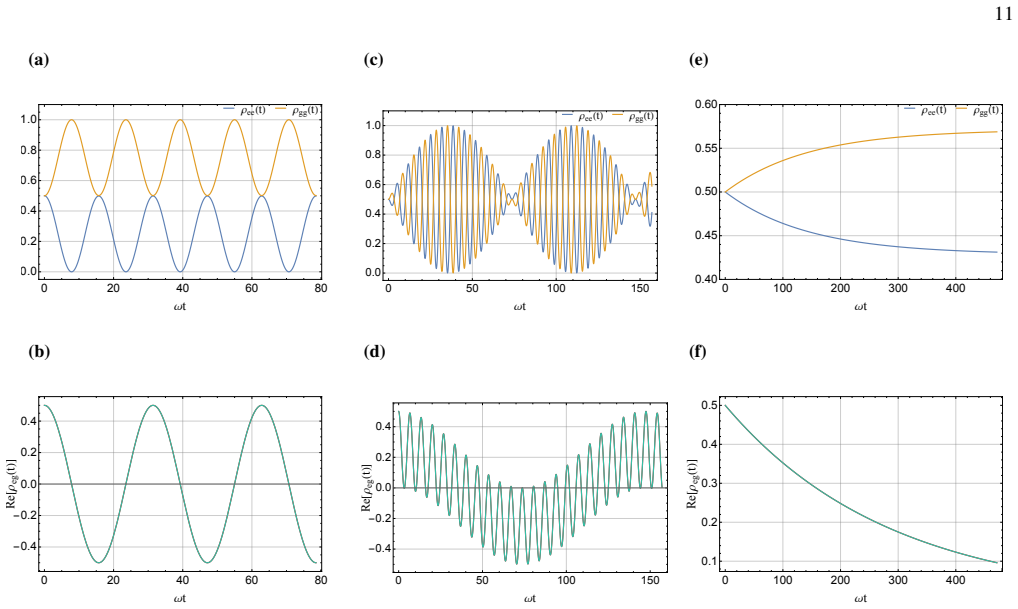
Work and heat We start by adapting Eq. (11) and Eq. (12) to our case, leading to the two differential equations ˙W(t) =−λω D sin(ωDt)[ρ eg (t) +ρ ge(t)] +iλω D cos(ωDt)[ρ eg (t)−ρ ge(t)],(17) ˙Q(t) =2[Γ 2(t)ρ gg (t)−Γ 1(t)ρ ee(t)].(18) The solutions of these equations are shown, respectively, in Fig. 4(a)and Fig. 4(b). From here, we notice that the work o...
-
[2]
symmetry
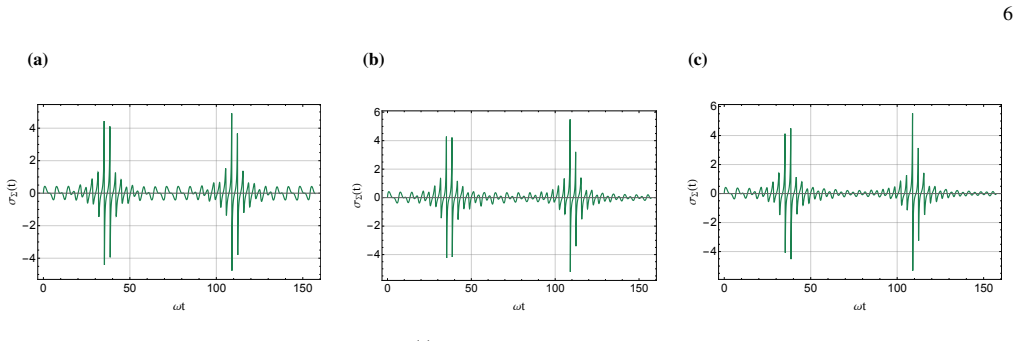
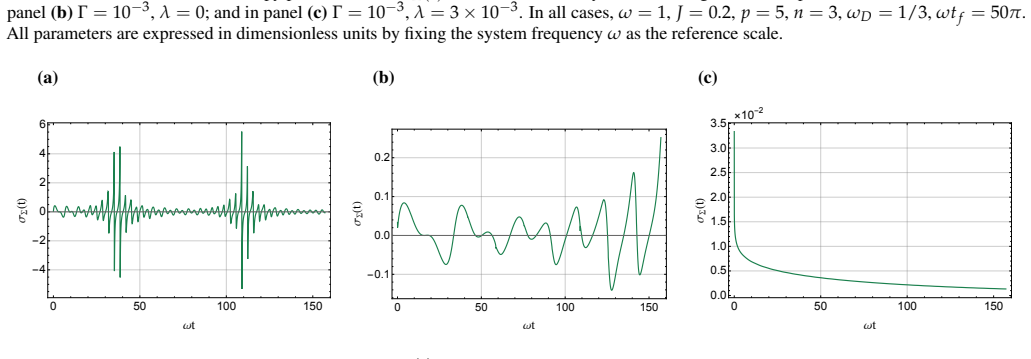
Entropy production and entropy production rate We proceed similarly with the analysis of the entropy pro- duction Σ(t), which takes into account the amount of entropy generated by the qubit during the interaction with the environ- ment, and its rate of change, σΣ(t). The entropy production Σ(t)can be cast as Σ(t) =S(t)−β(t)Q(t),(19) where ∆S(t) =S(t)−S(0)...
-
[3]
Breuer, E.-M
H.-P. Breuer, E.-M. Laine, J. Piilo, and B. Vacchini, Colloquium: Non-Markovian dynamics in open quantum systems, Rev. Mod. Phys.88, 021002 (2016)
2016
-
[4]
Lindblad, On the generators of quantum dynamical semi- groups, Commun
G. Lindblad, On the generators of quantum dynamical semi- groups, Commun. Math. Phys.48, 119 (1976)
1976
-
[5]
Gorini, A
V . Gorini, A. Kossakowski, and E. C. G. Sudarshan, Completely positive dynamical semigroups of N-level systems, J. Math. Phys. 8 17, 821 (1976)
1976
-
[6]
H. P. Breuer and F. Petruccione,The Theory of Open Quantum Systems(Oxford University Press, Oxford, UK, 2002)
2002
-
[7]
Zicari, M
G. Zicari, M. Brunelli, and M. Paternostro, Assessing the role of initial correlations in the entropy production rate for nonequilib- rium harmonic dynamics, Phys. Rev. Res.2, 043006 (2020)
2020
-
[8]
Breuer, E.-M
H.-P. Breuer, E.-M. Laine, and J. Piilo, Measure for the degree of non-Markovian behavior of quantum processes in open systems, Phys. Rev. Lett.103, 210401 (2009)
2009
-
[9]
Rivas, S
Á. Rivas, S. F. Huelga, and M. B. Plenio, Quantum non- Markovianity: characterization, quantification and detection, Reports on Progress in Physics77, 094001 (2014)
2014
-
[10]
de Vega and D
I. de Vega and D. Alonso, Dynamics of non-Markovian open quantum systems, Rev. Mod. Phys.89, 015001 (2017)
2017
-
[11]
Binder, L
F. Binder, L. A. Correa, C. Gogolin, J. Anders, and G. Adesso, Thermodynamics in the Quantum Regime: Fundamental Aspects and New Directions, Fundamental Theories of Physics, V ol. 195 (Springer, 2018)
2018
-
[12]
Spohn, Entropy production for quantum dynamical semi- groups, J
H. Spohn, Entropy production for quantum dynamical semi- groups, J. Math. Phys.19, 1227 (1978)
1978
-
[13]
Marcantoni, S
S. Marcantoni, S. Alipour, F. Benatti, R. Floreanini, and A. T. Rezakhani, Entropy production and non-Markovian dynamical maps, Sci. Rep.7, 12447 (2017)
2017
-
[14]
Popovic, B
M. Popovic, B. Vacchini, and S. Campbell, Entropy production and correlations in a controlled non-Markovian setting, Phys. Rev. A98, 012130 (2018)
2018
-
[15]
Strasberg and M
P. Strasberg and M. Esposito, Non-Markovianity and negative entropy production rates, Phys. Rev. E99, 012120 (2019)
2019
-
[16]
Dann, Interplay between external driving, dissipation and collective effects in the Markovian and non-Markovian regimes, Quantum9, 1740 (2025)
R. Dann, Interplay between external driving, dissipation and collective effects in the Markovian and non-Markovian regimes, Quantum9, 1740 (2025)
2025
- [17]
-
[18]
I. A. Picatoste, A. Colla, and H.-P. Breuer, Dynamically emer- gent quantum thermodynamics: Non-Markovian Otto cycle, Phys. Rev. Res.6, 013258 (2024)
2024
-
[19]
Abah and M
O. Abah and M. Paternostro, Implications of non-Markovian dynamics on information-driven engine, Journal of Physics Com- munications4, 085016 (2020)
2020
-
[20]
Deffner and E
S. Deffner and E. Lutz, Nonequilibrium entropy production for open quantum systems, Phys. Rev. Lett.107, 140404 (2011)
2011
-
[21]
Spohn and J
H. Spohn and J. L. Lebowitz,Irreversible Thermodynamics for Quantum Systems Weakly Coupled to Thermal Reservoirs, Advances in Chemical Physics (John Wiley & Sons, Ltd, 1978)
1978
-
[22]
Lindblad,Non-Equilibrium Entropy and Irreversibility, Math- ematical Physics Studies, V ol
G. Lindblad,Non-Equilibrium Entropy and Irreversibility, Math- ematical Physics Studies, V ol. 5 (Springer Dordrecht, 1983)
1983
-
[23]
Raimond and S
J.-M. Raimond and S. Haroche,Exploring the Quantum(Oxford University Press, Oxford, UK, 2006)
2006
-
[24]
Denzler, J
T. Denzler, J. F. G. Santos, E. Lutz, and R. M. Serra, Nonequi- librium fluctuations of a quantum heat engine, Quantum Science and Technology9, 045017 (2024)
2024
-
[25]
J. P. S. Peterson, T. B. Batalhão, M. Herrera, A. M. Souza, R. S. Sarthour, I. S. Oliveira, and R. M. Serra, Experimental characterization of a spin quantum heat engine, Phys. Rev. Lett. 123, 240601 (2019)
2019
-
[26]
Andersson, J
E. Andersson, J. D. Cresser, and M. J. W. Hall, Finding the Kraus decomposition from a master equation and vice versa, Journal of Modern Optics54, 1695 (2007)
2007
-
[27]
M. B. Ruskai, Beyond Strong Subadditivity? Improved Bounds on the Contraction of Generalized Relative Entropy, Reviews in Mathematical Physics6, 1147 (1994)
1994
-
[28]
Alicki, The quantum open system as a model of the heat engine, Journal of Physics A: Mathematical and General12, L103 (1979)
R. Alicki, The quantum open system as a model of the heat engine, Journal of Physics A: Mathematical and General12, L103 (1979)
1979
-
[29]
Gemmer, M
J. Gemmer, M. Michel, and G. Mahler,Quantum Thermodynam- ics: Emergence of Thermodynamic Behavior Within Composite Quantum Systems(Springer Berlin Heidelberg, Berlin, Heidel- berg, 2009)
2009
-
[30]
Rivas, Quantum thermodynamics in the refined weak cou- pling limit, Entropy21, 725 (2019)
Á. Rivas, Quantum thermodynamics in the refined weak cou- pling limit, Entropy21, 725 (2019)
2019
-
[31]
Esposito, K
M. Esposito, K. Lindenberg, and C. Van den Broeck, Entropy production as correlation between system and reservoir, New Journal of Physics12, 013013 (2010)
2010
-
[32]
Deffner and S
S. Deffner and S. Campbell,Quantum Thermodynamics(Morgan & Claypool Publishers, San Rafael, CA, USA, 2019)
2019
-
[33]
M. J. W. Hall, J. D. Cresser, L. Li, and E. Andersson, Canon- ical form of master equations and characterization of non- Markovianity, Phys. Rev. A89, 042120 (2014). Appendix A: Quantum dynamical map and master equation Here we show a detailed derivation of the master equation for the qubit interacting only with the harmonic oscillator. To this end, we ma...
2014
-
[34]
The Hamiltonian H(t) in Eq
The jump operators Li are found through the relation Li = ∑ j Pji Bj,(A13) with Pji being the elements of a passage matrix made up of the normalized eigenvectors of subA′(t). The Hamiltonian H(t) in Eq. (A12) is a Lamb-shift-like term given by H(t) = κ†(t)−κ(t) 2i withκ(t) = 1√ 2 ∑ i A′ i0(t)B i. (A14) An explicit calculation leads us to γ1(t) =− µ(t) +ν(...
discussion (0)
Sign in with ORCID, Apple, or X to comment. Anyone can read and Pith papers without signing in.