LLM-Conditioned Synthesis of Pathological Gaits via Structured Gait-Language Representations
Pith reviewed 2026-06-28 02:10 UTC · model grok-4.3
The pith
An LLM-guided framework synthesizes pathological gait sequences from text descriptions that improve recurrent classifier accuracy when added to real data.
A machine-rendered reading of the paper's core claim, the machinery that carries it, and where it could break.
Core claim
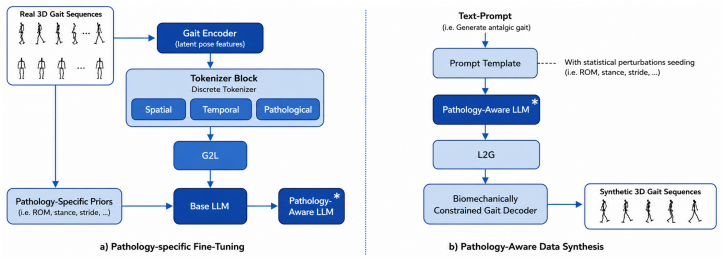
The authors claim that their LLM-conditioned framework produces fixed-length synthetic skeleton-based gait sequences from structured textual descriptions by integrating motion tokenisation, pathology-aware language conditioning, LLM-based semantic augmentation, and language-to-gait generation, with the pathological tokeniser preserving pathology-specific motion characteristics; when these synthetic sequences are combined with real data, recurrent classifiers achieve improved performance, reaching a peak of 92.77 percent accuracy with a GRU under leave-one-subject-out protocol.
What carries the argument
The pathological tokeniser, which performs discrete representation learning on gait motions while preserving pathology-specific characteristics to support effective language conditioning and generation.
If this is right
- Synthetic sequences generated from textual pathology descriptions can augment scarce real datasets for gait classification.
- Recurrent classifiers such as GRU show measurable accuracy gains when trained on the combined real and synthetic sets.
- The leave-one-subject-out protocol indicates that the synthetic data supports generalization across subjects.
- Pathology-aware conditioning maintains motion traits that remain useful for downstream classification tasks.
Where Pith is reading between the lines
- The textual conditioning mechanism could support generation of gait patterns for pathologies with very few real examples by varying the input descriptions.
- The same tokeniser and conditioning pipeline might extend to synthesizing gait variations for rehabilitation monitoring or sports analysis.
- If the discrete tokens prove reusable, the framework could reduce the need for new motion capture sessions when exploring new pathology combinations.
- Integration with real-time sensor streams could test whether the synthetic data remains effective when classifiers encounter live rather than recorded sequences.
Load-bearing premise
The pathological tokeniser preserves pathology-specific motion characteristics during discrete representation learning without introducing artifacts that would degrade downstream classification performance.
What would settle it
A direct test would compare a GRU classifier trained only on real data against the same architecture trained on real plus synthetic data under the same leave-one-subject-out protocol; if accuracy does not increase or decreases, the utility of the synthesis method is falsified.
Figures
read the original abstract
Pathological gait datasets remain scarce due to privacy, recruitment, cost, and movement variability. Our work presents a multimodal LLM-guided framework for pathology-aware 3D gait data synthesis from structured textual descriptions. The proposed method generates fixed-length synthetic skeleton-based gait sequences for pathological gait classification tasks. The framework combines motion tokenisation, pathology-aware language conditioning, LLM-based semantic augmentation, and language-to-gait generation. A key contribution is the proposed pathological tokeniser, which is designed to preserve pathology-specific motion characteristics during discrete representation learning. Experiments suggest that the proposed synthetic sequences improve downstream classification for recurrent classifiers when combined with real data. The best result is obtained using a GRU classifier trained with real and synthetic samples, achieving 92.77\% accuracy under a leave-one-subject-out protocol.
Editorial analysis
A structured set of objections, weighed in public.
Referee Report
Summary. The manuscript introduces a multimodal LLM-guided framework for synthesizing fixed-length 3D skeleton-based pathological gait sequences from structured textual descriptions. The approach integrates motion tokenisation, pathology-aware language conditioning, LLM-based semantic augmentation, and language-to-gait generation, with the pathological tokeniser presented as the key contribution for preserving pathology-specific motion characteristics. Experiments claim that combining the generated synthetic sequences with real data improves downstream classification performance for recurrent models, with the strongest reported result being 92.77% accuracy for a GRU classifier under a leave-one-subject-out protocol.
Significance. If the empirical claims hold after proper validation, the framework could help alleviate data scarcity in pathological gait analysis by enabling controlled generation of pathology-aware synthetic sequences, potentially improving the training of classifiers for clinical gait assessment tasks.
major comments (1)
- [Abstract] Abstract: The central empirical claim reports 92.77% accuracy for the GRU classifier trained on real plus synthetic samples under LOSO, yet supplies no baselines, ablation studies, error bars, dataset sizes, or statistical tests. This prevents any assessment of whether the synthetic data or the pathological tokeniser contributes to the result.
Simulated Author's Rebuttal
We thank the referee for highlighting the need for greater detail in the abstract to properly contextualize our empirical claims. We agree that the current abstract is too concise and will revise it in the next version to include key experimental context such as dataset sizes, baselines, and references to ablations and statistical tests reported in the main body. This will better allow readers to assess the contribution of the synthetic data and pathological tokeniser.
read point-by-point responses
-
Referee: [Abstract] Abstract: The central empirical claim reports 92.77% accuracy for the GRU classifier trained on real plus synthetic samples under LOSO, yet supplies no baselines, ablation studies, error bars, dataset sizes, or statistical tests. This prevents any assessment of whether the synthetic data or the pathological tokeniser contributes to the result.
Authors: The abstract was written to be concise within typical length limits, but the full manuscript (Sections 4 and 5) provides the requested details: (i) dataset sizes including number of subjects, sequences per pathology, and train/test splits under LOSO; (ii) baselines comparing the GRU on real-only data versus real+synthetic; (iii) ablation studies isolating the effect of the pathology-aware tokeniser versus standard tokenisation; (iv) error bars from repeated runs with different random seeds; and (v) statistical significance tests (paired t-tests) confirming improvements. We will revise the abstract to briefly reference these elements and the main experimental findings so that the 92.77% result can be properly evaluated without requiring the reader to consult the full text. revision: yes
Circularity Check
No significant circularity
full rationale
The manuscript describes an empirical ML pipeline for gait synthesis and downstream classification. No equations, derivations, or parameter-fitting steps are referenced in the abstract or reader summary. The 92.77% accuracy is reported as an experimental outcome under LOSO, not a quantity obtained by construction from fitted inputs or self-referential definitions. The pathological tokeniser is presented as a design choice whose validity is tested via classification performance rather than assumed by definition. No self-citation chains, uniqueness theorems, or ansatzes appear as load-bearing elements. The derivation chain is therefore self-contained and non-circular.
Axiom & Free-Parameter Ledger
Reference graph
Works this paper leans on
-
[1]
J. Ribeiro-Gomes, T. Cai, Z. A. Milacski, C. Wu, A. Prakash, S. Takagi, A. Aubel, D. Kim, A. Bernardino, and F. De La Torre, ``MotionGPT: Human motion synthesis with improved diversity and realism via GPT-3 prompting,'' in Proc. IEEE/CVF Winter Conf. Appl. Comput. Vis. (WACV), 2024, pp. 5058--5068, doi: 10.1109/WACV57701.2024.00499
-
[2]
W. Yang, S. Wang, J. Hou, H. Liu, C. Cao, and K. Huang, ``Bridging gait recognition and large language models sequence modeling,'' in Proc. IEEE/CVF Conf. Comput. Vis. Pattern Recognit. (CVPR), 2025. [Online]. Available: https://openaccess.thecvf.com/content/CVPR2025/html/Yang_Bridging_Gait_Recognition_and_Large_Language_Models_Sequence_Modeling_CVPR_2025...
2025
-
[3]
K. Jun, Y. Lee, S. Lee, D.-W. Lee, and M. S. Kim, ``Pathological gait classification using Kinect v2 and gated recurrent neural networks,'' IEEE Access, vol. 8, pp. 139881--139891, 2020
2020
-
[4]
C.-B. Lin, Z. Dong, W.-K. Kuan, and Y.-F. Huang, ``A framework for fall detection based on OpenPose skeleton and LSTM/GRU models,'' Applied Sciences, vol. 11, no. 1, p. 329, 2020
2020
-
[5]
Nguyen, V
K. Nguyen, V. V. Nguyen, N. T. Mai, A. H. Nguyen, and A. V. Nguyen, ``Human gait analysis using hybrid convolutional neural networks,'' Journal of Computer Science and Cybernetics, vol. 39, no. 2, pp. 125--142, 2023
2023
-
[6]
J. Bai, S. Bai, Y. Chu, Z. Cui, K. Dang, X. Deng, Y. Fan, W. Ge, Y. Han, F. Huang, et al., ``Qwen technical report,'' arXiv preprint arXiv:2309.16609, 2023
Pith/arXiv arXiv 2023
-
[7]
J. Ban, J. Jeon, and S.. Jeong, ``From diffusion to flow: Efficient motion generation in MotionGPT3,'' arXiv preprint arXiv:2603.26747, 2026
Pith/arXiv arXiv 2026
-
[8]
W. Yu, R. Liu, D. Zhou, Q. Zhang, and X. Wei, ``An improved GRU network for human motion prediction,'' in Proc. 2021 IEEE 7th Int. Conf. Virtual Reality (ICVR), 2021, pp. 427--433
2021
-
[9]
G. Tevet, S. Raab, B. Gordon, Y. Shafir, D. Cohen-Or, and A. H. Bermano, ``Human Motion Diffusion Model,'' arXiv preprint arXiv:2209.14916, 2022
Pith/arXiv arXiv 2022
-
[10]
Jiang, X
B. Jiang, X. Chen, W. Liu, J. Yu, G. Yu, and T. Chen, ``MotionGPT: Human Motion as a Foreign Language,'' in Advances in Neural Information Processing Systems, 2023
2023
-
[11]
Cormier, H
M. Cormier, H. F. G. Nunes, and J. Beyerer, ``Enhancing Skeleton-Based Action Recognition in Real-World Scenarios Through Realistic Data Augmentations,'' in Proc. IEEE/CVF Winter Conference on Applications of Computer Vision Workshops (WACVW), 2024
2024
-
[12]
Eason, B
G. Eason, B. Noble, and I. N. Sneddon, ``On certain integrals of Lipschitz-Hankel type involving products of Bessel functions,'' Phil. Trans. Roy. Soc. London, vol. A247, pp. 529--551, April 1955
1955
-
[13]
Clerk Maxwell, A Treatise on Electricity and Magnetism, 3rd ed., vol
J. Clerk Maxwell, A Treatise on Electricity and Magnetism, 3rd ed., vol. 2. Oxford: Clarendon, 1892, pp.68--73
-
[14]
I. S. Jacobs and C. P. Bean, ``Fine particles, thin films and exchange anisotropy,'' in Magnetism, vol. III, G. T. Rado and H. Suhl, Eds. New York: Academic, 1963, pp. 271--350
1963
-
[15]
Elissa, ``Title of paper if known,'' unpublished
K. Elissa, ``Title of paper if known,'' unpublished
-
[16]
Nicole, ``Title of paper with only first word capitalized,'' J
R. Nicole, ``Title of paper with only first word capitalized,'' J. Name Stand. Abbrev., in press
-
[17]
Yorozu, M
Y. Yorozu, M. Hirano, K. Oka, and Y. Tagawa, ``Electron spectroscopy studies on magneto-optical media and plastic substrate interface,'' IEEE Transl. J. Magn. Japan, vol. 2, pp. 740--741, August 1987 [Digests 9th Annual Conf. Magnetics Japan, p. 301, 1982]
1987
-
[18]
Young, The Technical Writer's Handbook
M. Young, The Technical Writer's Handbook. Mill Valley, CA: University Science, 1989
1989
discussion (0)
Sign in with ORCID, Apple, or X to comment. Anyone can read and Pith papers without signing in.