FontFusion: Enhancing Generative Text in Diffusion Models with Typographic Conditioning
Pith reviewed 2026-06-28 02:04 UTC · model grok-4.3
The pith
FontFusion resolves the font control versus legibility trade-off in diffusion models using dual encoders and three conditioning techniques.
A machine-rendered reading of the paper's core claim, the machinery that carries it, and where it could break.
Core claim
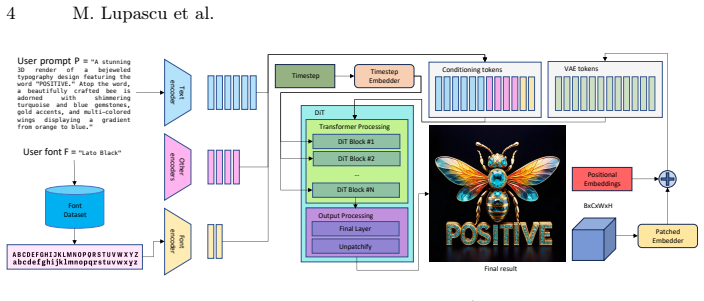
FontFusion is a plug-and-play conditioning framework for DiT architectures that resolves the trade-off between precise font control and text legibility through a hierarchical token representation establishing explicit text-font relationships at multiple granularities, position-aware embeddings creating spatial bindings between typography and image content, and a multi-level token dropping strategy improving efficiency and generalization to unseen fonts, with systematic evaluation showing that a dual encoder combining DeepFont and DINOv2 outperforms single encoders.
What carries the argument
Hierarchical token representation that establishes explicit text-font relationships at multiple granularities, augmented by position-aware embeddings and multi-level token dropping.
If this is right
- FontFusion integrates directly into existing DiT architectures without retraining the base model.
- A dual encoder combining DeepFont and DINOv2 outperforms any single encoder for typography tasks.
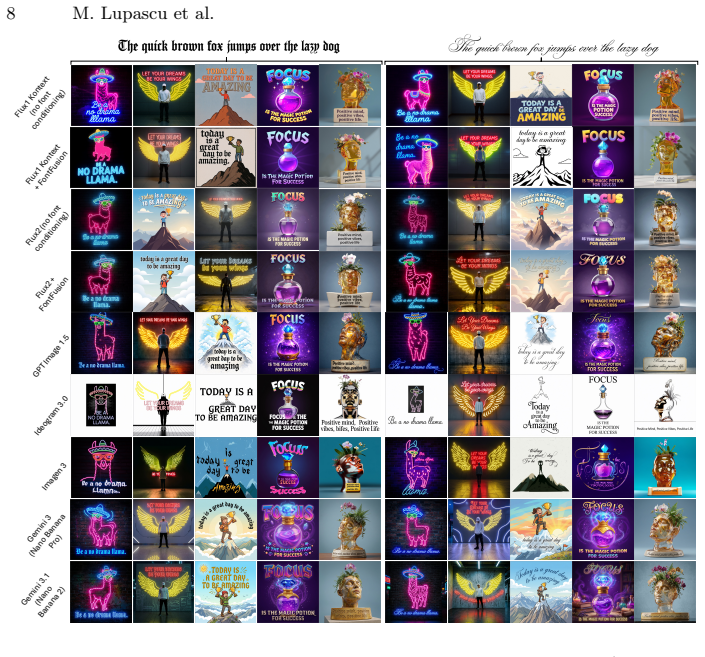
- The method produces 76 percent relative improvement on challenging decorative fonts over single-encoder baselines.
- Font consistency gains exceed approximately 68-76 percent over unconditioned models.
- Multi-level token dropping improves both computational efficiency and generalization to unseen fonts.
Where Pith is reading between the lines
- The same hierarchical and position-aware conditioning pattern could be tested on non-DiT diffusion backbones to check transferability.
- Design software could adopt the dual-encoder plus token hierarchy to let users specify exact fonts in generated images.
- Further work might measure whether the token-dropping schedule also reduces training time when the method is used from scratch.
- Extending the dual encoder with additional specialized font models might increase consistency on rare script styles.
Load-bearing premise
The measured gains arise from the dual-encoder choice and the three listed conditioning components rather than from dataset-specific tuning or metric selection that would not hold on other data.
What would settle it
Running the same models on a fresh collection of decorative fonts never seen during development and measuring whether the 76 percent relative improvement and legibility scores remain stable without any hyperparameter changes.
Figures
read the original abstract
Typography generation in diffusion models faces a persistent trade-off: enabling precise font control typically degrades text legibility, while maintaining readability often sacrifices typographic fidelity. We present FontFusion, a plug-and-play conditioning framework for Diffusion Transformer (DiT) architectures that resolves this dilemma through three core innovations: (1) a hierarchical token representation establishing explicit text-font relationships at multiple granularities, (2) position-aware embeddings creating spatial bindings between typography and image content, and (3) a multi-level token dropping strategy improving both computational efficiency and generalization to unseen fonts. Our systematic evaluation of font embedding spaces reveals that a dual encoder combining DeepFont and DINOv2 outperforms any single encoder for typography tasks. FontFusion demonstrates 76% relative improvement on challenging decorative fonts over single-encoder baselines and font consistency gains exceeding approximately 68-76% over unconditioned models, while integrating into existing DiT architectures without retraining.
Editorial analysis
A structured set of objections, weighed in public.
Referee Report
Summary. The paper introduces FontFusion, a plug-and-play conditioning framework for Diffusion Transformer (DiT) architectures to resolve the trade-off between precise font control and text legibility in typography generation. It proposes three core innovations: (1) a hierarchical token representation for explicit text-font relationships at multiple granularities, (2) position-aware embeddings for spatial bindings between typography and image content, and (3) a multi-level token dropping strategy for efficiency and generalization. The paper reports that a dual encoder combining DeepFont and DINOv2 outperforms single encoders, with FontFusion achieving 76% relative improvement on challenging decorative fonts over single-encoder baselines and font consistency gains of approximately 68-76% over unconditioned models, while integrating into existing DiT architectures without retraining.
Significance. If the quantitative claims hold under rigorous, reproducible evaluation, FontFusion would address a practically important limitation in controllable text generation within diffusion models. The plug-and-play design and dual-encoder insight could enable broader adoption in DiT-based systems. The identification of multi-granularity conditioning as a route to balancing fidelity and legibility is a potentially useful direction, though its impact depends on whether the gains generalize beyond the reported settings.
major comments (1)
- [Abstract] Abstract: the central claims of '76% relative improvement on challenging decorative fonts over single-encoder baselines' and 'font consistency gains exceeding approximately 68-76% over unconditioned models' are presented without any experimental protocol, metric definitions (e.g., how consistency or legibility is quantified), baseline implementation details, dataset descriptions, or error bars. This prevents assessment of whether the data-to-claim link is sound and makes the reported gains impossible to verify or reproduce from the given information.
minor comments (1)
- [Abstract] Abstract: the phrasing 'exceeding approximately 68-76%' is imprecise and should be replaced with an exact reported range or per-metric values once the full evaluation section is available.
Simulated Author's Rebuttal
We thank the referee for their review. The concern regarding the abstract is addressed below by clarifying that detailed experimental information is provided in the full manuscript, allowing verification of the reported results.
read point-by-point responses
-
Referee: [Abstract] Abstract: the central claims of '76% relative improvement on challenging decorative fonts over single-encoder baselines' and 'font consistency gains exceeding approximately 68-76% over unconditioned models' are presented without any experimental protocol, metric definitions (e.g., how consistency or legibility is quantified), baseline implementation details, dataset descriptions, or error bars. This prevents assessment of whether the data-to-claim link is sound and makes the reported gains impossible to verify or reproduce from the given information.
Authors: We agree that the abstract, as a concise summary, does not include full experimental protocols, metric definitions, baseline details, dataset descriptions, or error bars. These elements are provided in the manuscript's Experiments section (including quantitative evaluation protocols using the dual DeepFont+DINOv2 encoder, consistency metrics based on perceptual similarity and legibility scores, baseline DiT implementations, typography datasets, and reported standard deviations). The 76% relative improvement on decorative fonts and 68-76% consistency gains are derived from these systematic comparisons, enabling assessment of the data-to-claim link from the full paper rather than the abstract alone. revision: no
Circularity Check
No significant circularity
full rationale
The provided abstract and context describe three conditioning innovations and dual-encoder evaluation results without equations, self-definitional loops, fitted parameters renamed as predictions, or load-bearing self-citations. Claims rest on reported empirical gains (e.g., 76% relative improvement) over baselines rather than any derivation that reduces to its own inputs by construction. The paper's chain is self-contained against external benchmarks.
Axiom & Free-Parameter Ledger
Reference graph
Works this paper leans on
-
[1]
Berio,D.,Leymarie,F.F.,Asente,P.,Echevarria,J.:Strokestyles:Stroke-basedseg- mentation and stylization of fonts. ACM Trans. Graph.41(3), 28:1–28:21 (2022). https://doi.org/10.1145/3505246
-
[2]
Black Forest Labs: FLUX.1: A family of flow-based text-to-image models.https: //blackforestlabs.ai/announcing-black-forest-labs/(2024)
2024
-
[3]
Campbell, N.D.F., Kautz, J.: Learning a manifold of fonts. ACM Trans. Graph. 33(4), 91:1–91:11 (2014). https://doi.org/10.1145/2601097.2601212
-
[4]
arXiv preprint arXiv:2305.10855 (2023)
Chen, J., Huang, Y., Lv, T., Cui, L., Chen, Q., Wei, F.: Textdiffuser: Diffusion models as text painters. arXiv preprint arXiv:2305.10855 (2023)
arXiv 2023
-
[5]
In: Proceedings of the 41st International Conference on Machine Learning
Esser, P., Kulal, S., Blattmann, A., Entezari, R., Müller, J., Saini, H., Levi, Y., Lorenz, D., Sauer, A., Boesel, F., Podell, D., Dockhorn, T., English, Z., Rom- bach, R.: Scaling rectified flow transformers for high-resolution image synthesis. In: Proceedings of the 41st International Conference on Machine Learning. ICML’24, JMLR.org (2024). https://doi...
-
[6]
Feng, K., Zhang, Y., Yu, H., Ji, Z., Bai, J., Zhang, H., Zuo, W.: Vitaglyph: Vital- izing artistic typography with flexible dual-branch diffusion models. arXiv (2024). https://doi.org/10.48550/ARXIV.2410.01738
-
[7]
An Image is Worth One Word: Personalizing Text-to-Image Generation using Textual Inversion
Gal, R., Alaluf, Y., Atzmon, Y., Patashnik, O., Bermano, A.H., Chechik, G., Cohen-Or, D.: An image is worth one word: Personalizing text-to-image genera- tion using textual inversion (2022). https://doi.org/10.48550/ARXIV.2208.01618, https://arxiv.org/abs/2208.01618
work page internal anchor Pith review Pith/arXiv arXiv doi:10.48550/arxiv.2208.01618 2022
-
[8]
Google: Gemini 2.0 Flash (Nano Banana).https://deepmind.google/models/ gemini-image/pro/(2025)
2025
-
[9]
He, H., Chen, X., Wang, C., Liu, J., Du, B., Tao, D., Qiao, Y.: Diff-font: Diffusion model for robust one-shot font generation. Int. J. Comput. Vis.132(11), 5372–5386 (2024). https://doi.org/10.1007/S11263-024-02137-0 FontFusion 11
-
[10]
Ho,J.,Jain,A.,Abbeel,P.:Denoisingdiffusionprobabilisticmodels.In:Larochelle, H., Ranzato, M., Hadsell, R., Balcan, M., Lin, H. (eds.) Advances in Neural Information Processing Systems 33: Annual Conference on Neural Information Processing Systems 2020, NeurIPS 2020, December 6-12, 2020, virtual (2020). https://doi.org/10.5555/3495724.3496298
-
[11]
Ideogram: Ideogram 3.0.https://ideogram.ai(2025)
2025
-
[12]
Iluz, S., Vinker, Y., Hertz, A., Berio, D., Cohen-Or, D., Shamir, A.: Word-as- image for semantic typography. ACM Trans. Graph.42(4), 151:1–151:11 (2023). https://doi.org/10.1145/3592123
-
[13]
Imagen-Team-Google, :, Baldridge, J., Bauer, J., Bhutani, M., et al.: Imagen 3 (2024),https://arxiv.org/abs/2408.07009
arXiv 2024
-
[14]
Labs,B.F.,Batifol,S.,Blattmann,A.,Boesel,F.,Consul,S.,Diagne,C.,Dockhorn, T., English, J., English, Z., Esser, P., Kulal, S., Lacey, K., Levi, Y., Li, C., Lorenz, D., Müller, J., Podell, D., Rombach, R., Saini, H., Sauer, A., Smith, L.: Flux.1 kontext: Flow matching for in-context image generation and editing in latent space (2025),https://arxiv.org/abs/2...
Pith/arXiv arXiv 2025
-
[15]
In: Leonardis, A., Ricci, E., Roth, S., Russakovsky, O., Sattler, T., Varol, G
Liu, Z., Liang, W., Liang, Z., Luo, C., Li, J., Huang, G., Yuan, Y.: Glyph-byt5: A customized text encoder for accurate visual text rendering. In: Leonardis, A., Ricci, E., Roth, S., Russakovsky, O., Sattler, T., Varol, G. (eds.) Computer Vision - ECCV 2024 - 18th European Conference, Milan, Italy, September 29-October 4, 2024, Proceedings, Part LXXV. Lec...
-
[16]
https://cdn.openai.com/11998be9-5319-4302-bfbf-1167e093f1fb/Native_ Image_Generation_System_Card.pdf(2025)
OpenAI: Addendum to GPT-4o System Card: Native image generation. https://cdn.openai.com/11998be9-5319-4302-bfbf-1167e093f1fb/Native_ Image_Generation_System_Card.pdf(2025)
2025
-
[17]
Oquab, M., Darcet, T., Moutakanni, T., Vo, H.V., Szafraniec, M., Khalidov, V., Fernandez, P., Haziza, D., Massa, F., El-Nouby, A., Assran, M., Ballas, N., Galuba, W., Howes, R., Huang, P., Li, S., Misra, I., Rabbat, M., Sharma, V., Synnaeve, G., Xu, H., Jégou, H., Mairal, J., Labatut, P., Joulin, A., Bojanowski, P.: Dinov2: Learning robust visual features...
-
[18]
Boxdiff: Text-to-image synthesis with training-free box-constrained diffusion
Peebles, W., Xie, S.: Scalable diffusion models with transformers. In: IEEE/CVF International Conference on Computer Vision, ICCV 2023, Paris, France, October 1-6, 2023. pp. 4172–4182. IEEE (2023). https://doi.org/10.1109/ICCV51070.2023.00387
-
[19]
URLhttps://doi.org/10.5281/zenodo.5143773
Podell, D., English, Z., Lacey, K., Blattmann, A., Dockhorn, T., Müller, J., Penna, J., Rombach, R.: Sdxl: Improving latent diffusion models for high-resolution image synthesis. In: Kim, B., Yue, Y., Chaudhuri, S., Fragkiadaki, K., Khan, M., Sun, Y. (eds.) International Conference on Learning Representations. vol. 2024, pp. 1862– 1874 (2024). https://doi....
-
[20]
In: Meila, M., Zhang, T
Radford, A., Kim, J.W., Hallacy, C., Ramesh, A., Goh, G., Agarwal, S., Sastry, G., Askell, A., Mishkin, P., Clark, J., Krueger, G., Sutskever, I.: Learning transferable visual models from natural language supervision. In: Meila, M., Zhang, T. (eds.) Proceedings of the 38th International Conference on Machine Learning, ICML 2021, 18-24 July 2021, Virtual E...
2021
-
[21]
Raffel, C., Shazeer, N., Roberts, A., Lee, K., Narang, S., Matena, M., Zhou, Y., Li, W., Liu, P.J.: Exploring the limits of transfer learning with a unified text-to-text transformer. J. Mach. Learn. Res.21, 140:1–140:67 (2020),https://jmlr.org/ papers/v21/20-074.html 12 M. Lupascu et al
2020
-
[22]
Hierarchical Text-Conditional Image Generation with CLIP Latents
Ramesh, A., Dhariwal, P., Nichol, A., Chu, C., Chen, M.: Hierarchi- cal text-conditional image generation with CLIP latents. arXiv (2022). https://doi.org/10.48550/ARXIV.2204.06125
work page internal anchor Pith review Pith/arXiv arXiv doi:10.48550/arxiv.2204.06125 2022
-
[23]
In2022 IEEE/CVF Conference on Computer Vision and Pattern Recognition
Rombach, R., Blattmann, A., Lorenz, D., Esser, P., Ommer, B.: High- resolution image synthesis with latent diffusion models. In: IEEE/CVF Con- ference on Computer Vision and Pattern Recognition, CVPR 2022, New Orleans, LA, USA, June 18-24, 2022. pp. 10674–10685. IEEE (2022). https://doi.org/10.1109/CVPR52688.2022.01042
-
[24]
In2023 IEEE/CVF Conference on Computer Vision and Pattern Recognition (CVPR)
Ruiz, N., Li, Y., Jampani, V., Pritch, Y., Rubinstein, M., Aberman, K.: Dream- booth: Fine tuning text-to-image diffusion models for subject-driven generation. In: IEEE/CVF Conference on Computer Vision and Pattern Recognition, CVPR 2023, Vancouver, BC, Canada, June 17-24, 2023. pp. 22500–22510. IEEE (2023). https://doi.org/10.1109/CVPR52729.2023.02155
-
[25]
In: Koyejo, S., Mohamed, S., Agarwal, A., Belgrave, D., Cho, K., Oh, A
Saharia, C., Chan, W., Saxena, S., Li, L., Whang, J., Denton, E.L., Ghasemipour, S.K.S., Lopes, R.G., Ayan, B.K., Salimans, T., Ho, J., Fleet, D.J., Norouzi, M.: Photorealistic text-to-image diffusion models with deep language understanding. In: Koyejo, S., Mohamed, S., Agarwal, A., Belgrave, D., Cho, K., Oh, A. (eds.) Ad- vances in Neural Information Pro...
-
[26]
Shi, W., Song, Y., Zhang, D., Liu, J., Zou, X.: Fonts: Text rendering with typogra- phy and style controls. arXiv (2024). https://doi.org/10.48550/ARXIV.2412.00136
-
[27]
Boxdiff: Text-to-image synthesis with training-free box-constrained diffusion
Tanveer, M., Wang, Y., Mahdavi-Amiri, A., Zhang, H.: Ds-fusion: Artistic typog- raphy via discriminated and stylized diffusion. In: IEEE/CVF International Con- ference on Computer Vision, ICCV 2023, Paris, France, October 1-6, 2023. pp. 374–384. IEEE (2023). https://doi.org/10.1109/ICCV51070.2023.00041
-
[28]
Tatsukawa, Y., Shen, I., Qi, A., Koyama, Y., Igarashi, T., Shamir, A.: Fontclip: A semantic typography visual-language model for multilingual font applications. Comput. Graph. Forum43(2), i–iii (2024). https://doi.org/10.1111/CGF.15043
-
[29]
In: Zhou, X., Smeaton, A.F., Tian, Q., Bulterman, D.C.A., Shen, H.T., Mayer-Patel, K., Yan, S
Wang, Z., Yang, J., Jin, H., Shechtman, E., Agarwala, A., Brandt, J., Huang, T.S.: Deepfont: Identify your font from an image. In: Zhou, X., Smeaton, A.F., Tian, Q., Bulterman, D.C.A., Shen, H.T., Mayer-Patel, K., Yan, S. (eds.) Pro- ceedings of the 23rd Annual ACM Conference on Multimedia Conference, MM ’15, Brisbane, Australia, October 26 - 30, 2015. pp...
-
[30]
In: Wooldridge, M.J., Dy, J.G., Natarajan, S
Yang, Z., Peng, D., Kong, Y., Zhang, Y., Yao, C., Jin, L.: Fontdiffuser: One- shot font generation via denoising diffusion with multi-scale content aggrega- tion and style contrastive learning. In: Wooldridge, M.J., Dy, J.G., Natarajan, S. (eds.) Thirty-Eighth AAAI Conference on Artificial Intelligence, AAAI 2024, Thirty-Sixth Conference on Innovative App...
-
[31]
IP-Adapter: Text Compatible Image Prompt Adapter for Text-to-Image Diffusion Models
Ye, H., Zhang, J., Liu, S., Han, X., Yang, W.: Ip-adapter: Text compati- ble image prompt adapter for text-to-image diffusion models. arXiv (2023). https://doi.org/10.48550/ARXIV.2308.06721
work page internal anchor Pith review Pith/arXiv arXiv doi:10.48550/arxiv.2308.06721 2023
-
[32]
Boxdiff: Text-to-image synthesis with training-free box-constrained diffusion
Zhang, L., Rao, A., Agrawala, M.: Adding conditional control to text-to-image diffusion models. In: IEEE/CVF International Conference on Computer Vision, ICCV 2023, Paris, France, October 1-6, 2023. pp. 3813–3824. IEEE (2023). https://doi.org/10.1109/ICCV51070.2023.00355
discussion (0)
Sign in with ORCID, Apple, or X to comment. Anyone can read and Pith papers without signing in.