Geodesic Flow Matching on a Riemannian Degradation Manifold for Blind Image Restoration
Pith reviewed 2026-06-28 02:15 UTC · model grok-4.3
The pith
Modeling degradations as points on a Riemannian manifold turns blind restoration into geodesic transport that respects curvature and composes mixed effects.
A machine-rendered reading of the paper's core claim, the machinery that carries it, and where it could break.
Core claim
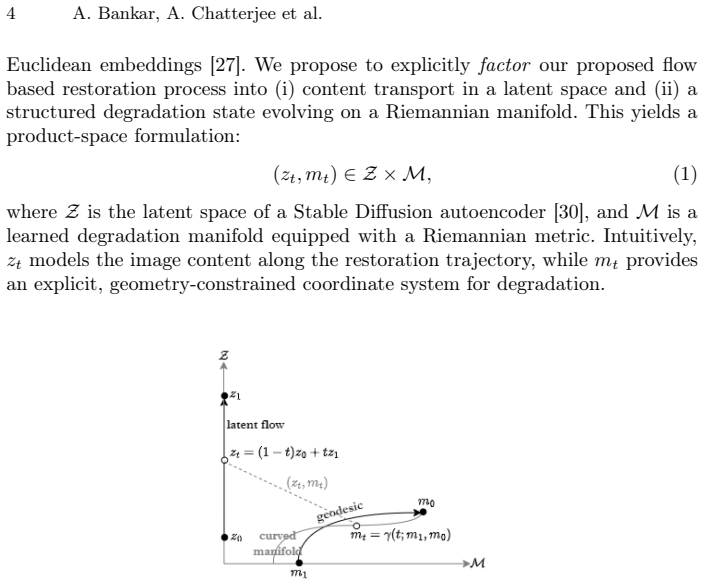
By placing degradations on a Riemannian manifold and optimizing geodesic flow matching, the model learns intrinsic transport dynamics that follow the manifold curvature, generalizing linear flow matching, treating mixed degradations as geodesic compositions, and providing a theoretical basis for generalization beyond observed degradations.
What carries the argument
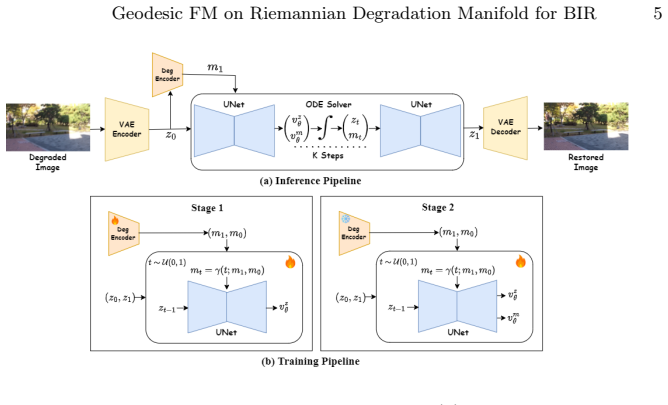
Geodesic flow matching objective on the joint image-manifold space that learns transport dynamics respecting degradation curvature.
If this is right
- Mixed degradations are handled directly as geodesic compositions rather than ad-hoc combinations.
- Linear flow matching emerges as a special case when the manifold is flat.
- Generalization to degradations outside the training distribution follows from the manifold geometry.
- The learned dynamics respect the intrinsic curvature of degradation space instead of assuming flat paths.
Where Pith is reading between the lines
- If the manifold model holds, similar geodesic formulations could apply to other inverse problems such as video restoration or medical imaging.
- Performance gaps between geodesic and Euclidean versions on real mixed-degradation benchmarks would indicate whether curvature is practically relevant.
- The approach suggests that explicit manifold learning might reduce reliance on exhaustive mixed-degradation training sets.
Load-bearing premise
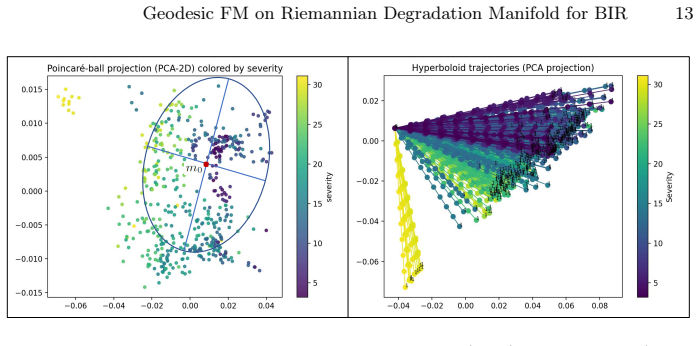
Degradations can be modeled as points on a low-dimensional Riemannian manifold such that restoration equals geodesic transport on the joint image-manifold space.
What would settle it
A controlled test on images with combined degradations where geodesic transport yields no improvement over standard Euclidean linear interpolation would falsify the claimed advantage.
Figures
read the original abstract
Blind image restoration requires recovering clean images from observations corrupted by unknown and potentially mixed degradations. While recent deterministic flow-based methods model restoration as transport processes that map degraded images to clean ones, they typically rely on Euclidean interpolation, implicitly assuming linear degradation geometry. In this paper, we explicitly model degradations as points on a low-dimensional Riemannian manifold and formulate restoration as geodesic transport on the joint image-manifold space. Using a geodesic flow matching objective, we learn intrinsic transport dynamics that respect the curvature of degradation space. This framework generalizes linear flow matching, provides a principled treatment of mixed degradations as geodesic compositions, and yields a clean theoretical interpretation for generalization beyond observed degradations.
Editorial analysis
A structured set of objections, weighed in public.
Referee Report
Summary. The paper proposes modeling degradations as points on a low-dimensional Riemannian manifold and formulates blind image restoration as geodesic transport on the joint image-manifold space via a geodesic flow matching objective. It claims this generalizes linear flow matching, treats mixed degradations as geodesic compositions, and provides a theoretical basis for generalization beyond observed degradations.
Significance. If the manifold construction, Riemannian metric, and geodesic objective are rigorously defined and shown to reduce to the Euclidean case, the approach could supply a principled geometric framework for handling composite degradations in image restoration, moving beyond heuristic interpolation in flow-based methods.
major comments (2)
- [Abstract] Abstract (first paragraph): the central premise that degradations form an explicit low-dimensional Riemannian manifold on which restoration is geodesic transport in the joint image-manifold space is asserted without any construction of the embedding, definition of the metric, or specification of the joint space; this modeling choice is load-bearing for all subsequent claims of generalization and principled composition.
- [Abstract] Abstract: no definition or equation is supplied for the geodesic flow matching objective, preventing verification that it reduces to linear flow matching when the manifold is flat or that mixed degradations are handled by geodesic composition rather than ad-hoc interpolation.
Simulated Author's Rebuttal
We thank the referee for the careful reading and constructive comments on the abstract. We address each major comment below. The manuscript body provides the requested constructions and definitions; the abstract is intentionally high-level per standard conventions, but we are willing to strengthen its signposting.
read point-by-point responses
-
Referee: [Abstract] Abstract (first paragraph): the central premise that degradations form an explicit low-dimensional Riemannian manifold on which restoration is geodesic transport in the joint image-manifold space is asserted without any construction of the embedding, definition of the metric, or specification of the joint space; this modeling choice is load-bearing for all subsequent claims of generalization and principled composition.
Authors: The abstract summarizes the modeling choice. The explicit low-dimensional Riemannian manifold for degradations, including the embedding map, the definition of the Riemannian metric (induced from the degradation parameter space), and the joint image-manifold space, are constructed in Section 3.1 and formalized in Section 3.2. The geodesic transport formulation appears in Section 4.1. We will revise the abstract to include a one-sentence pointer to these constructions and the metric definition. revision: yes
-
Referee: [Abstract] Abstract: no definition or equation is supplied for the geodesic flow matching objective, preventing verification that it reduces to linear flow matching when the manifold is flat or that mixed degradations are handled by geodesic composition rather than ad-hoc interpolation.
Authors: The geodesic flow matching objective is defined in Equation (5) (Section 4.1). Theorem 1 (Section 4.2) proves that it reduces exactly to the linear flow-matching objective on a flat manifold. Section 5.2 shows that mixed degradations correspond to geodesic compositions on the manifold rather than linear interpolation. We will add a brief clause in the abstract referencing the objective and its reduction property, while respecting abstract length limits. revision: partial
Circularity Check
No circularity; modeling choice stated as assumption with no reduction to inputs or self-citations.
full rationale
The abstract and provided text frame the Riemannian degradation manifold and geodesic transport as an explicit modeling premise rather than a derived result. No equations, fitted parameters renamed as predictions, or load-bearing self-citations appear that would make any claim equivalent to its inputs by construction. The generalization of linear flow matching follows directly from the stated framework definition, which remains independent of prior author results. This is a self-contained modeling paper with no detectable circular steps.
Axiom & Free-Parameter Ledger
axioms (1)
- domain assumption Degradations lie on a low-dimensional Riemannian manifold and restoration is geodesic transport on the joint space
Reference graph
Works this paper leans on
-
[1]
In: CVPR (2019)
Abdelhamed, A., Timofte, R., Brown, M.S.: A high-quality dataset for defocus deblurring. In: CVPR (2019)
2019
-
[2]
In: 2019 IEEE international conference on image processing (ICIP)
Ancuti, C.O., Ancuti, C., Sbert, M., Timofte, R.: Dense-haze: A benchmark for image dehazing with dense-haze and haze-free images. In: 2019 IEEE international conference on image processing (ICIP). pp. 1014–1018. IEEE (2019) Geodesic FM on Riemannian Degradation Manifold for BIR 15
2019
-
[3]
In: CVPR Workshops (2020)
Ancuti, C., Ancuti, C., De Vleeschouwer, C.: Nh-haze: An image dehazing bench- mark with non-homogeneous haze. In: CVPR Workshops (2020)
2020
-
[4]
In: ICLR (2018)
Binkowski, M., Sutherland, D.J., Arbel, M., Gretton, A.: Demystifying mmd gans. In: ICLR (2018)
2018
-
[5]
In: CVPR (2023)
Brooks, T., Holynski, A., Efros, A.A.: Instructpix2pix: Learning to follow image editing instructions. In: CVPR (2023)
2023
-
[6]
Birkhäuser (1992)
do Carmo, M.P.: Riemannian Geometry. Birkhäuser (1992)
1992
-
[7]
arXiv preprint arXiv:2503.07535 (2025)
Chadebec, C., Tasar, O., Sreetharan, S., Aubin, B.: Lbm: Latent bridge matching for fast image-to-image translation. arXiv preprint arXiv:2503.07535 (2025)
-
[8]
In: ECCV (2022)
Chen, L., et al.: Simple baselines for image restoration. In: ECCV (2022)
2022
-
[9]
arXiv preprint arXiv:2302.03660 , year=
Chen, R.T.Q., Lipman, Y.: Flow matching on general geometries. arXiv preprint arXiv:2302.03660 (2023)
-
[10]
In: CVPR (2021)
Chen, W., et al.: Densely connected pyramid dehazing network for snow removal. In: CVPR (2021)
2021
-
[11]
arXiv preprint arXiv:2105.15077 (2023)
Chen, X., Pan, J., Dong, J., Tang, J.: Towards unified deep image deraining: A survey and a new benchmark. arXiv preprint arXiv:2105.15077 (2023)
-
[12]
In: Proceedings of the IEEE/CVF international conference on computer vision
Cui, Y., Ren, W., Cao, X., Knoll, A.: Focal network for image restoration. In: Proceedings of the IEEE/CVF international conference on computer vision. pp. 13001–13011 (2023)
2023
-
[13]
In: Ad- vances in Neural Information Processing Systems (NeurIPS)
Ganea, O.E., Becigneul, G., Hofmann, T.: Hyperbolic neural networks. In: Ad- vances in Neural Information Processing Systems (NeurIPS). pp. 5350–5360 (2018)
2018
-
[14]
In: Proceedings of the IEEE/CVF conference on computer vision and pattern recognition
Guo, C.L., Yan, Q., Anwar, S., Cong, R., Ren, W., Li, C.: Image dehazing trans- former with transmission-aware 3d position embedding. In: Proceedings of the IEEE/CVF conference on computer vision and pattern recognition. pp. 5812–5820 (2022)
2022
-
[15]
In: Proceedings of the IEEE/CVF International Conference on Computer Vision (ICCV)
Guo, Y., Xiao, X., Chang, Y., Deng, S., Yan, L.: From sky to the ground: A large- scale benchmark and simple baseline towards real rain removal. In: Proceedings of the IEEE/CVF International Conference on Computer Vision (ICCV). pp. 12097– 12107 (October 2023)
2023
-
[16]
In: Proceedings of the IEEE/CVF international conference on computer vision
Guo, Y., Xiao, X., Chang, Y., Deng, S., Yan, L.: From sky to the ground: A large- scale benchmark and simple baseline towards real rain removal. In: Proceedings of the IEEE/CVF international conference on computer vision. pp. 12097–12107 (2023)
2023
-
[17]
In: NeurIPS (2017)
Heusel,M.,Ramsauer,H.,Unterthiner,T.,Nessler,B.,Hochreiter,S.:Ganstrained by a two time-scale update rule converge to a local nash equilibrium. In: NeurIPS (2017)
2017
-
[18]
In: TIP (2018)
Li, B., Peng, X., Wang, Z., Xu, J., Feng, D.: Reside: A benchmark for single image dehazing. In: TIP (2018)
2018
-
[19]
In: Proceedings of the IEEE/CVF conference on computer vision and pattern recognition
Li, R., Cheong, L.F., Tan, R.T.: Heavy rain image restoration: Integrating physics model and conditional adversarial learning. In: Proceedings of the IEEE/CVF conference on computer vision and pattern recognition. pp. 1633–1642 (2019)
2019
-
[20]
Flow Matching for Generative Modeling
Lipman, Y., Chen, R.T.Q., Ben-Hamu, H., Nickel, M., Le, M.: Flow matching for generative modeling. In: International Conference on Learning Representations (ICLR) (2023), arXiv:2210.02747
work page internal anchor Pith review Pith/arXiv arXiv 2023
-
[21]
In: AAAI (2021)
Liu, X., et al.: Realsnow: A large-scale benchmark for snow removal. In: AAAI (2021)
2021
-
[22]
In: Proceedings of the IEEE/CVF Conference on Computer Vision and Pattern Recognition
Liu, Y., Ke, Z., Liu, F., Zhao, N., Lau, R.W.: Diff-plugin: Revitalizing details for diffusion-based low-level tasks. In: Proceedings of the IEEE/CVF Conference on Computer Vision and Pattern Recognition. pp. 4197–4208 (2024) 16 A. Bankar, A. Chatterjee et al
2024
-
[23]
IEEE Transactions on Image Processing27(6), 3064– 3073 (2018)
Liu, Y.F., Jaw, D.W., Huang, S.C., Hwang, J.N.: Desnownet: Context-aware deep network for snow removal. IEEE Transactions on Image Processing27(6), 3064– 3073 (2018)
2018
-
[24]
In: Proceedings of the IEEE Conference on Computer Vision and Pattern Recognition (CVPR) (2017)
Nah, S., Kim, T.H., Lee, K.M.: Deep multi-scale convolutional neural network for dynamic scene deblurring. In: Proceedings of the IEEE Conference on Computer Vision and Pattern Recognition (CVPR) (2017)
2017
-
[25]
In: NeurIPS (2017)
Nickel, M., Kiela, D.: Poincare embeddings for learning hierarchical representation. In: NeurIPS (2017)
2017
-
[26]
In: Proceedings of the 35th International Conference on Machine Learning (ICML)
Nickel,M.,Kiela,D.:Learningcontinuoushierarchiesinthelorentzmodelofhyper- bolic geometry. In: Proceedings of the 35th International Conference on Machine Learning (ICML). pp. 3779–3788. PMLR (2018)
2018
-
[27]
In: Proceedings of the IEEE/CVF Conference on Computer Vision and Pattern Recognition (CVPR)
Qin, H., Luo, W., Wang, L., Zheng, D., Chen, J., Yang, M., Li, B., Hu, W.: Re- versing flow for image restoration. In: Proceedings of the IEEE/CVF Conference on Computer Vision and Pattern Recognition (CVPR). pp. 7545–7558 (Jun 2025)
2025
-
[28]
In: Proceedings of the Computer Vision and Pattern Recognition Conference
Qin, H., Luo, W., Wang, L., Zheng, D., Chen, J., Yang, M., Li, B., Hu, W.: Re- versing flow for image restoration. In: Proceedings of the Computer Vision and Pattern Recognition Conference. pp. 7545–7558 (2025)
2025
-
[29]
In: ECCV (2020)
Rim, J., Lee, G., Choi, J.H., Lee, J., Kim, S., Kim, S.: Real-world blur dataset for learning and benchmarking deblurring. In: ECCV (2020)
2020
-
[30]
In: CVPR (2022)
Rombach, R., Blattmann, A., Lorenz, D., Esser, P., Ommer, B.: High-resolution image synthesis with latent diffusion models. In: CVPR (2022)
2022
-
[31]
In: ACM SIGGRAPH (1985)
Shoemake, K.: Animating rotation with quaternion curves. In: ACM SIGGRAPH (1985)
1985
-
[32]
In: Proceedings of the IEEE/CVF conference on computer vision and pattern recognition
Valanarasu, J.M.J., Yasarla, R., Patel, V.M.: Transweather: Transformer-based restoration of images degraded by adverse weather conditions. In: Proceedings of the IEEE/CVF conference on computer vision and pattern recognition. pp. 2353– 2363 (2022)
2022
-
[33]
In: CVPR (2020)
Yang, W., Tan, R.T., et al.: Towards robust rain removal with real rain images. In: CVPR (2020)
2020
-
[34]
In: Proceedings of the IEEE/CVF conference on computer vision and pattern recognition
Ye, T., Chen, S., Chai, W., Xing, Z., Qin, J., Lin, G., Zhu, L.: Learning diffusion texture priors for image restoration. In: Proceedings of the IEEE/CVF conference on computer vision and pattern recognition. pp. 2524–2534 (2024)
2024
-
[35]
In: European conference on computer vision
Ye, T., Zhang, Y., Jiang, M., Chen, L., Liu, Y., Chen, S., Chen, E.: Perceiving and modeling density for image dehazing. In: European conference on computer vision. pp. 130–145. Springer (2022)
2022
-
[36]
In: CVPR (2021)
Zamir, S.W., Arora, A., Khan, S., Hayat, M., Khan, F., Yang, M.H.: Multi-stage progressive image restoration. In: CVPR (2021)
2021
-
[37]
In: CVPR (2022)
Zamir, S.W., Arora, A., Khan, S., Hayat, M., Khan, F., Yang, M.H.: Restormer: Efficient transformer for high-resolution image restoration. In: CVPR (2022)
2022
-
[38]
Zhang, L., Agrawala, M.: Adding conditional control to text-to-image diffusion models. In: ICCV (2023) Geodesic FM on Riemannian Degradation Manifold for BIR 1 Geodesic Flow Matching on a Riemannian Degradation Manifold for Blind Image Restoration Supplementary Material 6 Overview In this paper, we perform image restoration by learning the degradation pro...
2023
-
[39]
∥v∥2 g(x) =⟨v, v⟩ L
(61) Hyperboloid. ∥v∥2 g(x) =⟨v, v⟩ L. (62) This ensures that manifold velocity supervision is performed in the appro- priate Riemannian metric. 7.2 Inference Solver At inference time, restoration is performed by integrating the learned latent vector field in the latent space of the frozen Stable Diffusion autoencoder. Given a degraded imagey, we first en...
discussion (0)
Sign in with ORCID, Apple, or X to comment. Anyone can read and Pith papers without signing in.