Eigenmodes of synthetic antiferromagnetic skyrmions
Pith reviewed 2026-06-28 00:01 UTC · model grok-4.3
The pith
Antiferromagnetic interlayer coupling in skyrmion bilayers produces geometry-dependent gyrotropic and translational eigenmodes.
A machine-rendered reading of the paper's core claim, the machinery that carries it, and where it could break.
Core claim
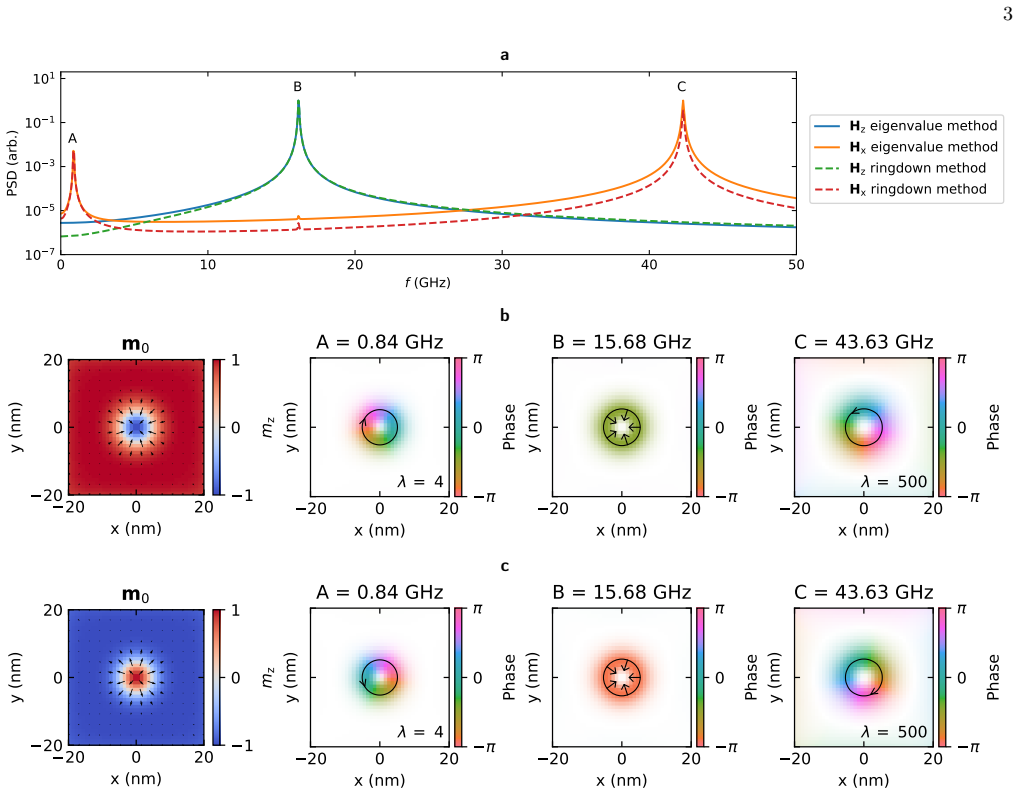
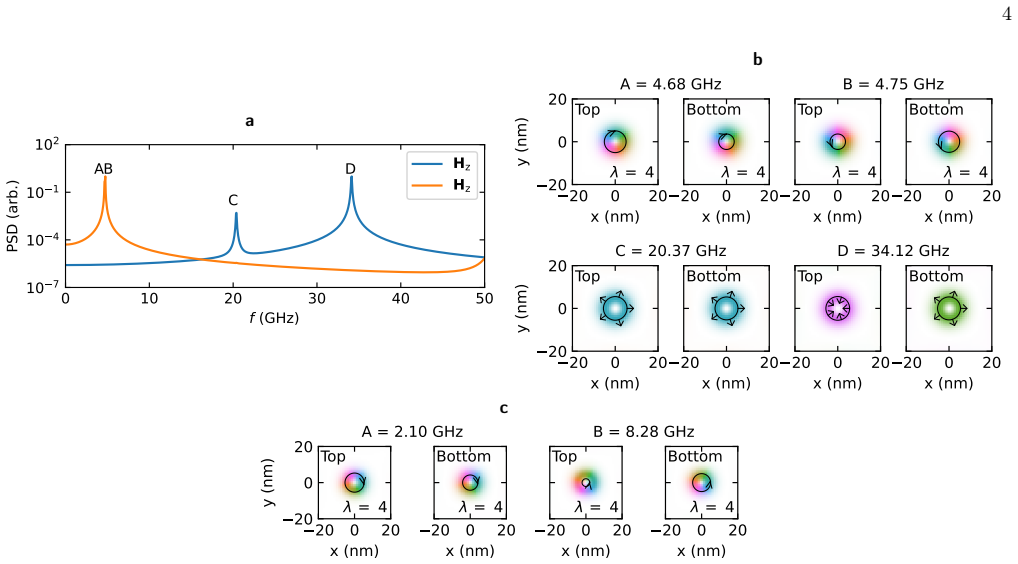
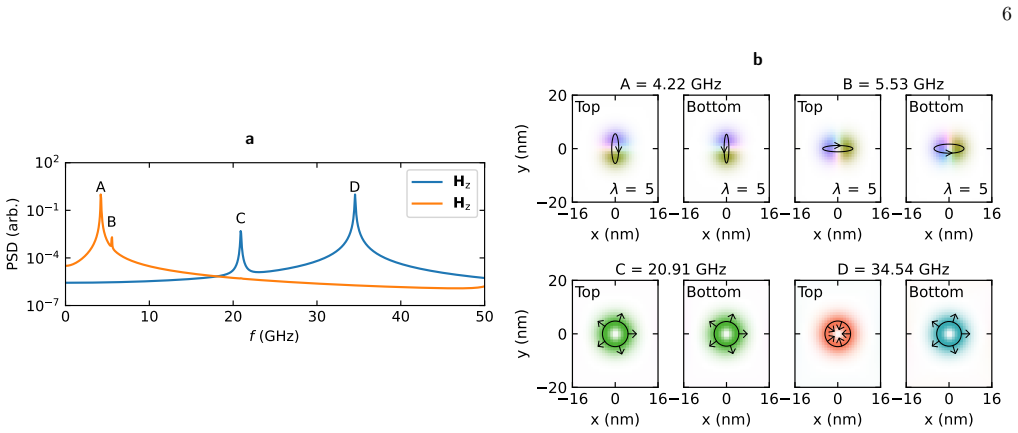
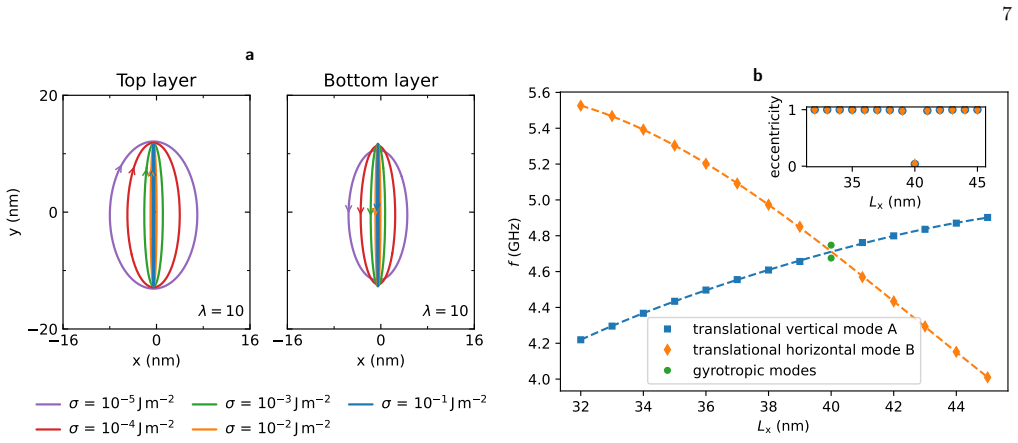
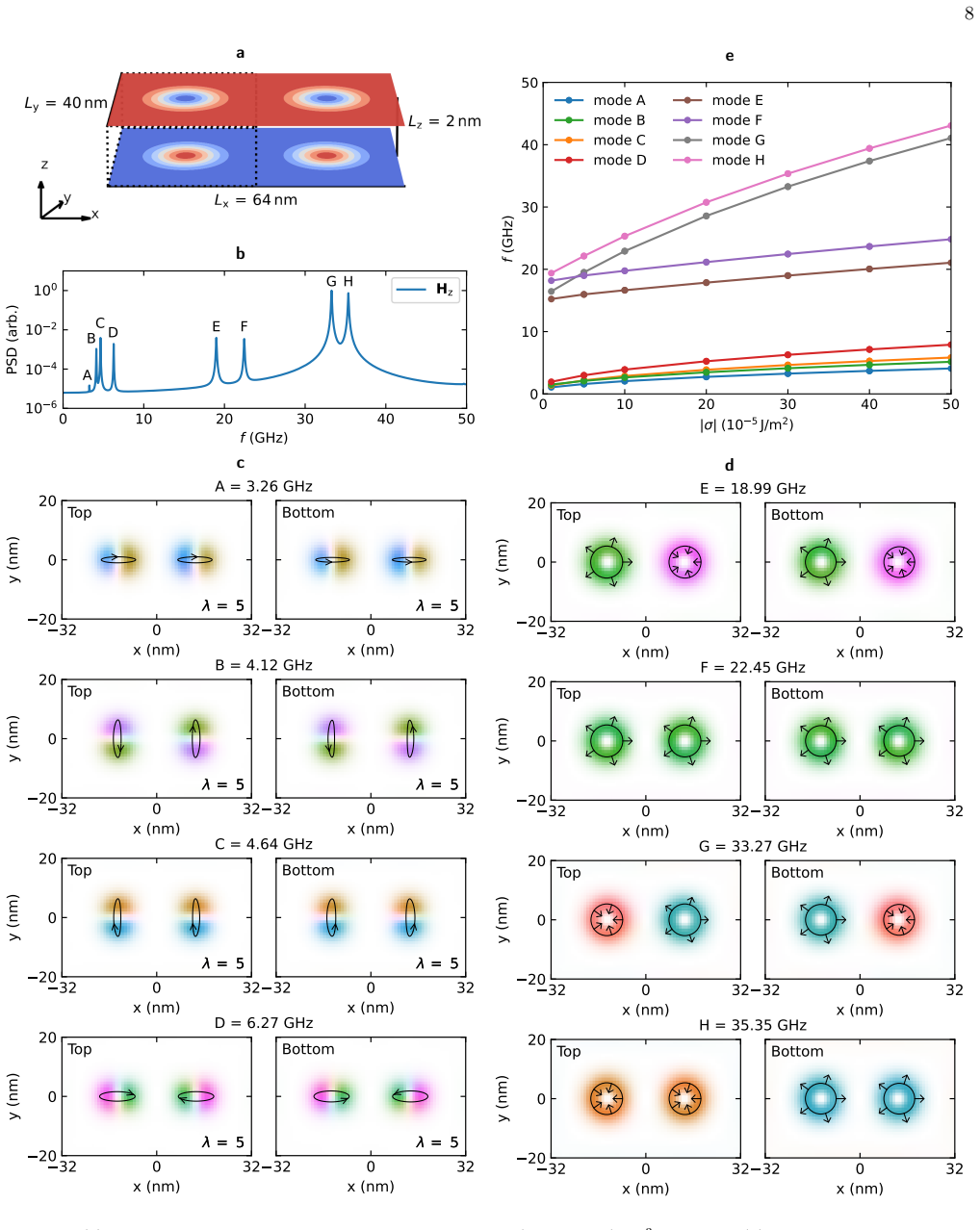
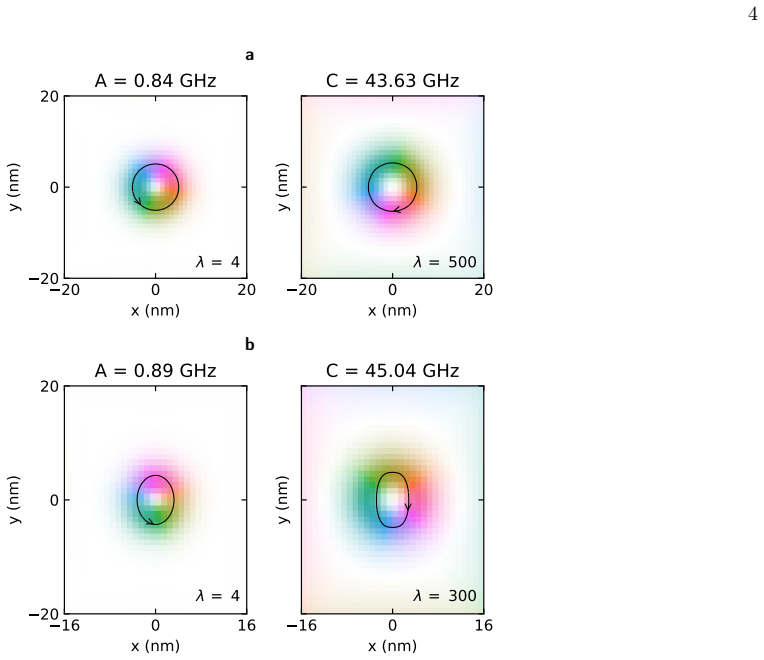
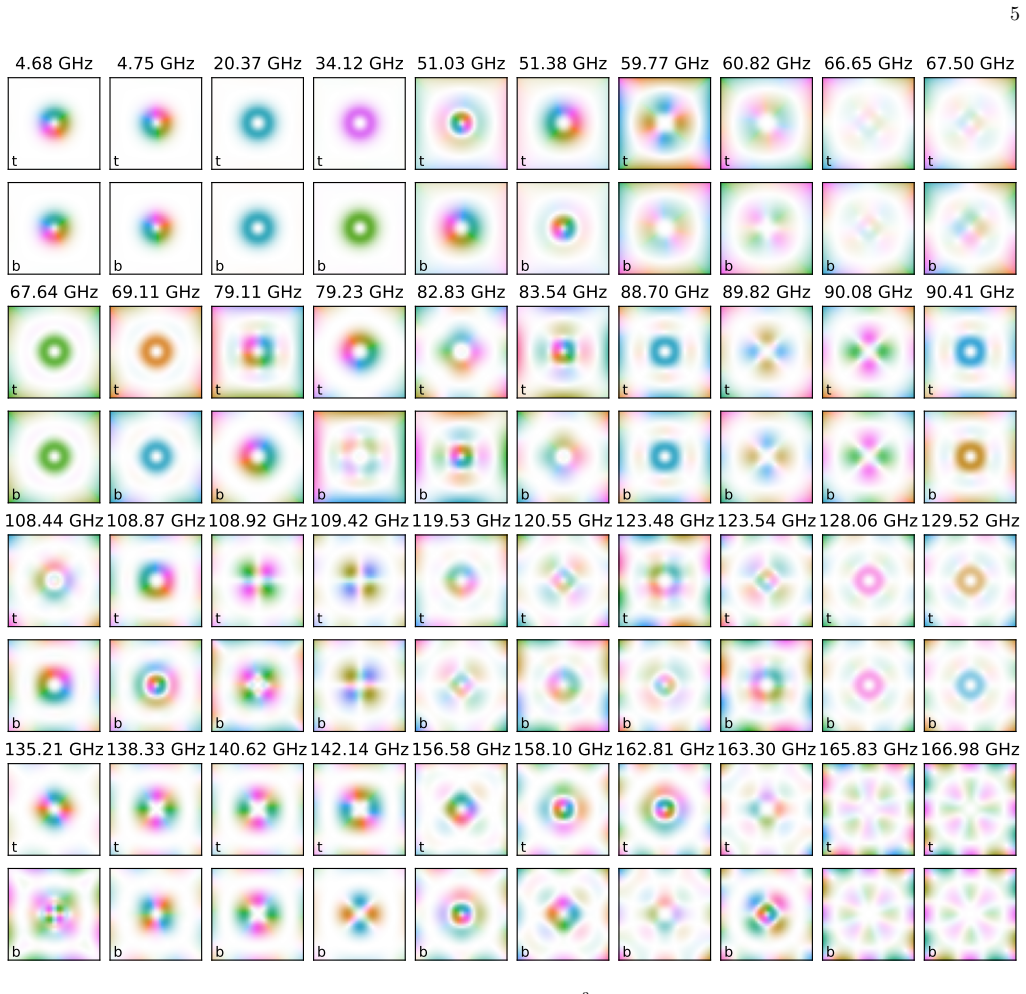
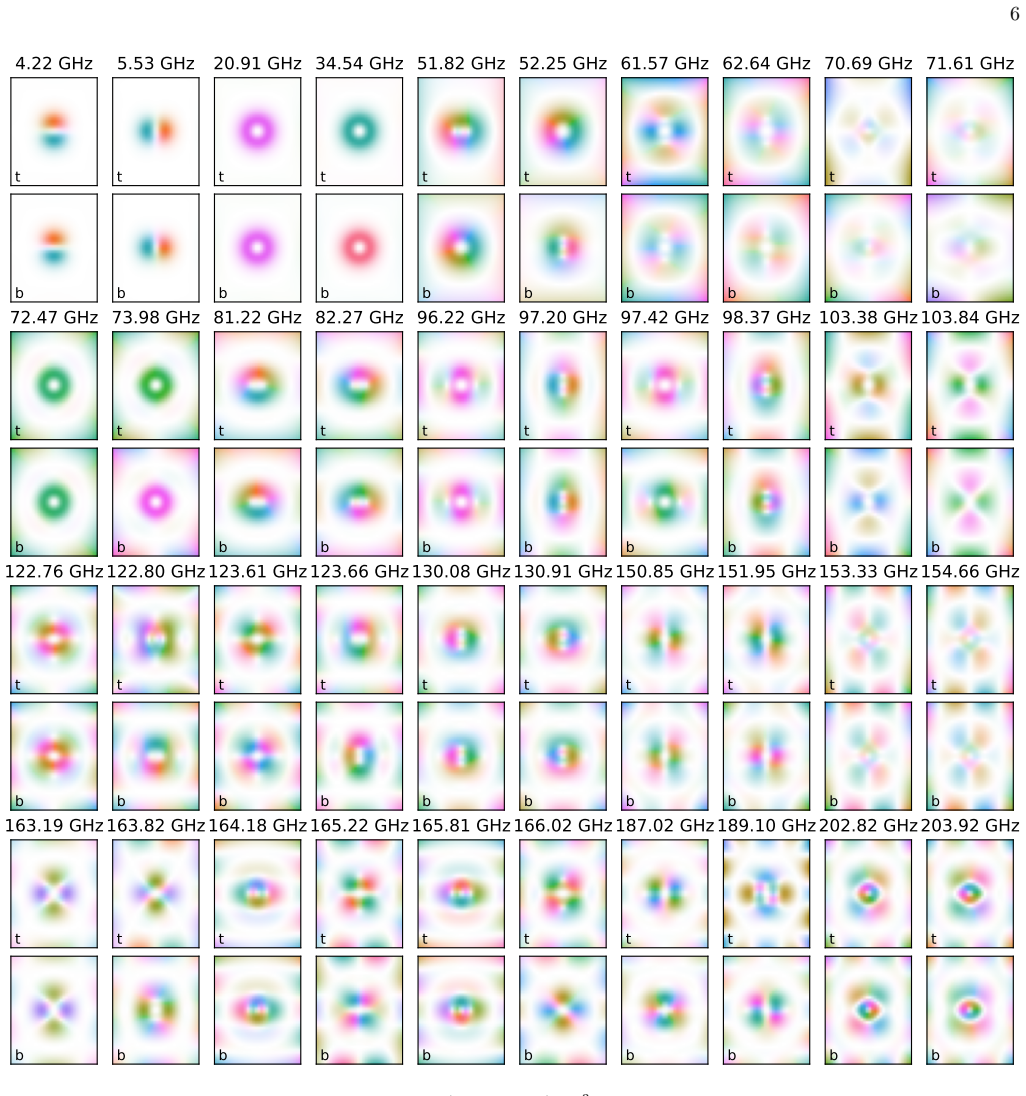
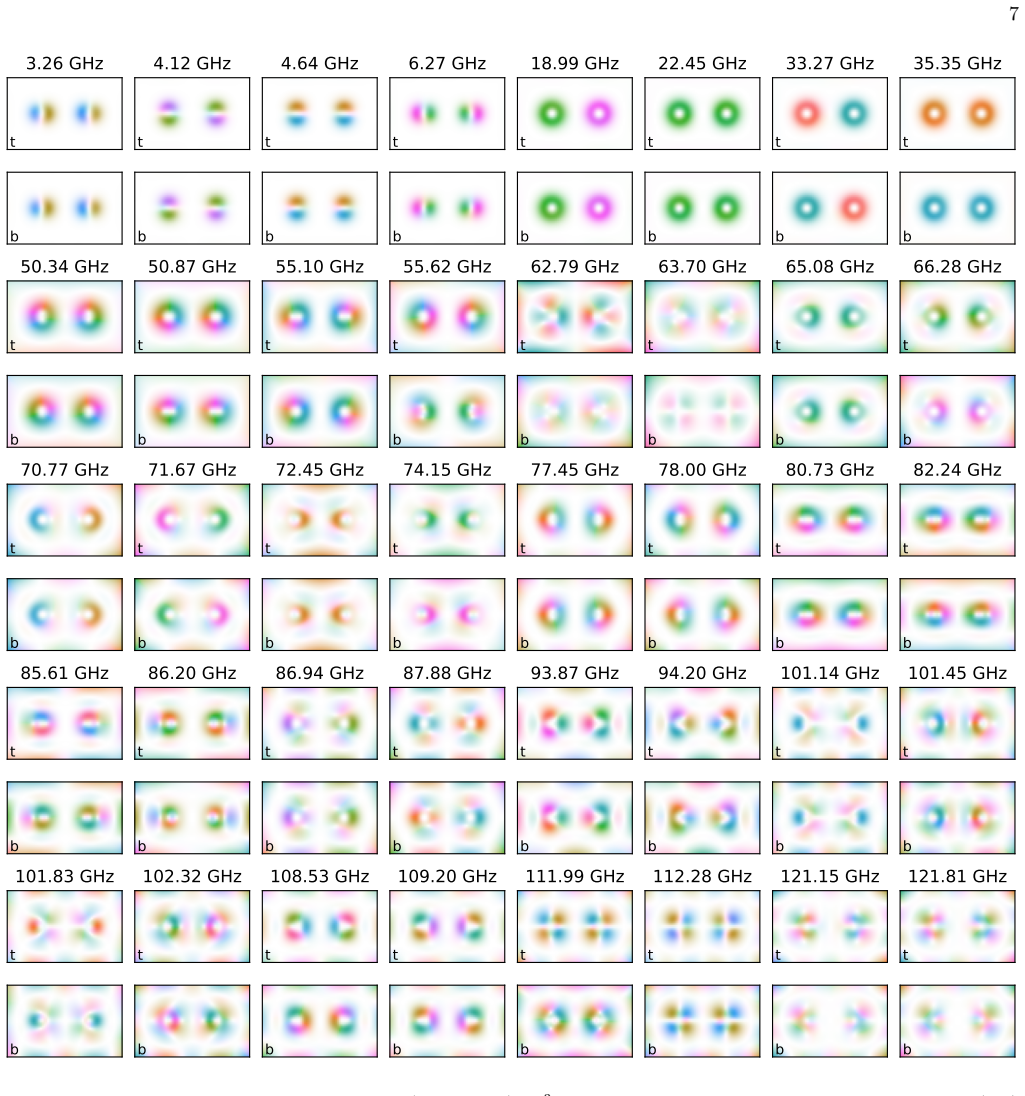
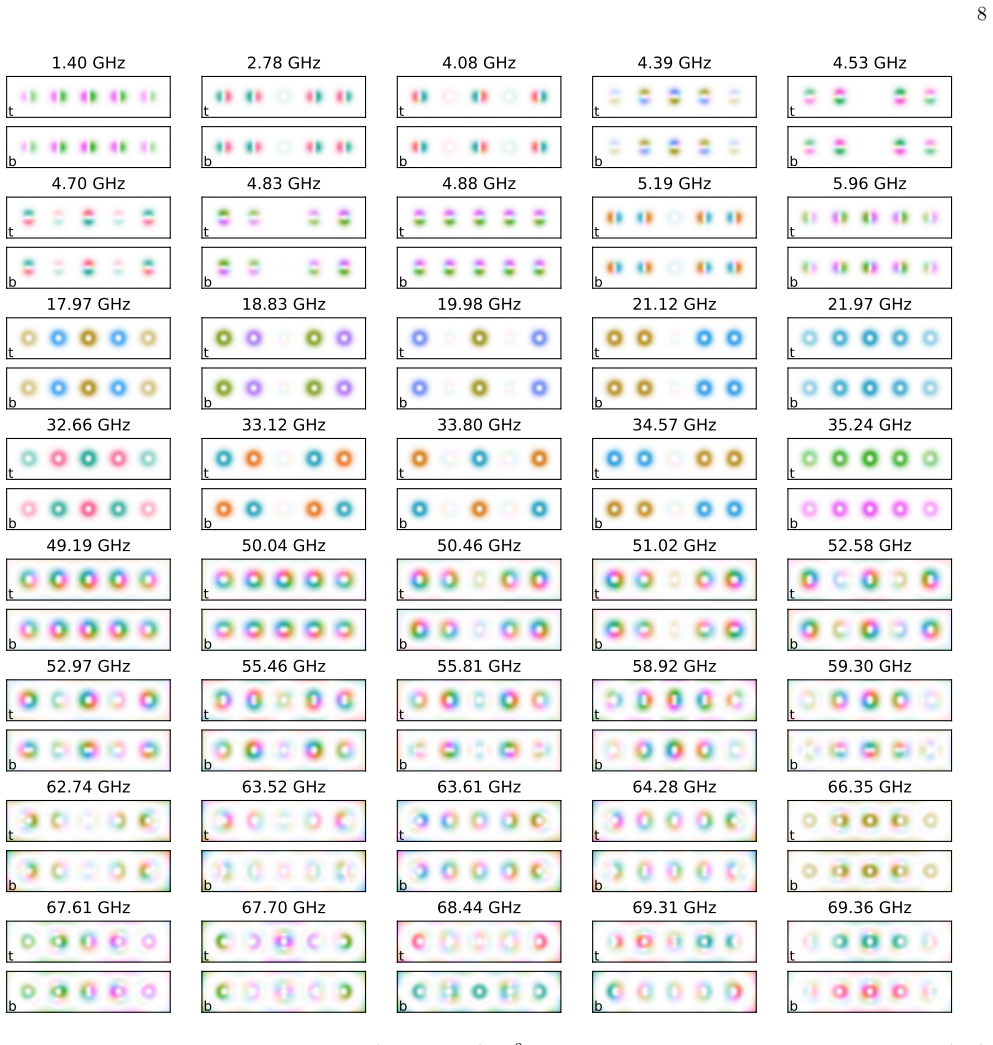
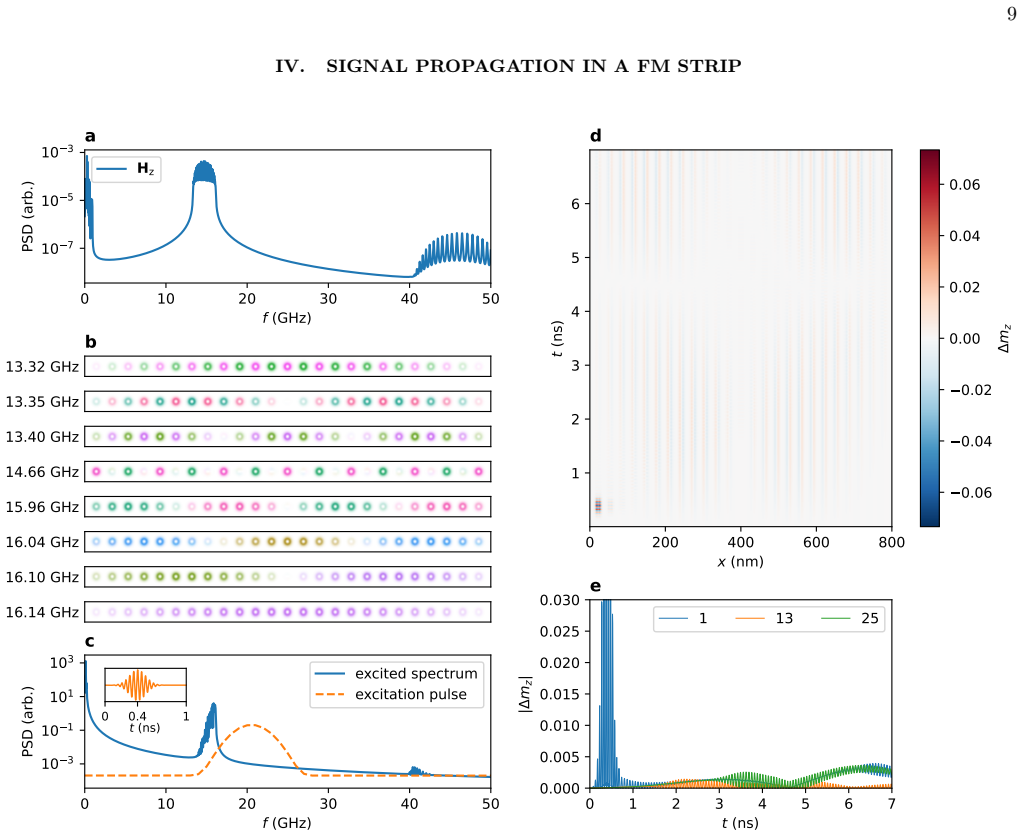
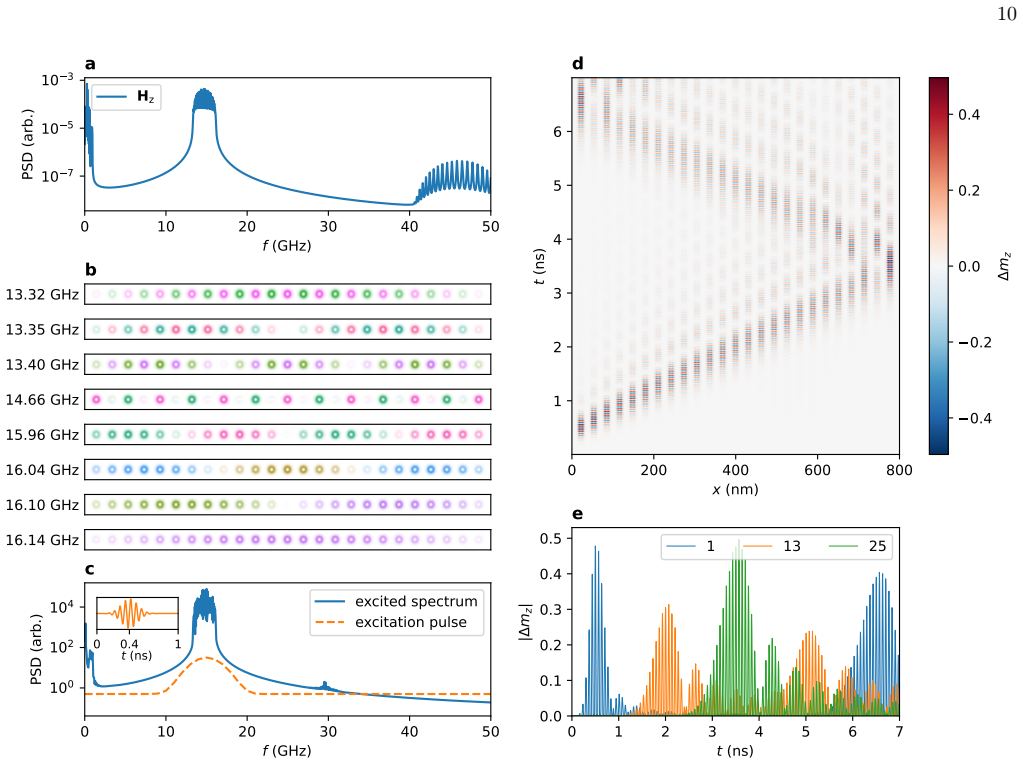
The antiferromagnetic coupling strongly modifies the low-frequency dynamics. The square geometry exhibits two nearly degenerate gyrotropic modes, where in each both layers have the same rotation sense. In rectangular geometries, we instead find nearly linear SAF skyrmion translation emerging from opposite gyration sense in the two layers. These translational modes become the characteristic low-frequency excitations of SAF skyrmion chains. For skyrmion chains, collective translational and breathing modes with standing-wave-like spatial profiles are identified, and the SAF geometry supports breathing oscillations in which the two layers oscillate out of phase, with signal propagation along ext
What carries the argument
Micromagnetic eigenvalue and ringdown simulations of synthetic antiferromagnetic bilayers that track the splitting and reordering of eigenmodes under effective interlayer exchange coupling.
If this is right
- Square confinement preserves gyrotropic character but renders the two lowest modes nearly degenerate with identical layer rotation senses.
- Rectangular confinement converts the lowest modes into linear translation driven by opposite gyration senses in the two layers.
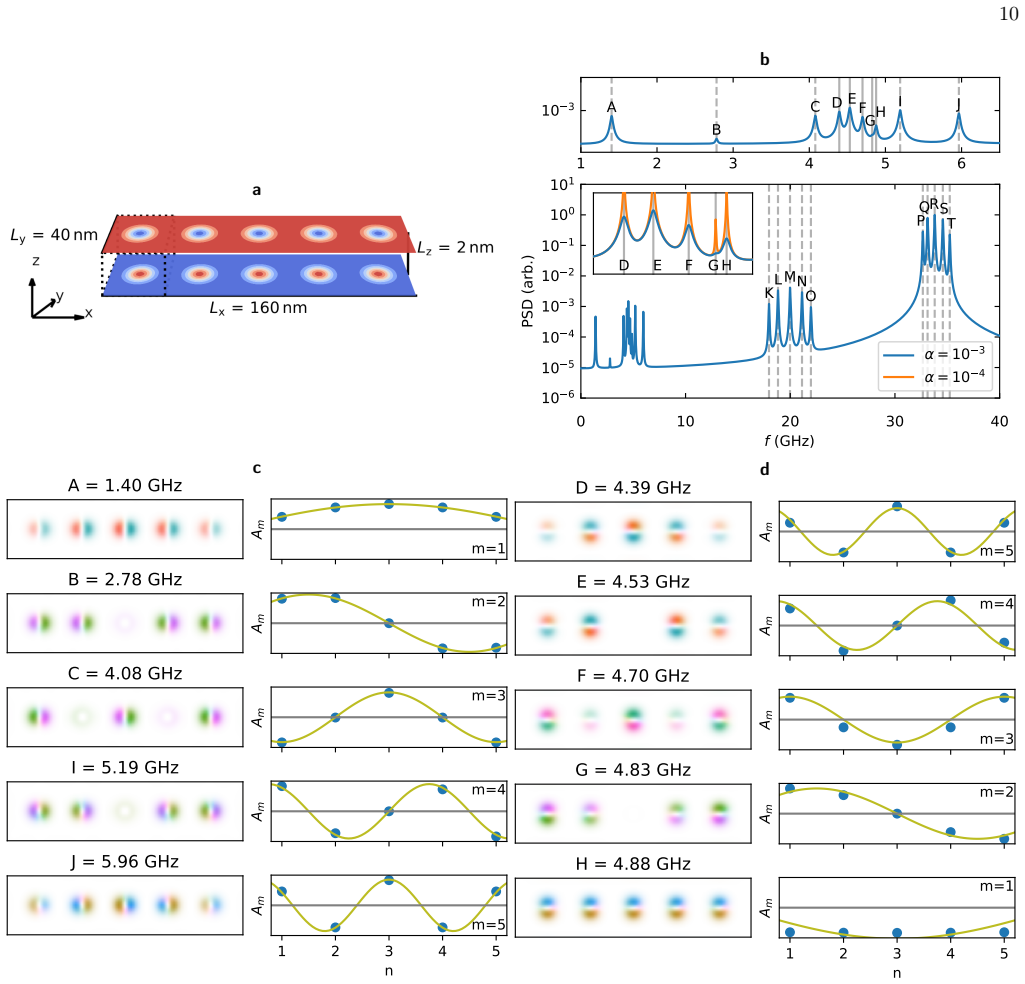
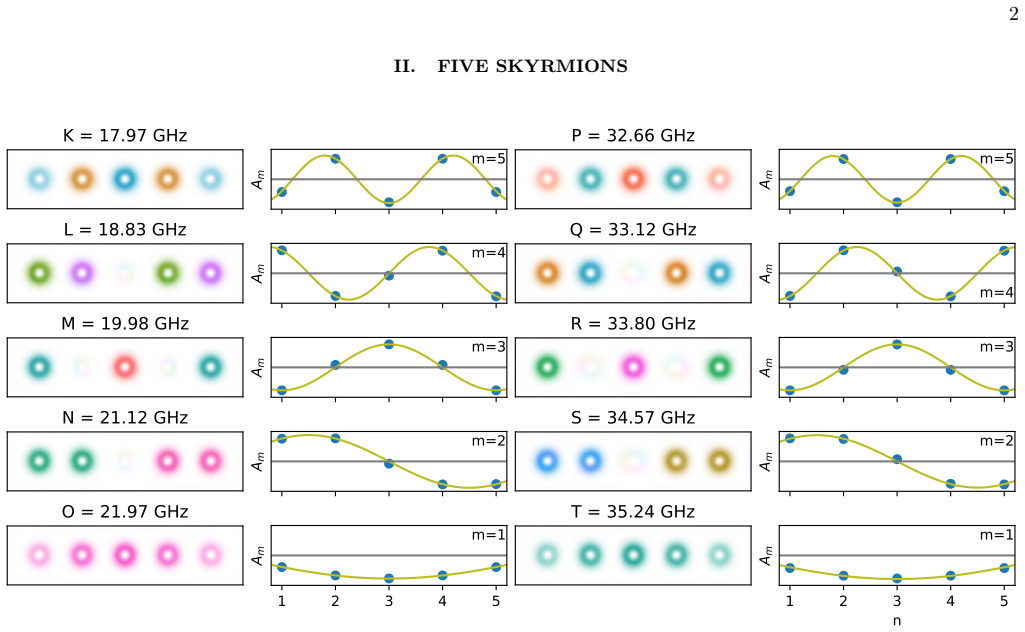
- Skyrmion chains support collective translational modes and both in-phase and out-of-phase breathing modes with standing-wave spatial profiles.
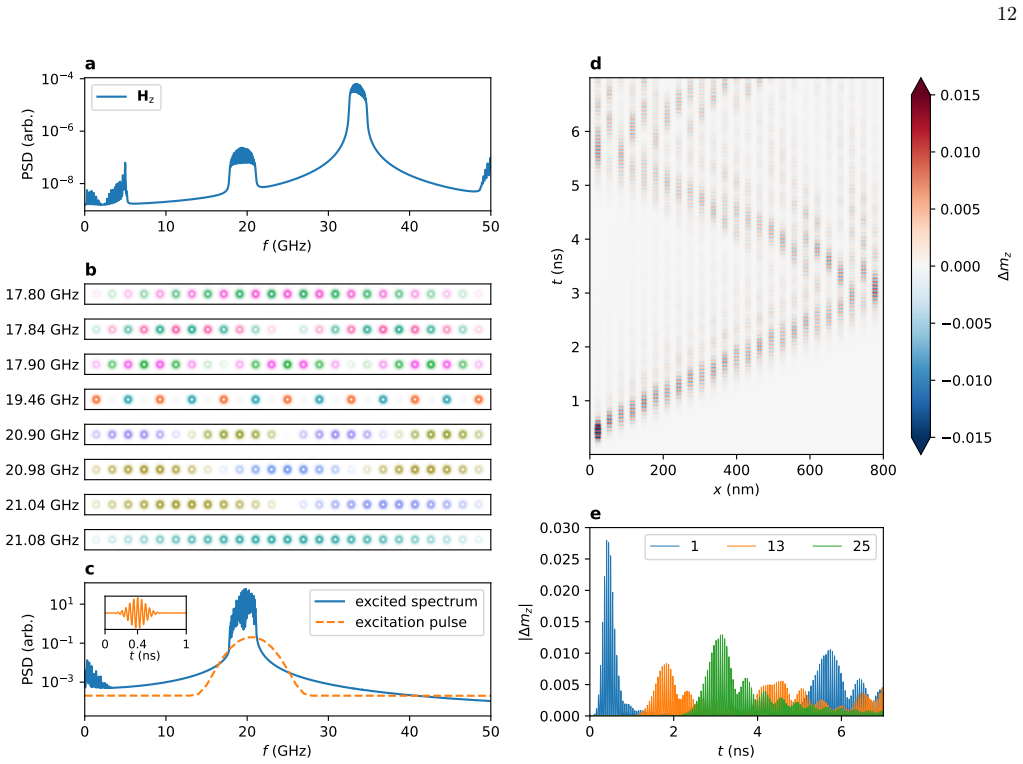
- Signal propagation occurs along extended SAF skyrmion chains at velocities comparable to those in ferromagnetic chains.
Where Pith is reading between the lines
- The out-of-phase breathing mode could be selectively excited or detected with layer-resolved probes such as element-specific x-ray microscopy.
- The geometry-controlled switch from gyration to translation may allow electrical tuning of skyrmion mobility via shape engineering alone.
- Extending the simulations to include Dzyaloshinskii-Moriya interaction gradients or temperature could test robustness of the translational modes.
- Comparison of the predicted mode frequencies with broadband microwave absorption spectra on patterned SAF samples would directly test the model.
Load-bearing premise
The micromagnetic continuum model with effective interlayer exchange coupling accurately represents the real bilayer system at the length and time scales of interest without significant atomic-scale effects or defects altering the eigenmode spectrum.
What would settle it
Time-resolved imaging or spectroscopy that either detects the two predicted nearly degenerate same-sense gyrotropic modes in square confinement or the opposite-sense translational mode in rectangular confinement, or fails to find them, would confirm or refute the claimed effect of antiferromagnetic coupling.
Figures
read the original abstract
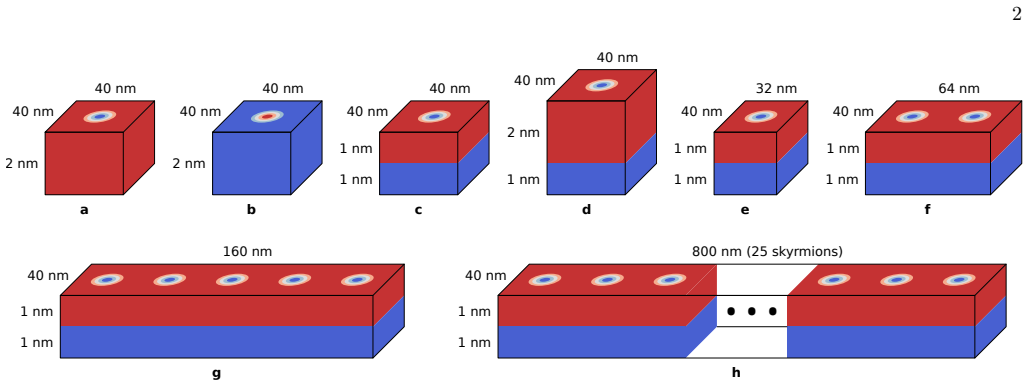
We investigate the excitation modes of confined synthetic-antiferromagnetic (SAF) skyrmions using micromagnetic eigenvalue and ringdown simulations. Starting from a single skyrmion in a ferromagnetic layer, where the lowest-frequency modes are a gyrotropic and a breathing mode, we study how antiferromagnetic interlayer coupling modifies the dynamics in SAF bilayers. We consider several geometries: single SAF skyrmions in square and rectangular confinement, unequal layer thicknesses, and strips containing multiple skyrmions. The antiferromagnetic coupling strongly modifies the low-frequency dynamics. The square geometry exhibits two nearly degenerate gyrotropic modes, where in each both layers have the same rotation sense. In rectangular geometries, we instead find nearly linear SAF skyrmion translation emerging from opposite gyration sense in the two layers. These translational modes become the characteristic low-frequency excitations of SAF skyrmion chains. For skyrmion chains, we identify collective translational and breathing modes with standing-wave-like spatial profiles. Beyond ferromagnetic-like breathing modes, the SAF geometry supports breathing oscillations in which the two layers oscillate out of phase. We further demonstrate signal propagation along extended SAF skyrmion chains with propagation velocities comparable to ferromagnetic skyrmion chains. These results provide a systematic description of the collective dynamics of SAF skyrmions arising from the interplay of geometric confinement, intralayer, and interlayer coupling.
Editorial analysis
A structured set of objections, weighed in public.
Referee Report
Summary. The paper uses micromagnetic eigenvalue and ringdown simulations to study the excitation modes of confined synthetic-antiferromagnetic (SAF) skyrmions. Starting from ferromagnetic single-layer modes (gyrotropic and breathing), it examines how antiferromagnetic interlayer coupling alters the spectrum in square and rectangular confinements, unequal-thickness bilayers, and multi-skyrmion strips. Key findings include two nearly degenerate same-sense gyrotropic modes in squares, opposite-sense translational modes in rectangles that become characteristic of SAF chains, collective standing-wave translational and breathing modes (including out-of-phase breathing), and comparable propagation velocities along chains.
Significance. If the numerical results hold, the work supplies a systematic classification of how geometric confinement and interlayer coupling reshape low-frequency SAF skyrmion dynamics, including identification of translational modes and out-of-phase breathing. This is relevant for spintronic device design involving SAF textures. The dual use of eigenvalue solvers and ringdown analysis is a methodological strength that aids unambiguous mode assignment.
major comments (2)
- [Methods] Methods (simulation protocol): No mesh-size convergence tests, time-step validation, or comparison against analytic limits (e.g., Thiele-equation frequencies for isolated skyrmions) are reported. This leaves the quantitative accuracy of the quoted eigenfrequencies and the claimed near-degeneracies open to question, directly affecting the central mode-identification claims.
- [Results (rectangular confinement)] Results on rectangular geometries: The emergence of linear translational modes from opposite-sense gyration is presented as a direct consequence of the interlayer term, yet no parameter sweep over interlayer exchange strength is shown to confirm the crossover from gyrotropic to translational character. Without this, the robustness of the geometry-dependent mode classification remains untested.
minor comments (2)
- [Figures 2-4] Figure captions and text should explicitly state the sign convention for rotation sense (clockwise/counterclockwise) when describing same-sense versus opposite-sense modes to avoid ambiguity in the square-geometry discussion.
- [Abstract and chain-propagation subsection] The abstract states that propagation velocities are 'comparable' to ferromagnetic chains; the main text should quantify the ratio and the relevant length/time scales used for the comparison.
Simulated Author's Rebuttal
We thank the referee for the positive evaluation and constructive comments on our manuscript. We address each major comment below and will revise the manuscript accordingly to improve the validation and robustness of our results.
read point-by-point responses
-
Referee: [Methods] Methods (simulation protocol): No mesh-size convergence tests, time-step validation, or comparison against analytic limits (e.g., Thiele-equation frequencies for isolated skyrmions) are reported. This leaves the quantitative accuracy of the quoted eigenfrequencies and the claimed near-degeneracies open to question, directly affecting the central mode-identification claims.
Authors: We agree that explicit validation of the numerical parameters is important for the quantitative reliability of the eigenfrequencies and mode assignments. In the revised manuscript we will add (i) mesh-size convergence tests for the reported geometries, (ii) time-step validation, and (iii) a direct comparison of the lowest eigenfrequencies obtained for an isolated skyrmion against the analytic Thiele-equation predictions. revision: yes
-
Referee: [Results (rectangular confinement)] Results on rectangular geometries: The emergence of linear translational modes from opposite-sense gyration is presented as a direct consequence of the interlayer term, yet no parameter sweep over interlayer exchange strength is shown to confirm the crossover from gyrotropic to translational character. Without this, the robustness of the geometry-dependent mode classification remains untested.
Authors: We accept that a parameter sweep would strengthen the claim that the translational character is a direct and robust consequence of the antiferromagnetic interlayer coupling. We will include an additional figure (or supplementary material) that varies the interlayer exchange strength and tracks the evolution of the mode character from gyrotropic to linear translational in rectangular confinement. revision: yes
Circularity Check
No significant circularity; results are direct numerical outputs
full rationale
The paper reports eigenmodes obtained via direct numerical solution of the Landau-Lifshitz-Gilbert equation (with added interlayer exchange term) using eigenvalue and ringdown micromagnetic simulations. No analytic derivation chain exists that reduces reported frequencies or mode characters to quantities defined by the same fit or self-citation. Mode classifications (same-sense gyrotropic pairs, opposite-sense translation) emerge as simulation outputs from the interplay of intralayer and interlayer couplings under geometric confinement; they are not forced by construction or renamed known results. No load-bearing self-citations, uniqueness theorems, or ansatzes are invoked. The derivation is self-contained against external benchmarks.
Axiom & Free-Parameter Ledger
free parameters (2)
- interlayer antiferromagnetic exchange strength
- intralayer exchange, DMI, and anisotropy constants
axioms (2)
- standard math Magnetization dynamics obey the Landau-Lifshitz-Gilbert equation with Gilbert damping.
- domain assumption Synthetic antiferromagnetic coupling can be represented by a uniform effective interlayer exchange field.
Reference graph
Works this paper leans on
-
[1]
vertical
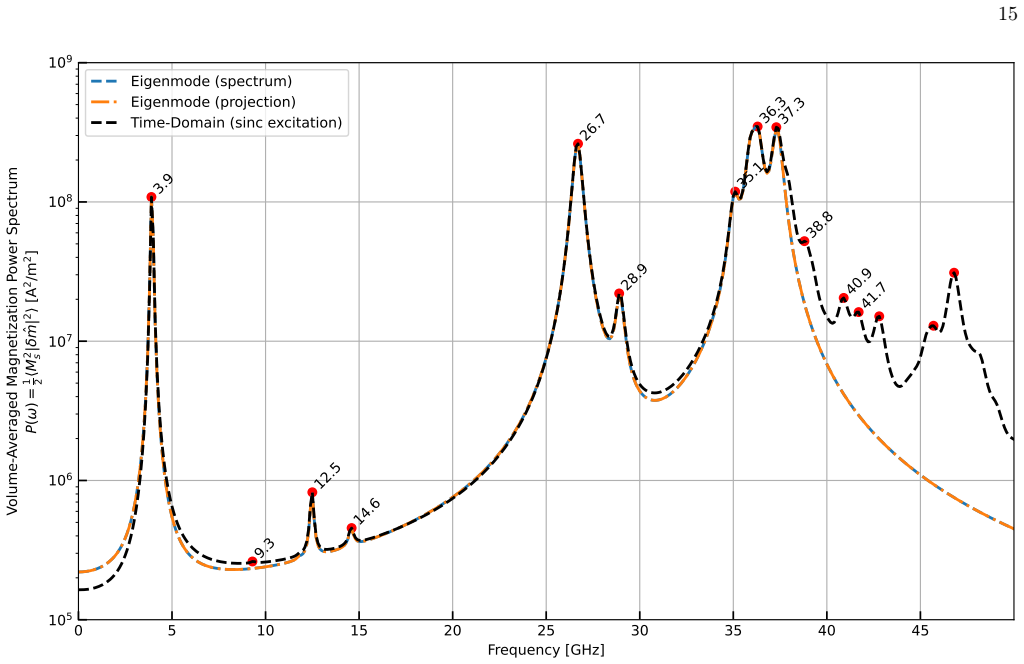
Breathing modes Modes C and D in Fig. 3b are breathing modes, in which the skyrmion radius grows and shrinks periodically [29, 42]. The visualisations show that in mode C atfC = 20.37GHz the top and bottom layer breath in phase, whereas in mode D atf D = 34.12GHz the top and bottom layer breath out of phase. The energetic impact of out-of-phase behaviour ...
-
[2]
the excitation of the system with a small-amplitude applied magnetic field, and 2
Ringdown method Starting from the equilibrium state, the ringdown method has two consecutive phase: 1. the excitation of the system with a small-amplitude applied magnetic field, and 2. the recording of the ‘ringing-down’ of the system, which is used for the time-domain Fourier analysis. In both phases, the damping is set to a much smaller value ofα= 10−3...
-
[3]
Eigenvalue method For the eigenvalue method we need to compute eigenvalues and eigenvectors of the linearised LLG equation for small perturbations of the equilibrium configurationm0 [51]. For this we use the eigenvalue solver built intomagnum.np, which internally uses the ARPACK implementation of the implicitly restarted Arnoldi method [52] via the SciPy ...
-
[4]
Skyrme, A unified field theory of mesons and baryons, Nuclear Physics31, 556 (1962)
T. Skyrme, A unified field theory of mesons and baryons, Nuclear Physics31, 556 (1962)
1962
-
[5]
U. K. Rößler, A. N. Bogdanov, and C. Pfleiderer, Spontaneous skyrmion ground states in magnetic metals, Nature442, 797 (2006)
2006
-
[6]
Nagaosa, Topological properties and dynamics of magnetic skyrmions, Nature Nanotechnology8(2013)
N. Nagaosa, Topological properties and dynamics of magnetic skyrmions, Nature Nanotechnology8(2013)
2013
-
[7]
Finocchio, F
G. Finocchio, F. Büttner, R. Tomasello, M. Carpentieri, and M. Kläui, Magnetic skyrmions: From fundamental to appli- cations, Journal of Physics D: Applied Physics49, 423001 (2016)
2016
-
[8]
Kong and H
L. Kong and H. Ding, Majorana gets an iron twist, National Science Review6, 196 (2019)
2019
-
[9]
Zhang, Y
X. Zhang, Y. Zhou, K. Mee Song, T.-E. Park, J. Xia, M. Ezawa, X. Liu, W. Zhao, G. Zhao, and S. Woo, Skyrmion- electronics: Writing, deleting, reading and processing magnetic skyrmions toward spintronic applications, Journal of Physics: Condensed Matter32, 143001 (2020)
2020
-
[10]
Zhang, Y
H. Zhang, Y. Zhang, Z. Hou, M. Qin, X. Gao, and J. Liu, Magnetic skyrmions: Materials, manipulation, detection, and applications in spintronic devices, Materials Futures2, 032201 (2023)
2023
-
[11]
K. M. Song, J.-S. Jeong, B. Pan, X. Zhang, J. Xia, S. Cha, T.-E. Park, K. Kim, S. Finizio, J. Raabe, J. Chang, Y. Zhou, W. Zhao, W. Kang, H. Ju, and S. Woo, Skyrmion-based artificial synapses for neuromorphic computing, Nature Electronics 3, 148 (2020)
2020
-
[12]
H. Y. Yuan, X. Zhang, and C. J. O. Reichhardt, Editorial: Generation, detection and manipulation of skyrmions in magnetic nanostructures, Frontiers in Physics10, 964975 (2022)
2022
-
[13]
S. A. Wolf, D. D. Awschalom, R. A. Buhrman, J. M. Daughton, S. Von Molnár, M. L. Roukes, A. Y. Chtchelkanova, and D. M. Treger, Spintronics: A Spin-Based Electronics Vision for the Future, Science294, 1488 (2001)
2001
-
[14]
Juarez-Martinez, A
G. Juarez-Martinez, A. Chiolerio, P. Allia, M. Poggio, C. L. Degen, L. Zhang, B. J. Nelson, L. Dong, M. Iwamoto, M. J. Buehler, G. Bratzel, F. A. Mohamed, N. Doble, A. Govil, I. Bita, E. Gusev, J.-T. Huang, K.-Y. Lee, H.-J. Hsu, P.-S. Chao, C.-Y. Lin, J. Muthuswamy, M. Okandan, D. P. Butler, Z. Celik-Butler, B. Kim, W.-T. Park, A. Baig, D. Gamzina, J. Zha...
2012
-
[15]
Everschor-Sitte, J
K. Everschor-Sitte, J. Masell, R. M. Reeve, and M. Kläui, Perspective: Magnetic skyrmions—Overview of recent progress in an active research field, Journal of Applied Physics124, 240901 (2018)
2018
-
[16]
W. Liu, M. T. Bryan, and Y. Xu, Introduction to spintronics and 2D materials, inSpintronic 2D Materials(Elsevier, 2020) pp. 1–24
2020
-
[17]
Hirohata, K
A. Hirohata, K. Yamada, Y. Nakatani, I.-L. Prejbeanu, B. Diény, P. Pirro, and B. Hillebrands, Review on spintronics: Principles and device applications, Journal of Magnetism and Magnetic Materials509, 166711 (2020)
2020
-
[18]
B. Chen, M. Zeng, K. H. Khoo, D. Das, X. Fong, S. Fukami, S. Li, W. Zhao, S. S. Parkin, S. Piramanayagam, and S. T. Lim, Spintronic devices for high-density memory and neuromorphic computing – A review, Materials Today70, 193 (2023)
2023
-
[19]
K. K. Mishra, A. H. Lone, S. Srinivasan, H. Fariborzi, and G. Setti, Magnetic Skyrmion: From Fundamental Physics to Pioneering Applications (2023), arXiv:2308.11811 [cond-mat]
arXiv 2023
-
[20]
A. Sud, A. Kumar, and M. Cubukcu, Novel Magnetic Materials for Spintronic Device Technology (2025), arXiv:2501.19087 [cond-mat]
arXiv 2025
-
[21]
A. Fert, V. Cros, and J. Sampaio, Skyrmions on the track, Nature Nanotechnology8, 152 (2013)
2013
-
[22]
Parkin and S.-H
S. Parkin and S.-H. Yang, Memory on the racetrack, Nature Nanotechnology10, 195 (2015)
2015
-
[23]
Lemesh, M.-A
S.Woo, K.Litzius, B.Krüger, M.-Y.Im, L.Caretta, K.Richter, M.Mann, A.Krone, R.M.Reeve, M.Weigand, P.Agrawal, I. Lemesh, M.-A. Mawass, P. Fischer, M. Kläui, and G. S. D. Beach, Observation of room-temperature magnetic skyrmions and their current-driven dynamics in ultrathin metallic ferromagnets, Nature Materials15, 501 (2016)
2016
-
[24]
A. V. Chumak, A. A. Serga, and B. Hillebrands, Magnonic crystals for data processing, Journal of Physics D: Applied Physics50, 244001 (2017)
2017
-
[25]
Chen and F
Z. Chen and F. Ma, Skyrmion based magnonic crystals, Journal of Applied Physics130, 090901 (2021)
2021
-
[26]
S. Luo, M. Song, X. Li, Y. Zhang, J. Hong, X. Yang, X. Zou, N. Xu, and L. You, Reconfigurable skyrmion logic gates, Nano Letters18, 1180 (2018), pMID: 29350935, https://doi.org/10.1021/acs.nanolett.7b04722
-
[27]
Z. Yan, Y. Liu, Y. Guang, K. Yue, J. Feng, R. Lake, G. Yu, and X. Han, Skyrmion-based programmable logic device with 17 complete boolean logic functions, Phys. Rev. Appl.15, 064004 (2021)
2021
-
[28]
Büttner, C
F. Büttner, C. Moutafis, M. Schneider, B. Krüger, C. M. Günther, J. Geilhufe, C. v. K. Schmising, J. Mohanty, B. Pfau, S. Schaffert, A. Bisig, M. Foerster, T. Schulz, C. a. F. Vaz, J. H. Franken, H. J. M. Swagten, M. Kläui, and S. Eisebitt, Dynamics and inertia of skyrmionic spin structures, Nature Physics11, 225 (2015)
2015
-
[29]
K. Y. Guslienko and Z. V. Gareeva, Gyrotropic Skyrmion Modes in Ultrathin Magnetic Circular Dots, IEEE Magnetics Letters8, 1 (2017)
2017
-
[30]
S. Woo, K. M. Song, H.-S. Han, M.-S. Jung, M.-Y. Im, K.-S. Lee, K. S. Song, P. Fischer, J.-I. Hong, J. W. Choi, B.-C. Min, H. C. Koo, and J. Chang, Spin-orbit torque-driven skyrmion dynamics revealed by time-resolved X-ray microscopy, Nature Communications8, 15573 (2017)
2017
-
[31]
D. A. Garanin, R. Jaafar, and E. M. Chudnovsky, Breathing mode of a skyrmion on a lattice, Physical Review B101, 014418 (2020)
2020
-
[32]
J. Kim, J. Yang, Y.-J. Cho, B. Kim, and S.-K. Kim, Coupled gyration modes in one-dimensional skyrmion arrays in thin-film nanostrips as new type of information carrier, Scientific Reports7, 45185 (2017)
2017
-
[33]
J. Kim, J. Yang, Y.-J. Cho, B. Kim, and S.-K. Kim, Coupled breathing modes in one-dimensional Skyrmion lattices, Journal of Applied Physics123, 053903 (2018)
2018
-
[34]
Garst, J
M. Garst, J. Waizner, and D. Grundler, Collective spin excitations of helices and magnetic skyrmions: review and per- spectives of magnonics in non-centrosymmetric magnets, Journal of Physics D: Applied Physics50, 293002 (2017)
2017
-
[35]
F.Büttner, I.Lemesh,andG.S.D.Beach,Theoryofisolatedmagneticskyrmions: Fromfundamentalstoroomtemperature applications, Scientific Reports8, 4464 (2018)
2018
-
[36]
Bernand-Mantel, L
A. Bernand-Mantel, L. Camosi, A. Wartelle, N. Rougemaille, M. Darques, and L. Ranno, The skyrmion-bubble transition in a ferromagnetic thin film, SciPost Physics4, 027 (2018)
2018
-
[37]
Moreau-Luchaire, C
C. Moreau-Luchaire, C. Moutafis, N. Reyren, J. Sampaio, C. a. F. Vaz, N. Van Horne, K. Bouzehouane, K. Garcia, C. Deranlot, P. Warnicke, P. Wohlhüter, J.-M. George, M. Weigand, J. Raabe, V. Cros, and A. Fert, Additive interfacial chiralinteractioninmultilayersforstabilizationofsmallindividualskyrmionsatroomtemperature,NatureNanotechnology 11, 444 (2016)
2016
-
[38]
Boulle, J
O. Boulle, J. Vogel, H. Yang, S. Pizzini, D. de Souza Chaves, A. Locatelli, T. O. Menteş, A. Sala, L. D. Buda-Prejbeanu, O. Klein, M. Belmeguenai, Y. Roussigné, A. Stashkevich, S. M. Chérif, L. Aballe, M. Foerster, M. Chshiev, S. Auffret, I. M. Miron, and G. Gaudin, Room-temperature chiral magnetic skyrmions in ultrathin magnetic nanostructures, Nature Na...
2016
-
[39]
M. Beg, M. Albert, M.-A. Bisotti, D. Cortés-Ortuño, W. Wang, R. Carey, M. Vousden, O. Hovorka, C. Ciccarelli, C. S. Spencer, C. H. Marrows, and H. Fangohr, Dynamics of skyrmionic states in confined helimagnetic nanostructures, Physical Review B95, 014433 (2017)
2017
-
[40]
Y. Zhao, S. Yang, K. Wu, S. Li, Y. Gao, H. Hao, X. Zhang, S. Wang, Q. Liu, S. Zhang, Z. Chu, J. Åkerman, and Y. Zhou, Identifying and Exploring Synthetic Antiferromagnetic Skyrmions, Advanced Functional Materials33, 2303133 (2023)
2023
-
[41]
R. A. Duine, K.-J. Lee, S. S. P. Parkin, and M. D. Stiles, Synthetic antiferromagnetic spintronics, Nature Physics14, 217 (2018)
2018
-
[42]
Zhang, Y
X. Zhang, Y. Zhou, and M. Ezawa, Magnetic bilayer-skyrmions without skyrmion Hall effect, Nature Communications7, 10293 (2016)
2016
-
[43]
Legrand, D
W. Legrand, D. Maccariello, F. Ajejas, S. Collin, A. Vecchiola, K. Bouzehouane, N. Reyren, V. Cros, and A. Fert, Room- temperature stabilization of antiferromagnetic skyrmions in synthetic antiferromagnets, Nature Materials19, 34 (2020)
2020
-
[44]
L. Xing, D. Hua, and W. Wang, Magnetic excitations of skyrmions in antiferromagnetic-exchange coupled disks, Journal of Applied Physics124, 123904 (2018)
2018
-
[45]
Lonsky and A
M. Lonsky and A. Hoffmann, Coupled skyrmion breathing modes in synthetic ferri- and antiferromagnets, Physical Review B102, 104403 (2020)
2020
-
[46]
C. E. A. Barker, E. Haltz, Thomas. A. Moore, and C. H. Marrows, Breathing modes of skyrmion strings in a synthetic antiferromagnet multilayer, Journal of Applied Physics133, 113901 (2023)
2023
-
[47]
J.-V. Kim, F. Garcia-Sanchez, J. Sampaio, C. Moreau-Luchaire, V. Cros, and A. Fert, Breathing modes of confined skyrmions in ultrathin magnetic dots, Physical Review B90, 064410 (2014)
2014
-
[48]
Mruczkiewicz, P
M. Mruczkiewicz, P. Gruszecki, M. Zelent, and M. Krawczyk, Collective dynamical skyrmion excitations in a magnonic crystal, Phys. Rev. B93, 174429 (2016)
2016
-
[49]
K. Y. Guslienko, Gauge and emergent electromagnetic fields for moving magnetic topological solitons, EPL (Europhysics Letters)113, 67002 (2016)
2016
-
[50]
Bruckner, S
F. Bruckner, S. Koraltan, C. Abert, and D. Suess, Magnum.np: A PyTorch based GPU enhanced finite difference micro- magnetic simulation framework for high level development and inverse design, Scientific Reports13, 12054 (2023)
2023
-
[51]
M. A. Ruderman and C. Kittel, Indirect Exchange Coupling of Nuclear Magnetic Moments by Conduction Electrons, Physical Review96, 99 (1954)
1954
-
[52]
Paszke, S
A. Paszke, S. Gross, F. Massa, A. Lerer, J. Bradbury, G. Chanan, T. Killeen, Z. Lin, N. Gimelshein, L. Antiga, A. Des- maison, A. Köpf, E. Yang, Z. DeVito, M. Raison, A. Tejani, S. Chilamkurthy, B. Steiner, L. Fang, J. Bai, and S. Chintala, Pytorch: an imperative style, high-performance deep learning library, inProceedings of the 33rd International Confer...
2019
-
[54]
d’Aquino, C
M. d’Aquino, C. Serpico, G. Miano, and C. Forestiere, A novel formulation for the numerical computation of magnetization modes in complex micromagnetic systems, Journal of Computational Physics228, 6130 (2009)
2009
-
[55]
K. J. Maschho and D. C. Sorensen, inLecture Notes in Computer Science(Springer, New York, 2005) pp. 478–486. 18
2005
-
[56]
Virtanen, R
P. Virtanen, R. Gommers, T. E. Oliphant, M. Haberland, T. Reddy, D. Cournapeau, E. Burovski, P. Peterson, W. Weckesser, J. Bright, S. J. van der Walt, M. Brett, J. Wilson, K. J. Millman, N. Mayorov, A. R. J. Nelson, E. Jones, R. Kern, E. Larson, C. J. Carey, I. Polat, Y. Feng, E. W. Moore, J. VanderPlas, D. Laxalde, J. Perktold, R. Cimrman, I. Henriksen, ...
2020
-
[58]
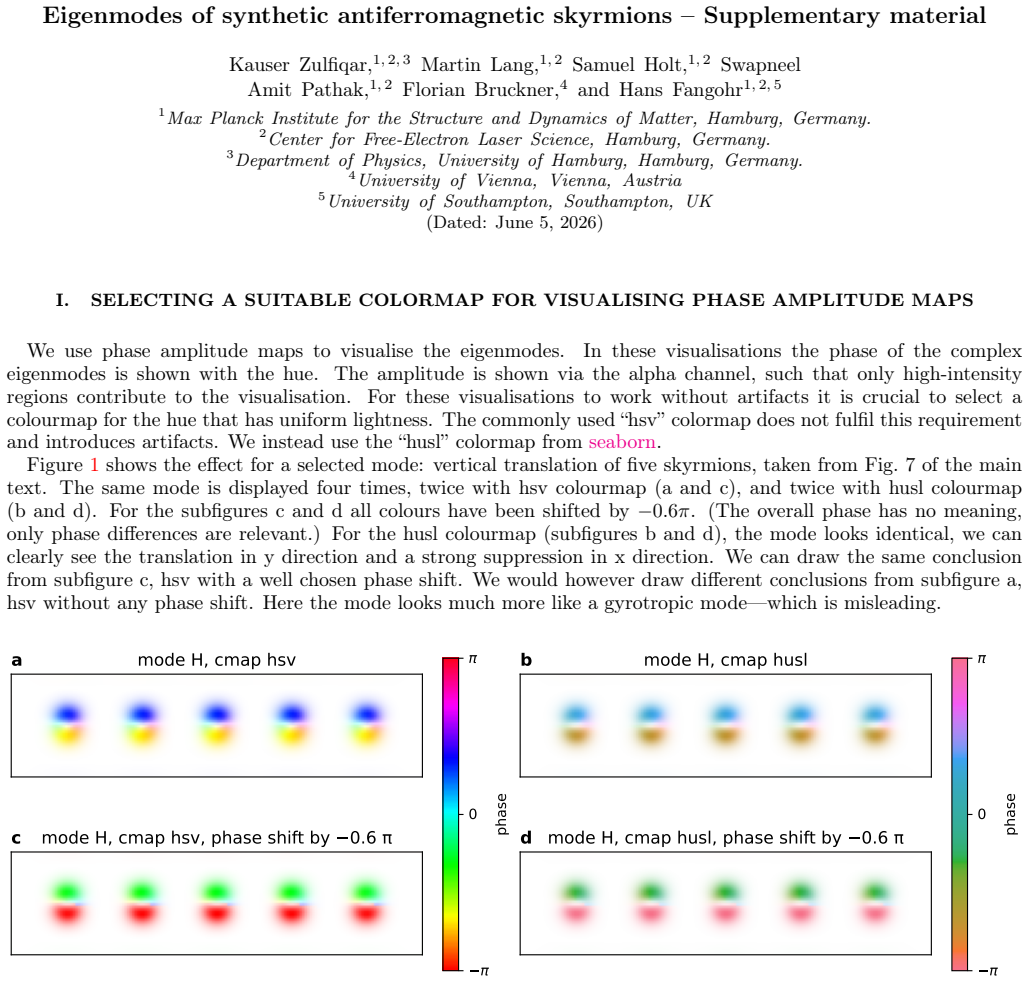
hsv” colormap does not fulfil this requirement and introduces artifacts. We instead use the “husl
C. Schütte, J. Iwasaki, A. Rosch, and N. Nagaosa, Inertia, diffusion, and dynamics of a driven skyrmion, Physical Review B90, 174434 (2014). ACKNOWLEDGEMENTS We thank Guido Meier for fruitful discussion. This work is supported by the European Union’s Horizon research and innovation program under MaMMoS No. 101135546, Marie Skłodowska Curie grant agreement...
-
[59]
Without Dampingα= 0 Settingα= 0in Eqn. (2) leads to the following Hermitian generalized eigenvalue problem A0⊥ [˜φk] =ω k B0 [˜φk],(3) where ˜φk andω k represent the undamped eigenmodes and eigenfrequencies, respectively. Both operatorsA0⊥ and B0 are Hermitian, which allows using the Lanczos algorithm for the solution of the eigenvalue problem, resulting ...
-
[60]
Perturbation analysis for dampingα >0 Starting from Eqn. (2) allowing for small dampingα >0and assuming perturbed quantities ˜φ′ k = ˜φk +δ ˜φk, ω′ k =ω k +i δω k, andB ′ 0 =B 0 +i δBresults in the following perturbated eigenvalue problem A0⊥ [˜φk +δ ˜φk] = (ωk +i δω k) (B0 +i δB) [ ˜φk +δ ˜φk],(7) with the perturbed operatorδB=−α1. Direct solution of the...
-
[61]
Harmonic Excitation Adding ˜h a as a source term to the unperturbed Eqn. (3) yields ωB 0 δ ˜m=A 0⊥ δ ˜m−γP 0 ˜h a (11) In order to utilise the orthogonality relation (6), the excited solutionδ˜mis expressed by the unperturbed eigen- vectors δ ˜m(x, ω) = X k ˜ak(ω) ˜φk(x)(12) 13 Scalar multiplying both sides of equation (11) with˜φh and utilizing the ortho...
-
[62]
(22) of Ref
Power Spectrum of Magnetization Thevolume-averagedpowerspectrumofthemagnetizationdrivenbyaharmonicexcitation ˜h a isdefinedas(compare Eqn. (22) of Ref. [13]) ˜p(ω) = 1 2V Z M2 s |δ ˜m(x, ω)|2 dx(15) = 1 2 ∥Msδ ˜m(x, ω)∥2,(16) withδ ˜mbeing the harmonic magnetization response driven by˜h a . Inserting the modal expansion (14) yields ˜p(ω) =γ2 2 X k,h ωkωh ...
-
[63]
(25) of Ref
Absorbed Magnetic Power The average power absorbed by the magnetic systemPabs(ω)driven by a harmonic excitation˜h a can be defined as the real part of the complex absorbed powerˆPabs(ω)(compare Eq. (25) of Ref. [13]) ˆPabs(ω) = µ0 2V Z iω Ms(x)δ ˜m(x, ω)· ˜h a∗ (x) dx(20) = µ0 2 iω⟨ ˜h a , M s δ ˜m⟩.(21) Inserting the modal expansion (14) and defining the...
-
[64]
The elliptical shape is defined by masking cells outside the ellipse boundary
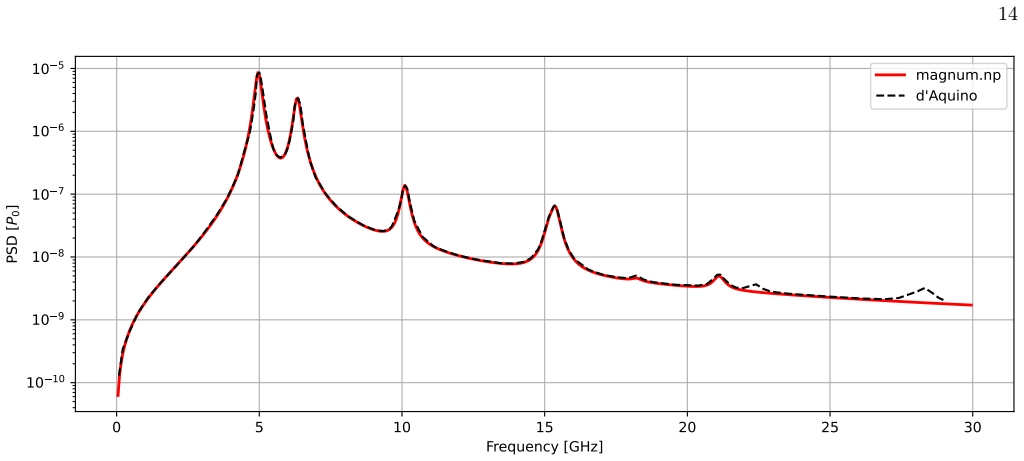
Elliptical nanodisc (run_carlotti.py) The eigenmode method is first applied to an elliptical Permalloy nanodisc with dimensions200 nm×100 nm×5 nm, discretized on a200×100×1finite-difference grid with a cell size of1 nm×1 nm×5 nm. The elliptical shape is defined by masking cells outside the ellipse boundary. The material parameters areMs = 800 kA/m,A= 13 p...
-
[65]
Each layer occupies one cell along thez-direction
Antiferromagnetically coupled bilayer (run_bilayer.py) The second example considers an antiferromagnetically coupled bilayer with dimensions120 nm×120 nm×10 nm, discretized on a24×24×2grid (cell size5 nm×5 nm×5 nm). Each layer occupies one cell along thez-direction. The material parameters areMs = 800 kA/m,A= 13 pJ/m, interfacial DMID i =−3 mJ/m 2, uniaxi...
-
[66]
Scholz, T
W. Scholz, T. Schrefl, and J. Fidler, Micromagnetic simulation of thermally activated switching in fine particles, Journal of Magnetism and Magnetic Materials233, 296 (2001)
2001
-
[67]
Bruckner, M
F. Bruckner, M. d’Aquino, C. Serpico, C. Abert, C. Vogler, and D. Suess, Large scale finite-element simulation of micro- magnetic thermal noise, Journal of Magnetism and Magnetic Materials468, 65 (2019)
2019
-
[68]
Baker, M
A. Baker, M. Beg, G. Ashton, M. Albert, D. Chernyshenko, W. Wang, S. Zhang, M.-A. Bisotti, M. Franchin, C. L. Hu, et al., Proposal of a micromagnetic standard problem for ferromagnetic resonance simulations, Journal of Magnetism and Magnetic Materials421, 428 (2017)
2017
-
[69]
G.Carlotti, G.Gubbiotti, M.Madami, S.Tacchi,andR.Stamps,Exchange-dominatedeigenmodesinsub-100nmpermalloy dots: A micromagnetic study at finite temperature, Journal of Applied Physics115, 17D119 (2014)
2014
-
[70]
H. N. Bertram, V. L. Safonov, and Z. Jin, Thermal magnetization noise, damping fundamentals, and mode analysis: application to a thin film GMR sensor, IEEE Transactions on Magnetics38, 2514 (2002)
2002
-
[71]
Z. Jin, H. Bertram, and V. Safonov, Quasi-analytical calculation of thermal magnetization fluctuation noise in giant magnetoresistive sensors, IEEE Transactions on Magnetics40, 1712 (2004)
2004
-
[72]
Grimsditch, L
M. Grimsditch, L. Giovannini, F. Montoncello, F. Nizzoli, G. K. Leaf, and H. G. Kaper, Magnetic normal modes in ferromagnetic nanoparticles: A dynamical matrix approach, Physical Review B70, 054409 (2004)
2004
-
[73]
R. D. McMichael and M. D. Stiles, Magnetic normal modes of nanoelements, Journal of Applied Physics97, 10J901 (2005)
2005
-
[74]
d’Aquino, C
M. d’Aquino, C. Serpico, G. Miano, and G. Bertotti, Computation of Resonant Modes and Frequencies for Saturated Ferromagnetic Nanoparticles, IEEE Transactions on Magnetics44, 3141 (2008)
2008
-
[75]
d’Aquino, C
M. d’Aquino, C. Serpico, G. Miano, and C. Forestiere, A novel formulation for the numerical computation of magnetization modes in complex micromagnetic systems, Journal of Computational Physics228, 6130 (2009). 16
2009
-
[76]
Forestiere, M
C. Forestiere, M. d’Aquino, G. Miano, and C. Serpico, Finite element computations of resonant modes for small magnetic particles, Journal of Applied Physics105, 07D312 (2009)
2009
-
[77]
R. B. Lehoucq, D. C. Sorensen, and C. Yang,ARPACK users’ guide: solution of large-scale eigenvalue problems with implicitly restarted Arnoldi methods, Vol. 6 (SIAM, 1998)
1998
-
[78]
d’Aquino and R
M. d’Aquino and R. Hertel, Micromagnetic frequency-domain simulation methods for magnonic systems, Journal of Applied Physics133, 033902 (2023)
2023
-
[79]
Perna, F
S. Perna, F. Bruckner, C. Serpico, D. Suess, and M. d’Aquino, Computational micromagnetics based on normal modes: Bridging the gap between macrospin and full spatial discretization, Journal of Magnetism and Magnetic Materials546, 168683 (2022)
2022
-
[80]
Bruckner, S
F. Bruckner, S. Koraltan, C. Abert, and D. Suess, magnum.np: a PyTorch based GPU enhanced finite difference micro- magnetic simulation framework for high level development and inverse design, Scientific Reports13, 12054 (2023)
2023
discussion (0)
Sign in with ORCID, Apple, or X to comment. Anyone can read and Pith papers without signing in.