Circular Raman responses from angular-momentum inequivalence in CoSi
Pith reviewed 2026-06-27 21:16 UTC · model grok-4.3
The pith
Circular Raman responses in CoSi arise from inequivalence of phonon states carrying opposite crystal angular momenta.
A machine-rendered reading of the paper's core claim, the machinery that carries it, and where it could break.
Core claim
These seemingly different responses can be understood within a common framework based on the inequivalence of phonon states carrying opposite crystal angular momenta. Using helicity-resolved Raman spectroscopy of the chiral crystal CoSi, ROA and frequency splitting arise from different symmetry channels, namely axial multipolar symmetry and structural chirality, respectively. First-principles calculations reproduce both effects and clarify their symmetry origins, establishing angular-momentum inequivalence as a unifying principle of circular Raman responses.
What carries the argument
Angular-momentum inequivalence between phonon states carrying opposite crystal angular momenta, which assigns the two observed responses to separate symmetry channels.
If this is right
- ROA arises specifically from axial multipolar symmetry while frequency splitting arises from structural chirality.
- Both effects are direct consequences of the same angular-momentum inequivalence in the phonon spectrum.
- Helicity-resolved Raman spectroscopy thereby probes the angular-momentum structure of chiral phonons.
- The framework applies to other chiral crystals where similar phonon states can be resolved.
Where Pith is reading between the lines
- The same angular-momentum lens could be applied to interpret circular Raman data in other topological or chiral materials without requiring separate models for each effect.
- If the mapping holds, helicity-resolved spectra might serve as a practical probe for crystal angular momentum in systems where direct phonon angular-momentum measurements are difficult.
- Extending the measurements to doped or strained CoSi could test whether the symmetry-channel assignment remains stable under small perturbations.
Load-bearing premise
The two observed effects map cleanly onto distinct symmetry channels of axial multipolar symmetry and structural chirality through angular-momentum inequivalence alone, without additional fitting or data-channel selection.
What would settle it
A first-principles calculation for CoSi that fails to reproduce both the ROA signal and the frequency splitting, or an experimental observation of frequency splitting in a material without structural chirality, would falsify the unification claim.
Figures
read the original abstract
Circularly polarized Raman scattering in solids exhibits distinct phenomena such as Raman optical activity (ROA) and chiral-phonon-induced frequency splitting, whose relationship has remained unclear. Here we show that these seemingly different responses can be understood within a common framework based on the inequivalence of phonon states carrying opposite crystal angular momenta. Using helicity-resolved Raman spectroscopy of the chiral crystal CoSi, we find that ROA and frequency splitting arise from different symmetry channels, namely axial multipolar symmetry and structural chirality, respectively. First-principles calculations reproduce both effects and clarify their symmetry origins. These results establish angular-momentum inequivalence as a unifying principle of circular Raman responses and link helicity-resolved Raman spectroscopy to the angular-momentum structure of chiral phonons in topological materials.
Editorial analysis
A structured set of objections, weighed in public.
Referee Report
Summary. The paper claims that ROA and chiral-phonon-induced frequency splitting in CoSi arise from inequivalence of phonon states with opposite crystal angular momenta, mapping to distinct symmetry channels (axial multipolar symmetry for ROA, structural chirality for splitting). Helicity-resolved Raman spectroscopy on CoSi and first-principles calculations are presented as reproducing both effects and clarifying their origins, establishing angular-momentum inequivalence as a unifying framework for circular Raman responses.
Significance. If the central mapping holds, the work supplies a common symmetry-based framework linking two circular Raman phenomena to chiral-phonon angular momentum, with explicit credit due to the first-principles calculations that reproduce the observables and the experimental isolation of symmetry channels in CoSi.
major comments (2)
- [Abstract] Abstract and symmetry-channel analysis: the claim that the ROA/splitting mapping 'follows directly' from angular-momentum inequivalence without post-selection or cross-talk requires an explicit check (e.g., via symmetry decomposition tables or phonon angular-momentum projections) that no auxiliary fitting or channel selection is used; the abstract alone supplies no such verification, which is load-bearing for the unifying claim.
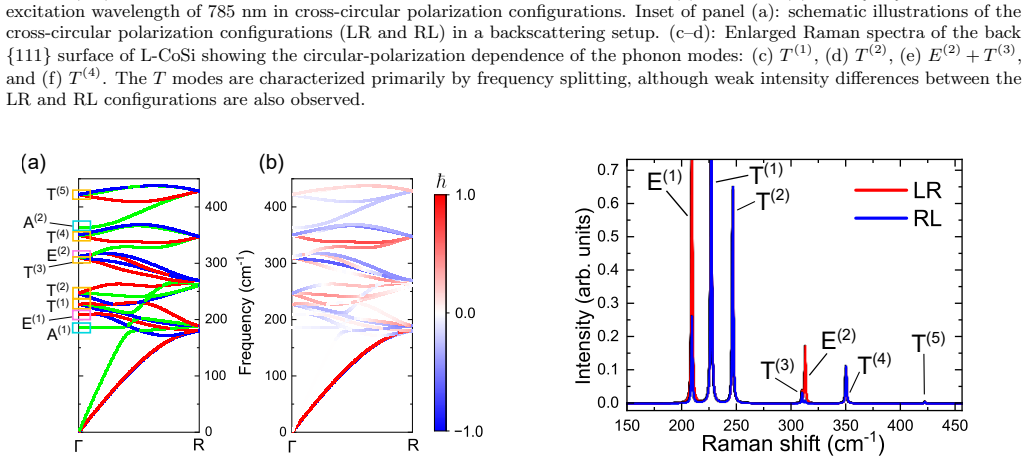
- [Methods] Computational methods section: the assertion that first-principles calculations reproduce both effects lacks reported parameters (k-point mesh, pseudopotentials, convergence criteria, error bars on frequencies or intensities), preventing independent assessment of whether the calculated phonon angular momenta alone control the two observables.
minor comments (2)
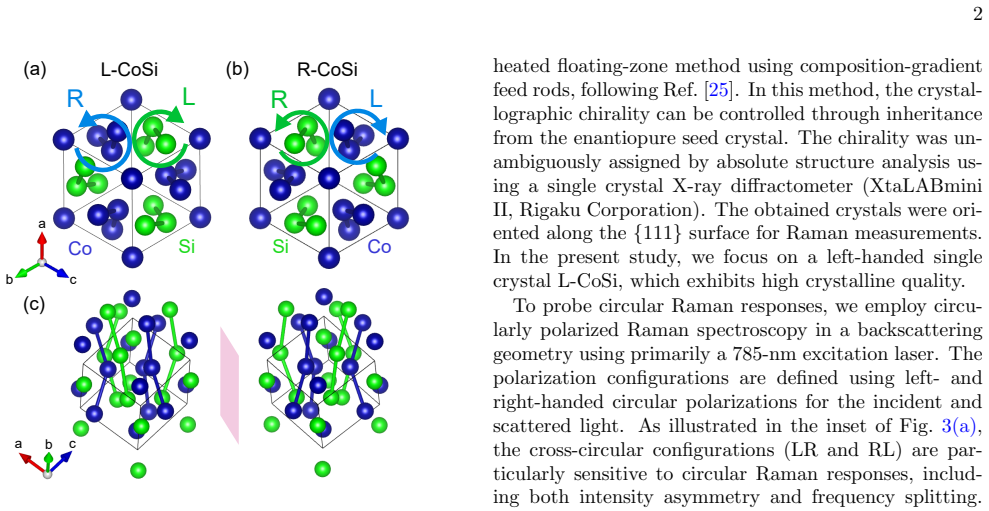
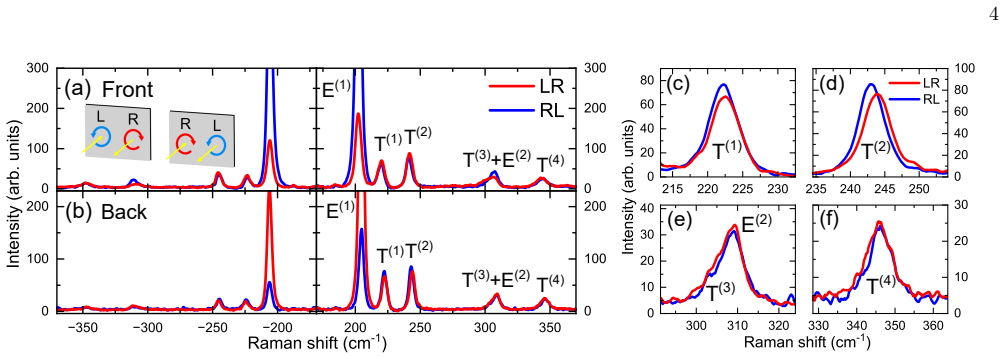
- Figure captions should explicitly label which panels correspond to axial-multipolar vs. structural-chirality channels.
- Notation for crystal angular momentum (e.g., L_z) should be defined at first use and kept consistent with phonon-mode labels.
Simulated Author's Rebuttal
We thank the referee for their careful reading of the manuscript and for the constructive comments. We address each major comment below and have made revisions to improve clarity and completeness.
read point-by-point responses
-
Referee: [Abstract] Abstract and symmetry-channel analysis: the claim that the ROA/splitting mapping 'follows directly' from angular-momentum inequivalence without post-selection or cross-talk requires an explicit check (e.g., via symmetry decomposition tables or phonon angular-momentum projections) that no auxiliary fitting or channel selection is used; the abstract alone supplies no such verification, which is load-bearing for the unifying claim.
Authors: We agree that the abstract should explicitly reference the verification of the symmetry mapping. The main text (Sections III and IV) already contains the full symmetry-channel decomposition into axial multipolar symmetry for ROA and structural chirality for frequency splitting, together with direct phonon angular-momentum projections obtained from the first-principles calculations; no auxiliary fitting or channel post-selection is performed. To make this verification immediately visible, we have revised the abstract to state that the mapping is confirmed by these explicit symmetry tables and projections (now also collected in a new supplementary table). revision: partial
-
Referee: [Methods] Computational methods section: the assertion that first-principles calculations reproduce both effects lacks reported parameters (k-point mesh, pseudopotentials, convergence criteria, error bars on frequencies or intensities), preventing independent assessment of whether the calculated phonon angular momenta alone control the two observables.
Authors: We accept that the computational details must be reported for reproducibility. In the revised manuscript we have expanded the Methods section to specify the k-point mesh, pseudopotentials, plane-wave cutoff, convergence thresholds, and the error bars obtained on the calculated phonon frequencies and Raman intensities. These additions confirm that the angular-momentum projections are obtained directly from the same calculations that reproduce the two observables. revision: yes
Circularity Check
No circularity: experimental data and first-principles calculations provide independent support
full rationale
The abstract and description present helicity-resolved Raman spectroscopy on CoSi as direct experimental input and first-principles calculations as separate reproduction of ROA and frequency splitting. The unifying claim of angular-momentum inequivalence is framed as an interpretation linking these two independent supports rather than a derivation that reduces to fitted parameters or self-citations. No equations or steps are shown that equate a prediction to its own input by construction, and no load-bearing self-citation chain is invoked. The derivation chain remains self-contained against external benchmarks.
Axiom & Free-Parameter Ledger
axioms (1)
- standard math Standard assumptions underlying density-functional-theory phonon calculations
Reference graph
Works this paper leans on
-
[1]
L. D. Barron,Molecular Light Scattering and Optical Ac- tivity, 2nd ed. (Cambridge University Press, 2004)
2004
-
[2]
L. D. Barron, M. P. Bogaard, and A. D. Buckingham, Ra- man scattering of circularly polarized light by optically active molecules, J. Am. Chem. Soc.95, 603 (1973)
1973
-
[3]
E. M. Lacinska, M. Furman, J. Binder, I. Lutsyk, P. J. Kowalczyk, R. Stepniewski, and A. Wysmolek, Raman optical activity of 1T-TaS 2, Nano Lett.22, 2835 (2022)
2022
-
[4]
H. F. Yang, K. Y. He, J. Koo, S. W. Shen, S. H. Zhang, G. Liu, Y. Z. Liu, C. Chen, A. J. Liang, K. Huang, M. X. Wang, J. J. Gao, X. Luo, L. X. Yang, J. P. Liu, Y. P. Sun, S. C. Yan, B. H. Yan, Y. L. Chen, X. Xi, and Z. K. Liu, Visualization of chiral electronic structure and anoma- lous optical response in a material with chiral charge density waves, Phys...
2022
-
[5]
V. A. Martinez, Y. Gao, J. Yang, F. Lyzwa, Z. Liu, C. J. Won, K. Du, V. Kiryukhin, S. W. Cheong, and A. A. Sirenko, Ferroaxial phonons in chiral and polar NiCo2TeO6, Phys. Rev. B112, 064411 (2025)
2025
-
[6]
Kusuno, T
G. Kusuno, T. Hayashida, T. Nagai, H. Watanabe, R. Oiwa, T. Kimura, and T. Satoh, Raman optical ac- tivity induced by ferroaxial order in NiTiO 3, Phys. Rev. Lett.136, 206902 (2026). 6
2026
-
[7]
Y. Suganuma, G. Kusuno, H. Watanabe, R. Oiwa, H. Mori, R. Arita, and T. Satoh, Electric toroidal oc- tupolar symmetry in pyrite FeS 2 probed by Raman op- tical activity, arXiv:2603.21756 (2026)
arXiv 2026
-
[8]
Watanabe, R
H. Watanabe, R. Oiwa, G. Kusuno, T. Satoh, and R. Arita, Symmetry analysis of cross-circular and parallel-circular Raman optical activity, Phys. Rev. B 112, 115105 (2025)
2025
-
[9]
H. Watanabe, R. Oiwa, H. Mori, and R. Arita, Dual- circular Raman optical activity of axial multipolar order, arXiv:2507.09237 (2025)
arXiv 2025
-
[10]
H. Zhu, J. Yi, M.-Y. Li, J. Xiao, L. Zhang, C.-W. Yang, R. A. Kaindl, L.-J. Li, Y. Wang, and X. Zhang, Obser- vation of chiral phonons, Science359, 579 (2018)
2018
-
[11]
D. M. Juraschek, R. M. Geilhufe, H. Zhu, M. Basini, P. Baum, A. Baydin, S. Chaudhary, M. Fechner, B. Fle- bus, G. Grissonnanche, A. I. Kirilyuk, M. Lemeshko, S. F. Maehrlein, M. Mignolet, S. Murakami, Q. Niu, U. Nowak, C. P. Romao, H. Rostami, T. Satoh, N. A. Spaldin, H. Ueda, and L. Zhang, Chiral phonons, Nat. Phys.21, 1532 (2025)
2025
-
[12]
Tsunetsugu and H
H. Tsunetsugu and H. Kusunose, Chiral phonons in a cubic lattice, J. Phys. Soc. Jpn.95, 013601 (2026)
2026
-
[13]
Zhang and Q
L. Zhang and Q. Niu, Angular momentum of phonons and the Einstein–de Haas effect, Phys. Rev. Lett.112, 085503 (2014)
2014
-
[14]
Boˇ zovic, Possible band-structure shapes of quasi-one- dimensional solids, Phys
I. Boˇ zovic, Possible band-structure shapes of quasi-one- dimensional solids, Phys. Rev. B29, 6586 (1984)
1984
-
[15]
Zhang and Q
L. Zhang and Q. Niu, Chiral phonons at high-symmetry points in monolayer hexagonal lattices, Phys. Rev. Lett. 115, 115502 (2015)
2015
-
[16]
Zhang and S
T. Zhang and S. Murakami, Chiral phonons and pseu- doangular momentum in nonsymmorphic systems, Phys. Rev. Res.4, L012024 (2022)
2022
-
[17]
Ishito, H
K. Ishito, H. Mao, Y. Kousaka, Y. Togawa, S. Iwasaki, T. Zhang, S. Murakami, J. Kishine, and T. Satoh, Truly chiral phonons inα-HgS, Nat. Phys.19, 35 (2023)
2023
-
[18]
Ishito, H
K. Ishito, H. Mao, K. Kobayashi, Y. Kousaka, Y. Togawa, H. Kusunose, J. Kishine, and T. Satoh, Chiral phonons: circularly polarized Raman spectroscopy and ab initio calculations in a chiral crystal tellurium, Chirality35, 338 (2023)
2023
-
[19]
Oishi, Y
E. Oishi, Y. Fujii, and A. Koreeda, Selective observation of enantiomeric chiral phonons inα-quartz, Phys. Rev. B109, 104306 (2024)
2024
-
[20]
Kusuno, S
G. Kusuno, S. Kisanuki, Y. Kousaka, Y. Togawa, and T. Satoh, Chiral phonons in sixfold chiral CrSi 2: Raman spectroscopy and first-principles calculations, Phys. Rev. B113, 104306 (2026)
2026
-
[21]
H. Ueda, M. Garc´ ıa-Fern´ andez, S. Agrestini, C. P. Ro- mao, J. van den Brink, N. A. Spaldin, K.-J. Zhou, and U. Staub, Chiral phonons in quartz probed by X-rays, Nature618, 946 (2023)
2023
-
[22]
Z. Rao, H. Li, T. Zhang, S. Tian, C. Li, B. Fu, C. Tang, L. Wang, Z. Li, W. Fan, J. Li, Y. Huang, Z. Liu, Y. Long, C. Fang, H. Weng, Y. Shi, H. Lei, Y. Sun, T. Qian, and H. Ding, Observation of unconventional chiral fermions with long Fermi arcs in CoSi, Nature567, 496 (2019)
2019
-
[23]
B. Xu, Z. Fang, M.-A. Sanchez-Martinez, J. W. F. Venderbos, Z. Ni, T. Qiu, K. Manna, K. Wang, J. Paglione, C. Bernhard, C. Felser, E. J. Mele, A. G. Grushin, A. M. Rappe, and L. Wu, Optical signatures of multifold fermions in the chiral topological semimetal CoSi, Proc. Natl. Acad. Sci. USA117, 27104 (2020)
2020
-
[24]
Hayami and H
S. Hayami and H. Kusunose, Unified description of elec- tronic orderings and cross correlations by complete multi- pole representation, J. Phys. Soc. Jpn.93, 072001 (2024)
2024
-
[25]
Kousaka, S
Y. Kousaka, S. Iwasaki, T. Sayo, H. Tanida, T. Mat- sumura, S. Araki, J. Akimitsu, and Y. Togawa, Chirality- controlled enantiopure crystal growth of a transition metal monosilicide by a floating zone method, Jpn. J. Appl. Phys.61, 045501 (2022)
2022
-
[26]
Hayami, M
S. Hayami, M. Yatsushiro, Y. Yanagi, and H. Kusunose, Classification of atomic-scale multipoles under crystallo- graphic point groups and application to linear response tensors, Phys. Rev. B98, 165110 (2018)
2018
-
[27]
Momma and F
K. Momma and F. Izumi, Vesta 3 for three-dimensional visualization of crystal, volumetric and morphology data, J. Appl. Crystallogr.44, 1272 (2011)
2011
-
[28]
See Supplemental Material athttp://link.aps.org/ supplemental/XXXXfor the experimental setup, addi- tional Raman spectra measured in parallel-circular po- larization configurations and at different excitation wave- lengths, computational details of the first-principles cal- culations, derivations of the Raman tensors and polariza- tion selection rules, an...
-
[29]
A.-M. Racu, D. Menzel, J. Schoenes, and K. Doll, Crys- tallographic disorder and electron-phonon coupling in Fe1−xCoxSi single crystals: Raman spectroscopy study, Phys. Rev. B76, 115103 (2007)
2007
-
[30]
Giannozzi, S
P. Giannozzi, S. Baroni, N. Bonini, M. Calandra, R. Car, C. Cavazzoni, D. Ceresoli, G. L. Chiarotti, M. Cococ- cioni, I. Dabo, A. Dal Corso, S. de Gironcoli, S. Fabris, G. Fratesi, R. Gebauer, U. Gerstmann, C. Gougoussis, A. Kokalj, M. Lazzeri, L. Martin-Samos, N. Marzari, F. Mauri, R. Mazzarello, S. Paolini, A. Pasquarello, L. Paulatto, C. Sbraccia, S. S...
2009
-
[31]
Giannozzi, O
P. Giannozzi, O. Andreussi, T. Brumme, O. Bunau, M. Buongiorno Nardelli, M. Calandra, R. Car, C. Cavaz- zoni, D. Ceresoli, M. Cococcioni, N. Colonna, I. Carn- imeo, A. Dal Corso, S. de Gironcoli, P. Delugas, R. A. DiStasio, Jr, A. Ferretti, A. Floris, G. Fratesi, G. Fugallo, R. Gebauer, U. Gerstmann, F. Giustino, T. Gorni, J. Jia, M. Kawamura, H.-Y. Ko, A...
2017
-
[32]
Pizzi, V
G. Pizzi, V. Vitale, R. Arita, S. Bl¨ ugel, F. Freimuth, G. G´ eranton, M. Gibertini, D. Gresch, C. Johnson, T. Koretsune, J. Iba˜ nez Azpiroz, H. Lee, J.-M. Lihm, D. Marchand, A. Marrazzo, Y. Mokrousov, J. I. Mustafa, Y. Nohara, Y. Nomura, L. Paulatto, S. Ponc´ e, T. Pon- weiser, J. Qiao, F. Th¨ ole, S. S. Tsirkin, M. Wierzbowska, N. Marzari, D. Vanderbi...
2020
-
[33]
H. Lee, S. Ponc´ e, K. Bushick, S. Hajinazar, J. Lafuente- 7 Bartolome, J. Leveillee, C. Lian, J.-M. Lihm, F. Macheda, H. Mori, H. Paudyal, W. H. Sio, S. Tiwari, M. Zacharias, X. Zhang, N. Bonini, E. Kioupakis, E. R. Margine, and F. Giustino, Electron–phonon physics from first principles using the EPW code, npj Comput. Mater. 9, 156 (2023)
2023
-
[34]
Huang, R
J. Huang, R. Liu, Y. Zhang, N. Tuan Hung, H. Guo, R. Saito, and T. Yang, Qr2-code: An open-source pro- gram for double resonance raman spectra, Comput. Phys. Commun.320, 110005 (2026)
2026
-
[35]
L. D. Barron and J. Vrbancich, Anti-Stokes magnetic Ra- man optical activity and time reversal, Chem. Phys. Lett. 92, 466 (1982)
1982
-
[36]
Cenker, B
J. Cenker, B. Huang, N. Suri, P. Thijssen, A. Miller, T. Song, T. Taniguchi, K. Watanabe, M. A. McGuire, D. Xiao, and X. Xu, Direct observation of two- dimensional magnons in atomically thin CrI3, Nat. Phys. 17, 20 (2021)
2021
-
[37]
Yariv and P
A. Yariv and P. Yeh,Photonics: Optical Electronics in Modern Communications, 6th ed. (Oxford University Press, New York, 2006)
2006
-
[38]
Zhang, Z
S. Zhang, Z. Huang, M. Du, T. Ying, L. Du, and T. Zhang, Comprehensive study of phonon chirality un- der symmetry constraints, Phys. Rev. B113, 024302 (2026)
2026
-
[39]
P. V. Sreenivasa Reddy and G.-Y. Guo, Coexistent topo- logical and chiral phonons in chiral RhGe: An ab initio study, Phys. Rev. B112, 155126 (2025)
2025
-
[40]
Zhang, Z
T. Zhang, Z. Song, A. Alexandradinata, H. Weng, C. Fang, L. Lu, and Z. Fang, Double-Weyl phonons in transition-metal monosilicides, Phys. Rev. Lett.120, 016401 (2018)
2018
-
[41]
H. Miao, T. T. Zhang, L. Wang, D. Meyers, A. H. Said, Y. L. Wang, Y. G. Shi, H. M. Weng, Z. Fang, and M. P. M. Dean, Observation of double Weyl phonons in parity-breaking FeSi, Phys. Rev. Lett.121, 035302 (2018)
2018
-
[42]
Zhang, Z
T. Zhang, Z. Huang, Z. Pan, L. Du, G. Zhang, and S. Mu- rakami, Weyl phonons in chiral crystals, Nano Lett.23, 7561 (2023)
2023
discussion (0)
Sign in with ORCID, Apple, or X to comment. Anyone can read and Pith papers without signing in.