Beyond Universality: The GCC-FER Dataset and Culture-Aware Adaptation for Dynamic Facial Expression Recognition
Pith reviewed 2026-06-27 20:32 UTC · model grok-4.3
The pith
A new multicultural dataset and culture-aware adaptation improve dynamic facial expression recognition across groups by using derived cultural priors.
A machine-rendered reading of the paper's core claim, the machinery that carries it, and where it could break.
Core claim
The GCC-FER dataset spans African, Caucasian, East Asian, and South Asian groups across seven expressions; cultural priors derived from it enable the CA-FER system to mitigate bias through adaptive recalibration of latent representations, yielding improved DFER performance.
What carries the argument
The CA-FER system that uses behaviorally grounded cultural priors to adaptively recalibrate latent facial representations.
If this is right
- The CA-FER system raises recognition accuracy in settings with mixed cultural populations.
- Cultural priors support practical global deployment without retraining per region.
- The dataset construction method combines supervised collection for underrepresented groups with filtered public sources.
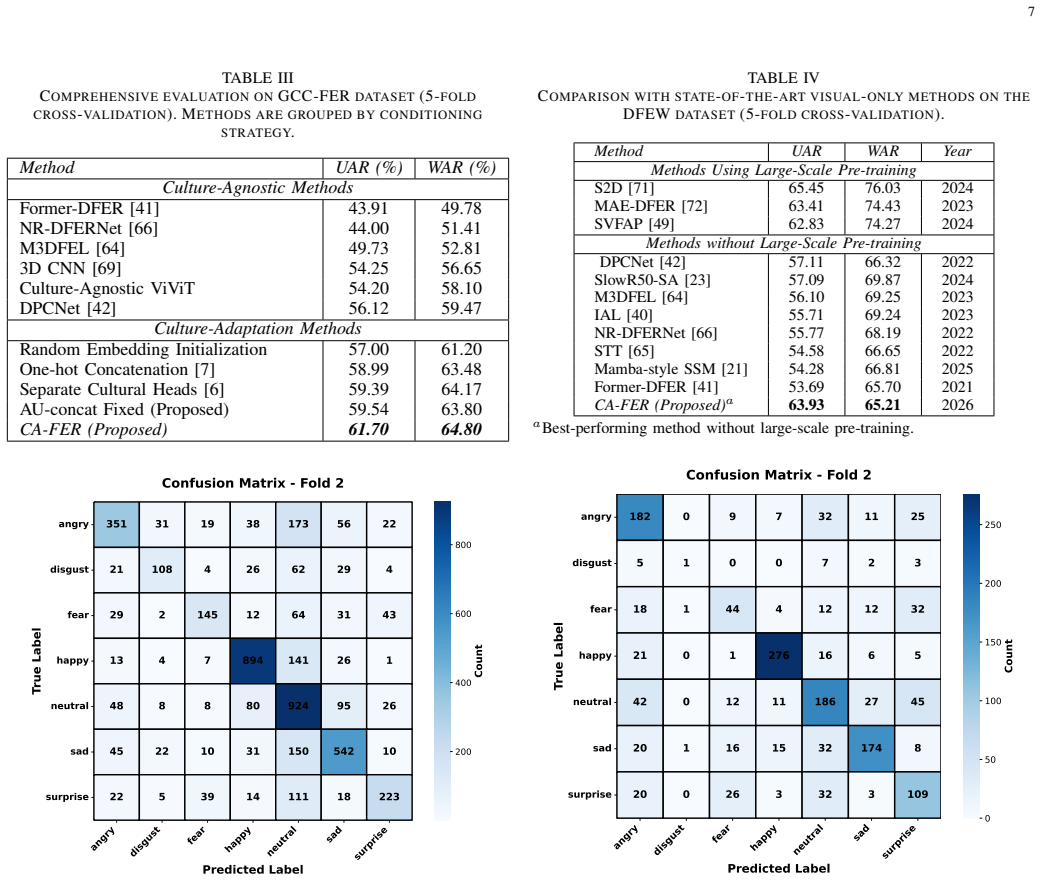
- Performance gains hold on both the new GCC-FER and the existing DFEW benchmark.
Where Pith is reading between the lines
- Similar prior-based recalibration could extend to cross-cultural speech emotion recognition or gesture analysis.
- If the priors reflect real differences, the approach might generalize to other biometric tasks affected by demographic variation.
- A natural test would measure whether the adapted model maintains gains on newly collected videos from the same cultural groups.
Load-bearing premise
The four cultural groups are correctly partitioned and the derived cultural priors capture genuine systematic differences in expression rather than artifacts of data collection or filtering.
What would settle it
A controlled test showing no accuracy gain from the cultural priors on held-out multicultural videos, or priors that fail to align with independent psychological measures of expression variation.
Figures



read the original abstract
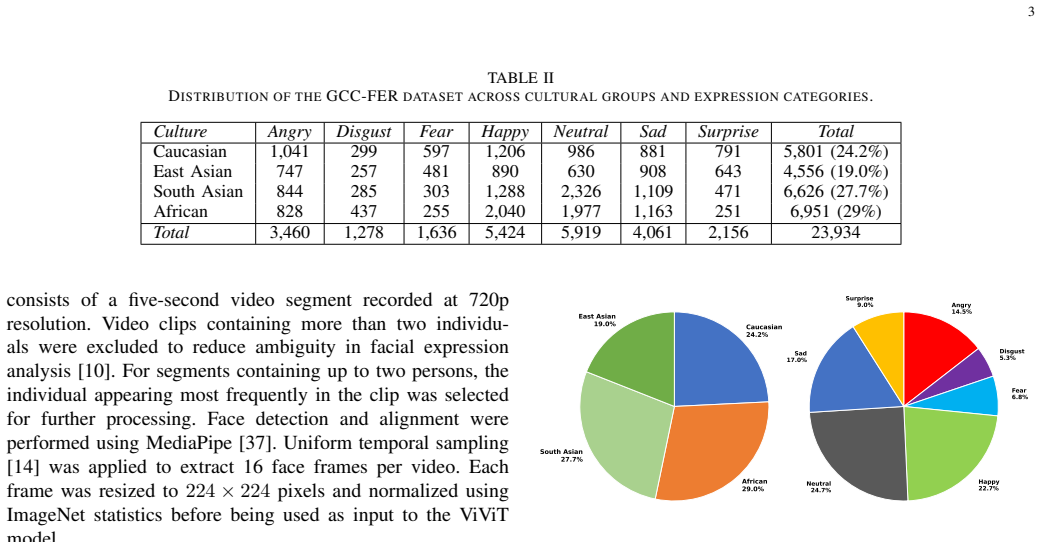
Dynamic Facial Expression Recognition (DFER) is a key enabling technology in affective computing, human-computer interaction, and intelligent multimedia systems. Despite the significant influence of cultural nuances on FER performance, most existing FER systems assume that emotional expressions are universally consistent across populations. This variation can be attributed to systematic differences in facial muscle activation patterns across cultures. A major challenge in advancing cross-cultural FER lies in the scarcity of culturally diverse benchmark datasets. To address this, a new hybrid multicultural video dataset termed Global Cross-Cultural Facial Expression Recognition (GCC-FER) is introduced. GCC-FER comprises 23,934 video samples spanning four cultural groups (African, Caucasian, East Asian, and South Asian) across seven basic expressions, combining psychologically supervised in-house data collection for underrepresented populations with rigorous ethnicity filtering of existing sources. To the best of our knowledge, GCC-FER is the first large-scale global cross-cultural DFER dataset designed to address these demographic gaps. Leveraging this dataset, behaviorally grounded cultural priors are derived for each cultural group and a global prior for practical deployment. A Culture-Aware FER (CA-FER) system is proposed to mitigate cultural bias by adaptively recalibrating latent facial representations. Extensive experiments on GCC-FER and DFEW demonstrate that the proposed system consistently improves FER performance across multicultural settings.
Editorial analysis
A structured set of objections, weighed in public.
Referee Report
Summary. The manuscript introduces the GCC-FER dataset (23,934 video samples spanning African, Caucasian, East Asian, and South Asian groups across seven basic expressions), constructed via a hybrid approach of supervised in-house collection and ethnicity filtering of existing sources. It derives behaviorally grounded cultural priors per group plus a global prior, and proposes the CA-FER system that adaptively recalibrates latent facial representations to reduce cultural bias. Experiments on GCC-FER and DFEW are reported to show consistent FER performance gains across multicultural settings.
Significance. If the cultural priors are shown to capture genuine expression differences (rather than collection artifacts) and the performance gains prove robust under proper statistical controls and data splits, the work would supply a needed multicultural benchmark and an adaptation technique that challenges the universality assumption in dynamic FER.
major comments (2)
- [Dataset construction paragraph] Dataset construction (abstract paragraph on GCC-FER): the hybrid method of in-house supervised collection for underrepresented groups plus ethnicity filtering of existing sources introduces plausible confounds (lighting, camera quality, annotation protocols, intra-group demographics) that could generate spurious group-level statistics; no evidence is supplied that these factors were controlled or that the resulting priors reflect systematic cultural differences in muscle activation rather than artifacts.
- [Prior derivation and evaluation] Prior derivation and CA-FER evaluation (abstract): it is not stated whether cultural priors are computed exclusively on training splits or whether adaptation parameters are fitted using any test data, which directly affects whether the reported improvements on GCC-FER demonstrate genuine out-of-sample generalization or in-sample fit.
minor comments (1)
- The claim that GCC-FER is 'the first large-scale global cross-cultural DFER dataset' should be supported by an explicit comparison table against prior multicultural or cross-cultural FER corpora in the related-work section.
Simulated Author's Rebuttal
We thank the referee for their detailed and constructive comments. We address each of the major comments below, indicating the changes we plan to make in the revised manuscript.
read point-by-point responses
-
Referee: Dataset construction (abstract paragraph on GCC-FER): the hybrid method of in-house supervised collection for underrepresented groups plus ethnicity filtering of existing sources introduces plausible confounds (lighting, camera quality, annotation protocols, intra-group demographics) that could generate spurious group-level statistics; no evidence is supplied that these factors were controlled or that the resulting priors reflect systematic cultural differences in muscle activation rather than artifacts.
Authors: We agree that the hybrid dataset construction method raises important questions regarding potential confounds. The current manuscript describes the collection process but does not provide explicit details on controls for lighting, camera quality, or annotation protocols across sources. In the revised version, we will add a dedicated subsection on dataset construction that elaborates on any standardization efforts applied and discusses the limitations of the hybrid approach. We will also include an analysis comparing intra-group variations to assess whether the priors capture cultural patterns beyond collection artifacts. revision: yes
-
Referee: Prior derivation and CA-FER evaluation (abstract): it is not stated whether cultural priors are computed exclusively on training splits or whether adaptation parameters are fitted using any test data, which directly affects whether the reported improvements on GCC-FER demonstrate genuine out-of-sample generalization or in-sample fit.
Authors: The cultural priors were computed using only the training splits of the respective datasets, and no test data was used in fitting the adaptation parameters. However, this information is not explicitly stated in the current manuscript. We will revise the methods section to clearly specify the data splits used for prior derivation and confirm that all evaluations use held-out test sets, thereby demonstrating out-of-sample performance. revision: yes
Circularity Check
No significant circularity; claims rest on new dataset and empirical splits
full rationale
The paper introduces the GCC-FER dataset, derives cultural priors from it, and proposes CA-FER adaptation with reported gains on GCC-FER and DFEW. No equations, self-citations, or derivation steps are quoted that reduce any claimed result to a definitional identity or to a parameter fitted on the identical evaluation data. The performance claims are presented as outcomes of experiments rather than tautological consequences of the inputs, satisfying the requirement for independent content. Absent explicit reduction (e.g., a prior derived on test splits then re-used as a 'prediction'), the derivation chain is treated as self-contained.
Axiom & Free-Parameter Ledger
Reference graph
Works this paper leans on
-
[1]
Survey on RGB, 3D, thermal, and multimodal approaches for facial expres- sion recognition: History, trends, and affect-related applications,
C. A. Corneanu, M. O. Sim ´on, J. F. Cohn, and S. E. Guerrero, “Survey on RGB, 3D, thermal, and multimodal approaches for facial expres- sion recognition: History, trends, and affect-related applications,”IEEE Transactions on Pattern Analysis and Machine Intelligence, vol. 38, no. 8, pp. 1548–1568, 2016
2016
-
[2]
V oxceleb: A large-scale speaker identification dataset,
A. Nagrani, J. S. Chung, and A. Zisserman, “V oxceleb: a large-scale speaker identification dataset,”arXiv preprint arXiv:1706.08612, 2017
-
[3]
Visualizing data using t-SNE,
L. Van der Maaten and G. Hinton, “Visualizing data using t-SNE,” Journal of Machine Learning Research, vol. 9, no. 11, 2008
2008
-
[4]
Is space-time attention all you need for video understanding?
G. Bertasius, H. Wang, and L. Torresani, “Is space-time attention all you need for video understanding?” inICML, vol. 2, no. 3, 2021, p. 4
2021
-
[5]
Py-Feat: Python facial expression analysis toolbox,
J. H. Cheong, E. Jolly, T. Xie, S. Byrne, M. Kenney, and L. J. Chang, “Py-Feat: Python facial expression analysis toolbox,”Affective Science, vol. 4, no. 4, pp. 781–796, 2023
2023
-
[6]
AdaShare: Learning what to share for efficient deep multi-task learning,
X. Sun, R. Panda, R. Feris, and K. Saenko, “AdaShare: Learning what to share for efficient deep multi-task learning,”Advances in Neural Information Processing Systems, vol. 33, pp. 8728–8740, 2020
2020
-
[7]
Beyond one- hot encoding: lower dimensional target embedding,
P. Rodr ´ıguez, M. A. Bautista, J. Gonzalez, and S. Escalera, “Beyond one- hot encoding: lower dimensional target embedding,”Image and Vision Computing, vol. 75, pp. 21–31, 2018
2018
-
[8]
Constants across cultures in the face and emotion,
P. Ekman and W. V . Friesen, “Constants across cultures in the face and emotion,”Journal of Personality and Social Psychology, vol. 17, no. 2, pp. 124–129, 1971
1971
-
[9]
Facial micro- expression recognition from videos through domain adaptation and multi-modal spatio-temporal feature ensemble,
M. S. Islam, Y . Sang, A. A. Mohammed, and J. Lv, “Facial micro- expression recognition from videos through domain adaptation and multi-modal spatio-temporal feature ensemble,”Multimedia Systems, vol. 31, no. 5, p. 330, 2025
2025
-
[10]
Facial expression recognition based on multi-modal features for videos in the wild,
C. Liu, X. Zhang, X. Liu, T. Zhang, L. Meng, Y . Liu, Y . Deng, and W. Jiang, “Facial expression recognition based on multi-modal features for videos in the wild,” inProceedings of the IEEE/CVF Conference on Computer Vision and Pattern Recognition Workshops (CVPRW), 2023, pp. 5872–5879
2023
-
[11]
Facial expressions of emotion are not culturally universal,
R. E. Jack, O. G. B. Garrod, H. Yu, R. Caldara, and P. G. Schyns, “Facial expressions of emotion are not culturally universal,”Proceedings of the National Academy of Sciences, vol. 109, no. 17, pp. 7241–7244, 2012
2012
-
[12]
AI enabled facial emotion recognition using low-cost thermal cameras,
J. T. Black and M. Z. Shakir, “AI enabled facial emotion recognition using low-cost thermal cameras,”Computing & AI Connect, vol. 2, 2025
2025
-
[13]
Internal representations reveal cultural diversity in expectations of facial expressions of emotion,
R. E. Jack, R. Caldara, and P. G. Schyns, “Internal representations reveal cultural diversity in expectations of facial expressions of emotion,” Journal of Experimental Psychology: General, vol. 141, no. 1, pp. 19– 25, 2012
2012
-
[14]
Decoding viewer emotions in video ads,
A. Antonov, S. S. Kumar, J. Wei, W. Headley, D. Woodet al., “Decoding viewer emotions in video ads,”Scientific Reports, vol. 14, p. 26382, 2024
2024
-
[15]
Study on emotion recognition bias in different regional groups,
M. Lukac, G. Zhambulova, K. Abdiyeva, and M. Lewis, “Study on emotion recognition bias in different regional groups,”Scientific Reports, vol. 13, p. 19642, 2023
2023
-
[16]
Macro- and micro-expressions facial datasets: A survey,
H. Guerdelli, C. Ferrari, W. Barhoumi, H. Ghazouani, and S. Berretti, “Macro- and micro-expressions facial datasets: A survey,”Sensors, vol. 22, no. 4, p. 1524, 2022
2022
-
[17]
Japanese and American differences in recognizing facial expressions of emotion,
D. Matsumoto, “Japanese and American differences in recognizing facial expressions of emotion,”Motivation and Emotion, vol. 16, pp. 85–100, 1992
1992
-
[18]
DFEW: A large- scale database for recognizing dynamic facial expressions in the wild,
X. Jiang, Y . Zong, W. Zheng, C. Tang, and W. Xia, “DFEW: A large- scale database for recognizing dynamic facial expressions in the wild,” in Proceedings of the 28th ACM International Conference on Multimedia, 2020, pp. 2881–2889
2020
-
[19]
Facial expression recognition from near-infrared videos,
G. Zhao, X. Huang, M. Taini, S. Z. Li, and M. Pietik ¨ainen, “Facial expression recognition from near-infrared videos,”Image and Vision Computing, vol. 29, no. 9, pp. 607–619, 2011
2011
-
[20]
Mafw: A large-scale, multi-modal, compound affective database for dynamic facial expression recognition in the wild,
Y . Liu, W. Dai, C. Feng, W. Wang, G. Yin, J. Zeng, and S. Shan, “Mafw: A large-scale, multi-modal, compound affective database for dynamic facial expression recognition in the wild,” inProceedings of the 30th ACM International Conference on Multimedia, 2022, pp. 24–32
2022
-
[21]
Dynamic facial expression recognition in the wild using mamba-style selective ssm and facial attention mechanism,
Y . A. Pratama, T. E. N. Pandin, and Y .-Z. Hsieh, “Dynamic facial expression recognition in the wild using mamba-style selective ssm and facial attention mechanism,” in2025 Asia Pacific Signal and Information Processing Association Annual Summit and Conference (APSIPA ASC), 2025, pp. 2371–2375
2025
-
[22]
Ferv39k: A large-scale multi-scene dataset for facial expression recognition in videos,
Y . Wang, Y . Sun, Y . Huang, Z. Liu, S. Gao, W. Zhang, W. Ge, and W. Zhang, “Ferv39k: A large-scale multi-scene dataset for facial expression recognition in videos,” inProceedings of the IEEE/CVF Conference on Computer Vision and Pattern Recognition, 2022, pp. 20 922–20 931
2022
-
[23]
Slowr50-sa: A self-attention enhanced dynamic facial expression recog- nition model for tactile internet applications,
N. Neshov, N. Christoff, T. Sechkova, K. Tonchev, and A. Manolova, “Slowr50-sa: A self-attention enhanced dynamic facial expression recog- nition model for tactile internet applications,”Electronics, vol. 13, no. 9, p. 1606, 2024
2024
-
[24]
FiLM: Visual reasoning with a general conditioning layer,
E. Perez, F. Strub, H. de Vries, V . Dumoulin, and A. Courville, “FiLM: Visual reasoning with a general conditioning layer,” inProceedings of the AAAI Conference on Artificial Intelligence, vol. 32, 2018
2018
-
[25]
Is there universal recognition of emotion from facial ex- pression? A review of the cross-cultural studies,
J. A. Russell, “Is there universal recognition of emotion from facial ex- pression? A review of the cross-cultural studies,”Psychological Bulletin, vol. 115, no. 1, pp. 102–141, 1994
1994
-
[26]
On the universality and cultural specificity of emotion recognition: A meta-analysis,
H. A. Elfenbein and N. Ambady, “On the universality and cultural specificity of emotion recognition: A meta-analysis,”Psychological Bulletin, vol. 128, no. 2, pp. 203–235, 2002
2002
-
[27]
Multicultural facial expression recognition based on differences of Western-Caucasian and East-Asian facial expressions of emotions,
G. Benitez-Garcia, T. Nakamura, and M. Kaneko, “Multicultural facial expression recognition based on differences of Western-Caucasian and East-Asian facial expressions of emotions,”IEICE Transactions on Information and Systems, vol. E101-D, no. 5, pp. 1317–1324, 2018
2018
-
[28]
A fusion of cnn and sift for multicultural facial expression recognition,
I. Qadir, M. A. Iqbal, S. Ashraf, and S. Akram, “A fusion of cnn and sift for multicultural facial expression recognition,”Multimedia Tools and Applications, vol. 84, no. 28, pp. 33 505–33 523, 2025
2025
-
[29]
The recognition of cross-cultural emotional faces is affected by intensity and ethnicity in a Japanese sample,
A. Bonassi, T. Ghilardi, G. Gabrieli, A. Truzzi, T. Munesue, J. L. Borelli, B. Lepri, K. Shinohara, and G. Esposito, “The recognition of cross-cultural emotional faces is affected by intensity and ethnicity in a Japanese sample,”Behavioral Sciences, vol. 11, no. 5, p. 59, 2021. 11
2021
-
[30]
Label distribution learning with valence-arousal for facial expression recognition,
N. Le, K. Nguyen, Q. Tran, E. Tjiputra, B. Le, and A. Nguyen, “Label distribution learning with valence-arousal for facial expression recognition,” inProceedings of the IEEE/CVF Conference on Computer Vision and Pattern Recognition Workshops, 2020, pp. 2000–2009
2020
-
[31]
Cross-cultural facial ex- pression recognition: A deep learning study on Indian cultural diversity,
S. Singh, K. S. Yadav, P. Gupta, and L. Kumar, “Cross-cultural facial ex- pression recognition: A deep learning study on Indian cultural diversity,” inProceedings of the 2025 National Conference on Communications (NCC), 2025, pp. 1–6
2025
-
[32]
ViViT: A video vision transformer,
A. Arnab, M. Dehghani, G. Heigold, C. Sun, M. Lu ˇci´c, and C. Schmid, “ViViT: A video vision transformer,” inProceedings of the IEEE/CVF International Conference on Computer Vision, 2021, pp. 6836–6846
2021
-
[33]
EfficientViT: Multi-scale vision transformer with cascaded group attention,
X. Liu, H. Peng, N. Zheng, Y . Yang, H. Hu, and Y . Yuan, “EfficientViT: Multi-scale vision transformer with cascaded group attention,” inPro- ceedings of the IEEE/CVF Conference on Computer Vision and Pattern Recognition, 2023, pp. 17 588–17 598
2023
-
[34]
HLA-ViT: Hierarchical local attention vision trans- former for facial expression recognition,
Q. Chenget al., “HLA-ViT: Hierarchical local attention vision trans- former for facial expression recognition,” inProceedings of the IEEE International Conference on Computer Vision Workshops, 2023
2023
-
[35]
Facial expression recognition under small sample setting: A transfer learning approach,
X. Liuet al., “Facial expression recognition under small sample setting: A transfer learning approach,” inProceedings of the IEEE Conference on Computer Vision and Pattern Recognition Workshops, 2018, pp. 33– 39
2018
-
[36]
ECAN: Enhanced cross-dataset adaptation for facial expression recognition,
P. Wanget al., “ECAN: Enhanced cross-dataset adaptation for facial expression recognition,” inProceedings of the International Conference on Pattern Recognition, 2020
2020
-
[37]
Mediapipe: A framework for building perception pipelines,
C. Lugaresi, J. Tang, H. Nash, C. McClanahan, E. Uboweja, M. Hays, F. Zhang, C.-L. Chang, M. Yong, J. Leeet al., “Mediapipe: A framework for building perception pipelines,” inThird Workshop on Computer Vision for AR/VR at IEEE CVPR, 2019
2019
-
[38]
AFEW- V A database for valence and arousal estimation in-the-wild,
J. Kossaifi, G. Tzimiropoulos, S. Todorovic, and M. Pantic, “AFEW- V A database for valence and arousal estimation in-the-wild,”Image and Vision Computing, vol. 65, pp. 23–36, 2017
2017
-
[39]
MIDAS: Mixing ambiguous data with soft labels for dynamic facial expression recognition,
R. Kawamura, H. Hayashi, N. Takemura, and H. Nagahara, “MIDAS: Mixing ambiguous data with soft labels for dynamic facial expression recognition,” inProceedings of the IEEE/CVF Winter Conference on Applications of Computer Vision, 2024, pp. 6552–6562
2024
-
[40]
Intensity-aware loss for dynamic facial expression recognition in the wild,
H. Li, H. Niu, Z. Zhu, and F. Zhao, “Intensity-aware loss for dynamic facial expression recognition in the wild,” inProceedings of the AAAI Conference on Artificial Intelligence, vol. 37, 2023, pp. 67–75
2023
-
[41]
Former-DFER: Dynamic facial expression recog- nition transformer,
Z. Zhao and Q. Liu, “Former-DFER: Dynamic facial expression recog- nition transformer,” inProceedings of the 29th ACM International Conference on Multimedia, 2021, pp. 1553–1561
2021
-
[42]
DPCnet: Dual path multi-excitation collaborative network for facial expression representation learning in videos,
Y . Wang, Y . Sun, W. Song, S. Gao, Y . Huang, Z. Chen, W. Ge, and W. Zhang, “DPCnet: Dual path multi-excitation collaborative network for facial expression representation learning in videos,” inProceedings of the 30th ACM International Conference on Multimedia, 2022, pp. 101–110
2022
-
[43]
HMDB: A large video database for human motion recognition,
H. Kuehne, H. Jhuang, E. Garrote, T. Poggio, and T. Serre, “HMDB: A large video database for human motion recognition,” inProceedings of the IEEE International Conference on Computer Vision, 2011, pp. 2556–2563
2011
-
[44]
Reliable crowdsourcing and deep locality- preserving learning for expression recognition in the wild,
S. Li, W. Deng, and J. Du, “Reliable crowdsourcing and deep locality- preserving learning for expression recognition in the wild,” inPro- ceedings of the IEEE Conference on Computer Vision and Pattern Recognition, 2017, pp. 2852–2861
2017
-
[45]
Facial expression and emotion,
P. Ekman, “Facial expression and emotion,”American Psychologist, vol. 48, no. 4, pp. 384–392, 1993
1993
-
[46]
What are emotions? And how can they be measured?
K. R. Scherer, “What are emotions? And how can they be measured?” Social Science Information, vol. 44, no. 4, pp. 695–729, 2005
2005
-
[47]
The extended Cohn-Kanade dataset (CK+): A complete dataset for action unit and emotion-specified expression,
P. Lucey, J. F. Cohn, T. Kanade, J. Saragih, Z. Ambadar, and I. Matthews, “The extended Cohn-Kanade dataset (CK+): A complete dataset for action unit and emotion-specified expression,”IEEE Conference on Computer Vision and Pattern Recognition Workshops, 2010
2010
-
[48]
Introduction to convolutional neural networks,
J. Wu, “Introduction to convolutional neural networks,”National Key Lab for Novel Software Technology, Nanjing University, China, vol. 5, no. 23, p. 495, 2017
2017
-
[49]
Svfap: Self-supervised Video Facial Affect Perceiver,
L. Sun, Z. Lian, K. Wang, Y . He, M. Xu, H. Sun, B. Liu, and J. Tao, “Svfap: Self-supervised Video Facial Affect Perceiver,”IEEE Transactions on Affective Computing, 2024
2024
-
[50]
AffectNet: A database for facial expression, valence, and arousal computing in the wild,
A. Mollahosseini, B. Hasani, and M. H. Mahoor, “AffectNet: A database for facial expression, valence, and arousal computing in the wild,”IEEE Transactions on Affective Computing, 2017
2017
-
[51]
Acted facial expres- sions in the wild database,
A. Dhall, R. Goecke, S. Lucey, and T. Gedeon, “Acted facial expres- sions in the wild database,”Australian National University, Canberra, Australia, Technical Report TR-CS-11, vol. 2, no. 1, 2011
2011
-
[52]
Real emotion seeker: recalibrating anno- tation for facial expression recognition,
Z. Lin, J. She, and Q. Shen, “Real emotion seeker: recalibrating anno- tation for facial expression recognition,”Multimedia Systems, vol. 29, no. 1, pp. 139–151, 2023
2023
-
[53]
A cross-cultural comparison of facial emotion recognition between Germans and the Karamojong,
M. Krippl and A. Tcherkassof, “A cross-cultural comparison of facial emotion recognition between Germans and the Karamojong,”Evolution- ary Psychological Science, 2026
2026
-
[54]
An exploratory study on cross- cultural differences in facial emotion recognition between adults from Malaysia and Australia,
S. N. Mohan, F. Mukhtar, and L. Jobson, “An exploratory study on cross- cultural differences in facial emotion recognition between adults from Malaysia and Australia,”Frontiers in Psychiatry, vol. 12, p. 622077, 2021
2021
-
[55]
Toward cross-cultural emotion detection: the indian spontaneous micro-expression dataset,
R. Mishra, B. Bhushan, and K. Venkatesh, “Toward cross-cultural emotion detection: the indian spontaneous micro-expression dataset,” Frontiers in Psychology, vol. 16, p. 1656104, 2025
2025
-
[56]
Exploring the cultural gaps in facial expression recognition systems by visual features,
P. Siritanawan, H. Kojima, and K. Kotani, “Exploring the cultural gaps in facial expression recognition systems by visual features,” inTENCON 2023 IEEE Region 10 Conference. IEEE, 2023, pp. 1157–1162
2023
-
[57]
The cross-race effect in auto- matic facial expression recognition violates measurement invariance,
Y .-T. Li, S.-L. Yeh, and T.-R. Huang, “The cross-race effect in auto- matic facial expression recognition violates measurement invariance,” Frontiers in Psychology, vol. 14, p. 1201145, 2023
2023
-
[58]
Facial expression in affective disorders,
P. Ekman, “Facial expression in affective disorders,” inWhat The Face Reveals: Basic and Applied Studies of Spontaneous Expression Using the Facial Action Coding System (FACS), 2nd ed., P. Ekman and E. L. Rosenberg, Eds. New York: Oxford University Press, 1997, pp. 331– 342
1997
-
[59]
Culture, emotion regu- lation, and adjustment,
D. Matsumoto, S. H. Yoo, and S. Nakagawa, “Culture, emotion regu- lation, and adjustment,”Journal of Personality and Social Psychology, vol. 94, no. 6, p. 925, 2008
2008
-
[60]
An argument for basic emotions,
P. Ekman, “An argument for basic emotions,”Cognition & Emotion, vol. 6, no. 3-4, pp. 169–200, 1992
1992
-
[61]
DeepFace: Closing the gap to human-level performance in face verification,
Y . Taigman, M. Yang, M. Ranzato, and L. Wolf, “DeepFace: Closing the gap to human-level performance in face verification,” inProceedings of the IEEE Conference on Computer Vision and Pattern Recognition, 2014, pp. 1701–1708
2014
-
[62]
FER-YOLO: a YOLO-based classifier for facial expression recognition,
Y . Jin and J. Qi, “FER-YOLO: a YOLO-based classifier for facial expression recognition,”Multimedia Systems, vol. 32, no. 3, p. 229, 2026
2026
-
[63]
The measurement of observer agreement for categorical data,
J. R. Landis and G. G. Koch, “The measurement of observer agreement for categorical data,”Biometrics, vol. 33, no. 1, pp. 159–174, 1977
1977
-
[64]
Rethink- ing the learning paradigm for dynamic facial expression recognition,
H. Wang, B. Li, S. Wu, S. Shen, F. Liu, S. Ding, and A. Zhou, “Rethink- ing the learning paradigm for dynamic facial expression recognition,” inProceedings of the IEEE/CVF Conference on Computer Vision and Pattern Recognition, 2023, pp. 17 958–17 968
2023
-
[65]
Spatio-temporal transformer for dynamic facial expression recognition in the wild,
F. Maet al., “Spatio-temporal transformer for dynamic facial expression recognition in the wild,”arXiv preprint arXiv:2205.04749, 2022
-
[66]
NR-DFERNet: Noise-robust network for dynamic facial expression recognition,
H. Liet al., “NR-DFERNet: Noise-robust network for dynamic facial expression recognition,”arXiv preprint arXiv:2206.04975, 2022
-
[67]
Uncertainty- aware label refinement on hypergraphs for personalized federated facial expression recognition,
H. Ding, Y . Yan, Y . Lu, J.-H. Xue, and H. Wang, “Uncertainty- aware label refinement on hypergraphs for personalized federated facial expression recognition,”IEEE Transactions on Circuits and Systems for Video Technology, vol. 35, no. 5, pp. 4675–4685, 2024
2024
-
[68]
Ceprompt: Cross-modal emotion-aware prompting for facial expression recognition,
H. Zhou, S. Huang, F. Zhang, and C. Xu, “Ceprompt: Cross-modal emotion-aware prompting for facial expression recognition,”IEEE Transactions on Circuits and Systems for Video Technology, vol. 34, no. 11, pp. 11 886–11 899, 2024
2024
-
[69]
Learning spatiotemporal features with 3D convolutional networks,
D. Tran, L. Bourdev, R. Fergus, L. Torresani, and M. Paluri, “Learning spatiotemporal features with 3D convolutional networks,” inProceedings of the IEEE International Conference on Computer Vision, 2015, pp. 4489–4497
2015
-
[70]
A closer look at spatiotemporal convolutions for action recognition,
D. Tran, H. Wang, L. Torresani, J. Ray, Y . LeCun, and M. Paluri, “A closer look at spatiotemporal convolutions for action recognition,” in Proceedings of the IEEE Conference on Computer Vision and Pattern Recognition, 2018, pp. 6450–6459
2018
-
[71]
From static to dynamic: Adapting landmark-aware image models for facial expression recognition in videos,
Y . Chenet al., “From static to dynamic: Adapting landmark-aware image models for facial expression recognition in videos,”IEEE Transactions on Affective Computing, 2024
2024
-
[72]
MAE-DFER: Efficient masked au- toencoder for self-supervised dynamic facial expression recognition,
L. Sun, Z. Lian, B. Liu, and J. Tao, “MAE-DFER: Efficient masked au- toencoder for self-supervised dynamic facial expression recognition,” in Proceedings of the 31st ACM International Conference on Multimedia, 2023, pp. 6110–6121
2023
discussion (0)
Sign in with ORCID, Apple, or X to comment. Anyone can read and Pith papers without signing in.