The discovery of the effects of women employment participation on the fertility of developing countries: A panel data approach
Pith reviewed 2026-06-27 22:40 UTC · model grok-4.3
The pith
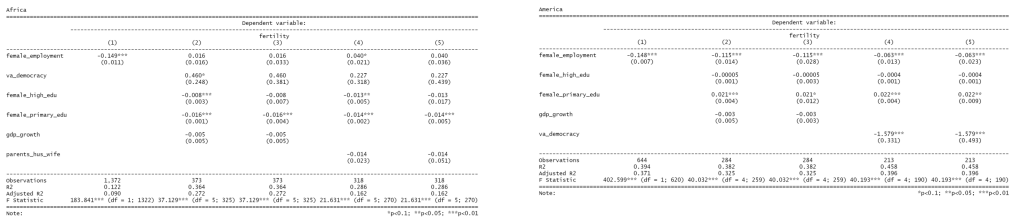
Employment participation influences fertility only in the Americas among developing countries.
A machine-rendered reading of the paper's core claim, the machinery that carries it, and where it could break.
Core claim
The fertility behaviors of women in the North/South America continents are influenced by their career choice; meanwhile in society of other regions, other factors might be more important to women when thinking of having children. This follows from dividing the dataset of 115 developing countries in the period of 1991-2018 into four continents group and applying a data-driven panel data econometric procedure to mitigate omitted bias.
What carries the argument
The data-driven panel data econometric procedure applied to each continent-grouped subset of the 115-country panel, used to estimate the effect of women employment participation on total fertility rate while addressing omitted variable bias.
Load-bearing premise
The panel data econometric procedure successfully mitigates omitted variable bias and supports causal claims about the effect of employment participation on fertility.
What would settle it
Re-estimating the models with additional control variables, different lag structures, or alternative estimators that produces no significant employment-fertility link in the Americas group (or produces such a link in the other groups) would undermine the central claim.
Figures

read the original abstract
The fertility trend in developing countries has experienced a significant decline in the last few decades; at the same time, the role of women in the workplace has improved. To have a better insight of the causality of the rate of women participation in the labor market on the total fertility rate in developing world, this paper divides the dataset of 115 developing countries in the period of 1991-2018 into four continents group (Africa, North/South America, Asia/Pacific, Europe) and then applies a data-driven panel data econometric procedure to mitigate omitted bias. The results suggest that the fertility behaviors of women in the North/South America continents are influenced by their career choice; meanwhile in society of other regions, other factors might be more important to women when thinking of having children. In conclusion, policymakers can reference to the paper and formulate policies to have more incentives in making reproductive decisions and further research in the field needs to consider family policies and patrilocality of developing countries as important data.
Editorial analysis
A structured set of objections, weighed in public.
Referee Report
Summary. The paper claims that women's labor force participation causally affects fertility rates in developing countries. Using panel data on 115 countries from 1991-2018, the sample is split into four continental groups and a data-driven panel data econometric procedure is applied to mitigate omitted variable bias. The headline result is that employment participation influences fertility only in North/South America (via career choices), while other factors dominate in Africa, Asia/Pacific, and Europe.
Significance. If the unspecified procedure validly identifies causal effects and the regional heterogeneity is robust, the paper would document continent-level differences in the employment-fertility link that could inform differentiated family and labor policies. The large cross-country panel is a potential strength, but the absence of any methodological detail, equations, or validation prevents assessment of whether the central claim holds.
major comments (3)
- [Abstract] Abstract: the 'data-driven panel data econometric procedure' used to 'mitigate omitted bias' is never named or specified (no estimator, no equation, no instruments, no fixed effects, no lags). Without this, the claim that the America-specific effect is causal cannot be evaluated and is load-bearing for the entire regional-heterogeneity conclusion.
- [Abstract] Abstract: after splitting 115 countries into four continental groups, no information is given on group sizes, balance, or whether the null results outside the Americas survive alternative groupings or controls for data-quality differences across regions. This directly undermines the cross-continent comparison.
- [Abstract] Abstract: standard panel concerns (reverse causality from fertility to labor supply, time-varying policy or cultural confounders) are not addressed in the procedure description, yet the paper asserts a causal interpretation of the employment-fertility link that differs by continent.
minor comments (2)
- [Abstract] Abstract: 'omitted bias' should read 'omitted variable bias'; 'North/South America continents' is grammatically imprecise.
- [Abstract] Abstract: the conclusion introduces 'patrilocality' and 'family policies' without any prior mention or definition.
Simulated Author's Rebuttal
We thank the referee for the constructive comments on our manuscript. We address each major comment below and indicate the revisions we will make.
read point-by-point responses
-
Referee: [Abstract] Abstract: the 'data-driven panel data econometric procedure' used to 'mitigate omitted bias' is never named or specified (no estimator, no equation, no instruments, no fixed effects, no lags). Without this, the claim that the America-specific effect is causal cannot be evaluated and is load-bearing for the entire regional-heterogeneity conclusion.
Authors: We agree that the abstract provides insufficient detail on the procedure. The manuscript uses a fixed-effects panel regression with lagged employment participation to mitigate omitted variable bias. We will revise the abstract to name the estimator, reference the key equations from the methods section, and briefly describe the lag structure. This will allow evaluation of the causal claims. revision: yes
-
Referee: [Abstract] Abstract: after splitting 115 countries into four continental groups, no information is given on group sizes, balance, or whether the null results outside the Americas survive alternative groupings or controls for data-quality differences across regions. This directly undermines the cross-continent comparison.
Authors: We will add explicit information on group sizes (number of countries and observations per continent) and data balance in the revised manuscript. We will also report robustness checks with alternative groupings and include discussion or controls for regional data-quality differences to support the heterogeneity results. revision: yes
-
Referee: [Abstract] Abstract: standard panel concerns (reverse causality from fertility to labor supply, time-varying policy or cultural confounders) are not addressed in the procedure description, yet the paper asserts a causal interpretation of the employment-fertility link that differs by continent.
Authors: The panel procedure incorporates fixed effects and lags to help address omitted bias and reverse causality. We acknowledge that the abstract does not explicitly discuss time-varying confounders. We will expand the methods description in revision to clarify these aspects, report any relevant robustness tests, and qualify the causal language while preserving the observed regional patterns. revision: yes
Circularity Check
No circularity: standard empirical panel estimation on observed data
full rationale
The paper reports coefficient estimates obtained by applying a panel data procedure to the 1991-2018 dataset of 115 countries, split by continent. These estimates are direct outputs of the chosen estimator applied to the observed variables; they are not shown to be equivalent by construction to any input assumption, prior self-citation, or fitted parameter renamed as a prediction. No equations, uniqueness theorems, or ansatzes are quoted that reduce the regional heterogeneity result to a definitional loop. The work is therefore self-contained as an empirical exercise against the supplied data.
Axiom & Free-Parameter Ledger
axioms (1)
- domain assumption The panel data econometric procedure mitigates omitted variable bias sufficiently for causal inference
Reference graph
Works this paper leans on
-
[1]
Africa: Angola, Burundi, Benin, Burkina Faso, Botswana, Central African Republic CAR, Cote d’Ivoire, Cameroon, Congo Democratic Republic, Congo Brazzav- ille, Comoros, Djibouti, Algeria, Egypt, Eritrea, Ethiopia, Gabon, Ghana, Guinea, Gambia, Guinea, Gambia, Guinea Bissau, Kenya, Liberia, Lesotho, Morocco, Madagascar, Mali, Mozambique, Mauritania, Malawi,...
-
[2]
North/South America: Argentina, Belize, Bolivia, Brazil, Barbados, Chili, Colombia, Costa Rica, Cuba, Guatemala, Guyana, Honduras, Haiti, Jamaica, Saint Lucia, Mexico, Panama, Peru, Paraguay, El Salvador, Suriname, Trinidad & Tobago, Uruguay (Total: 23)
-
[3]
Asia/Pacific: Afghanistan, Bangladesh, Bhutan, China, Indonesia, India, Iran, Iraq, Jordan, Kazakhstan, Kyrgyzs- tan, Cambodia, Lao, Maldives Myanmar, Mongolia, Nepal, Pakistan, Philippines, Papua New Guinea, Palestine, Qatar, Thailand, Tajikistan, Turkmenistan, Timor-Leste, Turkey, Uzbekistan, Vietnam, Vanuatu, Yemen (Total: 31)
-
[4]
Europe: Albania, Armenia, Azerbaijan, Bosnia Herze- govina, Belarus, Georgia, Moldova, North Macedonia, Monte Negro, Serbia, Ukraine, Kosovo (Total: 12)
discussion (0)
Sign in with ORCID, Apple, or X to comment. Anyone can read and Pith papers without signing in.