Study of photometric and spectral variability of the roAp star HD~210684
Pith reviewed 2026-06-27 20:49 UTC · model grok-4.3
The pith
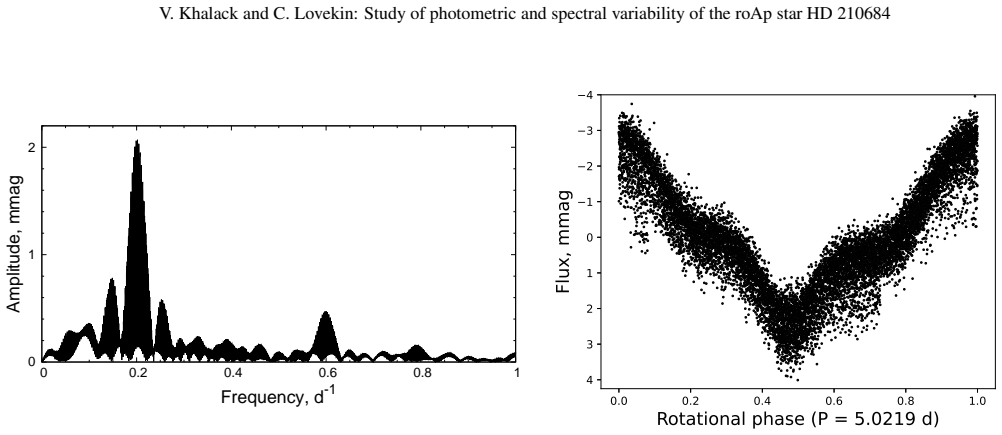
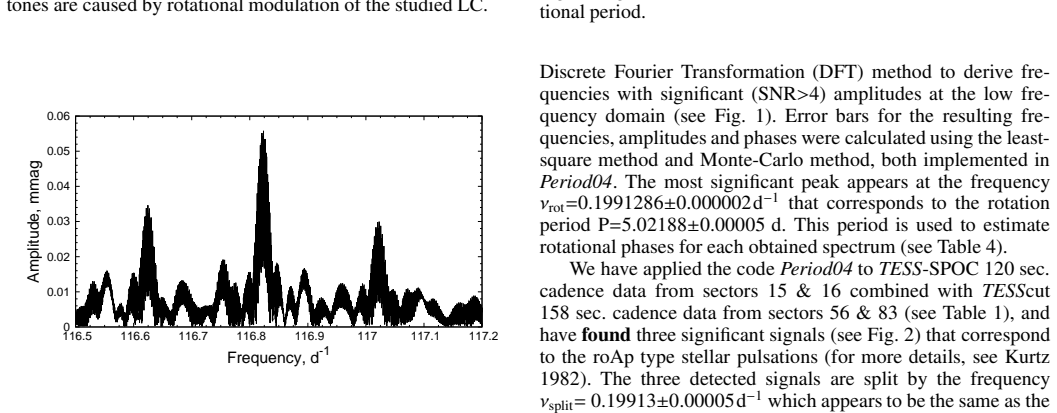
HD210684 shows a 5.022-day rotation, 31-degree inclination, and 77-degree magnetic obliquity that favors an ℓ=2 pulsation mode and main-sequence age of 1.45 Gyr.
A machine-rendered reading of the paper's core claim, the machinery that carries it, and where it could break.
Core claim
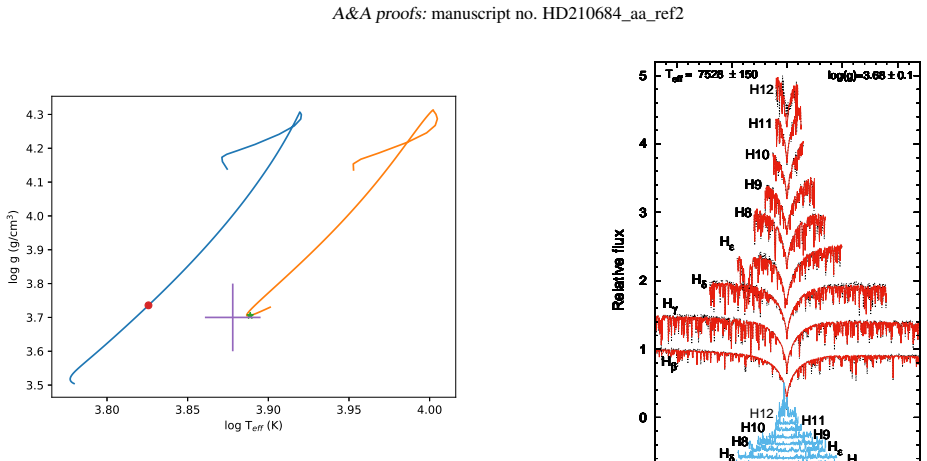
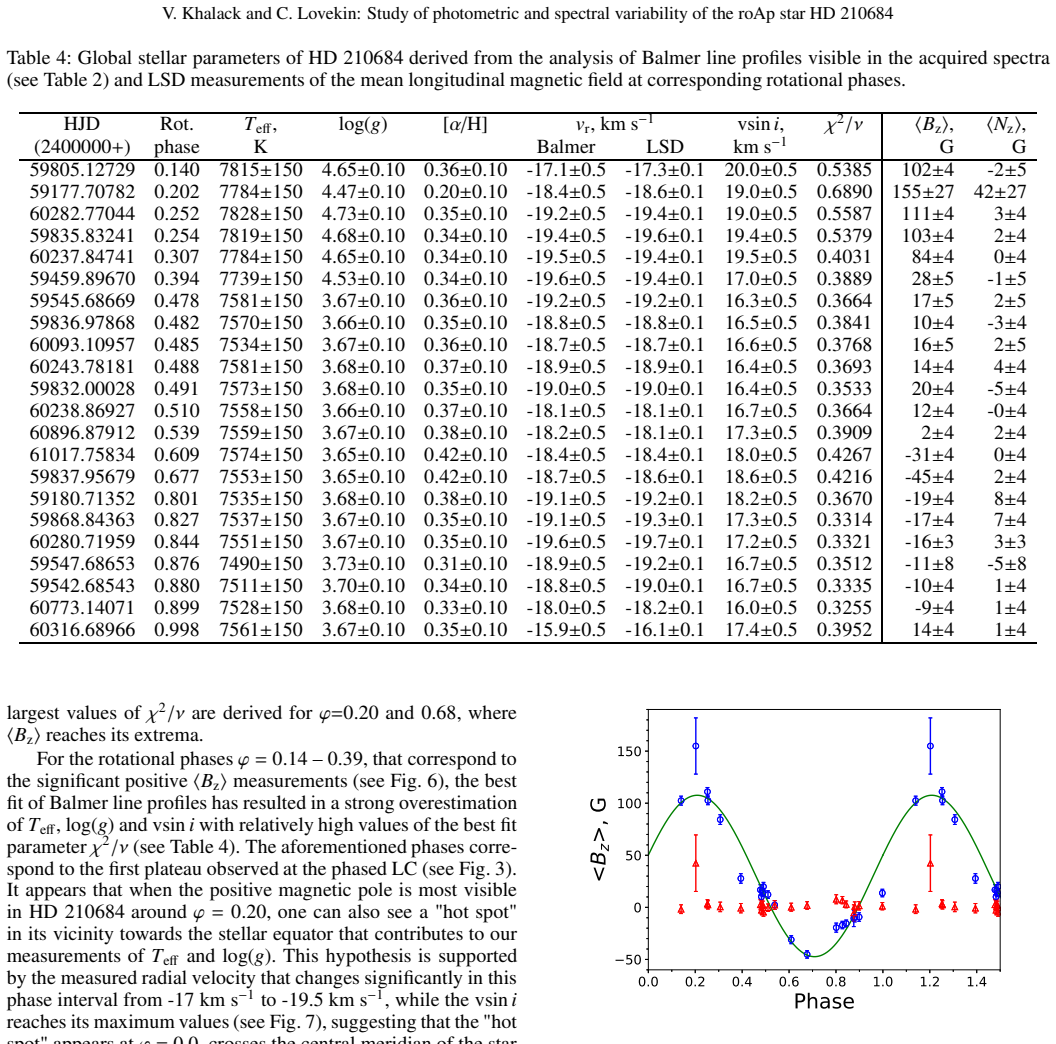
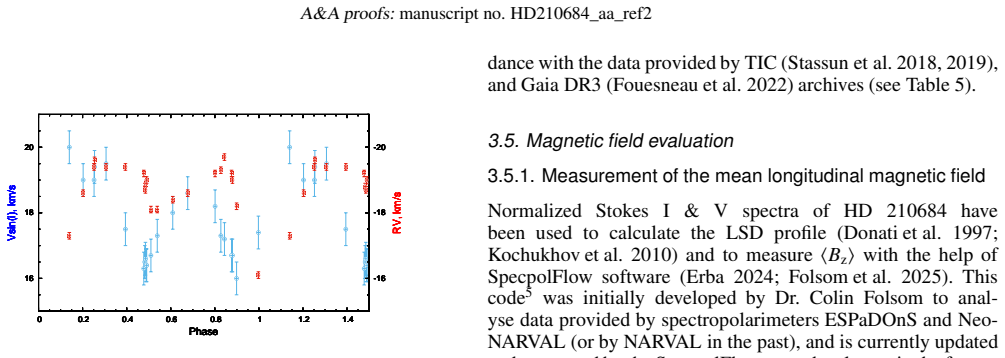
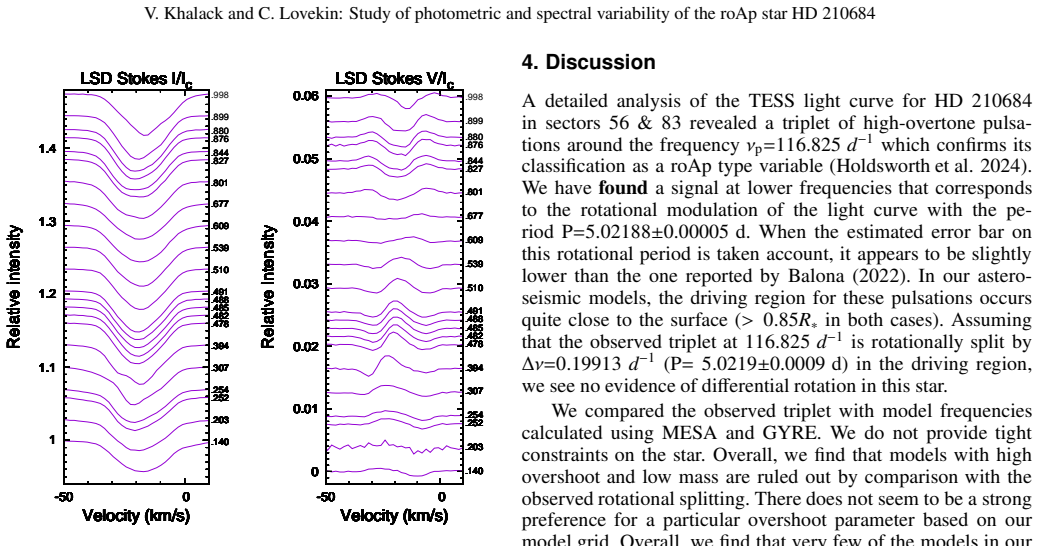
The analysis determines the inclination i = 31° ± 2° and magnetic obliquity β = 77° ± 3°. The rotational period of 5.02188 ± 0.00005 days appears in photometry, pulsation frequency splitting, and magnetic-field variations, although the field curve deviates from a centered-dipole prediction. GYRE simulations constrain log Teff < 3.85 and show that the best-matching evolutionary model depends on mode degree; the derived β leads the authors to prefer the ℓ = 2 solution, which places HD210684 on the main sequence at an age of approximately 1.45 Gyr. Balmer-line fits indicate higher effective temperature and surface gravity at rotational phases 0.14–0.39.
What carries the argument
The magnetic obliquity β derived from combined photometric and LSD magnetic data, used to discriminate between ℓ = 1 and ℓ = 2 high-overtone p-mode solutions in GYRE/MESA pulsation models.
If this is right
- The same 5.022-day period governs photometric modulation, pulsation splitting, and longitudinal-field changes, although the field curve is inconsistent with a simple centered dipole.
- Effective temperature is limited to log Teff < 3.85 from the requirement that pulsation models match the data.
- Balmer-line fits indicate patches of higher temperature become visible at specific rotational phases.
- The preferred ℓ = 2 model locates the star on the main sequence at roughly 1.45 Gyr.
Where Pith is reading between the lines
- If future mode identification favors ℓ = 1, the evolutionary age would shift away from the main sequence.
- The reported deviation from a centered dipole suggests the magnetic topology may require a more complex model than a pure dipole.
- Repeating the same obliquity-based mode selection on other roAp stars could test whether β values systematically correlate with evolutionary stage.
Load-bearing premise
The observed pulsations are high-overtone p-modes whose spherical degree is either 1 or 2, and the measured magnetic obliquity alone is sufficient to select the ℓ = 2 solution over the ℓ = 1 solution.
What would settle it
New observations that establish the pulsation modes as ℓ = 1 rather than ℓ = 2, or that yield a magnetic obliquity substantially different from 77 degrees, would remove the basis for preferring the main-sequence model.
Figures
read the original abstract
This paper studies photometric and spectropolarimetric variability of HD210684 in order to derive its magnetic properties, rotational period, evolutionary stage, and global stellar parameters. The Discrete Fourier Transform is used to measure frequencies and amplitudes of periodic signals present in light curves of HD210684. Evolution models are calculated with MESA, while roAp type pulsations are simulated with GYRE. The values of $T_{eff}$, log(g), $v\sin{i}$, and radial velocity (RV) are derived from the best fit of Balmer line profiles using FITSB2. The Least Square Deconvolution (LSD) method is applied to available Stokes I&V spectra to measure the mean longitudinal magnetic field <Bz> and RV. Detailed analysis of photometric variability reveals rotational modulation with period P=5.02188$\pm$0.00005d and splitting of high-overtone pulsations that corresponds to the same rotational period. Derived <Bz> measurements also show periodic variability with P=5.02188d, but this variability appears to be different from the one predicted by a centred magnetic dipole model. We have determined the inclination angle between the line of sight and the rotation axis to be $i = 31^{\circ} \pm 2^{\circ}$, and the angle between the rotation and magnetic dipole axes as $\beta= 77^{\circ} \pm 3^{\circ}$. Simulations of stellar pulsations constrain $\log T_{eff}$<3.85 and show that our best fitting model depends on whether the observed modes are $\ell = 1$ or $\ell =2$. Considering the derived value of $\beta$, we prefer the best fit model with $\ell =2$ mode, which predicts that HD210684 lies on the main sequence with an age of approximately 1.45Gyr. The best fit of Balmer line profiles has resulted in higher values of $T_{eff}$ and log(g) for spectra acquired at rotational phases $\varphi$= 0.14 - 0.39 suggesting visibility of an area with higher surface temperature.
Editorial analysis
A structured set of objections, weighed in public.
Referee Report
Summary. The paper analyzes photometric and spectropolarimetric observations of the roAp star HD 210684, deriving a rotational period of 5.02188 d from light curves and <Bz> variations, extracting inclination i = 31° ± 2° and magnetic obliquity β = 77° ± 3° via a centered-dipole model, and using MESA/GYRE simulations to constrain log Teff < 3.85 and select an ℓ = 2 pulsation mode (preferred due to the derived β) that places the star on the main sequence at an age of ~1.45 Gyr. Balmer-line fitting yields phase-dependent Teff and log g values.
Significance. If the magnetic geometry and mode identification are robust, the results add a well-characterized roAp star with measured rotational and magnetic parameters to the sample, providing an empirical test of how magnetic obliquity influences pulsation visibility and evolutionary inferences in Ap stars.
major comments (2)
- [Abstract / magnetic geometry derivation] Abstract: the derivation of β = 77° ± 3° relies on a centered-dipole model for the periodic <Bz> curve, yet the same abstract states that the observed <Bz> variability 'appears to be different from the one predicted by a centred magnetic dipole model.' No alternative geometry, goodness-of-fit metric, or quantitative assessment of the dipole assumption is supplied, yet this β value is used to prefer the ℓ = 2 solution over ℓ = 1 and thereby fix the evolutionary age at ~1.45 Gyr. This is load-bearing for the central claim.
- [Pulsation simulations and evolutionary modeling] Pulsation simulations section: the statement that 'our best fitting model depends on whether the observed modes are ℓ = 1 or ℓ = 2' and the subsequent preference for ℓ = 2 'considering the derived value of β' makes the evolutionary-stage conclusion conditional on the magnetic obliquity. The manuscript should test how the age and main-sequence placement change when β is varied within its uncertainty or when the dipole assumption is relaxed.
minor comments (2)
- [Abstract] Abstract: the inequality 'log Teff<3.85' should be written with proper spacing and units (log Teff < 3.85) for clarity.
- [Photometric and magnetic period analysis] The period is given to five decimal places (5.02188 d) from both photometry and <Bz>; confirm that the two independent determinations are statistically consistent and report the combined uncertainty.
Simulated Author's Rebuttal
We thank the referee for the constructive comments on the magnetic geometry and its role in mode identification. We address each point below and outline the revisions we will make.
read point-by-point responses
-
Referee: [Abstract / magnetic geometry derivation] Abstract: the derivation of β = 77° ± 3° relies on a centered-dipole model for the periodic <Bz> curve, yet the same abstract states that the observed <Bz> variability 'appears to be different from the one predicted by a centred magnetic dipole model.' No alternative geometry, goodness-of-fit metric, or quantitative assessment of the dipole assumption is supplied, yet this β value is used to prefer the ℓ = 2 solution over ℓ = 1 and thereby fix the evolutionary age at ~1.45 Gyr. This is load-bearing for the central claim.
Authors: The abstract correctly flags that the <Bz> curve shape deviates from a pure centered-dipole prediction, yet the quoted i and β were obtained by applying the standard oblique-rotator formalism to the observed <Bz> amplitude together with the photometric constraint on i. This is the conventional first-order approach even when the phase curve is not perfectly sinusoidal, given the limited phase sampling. No formal χ² or alternative multipole geometry is presented because the data do not justify a more complex model. We will revise the abstract to separate the observational remark from the approximate geometry that was adopted, and we will add a short statement that the derived β is used only as a guide for mode visibility rather than as a definitive discriminator. revision: partial
-
Referee: [Pulsation simulations and evolutionary modeling] Pulsation simulations section: the statement that 'our best fitting model depends on whether the observed modes are ℓ = 1 or ℓ = 2' and the subsequent preference for ℓ = 2 'considering the derived value of β' makes the evolutionary-stage conclusion conditional on the magnetic obliquity. The manuscript should test how the age and main-sequence placement change when β is varied within its uncertainty or when the dipole assumption is relaxed.
Authors: We agree that the dependence on β should be quantified. We will rerun the GYRE grid for β values spanning the quoted ±3° uncertainty (and a modest extension) while keeping all other parameters fixed, and we will report the resulting range of ages and evolutionary stages. This will demonstrate that the main-sequence solution at ~1.45 Gyr remains preferred. A full relaxation of the centered-dipole assumption would require a non-dipolar field model and additional free parameters that exceed the information content of the present <Bz> data set; the requested variation within the stated uncertainty is the appropriate test. revision: yes
Circularity Check
No significant circularity; derivation uses independent data sources and model choices
full rationale
The paper measures the rotational period independently from photometric light curves and from <Bz> variability, then fits a centered-dipole model to the <Bz> curve (explicitly noting the mismatch) to extract i and β. These angles are then used only as a tie-breaker to prefer the ℓ=2 solution among two GYRE pulsation simulations; the final age is obtained from a separate MESA evolutionary track for that mode. None of these steps reduces by construction to a prior fitted quantity, self-citation, or renamed input; the magnetic geometry, pulsation frequencies, and evolutionary parameters remain distinct calculations.
Axiom & Free-Parameter Ledger
free parameters (2)
- inclination i =
31°
- magnetic obliquity β =
77°
axioms (2)
- domain assumption Observed frequency splitting of high-overtone pulsations is caused by stellar rotation and equals the photometric rotational period.
- domain assumption MESA evolutionary tracks and GYRE pulsation calculations accurately represent the structure and oscillation spectrum of roAp stars for the purpose of mode identification and age estimation.
Reference graph
Works this paper leans on
-
[1]
The Relation between Rotational Velocities and Spectral Peculiarities among A-Type Stars. , keywords =. doi:10.1086/192182 , adsurl =
-
[2]
Forward Asteroseismic Modeling of Stars with a Convective Core from Gravity-mode Oscillations: Parameter Estimation and Stellar Model Selection. , keywords =. 2018. doi:10.3847/1538-4365/aaccfb , archivePrefix =. 1806.06869 , primaryClass =
work page internal anchor Pith review Pith/arXiv arXiv doi:10.3847/1538-4365/aaccfb 2018
-
[3]
Asteroseismology. 2010
2010
-
[4]
Diffusion velocity of metals in Ap star atmospheres: the effect of ambipolar diffusion of H. , keywords =. doi:10.1093/mnras/stad034 , adsurl =
-
[5]
3D distribution models of Ca, Cr, and Fe in a magnetic CP star atmosphere with anisotropic wind. , keywords =. doi:10.1093/mnras/stab952 , adsurl =
-
[6]
Bi-dimensional element stratifications computed for magnetic Ap star atmospheres. , keywords =. 2010. doi:10.1051/0004-6361/200913772 , adsurl =
-
[7]
The Role of Turbulent Pressure as a Coherent Pulsational Driving Mechanism: The Case of the Scuti Star HD 187547. , keywords =. 2014. doi:10.1088/0004-637X/796/2/118 , archivePrefix =. 1411.0931 , primaryClass =
work page internal anchor Pith review Pith/arXiv arXiv doi:10.1088/0004-637x/796/2/118 2014
-
[8]
Magnetic Fields of the A-Type Stars. , year = "1958", month = "Sep", volume =. doi:10.1086/146539 , adsurl =
-
[9]
, keywords =
Etoiles doubles orbitales a composantes variables. , keywords =. 1989
1989
-
[10]
Discovery of secular variations in the atmospheric abundances of magnetic Ap stars
Discovery of secular variations in the atmospheric abundances of magnetic Ap stars. , keywords =. 2014. doi:10.1051/0004-6361/201322853 , archivePrefix =. 1312.0511 , primaryClass =
work page internal anchor Pith review Pith/arXiv arXiv doi:10.1051/0004-6361/201322853 2014
-
[11]
, keywords =
Multipolar magnetic fields in rotating AP stars: modeling of observable quantities. , keywords =
-
[12]
Searching for links between magnetic fields and stellar evolution. I. A survey of magnetic fields in open cluster A- and B-type stars with FORS1. , keywords =. 2006. doi:10.1051/0004-6361:20054223 , archivePrefix =. astro-ph/0601516 , primaryClass =
work page internal anchor Pith review Pith/arXiv arXiv doi:10.1051/0004-6361:20054223 2006
-
[13]
Rapidly oscillating TESS A-F main-sequence stars: are the roAp stars a distinct class?. , keywords =. doi:10.1093/mnras/stac011 , archivePrefix =. 2109.02246 , primaryClass =
-
[14]
High frequencies in TESS A-F main-sequence stars. , keywords =. 2019. doi:10.1093/mnras/stz1423 , adsurl =
-
[15]
The oblique pulsator model revisited. , keywords =. doi:10.1051/0004-6361:20020824 , adsurl =
-
[16]
Theoretical light curves of dipole oscillations in roAp stars
Theoretical light curves of dipole oscillations in roAp stars. , keywords =. 2011. doi:10.1051/0004-6361/201116981 , archivePrefix =. 1110.0988 , primaryClass =
work page internal anchor Pith review Pith/arXiv arXiv doi:10.1051/0004-6361/201116981 2011
-
[17]
Gaia Data Release 3: Hot-star radial velocities. arXiv e-prints , keywords =. doi:10.48550/arXiv.2206.05486 , archivePrefix =. 2206.05486 , primaryClass =
-
[18]
U ber die Temperatur- und Druckschichtung der Sonnenatmosph \
\"U ber die Temperatur- und Druckschichtung der Sonnenatmosph \"a re. Mit 6 Textabbildungen. , year = 1954, month = jan, volume =
1954
-
[19]
Bulletin of the American Astronomical Society , year = 1978, volume =
Stellar Chromospheres and the Theory of Convection. Bulletin of the American Astronomical Society , year = 1978, volume =
1978
-
[20]
K2 space photometry reveals rotational modulation and stellar pulsations in chemically peculiar A and B stars. , keywords =. 2018. doi:10.1051/0004-6361/201833037 , archivePrefix =. 1805.01799 , primaryClass =
work page internal anchor Pith review Pith/arXiv arXiv doi:10.1051/0004-6361/201833037 2018
-
[21]
Amplitude Modulation and Energy Conservation of Pulsation Modes in Delta Scuti Stars. 2016
2016
-
[22]
Amplitude modulation in $\delta$ Sct stars: statistics from an ensemble study of Kepler targets
Amplitude modulation in Sct stars: statistics from an ensemble study of Kepler targets. , keywords =. 2016. doi:10.1093/mnras/stw1153 , archivePrefix =. 1605.03955 , primaryClass =
work page internal anchor Pith review Pith/arXiv arXiv doi:10.1093/mnras/stw1153 2016
-
[23]
Characterizing the observational properties of Sct stars in the era of space photometry from the Kepler mission. , keywords =. 2018. doi:10.1093/mnras/sty449 , archivePrefix =. 1802.05433 , primaryClass =
work page internal anchor Pith review Pith/arXiv arXiv doi:10.1093/mnras/sty449 2018
-
[24]
The Hipparcos-Gaia Catalog of Accelerations: Gaia EDR3 Edition. , keywords =. doi:10.3847/1538-4365/abf93c , archivePrefix =. 2105.11662 , primaryClass =
-
[25]
The multiperiodic Scuti star 4 Canum Venaticorum: amplitude variability. , keywords =. 2000. doi:10.1046/j.1365-8711.2000.03185.x , adsurl =
-
[26]
Forward seismic modelling of the pulsating magnetic B-type star HD 43317
Forward seismic modeling of the pulsating magnetic B-type star HD 43317. , keywords =. 2018. doi:10.1051/0004-6361/201832642 , archivePrefix =. 1805.00802 , primaryClass =
work page internal anchor Pith review Pith/arXiv arXiv doi:10.1051/0004-6361/201832642 2018
-
[27]
Catalogue of averaged stellar effective magnetic fields. I. Chemically peculiar A and B type stars. , keywords =. 2003. doi:10.1051/0004-6361:20030741 , archivePrefix =. astro-ph/0307356 , primaryClass =
work page internal anchor Pith review Pith/arXiv arXiv doi:10.1051/0004-6361:20030741 2003
-
[28]
TESS Science Processing Operations Center FFI Target List Products. Research Notes of the American Astronomical Society , keywords =. doi:10.3847/2515-5172/abc9b3 , archivePrefix =. 2011.05495 , primaryClass =
-
[29]
VizieR Online Data Catalog , keywords =
VizieR Online Data Catalog: Henry Draper Catalogue and Extension (Cannon+ 1918-1924; ADC 1989). VizieR Online Data Catalog , keywords =
1918
-
[30]
The asteroseismic potential of TESS: exoplanet-host stars
The Asteroseismic Potential of TESS: Exoplanet-host Stars. , keywords =. 2016. doi:10.3847/0004-637X/830/2/138 , archivePrefix =. 1608.01138 , primaryClass =
work page internal anchor Pith review Pith/arXiv arXiv doi:10.3847/0004-637x/830/2/138 2016
-
[31]
Rotation and pulsation in Ap stars: first light results from TESS sectors 1 and 2
Rotation and pulsation in Ap stars: first light results from TESS sectors 1 and 2. , keywords =. 2019. doi:10.1093/mnras/stz1332 , archivePrefix =. 1906.01111 , primaryClass =
work page internal anchor Pith review Pith/arXiv arXiv doi:10.1093/mnras/stz1332 2019
-
[32]
Magnetic OB[A] Stars with TESS: probing their Evolutionary and Rotational properties (MOBSTER) - I. First-light observations of known magnetic B and A stars. , keywords =. 2019. doi:10.1093/mnras/stz1181 , archivePrefix =. 1904.11539 , primaryClass =
work page internal anchor Pith review Pith/arXiv arXiv doi:10.1093/mnras/stz1181 2019
-
[33]
Spectropolarimetric observations of active stars. , keywords =. 1997. doi:10.1093/mnras/291.4.658 , adsurl =
-
[34]
Performances and First Results
ESPaDOnS: The New Generation Stellar Spectro-Polarimeter. Performances and First Results. Solar Polarization 4 , year = 2006, editor =
2006
-
[35]
Theoretical instability strips for Scuti and Doradus stars. , keywords =. 2004. doi:10.1051/0004-6361:20031740 , adsurl =
-
[36]
American Astronomical Society Meeting Abstracts , year = 2024, series =
SpecpolFlow: a new, open-source, pythonic workflow for optical spectropolarimetry. American Astronomical Society Meeting Abstracts , year = 2024, series =
2024
-
[37]
Automated spectroscopic abundances of A and F-type stars using echelle spectrographs. II. Abundances of 140 A-F stars from ELODIE. , keywords =. doi:10.1051/0004-6361:20021711 , archivePrefix =. astro-ph/0210065 , primaryClass =
work page internal anchor Pith review Pith/arXiv arXiv doi:10.1051/0004-6361:20021711
-
[38]
, keywords =
Vitesses radiales AU prisme objectif dans la direction du Grand Nuage de Magellan. , keywords =. 1982
1982
-
[39]
Mesures de vitesses radiales. VIII. Accompagnement AU sol du programme d'observation du satellite HIPPARCOS. , keywords =
-
[40]
Transformations from Theoretical Hertzsprung-Russell Diagrams to Color-Magnitude Diagrams: Effective Temperatures, B-V Colors, and Bolometric Corrections. , keywords =. doi:10.1086/177785 , adsurl =
-
[41]
SpecpolFlow: a new software package for spectropolarimetry using Python. arXiv e-prints , keywords =. doi:10.48550/arXiv.2505.18476 , archivePrefix =. 2505.18476 , primaryClass =
-
[42]
Gaia Data Release 3: Apsis II -- Stellar Parameters. arXiv e-prints , keywords =. doi:10.48550/arXiv.2206.05992 , archivePrefix =. 2206.05992 , primaryClass =
-
[43]
VizieR Online Data Catalog , keywords =
VizieR Online Data Catalog: Gaia DR2 (Gaia Collaboration, 2018). VizieR Online Data Catalog , keywords =
2018
-
[44]
Chemical composition and fundamental parameters of roAp stars
Chemical composition and fundamental parameters of roAp stars. Contributions of the Astronomical Observatory Skalnate Pleso , keywords =. doi:10.48550/arXiv.astro-ph/9805037 , archivePrefix =. astro-ph/9805037 , primaryClass =
work page internal anchor Pith review Pith/arXiv arXiv doi:10.48550/arxiv.astro-ph/9805037
-
[45]
Statistical analysis of roAp, He-weak and He-rich stars
Statistical analysis of roAp, He-weak, and He-rich stars. , keywords =. doi:10.1093/mnras/stz1678 , archivePrefix =. 1906.06984 , primaryClass =
work page internal anchor Pith review Pith/arXiv arXiv doi:10.1093/mnras/stz1678 1906
-
[46]
Pulkovo Compilation of Radial Velocities for 35495 Hipparcos Stars in a Common System
Pulkovo Compilation of Radial Velocities for 35 495 Hipparcos stars in a common system. Astronomy Letters , keywords =. doi:10.1134/S1063773706110065 , archivePrefix =. 1606.08053 , primaryClass =
work page internal anchor Pith review Pith/arXiv arXiv doi:10.1134/s1063773706110065
-
[47]
The elemental composition of the Sun. III. The heavy elements Cu to Th. , keywords =. 2015. doi:10.1051/0004-6361/201424111 , archivePrefix =. 1405.0288 , primaryClass =
work page internal anchor Pith review Pith/arXiv arXiv doi:10.1051/0004-6361/201424111 2015
-
[48]
The rapidly oscillating Ap star HD 99563 and its distorted dipole pulsation mode. , keywords =. doi:10.1111/j.1365-2966.2005.09849.x , archivePrefix =. astro-ph/0511360 , primaryClass =
-
[49]
Uvbybeta photoelectric photometric catalogue. , keywords =. doi:10.1051/aas:1998195 , adsurl =
-
[50]
Journal of Computational and Applied Mathematics , keywords =
Numerical solution of the expanding stellar atmosphere problem. Journal of Computational and Applied Mathematics , keywords =. 1999
1999
-
[51]
The NEXTGEN Model Atmosphere Grid. II. Spherically Symmetric Model Atmospheres for Giant Stars with Effective Temperatures between 3000 and 6800 K. , keywords =. doi:10.1086/307954 , archivePrefix =. astro-ph/9907194 , primaryClass =
work page internal anchor Pith review Pith/arXiv arXiv doi:10.1086/307954
-
[52]
Parallel Implementation of the PHOENIX Generalized Stellar Atmosphere Program
Parallel Implementation of the PHOENIX Generalized Stellar Atmosphere Program. , keywords =. 1997. doi:10.1086/304233 , archivePrefix =. astro-ph/9607087 , primaryClass =
work page internal anchor Pith review Pith/arXiv arXiv doi:10.1086/304233 1997
-
[53]
, keywords =
The evolution of AGB stars with convective overshoot. , keywords =. 2000
2000
-
[54]
TESS Cycle 2 observations of roAp stars with 2-min cadence data. , keywords =. doi:10.1093/mnras/stad3800 , archivePrefix =. 2312.04199 , primaryClass =
-
[55]
TESS cycle 1 observations of roAp stars with 2-min cadence data. , keywords =. doi:10.1093/mnras/stab1578 , archivePrefix =. 2105.13274 , primaryClass =
-
[56]
HD 24355 observed by the Kepler K2 mission: a rapidly oscillating Ap star pulsating in a distorted quadrupole mode. , keywords =. 2016. doi:10.1093/mnras/stw1711 , archivePrefix =. 1607.03853 , primaryClass =
work page internal anchor Pith review Pith/arXiv arXiv doi:10.1093/mnras/stw1711 2016
-
[57]
K2 observations of the rapidly oscillating Ap star 33 Lib (HD 137949): new frequencies and unique non-linear interactions. , keywords =. 2018. doi:10.1093/mnras/sty2053 , archivePrefix =. 1807.10533 , primaryClass =
work page internal anchor Pith review Pith/arXiv arXiv doi:10.1093/mnras/sty2053 2018
-
[58]
High frequency A-type pulsators discovered using SuperWASP
High-frequency A-type pulsators discovered using SuperWASP. , keywords =. 2014. doi:10.1093/mnras/stu094 , archivePrefix =. 1401.3199 , primaryClass =
work page internal anchor Pith review Pith/arXiv arXiv doi:10.1093/mnras/stu094 2014
-
[59]
Volume I
University of Michigan Catalogue of two-dimensional spectral types for the HD stars. Volume I. Declinations -90\_ to -53\_ 0. 1975
1975
-
[60]
TESS Discovery of a Transiting Super-Earth in the $\pi$ Mensae System
TESS Discovery of a Transiting Super-Earth in the pi Mensae System. , keywords =. 2018. doi:10.3847/2041-8213/aaef91 , archivePrefix =. 1809.05967 , primaryClass =
work page internal anchor Pith review Pith/arXiv arXiv doi:10.3847/2041-8213/aaef91 2018
-
[61]
A Hot Saturn Orbiting An Oscillating Late Subgiant Discovered by TESS
A Hot Saturn Orbiting an Oscillating Late Subgiant Discovered by TESS. , keywords =. 2019. doi:10.3847/1538-3881/ab1488 , archivePrefix =. 1901.01643 , primaryClass =
work page internal anchor Pith review Pith/arXiv arXiv doi:10.3847/1538-3881/ab1488 2019
-
[62]
A new extensive library of PHOENIX stellar atmospheres and synthetic spectra
A new extensive library of PHOENIX stellar atmospheres and synthetic spectra. , keywords =. 2013. doi:10.1051/0004-6361/201219058 , archivePrefix =. 1303.5632 , primaryClass =
work page internal anchor Pith review Pith/arXiv arXiv doi:10.1051/0004-6361/201219058 2013
-
[63]
Evolution of magnetic fields in stars across the upper main sequence: I. Catalogue of magnetic field measurements with FORS 1 at the VLT. Astronomische Nachrichten , keywords =. 2006. doi:10.1002/asna.200610535 , archivePrefix =. astro-ph/0603610 , primaryClass =
work page internal anchor Pith review Pith/arXiv arXiv doi:10.1002/asna.200610535 2006
-
[64]
Evolution of magnetic fields in stars across the upper main sequence: II. Observed distribution of the magnetic field geometry. Astronomische Nachrichten , keywords =. 2007. doi:10.1002/asna.200710773 , archivePrefix =. 0704.1502 , primaryClass =
work page internal anchor Pith review Pith/arXiv arXiv doi:10.1002/asna.200710773 2007
-
[65]
Stellar and substellar companions of nearby stars from Gaia DR2. Binarity from proper motion anomaly. , keywords =. doi:10.1051/0004-6361/201834371 , archivePrefix =. 1811.08902 , primaryClass =
work page internal anchor Pith review Pith/arXiv arXiv doi:10.1051/0004-6361/201834371
-
[66]
this Proceedings , keywords =
Study of slowly rotating CP stars observed with TESS. this Proceedings , keywords =. 2019
2019
-
[67]
Software and Cyberinfrastructure for Astronomy IV , year = 2016, editor =
The TESS science processing operations center. , year = "2016", volume =. doi:10.1117/12.2233418 , adsurl =
-
[68]
The Nainital-Cape Survey. IV. A search for pulsational variability in 108 chemically peculiar stars. , keywords =. 2016. doi:10.1051/0004-6361/201527242 , archivePrefix =. 1603.03517 , primaryClass =
work page internal anchor Pith review Pith/arXiv arXiv doi:10.1051/0004-6361/201527242 2016
-
[69]
The Messenger , keywords =
Commissioning FEROS, the new high-resolution spectrograph at La-Silla. The Messenger , keywords =. 1999
1999
-
[70]
Kinematika i Fizika Nebesnykh Tel , year = 2002, month = dec, volume =
Modelling of magnetic field on stellar surface with the use of decentered radially oriented dipole. Kinematika i Fizika Nebesnykh Tel , year = 2002, month = dec, volume =
2002
-
[71]
The magnetic field of an ellipsoidal star. , keywords =. doi:10.1051/0004-6361:20047049 , adsurl =
-
[72]
Project VeSElkA: Analysis of Balmer line profiles in slowly rotating chemically peculiar stars
Project VeSElkA: Analysis of Balmer Line Profiles of Slowly Rotating Chemically Peculiar Stars. , keywords =. 2015. doi:10.1088/0004-6256/150/1/2 , archivePrefix =. 1505.08158 , primaryClass =
work page internal anchor Pith review Pith/arXiv arXiv doi:10.1088/0004-6256/150/1/2 2015
-
[73]
Project VeSElkA: Vertical Stratification of Element Abundances
Project VeSElkA: Vertical Stratification of Element Abundances in CP stars. Advances in Astronomy and Space Physics , keywords =. 2015. doi:10.17721/2227-1481.5.3-10 , archivePrefix =. 1506.01269 , primaryClass =
work page internal anchor Pith review Pith/arXiv arXiv doi:10.17721/2227-1481.5.3-10 2015
-
[74]
Project VeSElkA: Search for vertical stratification of element abundances in HD157087
Project VeSElkA: a search for the vertical stratification of element abundances in HD 157087. , keywords =. 2018. doi:10.1093/mnras/sty573 , archivePrefix =. 1803.00033 , primaryClass =
work page internal anchor Pith review Pith/arXiv arXiv doi:10.1093/mnras/sty573 2018
-
[75]
Rotational and pulsational variability in the TESS light curve of HD 27463. , keywords =. 2019. doi:10.1093/mnras/stz2782 , archivePrefix =. 1910.00512 , primaryClass =
-
[76]
Project VeSElkA: Abundance analysis of chemical species in HD41076 and HD148330
Project VeSElkA: abundance analysis of chemical species in HD 41076 and HD 148330. , keywords =. 2017. doi:10.1093/mnras/stx1563 , archivePrefix =. 1706.07008 , primaryClass =
work page internal anchor Pith review Pith/arXiv arXiv doi:10.1093/mnras/stx1563 2017
-
[77]
Astrophysical supplements to the ASCC-2.5: Ia. Radial velocities of 55000 stars and mean radial velocities of 516 Galactic open clusters and associations. Astronomische Nachrichten , keywords =. doi:10.1002/asna.200710776 , archivePrefix =. 0705.0878 , primaryClass =
work page internal anchor Pith review Pith/arXiv arXiv doi:10.1002/asna.200710776
-
[78]
Analysis of eight magnetic chemically peculiar stars with rotational modulation. , keywords =. doi:10.1093/mnras/stac2799 , archivePrefix =. 2208.03301 , primaryClass =
-
[79]
Least squares deconvolution of the stellar intensity and polarization spectra
Least-squares deconvolution of the stellar intensity and polarization spectra. , keywords =. doi:10.1051/0004-6361/201015429 , archivePrefix =. 1008.5115 , primaryClass =
work page internal anchor Pith review Pith/arXiv arXiv doi:10.1051/0004-6361/201015429
-
[80]
Magnetic field topologies of the bright, weak-field Ap stars theta Aurigae and epsilon Ursae Majoris
Magnetic field topologies of the bright, weak-field Ap stars Aurigae and Ursae Majoris. , keywords =. 2019. doi:10.1051/0004-6361/201834279 , archivePrefix =. 1811.04928 , primaryClass =
work page internal anchor Pith review Pith/arXiv arXiv doi:10.1051/0004-6361/201834279 2019
discussion (0)
Sign in with ORCID, Apple, or X to comment. Anyone can read and Pith papers without signing in.