A Held-Out Transition-Pair Falsifier for Long-Horizon Non-Abelian State Tracking
Pith reviewed 2026-06-27 22:46 UTC · model grok-4.3
The pith
A projected recurrent state model tracks non-Abelian group states perfectly over million-token horizons when trained only on length-8 sequences under a held-out transition-pair protocol.
A machine-rendered reading of the paper's core claim, the machinery that carries it, and where it could break.
Core claim
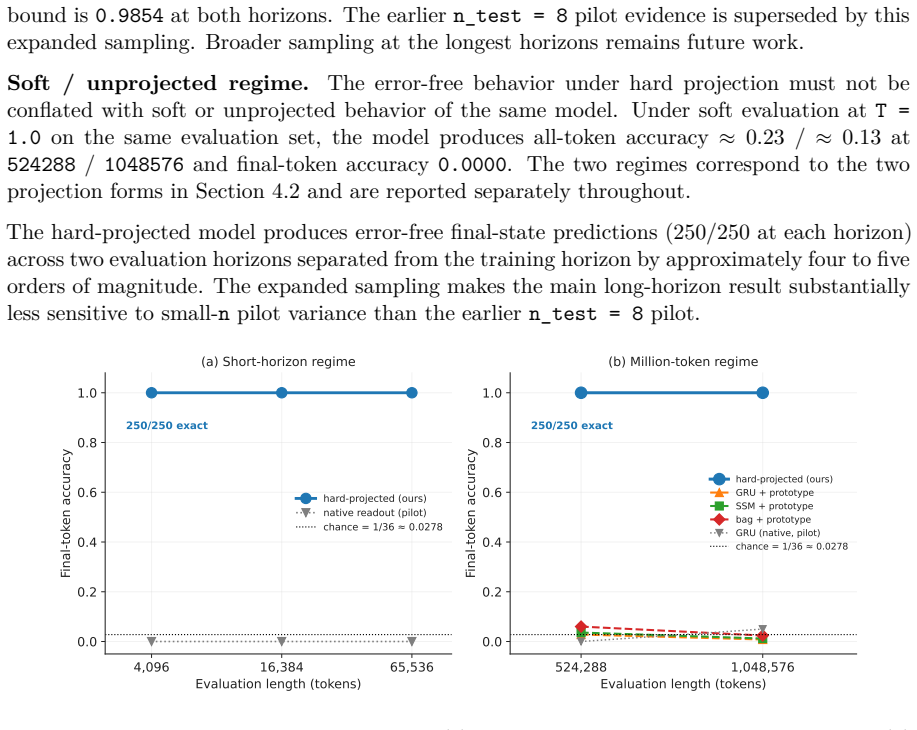
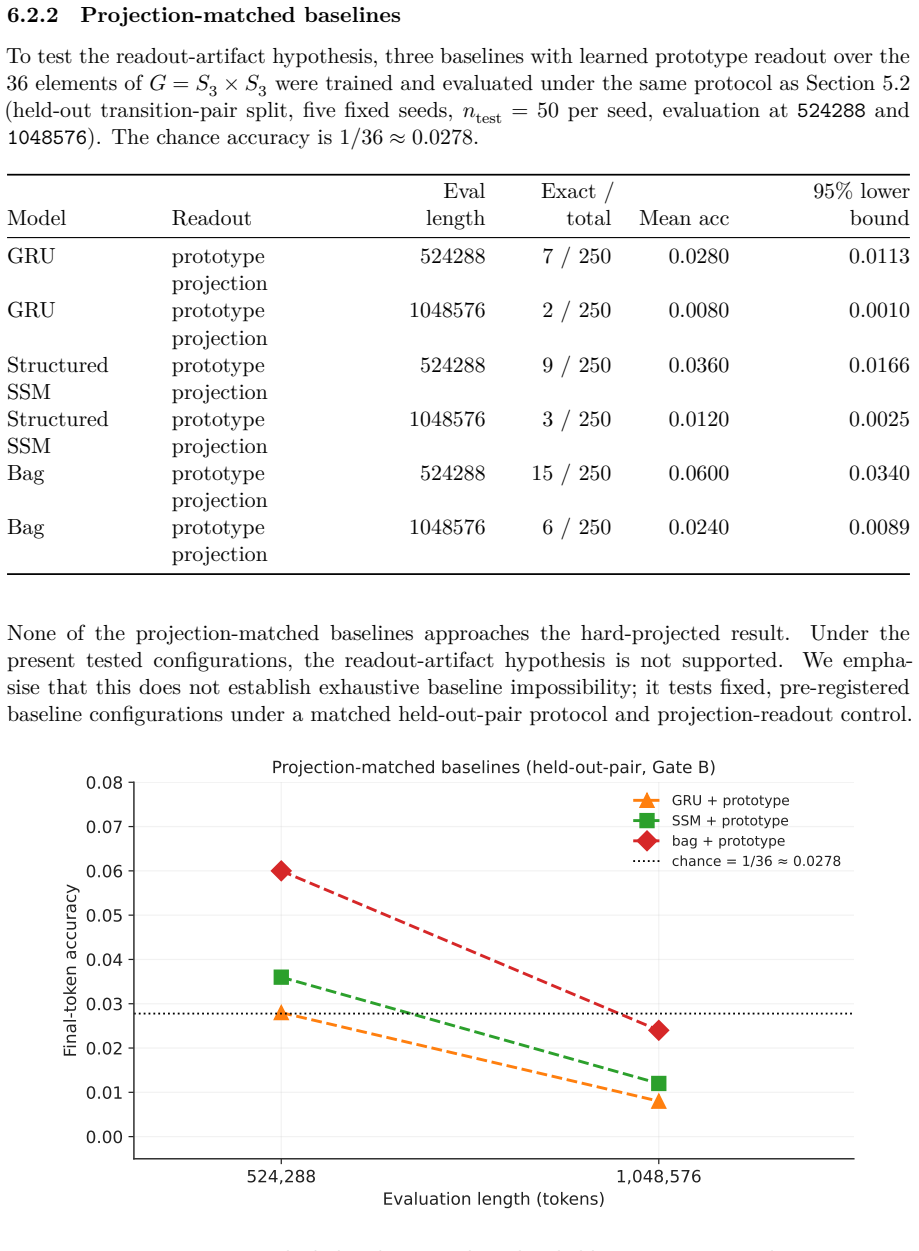
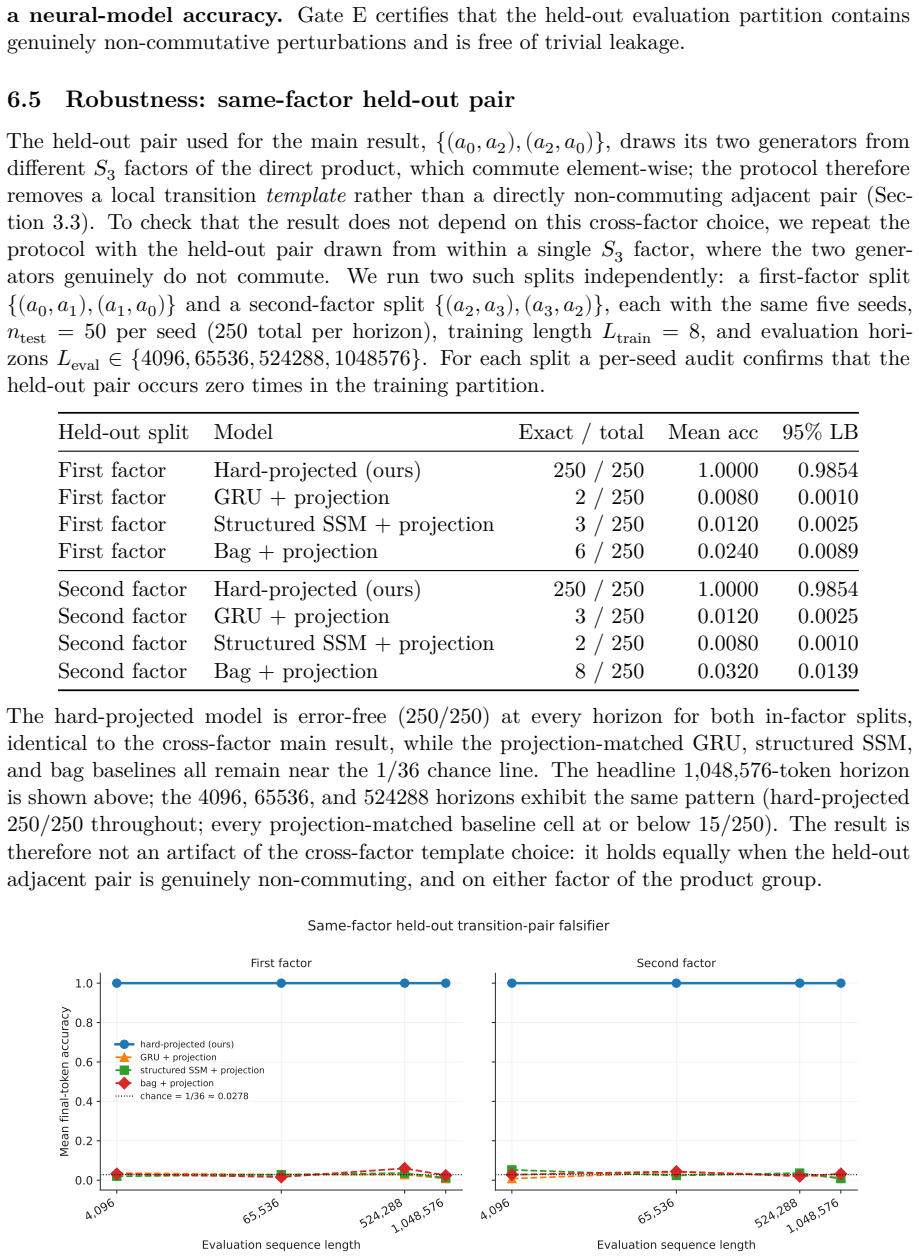
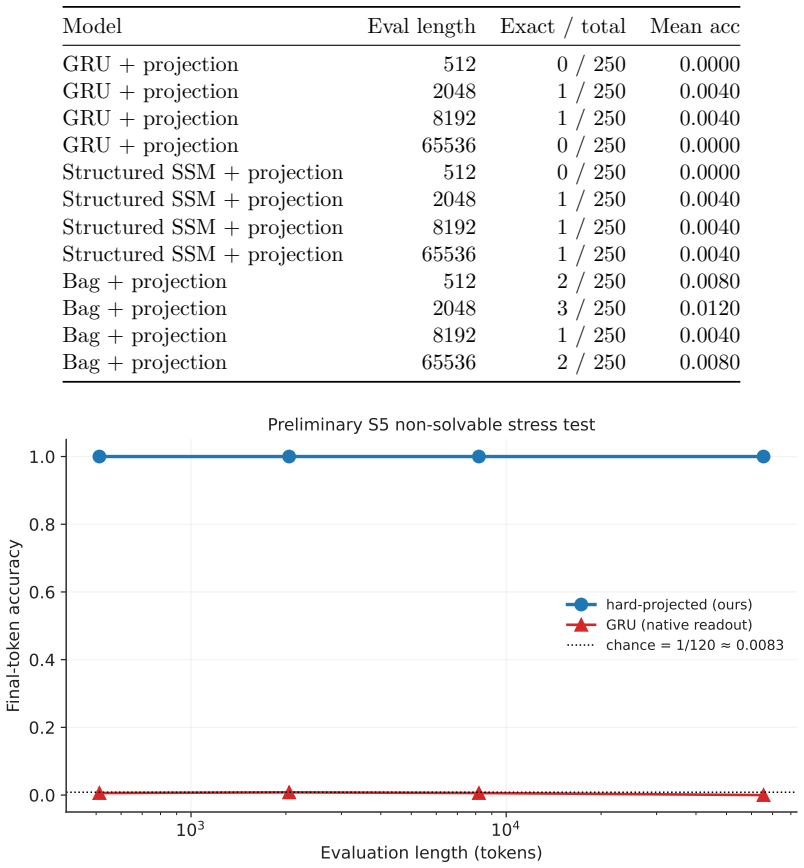
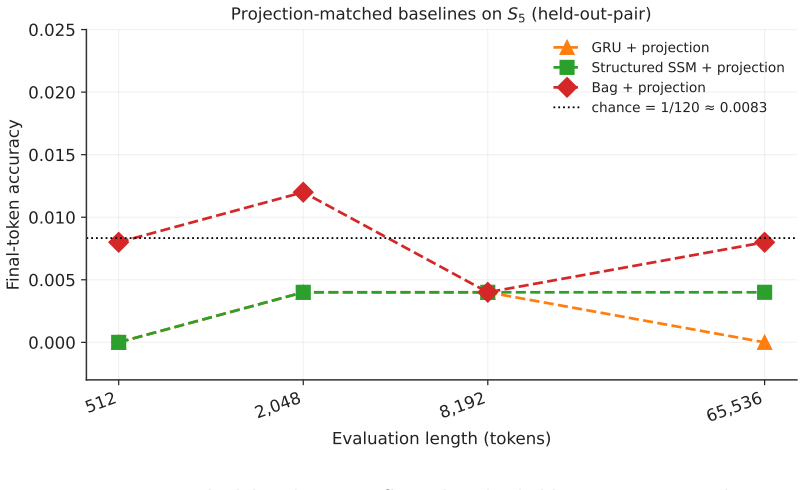
The held-out transition-pair falsifier blocks selected ordered generator pairs during training and requires the same local patterns during evaluation. In an S3 × S3 benchmark, a projected recurrent state model trained only on length-8 sequences produces error-free final-state predictions through evaluation horizons up to 1,048,576 tokens across five seeds, while matched native-readout baselines remain near floor and projection-matched baselines also fail.
What carries the argument
The held-out transition-pair falsifier, which forbids selected ordered generator pairs from training while mandating them in evaluation to isolate non-local state composition.
If this is right
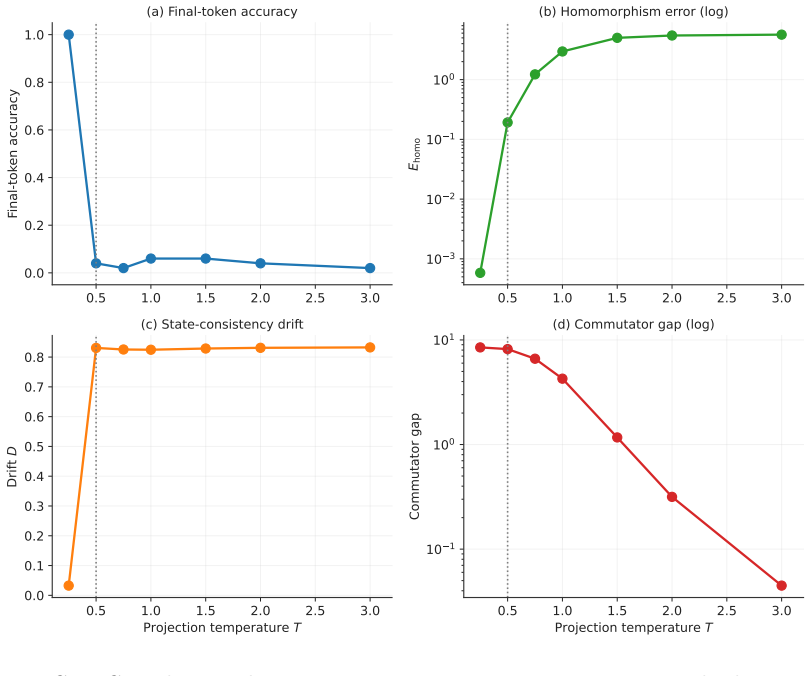
- Hard projection onto finite-group elements is necessary, since softening the projection causes final-state accuracy to collapse.
- The successful model exhibits low homomorphism error, low state-consistency drift, and non-trivial commutator separation.
- Explicit projected non-commutative state composition supplies an inductive bias that supports long-horizon hidden-state tracking in this regime.
- Clean audits confirm zero verbatim reduced-word overlap and zero structural-template overlap between the training and evaluation partitions.
Where Pith is reading between the lines
- The falsifier protocol could be extended to larger finite groups or other algebraic structures to test whether the projection bias scales.
- Success on this controlled benchmark raises the question of whether similar explicit composition mechanisms would improve performance on permutation-based planning tasks.
- The gap between projected and native-readout models suggests that architectural incorporation of group structure may matter more than raw capacity in non-commutative tracking.
Load-bearing premise
The held-out transition pairs during training combined with their requirement in evaluation fully block direct local-transition memorization pathways without leaving other memorization routes open.
What would settle it
Observing even one error in the 250/250 final-state predictions on a held-out transition pair at a long horizon, or observing a baseline model succeeding under the identical split, would falsify the reported advantage.
Figures
read the original abstract
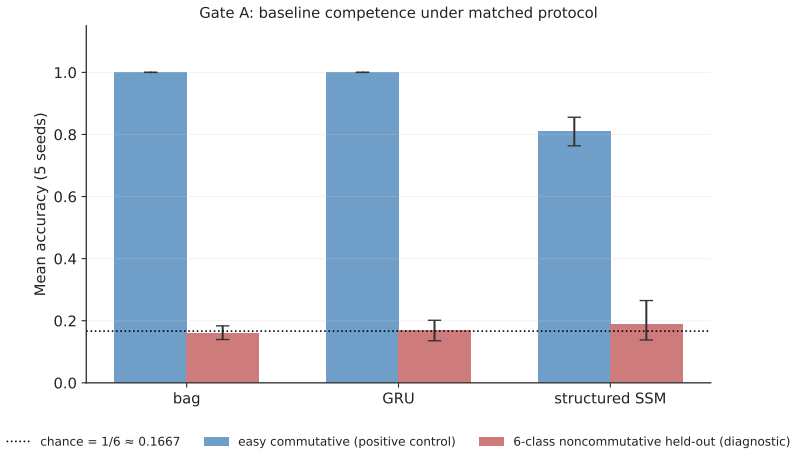
State tracking exposes a sharp limitation of sequence models: the relevant signal is often not a summary of observed tokens, but an ordered latent state that evolves through non-commutative transformations. We introduce a held-out transition-pair falsifier for finite non-Abelian group tracking. The protocol forbids selected ordered generator pairs during training and requires the same local patterns during evaluation, blocking one direct local-transition memorization pathway. In a controlled $S_3 \times S_3$ benchmark, a projected recurrent state model trained only on length-8 sequences produces error-free final-state predictions (perfect 250/250 per horizon) through evaluation horizons up to 1,048,576 tokens across five seeds. Matched native-readout baselines, including bag, GRU, and a single-configuration structured state-space model, remain near floor under the same protocol. Projection-matched GRU, structured SSM, and bag baselines equipped with analogous finite-group prototype readouts also remain near chance under the same split. Mechanism diagnostics show that hard projection coincides with low homomorphism error, low state-consistency drift, and non-trivial commutator separation, while softened projection collapses final-state accuracy. Clean-split audits verify zero verbatim reduced-word overlap and zero structural-template overlap between training and evaluation partitions. The evidence is scoped to this controlled finite-group falsifier rather than to a general architecture ranking. Within that regime, explicit projected non-commutative state composition acts as a useful inductive bias for long-horizon hidden-state tracking.
Editorial analysis
A structured set of objections, weighed in public.
Referee Report
Summary. The manuscript introduces a held-out transition-pair falsifier protocol for finite non-Abelian group state tracking. In an S3×S3 benchmark, a projected recurrent state model trained exclusively on length-8 sequences achieves perfect final-state prediction accuracy (250/250 per horizon) on held-out transitions for evaluation horizons up to 1,048,576 tokens across five seeds. Matched baselines (bag, GRU, structured SSM) remain near chance under the same protocol. The protocol is supported by mechanism diagnostics (homomorphism error, state-consistency drift, commutator separation) and clean-split audits showing zero verbatim or structural-template overlap between partitions. The scope is limited to this controlled falsifier rather than general architecture ranking.
Significance. If the falsifier protocol demonstrably prevents all memorization routes (direct and indirect), the result supplies a concrete empirical demonstration that explicit projection onto finite-group prototypes supplies a useful inductive bias for accurate long-horizon non-commutative state composition. The extreme horizon lengths and perfect per-seed accuracy constitute a strong positive signal for the architecture class under the stated conditions; the clean-split design and mechanism diagnostics are positive features of the evaluation.
major comments (2)
- [Abstract / protocol section] Abstract and protocol description: the claim that withholding selected ordered generator pairs 'blocks one direct local-transition memorization pathway' is load-bearing for the interpretation of the perfect 250/250 scores. In the finite S3×S3 group (36 elements), a model that recovers a faithful homomorphism from the observed pairs can algebraically deduce the withheld multiplications via closure, associativity, and inverses. The clean-split audits verify zero verbatim and template overlap but do not test whether the learned map is a full homomorphism on the withheld generators; therefore the results do not yet rule out that the model simply reconstructs the complete multiplication table rather than performing genuine held-out state tracking.
- [Mechanism diagnostics] Mechanism diagnostics paragraph: the reported 'low homomorphism error' under hard projection is not stated to have been evaluated on the held-out pairs themselves. If the metric is computed only on observed transitions, it does not address whether the model has inferred the withheld transitions via group structure, weakening the link between low homomorphism error and the claimed blocking of memorization routes.
minor comments (1)
- [Abstract] The abstract states 'perfect 250/250 per horizon' across five seeds; the main text should report per-seed variance or confirm that every seed achieved exactly 250/250 rather than an aggregate.
Simulated Author's Rebuttal
We thank the referee for the careful review and constructive comments on the held-out transition-pair falsifier. We respond point-by-point to the major comments below and will revise the manuscript accordingly.
read point-by-point responses
-
Referee: [Abstract / protocol section] Abstract and protocol description: the claim that withholding selected ordered generator pairs 'blocks one direct local-transition memorization pathway' is load-bearing for the interpretation of the perfect 250/250 scores. In the finite S3×S3 group (36 elements), a model that recovers a faithful homomorphism from the observed pairs can algebraically deduce the withheld multiplications via closure, associativity, and inverses. The clean-split audits verify zero verbatim and template overlap but do not test whether the learned map is a full homomorphism on the withheld generators; therefore the results do not yet rule out that the model simply reconstructs the complete multiplication table rather than performing genuine held-out state tracking.
Authors: We agree that the clean-split audits confirm absence of verbatim and template overlap but do not test whether the learned map constitutes a full homomorphism on the withheld generators. The protocol is explicitly scoped to blocking one direct local-transition memorization pathway (exposure to the specific ordered pairs), not to excluding all algebraic reconstruction routes via group closure. The perfect accuracy of the projected model versus matched baselines (including projection-equipped variants) under this split provides evidence that the projection supplies a useful inductive bias within the protocol's constraints. To address the concern, we will add an explicit evaluation of homomorphism error on the held-out pairs and report the results in the revised mechanism diagnostics section. revision: yes
-
Referee: [Mechanism diagnostics] Mechanism diagnostics paragraph: the reported 'low homomorphism error' under hard projection is not stated to have been evaluated on the held-out pairs themselves. If the metric is computed only on observed transitions, it does not address whether the model has inferred the withheld transitions via group structure, weakening the link between low homomorphism error and the claimed blocking of memorization routes.
Authors: The referee correctly notes that the manuscript does not state the homomorphism error was evaluated on held-out pairs; the reported values were computed on observed transitions. We will revise the mechanism diagnostics paragraph to separately report homomorphism error on both observed and held-out pairs, clarifying the scope of the diagnostic and its relation to the falsifier protocol. revision: yes
Circularity Check
Empirical held-out falsifier benchmark; no derivation reduces accuracy to fitted input by construction
full rationale
The paper reports an empirical result: a projected recurrent model trained on length-8 sequences with selected transition pairs withheld achieves perfect final-state accuracy on long-horizon evaluation sequences that require those pairs. The abstract and protocol description contain no equations, no fitted parameters renamed as predictions, and no self-citations that bear the central claim. The held-out split and clean-split audits are presented as direct measurements on held-out data, not tautological re-expressions of training statistics. The result is therefore scoped as an empirical benchmark rather than a first-principles derivation that collapses to its inputs.
Axiom & Free-Parameter Ledger
Reference graph
Works this paper leans on
-
[1]
Barrington
David A. Barrington. Bounded-Width Polynomial-Size Branching Programs Recognize Ex- actly Those Languages in NC^1 . Journal of Computer and System Sciences, 38(1):150–164,
-
[2]
doi:10.1016/0022-0000(89)90037-8
-
[3]
Kenneth Krohn and John Rhodes. Algebraic Theory of Machines. I. Prime Decomposition Theorem for Finite Semigroups and Machines . Transactions of the American Mathematical Society, 116:450–464, 1965. doi:10.2307/1994127
-
[4]
arXiv preprint arXiv:2404.08819 , year=
William Merrill, Jackson Petty, and Ashish Sabharwal. The Illusion of State in State-Space Models. ICML 2024; arXiv:2404.08819, 2024
-
[5]
The Expressive Limits of Diagonal SSMs for State-Tracking
Mehran Shakerinava, Behnoush Khavari, Siamak Ravanbakhsh, and Sarath Chandar. The Expressive Limits of Diagonal SSMs for State-Tracking . arXiv:2603.01959, 2026
-
[6]
On the "Induction Bias" in Sequence Models
M. Reza Ebrahimi, Michaël Defferrard, Sunny Panchal, and Roland Memisevic. On the “Induction Bias” in Sequence Models . arXiv:2602.18333, 2026
work page internal anchor Pith review Pith/arXiv arXiv 2026
-
[7]
Structured Sparse Transition Matrices to Enable State Tracking in State-Space Models
Aleksandar Terzić, Nicolas Menet, Michael Hersche, Thomas Hofmann, and Abbas Rahimi. Structured Sparse Transition Matrices to Enable State Tracking in State-Space Models . NeurIPS 2025 Spotlight; arXiv:2509.22284, 2025
-
[8]
M$^2$RNN: Non-Linear RNNs with Matrix-Valued States for Scalable Language Modeling
Mayank Mishra, Shawn Tan, Ion Stoica, Joseph Gonzalez, and Tri Dao. 𝑀 2RNN: Non- Linear RNNs with Matrix-Valued States for Scalable Language Modeling . arXiv:2603.14360, 2026
work page internal anchor Pith review Pith/arXiv arXiv 2026
-
[9]
Robust Reasoning as a Symmetry-Protected Topological Phase
Ilmo Sung. Robust Reasoning as a Symmetry-Protected Topological Phase. arXiv:2601.05240, 2026. Code and Data A vailability The public release package includes benchmark generation code, held-out split construction, overlap-audit scripts, Gate E specificity checks, result CSVs, figure scripts, evaluation-set hashes, and projection-matched baseline configur...
work page doi:10.5281/ze 2026
discussion (0)
Sign in with ORCID, Apple, or X to comment. Anyone can read and Pith papers without signing in.