Fermion sign problem and the structure of Lee-Yang zeros. II. Finite temperature results for a model system without interactions
Pith reviewed 2026-06-27 20:27 UTC · model grok-4.3
The pith
The Lee-Yang zero near ξ=-1 stays close to -1 at low T and fixes the sign factor that blocks real-axis continuation.
A machine-rendered reading of the paper's core claim, the machinery that carries it, and where it could break.
Core claim
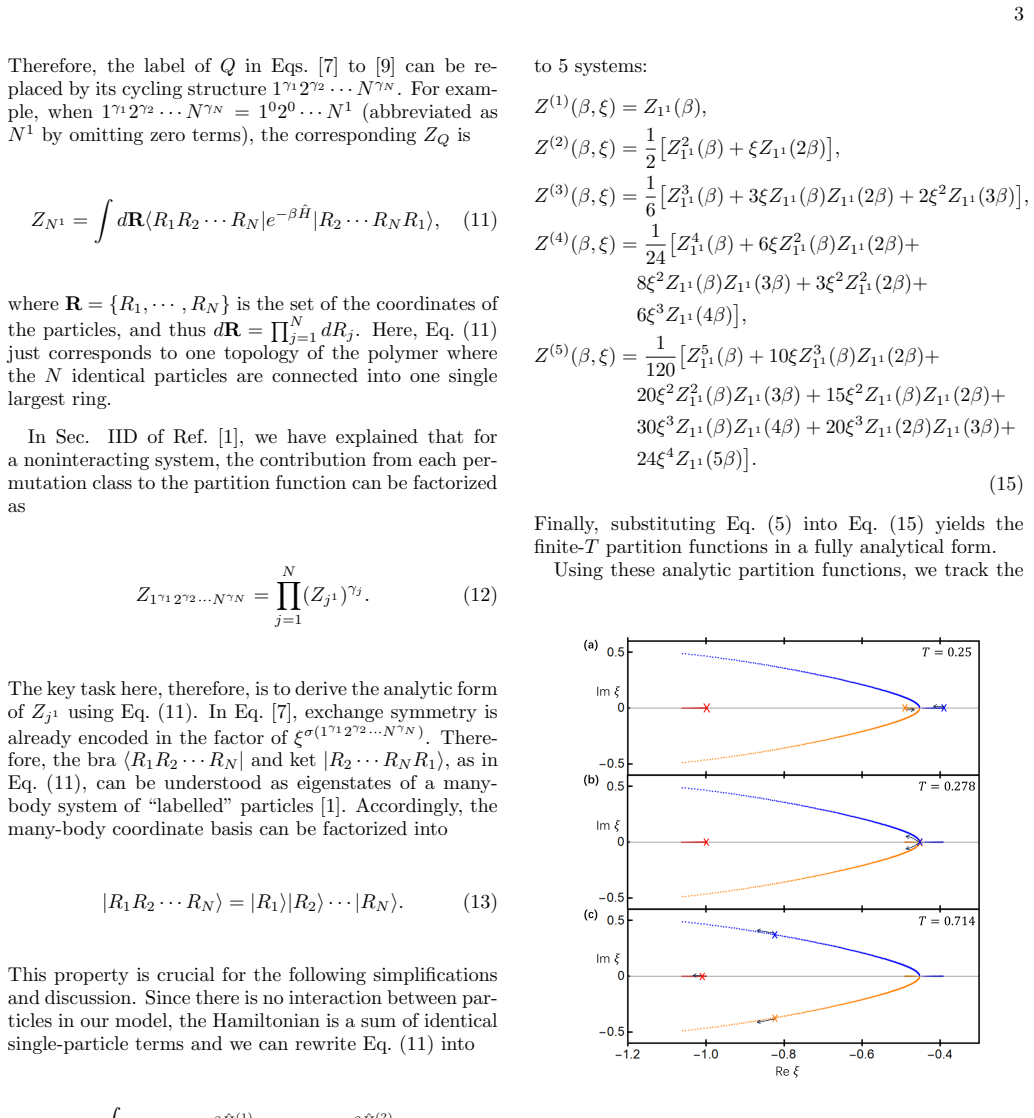
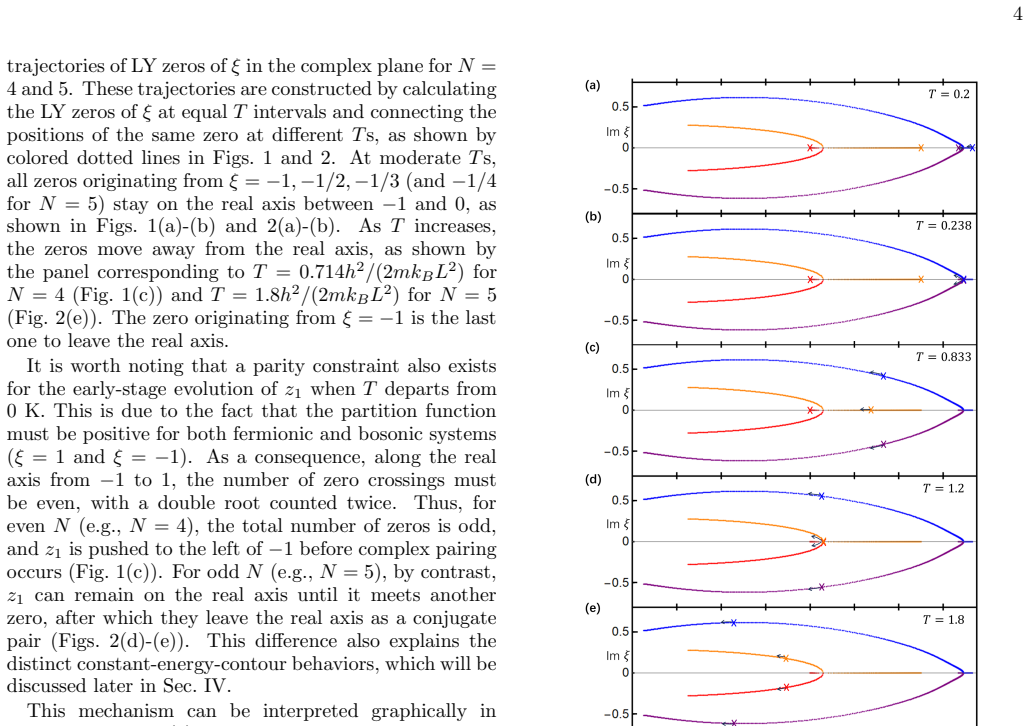
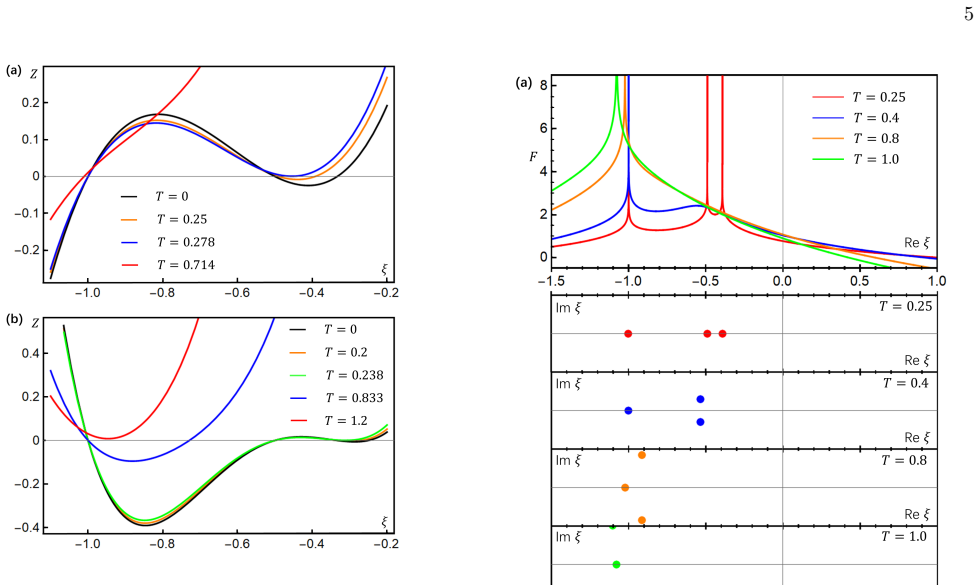
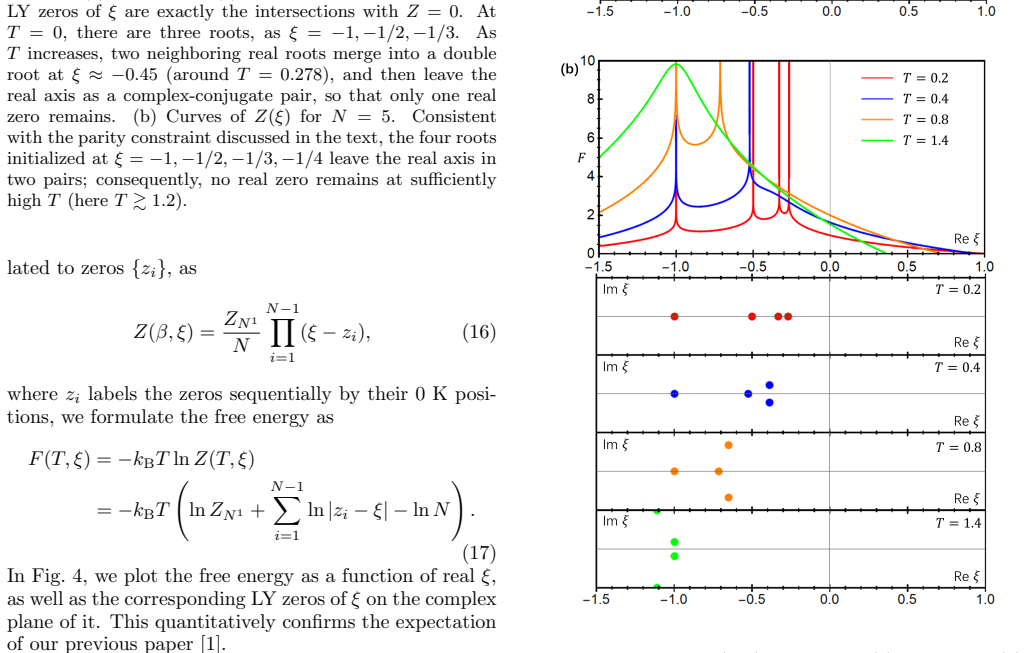
In the noninteracting model the partition function is a polynomial in ξ whose zeros trace definite trajectories with temperature; the zero that begins at ξ=-1 at zero temperature remains close to -1 at low but finite temperature, thereby fixing the sign factor and constraining any continuation along the real ξ axis.
What carries the argument
Trajectories of the Lee-Yang zeros of the partition function polynomial Z(ξ,T) in the complex ξ-plane as temperature is varied.
If this is right
- Direct extrapolation from ξ in [0,1] to ξ=-1 fails at low T because a zero lies close to the target point.
- Contour-based or implicit fitting schemes also fail at low T for the same geometric reason.
- Both classes of methods regain accuracy once temperature is high enough for the nearby zero to move away.
- High-T continuation of sign-problem-free data followed by T-fitting of the ξ-independent remainder φ(β) yields reliable low-T fermionic properties.
Where Pith is reading between the lines
- The same zero-tracking logic could be applied to interacting models to diagnose when standard continuation methods are expected to break down.
- The proposed high-T-then-T-fit route offers a concrete numerical protocol that can be tested on small interacting systems where exact results are still available.
- If the zero near -1 persists in interacting cases, it would set a practical lower-temperature bound below which real-axis methods require auxiliary information from the imaginary axis.
Load-bearing premise
The zero trajectories and fitting behavior found in this noninteracting model will carry over usefully to interacting fermionic systems.
What would settle it
Compute the locations of the partition-function zeros at several low but finite temperatures in an interacting lattice fermion model and check whether any zero remains near ξ=-1.
Figures
read the original abstract
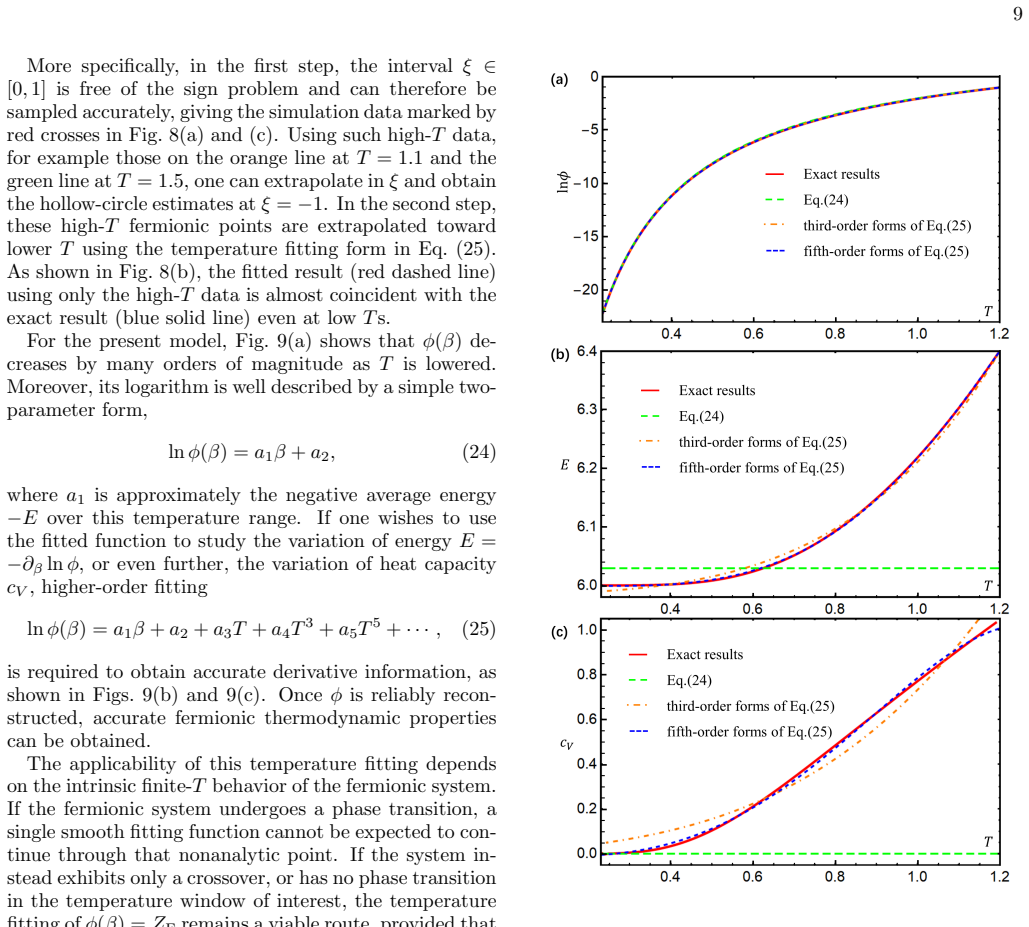
Beyond the analysis of the Lee-Yang (LY) zero of $\xi$ at $0$ K presented by our previous work [He et. al. Phys. Rev. E 113, 24115 (2026)], it is important but intricate to understand how these zeros evolve with temperature ($T$). Here, we use an analytically solvable noninteracting one-dimensional particle-on-a-ring model to address this. We determine the trajectories of these zeros and analyze how their evolution with $T$ reshapes the analytic structure of the partition function. In particular, the zero originating from $\xi=-1$ at $T=0$ remains close to $-1$ at low $T$, where it governs the sign factor and strongly constrains continuation along the real $\xi$ axis. This explains why both direct extrapolation and implicit schemes such as contour-based fitting can fail in the low-$T$ regime, even at high fitting order, while becoming reasonable again once the relevant zeros move away at higher $T$s. Furthermore, based on the polynomial structure of the partition function, we propose a new fitting strategy for low-$T$ fermionic properties. The key is to first obtain reliable high-$T$ fermionic properties by continuing sign-problem-free data in $\xi\in[0,1]$ to $\xi=-1$, and then extend this information toward lower $T$ through $T$-fitting of the $\xi$-independent remainder $\phi(\beta)=Z_{\text{F}}$. These results provide a solvable benchmark for diagnosing the validity of analytic continuation and suggest a possible route toward treating more realistic interacting fermionic systems.
Editorial analysis
A structured set of objections, weighed in public.
Referee Report
Summary. The paper analyzes the finite-temperature trajectories of Lee-Yang zeros in an exactly solvable noninteracting one-dimensional particle-on-a-ring model whose partition function is a finite polynomial in the auxiliary variable ξ. It shows that the zero originating from ξ = −1 at T = 0 remains close to −1 at low T, where it governs the sign factor and constrains real-axis continuation; this structure directly accounts for the reported failure of both direct extrapolation and high-order contour fitting at low T. Based on the polynomial factorization, the authors propose a fitting strategy that first continues sign-problem-free data along ξ ∈ [0,1] to ξ = −1 at high T and then extends to lower T via T-fitting of the ξ-independent remainder φ(β) = Z_F. The work supplies an analytic benchmark for continuation methods and suggests possible implications for interacting systems.
Significance. If the results hold, the manuscript supplies a rigorous, closed-form benchmark that links zero trajectories to the breakdown of extrapolation schemes at low T. Because every step follows from direct evaluation of the known polynomial, the explanation of method failure and the algebraic derivation of the T-fitting procedure are internally consistent and falsifiable within the model. This diagnostic clarity is a concrete strength for the field of sign-problem studies.
minor comments (2)
- [Abstract] Abstract: the statement that the results 'suggest a possible route toward treating more realistic interacting fermionic systems' is presented without any supporting argument or test; this phrasing should be qualified as purely speculative to avoid overstating the scope of the noninteracting benchmark.
- [Discussion of fitting strategy] The manuscript would benefit from an explicit statement (perhaps in the concluding section) of the precise conditions under which the proposed T-fitting procedure reduces to a parameter-free algebraic identity versus requiring numerical fitting.
Simulated Author's Rebuttal
We thank the referee for the supportive summary, the assessment of significance, and the recommendation of minor revision. No specific major comments were provided in the report.
Circularity Check
No significant circularity; derivation self-contained in solvable model
full rationale
The paper computes zero trajectories and low-T behavior directly from the closed-form partition function polynomial of the exactly solvable noninteracting ring model. The persistence of the root near ξ=-1 follows by continuity from the T=0 case (established in part I) and the polynomial factorization; the proposed T-fitting of the ξ-independent remainder φ(β) is an algebraic consequence of that factorization rather than any fitted parameter reused as a prediction. The self-citation to part I supplies only the T=0 baseline and is not load-bearing for the finite-T analysis. The suggestion of applicability to interacting systems is stated explicitly as a suggestion, not a derived result. All load-bearing steps remain internal to the model's exact structure with no reduction by construction.
Axiom & Free-Parameter Ledger
axioms (1)
- standard math The grand partition function of a noninteracting system is a finite polynomial in the fugacity ξ whose roots are the Lee-Yang zeros.
Reference graph
Works this paper leans on
-
[1]
R. C. He, J. X. Zeng, S. Yang, C. Wang, Q. J. Ye, and X. Li, Phys. Rev. E113, 024115 (2026)
2026
-
[2]
J. M. Leinaas and J. Myrheim, Il Nuovo Cimento B(1971- 1996)37, 1 (1977)
1971
-
[3]
Wilczek, Phys
F. Wilczek, Phys. Rev. Lett.49, 957 (1982)
1982
-
[4]
F. D. M. Haldane, Phys. Rev. Lett.67, 937 (1991)
1991
-
[5]
M. T. Batchelor, X.-W. Guan, and N. Oelkers, Phys. Rev. Lett.96, 210402 (2006)
2006
-
[6]
Keilmann, S
T. Keilmann, S. Lanzmich, I. McCulloch, and M. Roncaglia, Nat. Commun.2, 361 (2011)
2011
-
[7]
C. N. Yang and T. D. Lee, Phys. Rev.87, 404 (1952)
1952
-
[8]
T. D. Lee and C. N. Yang, Phys. Rev.87, 410 (1952)
1952
-
[9]
Bloch, J
I. Bloch, J. Dalibard, and W. Zwerger, Rev. Mod. Phys. 80, 885 (2008)
2008
-
[10]
J. S. Douglas, H. Habibian, C.-L. Hung, A. V. Gorshkov, H. J. Kimble, and D. E. Chang, Nat. Photonics9, 326 (2015)
2015
-
[11]
Bruus and K
H. Bruus and K. Flensberg,Many-body quantum theory in condensed matter physics - an introduction(Oxford University Press, Oxford, 2004)
2004
-
[12]
Coleman,Introduction to Many-Body Physics(Cam- bridge University Press, Cambridge, 2015)
P. Coleman,Introduction to Many-Body Physics(Cam- bridge University Press, Cambridge, 2015)
2015
-
[13]
W. M. C. Foulkes, L. Mitas, R. J. Needs, and G. Ra- jagopal, Rev. Mod. Phys.73, 33 (2001)
2001
-
[14]
Thompson,An Introduction to Plasma Physics(Perg- amon Press, Oxford, 1964)
W. Thompson,An Introduction to Plasma Physics(Perg- amon Press, Oxford, 1964)
1964
-
[15]
Birdsall and A
C. Birdsall and A. Langdon,Plasma Physics via Com- puter Simulation(McGraw-Hill, New York, 1985)
1985
-
[16]
J. M. McMahon, M. A. Morales, C. Pierleoni, and D. M. Ceperley, Rev. Mod. Phys.84, 1607 (2012)
2012
-
[17]
Dornheim, S
T. Dornheim, S. Groth, and M. Bonitz, Phys. Rep.744, 1 (2018)
2018
-
[18]
Bonitz, J
M. Bonitz, J. Vorberger, M. Bethkenhagen, M. P. B¨ ohme, D. M. Ceperley, A. Filinov, T. Gawne, F. Graziani, G. Gregori, P. Hamann, S. B. Hansen, M. Holzmann, S. X. Hu, H. K¨ ahlert, V. V. Karasiev, U. Kleinschmidt, L. Kordts, C. Makait, B. Militzer, Z. A. Moldabekov, C. Pierleoni, M. Preising, K. Ramakrishna, R. Redmer, S. Schwalbe, P. Svensson, and T. Do...
2024
-
[19]
Xiong and H
Y. Xiong and H. Xiong, J. Chem. Phys.157, 094112 (2022)
2022
-
[20]
Xiong and H
Y. Xiong and H. Xiong, J. Chem. Phys.156, 204117 (2022)
2022
-
[21]
Xiong and H
Y. Xiong and H. Xiong, Phys. Rev. E106, 025309 (2022)
2022
-
[22]
Xiong and H
Y. Xiong and H. Xiong, Phys. Rev. E107, 055308 (2023)
2023
-
[23]
Xiong, S
Y. Xiong, S. Liu, and H. Xiong, Phys. Rev. E110, 065303 (2024)
2024
-
[24]
Dornheim, P
T. Dornheim, P. Tolias, S. Groth, Z. A. Moldabekov, J. Vorberger, and B. Hirshberg, J. Chem. Phys.159, 164113 (2023)
2023
-
[25]
Dornheim, S
T. Dornheim, S. Schwalbe, M. P. B¨ ohme, Z. A. Mold- abekov, J. Vorberger, and P. Tolias, J. Chem. Phys. 160, 164111 (2024)
2024
-
[26]
Dornheim, S
T. Dornheim, S. Schwalbe, Z. A. Moldabekov, J. Vor- berger, and P. Tolias, J. Phys. Chem. Lett.15, 1305 (2024)
2024
-
[27]
Dornheim, T
T. Dornheim, T. D¨ oppner, P. Tolias, M. P. B¨ ohme, L. B. Fletcher, T. Gawne, F. R. Graziani, D. Kraus, M. J. Mac- Donald, Z. A. Moldabekov, S. Schwalbe, D. O. Gericke, and J. Vorberger, Nat. Commun.16, 5103 (2025)
2025
-
[28]
Dornheim, Z
T. Dornheim, Z. Moldabekov, S. Schwalbe, P. Tolias, and J. Vorberger, J. Chem. Theory Comput.21, 7290 (2025)
2025
-
[29]
Dornheim, P
T. Dornheim, P. Svensson, P. Hamann, S. Schwalbe, Z. A. Moldabekov, P. Tolias, and J. Vorberger, J. Chem. Phys.163, 154101 (2025)
2025
-
[30]
Dornheim, A
T. Dornheim, A. Benedix Robles, P. Hamann, T. M. Chuna, P. Svensson, S. Schwalbe, Z. A. Moldabekov, P. Tolias, and J. Vorberger, Phys. Rev. Res.8, 023042 (2026)
2026
-
[31]
Tommaso and G
M. Tommaso and G. Giovanni, Phys. Rev. B.111, 014521 (2025)
2025
-
[32]
Morresi, G
T. Morresi, G. Garberoglio, H. Xiong, and Y. Xiong, Phys. Rev. B112, 155131 (2025)
2025
-
[33]
Xiong and H
Y. Xiong and H. Xiong, J. Chem. Phys.163, 174107 (2025)
2025
-
[34]
Quantum path-integral method for fictitious particle hubbard model,
Z. Fan, T. Xiao, and Y. Deng, “Quantum path-integral method for fictitious particle hubbard model,” (2025)
2025
-
[35]
Hirshberg, V
B. Hirshberg, V. Rizzi, and M. Parrinello, Proc. Natl. Acad. Sci. USA116, 21445 (2019)
2019
-
[36]
Hirshberg, M
B. Hirshberg, M. Invernizzi, and M. Parrinello, J. Chem. Phys.152, 171102 (2020)
2020
-
[37]
Y. M. Y. Feldman and B. Hirshberg, J. Chem. Phys.159, 154107 (2023)
2023
-
[38]
Higer, Y
J. Higer, Y. M. Y. Feldman, and B. Hirshberg, J. Chem. Phys.163, 024101 (2025)
2025
-
[39]
Ouyang, Q.-J
X.-Y. Ouyang, Q.-J. Ye, and X.-Z. Li, Phys. Rev. E109, 024118 (2024)
2024
-
[40]
L. Liu, Y. Dong, Q.-J. Ye, and X.-Z. Li, Phys. Rev. B 112, 104102 (2025)
2025
-
[41]
M. E. Fisher, Rep. Prog. Phys.30, 615 (1967)
1967
discussion (0)
Sign in with ORCID, Apple, or X to comment. Anyone can read and Pith papers without signing in.