Quantum correlations in QBism's reconstruction program
Pith reviewed 2026-06-27 21:28 UTC · model grok-4.3
The pith
Qplex geometry reproduces the Tsirelson bound for CHSH but permits super-quantum violations of the CGLMP inequality.
A machine-rendered reading of the paper's core claim, the machinery that carries it, and where it could break.
Core claim
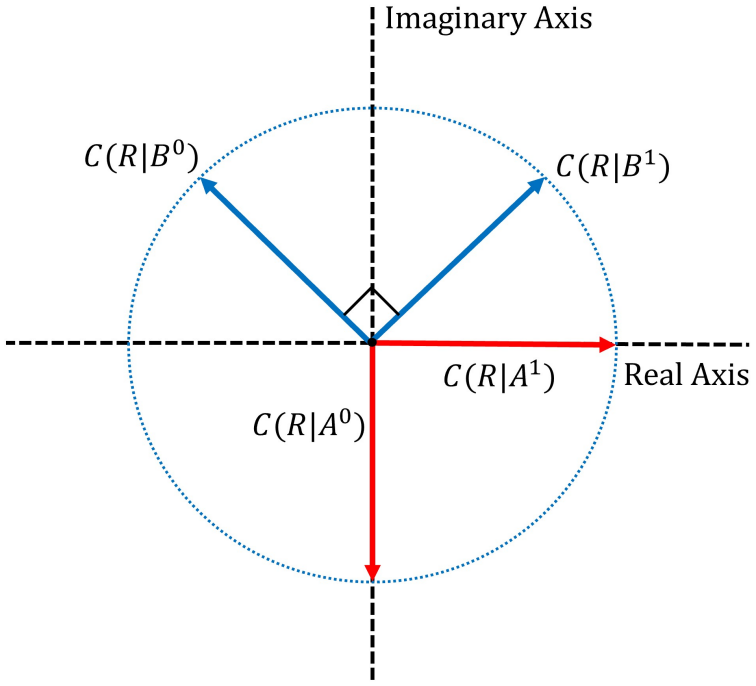
By expressing joint expectation values as inner products between C-vectors whose norms and inner products are constrained by qplex geometry, the maximal CHSH violation is shown to equal the Tsirelson bound while the CGLMP inequality I_{2233} can reach up to 2 + 2√3/3 ≈ 3.1547, exceeding the quantum maximum of ≈2.8729. These results demonstrate that qplex geometry captures enough structure to reproduce an important quantum bound in the two-outcome case but not enough to recover the full set of quantum correlation constraints.
What carries the argument
C-vectors whose inner products encode joint expectation values subject to qplex geometric constraints on states and measurements.
Load-bearing premise
Expressing joint expectation values as inner products between suitably defined C-vectors accurately encodes the qplex-compatible probability assignments for bipartite systems.
What would settle it
An explicit set of C-vectors obeying qplex norm and inner-product rules that produces a CHSH value larger than 2√2, or a proof that the reported upper bound on I_{2233} cannot be attained within those rules.
Figures
read the original abstract
QBism recasts quantum theory as a normative framework for an agent's probability assignments, with the Born rule taking the form of a consistency condition known as the Urgleichung. Motivated by this perspective, qplex theories provide a broader class of probabilistic models in which the sets of valid states and measurements are constrained by QBist-inspired geometric conditions. While qplexes have been extensively studied for single systems, their implications for bipartite correlations remain largely unexplored. In this work, we investigate bipartite correlations in qplex theories by expressing joint expectation values as inner products between suitably defined $C$-vectors. This geometric formulation allows Bell-type inequalities to be studied as optimization problems over qplex-compatible probability assignments. We first analyze the CHSH scenario and show that the shared inner-product structure of the $C$-vectors restricts the maximal value to the Tsirelson bound $2\sqrt{2}$. We then turn to the three-outcome CGLMP inequality $I_{2233}$ and find that the same qplex-derived norm and inner-product constraints allow a violation of up to $\leq 2+2\sqrt(3)/3 \approx 3.1547$ versus the quantum maximum of $\approx 2.8729$, thereby exhibiting super-quantum correlations. These results show that qplex geometry captures enough structure to reproduce an important quantum bound in the two-outcome case, but not enough to recover the full set of quantum correlation constraints. The analysis therefore suggests that additional principles are needed to complete the QBist reconstruction of quantum theory.
Editorial analysis
A structured set of objections, weighed in public.
Referee Report
Summary. The paper claims that qplex theories, defined by QBist-inspired geometric constraints on probability assignments, can be extended to bipartite systems by representing joint expectation values as inner products of suitably defined C-vectors. This formulation yields a Tsirelson bound of 2√2 for the CHSH inequality but permits a violation of the CGLMP inequality I_{2233} up to 2 + 2√3/3 ≈ 3.1547, exceeding the quantum value ≈2.8729. The authors conclude that qplex geometry recovers some but not all quantum correlation constraints, implying additional principles are needed for a full QBist reconstruction.
Significance. If the C-vector encoding is shown to be equivalent to the full set of qplex constraints, the results would demonstrate a concrete limitation of the geometric axioms in reproducing quantum correlations, providing a falsifiable test for the reconstruction program. The inner-product optimization approach is a strength, as it converts correlation bounds into a geometric problem without direct fitting to quantum data.
major comments (3)
- [Abstract] Abstract, paragraph on geometric formulation: The claim that joint expectation values are expressed as inner products between C-vectors that 'encode all qplex-compatible probability assignments for bipartite systems' is introduced as a definition rather than derived from the single-system geometric axioms; without an explicit proof that this construction respects independent qplex restrictions on each subsystem (and adds no extraneous freedom), the reported bounds for both CHSH and I_{2233} rest on an unverified equivalence.
- [CHSH analysis] CHSH analysis section: The restriction of the maximal CHSH value to exactly the Tsirelson bound 2√2 is attributed to the shared inner-product structure and qplex norm constraints on the C-vectors, but the manuscript does not exhibit the explicit optimization problem, the definition of the relevant C-vectors, or verification that the feasible set matches the qplex geometry; this step is load-bearing for the claim that qplex reproduces the quantum bound in the two-outcome case.
- [I_{2233} analysis] I_{2233} analysis section: The upper bound ≤ 2 + 2√3/3 is obtained from the same C-vector inner-product optimization; if the construction omits single-system qplex constraints or permits assignments outside the original geometric axioms, the reported super-quantum value does not correctly characterize qplex theories and undermines the contrast with the quantum maximum of ≈2.8729.
minor comments (2)
- [Abstract] Abstract: The expression '2+2√(3)/3' is ambiguous in inline text; rewrite as '2 + (2√3)/3' for clarity.
- The manuscript would benefit from an explicit statement of the single-system qplex axioms (e.g., the precise form of the Urgleichung-derived constraints) before introducing the bipartite C-vector construction.
Simulated Author's Rebuttal
We thank the referee for their careful and constructive review of our manuscript on bipartite correlations in qplex theories. The comments correctly identify areas where the connection between the C-vector construction and the single-system qplex axioms requires more explicit elaboration. We address each major comment below and will revise the manuscript to incorporate the requested details.
read point-by-point responses
-
Referee: [Abstract] Abstract, paragraph on geometric formulation: The claim that joint expectation values are expressed as inner products between C-vectors that 'encode all qplex-compatible probability assignments for bipartite systems' is introduced as a definition rather than derived from the single-system geometric axioms; without an explicit proof that this construction respects independent qplex restrictions on each subsystem (and adds no extraneous freedom), the reported bounds for both CHSH and I_{2233} rest on an unverified equivalence.
Authors: We agree that the C-vector encoding would benefit from an explicit derivation rather than being presented primarily as a definition. In the revised manuscript, we will add a dedicated subsection that starts from the independent application of single-system qplex geometric constraints to each subsystem and derives the joint C-vector representation, including a proof that the resulting inner-product structure introduces no extraneous freedom beyond the original axioms. revision: yes
-
Referee: [CHSH analysis] CHSH analysis section: The restriction of the maximal CHSH value to exactly the Tsirelson bound 2√2 is attributed to the shared inner-product structure and qplex norm constraints on the C-vectors, but the manuscript does not exhibit the explicit optimization problem, the definition of the relevant C-vectors, or verification that the feasible set matches the qplex geometry; this step is load-bearing for the claim that qplex reproduces the quantum bound in the two-outcome case.
Authors: The referee correctly observes that the CHSH section lacks the full explicit optimization setup. We will expand the section to define the relevant C-vectors, formulate the optimization problem of maximizing the appropriate inner product subject to the qplex norm constraints, and include a verification (via direct computation or geometric argument) that the feasible set reproduces the Tsirelson bound of 2√2. revision: yes
-
Referee: [I_{2233} analysis] I_{2233} analysis section: The upper bound ≤ 2 + 2√3/3 is obtained from the same C-vector inner-product optimization; if the construction omits single-system qplex constraints or permits assignments outside the original geometric axioms, the reported super-quantum value does not correctly characterize qplex theories and undermines the contrast with the quantum maximum of ≈2.8729.
Authors: We acknowledge the importance of confirming that the I_{2233} bound is computed strictly within the qplex constraints. The revision will apply the same explicit C-vector derivation developed for the CHSH case to the I_{2233} analysis, demonstrating that single-system restrictions are preserved while the optimization still yields the reported upper bound of 2 + 2√3/3. revision: yes
Circularity Check
No circularity: bounds derived from optimization over explicitly stated qplex geometry
full rationale
The paper sets up a geometric representation of bipartite qplex assignments via C-vectors whose inner-product structure is asserted to encode the single-system qplex conditions, then directly optimizes the CHSH and I2233 expressions under the resulting norm and inner-product constraints. The reported values (2√2 and ≤2+2√3/3) are outputs of that optimization, not inputs or redefinitions of the qplex axioms themselves. No parameter is fitted to target data and then relabeled a prediction, no self-citation supplies a load-bearing uniqueness theorem, and the construction is presented as an explicit modeling choice rather than a hidden equivalence that collapses the derivation. The work is therefore self-contained against its own stated assumptions.
Axiom & Free-Parameter Ledger
axioms (2)
- domain assumption QBism recasts quantum theory as a normative framework for an agent's probability assignments, with the Born rule taking the form of the Urgleichung consistency condition.
- domain assumption The sets of valid states and measurements in qplex theories are constrained by QBist-inspired geometric conditions.
invented entities (1)
-
C-vectors
no independent evidence
Reference graph
Works this paper leans on
-
[1]
We then turn to the three-outcome CGLMP inequalityI 2233 and find that the same qplex-derived norm and inner-product constraints allow a violation of up to≤2 + 2 p (3)/3≈3.1547 versus the quantum maximum of≈2.8729, thereby exhibiting super-quantum correlations. These results show that qplex geometry captures enough structure to reproduce an impor- tant qu...
-
[2]
QBism and qplex theories 4
-
[4]
Conclusions 18 References 19
-
[5]
almost quantum
INTRODUCTION The contemporaryreconstructionprogram in quantum foundations seeks to explain why quan- tum theory has the particular shape that it does, by positing information-theoretic principles that uniquely single out quantum theory from among a broader class ofgeneral probabilistic theories (GPTs) [1, 2]. There are two complementary approaches to the ...
-
[6]
In Sec. 3 B, we consider the three-outcome CGLMP inequalityI 2233 and show that, unlike in the CHSH case, the qplex constraints considered here allow a violation of up to 2+2 p (3)/3≈3.1547. This demonstrates that general qplex theories can exhibit superquantum correlations. In Sec. 4, we discuss the implications of these results for 3 QBism’s reconstruct...
-
[7]
More formally, consider an informationally complete measurementπwithnoutcomes {i= 1,2,
QBISM AND QPLEX THEORIES QBism relies on the fact that quantum theory admits of certain measurements – calledin- formationally complete– that allow quantum states to be faithfully represented as probability vectors. More formally, consider an informationally complete measurementπwithnoutcomes {i= 1,2, . . . , n}, and letπ i(ρ) denote the probability to ob...
-
[8]
(d+ 1) X i P(R i|Aα a)P(R i|Bβ b )− 1 d # . (3.8) 8 Since|x a|= 1 =|y b|, we can put a constraint on the joint expectation as |Eα,β| ≤d 2X a,b P(A α a)γβ b
BIP AR TITE CORRELA TIONS IN QPLEX THEORIES Having introduced the basic geometric structure of qplexes, we now turn to the problem of understanding correlations in bipartite systems within this framework. In standard quantum theory, correlations between distinct systems are typically described through tensor-product Hilbert spaces and joint measurement pr...
-
[9]
In summary, these probabilities are all valid assignments within the same qplex
We observe that the vectors are extremal: PAαa ·P Aαa =P Bβ b ·P Bβ b = 1 6 =U ,(3.38) and within each measurement, the associated states have minimal mutual overlap: PAαa ·P Aα a′ =P Bβ b ·P Bβ b′ = 1 12 =L ,(a̸=a ′),(b̸=b ′).(3.39) More generally, it can be checked that the overlaps between any pair of vectors lies between these bounds. In summary, thes...
-
[10]
The qplex framework cap- tures enough structure to reproduce the Tsirelson bound in the CHSH scenario
DISCUSSION The results of this paper provide a first answer to the question of how qplex geometry constrains correlations between independent measurements on bipartite systems. The qplex framework cap- tures enough structure to reproduce the Tsirelson bound in the CHSH scenario. This bound is not imposed through the standard Hilbert-space tensor product f...
-
[11]
The appearance of algebraic CGLMP violations suggests that the Urgleichung and the basic qplex constraints identify only part of the quantum structure
CONCLUSIONS The qplex geometry already contains enough structure to explain why CHSH correlations stop at the Tsirelson bound, but it does not yet contain enough structure to recover all quantum cor- relation bounds. The appearance of algebraic CGLMP violations suggests that the Urgleichung and the basic qplex constraints identify only part of the quantum...
2025
-
[12]
General probabilistic theories: An introduction
Martin Pl´ avala. General probabilistic theories: An introduction. Physics Reports, 1033:1–64, 2023. General probabilistic theories: An introduction
2023
-
[13]
Information processing in generalized probabilistic theories
Jonathan Barrett. Information processing in generalized probabilistic theories. Physical Review A, 75(3):032304, March 2007
2007
-
[14]
Quantum generalizations of bell’s inequality
Boris S Cirel’son. Quantum generalizations of bell’s inequality. Letters in Mathematical Physics, 4(2):93–100, 1980
1980
-
[15]
Quantum nonlocality as an axiom
Sandu Popescu and Daniel Rohrlich. Quantum nonlocality as an axiom. Foundations of Physics, 24(3):379–385, 1994
1994
-
[16]
C. A. Fuchs. QBism, the Perimeter of Quantum Bayesianism. arXiv preprint, 2010
2010
-
[17]
Fuchs, N
Christopher A. Fuchs, N. David Mermin, and R¨ udiger Schack. An introduction to QBism with an application to the locality of quantum mechanics. American Journal of Physics, 82(8):749–754, 2014
2014
-
[18]
Qbism: Quantum theory as a hero’s handbook
CA Fuchs and BC Stacey. Qbism: Quantum theory as a hero’s handbook. arxiv: 161207308. 2016
2016
-
[19]
Introducing the qplex: a novel arena for quantum theory
Marcus Appleby, Christopher A Fuchs, Blake C Stacey, and Huangjun Zhu. Introducing the qplex: a novel arena for quantum theory. The European Physical Journal D, 71(7):197, 2017
2017
-
[20]
Nothing in principle prevents a single agent from reasoning about independent measurements on multiple systems
-
[21]
Hoban, and Antonio Ac´ ın
Miguel Navascu´ es, Yelena Guryanova, Matty J. Hoban, and Antonio Ac´ ın. Almost quantum correlations. Nature Communications, 6(1):6288, February 2015
2015
-
[22]
Symmetric informa- tionally complete quantum measurements
Joseph M Renes, Robin Blume-Kohout, Andrew J Scott, and Carlton M Caves. Symmetric informa- tionally complete quantum measurements. Journal of Mathematical Physics, 45(6):2171–2180, 2004
2004
-
[23]
The SIC question: History and state of play
Christopher A Fuchs, Michael C Hoang, and Blake C Stacey. The SIC question: History and state of play. Axioms, 6(3):21, 2017
2017
-
[24]
SICs and algebraic number theory
Marcus Appleby, Steven Flammia, Gary McConnell, and Jon Yard. SICs and algebraic number theory. Foundations of Physics, 47(8):1042–1059, 2017
2017
-
[25]
Generating ray class fields of real quadratic fields via complex equiangular lines
Marcus Appleby, Steven Flammia, Gary McConnell, and Jon Yard. Generating ray class fields of real quadratic fields via complex equiangular lines. arXiv preprint arXiv:1604.06098, 2016
-
[26]
Tight informationally complete quantum measurements
A J Scott. Tight informationally complete quantum measurements. Journal of Physics A: Mathematical and General, 39(43):13507, oct 2006
2006
-
[27]
A First Course in the Sporadic SICs
Blake C Stacey. A First Course in the Sporadic SICs. Springer, 2021. 19
2021
-
[28]
The number behind the simplest SIC–POVM
Ingemar Bengtsson. The number behind the simplest SIC–POVM. Foundations of Physics, 47(8):1031– 1041, 2017
2017
-
[29]
Constructing exact symmetric informationally complete measurements from numerical solutions
Marcus Appleby, Tuan-Yow Chien, Steven Flammia, and Shayne Waldron. Constructing exact symmetric informationally complete measurements from numerical solutions. Journal of Physics A: Mathematical and Theoretical, 51(16):165302, 2018
2018
-
[30]
DeBrota, Christopher A
John B. DeBrota, Christopher A. Fuchs, and Blake C. Stacey. Symmetric informationally complete measurements identify the irreducible difference between classical and quantum systems. Phys. Rev. Res., 2:013074, Jan 2020
2020
-
[31]
Loosely translated: ‘primal’ or ‘originary’ equation
-
[32]
Proposed experiment to test local hidden-variable theories
John F Clauser, Michael A Horne, Abner Shimony, and Richard A Holt. Proposed experiment to test local hidden-variable theories. Physical review letters, 23(15):880, 1969
1969
-
[33]
Bell inequalities for arbitrarily high-dimensional systems
Daniel Collins, Nicolas Gisin, Noah Linden, Serge Massar, and Sandu Popescu. Bell inequalities for arbitrarily high-dimensional systems. Physical review letters, 88(4):040404, 2002
2002
-
[34]
Our aim is not to prove any kind of no-go theorem about hidden variables; we merely want to study the possible correlations between independent measurements
The reader should not worry that this communication makes it impossible for Bob’s measurement to be spacelike separated from Alice’s measurement, as would usually be required in a Bell-type experiment. Our aim is not to prove any kind of no-go theorem about hidden variables; we merely want to study the possible correlations between independent measurement...
-
[35]
D. M. Appleby. Maximally consistent sets and the convex cone approach. Unpublished notes., 2013
2013
-
[36]
(3.10) is bilinear whereas the norm ofC-vectors are Hermitian, the vector maximizing Re[C(A)·V] at fixed norm is proportional toV ∗
Since the correlation pairing in Sec. (3.10) is bilinear whereas the norm ofC-vectors are Hermitian, the vector maximizing Re[C(A)·V] at fixed norm is proportional toV ∗. In the CHSH scenario this distinction is immaterial because the outcome values are real, and hence the correspondingC-vectors are real. However, for multi-outcome scenarios such as the C...
-
[37]
Quantum correlations in QBism's reconstruction program
S. Gupta and J.L. Pienaar. Quantum correlations in QBism’s reconstruction program, 2026. preprint: arXiv:2606.07485v1 (version 1). 20
work page internal anchor Pith review Pith/arXiv arXiv 2026
discussion (0)
Sign in with ORCID, Apple, or X to comment. Anyone can read and Pith papers without signing in.