Mitigating the Contractivity Trap in Diffusion ODEs via Stein Stabilization
Pith reviewed 2026-06-27 22:27 UTC · model grok-4.3
The pith
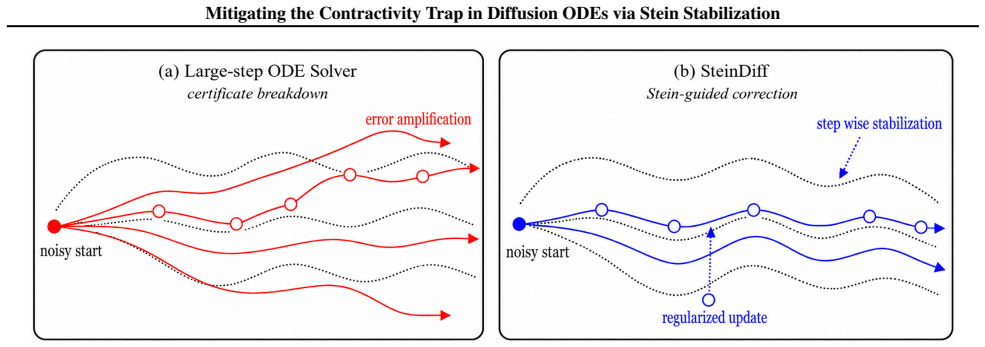
SteinDiff applies Stein-derived corrections to stabilize large-step diffusion ODE trajectories without reference samples.
A machine-rendered reading of the paper's core claim, the machinery that carries it, and where it could break.
Core claim
SteinDiff mitigates the contractivity trap by deriving a closed-form Stein correction coefficient that regularizes large-step PF-ODE solver updates; the coefficient produces a score-controlled perturbation bound under distributional shifts and supplies a Stein-based view of EDM-style parameterizations, all without requiring reference samples or model retraining.
What carries the argument
The closed-form Stein correction coefficient, which computes a residual adjustment from the score function and local data geometry to regularize each solver step.
If this is right
- Large-step PF-ODE inference produces fewer artifacts without retraining.
- The method works reference-free, depending only on the existing score estimate.
- A score-controlled bound holds under the induced distributional shifts.
- The same correction supplies an alternative perspective on EDM-style parameterizations.
Where Pith is reading between the lines
- The approach might extend to other ODE-based samplers beyond diffusion if their score functions admit similar Stein identities.
- Hardware-limited deployments could gain speed by safely increasing step size once the correction is applied.
- The geometry-aware nature suggests testing whether the coefficient adapts automatically when the underlying data distribution shifts between training and test.
Load-bearing premise
A closed-form Stein correction derived for step-wise adjustment can regularize updates using only local data geometry and the score function.
What would settle it
Running SteinDiff on standard diffusion benchmarks with large step counts and observing no reduction in severe artifacts compared to the baseline solver would falsify the stabilization claim.
Figures


read the original abstract
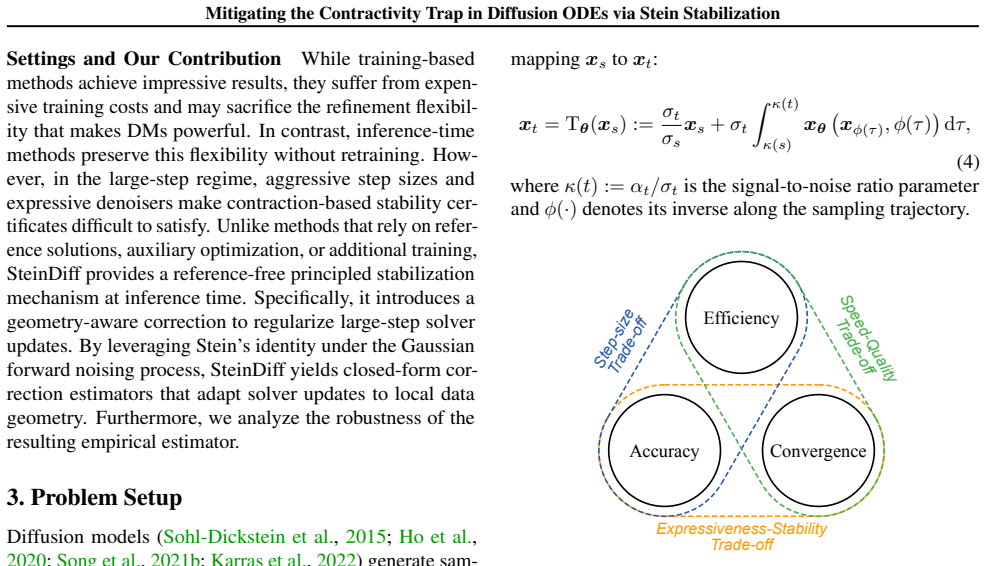
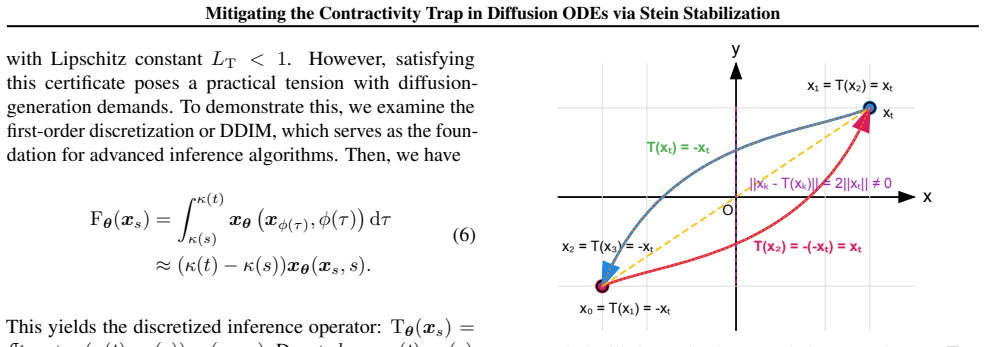
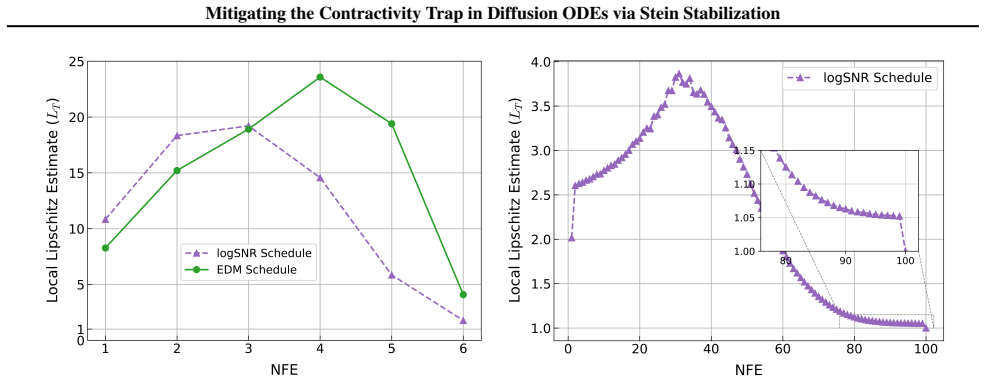
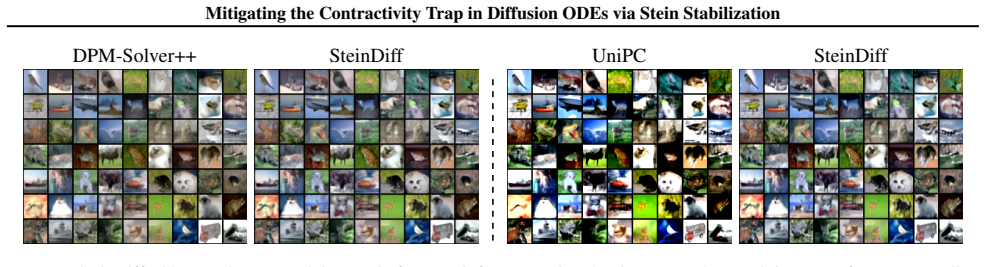
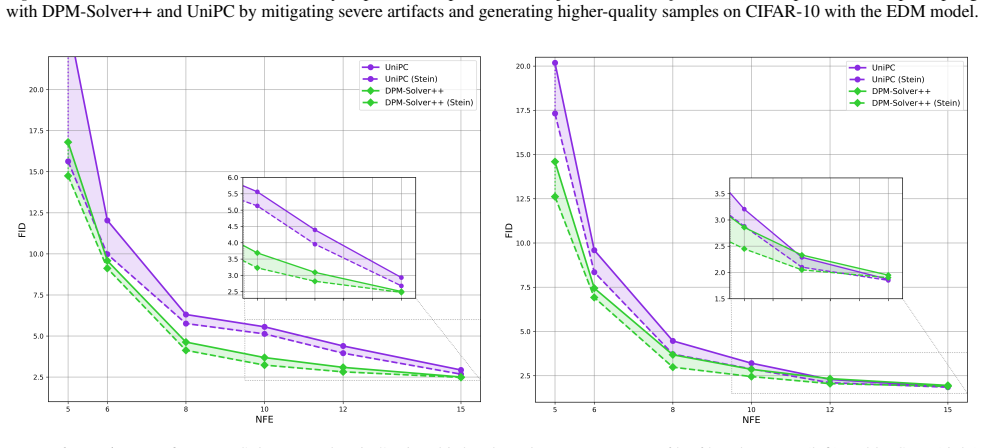
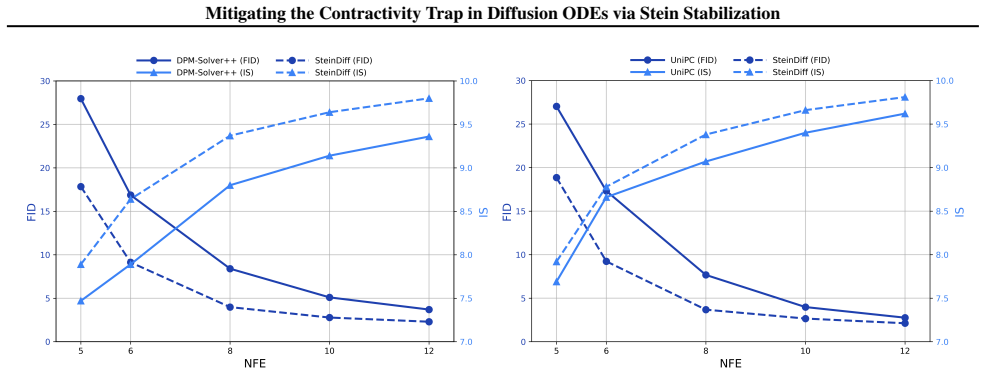
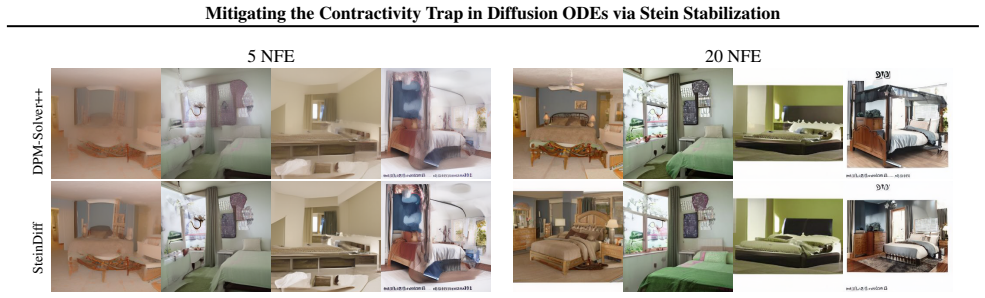
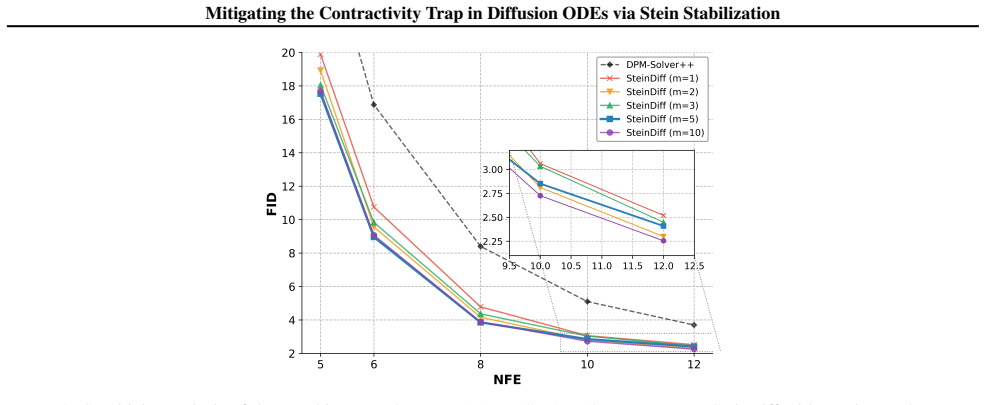
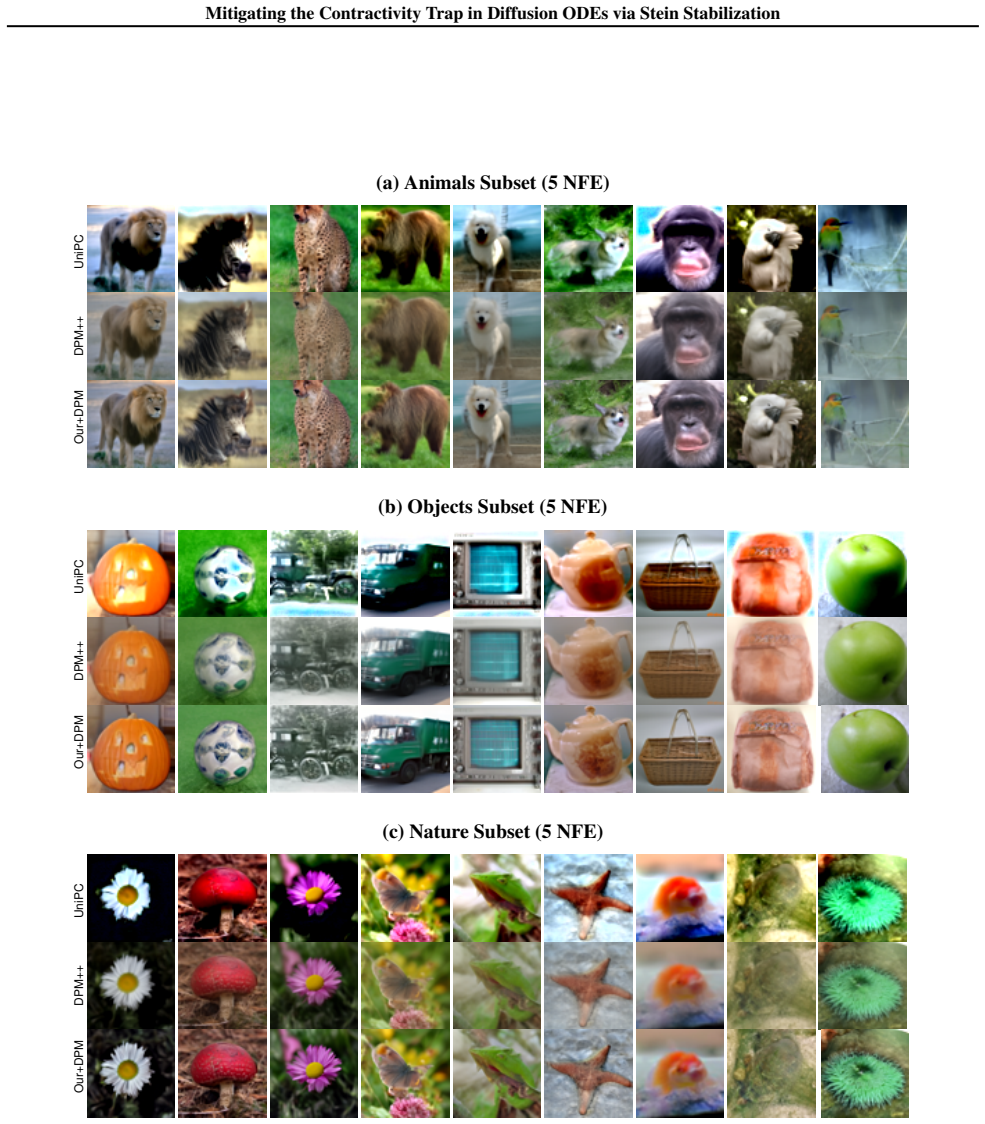
A fundamental tension exists in the large-step inference of diffusion models via their deterministic probability flow ordinary differential equation (PF-ODE) trajectories, which we identify as the contractivity trap: efficient inference favors large step sizes, while aggressive steps and highly expressive denoisers can undermine contraction-based stability certificates for error suppression. To address this, we propose SteinDiff, a step-wise inference-time stabilization framework that employs Stein-derived corrections without requiring reference samples. Specifically, SteinDiff introduces a geometry-aware residual correction mechanism that regularizes large-step solver updates without retraining. To this end, we derive a closed-form Stein correction coefficient for step-wise solver adjustment, enabling reference-free adaptation to local data geometry. We further establish a score-controlled perturbation bound under distributional shifts and provide a complementary Stein perspective on EDM-style parameterizations. Extensive experiments demonstrate that SteinDiff mitigates severe artifacts and improves generative quality across large-step inference settings.
Editorial analysis
A structured set of objections, weighed in public.
Referee Report
Summary. The paper identifies the 'contractivity trap' in large-step PF-ODE sampling of diffusion models, where large steps and expressive denoisers undermine contraction-based stability. It proposes SteinDiff, an inference-time stabilization method that applies Stein-derived residual corrections to solver updates without reference samples. The central contributions are a claimed closed-form Stein correction coefficient for step-wise adjustment based on local geometry and the score function, a score-controlled perturbation bound under distributional shifts, a Stein-based view of EDM parameterizations, and experiments showing reduced artifacts and better generative quality in large-step regimes.
Significance. If the closed-form coefficient derivation is valid and the perturbation bound holds without hidden step-size or Lipschitz assumptions, SteinDiff would provide a practical, training-free way to stabilize deterministic diffusion sampling at large steps. The reference-free property and use of Stein identity are potentially useful strengths for the field. However, the significance is tempered by the need to confirm that the derivation does not implicitly rely on regularity conditions that the contractivity trap analysis itself shows are violated precisely in the targeted large-step, expressive-denoiser regime.
major comments (3)
- [§3] §3 (method derivation): the closed-form Stein correction coefficient is asserted to regularize updates using only local data geometry and the score without additional assumptions, but the skeptic concern indicates this may implicitly require regularity conditions (e.g., on denoiser Lipschitz constants or step-size bounds) that are undermined exactly when steps are large; the manuscript must explicitly state and verify these conditions in the derivation.
- [§4] §4 (perturbation bound): the score-controlled perturbation bound is presented as complementary evidence, but it is unclear whether the bound remains valid under the same large-step regimes where the contractivity trap is active; a concrete check against the trap's stability certificates is needed to support the central claim.
- [§5] §5 (experiments): the reported improvements in artifact mitigation and generative quality for large-step inference are central to the practical claim, but without details on the exact step-size schedules, denoiser architectures, and quantitative metrics (e.g., FID, precision/recall) relative to strong baselines, it is difficult to assess whether the gains are attributable to the Stein correction or other factors.
minor comments (2)
- The abstract and introduction would benefit from a brief equation or pseudocode snippet illustrating the Stein correction coefficient to make the core idea more accessible before the full derivation.
- Notation for the PF-ODE solver steps and the Stein identity application should be unified across sections to avoid ambiguity in the geometry-aware residual mechanism.
Simulated Author's Rebuttal
We thank the referee for the constructive comments. We address each major point below with clarifications on assumptions and commitments to strengthen the manuscript.
read point-by-point responses
-
Referee: [§3] §3 (method derivation): the closed-form Stein correction coefficient is asserted to regularize updates using only local data geometry and the score without additional assumptions, but the skeptic concern indicates this may implicitly require regularity conditions (e.g., on denoiser Lipschitz constants or step-size bounds) that are undermined exactly when steps are large; the manuscript must explicitly state and verify these conditions in the derivation.
Authors: The derivation of the closed-form Stein correction relies solely on the Stein identity applied to the local score and data geometry at each step. This identity holds under standard integrability and differentiability conditions on the density (i.e., the score exists and the relevant expectations are finite), which are satisfied by diffusion models and do not involve denoiser Lipschitz constants or step-size restrictions. These conditions are independent of the contractivity trap, which concerns global flow stability rather than the local residual correction. We will add an explicit statement of these conditions in §3 together with a short verification that they remain valid in the large-step regime. revision: yes
-
Referee: [§4] §4 (perturbation bound): the score-controlled perturbation bound is presented as complementary evidence, but it is unclear whether the bound remains valid under the same large-step regimes where the contractivity trap is active; a concrete check against the trap's stability certificates is needed to support the central claim.
Authors: We will revise §4 to include a direct comparison of the score-controlled perturbation bound against the contraction-based stability certificates. The bound is derived from score mismatch under distributional shifts and does not invoke the Lipschitz or contraction assumptions that fail in the trap; it therefore remains valid precisely when contraction certificates cease to apply. A new remark will cross-reference the trap analysis to demonstrate this complementarity. revision: yes
-
Referee: [§5] §5 (experiments): the reported improvements in artifact mitigation and generative quality for large-step inference are central to the practical claim, but without details on the exact step-size schedules, denoiser architectures, and quantitative metrics (e.g., FID, precision/recall) relative to strong baselines, it is difficult to assess whether the gains are attributable to the Stein correction or other factors.
Authors: We agree that additional experimental details are required. The revised manuscript will specify the exact step-size schedules (linear spacing with the listed number of steps), the precise denoiser architectures (EDM U-Net configurations), and report FID, precision, and recall against the same baselines (Euler, Heun, and DDIM) used in the original experiments. These additions will make clear that observed gains are due to the Stein correction. revision: yes
Circularity Check
No circularity: derivation rests on standard Stein identity applied to PF-ODE without self-referential fitting or load-bearing self-citation
full rationale
The provided abstract and description show SteinDiff derives a closed-form correction coefficient directly from the Stein identity applied to the probability flow ODE, using local geometry and the score function. No equations or steps are shown that define the coefficient in terms of fitted outputs from the same data, rename known results, or rely on self-citations for uniqueness or ansatz. The central claim of reference-free adaptation is presented as following from the identity without reduction to inputs by construction. This matches the default expectation of a self-contained derivation.
Axiom & Free-Parameter Ledger
axioms (1)
- standard math Stein's identity holds for the score function of the diffusion process
invented entities (1)
-
SteinDiff
no independent evidence
Reference graph
Works this paper leans on
-
[1]
Expert Certification
URL https://openreview.net/forum? id=MhK5aXo3gB. Expert Certification. Chen, D., Zhou, Z., Wang, C., Shen, C., and Lyu, S. On the trajectory regularity of ODE-based diffusion sam- pling. InForty-first International Conference on Machine Learning, 2024. URL https://openreview.net/ forum?id=H86WzfH5N1. Chen, W., Du, S., Li, S., Zeng, D., and Paisley, J. Ent...
2024
-
[2]
jbusres.2019.07.039 Solomonides, A
ISSN 0031-3203. doi: https://doi.org/10.1016/j. patcog.2025.112442. Dhariwal, P. and Nichol, A. Diffusion models beat gans on image synthesis.Advances in neural information processing systems, 34:8780–8794, 2021. Frans, K., Hafner, D., Levine, S., and Abbeel, P. One step diffusion via shortcut models. InThe Thirteenth International Conference on Learning ...
work page doi:10.1016/j 2025
-
[3]
Geng, Z., Deng, M., Bai, X., Kolter, J
URL https://openreview.net/forum? id=OlzB6LnXcS. Geng, Z., Deng, M., Bai, X., Kolter, J. Z., and He, K. Mean flows for one-step generative modeling. InThe Thirty- ninth Annual Conference on Neural Information Pro- cessing Systems, 2025. URL https://openreview. net/forum?id=uWj4s7rMnR. Gonzalez, M., Fernandez Pinto, N., Tran, T., Hajri, H., Mas- moudi, N.,...
Pith/arXiv arXiv 2025
-
[4]
Heusel, M., Ramsauer, H., Unterthiner, T., Nessler, B., and Hochreiter, S
URL https://openreview.net/forum? id=rJxgknCcK7. Heusel, M., Ramsauer, H., Unterthiner, T., Nessler, B., and Hochreiter, S. Gans trained by a two time-scale update rule converge to a local nash equilibrium.Advances in neural information processing systems, 30, 2017. Ho, J., Jain, A., and Abbeel, P. Denoising diffusion proba- bilistic models.Advances in ne...
arXiv 2017
-
[5]
Liu, X., Gong, C., and qiang liu
URL https://openreview.net/forum? id=PlKWVd2yBkY. Liu, X., Gong, C., and qiang liu. Flow straight and fast: Learning to generate and transfer data with rectified flow. InThe Eleventh International Conference on Learning Representations, 2023. URL https://openreview. net/forum?id=XVjTT1nw5z. Liu, X., Zhang, X., Ma, J., Peng, J., and qiang liu. Instaflow: O...
Pith/arXiv arXiv 2023
-
[6]
Salimans, T
URL https://openreview.net/forum? id=nBGBzV4It3. Salimans, T. and Ho, J. Progressive distillation for fast sampling of diffusion models. InInternational Confer- ence on Learning Representations, 2022. URL https: //openreview.net/forum?id=TIdIXIpzhoI. Salimans, T., Goodfellow, I., Zaremba, W., Cheung, V ., Radford, A., and Chen, X. Improved techniques for ...
2022
-
[7]
Wang, Z., Jiang, Y ., Zheng, H., Wang, P., He, P., Wang, Z., Chen, W., Zhou, M., et al
URL https://openreview.net/forum? id=HyebplHYwB. Wang, Z., Jiang, Y ., Zheng, H., Wang, P., He, P., Wang, Z., Chen, W., Zhou, M., et al. Patch diffusion: Faster and more data-efficient training of diffusion models.Ad- vances in neural information processing systems, 36: 72137–72154, 2023. Watson, D., Chan, W., Ho, J., and Norouzi, M. Learning fast sampler...
2023
-
[8]
12 Mitigating the Contractivity Trap in Diffusion ODEs via Stein Stabilization Xing, Z., Feng, Q., Chen, H., Dai, Q., Hu, H., Xu, H., Wu, Z., and Jiang, Y .-G
URL https://openreview.net/forum? id=JprM0p-q0Co. 12 Mitigating the Contractivity Trap in Diffusion ODEs via Stein Stabilization Xing, Z., Feng, Q., Chen, H., Dai, Q., Hu, H., Xu, H., Wu, Z., and Jiang, Y .-G. A survey on video diffusion models. ACM Computing Surveys, 57(2):1–42, 2024. Xu, J., Zeng, D., and Paisley, J. Sparse inducing points in deep gauss...
2024
-
[9]
Zhang, Q
URL https://openreview.net/forum? id=MtDd7rWok1. Zhang, Q. and Chen, Y . Fast sampling of diffusion mod- els with exponential integrator. InThe Eleventh In- ternational Conference on Learning Representations,
-
[10]
Zhao, W., Bai, L., Rao, Y ., Zhou, J., and Lu, J
URL https://openreview.net/forum? id=Loek7hfb46P. Zhao, W., Bai, L., Rao, Y ., Zhou, J., and Lu, J. UniPC: A unified predictor-corrector framework for fast sampling of diffusion models. InThirty-seventh Conference on Neural Information Processing Systems, 2023. URL https: //openreview.net/forum?id=hrkmlPhp1u. Zhao, W., Wang, H., Zhou, J., and Lu, J. Dc-so...
2023
-
[11]
EDM avoids this entirely
Removal of αt-induced singularities: In VP schedules, as αt →0 (high noise), the term 1/αk can become numerically unstable. EDM avoids this entirely
-
[12]
3.Simplified estimation: Fewer terms to estimate reduces variance in the Hutchinson estimator
Pure geometric signal: The correction only depends on local manifold geometry (divergence), not on global data scaling. 3.Simplified estimation: Fewer terms to estimate reduces variance in the Hutchinson estimator. Proof.For VP schedules withα 2 t +σ 2 t = 1: • At high noise levels (tlarge):α t →0, causing(1−1/α t)→ −∞. • The drift term magnitude|1−1/α t|...
1923
-
[13]
Computeu k =x k −T θ(xk): Already computed by baseline (free)
-
[14]
Computeˆsxu = 1 B PB i=1⟨u(i) k ,x (i) k ⟩:O(Bd)operations
-
[15]
Computeˆsuu = 1 B PB i=1 ∥u(i) k ∥2:O(Bd)operations
-
[16]
Compute divergence via Hutchinson:mVJP calls
-
[17]
The VJP computation dominates
Computeˆγk and update:O(1)operations. The VJP computation dominates. Each VJP has complexity comparable to one forward pass through the Jacobian. For neural networks, this is O(params) via backpropagation. The m VJP calls are embarrassingly parallel across the batch dimension on modern GPUs. Table 3.Comparison of computational overhead across methods. Met...
discussion (0)
Sign in with ORCID, Apple, or X to comment. Anyone can read and Pith papers without signing in.