Elusive Exciton Insulator States in 1T-HfTe2: Exciton softening, and Symmetry Breaking by Ab Initio Methods
Pith reviewed 2026-06-27 21:11 UTC · model grok-4.3
The pith
Monolayer and bilayer 1T-HfTe2 form excitonic insulator states with negative exciton energies while trilayer and bulk do not.
A machine-rendered reading of the paper's core claim, the machinery that carries it, and where it could break.
Core claim
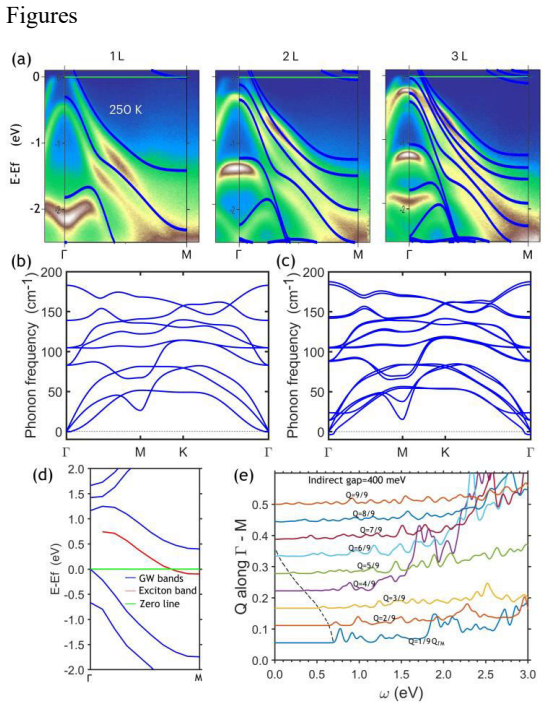
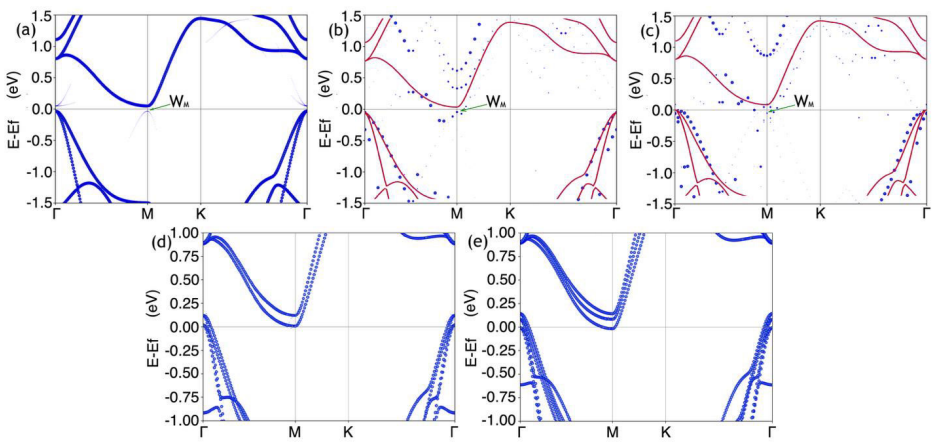
Using meta-GGA calculations and a model Bethe-Salpeter equation approach, both the monolayer and bilayer of 1T-HfTe2 exhibit negative exciton energies leading to spontaneous formation of bound excitons and EI states, whereas the trilayer and bulk display positive exciton energies and do not support EI states. Structural symmetry-breaking calculations show very small in-plane displacements of the Hf atoms, and electronic symmetry-breaking calculations for the monolayer reveal a pronounced unfolded valence-band feature at the M point with no unfolded conduction-band states near the Fermi level at Gamma, both consistent with experimental observations.
What carries the argument
Meta-GGA functional combined with a model Bethe-Salpeter equation approach for computing exciton energies, supplemented by structural and electronic symmetry-breaking analyses.
If this is right
- EI states appear only in monolayer and bilayer 1T-HfTe2.
- Trilayer and bulk 1T-HfTe2 remain normal insulators without the EI instability.
- Small Hf-atom displacements from symmetric positions occur in all layer counts but do not drive the EI transition.
- Monolayer electronic band unfolding matches the valence feature seen in experiment.
- The same computational workflow applies directly to related layered materials.
Where Pith is reading between the lines
- Layer thickness may act as a control knob for EI formation in other transition-metal dichalcogenides with similar band structures.
- Transport or optical probes that resolve layer number could map the exact thickness where the exciton energy crosses zero.
- Application of the same meta-GGA plus model BSE pipeline to additional candidate compounds would identify further low-dimensional EI systems.
Load-bearing premise
The sign of the computed exciton energies remains reliable when the meta-GGA functional and simplified BSE kernel are applied to this material.
What would settle it
Measurement of exciton energy sign or EI signatures in trilayer 1T-HfTe2 samples that contradicts the positive-energy prediction.
Figures
read the original abstract
Recent experiments have provided evidence for excitonic insulator (EI) states in 1T HfTe2. In this work, we investigate EI states in monolayer, bilayer, trilayer, and bulk 1T HfTe2 using advanced meta generalized gradient approximation (meta GGA) calculations and a model Bethe-Salpeter equation (BSE) approach, together with structural and electronic symmetry breaking analyses. Our results show that both the monolayer and bilayer exhibit negative exciton energies, leading to the spontaneous formation of bound excitons and EI states, whereas the trilayer and bulk display positive exciton energies and do not support EI states. Structural symmetry-breaking calculations show very small in-plane displacements of the Hf atoms from their symmetric positions in the monolayer and multilayers, consistent with experimental observations. Interestingly, electronic symmetry-breaking calculations for the monolayer, performed using a symmetric structure and a hybrid functional, show a pronounced unfolded valence-band feature at the M point and no unfolded conduction-band states near the Fermi level at Gamma, in good agreement with experimental results. Overall, our findings support the existence of EI states in low dimensional 1T HfTe2. The methodology developed here can be readily extended to investigate EI behavior in other related quantum material systems.
Editorial analysis
A structured set of objections, weighed in public.
Referee Report
Summary. The paper investigates excitonic insulator (EI) states in 1T-HfTe2 monolayers, bilayers, trilayers, and bulk using meta-GGA calculations combined with a model Bethe-Salpeter equation (BSE) approach, together with structural and electronic symmetry-breaking analyses. It reports that monolayer and bilayer systems exhibit negative exciton energies, implying spontaneous bound-exciton formation and EI states, whereas trilayer and bulk systems show positive exciton energies and do not support EI states. Small in-plane Hf displacements are found in the structural calculations, and hybrid-functional electronic symmetry breaking reproduces an unfolded valence-band feature at M and absence of conduction-band states near Gamma, consistent with experiment.
Significance. If the reported signs of the exciton energies prove robust, the work supplies theoretical backing for experimental indications of EI behavior in low-dimensional 1T-HfTe2 and supplies a reusable computational protocol for related layered materials. The dual structural/electronic symmetry-breaking analysis adds a useful consistency check with measured spectra.
major comments (2)
- [Abstract and exciton-energy results] Abstract and the exciton-energy results section: the central claim that monolayer and bilayer exciton energies are negative (while trilayer/bulk are positive) rests on meta-GGA bands plus a model BSE kernel; no benchmarks against GW+BSE, full ab initio BSE, or measured exciton signatures are supplied to establish that the sign is insensitive to the several-hundred-meV gap errors typical of meta-GGA functionals near the EI boundary.
- [Abstract and computational-details section] Abstract and computational-details section: the manuscript states the numerical findings on exciton energies but supplies no convergence tests with respect to k-point sampling, cutoff energies, or model-BSE parameters, nor any error estimates on the reported energies; such tests are required to assess whether the sign difference between mono-/bilayer and thicker systems is numerically stable.
minor comments (1)
- [Abstract] Abstract: the phrase '1T HfTe2' should be written consistently as '1T-HfTe2' to match the title.
Simulated Author's Rebuttal
We thank the referee for their careful reading of our manuscript and for providing constructive comments. We address each of the major comments point by point below.
read point-by-point responses
-
Referee: [Abstract and exciton-energy results] Abstract and the exciton-energy results section: the central claim that monolayer and bilayer exciton energies are negative (while trilayer/bulk are positive) rests on meta-GGA bands plus a model BSE kernel; no benchmarks against GW+BSE, full ab initio BSE, or measured exciton signatures are supplied to establish that the sign is insensitive to the several-hundred-meV gap errors typical of meta-GGA functionals near the EI boundary.
Authors: We thank the referee for highlighting this important point regarding the robustness of the exciton energy signs. The meta-GGA plus model BSE approach was selected to balance accuracy and computational feasibility for systematic comparison across monolayer to bulk thicknesses. Full GW+BSE benchmarks, while desirable, remain computationally prohibitive for the thicker systems. The observed sign change with increasing layer number is consistent with the experimental indications of EI states being confined to low dimensions. In the revised manuscript we will add a dedicated paragraph discussing the potential influence of meta-GGA gap errors on the exciton energies and reference related validation studies in the literature. revision: partial
-
Referee: [Abstract and computational-details section] Abstract and computational-details section: the manuscript states the numerical findings on exciton energies but supplies no convergence tests with respect to k-point sampling, cutoff energies, or model-BSE parameters, nor any error estimates on the reported energies; such tests are required to assess whether the sign difference between mono-/bilayer and thicker systems is numerically stable.
Authors: We agree that explicit convergence tests and error estimates strengthen the numerical claims. Although the original manuscript emphasized the physical results, we will expand the computational-details section in the revision to include systematic tests of k-point sampling, plane-wave cutoffs, and model-BSE parameters, together with estimated uncertainties on the exciton energies. These additions will confirm that the sign difference between the mono-/bilayer and trilayer/bulk cases is numerically stable. revision: yes
Circularity Check
No circularity: exciton energies obtained from external meta-GGA + model BSE pipeline
full rationale
The derivation chain consists of standard meta-GGA band-structure calculations followed by a model BSE kernel to obtain exciton energies whose sign determines EI stability. No equation in the provided text defines the exciton energy in terms of the EI conclusion, fits a parameter to the target sign, or imports a uniqueness theorem from the authors' prior work that would force the result. Symmetry-breaking checks are performed independently with a hybrid functional and compared to external experiment. The central claim therefore rests on the accuracy of the chosen approximations rather than on any definitional or self-referential reduction.
Axiom & Free-Parameter Ledger
axioms (2)
- domain assumption The chosen meta-GGA functional and model BSE kernel produce exciton energies whose sign is physically meaningful for 1T-HfTe2.
- domain assumption Negative calculated exciton energy implies spontaneous formation of bound excitons and an EI ground state.
Reference graph
Works this paper leans on
-
[1]
Efficient Iterative Schemes for Ab Initio Total-Energy Calculations Using a Plane-Wave Basis Set, Phys
Kresse, G.; Furthmüller, J. Efficient Iterative Schemes for Ab Initio Total-Energy Calculations Using a Plane-Wave Basis Set, Phys. Rev. B 1996, 54, 11169
1996
-
[2]
From Ultrasoft Pseudopotentials to the Projector Augmented-Wave Method, Phys
Kresse, G.; Joubert, D. From Ultrasoft Pseudopotentials to the Projector Augmented-Wave Method, Phys. Rev. B 1999, 59, 1758
1999
-
[3]
W.; Kaplan, A
Furness, J. W.; Kaplan, A. D.; Ning, J.; Perdew, J. P.; Sun, J. Accurate and Numerically Efficient r2SCAN Meta-Generalized Gradient Approximation, J. Phys. Chem. Lett. 2020, 11, 8208−8215
2020
-
[4]
Atsushi Togo, Laurent Chaput, Terumasa Tadano, and Isao Tanaka, Implementation strategies in phonopy and phono3py, J. Phys. Condens. Matter 35, 353001-1-22 (2023)
2023
-
[5]
Sabatini, T
R. Sabatini, T. Gorni, and S. de Gironcoli, Nonlocal van der Waals density functional made simple and efficient, Phys. Rev. B 87, 041108(R) (2013)
2013
-
[6]
J. Ning, M. Kothakonda, J. W. Furness, A. D. Kaplan, S. Ehlert, J. G. Brandenburg, J. P. Perdew, and J. Sun, Workhorse minimally empirical dispersion-corrected density functional with tests for weakly bound systems: r²SCAN+rVV10, Phys. Rev. B 106, 075422 (2022)
2022
-
[7]
A. Tal, P. Liu, G. Kresse, and A. Pasquarello, Accurate optical spectra through time-dependent density functional theory based on screening-dependent hybrid functionals, Phys. Rev. Research 2, 032019(R) (2020). 13
2020
-
[8]
W. Chen, G. Miceli, G.M. Rignanese, and A. Pasquarello, Nonempirical dielectric-dependent hybrid functional with range separation for semiconductors and insulators, Phys. Rev. Mater. 2, 073803 (2018)
2018
-
[9]
I.; Ruzsinszky, A
Tang, H.; Yin, L.; Csonka, G. I.; Ruzsinszky, A. Exploring the exciton insulator state in 1T-TiSe2 monolayer with advanced electronic structure methods, Phys. Rev. B 2025, 111, L201401
2025
-
[10]
V . Wang, N. Xu, J.-C. Liu, G. Tang, W.-T. Geng, V ASPKIT: A User-Friendly Interface Facilitating High- Throughput Computing and Analysis Using V ASP Code, Computer Physics Communications 267, 108033 (2021)
2021
-
[11]
A.; Jain, M.; Cohen, M
Deslippe, J.; Samsonidze, G.; Strubbe, D. A.; Jain, M.; Cohen, M. L.; Louie, S. G. BerkeleyGW: A Massively Parallel Computer Package for the Calculation of the Quasiparticle and Optical Properties of Materials and Nanostructures, Comput. Phys. Commun. 2012, 183, 1269
2012
-
[12]
Rohlfing, M.; Louie, S. G. Electron-Hole Excitations and Optical Spectra from First Principles, Phys. Rev. B, 2000, 62, 4927
2000
-
[13]
A.; Ferretti, A.; Floris, A.; Fratesi, G.; Fugallo, G.; Gebauer, R
Giannozzi, P.; Andreussi, O.; Brumme, T.; Bunau, O.; Buongiorno Nardelli, M.; Calandra, M.; Car, R.; Cavazzoni, C.; Ceresoli, D.; Cococcioni, M.; Colonna, N.; Carnimeo, I.; Dal Corso, A.; de Gironcoli, S.; Delugas, P.; DiStasio Jr, R. A.; Ferretti, A.; Floris, A.; Fratesi, G.; Fugallo, G.; Gebauer, R. et al. Advanced Capabilities for Materials Modelling w...
2017
-
[14]
P.; Burke, K.; Ernzerhof, M
Perdew, J. P.; Burke, K.; Ernzerhof, M. Generalized Gradient Approximation Made Simple, Phys. Rev. Lett. 1996, 77, 3865
1996
-
[15]
L.; Louie, S
Deslippe, J.; Samsonidze, G.; Jain, M.; Cohen, M. L.; Louie, S. G. Coulomb-hole summations and energies for 𝐺𝑊 calculations with limited number of empty orbitals: A modified static remainder approach, Phys. Rev. B 2013, 87, 165124
2013
-
[16]
Nakata, K
Y . Nakata, K. Sugawara, A. Chainani, K. Yamauchi, K. Nakayama, S. Souma, P.-Y . Chuang, C.-M. Cheng, T. Oguchi, K. Ueno, T. Takahashi, and T. Sato, Dimensionality reduction and band quantization induced by potassium intercalation in 1T-HfTe2, Phys. Rev. Materials 3, 071001(R) (2019)
2019
discussion (0)
Sign in with ORCID, Apple, or X to comment. Anyone can read and Pith papers without signing in.