Earth-Density Stratification and Quantum Gravity Corrections in Long-Baseline Neutrino Oscillation Experiments
Pith reviewed 2026-06-27 19:45 UTC · model grok-4.3
The pith
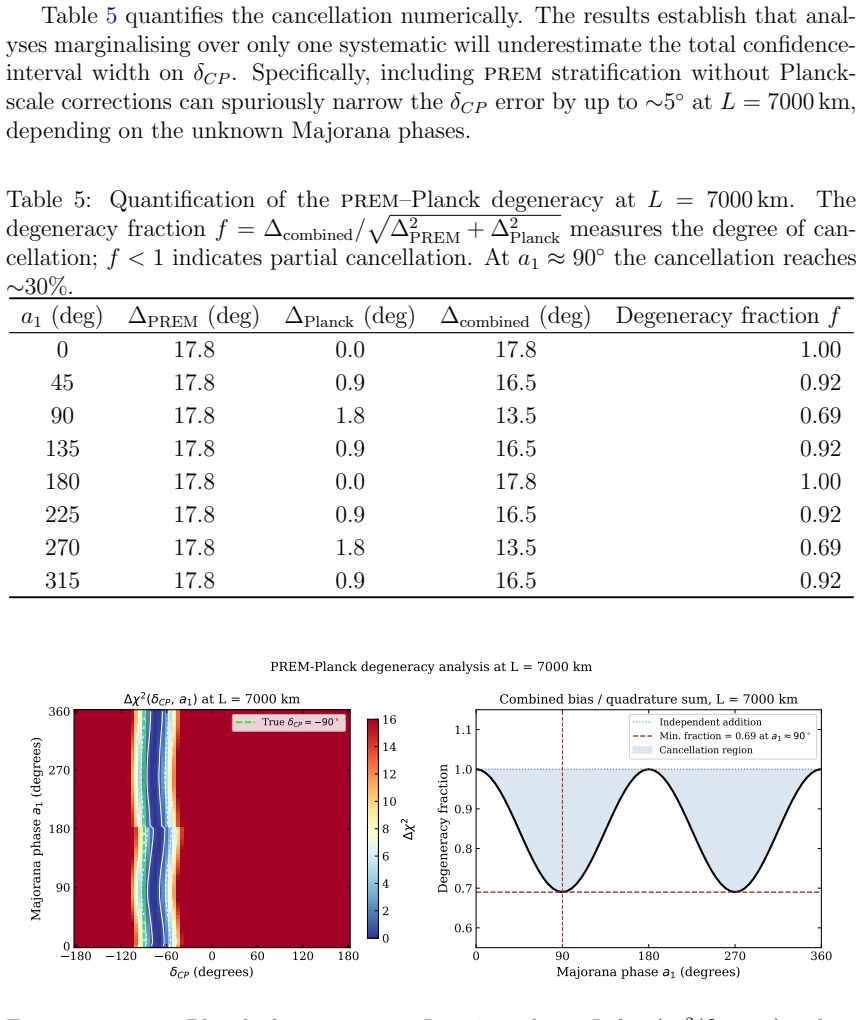
Matter density and Planck-scale effects interact in neutrino oscillations, with Majorana phases cutting combined CP bias by 30% at 7000 km.
A machine-rendered reading of the paper's core claim, the machinery that carries it, and where it could break.
Core claim
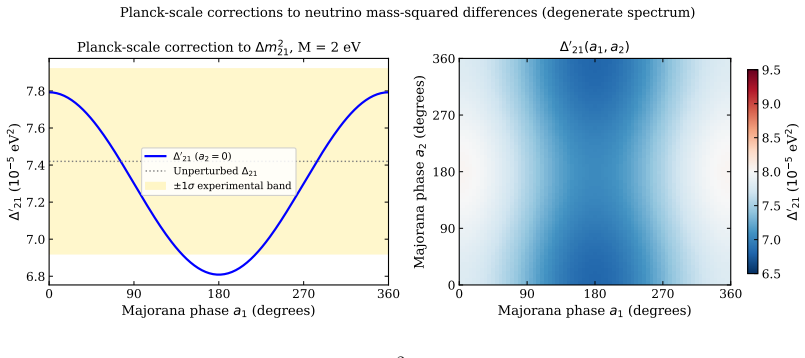
The central claim is that Planck-scale perturbations induced by the unique gauge-invariant dimension-5 operator can partially compensate matter-induced biases when specific Majorana phases are chosen. For quasi-degenerate neutrino masses near 2 eV the solar mass-squared splitting receives a correction of order (1.0 ± 0.5)×10^{-5} eV² while the atmospheric splitting remains essentially unchanged. Around L ≈ 7000 km this compensation reduces the combined bias by about 30%, demonstrating that the two effects must be propagated together rather than independently.
What carries the argument
Spatially resolved PREM density profiles for matter propagation together with the dimension-5 SMEFT operator that generates Planck-scale corrections to the neutrino mass matrix, acting through Majorana phases in the oscillation probability.
If this is right
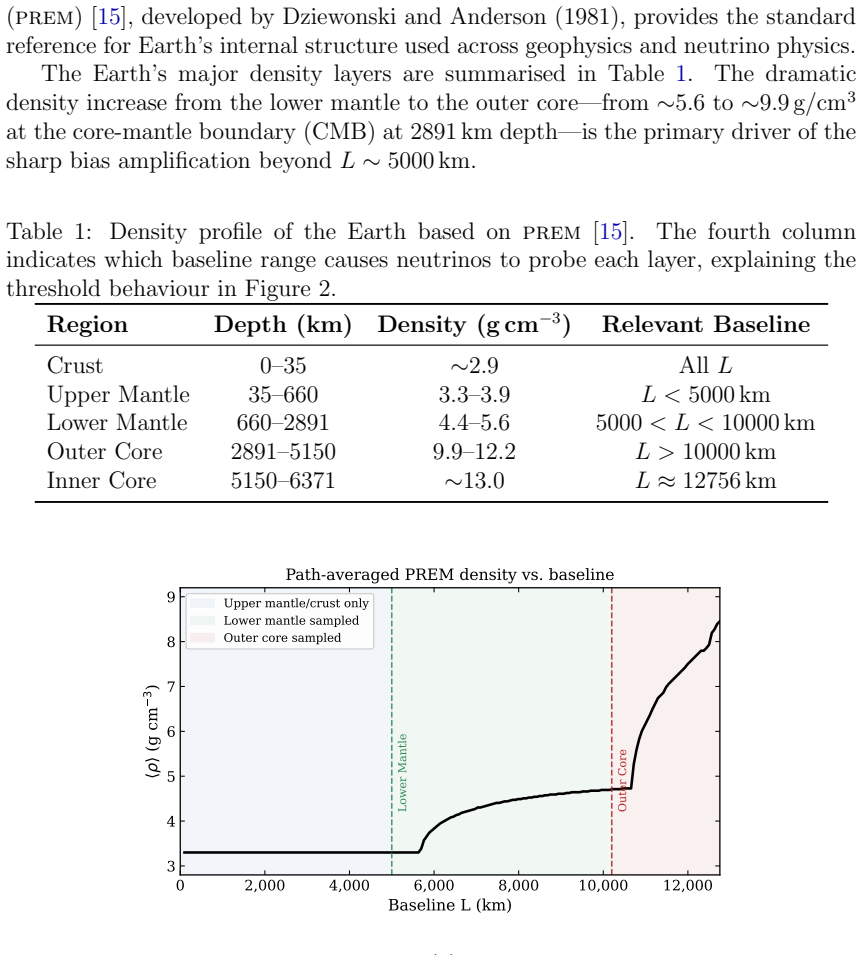
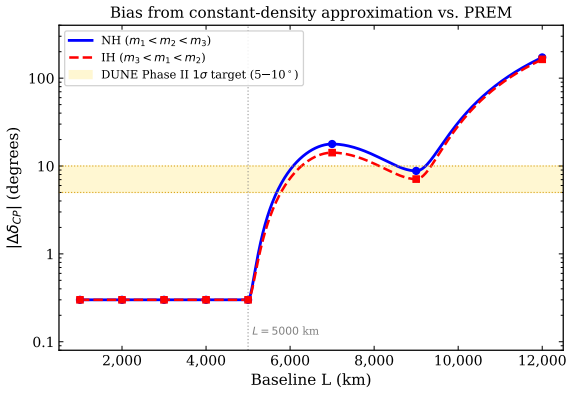
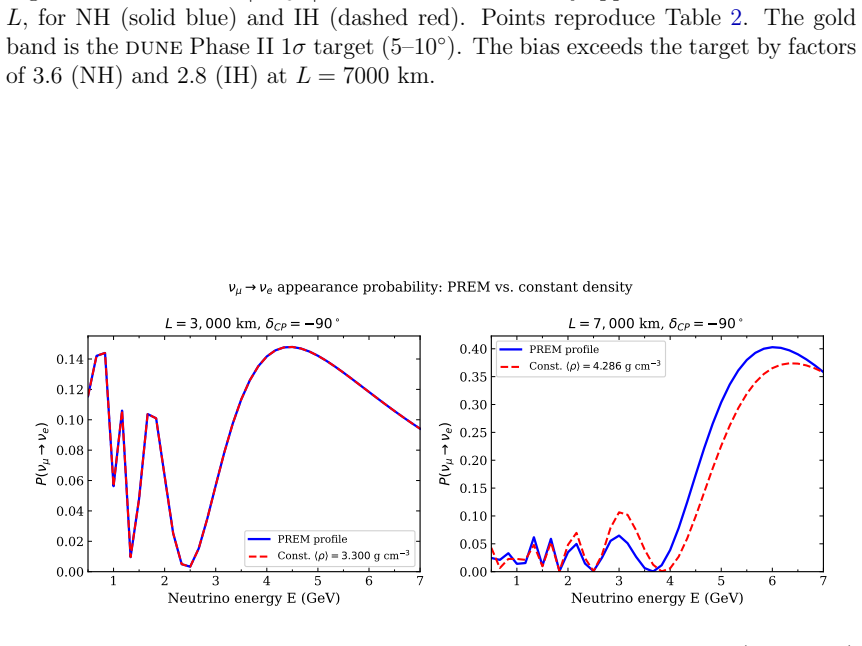
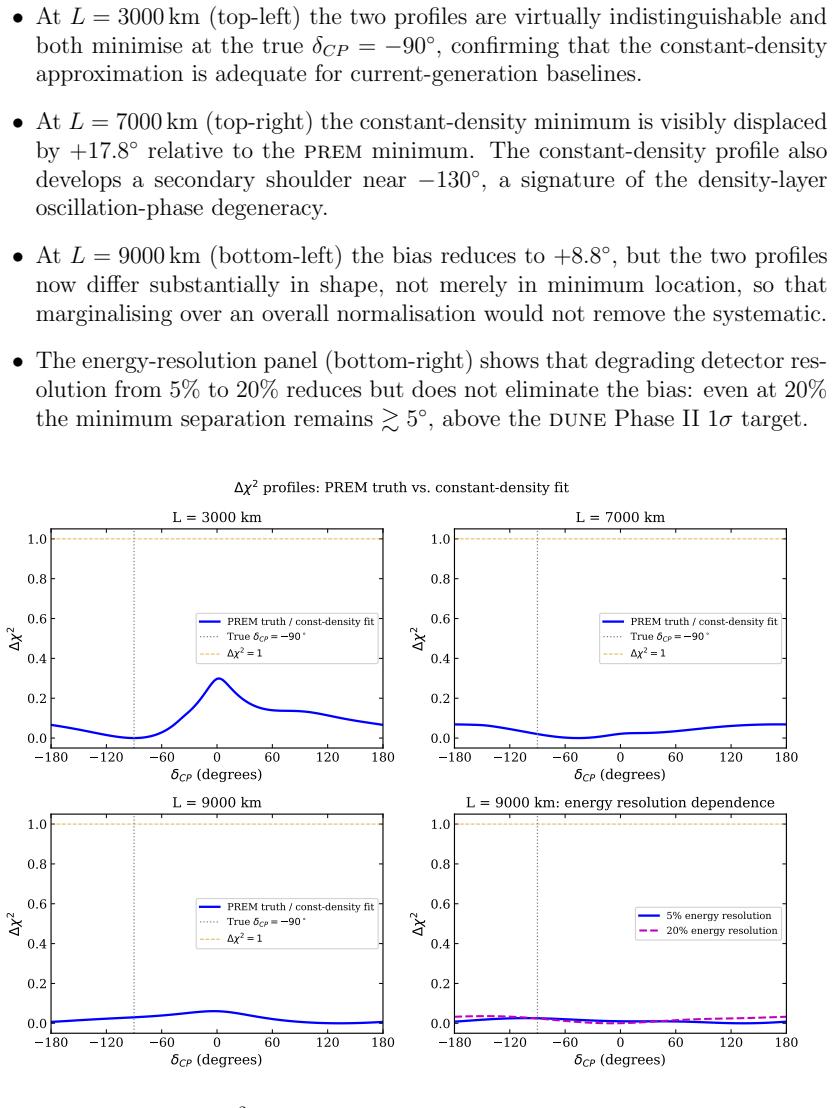
- Bias in the reconstructed CP phase remains below 0.3° for baselines ≲ 5000 km but reaches 17.8° at 7000 km and 172.2° at 12000 km.
- At 7000 km specific Majorana phases reduce the combined bias by about 30%.
- The two effects cannot be treated independently and must be propagated as correlated systematics.
- Large biases at very long baselines can reverse the sign of inferred CP violation.
Where Pith is reading between the lines
- Future long-baseline experiments will need joint modeling of density and quantum-gravity uncertainties to extract reliable CP phases.
- If neutrino masses are quasi-degenerate this framework could turn oscillation data into a probe of Planck-scale physics.
- The identified degeneracy regime suggests similar partial cancellations may exist with other systematic uncertainties in neutrino physics.
Load-bearing premise
Neutrinos are quasi-degenerate with masses around 2 eV so that the Planck-scale correction produces a solar mass splitting shift of order 10^{-5} eV².
What would settle it
A direct measurement showing that the solar mass-squared difference does not shift by (1.0 ± 0.5)×10^{-5} eV² when m ≈ 2 eV, or no reduction in combined bias when Majorana phases are included at 7000 km baselines.
Figures
read the original abstract
We present the first unified study of Earth matter-density stratification and Planck-scale quantum-gravity effects in long-baseline neutrino oscillations, treating both as correlated systematic uncertainties within a full three-flavor framework. Neutrino propagation is computed using matrix exponentiation with spatially resolved Preliminary Reference Earth Model (PREM) density profiles, allowing a quantitative assessment of matter-profile effects beyond the constant-density approximation. We find that the resulting bias in the reconstructed CP-violating phase remains below 0.3{\deg} for baselines (L \lesssim 5000) km, but increases to 17.8{\deg} at (L=7000) km and 172.2{\deg} at (L=12000) km, leading to a potential sign reversal of the inferred CP violation. We further incorporate Planck-scale corrections through the unique gauge-invariant dimension-5 operator of the Standard Model effective field theory. For quasi-degenerate neutrino masses ((m \sim 2) eV), the solar mass-squared splitting receives a correction of order ((1.0 \pm 0.5)\times10^{-5},\mathrm{eV}^2), while the atmospheric splitting remains essentially unchanged. Most importantly, we identify a previously unexplored degeneracy regime in which Planck-scale perturbations can partially compensate matter-induced biases. Around (L\approx7000) km, specific Majorana phases reduce the combined bias by about 30%, demonstrating that the two effects cannot be treated independently. These results highlight the necessity of propagating both Earth-density and quantum-gravity uncertainties as correlated systematics in precision measurements of leptonic CP violation.
Editorial analysis
A structured set of objections, weighed in public.
Referee Report
Summary. The manuscript presents the first unified treatment of Earth matter-density stratification (via full PREM profiles and matrix exponentiation) and Planck-scale corrections from the unique dimension-5 SMEFT operator in three-flavor long-baseline neutrino oscillations. It reports baseline-dependent biases in the reconstructed CP phase (below 0.3° for L≲5000 km, 17.8° at 7000 km, 172.2° at 12000 km) and identifies a degeneracy at L≈7000 km where, for quasi-degenerate masses m∼2 eV inducing a (1.0±0.5)×10^{-5} eV² correction to the solar splitting, specific Majorana phases reduce the combined bias by ~30%, implying the effects cannot be treated independently.
Significance. The methodological choice to propagate full PREM stratification and to treat both matter and QG effects as correlated systematics is a clear strength and would be valuable if the numerical claims were robust. However, the central claim of non-independence rests on a mass scale excluded by KATRIN and cosmology, so the result does not demonstrate the claimed necessity under observationally allowed parameters; the work would still be useful if revised to quantify the size of the effect (or its absence) at realistic masses.
major comments (2)
- [Abstract] Abstract: the 30% compensation and the conclusion that 'the two effects cannot be treated independently' are obtained only for the quasi-degenerate mass m∼2 eV that produces the quoted QG correction of order 10^{-5} eV² to Δm²_{21}; this mass is excluded by KATRIN (m_ν<0.8 eV) and Planck (∑m_ν<0.12 eV) bounds, so the reported degeneracy does not exist in the allowed parameter space where the QG term is negligible compared with the 17.8° matter bias.
- [Abstract] Abstract: the quantitative bias values (0.3°, 17.8°, 172.2°) and the 30% reduction figure are stated without derivation details, validation against constant-density limits, propagation of PREM uncertainties, or sensitivity to the dimension-5 operator coefficient; these central numerical claims cannot be assessed without the explicit implementation equations and error analysis.
minor comments (1)
- [Abstract] Abstract: the phrase 'unique gauge-invariant dimension-5 operator' should include a reference to the relevant SMEFT literature for the operator definition.
Simulated Author's Rebuttal
We thank the referee for the detailed and constructive report. We agree that the quasi-degenerate mass scale used for the degeneracy example lies outside current experimental bounds, and we will revise the manuscript to clarify this limitation while adding quantitative results at realistic masses. We also agree that the abstract and methods require additional implementation details and validation; these will be supplied in the revision.
read point-by-point responses
-
Referee: [Abstract] Abstract: the 30% compensation and the conclusion that 'the two effects cannot be treated independently' are obtained only for the quasi-degenerate mass m∼2 eV that produces the quoted QG correction of order 10^{-5} eV² to Δm²_{21}; this mass is excluded by KATRIN (m_ν<0.8 eV) and Planck (∑m_ν<0.12 eV) bounds, so the reported degeneracy does not exist in the allowed parameter space where the QG term is negligible compared with the 17.8° matter bias.
Authors: We accept this criticism. The m∼2 eV scale is excluded, so the reported 30% compensation and the associated claim of non-independence do not apply under observationally allowed parameters. In the revised manuscript we will (i) explicitly note the exclusion by KATRIN and Planck, (ii) remove or qualify the statement that the effects cannot be treated independently, and (iii) add a new subsection that evaluates the magnitude of the Planck-scale correction at m_ν<0.8 eV, confirming that it is negligible relative to the matter-induced bias. The baseline-dependent matter biases themselves remain unchanged and will be presented as the primary result. revision: yes
-
Referee: [Abstract] Abstract: the quantitative bias values (0.3°, 17.8°, 172.2°) and the 30% reduction figure are stated without derivation details, validation against constant-density limits, propagation of PREM uncertainties, or sensitivity to the dimension-5 operator coefficient; these central numerical claims cannot be assessed without the explicit implementation equations and error analysis.
Authors: We agree that the abstract and main text do not supply sufficient methodological transparency. The revised version will include: (a) the explicit matrix-exponentiation algorithm and its implementation for the PREM density profile, (b) direct numerical comparisons with the constant-density approximation at the same baselines, (c) an assessment of PREM model uncertainties by varying the density profile within published error envelopes, and (d) a sensitivity scan over the coefficient of the dimension-5 SMEFT operator. The quoted bias values will be accompanied by the corresponding uncertainty ranges obtained from these studies. revision: yes
Circularity Check
No significant circularity; derivation uses explicit mass assumption and standard numerical methods
full rationale
The paper states the Planck-scale correction magnitude explicitly as a consequence of the input assumption of quasi-degenerate masses m∼2 eV applied to the dimension-5 operator, then computes oscillation probabilities via matrix exponentiation on PREM profiles. The reported 30% bias reduction at L≈7000 km is a numerical outcome under those inputs rather than a quantity forced by redefinition or self-citation. No load-bearing step equates a claimed prediction to a fitted parameter by construction, and no uniqueness theorem or ansatz is imported via self-citation. The derivation chain remains self-contained against the stated assumptions.
Axiom & Free-Parameter Ledger
free parameters (2)
- neutrino mass scale m =
2 eV
- dimension-5 operator coefficient
axioms (3)
- standard math Standard three-flavor neutrino oscillation framework with matrix exponentiation for propagation through varying density.
- domain assumption PREM density profile accurately represents Earth matter distribution without significant uncertainties affecting the bias results.
- domain assumption Unique gauge-invariant dimension-5 operator in SMEFT captures the relevant Planck-scale quantum gravity corrections to neutrino masses.
Reference graph
Works this paper leans on
-
[1]
E. K. Akhmedov and V. Niro. An accurate analytic description of neutrino oscillations in matter.JHEP, 12:012, 2008
2008
-
[2]
Abe et al
K. Abe et al. The T2K experiment.Nucl. Instrum. Meth. A, 659:106–135, 2011
2011
-
[3]
J. Bian. The NOvA experiment: overview and status.Nucl. Phys. B Proc. Suppl., 248–250:196–198, 2014
2014
-
[4]
R. Acciarri et al. Long-Baseline Neutrino Facility (LBNF) and Deep Under- ground Neutrino Experiment (DUNE): Conceptual Design Report, Volume 1. arXiv e-prints, arXiv:1512.06148, 2016
-
[5]
Wolfenstein
L. Wolfenstein. Neutrino oscillations in matter.Phys. Rev. D, 17:2369–2374, 1978
1978
-
[6]
A. Yu. Smirnov. The MSW effect and solar neutrinos.Phys. Scripta, T121:57– 64, 2005
2005
-
[7]
Earth-Density Effects in Long Baseline Neutrino Experiments
T. Pandit and B. S. Koranga. Earth-density effects in LBL experiments: a comprehensive review of theory, observations, and future directions.arXiv e- prints, arXiv:2601.21256, 2026
work page internal anchor Pith review Pith/arXiv arXiv 2026
-
[8]
Weinberg
S. Weinberg. Baryon and lepton nonconserving processes.Phys. Rev. Lett., 43:1566–1570, 1979. 16
1979
-
[9]
Vissani, M
F. Vissani, M. Baldo, and G. F. Burgio. Revisiting the Planck scale effects on neutrino masses.Phys. Lett. B, 571:209–214, 2003
2003
-
[10]
B. S. Koranga, M. Narayan, and S. Uma Sankar. Planck scale effects in neutrino oscillations.Phys. Lett. B, 665:63–68, 2008
2008
-
[11]
B. S. Koranga, M. Narayan, and S. Uma Sankar. Planck scale corrections to neutrino mixing angles and CP violation.Fizika B, 18:219–226, 2009
2009
-
[12]
K. J. Kelly and S. J. Parke. Matter density profile shape effects at DUNE. Phys. Rev. D, 98:015025, 2018
2018
-
[13]
Ohlsson and H
T. Ohlsson and H. Snellman. Three-flavour neutrino oscillations in matter. Phys. Rev. D, 62:073004, 2000
2000
-
[14]
Giunti and C
C. Giunti and C. W. Kim.Fundamentals of Neutrino Physics and Astrophysics. Oxford University Press, Oxford, 2007
2007
-
[15]
A. M. Dziewonski and D. L. Anderson. Preliminary reference Earth model. Phys. Earth Planet. Inter., 25:297–356, 1981. 17
1981
discussion (0)
Sign in with ORCID, Apple, or X to comment. Anyone can read and Pith papers without signing in.