Electron-muon colliders at high energies to discover heavy sterile neutrinos
Pith reviewed 2026-06-27 19:21 UTC · model grok-4.3
The pith
High-energy e-μ collisions can detect heavy sterile neutrinos via W-pair production
A machine-rendered reading of the paper's core claim, the machinery that carries it, and where it could break.
Core claim
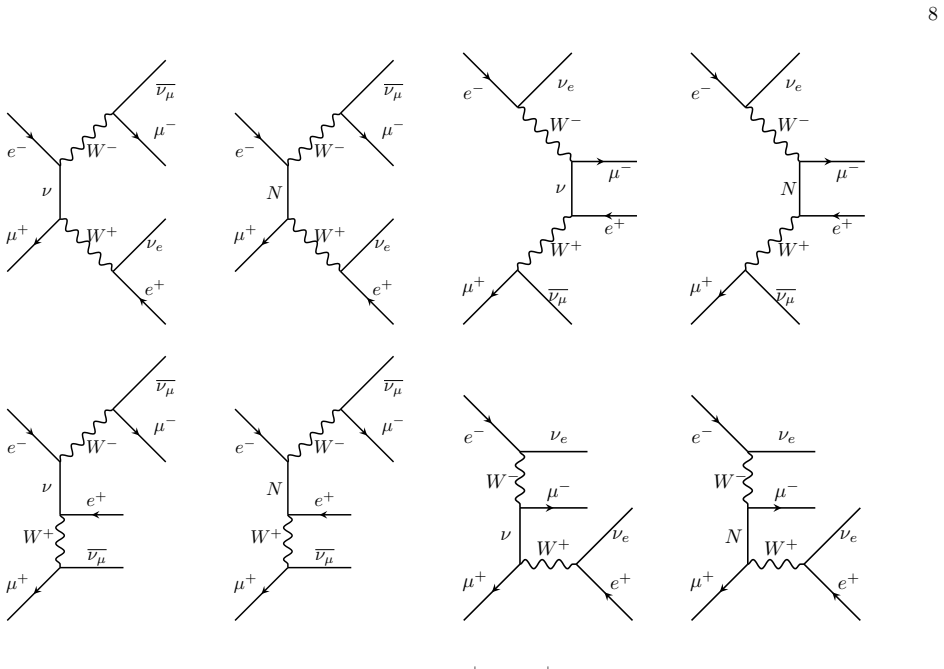
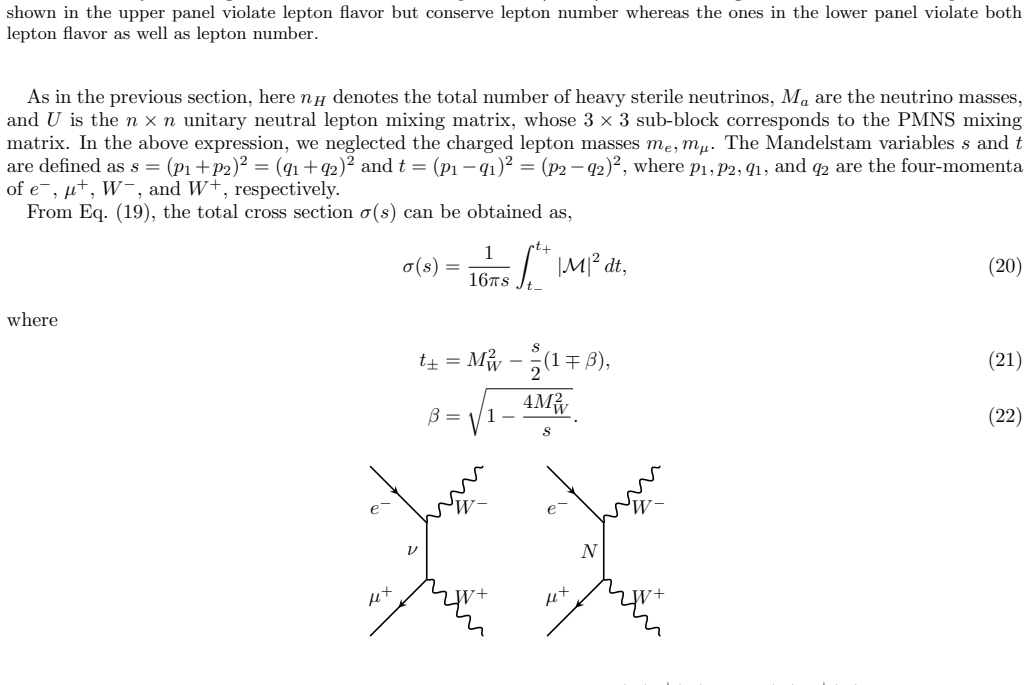
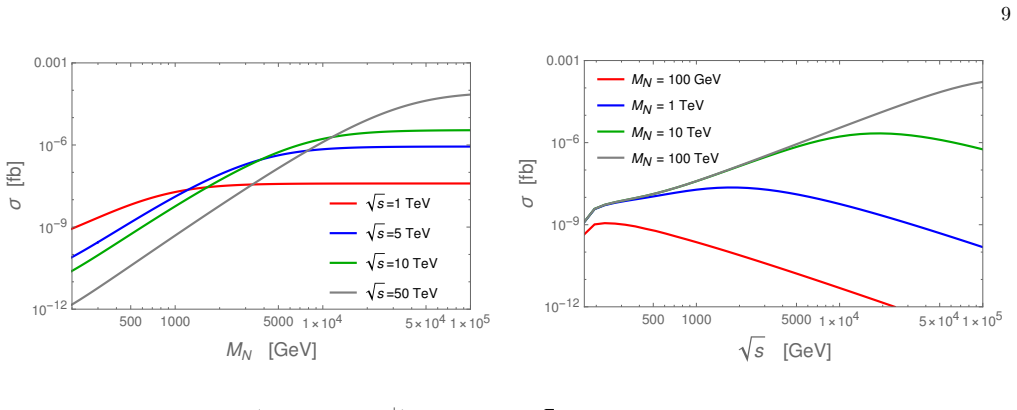
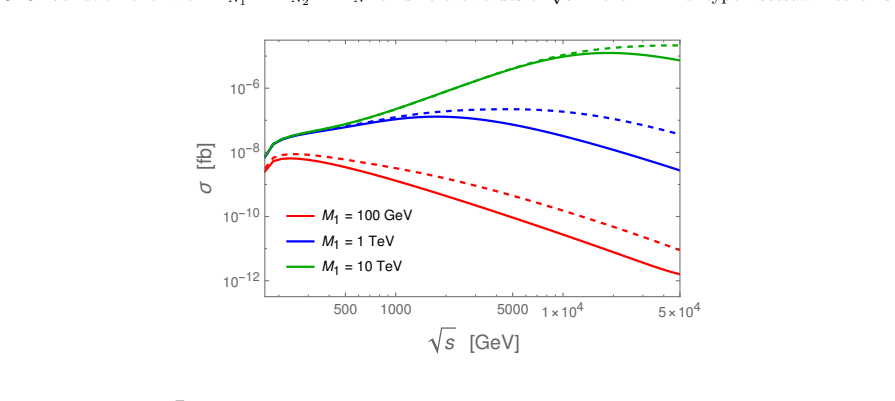
For center-of-mass energies above 2 M_W the process e^- μ^+ → W^+ W^- provides a viable probe for heavy sterile neutrinos, with cross sections that can be observable given present constraints on active-sterile mixing, whereas the lower-energy process e^- μ^+ → e^+ μ^- is strongly suppressed by quartic mixing dependence.
What carries the argument
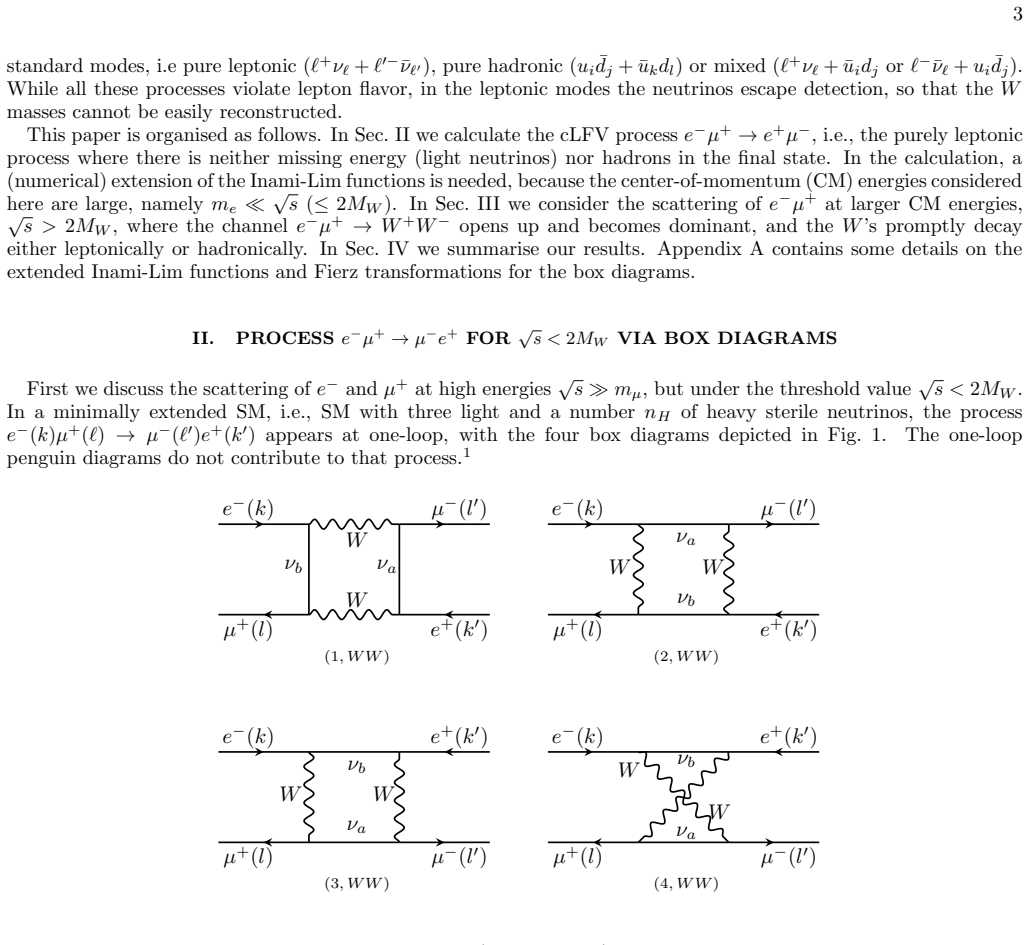
Heavy sterile neutrino exchange diagrams contributing to the high-energy e^- μ^+ → W^+ W^- process
If this is right
- The W-pair channel gives cross sections orders of magnitude above the loop-induced process
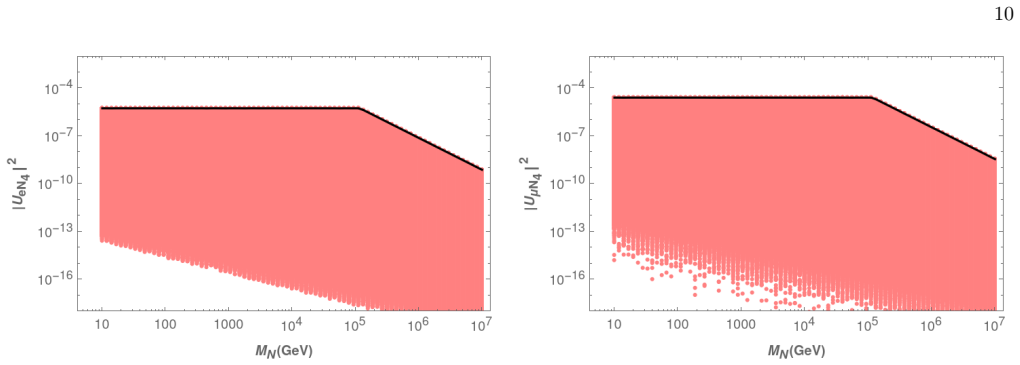
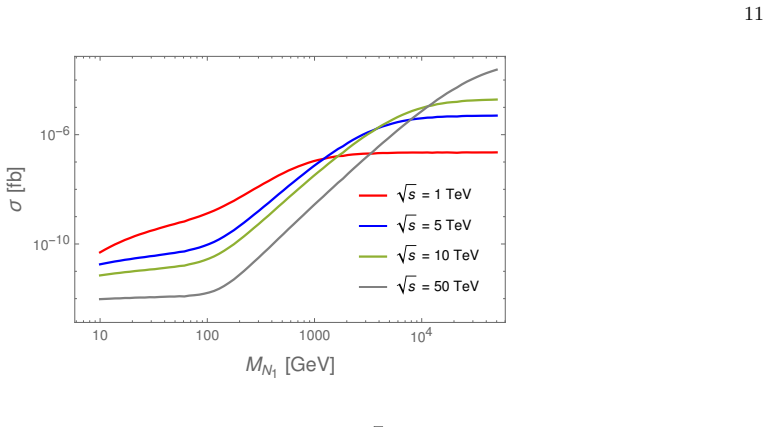
- Observable signals are possible at future e-μ colliders without violating existing mixing bounds
- Results hold for both a single heavy sterile neutrino and the minimal type-I seesaw scenario
Where Pith is reading between the lines
- Designs for electron-muon colliders should aim for energies well above the W threshold to exploit this channel
- The same mechanism could be studied in other lepton flavor combinations or at different collider types
- Limits from non-observation would directly constrain sterile neutrino parameters in a new way
Load-bearing premise
Current upper limits on active-sterile neutrino mixing angles can be applied straightforwardly to calculate the maximum possible rates for the new processes
What would settle it
A precise measurement at an e-μ collider finding the W-pair production rate substantially lower than the maximum value allowed by present mixing bounds would show that the process is not as promising as calculated
Figures
read the original abstract
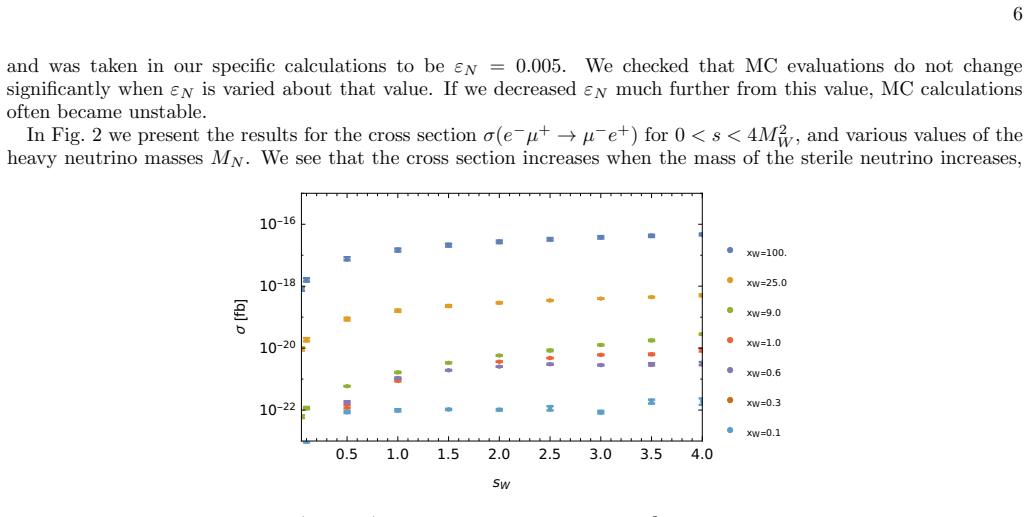
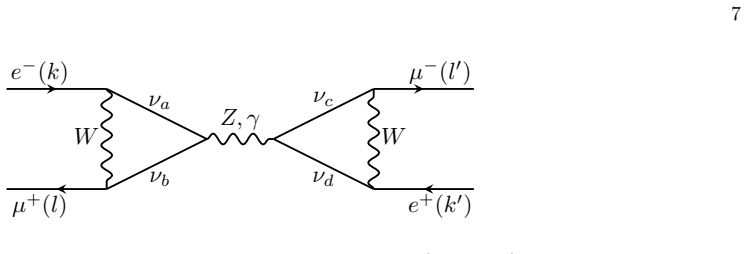
We study high-energy charged-lepton-flavor-violating (cLFV) channels in $e^- \mu^+$ scattering to probe heavy sterile neutrinos, which arise naturally in minimal extensions of the Standard Model. For $\sqrt{s} \le 2M_W$, we consider the process $e^- \mu^+ \to e^+ \mu^-$, which is dominated by one-loop box diagrams. We numerically evaluate these diagrams, involving a high-energy extension of the Inami-Lim functions, and find that the amplitudes are strongly suppressed because of their quartic dependence on light-heavy mixing. Using current bounds on active-sterile neutrino mixing, we determine the maximal rates allowed by existing constraints. For $\sqrt{s} > 2M_W$, we analyze the process $e^- \mu^+ \to W^+ W^-$ and compute the corresponding cross sections in both single-sterile and minimal type-I seesaw scenarios. We find this latter process to be significantly more promising for revealing the presence of heavy sterile neutrinos at $e-\mu$ colliders.
Editorial analysis
A structured set of objections, weighed in public.
Referee Report
Summary. The manuscript studies charged-lepton-flavor-violating processes in high-energy e−μ+ scattering to probe heavy sterile neutrinos. For √s ≤ 2MW it numerically evaluates one-loop box diagrams for e−μ+ → e+μ− using a high-energy extension of the Inami-Lim functions and finds strong quartic suppression from active-sterile mixing; maximal rates are set using existing experimental bounds. For √s > 2MW it computes cross sections for e−μ+ → W+W− in both the single-sterile-neutrino case and the minimal type-I seesaw, concluding that the latter channel is significantly more promising for discovery at e-μ colliders.
Significance. If the one-loop evaluations and cross-section results hold, the work identifies a collider channel with reduced suppression relative to low-energy cLFV, potentially offering improved sensitivity to heavy steriles within current mixing limits. Explicit computation in both single-sterile and type-I seesaw scenarios provides a concrete check on model-dependent effects.
minor comments (2)
- Abstract states that both single-sterile and minimal type-I seesaw scenarios are computed for the WW channel; the manuscript should include an explicit subsection (e.g., §4) showing how the seesaw relation is imposed on the mixing matrix and whether any cancellations appear in the amplitudes.
- The numerical stability of the high-energy Inami-Lim extension and the treatment of integration errors or cutoff dependence should be documented, as the low-energy process is reported to be strongly suppressed.
Simulated Author's Rebuttal
We thank the referee for their positive assessment of our work and for recommending minor revision. The provided summary accurately reflects the scope and conclusions of the manuscript. No specific major comments were listed in the report.
Circularity Check
No circularity: cross sections computed from standard extensions and external bounds
full rationale
The paper evaluates cLFV amplitudes via one-loop diagrams (extended Inami-Lim functions) and computes cross sections for e-μ → W+W− in both single-sterile and minimal type-I seesaw cases. Maximal rates are set by applying published experimental limits on active-sterile mixing; these limits are external inputs, not fitted or redefined within the work. No step equates a derived quantity to its own input by construction, renames a known result, or relies on a load-bearing self-citation whose validity is presupposed. The derivation chain remains independent of the target observables.
Axiom & Free-Parameter Ledger
free parameters (1)
- active-sterile mixing parameters
axioms (1)
- domain assumption Minimal type-I seesaw model correctly parametrizes heavy sterile neutrinos
Forward citations
Cited by 1 Pith paper
-
Torsional four-fermion interaction for Majorana neutrinos
Torsion-induced four-fermion interactions modify effective masses and mixing parameters for Majorana neutrinos with sterile partners in matter.
Reference graph
Works this paper leans on
-
[1]
J. P. Delahaye et al., “Muon colliders,”arXiv:1901.06150 [physics.acc-ph]
Pith/arXiv arXiv 1901
-
[2]
N. Bartosik et al., “Muon collider study,”arXiv:2001.04431 [physics.acc-ph]
arXiv 2001
-
[3]
Muon colliders to expand frontiers of particle physics,
A. Blondel et al., “Muon colliders to expand frontiers of particle physics,” Nature Reviews Physics2(2020) 139–151
2020
-
[4]
Muon Collider Collaboration, “Muon collider forum report,”arXiv:2203.07256 [physics.acc-ph]
-
[5]
High-energy FCNC search through e mu colliders,
S. Y. Choi, C. S. Kim, Y. J. Kwon, and S.-H. Lee, “High-energy FCNC search through e mu colliders,” Phys. Rev. D57 (1998) 7023–7026,arXiv:hep-ph/9707483
Pith/arXiv arXiv 1998
-
[6]
Lepton Flavor Violation at muon-electron colliders,
F. Bossi and P. Ciafaloni, “Lepton Flavor Violation at muon-electron colliders,” JHEP10(2020) 033,arXiv:2003.03997 [hep-ph]
arXiv 2020
- [7]
-
[8]
The physics case for an electron-muon collider,
M. Lu, A. M. Levin, C. Li, A. Agapitos, Q. Li, F. Meng, S. Qian, J. Xiao, and T. Yang, “The physics case for an electron-muon collider,” Adv. High Energy Phys.2021(2021) 6693618,arXiv:2010.15144 [hep-ph]
arXiv 2021
-
[9]
Muon decay and physics beyond the standard model,
Y. Kuno and Y. Okada, “Muon decay and physics beyond the standard model,” Rev. Mod. Phys.73(2001) 151, hep-ph/9909265
Pith/arXiv arXiv 2001
-
[10]
Flavour physics of leptons and dipole moments,
M. Raidal, A. van der Schaaf, I. I. Bigi, A. Boyarsky, R. Brinkmann, et al., “Flavour physics of leptons and dipole moments,” Eur. Phys. J. C57(2008) 13–182,arXiv:0801.1826 [hep-ph]
Pith/arXiv arXiv 2008
-
[11]
Charged lepton flavour violation: An experimental and theoretical introduction,
L. Calibbi and G. Signorelli, “Charged lepton flavour violation: An experimental and theoretical introduction,” Riv. Nuovo Cim.41(2018) 71–174,arXiv:1709.00294 [hep-ph]. 15
Pith/arXiv arXiv 2018
-
[12]
A call for new physics: The muon anomalous magnetic moment and lepton flavor violation,
M. Lindner, M. Platscher, and F. S. Queiroz, “A call for new physics: The muon anomalous magnetic moment and lepton flavor violation,” Phys. Rept.731(2018) 1–82,arXiv:1610.06587 [hep-ph]
Pith/arXiv arXiv 2018
-
[13]
Non-unitarity of the leptonic mixing matrix: Present bounds and future sensitivities,
S. Antusch and O. Fischer, “Non-unitarity of the leptonic mixing matrix: Present bounds and future sensitivities,” JHEP 10(2014) 094,arXiv:1407.6607 [hep-ph]
Pith/arXiv arXiv 2014
-
[14]
Heavy neutrino signals at large hadron colliders,
F. del Aguila, J. A. Aguilar-Saavedra, and R. Pittau, “Heavy neutrino signals at large hadron colliders,” Phys. Lett. B 670(2009) 399–402,arXiv:0806.0876 [hep-ph]
Pith/arXiv arXiv 2009
-
[15]
Neutrinos and collider physics,
F. F. Deppisch, P. S. B. Dev, and A. Pilaftsis, “Neutrinos and collider physics,” New J. Phys.17(2015) 075019, arXiv:1502.06541 [hep-ph]
Pith/arXiv arXiv 2015
-
[16]
Particle dark matter: Evidence, candidates and constraints,
G. Bertone, D. Hooper, and J. Silk, “Particle dark matter: Evidence, candidates and constraints,” Phys. Rept.405 (2005) 279–390,arXiv:hep-ph/0404175 [hep-ph]
Pith/arXiv arXiv 2005
-
[17]
Dark matter candidates from particle physics and methods of detection,
J. L. Feng, “Dark matter candidates from particle physics and methods of detection,” Ann. Rev. Astron. Astrophys.48 (2010) 495–545,arXiv:1003.0904 [astro-ph.CO]
Pith/arXiv arXiv 2010
-
[18]
The waning of the wimp? a review of models, searches, and constraints,
G. Arcadi, M. Dutra, P. Ghosh, M. Lindner, Y. Mambrini, M. Pierre, S. Profumo, and F. S. Queiroz, “The waning of the wimp? a review of models, searches, and constraints,” Eur. Phys. J. C78(2018) 203,arXiv:1703.07364 [hep-ph]
Pith/arXiv arXiv 2018
-
[19]
Wimp dark matter candidates and searches – current status and future prospects,
L. Roszkowski, E. M. Sessolo, and S. Trojanowski, “Wimp dark matter candidates and searches – current status and future prospects,” Rept. Prog. Phys.81(2018) 066201,arXiv:1707.06277 [hep-ph]
Pith/arXiv arXiv 2018
-
[20]
Dark sectors 2016 workshop: Community report,
J. Alexander et al., “Dark sectors 2016 workshop: Community report,”arXiv:1608.08632 [hep-ph]
Pith/arXiv arXiv 2016
-
[21]
Recent progress in baryogenesis,
A. Riotto and M. Trodden, “Recent progress in baryogenesis,” Ann. Rev. Nucl. Part. Sci.49(1999) 35–75, arXiv:hep-ph/9901362 [hep-ph]
Pith/arXiv arXiv 1999
-
[22]
The origin of the matter-antimatter asymmetry,
M. Dine and A. Kusenko, “The origin of the matter-antimatter asymmetry,” Rev. Mod. Phys.76(2003) 1–30, arXiv:hep-ph/0303065 [hep-ph]
Pith/arXiv arXiv 2003
-
[23]
Leptogenesis as the origin of matter,
W. Buchm¨ uller, R. D. Peccei, and T. Yanagida, “Leptogenesis as the origin of matter,” Ann. Rev. Nucl. Part. Sci.55 (2005) 311–355,arXiv:hep-ph/0502169 [hep-ph]
Pith/arXiv arXiv 2005
-
[24]
S. Davidson, E. Nardi, and Y. Nir, “Leptogenesis,” Phys. Rept.466(2008) 105–177,arXiv:0802.2962 [hep-ph]
Pith/arXiv arXiv 2008
-
[25]
Matter and antimatter in the universe,
L. Canetti, M. Drewes, and M. Shaposhnikov, “Matter and antimatter in the universe,” New J. Phys.14(2012) 095012, arXiv:1204.4186 [hep-ph]. [26]Super-KamiokandeCollaboration, Y. Fukuda et al., “Evidence for oscillation of atmospheric neutrinos,” Phys. Rev. Lett.81(1998) 1562–1567,arXiv:hep-ex/9807003. [27]SNOCollaboration, Q. R. Ahmad et al., “Measurement...
Pith/arXiv arXiv 2012
-
[26]
The processesµ→eγ,µ→ee¯e,ν ′ →νγin the weinberg-salam model with neutrino mixing,
S. T. Petcov, “The processesµ→eγ,µ→ee¯e,ν ′ →νγin the weinberg-salam model with neutrino mixing,” Sov. J. Nucl. Phys.25(1977) 340
1977
-
[27]
Lepton mixing and neutrino oscillations,
S. M. Bilenky and B. Pontecorvo, “Lepton mixing and neutrino oscillations,” Phys. Rept.41(1978) 225–261
1978
-
[28]
Natural suppression of symmetry violation in gauge theories: Muon- and electron-lepton number nonconservation,
B. W. Lee and R. E. Shrock, “Natural suppression of symmetry violation in gauge theories: Muon- and electron-lepton number nonconservation,” Phys. Rev. D16(1977) 1444
1977
-
[29]
µ→eγat a rate of one out of 10 9 muon decays?
P. Minkowski, “µ→eγat a rate of one out of 10 9 muon decays?” Phys. Lett. B67(1977) 421–428
1977
-
[30]
Horizontal gauge symmetry and masses of neutrinos,
T. Yanagida, “Horizontal gauge symmetry and masses of neutrinos,”
-
[32]
Neutrino mass and spontaneous parity nonconservation,
R. N. Mohapatra and G. Senjanovic, “Neutrino mass and spontaneous parity nonconservation,” Phys. Rev. Lett.44 (1980) 912–915
1980
-
[33]
Neutrino mass and baryon number nonconservation in superstring models,
R. N. Mohapatra and J. W. F. Valle, “Neutrino mass and baryon number nonconservation in superstring models,” Phys. Rev. D34(1986) 1642
1986
-
[34]
Massless neutrinos in left-right symmetric models,
D. Wyler and L. Wolfenstein, “Massless neutrinos in left-right symmetric models,” Nucl. Phys. B218(1983) 205–214
1983
-
[35]
Lepton flavor nonconservation at high-energies in a superstring inspired standard model,
J. Bernabeu, A. Santamaria, J. Vidal, A. Mendez, and J. W. F. Valle, “Lepton flavor nonconservation at high-energies in a superstring inspired standard model,” Phys. Lett. B187(1987) 303–308
1987
-
[36]
Left-right symmetry breaking in njl approach,
E. K. Akhmedov, M. Lindner, E. Schnapka, and J. W. F. Valle, “Left-right symmetry breaking in njl approach,” Phys. 16 Lett. B368(1996) 270–280,arXiv:hep-ph/9507275
Pith/arXiv arXiv 1996
-
[37]
Feyn Calc: Computer algebraic calculation of Feynman amplitudes,
R. Mertig, M. Bohm, and A. Denner, “Feyn Calc: Computer algebraic calculation of Feynman amplitudes,” Comput. Phys. Commun.64(1991) 345–359
1991
-
[38]
New Developments in FeynCalc 9.0
V. Shtabovenko, R. Mertig, and F. Orellana, “New Developments in FeynCalc 9.0” Comput. Phys. Commun.207(2016) 432–444,arXiv:1601.01167 [hep-ph]
Pith/arXiv arXiv 2016
-
[39]
FeynCalc 9.3: New features and improvements,
V. Shtabovenko, R. Mertig, and F. Orellana, “FeynCalc 9.3: New features and improvements,” Comput. Phys. Commun. 256(2020) 107478,arXiv:2001.04407 [hep-ph]
Pith/arXiv arXiv 2020
-
[40]
FeynCalc 10: New developments and features,
V. Shtabovenko, R. Mertig, and F. Orellana, “FeynCalc 10: New developments and features,”arXiv:2312.14089 [hep-ph]
-
[41]
Mathematica, Version 14.3
Wolfram Research, Inc., “Mathematica, Version 14.3.” 2017
2017
-
[42]
Effects of superheavy quarks and leptons in low-energy weak processes,
T. Inami and C. S. Lim, “Effects of superheavy quarks and leptons in low-energy weak processes,” Prog. Theor. Phys.65 (1981) 297–314. Erratum: Prog. Theor. Phys. 65 (1981) 1772
1981
-
[43]
Lepton flavor violation in muonium decay and muon colliders in models with heavy neutrinos,
G. Cvetic, C. O. Dib, C.-S. Kim, and J. Kim, “Lepton flavor violation in muonium decay and muon colliders in models with heavy neutrinos,” Phys. Rev. D74(2006) 093011,arXiv:hep-ph/0608203
Pith/arXiv arXiv 2006
-
[44]
Complex Spinors and Unified Theories,
M. Gell-Mann, P. Ramond, and R. Slansky, “Complex Spinors and Unified Theories,” Conf. Proc. C790927(1979) 315–321,arXiv:1306.4669 [hep-th]
Pith/arXiv arXiv 1979
-
[45]
Oscillating neutrinos andµ→e, γ,
J. A. Casas and A. Ibarra, “Oscillating neutrinos andµ→e, γ,” Nucl. Phys. B618(2001) 171–204, arXiv:hep-ph/0103065
Pith/arXiv arXiv 2001
-
[46]
Bounds on lepton non-unitarity and heavy neutrino mixing,
M. Blennow, E. Fern´ andez-Mart´ ınez, J. Hern´ andez-Garc´ ıa, J. L´ opez-Pav´ on, X. Marcano, and D. Naredo-Tuero, “Bounds on lepton non-unitarity and heavy neutrino mixing,” JHEP08(2023) 030,arXiv:2306.01040 [hep-ph]
arXiv 2023
-
[47]
NuFit-6.0: updated global analysis of three-flavor neutrino oscillations,
I. Esteban, M. C. Gonzalez-Garcia, M. Maltoni, I. Martinez-Soler, J. P. Pinheiro, and T. Schwetz, “NuFit-6.0: updated global analysis of three-flavor neutrino oscillations,” JHEP12(2024) 216,arXiv:2410.05380 [hep-ph]
Pith/arXiv arXiv 2024
-
[48]
Itzykson and J.-B
C. Itzykson and J.-B. Zuber, Quantum Field Theory. McGraw-Hill, 1980
1980
discussion (0)
Sign in with ORCID, Apple, or X to comment. Anyone can read and Pith papers without signing in.