Explainable Optimization: A Call for Interdisciplinary Action
Pith reviewed 2026-06-27 17:53 UTC · model grok-4.3
The pith
Mathematical transparency alone does not suffice for stakeholders to trust optimization decisions
A machine-rendered reading of the paper's core claim, the machinery that carries it, and where it could break.
Core claim
The central claim is that the field must develop explainable optimization (XOpt) as a distinct interdisciplinary area because traditional mathematical transparency does not meet stakeholder needs for understanding, trusting, contesting, and implementing decisions.
What carries the argument
explainable optimization (XOpt), an interdisciplinary approach that incorporates behavioral, cognitive, and pragmatic perspectives beyond algorithmic efficiency
If this is right
- Optimization models will be evaluated not only on feasibility and optimality but also on their explanatory value.
- Interdisciplinary teams will work to create justifications that bridge math outputs and stakeholder reasoning.
- Decision makers in healthcare, disaster relief, and workforce management will gain actionable explanations for recommended actions.
Where Pith is reading between the lines
- Similar explanatory deficits may exist in other quantitative decision fields like machine learning or statistics.
- Developing XOpt could involve empirical studies testing which forms of explanation increase stakeholder acceptance.
- XOpt might integrate with existing explainable AI methods but focus specifically on optimization structures like constraints and dual variables.
Load-bearing premise
Current mathematical transparency through objectives, constraints, shadow prices, and sensitivity reports is insufficient for stakeholders to understand, trust, contest, or implement decisions.
What would settle it
Empirical evidence that providing standard optimization outputs like shadow prices enables stakeholders to fully understand and implement decisions without further explanation.
Figures
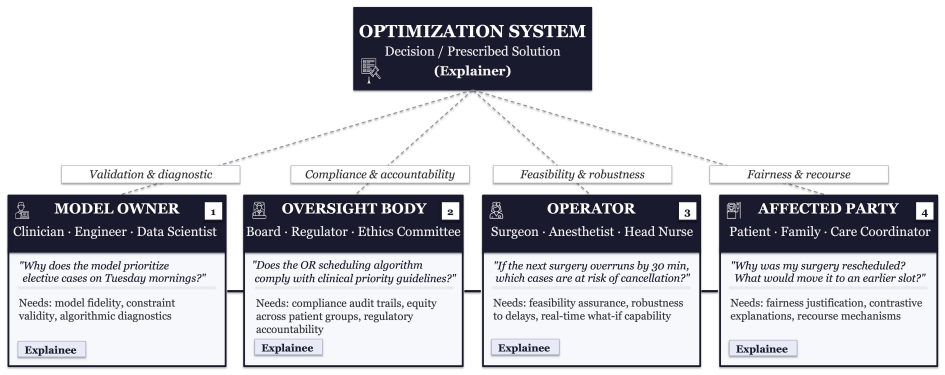
read the original abstract
Operations research and management science models support decisions that affect patients, workers, citizens, and public institutions. Decision-makers, such as clinicians approving surgical schedules, planners allocating disaster relief resources, or managers designing workforce rotations, increasingly require clear and actionable justifications that bridge the gap between mathematical optimization outputs and the intuitive reasoning stakeholders need to trust, contest, and implement recommended decisions. Yet the field has traditionally evaluated optimization models through computational criteria such as feasibility, optimality, scalability, and solution time, while treating explanation as a secondary concern. Mathematical transparency, provided through access to objectives, constraints, shadow prices, or sensitivity reports, does not automatically offer the forms of justification that stakeholders need to understand, trust, contest, or implement optimization-based decisions. This paper calls for the development of explainable optimization (XOpt) as a distinct interdisciplinary area that moves beyond algorithmic efficiency and incorporates behavioral, cognitive, and pragmatic perspectives to address this explanatory deficit.
Editorial analysis
A structured set of objections, weighed in public.
Referee Report
Summary. The manuscript argues that optimization models in operations research and management science require explanations beyond traditional mathematical transparency (such as objectives, constraints, shadow prices, and sensitivity reports) to enable stakeholders to understand, trust, contest, and implement decisions. It calls for the establishment of explainable optimization (XOpt) as a new interdisciplinary field that integrates behavioral, cognitive, and pragmatic perspectives.
Significance. If the claimed explanatory deficit is real and widespread, the paper could catalyze research into more stakeholder-friendly optimization methods, potentially increasing the practical impact of OR/MS in domains like healthcare scheduling and resource allocation. The call highlights a potential gap between technical optimality and decision justification.
major comments (2)
- Abstract: The central premise that 'Mathematical transparency, provided through access to objectives, constraints, shadow prices, or sensitivity reports, does not automatically offer the forms of justification that stakeholders need to understand, trust, contest, or implement optimization-based decisions' is presented as an assertion without supporting examples, case studies, references to documented failures, or stakeholder feedback showing where standard OR/MS tools have proven inadequate in practice.
- The proposal to create XOpt as a distinct field rests on the unverified size of the explanatory gap; the manuscript does not address whether incremental extensions within existing optimization practice (e.g., enhanced sensitivity analysis interfaces or decision-support tools) could address the stated needs without requiring a new named area.
Simulated Author's Rebuttal
We thank the referee for the constructive comments on our position paper. We address each major comment below and indicate where revisions will be made to strengthen the argument.
read point-by-point responses
-
Referee: Abstract: The central premise that 'Mathematical transparency, provided through access to objectives, constraints, shadow prices, or sensitivity reports, does not automatically offer the forms of justification that stakeholders need to understand, trust, contest, or implement optimization-based decisions' is presented as an assertion without supporting examples, case studies, references to documented failures, or stakeholder feedback showing where standard OR/MS tools have proven inadequate in practice.
Authors: We agree that the abstract states the premise concisely. The full manuscript provides context through application domains (healthcare scheduling, disaster relief, workforce planning) but does not include specific case studies or references to failures. In revision we will expand the abstract and add a short section with illustrative examples and citations to existing literature on implementation barriers in OR/MS. revision: yes
-
Referee: The proposal to create XOpt as a distinct field rests on the unverified size of the explanatory gap; the manuscript does not address whether incremental extensions within existing optimization practice (e.g., enhanced sensitivity analysis interfaces or decision-support tools) could address the stated needs without requiring a new named area.
Authors: The call for a distinct XOpt field is based on the argument that systematic integration of behavioral, cognitive, and pragmatic perspectives requires dedicated interdisciplinary structures that incremental extensions within traditional OR/MS may not prioritize. We will revise the manuscript to explicitly compare the proposed approach with possible incremental enhancements and clarify the rationale for a named area. revision: partial
Circularity Check
No circularity: position paper with no derivations or self-referential reductions
full rationale
The paper is a call for creating an interdisciplinary field (XOpt) based on the assertion that existing mathematical transparency tools are insufficient for stakeholder needs. No equations, fitted parameters, predictions, or derivations are present. The central claim does not reduce to any self-definition, fitted input, or self-citation chain; it is an unverified premise about explanatory gaps rather than a technical result constructed from its own inputs. No load-bearing self-citations or ansatz smuggling occur. This matches the default case of a non-circular position paper.
Axiom & Free-Parameter Ledger
Reference graph
Works this paper leans on
-
[1]
EXALT: EXplainable ALgo- rithmic Tools for optimization problems.arXiv preprint arXiv:2503.05789,
Zuzanna Bączek, Michał Bizoń, Adam Pawelec, and Piotr Sankowski. EXALT: EXplainable ALgo- rithmic Tools for optimization problems.arXiv preprint arXiv:2503.05789,
-
[2]
Operations research: Topics, impact, and trends from 1952–2019.Operations Research, 69(5):1487–1508,
Angelito Calma, William Ho, Lusheng Shao, and Huashan Li. Operations research: Topics, impact, and trends from 1952–2019.Operations Research, 69(5):1487–1508,
1952
-
[3]
Felix Engelhardt, Jannis Kurtz, Ş. İlker Birbil, and Ted Ralphs. Counterfactual explanations for integer optimization problems.arXiv preprint, arXiv:2510.17624,
-
[4]
Internet of Things27, 101272 (Oct 2024)
doi: 10.1016/j.cola.2024.101272. Michael Fairley, David Scheinker, and Margaret L. Brandeau. Improving the efficiency of the operating room environment with an optimization and machine learning model.Health Care Management Science, 22:756–767,
-
[5]
Robert R. Hoffman, Shane T. Mueller, Gary Klein, and Jordan Litman. Metrics for explainable AI: Challenges and prospects.arXiv preprint arXiv:1812.04608,
-
[6]
Mark T. Keane, Eoin M. Kenny, Eoin Delaney, and Barry Smyth. If only we had better counterfac- tual explanations: Five key deficits to rectify in the evaluation of counterfactual xai techniques. arXiv preprint, arXiv:2103.01035,
-
[7]
Connor Lawless, Jakob Schoeffer, and Madeleine Udell. “It was a magical box”: Understanding practitioner workflows and needs in optimization.arXiv preprint arXiv:2509.16402,
-
[8]
Vera Liao, Daniel Gruen, and Sarah Miller
Q. Vera Liao, Daniel Gruen, and Sarah Miller. Questioning the AI: Informing design practices for explainable AI user experiences. InProceedings of the 2020 CHI Conference on Human Factors in Computing Systems, pages 1–15,
2020
-
[9]
Marco Mochi. Planning and scheduling in digital health with answer set programming.arXiv preprint arXiv:2208.03099,
-
[10]
Daan Otto, Jannis Kurtz, and Ş. İlker Birbil. Coherent local explanations for mathematical opti- mization.arXiv preprint arXiv:2502.04840,
-
[11]
Decision information meets large language models: The future of explainable operations research
Yansen Zhang, Qingcan Kang, Wing Yin Yu, Xiaojin Fu, Xiongwei Han, Tao Zhong, and Chen Ma. Decision information meets large language models: The future of explainable operations research. InInternational Conference on Learning Representations, volume 2025, pages 65698–65722,
2025
-
[12]
Ryan Zhou, Jaume Bacardit, Alexander Brownlee, Stefano Cagnoni, Martin Fyvie, Giovanni Iacca, John McCall, Niki van Stein, David J. Walker, and Ting Hu. Evolutionary computation and ex- plainable ai: A roadmap to understandable intelligent systems.arXiv preprint arXiv:2406.07811,
discussion (0)
Sign in with ORCID, Apple, or X to comment. Anyone can read and Pith papers without signing in.