Precipitate phase selection and grain boundary morphology in Cu-Ni-Si-Mn alloys: A machine-learning interatomic potential study
Pith reviewed 2026-06-27 16:07 UTC · model grok-4.3
The pith
Mn addition in Cu-Ni-Si alloys switches grain-boundary precipitates from irregular Ni2Si to continuous film-shaped Mn6Ni16Si7 by changing interface coherence.
A machine-rendered reading of the paper's core claim, the machinery that carries it, and where it could break.
Core claim
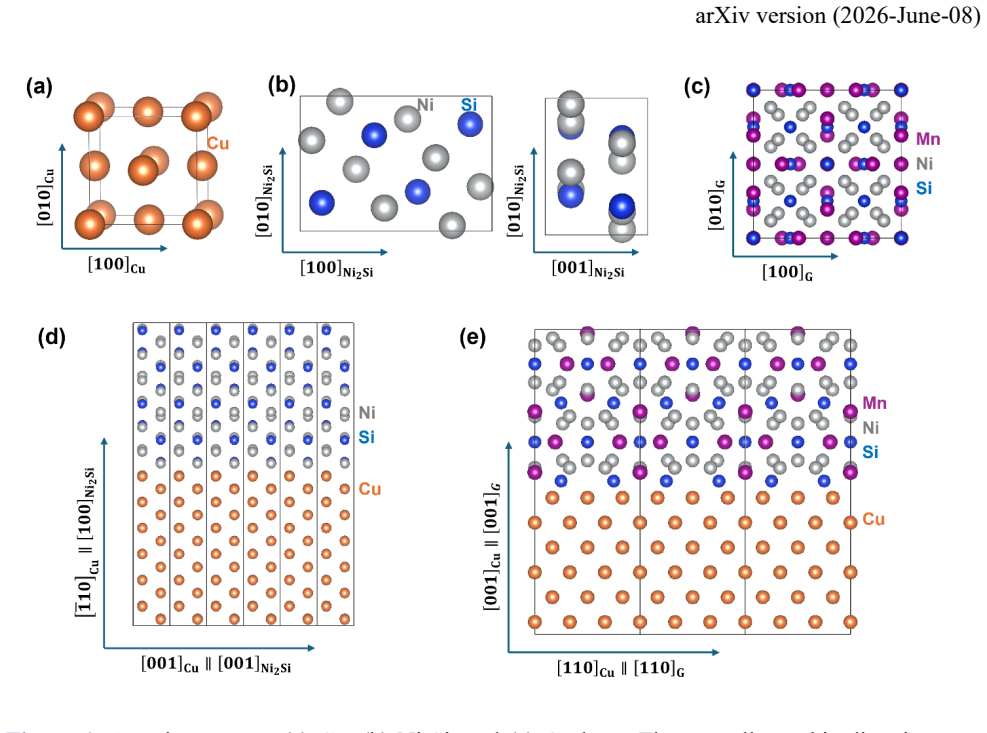
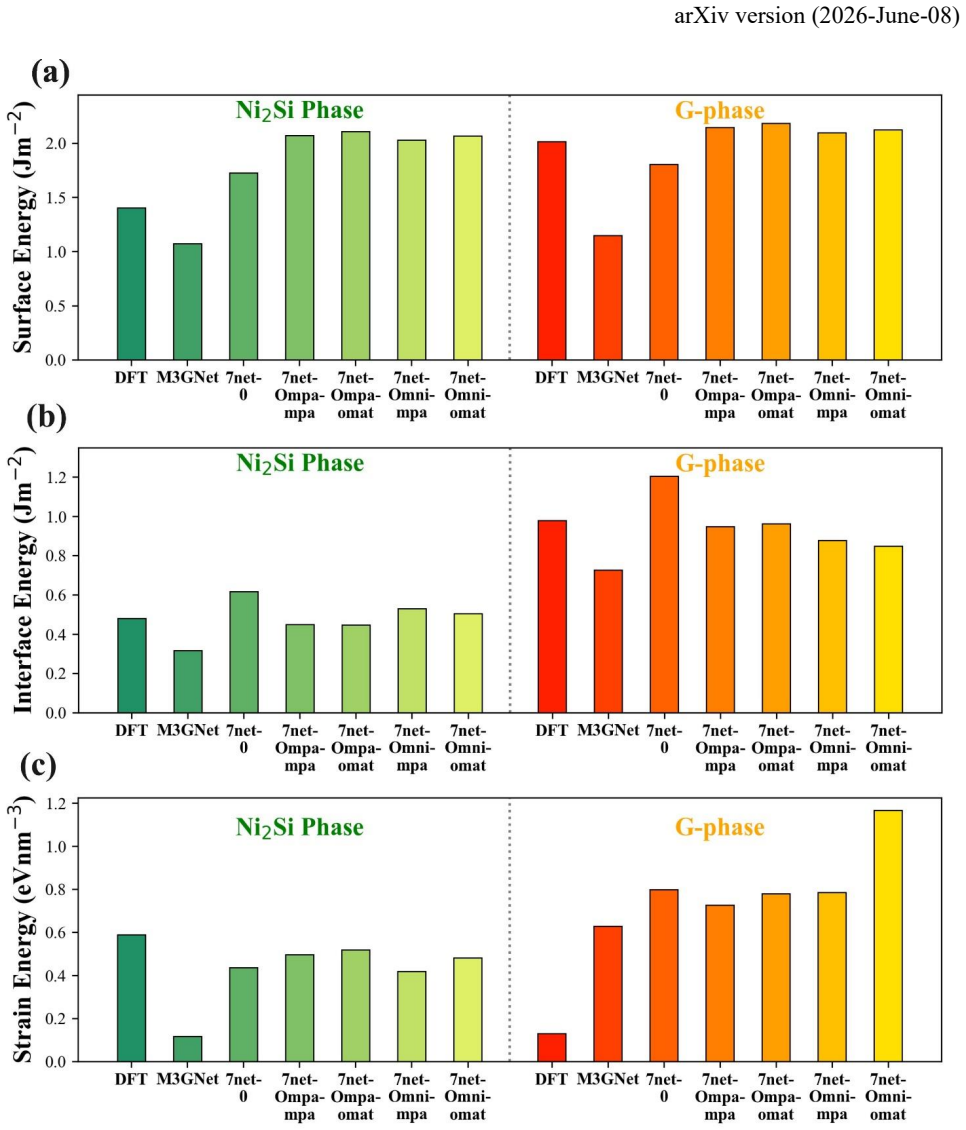
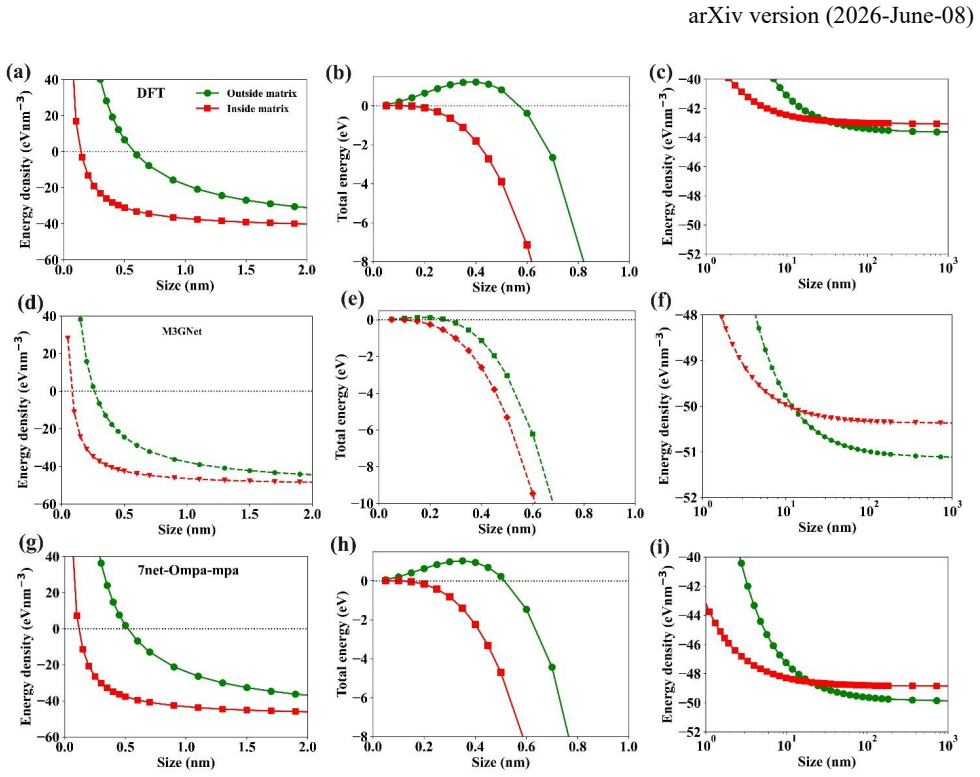
Mn addition favors GB precipitation of Mn6Ni16Si7 rather than Ni2Si. The coherent interface structure between Cu and Ni2Si favors plate-like strained precipitates in the matrix; upon coarsening and stress release an out-of-phase coherent-like interface forms at GBs, generating a local repulsive region that produces surface-like open-boundary structures and irregular morphology. In contrast, Cu/Mn6Ni16Si7 interfaces remain predominantly incoherent with moderate boundary energies and no pronounced repulsive regime, thereby stabilizing continuous interfacial contact and film-shaped GB precipitation.
What carries the argument
Machine-learning interatomic potential calculations of Cu/Ni2Si and Cu/Mn6Ni16Si7 interphase boundary structures and energies
If this is right
- Mn-free alloys exhibit irregularly-shaped Ni2Si precipitates with open-boundary-like Cu/Ni2Si interfaces.
- Mn-added alloys exhibit film-like G-phase precipitates at grain boundaries.
- Coherent Cu/Ni2Si interfaces drive plate-like matrix precipitates that evolve into irregular GB morphology after stress release.
- Incoherent Cu/Mn6Ni16Si7 interfaces with moderate energies prevent repulsive regimes and maintain continuous film contact.
Where Pith is reading between the lines
- The same interface-coherence criterion could be used to screen other minor-element additions for desired precipitate morphology in copper alloys.
- Large-scale MLIP simulations of the type performed here may identify temperature or composition windows where the out-of-phase repulsive regime in Ni2Si is suppressed.
- If the moderate-energy incoherent interfaces prove general, they could serve as a design rule for stabilizing film-like grain-boundary phases in other FCC alloy systems.
Load-bearing premise
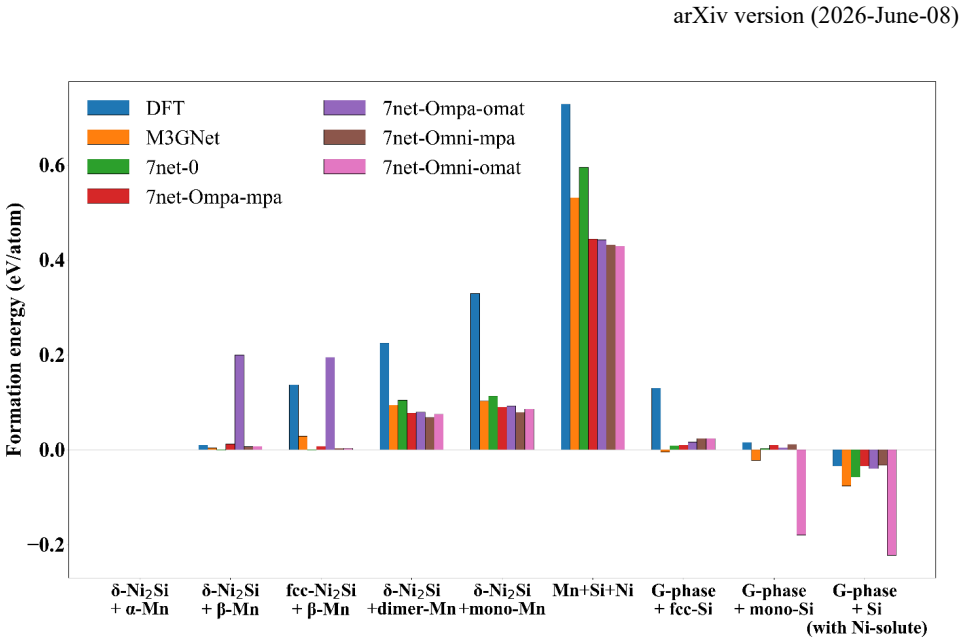
The machine-learning interatomic potential accurately reproduces the DFT-level energetics for the interfacial bonding and microstructural configurations in these specific alloy systems, and the modeled interfaces represent the experimental grain boundary conditions.
What would settle it
High-resolution transmission electron microscopy showing that Cu/Ni2Si grain-boundary interfaces remain fully coherent without repulsive regions or open-boundary structures while Cu/Mn6Ni16Si7 interfaces exhibit high-energy coherent patches.
Figures
read the original abstract
Alloys inevitably contain interphase boundaries, whose energetics govern nucleation processes and precipitate morphology. In Cu-Ni-Si alloys, Mn addition markedly changes grain boundary (GB) precipitation behavior. While GB precipitation of stable Ni$_2$Si in Mn-free alloys is associated with degraded mechanical properties, Mn addition instead promotes film-shaped Mn$_6$Ni$_{16}$Si$_7$ (G-phase) precipitation, which is correlated improved mechanical properties. However, the atomic origin of the contrasting GB phase selection and morphology remains unclear. Here we perform machine-learning interatomic potential (MLIP) calculations to investigate the effect of interphase-boundary atomic structure on GB precipitates in Cu-Ni-Si alloys with and without Mn. The MLIP calculations reliably reproduce DFT-level energetics for interfacial bonding and microstructural configurations, and further predict that Mn addition favors GB precipitation of Mn$_6$Ni$_{16}$Si$_7$ rather than Ni$_2$Si. Experimentally, Mn-free alloys are observed to exhibit irregularly-shaped Ni$_2$Si precipitates with open-boundary-like Cu/Ni$_2$Si interfaces, whereas Mn-added alloys exhibit film-like G-phase at GBs. Large-scale atomistic interface calculations reveal that the coherent interface structure between Cu and Ni$_2$Si favors the formation of plate-like strained Ni$_2$Si precipitates in the matrix. Upon coarsening and stress release, an out-of-phase coherent-like interface can form at GBs, generating a local repulsive region that gives rise to surface-like open-boundary structures and explains the irregular morphology of GB stable Ni$_2$Si precipitates. In contrast, Cu/Mn$_6$Ni$_{16}$Si$_7$ interfaces remain predominantly incoherent with moderate boundary energies and no pronounced repulsive regime, thereby stabilizing continuous interfacial contact and explaining film-shaped GB precipitation.
Editorial analysis
A structured set of objections, weighed in public.
Referee Report
Summary. The manuscript uses machine-learning interatomic potentials (MLIPs) to examine how Mn addition alters grain boundary (GB) precipitate phase selection and morphology in Cu-Ni-Si alloys. It claims that the MLIP reproduces DFT energetics and predicts Mn favors Mn6Ni16Si7 (G-phase) precipitation at GBs via incoherent interfaces of moderate energy that stabilize film-like morphologies, while Ni2Si in Mn-free alloys produces irregular GB precipitates due to coherent interfaces that develop out-of-phase repulsion and open-boundary structures upon coarsening and stress release. Experimental observations of precipitate shapes are presented as consistent with these predictions.
Significance. If the MLIP interface results hold, the work supplies an atomistic mechanism linking interface coherence, energy, and stress relaxation to the experimentally observed shift from irregular Ni2Si to film-like G-phase GB precipitation upon Mn addition. This could inform alloy design for improved mechanical properties. The large-scale simulations that distinguish coherent vs. incoherent behaviors and their morphological consequences are a positive feature.
major comments (1)
- [Abstract and Results (interface calculations)] Abstract and Results (interface calculations): The central claims that Mn addition selects Mn6Ni16Si7 via incoherent moderate-energy interfaces while Ni2Si produces irregular morphology via coherent out-of-phase repulsion rest on the MLIP correctly ranking and structurally distinguishing these Cu/Ni2Si and Cu/Mn6Ni16Si7 interfaces. The abstract asserts that the MLIP 'reliably reproduce[s] DFT-level energetics for interfacial bonding and microstructural configurations,' yet the text provides no quantitative validation metrics (RMSE, energy tables, or structure comparisons) specifically for the GB-relevant supercells or the coherent-to-incoherent transition. This is load-bearing for the phase-selection and morphology explanations.
minor comments (1)
- [Figure captions] Figure captions and text should explicitly state the supercell sizes and boundary conditions used for the large-scale interface calculations to allow reproducibility assessment.
Simulated Author's Rebuttal
We thank the referee for their careful reading of the manuscript and for the positive assessment of its potential significance. We address the single major comment below and agree that additional quantitative detail is warranted.
read point-by-point responses
-
Referee: The central claims that Mn addition selects Mn6Ni16Si7 via incoherent moderate-energy interfaces while Ni2Si produces irregular morphology via coherent out-of-phase repulsion rest on the MLIP correctly ranking and structurally distinguishing these Cu/Ni2Si and Cu/Mn6Ni16Si7 interfaces. The abstract asserts that the MLIP 'reliably reproduce[s] DFT-level energetics for interfacial bonding and microstructural configurations,' yet the text provides no quantitative validation metrics (RMSE, energy tables, or structure comparisons) specifically for the GB-relevant supercells or the coherent-to-incoherent transition. This is load-bearing for the phase-selection and morphology explanations.
Authors: We agree that the manuscript would be strengthened by explicit quantitative validation metrics for the specific interface supercells central to the GB precipitate analysis. While the Methods section describes the MLIP training set and overall validation against DFT for bulk phases and selected interfaces, direct RMSE values, energy tables, and structural comparisons for the coherent Cu/Ni2Si, incoherent Cu/Ni2Si, and Cu/Mn6Ni16Si7 GB-relevant models are not provided. In the revised manuscript we will add a new subsection (or supplementary table) reporting MLIP–DFT energy differences, RMSE, and relaxed structural metrics (lattice mismatch, atomic displacements) for representative supercells of each interface type, including those used to identify the out-of-phase repulsion and incoherent regimes. This addition will directly substantiate the interface ranking and coherence arguments. revision: yes
Circularity Check
No significant circularity; derivation uses independent MLIP interface calculations
full rationale
The paper's central chain computes Cu/Ni2Si and Cu/G-phase interface energies and structures via MLIP (trained on DFT), then uses those computed values to rationalize observed morphologies and phase selection. These interface results are not fitted to the morphology data or defined in terms of the target conclusions; the abstract and text present them as forward predictions from the potential. No self-definitional equations, fitted-input-as-prediction steps, or load-bearing self-citations appear in the provided text. The derivation remains self-contained against external DFT benchmarks.
Axiom & Free-Parameter Ledger
free parameters (1)
- MLIP model parameters
axioms (1)
- domain assumption The selected interface models represent the relevant experimental grain boundary configurations
Reference graph
Works this paper leans on
-
[1]
S.Z. Han, E.-A. Choi, S.H. Lim, S. Kim, J. Lee, Alloy design strategies to increase strength and its trade-offs together, Prog. Mater. Sci. 117 (2021) 100720. https://doi.org/10.1016/j.pmatsci.2020.100720
-
[2]
L. Feng, J. Li, Q. Lu, Y. You, Z. Xu, L. Liu, L. Fu, P. Gao, J. Yi, C. Li, Accelerated development of high-strength and high-conductivity Cu-Cr-Ti alloys based on data-driven design and experimental validation, Mater. Des. 253 (2025) 113948. https://doi.org/10.1016/j.matdes.2025.113948
-
[3]
J. Huang, Z. Xiao, J. Dai, Z. Li, H. Jiang, W. Wang, X. Zhang, Microstructure and Properties of a Novel Cu–Ni–Co–Si–Mg Alloy with Super-high Strength and Conductivity, Mater. Sci. Eng. A 744 (2019) 754–763. https://doi.org/10.1016/j.msea.2018.12.075
-
[4]
N. Guo, Q. Cheng, X. Zhang, Y. Fu, L. Huang, Microstructure and Mechanical Properties of Underwater Laser Welding of Titanium Alloy, Materials 12 (2019) 2703. https://doi.org/10.3390/ma12172703
-
[5]
H. Yang, Y. Fan, J. Zhou, B. Shi, J. Chen, N. Lin, C. Wang, L. Xiao, Simultaneous enhancement of mechanical properties and electrical conductivity in Cu-Ni-Si alloy by constrained groove pressing and aging treatments, Mater. Sci. Eng. A 938 (2025) 148465. https://doi.org/10.1016/j.msea.2025.148465
-
[6]
J. Kang, H. Tan, Q. Lei, Y. Liang, J. Li, Y. Wang, M. Zhu, J. Wu, Y. Gao, Y. Jiang, Discontinuous precipitation in a Cu-10Ni-1Si alloy with ultra-high strength, high shock absorption, and good stress relaxation resistance, J. Alloys Compd. 934 (2023) 167676. https://doi.org/10.1016/j.jallcom.2022.167676
-
[7]
J. Li, G. Huang, X. Mi, L. Peng, H. Xie, Y. Kang, Relationship between the microstructure and properties of a peak aged Cu–Ni–Co–Si alloy, Mater. Sci. Technol. 35 (2019) 606–614. https://doi.org/10.1080/02670836.2019.1576374
-
[8]
Y. Shan, Y. Zhang, C. Zhang, J. Feng, B. Huang, S. Zhao, K. Song, Study on the microstructure evolution and strengthening mechanism of Cu-Ni-Si alloy after two-stage rolling and aging, Mater. Des. 254 (2025) 113935. https://doi.org/10.1016/j.matdes.2025.113935
-
[9]
X. Zhang, Q. Liu, X. Liu, X. Zhang, H. Liu, D. Zhao, F. Qi, J. Jie, C. Li, H. Ding, Research on the microstructure and properties of Cu-Ni-Si-Ti alloys with micro-nano hybrid systems, Mater. Des. 259 (2025) 114915. https://doi.org/10.1016/j.matdes.2025.114915
-
[10]
J.H. Ahn, S.Z. Han, E.-A. Choi, H. Lee, S.H. Lim, J. Lee, K. Kim, N.M. Hwang, H.N. Han, The effect of bimodal structure with nanofibers and normal precipitates on the mechanical and electrical properties of CuNiSi alloy, Mater. Charact. 170 (2020) 110642. https://doi.org/10.1016/j.matchar.2020.110642
-
[11]
M. Goto, T. Yamamoto, S.Z. Han, T. Utsunomiya, S. Kim, J. Kitamura, J.H. Ahn, S.H. Lim, J. Lee, Simultaneous increase in electrical conductivity and fatigue strength of Cu-Ni-Si alloy by utilizing discontinuous precipitates, Mater. Lett. 288 (2021) 129353. https://doi.org/10.1016/j.matlet.2021.129353
-
[12]
M. Goto, T. Yamamoto, E.-A. Choi, S. Kim, R. Hirano, S.H. Lim, J.-H. Ahn, J. Lee, S.Z. Han, Physical background of significant increase in mechanical properties and fatigue strength of groove-rolled Cu-Ni-Si alloy with discontinuous precipitates, J. Alloys Compd. 947 (2023) 169569. https://doi.org/10.1016/j.jallcom.2023.169569
-
[13]
Zięba, Recent Developments on Discontinuous Precipitation, Arch
P. Zięba, Recent Developments on Discontinuous Precipitation, Arch. Metall. Mater. Vol. 62, iss. 2A (2017). https://doi.org/10.1515/amm-2017-0138
-
[14]
X. Meng, G. Xie, W. Xue, Y. Fu, R. Wang, X. Liu, The Precipitation Behavior of a Cu-Ni-Si Alloy with Cr Addition Prepared by Heating-Cooling Combined Mold (HCCM) Continuous Casting, Materials 15 (2022) 4521. https://doi.org/10.3390/ma15134521. arXiv version (2026-June-08) 37
-
[15]
Y. Wu, Y. Li, J. Lu, S. Tan, F. Jiang, J. Sun, Effects of pre-deformation on precipitation behaviors and properties in Cu-Ni-Si-Cr alloy, Mater. Sci. Eng. A 742 (2019) 501–507. https://doi.org/10.1016/j.msea.2018.11.045
-
[16]
Q.S. Wang, G.L. Xie, X.J. Mi, B.Q. Xiong, X.P. Xiao, The Precipitation and Strengthening Mechanism of Cu-Ni-Si-Co Alloy, Mater. Sci. Forum 749 (2013) 294–298. https://doi.org/10.4028/www.scientific.net/MSF.749.294
-
[17]
J. Li, G. Huang, X. Mi, L. Peng, H. Xie, Y. Kang, Microstructure evolution and properties of a quaternary Cu–Ni–Co–Si alloy with high strength and conductivity, Mater. Sci. Eng. A 766 (2019) 138390. https://doi.org/10.1016/j.msea.2019.138390
-
[18]
S. Chenna Krishna, J. Srinath, A.K. Jha, B. Pant, S.C. Sharma, K.M. George, Microstructure and Properties of a High-Strength Cu-Ni-Si-Co-Zr Alloy, J. Mater. Eng. Perform. 22 (2013) 2115–2120. https://doi.org/10.1007/s11665-013-0482-6
-
[19]
H. Ling, Y. Tang, J. Zhong, X. Meng, M. Zhang, L. Zhang, Thermodynamic, diffusion and precipitation behaviors in Cu–Ni–Si–Co alloys: Modeling and experimental validation, J. Mater. Res. Technol. 35 (2025) 3257–3269. https://doi.org/10.1016/j.jmrt.2025.01.242
-
[20]
E. Choi, S.Z. Han, J.H. Ahn, S. Semboshi, J. Lee, S.H. Lim, Computational Screening of Efficient Additive Elements to Stabilize the Interface between Cu Matrix and Ni2Si Precipitates in Cu–Ni–Si Alloys, J. Jpn. Inst. Copp. 60 (2021) 293–297. https://doi.org/10.34562/jic.60.1_293
-
[21]
Zhao, Co-precipitated Ni/Mn shell coated nano Cu-rich core structure: A phase-field study, J
Y. Zhao, Co-precipitated Ni/Mn shell coated nano Cu-rich core structure: A phase-field study, J. Mater. Res. Technol. 21 (2022) 546–560. https://doi.org/10.1016/j.jmrt.2022.09.032
-
[22]
S.Z. Han, E.-A. Choi, S.H. Lim, S. Semboshi, Discontinuous Precipitating Behavior for Cu-Ni- Si Alloy with Mn Addition, Mater. Trans. 66 (2025) 23–28. https://doi.org/10.2320/matertrans.MT-D2024006
-
[23]
W.E. Frazier, T.G. Lach, T.S. Byun, Monte Carlo simulations of Cu/Ni–Si–Mn co-precipitation in duplex stainless steels, Acta Mater. 194 (2020) 1–12. https://doi.org/10.1016/j.actamat.2020.03.053
-
[24]
S.Z. Han, I.-S. Jeong, B. Ryu, S.J. Lee, J.H. Ahn, E.-A. Choi, Enhanced strength of Cu-Ni-Si alloy via heterogeneous nucleation at grain boundaries during homogenization, Mater. Charact. 215 (2024) 114198. https://doi.org/10.1016/j.matchar.2024.114198
-
[25]
H. Liu, S. Wen, Y. Liu, C. Du, Q. Min, Z. Chen, Y. Du, Diffusion kinetics for fcc quinary Cu– Co–Mn–Ni–Si system and its application to precipitation simulations, J. Mater. Res. Technol. 24 (2023) 675–688. https://doi.org/10.1016/j.jmrt.2023.03.033
-
[26]
Shuro, H.H
I. Shuro, H.H. Kuo, T. Sasaki, K. Hono, Y. Todaka, M. Umemoto, G-phase precipitation in austenitic stainless steel deformed by high pressure torsion, Mater. Sci. Eng. A 552 (2012) 194–
2012
-
[27]
https://doi.org/10.1016/j.msea.2012.05.030
-
[28]
M. Murayama, K. Hono, Y. Katayama, Microstructural evolution in a 17-4 PH stainless steel after aging at 400 °C, Metall. Mater. Trans. A 30 (1999) 345–353. https://doi.org/10.1007/s11661-999-0323-2
-
[29]
J. Wang, H. Zou, C. Li, S. Qiu, B. Shen, The effect of microstructural evolution on hardening behavior of type 17-4PH stainless steel in long-term aging at 350 °C, Mater. Charact. 57 (2006) 274–280. https://doi.org/10.1016/j.matchar.2006.02.004
-
[30]
D. Kleiven, J. Akola, Precipitate formation in aluminium alloys: Multi-scale modelling approach, Acta Mater. 195 (2020) 123–131. https://doi.org/10.1016/j.actamat.2020.05.050
-
[31]
H.M. Nam, H. Lee, H. Kim, J.G. Lee, J. Kim, Precipitation strengthening of Cu–Ni–Si-based alloys: Experimental and computational insights, J. Mater. Res. Technol. 27 (2023) 5372–5379. https://doi.org/10.1016/j.jmrt.2023.11.019. arXiv version (2026-June-08) 38
-
[32]
H. Peng, C. Zhou, W. Xie, H. Chen, Interfacial characteristics and their influence on stress relaxation in Cu-Ni-Co-Si alloys, J. Alloys Compd. 1038 (2025) 182688. https://doi.org/10.1016/j.jallcom.2025.182688
-
[33]
S. Hocker, H. Lipp, E. Eisfeld, S. Schmauder, J. Roth, Precipitation strengthening in Cu–Ni–Si alloys modeled with ab initio based interatomic potentials, J. Chem. Phys. 149 (2018) 024701. https://doi.org/10.1063/1.5029887
-
[34]
Mishin, Machine-learning interatomic potentials for materials science, Acta Mater
Y. Mishin, Machine-learning interatomic potentials for materials science, Acta Mater. 214 (2021) 116980. https://doi.org/10.1016/j.actamat.2021.116980
-
[35]
T. Mueller, A. Hernandez, C. Wang, Machine learning for interatomic potential models, J. Chem. Phys. 152 (2020) 050902. https://doi.org/10.1063/1.5126336
-
[36]
A.P. Bartók, J. Kermode, N. Bernstein, G. Csányi, Machine Learning a General-Purpose Interatomic Potential for Silicon, Phys. Rev. X 8 (2018) 041048. https://doi.org/10.1103/PhysRevX.8.041048
-
[37]
Mortazavi, X
B. Mortazavi, X. Zhuang, T. Rabczuk, A.V. Shapeev, Atomistic modeling of the mechanical properties: the rise of machine learning interatomic potentials, Mater. Horiz. 10 (2023) 1956–
2023
-
[38]
https://doi.org/10.1039/D3MH00125C
-
[39]
G. Wang, C. Wang, X. Zhang, Z. Li, J. Zhou, Z. Sun, Machine learning interatomic potential: Bridge the gap between small-scale models and realistic device-scale simulations, iScience 27 (2024) 109673. https://doi.org/10.1016/j.isci.2024.109673
-
[40]
Y.-W. Zhang, V. Sorkin, Z.H. Aitken, A. Politano, J. Behler, A. P Thompson, T.W. Ko, S.P. Ong, O. Chalykh, D. Korogod, E. Podryabinkin, A. Shapeev, J. Li, Y. Mishin, Z. Pei, X. Liu, J. Kim, Y. Park, S. Hwang, S. Han, K. Sheriff, Y. Cao, R. Freitas, Roadmap for the development of machine learning-based interatomic potentials, Model. Simul. Mater. Sci. Eng....
-
[41]
N. Leimeroth, L.C. Erhard, K. Albe, J. Rohrer, Machine-learning interatomic potentials from a users perspective: a comparison of accuracy, speed and data efficiency, Model. Simul. Mater. Sci. Eng. 33 (2025) 065012. https://doi.org/10.1088/1361-651X/adf56d
-
[42]
V.L. Deringer, M.A. Caro, G. Csányi, Machine Learning Interatomic Potentials as Emerging Tools for Materials Science, Adv. Mater. 31 (2019) 1902765. https://doi.org/10.1002/adma.201902765
-
[43]
W. Yu, C. Ji, X. Wan, Z. Zhang, J. Robertson, S. Liu, Y. Guo, Machine-learning-based interatomic potentials for advanced manufacturing, Int. J. Mech. Syst. Dyn. 1 (2021) 159–172. https://doi.org/10.1002/msd2.12021
-
[44]
N. Artrith, A. Urban, G. Ceder, Efficient and accurate machine-learning interpolation of atomic energies in compositions with many species, Phys. Rev. B 96 (2017) 014112. https://doi.org/10.1103/PhysRevB.96.014112
-
[45]
P. Hohenberg, W. Kohn, Inhomogeneous Electron Gas, Phys. Rev. 136 (1964) B864–B871. https://doi.org/10.1103/PhysRev.136.B864
-
[46]
Self-consistent equations including exchange and correlation effects,
W. Kohn, L.J. Sham, Self-Consistent Equations Including Exchange and Correlation Effects, Phys. Rev. 140 (1965) A1133–A1138. https://doi.org/10.1103/PhysRev.140.A1133
-
[47]
Available: https://doi.org/10.1103/PhysRevLett.77.3865
J.P. Perdew, K. Burke, M. Ernzerhof, Generalized Gradient Approximation Made Simple, Phys. Rev. Lett. 77 (1996) 3865–3868. https://doi.org/10.1103/PhysRevLett.77.3865
-
[48]
Projector augmented-wave method
P.E. Blöchl, Projector augmented-wave method, Phys. Rev. B 50 (1994) 17953–17979. https://doi.org/10.1103/PhysRevB.50.17953
-
[49]
Efficient iterative schemes for ab initio total-energy calculations using a plane-wave basis set
G. Kresse, J. Furthmüller, Efficient iterative schemes for ab initio total-energy calculations using a plane-wave basis set, Phys. Rev. B 54 (1996) 11169–11186. https://doi.org/10.1103/PhysRevB.54.11169
-
[50]
Nature Computational Science , year=
C. Chen, S.P. Ong, A universal graph deep learning interatomic potential for the periodic table, Nat. Comput. Sci. 2 (2022) 718–728. https://doi.org/10.1038/s43588-022-00349-3. arXiv version (2026-June-08) 39
-
[51]
Y. Park, J. Kim, S. Hwang, S. Han, Scalable Parallel Algorithm for Graph Neural Network Interatomic Potentials in Molecular Dynamics Simulations, J. Chem. Theory Comput. 20 (2024) 4857–4868. https://doi.org/10.1021/acs.jctc.4c00190
-
[52]
J. Kim, J. You, Y. Park, Y. Lim, Y. Kang, J. Kim, H. Jeon, S. Ju, D. Hong, S.Y. Lee, S. Choi, Y. Kim, J.W. Lee, S. Han, Optimizing cross-domain transfer for universal machine learning interatomic potentials, Nat. Commun. (2026). https://doi.org/10.1038/s41467-026-70195-8
-
[53]
B. Deng, P. Zhong, K. Jun, J. Riebesell, K. Han, C.J. Bartel, G. Ceder, CHGNet as a pretrained universal neural network potential for charge-informed atomistic modelling, Nat. Mach. Intell. 5 (2023) 1031–1041. https://doi.org/10.1038/s42256-023-00716-3
-
[54]
J. Kim, J. Kim, J. Kim, J. Lee, Y. Park, Y. Kang, S. Han, Data-Efficient Multifidelity Training for High-Fidelity Machine Learning Interatomic Potentials, J. Am. Chem. Soc. 147 (2025) 1042–1054. https://doi.org/10.1021/jacs.4c14455
-
[55]
D. Xie, S.B. Biggers, Calculation of transient strain energy release rates under impact loading based on the virtual crack closure technique, Int. J. Impact Eng. 34 (2007) 1047–1060. https://doi.org/10.1016/j.ijimpeng.2006.02.007
-
[56]
S.Y. Hu, M.I. Baskes, M. Stan, L.Q. Chen, Atomistic calculations of interfacial energies, nucleus shape and size of θ′ precipitates in Al–Cu alloys, Acta Mater. 54 (2006) 4699–4707. https://doi.org/10.1016/j.actamat.2006.06.010
-
[57]
T. Yang, X. Chen, W. Li, X. Han, P. Liu, First-principles calculations to investigate the interfacial energy and electronic properties of Mg/AlN interface, J. Phys. Chem. Solids 167 (2022) 110705. https://doi.org/10.1016/j.jpcs.2022.110705
-
[58]
N.M. Stuart, K. Sohlberg, A method of calculating surface energies for asymmetric slab models, Phys. Chem. Chem. Phys. 25 (2023) 13351–13358. https://doi.org/10.1039/D2CP04460A
-
[59]
V. Fiorentini, M. Methfessel, Extracting convergent surface energies from slab calculations, J. Phys. Condens. Matter 8 (1996) 6525. https://doi.org/10.1088/0953-8984/8/36/005
-
[60]
D.A. Porter, K.E. Easterling, K.E. Easterling, Phase Transformations in Metals and Alloys (Revised Reprint), 3rd ed., CRC Press, Boca Raton, 2009. https://doi.org/10.1201/9781439883570
-
[61]
Christian, The Theory of Transformations in Metals and Alloys, Pergamon, 2007
J.W. Christian, The Theory of Transformations in Metals and Alloys, Pergamon, 2007. https://doi.org/10.1016/B978-0-08-044019-4.X5000-4
-
[62]
X. Yan, A. Grytsiv, P. Rogl, V. Pomjakushin, X. Xue, On the crystal structure of the Mn–Ni–Si G-phase, J. Alloys Compd. 469 (2009) 152–155. https://doi.org/10.1016/j.jallcom.2008.01.142
-
[63]
C. Watanabe, R. Monzen, Coarsening of δ-Ni2Si precipitates in a Cu–Ni–Si alloy, J. Mater. Sci. 46 (2011) 4327–4335. https://doi.org/10.1007/s10853-011-5261-x. arXiv version (2026-June-08) 40 Supplementary Materials Precipitate phase selection and grain boundary morphology in Cu-Ni- Si-Mn alloys: A machine-learning interatomic potential study Aadil Fayaz W...
discussion (0)
Sign in with ORCID, Apple, or X to comment. Anyone can read and Pith papers without signing in.