Alcmean's: Unsupervised community detection using local Laplacian, automatic detection of the number of centers
Pith reviewed 2026-06-27 14:29 UTC · model grok-4.3
The pith
ALCMeans detects communities in networks without users specifying the number of communities in advance.
A machine-rendered reading of the paper's core claim, the machinery that carries it, and where it could break.
Core claim
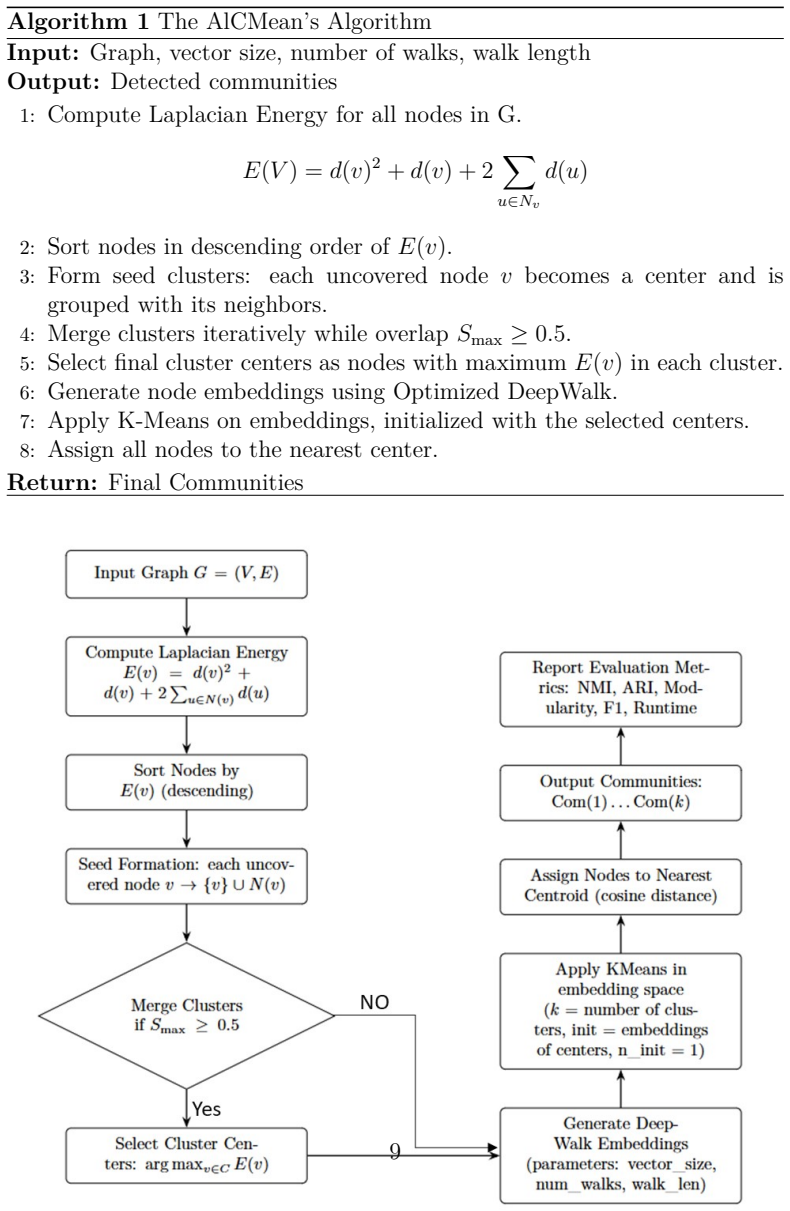
ALCMeans combines Laplacian energy-based automatic center identification with DeepWalk embeddings for robust node representation. Unlike existing Laplacian-based and clustering methods, ALCMeans eliminates the need to predefine the number of communities, enhances cluster center selection using structural importance, and leverages representation learning for more accurate and stable assignments.
What carries the argument
Automatic Laplacian Centrality Means (ALCMeans), which uses Laplacian energy to select centers automatically and DeepWalk embeddings to assign nodes to communities without a preset count.
If this is right
- The number of communities can be determined during the process rather than supplied beforehand.
- Cluster centers are chosen according to structural importance measured by Laplacian energy.
- Node representations from DeepWalk improve assignment accuracy and stability over direct graph methods.
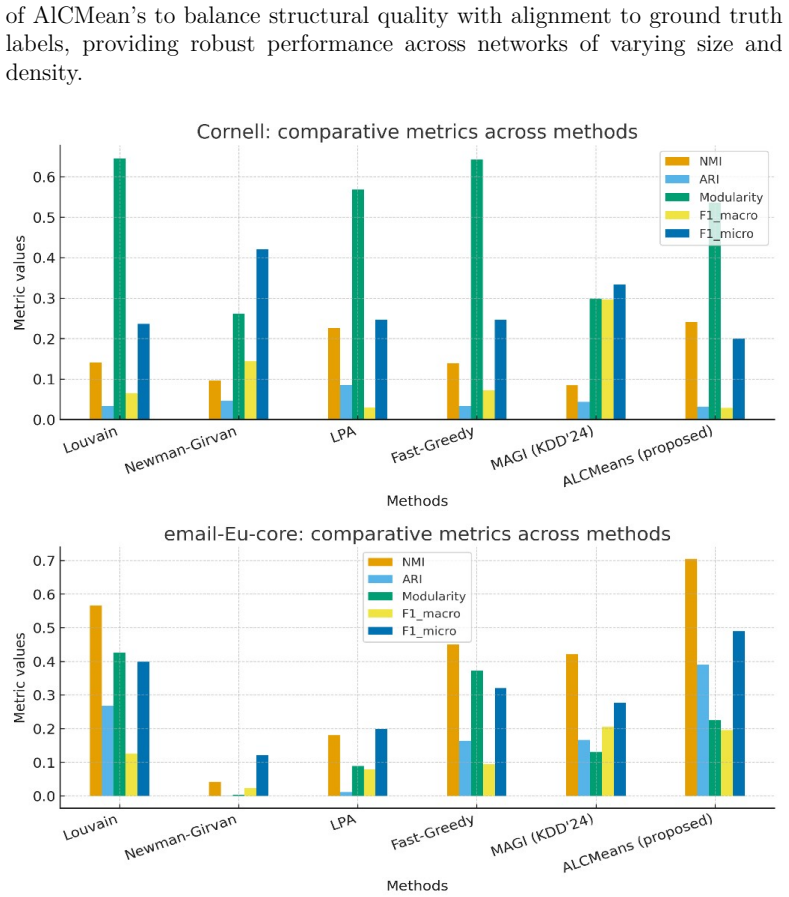
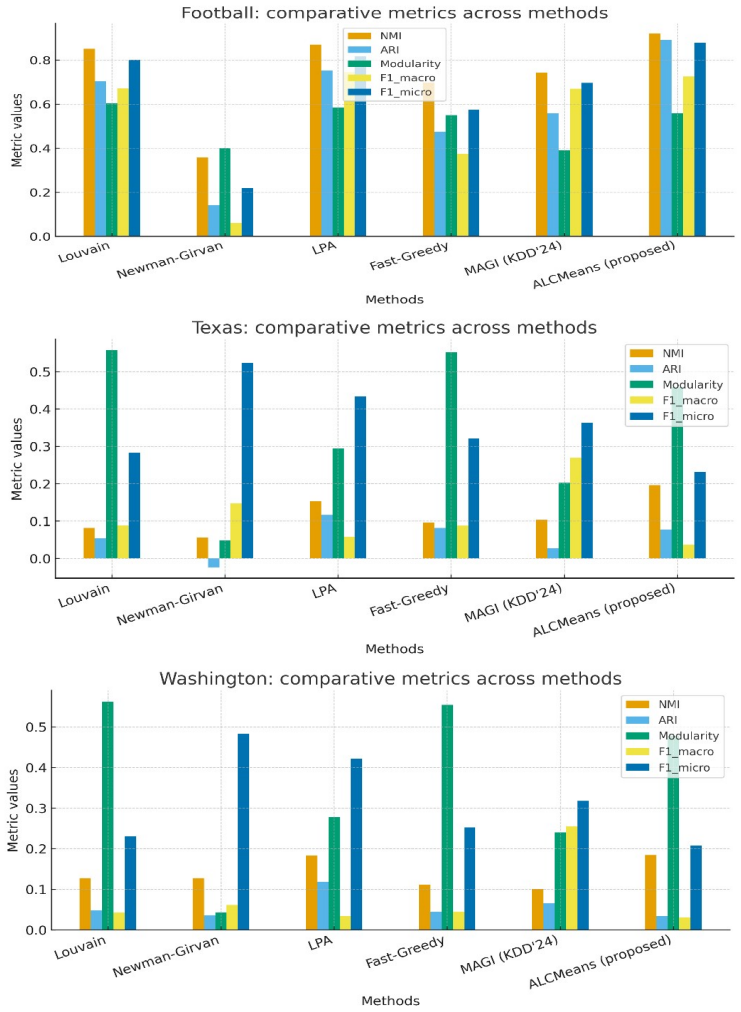
- The full method produces 10 to 20 percent higher NMI and ARI than Louvain, LPA, and similar baselines on tested datasets.
- Removing either the Laplacian center step or the embedding step reduces performance, as shown in ablation checks.
Where Pith is reading between the lines
- The same center-selection idea could be tested on temporal networks by updating the Laplacian incrementally between time steps.
- Substituting other embedding techniques for DeepWalk might further raise scores on networks where random walks are less effective.
- The automatic count feature reduces the risk of forcing an incorrect partition size in applications such as biological interaction graphs.
Load-bearing premise
Laplacian energy will identify the correct centers and DeepWalk embeddings will produce stable clusters across diverse networks without manual specification of community count or extensive tuning.
What would settle it
A benchmark network with known ground-truth communities where the Laplacian energy step selects a different number of centers than the true count and yields lower NMI than methods supplied with the correct count.
Figures
read the original abstract
Community detection is a fundamental problem in the analysis of complex networks. It has applications across social, biological, and financial domains. Traditional algorithms such as Louvain, LPA, and modularity optimization often require manual parameter tuning. They also suffer from inaccurate cluster center selection and struggle with scalability. To address these challenges, we propose Automatic Laplacian Centrality Means (ALCMeans), a novel community detection algorithm. ALCMeans combines Laplacian energy-based automatic center identification with DeepWalk embeddings for robust node representation. Unlike existing Laplacian-based and clustering methods, ALCMeans eliminates the need to predefine the number of communities, enhances cluster center selection using structural importance, and leverages representation learning for more accurate and stable assignments. Experimental results on benchmark datasets demonstrate 10 to 20 percent higher NMI and ARI scores compared to Louvain, Newman-Girvan, LPA, Fast-Greedy, and a recent GNN-based competitor (MAGI, KDD 2024). Additional evaluations with modularity and F1-scores confirm the superiority of ALCMeans. Ablation studies highlight the critical contributions of each component. Despite its reliance on DeepWalk parameters and increased runtime relative to lightweight heuristics, ALCMeans consistently outperforms state-of-the-art methods. This makes it a promising tool for real-world network analysis.
Editorial analysis
A structured set of objections, weighed in public.
Referee Report
Summary. The manuscript presents ALCMeans, an unsupervised community detection algorithm that combines Laplacian energy-based automatic identification of the number of cluster centers with DeepWalk embeddings. It claims to remove the need to predefine the number of communities, improve center selection via structural importance, and produce more accurate and stable assignments than existing methods. Experimental results on benchmark datasets are stated to yield 10-20% higher NMI and ARI scores versus Louvain, Newman-Girvan, LPA, Fast-Greedy, and MAGI (KDD 2024), with supporting modularity and F1 results plus ablation studies.
Significance. If the Laplacian-energy procedure reliably recovers the ground-truth number of communities and the reported gains prove reproducible with proper controls, the work would address a practical limitation of many community-detection algorithms. The integration of spectral center detection with representation learning is a coherent direction. However, the absence of experimental details and the acknowledged dependence on DeepWalk parameters limit the assessed significance.
major comments (2)
- [Abstract] Abstract: the performance claims of 10-20% higher NMI and ARI are presented without dataset descriptions, number of runs, error bars, ablation verification, or any experimental protocol, rendering the superiority statements impossible to evaluate.
- [Abstract] Abstract: the central claim that Laplacian energy automatically identifies the correct number of centers (thereby eliminating manual k specification) is load-bearing for both the method and the performance advantage, yet no evidence is supplied that the energy statistic exhibits a detectable optimum at the true community count on networks lacking clear spectral gaps.
minor comments (1)
- [Title] Abstract: the title spelling 'Alcmean's' is inconsistent with the acronym ALCMeans used in the text.
Simulated Author's Rebuttal
We thank the referee for the detailed review and constructive feedback. We address each major comment below and outline planned revisions to strengthen the manuscript.
read point-by-point responses
-
Referee: [Abstract] Abstract: the performance claims of 10-20% higher NMI and ARI are presented without dataset descriptions, number of runs, error bars, ablation verification, or any experimental protocol, rendering the superiority statements impossible to evaluate.
Authors: We agree the abstract's brevity omits full protocol details. The manuscript body specifies the benchmark datasets, reports results over multiple independent runs with error bars in figures, and includes dedicated ablation studies. To address the concern directly, we will revise the abstract to briefly note the evaluation on standard benchmarks with repeated runs and statistical reporting. This makes the superiority claims more transparent while respecting abstract length constraints. revision: partial
-
Referee: [Abstract] Abstract: the central claim that Laplacian energy automatically identifies the correct number of centers (thereby eliminating manual k specification) is load-bearing for both the method and the performance advantage, yet no evidence is supplied that the energy statistic exhibits a detectable optimum at the true community count on networks lacking clear spectral gaps.
Authors: The experiments section demonstrates the Laplacian-energy procedure recovering the ground-truth number of communities on the reported benchmarks. However, we acknowledge that explicit curves or analysis for networks without clear spectral gaps (e.g., those with weak structure or overlaps) could be more prominently featured. We will add a targeted figure and accompanying text showing the energy statistic's behavior and optimum on such networks, confirming detectability at the true count. This directly supports the load-bearing claim. revision: yes
Circularity Check
No significant circularity detected
full rationale
The provided abstract and description present ALCMeans as a combination of Laplacian energy for automatic center detection plus DeepWalk embeddings, with performance claims evaluated on external benchmark datasets against named competitors. No equations, self-citations, fitted parameters renamed as predictions, or self-referential definitions appear in the text. The central claims rest on empirical comparisons rather than reducing by construction to inputs or prior self-work, making the derivation self-contained.
Axiom & Free-Parameter Ledger
free parameters (1)
- DeepWalk parameters
axioms (2)
- domain assumption Laplacian energy identifies nodes of structural importance suitable as cluster centers
- domain assumption DeepWalk embeddings provide robust node representations that improve clustering stability when combined with Laplacian centers
Reference graph
Works this paper leans on
-
[1]
Papadopoulos, S., et al. (2012). Community detection in social media: Performance and application considerations. Data Mining and Knowledge Discovery , 24, 515-554. https://doi.org/10.1007/ s10618-011-0224-z
2012
-
[2]
Momenzadeh, S., & Mohammadiani, R. P. (2025). Community Detec- tion by ELPMeans: An Unsupervised Approach That Uses Laplacian Centrality and Clustering. arXiv preprint arXiv:2502.19895 . https: //doi.org/10.48550/arXiv.2502.19895 23
-
[3]
Fani, H., & Bagheri, E. (2017). Community detection in social networks. Encyclopedia with Semantic Computing and Robotic Intelligence , 1(01), 1630001. https://doi.org/10.1142/S2425038416300019
-
[4]
Tang, L., & Liu, H. (2022). Community detection and min- ing in social media . Springer Nature. https://doi.org/10.2200/ s00298ed1v01y201009dmk003
2022
-
[5]
Berahmand, K., Nasiri, E., & Li, Y. (2021). Spectral clustering on protein-protein interaction networks via constructing affinity matrix us- ing attributed graph embedding. Computers in Biology and Medicine , 138, 104933. https://doi.org/10.1016/j.compbiomed.2021.104933
-
[6]
Li, J., et al. (2024). A comprehensive review of community detec- tion in graphs. Neurocomputing, 128169. https://doi.org/10.1016/ j.neucom.2024.128169
arXiv 2024
-
[7]
Shen, H.-W. (2013). Community structure of complex networks . Springer Science & Business Media. https://dl.acm.org/doi/10. 1145/2956185
2013
-
[8]
Rossetti, G., & Cazabet, R. (2018). Community discovery in dynamic networks: A survey. ACM Computing Surveys (CSUR) , 51(2), 1-37. https://doi.org/10.1145/3172867
-
[9]
Newman, M. E., & Clauset, A. (2016). Structure and inference in an- notated networks. Nature Communications, 7(1), 11863. https://doi. org/10.1038/ncomms11863
-
[10]
Zhao, Y. (2017). A survey on theoretical advances of community de- tection in networks. Wiley Interdisciplinary Reviews: Computational Statistics, 9(5), e1403. https://doi.org/10.1002/wics.1403
-
[11]
Bhowmick, S. S., & Seah, B. S. (2015). Clustering and summarizing protein-protein interaction networks: A survey. IEEE Transactions on Knowledge and Data Engineering , 28(3), 638-658. https://doi.org/ 10.1109/TKDE.2015.2492559
-
[12]
Khawaja, F. R., et al. (2024). Exploring community detection methods and their diverse applications in complex networks: A comprehensive 24 review. Social Network Analysis and Mining , 14(1), 115. https://doi. org/10.1007/s13278-024-01274-1
-
[13]
Venturini, S. (2023). Complex networks: community detection and graph semi-supervised learning on higher-order networks, with an application to the science of science . https://hdl.handle.net/20.500.14242/ 160925
2023
-
[14]
Javed, M. A., et al. (2018). Community detection in networks: A mul- tidisciplinary review. Journal of Network and Computer Applications , 108, 87-111. https://doi.org/10.1016/j.jnca.2018.02.011
-
[15]
Zhou, S., et al. (2024). A comprehensive survey on deep clustering: Taxonomy, challenges, and future directions. ACM Computing Surveys , 57(3), 1-38. https://doi.org/10.1145/3689036
-
[16]
Liu, Y., et al. (2024). Revisiting modularity maximization for graph clustering: A contrastive learning perspective. In Proceedings of the 30th ACM SIGKDD Conference on Knowledge Discovery and Data Mining . https://doi.org/10.1145/3637528.3671967
-
[17]
Jiang, Y., Jia, C., & Yu, J. (2013). An efficient community detec- tion method based on rank centrality. Physica A: Statistical Mechanics and its Applications , 392(9), 2182-2194. https://doi.org/10.1016/j. physa.2012.12.013
work page doi:10.1016/j 2013
-
[18]
Li, Y., Jia, C., & Yu, J. (2015). A parameter-free community detec- tion method based on centrality and dispersion of nodes in complex networks. Physica A: Statistical Mechanics and its Applications , 438, 321-334. https://doi.org/10.1016/j.physa.2015.06.043
-
[19]
Bai, X., Yang, P., & Shi, X. (2017). An overlapping community detection algorithm based on density peaks. Neurocomputing, 226, 7-15. https: //doi.org/10.1016/j.neucom.2016.11.019
-
[20]
Yang, X.-H., et al. (2017). Parameter-free Laplacian centrality peaks clustering. Pattern Recognition Letters , 100, 167-173. https://doi. org/10.1016/j.patrec.2017.10.025 25
-
[21]
Yuan, X., et al. (2021). A novel density peaks clustering algorithm based on K nearest neighbors with adaptive merging strategy. Interna- tional Journal of Machine Learning and Cybernetics , 12(10), 2825-2841. https://doi.org/10.21203/rs.3.rs-95747/v1
-
[22]
Guo, W., et al. (2022). Density peak clustering with connectivity esti- mation. Knowledge-Based Systems, 243, 108501. https://doi.org/10. 1016/j.knosys.2022.108501
arXiv 2022
-
[23]
Yang, Y., et al. (2022). Density clustering with divergence distance and automatic center selection. Information Sciences , 596, 414-438. https: //doi.org/10.1016/j.ins.2022.03.027
-
[24]
Hasan, A., & Kamal, A. (2022). LapEFCM: Overlapping commu- nity detection using laplacian eigenmaps and fuzzy C-means cluster- ing. International Journal of Information Technology , 14(6), 3133-3144. https://doi.org/10.1007/s41870-022-01028-2
-
[25]
Zhang, C., et al. (2023). Community Deception in Large Networks: Through the Lens of Laplacian Spectrum. IEEE Transactions on Com- putational Social Systems , 11(2), 2057-2069. https://doi.org/10. 1109/TCSS.2023.3268564
arXiv 2023
-
[26]
Gutman, I., & Zhou, B. (2006). Laplacian energy of a graph. Linear Al- gebra and its Applications , 414(1), 29-37. https://doi.org/10.1016/ j.laa.2005.09.008
2006
-
[27]
Louafi, W., & Titouna, F. (2023). PCMeans: Community detec- tion using local PageRank, clustering, and K-means. Social Net- work Analysis and Mining , 13(1), 103. https://doi.org/10.1007/ s13278-023-01109-5
2023
-
[28]
Khan, T. A., et al. (2024). Community Detection and Modularity Anal- ysis in Stack Overflow Network Graphs. In 2024 1st International Con- ference on Advanced Computing and Emerging Technologies (ACET) . IEEE. https://doi.org/10.1109/ACET61898.2024.10730545
-
[29]
Bražinskas, A., Havrylov, S., & Titov, I. (2017). Embedding words as distributions with a Bayesian skip-gram model. arXiv preprint , arXiv:1711.11027. https://aclanthology.org/C18-1151/ 26
Pith/arXiv arXiv 2017
-
[30]
Krevl, J.L., & Andrej, A. (2014). SNAP Datasets: Stanford Large Net- work Dataset Collection. A vailable from: http://snap.stanford.edu/ data 27
2014
discussion (0)
Sign in with ORCID, Apple, or X to comment. Anyone can read and Pith papers without signing in.