Metal Halide Perovskite/Chalcohalide Heterojunctions for the Photoinduced Oxidative Coupling of p-substituted Thiophenols
Pith reviewed 2026-06-27 15:53 UTC · model grok-4.3
The pith
CsPbBr3/Pb4S3Br2 type-II heterojunctions reach 94% selectivity in photooxidative thiophenol coupling with turnover of 14300.
A machine-rendered reading of the paper's core claim, the machinery that carries it, and where it could break.
Core claim
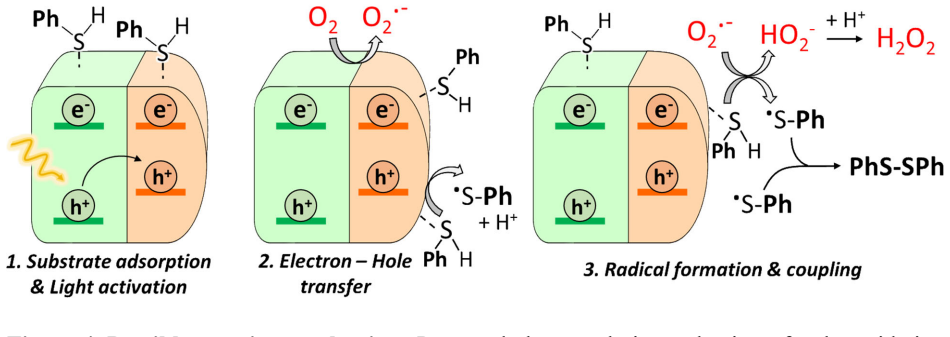
CsPbBr3/Pb4S3Br2 heterostructures achieve up to 94% selectivity toward the disulfide product in the photooxidative coupling of p-methoxy thiophenol, accompanied by a turnover number of 14300, because the type-II heterojunction promotes efficient charge separation and electron delocalization across the junction.
What carries the argument
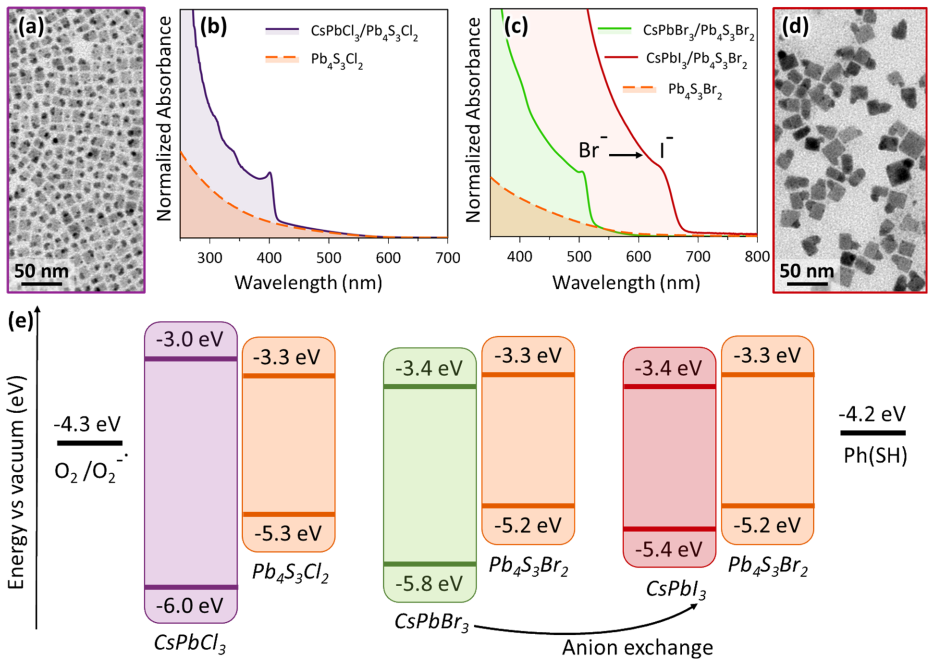
The type-II heterojunction between CsPbBr3 and Pb4S3Br2 whose band alignment is tuned by halide choice, which separates charges and delocalizes electrons across the interface.
If this is right
- The same heterojunction strategy applies across Cl, Br, and I compositions to tune performance for the same reaction.
- The process runs sustainably without added electron donors or heating.
- High turnover numbers indicate the catalyst supports many reaction cycles before deactivation.
- Selectivity to disulfide is tied directly to the junction-enabled charge dynamics rather than to the individual components.
Where Pith is reading between the lines
- The approach could be tested on other oxidative couplings by swapping the thiophenol substituent or the light source wavelength.
- If band alignment is the controlling factor, analogous junctions between different perovskite and chalcogenide pairs might improve photocatalysis in unrelated reactions.
- The high turnover suggests the material could support continuous-flow versions of the reaction at larger scale.
Load-bearing premise
The observed selectivity and turnover arise specifically from the type-II heterojunction and its band alignment rather than from surface chemistry, particle size, or impurities in the synthesized material.
What would settle it
If separate CsPbBr3 and Pb4S3Br2 particles mixed without forming an intimate junction, or if a different halide composition that breaks type-II alignment, produce the same 94% selectivity and 14300 turnover, the claim that the heterojunction is responsible would be falsified.
Figures
read the original abstract
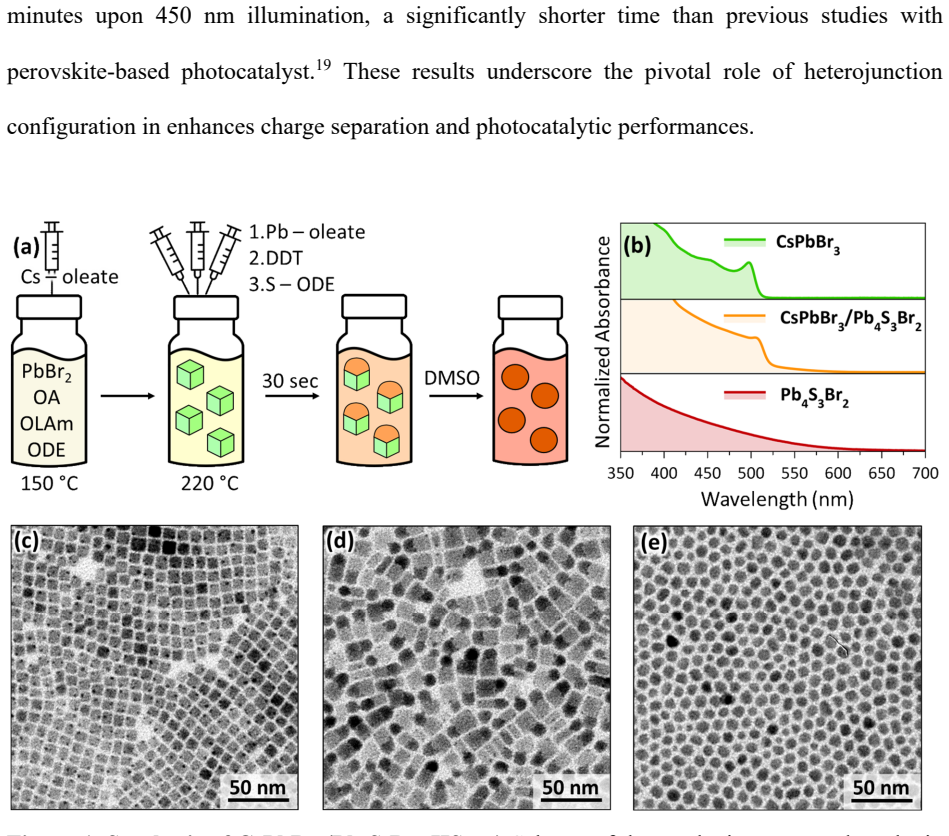
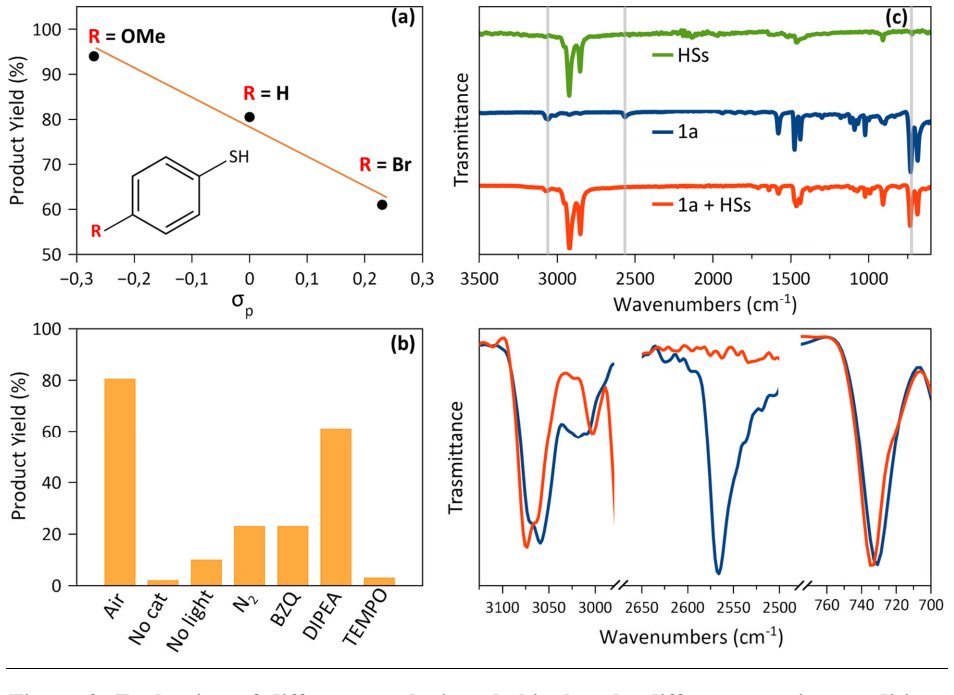
The introduction of a semiconductor-semiconductor junction is an effective strategy to enhance the photocatalytic performance of perovskite nanocrystal-based systems. Herein, we optimized the synthesis of CsPbX3/Pb4S3X2 (X= Cl, Br, I) perovskites-chalcohalides heterostructures, whose band alignment can be tuned by halide composition. As a proof-of-concept, we evaluated the photooxidative coupling of p-substituted thiophenols at room temperature, under visible-light, air, and without sacrificial electron donor. Notably, CsPbBr3/Pb4S3Br2 achieved up to 94 % selectivity toward disulfide (p-OCH3 thiophenol with a turnover number of 14300) highlighting the crucial role of the type-II heterojunction to promote charge separation and efficient electron delocalization across the junction.
Editorial analysis
A structured set of objections, weighed in public.
Referee Report
Summary. The manuscript reports optimized synthesis of CsPbX3/Pb4S3X2 (X=Cl, Br, I) perovskite-chalcohalide heterostructures whose band alignment is tunable by halide composition. As a proof-of-concept, these materials are evaluated for room-temperature photooxidative coupling of p-substituted thiophenols under visible light and air (no sacrificial donor). The central claim is that the type-II heterojunction in CsPbBr3/Pb4S3Br2 is crucial for achieving up to 94% disulfide selectivity and TON=14300 (p-OCH3 thiophenol), via promoted charge separation and electron delocalization.
Significance. If the performance metrics are reproducible and the heterojunction effect can be isolated from composition or morphology, the work would add a concrete example of halide-tunable perovskite/chalcohalide junctions for selective photocatalysis. No machine-checked proofs, parameter-free derivations, or falsifiable predictions are present.
major comments (2)
- [Abstract] Abstract: the attribution of 94% selectivity and TON=14300 specifically to the type-II heterojunction is not supported by any controls (single-phase CsPbBr3, physical mixtures, or composition-matched non-junction materials) that would isolate the junction from surface chemistry, particle size, or impurities.
- [Abstract] Abstract/Results: no verification is described that the synthesized particles actually form the claimed type-II band alignment (e.g., via UPS/XPS valence-band offsets or optical data showing staggered gaps), leaving the 'tunable by halide composition' and 'crucial role' statements unanchored.
minor comments (2)
- Full datasets, error bars, and number of replicates for conversion, selectivity, and TON values are required; the abstract reports point values only.
- Standard materials characterization (TEM, XRD, elemental mapping) confirming interface formation and phase purity should be shown to support the heterostructure description.
Simulated Author's Rebuttal
We thank the referee for the constructive feedback on our manuscript. We address each major comment below and indicate the revisions planned for the next version.
read point-by-point responses
-
Referee: [Abstract] Abstract: the attribution of 94% selectivity and TON=14300 specifically to the type-II heterojunction is not supported by any controls (single-phase CsPbBr3, physical mixtures, or composition-matched non-junction materials) that would isolate the junction from surface chemistry, particle size, or impurities.
Authors: The manuscript reports performance trends across halide compositions (Cl, Br, I) that correlate with the expected band alignments, with the Br variant showing the highest metrics. We agree, however, that explicit controls isolating the heterojunction (e.g., single-phase CsPbBr3 or physical mixtures) are not presented. In the revised manuscript we will add a dedicated control section or additional data to better separate junction effects from other variables. revision: yes
-
Referee: [Abstract] Abstract/Results: no verification is described that the synthesized particles actually form the claimed type-II band alignment (e.g., via UPS/XPS valence-band offsets or optical data showing staggered gaps), leaving the 'tunable by halide composition' and 'crucial role' statements unanchored.
Authors: Band alignment is proposed on the basis of the heterostructure composition and halide-dependent behavior. We acknowledge that direct experimental verification (UPS/XPS or optical confirmation of staggered gaps) is not described in the current text. We will revise the manuscript to include supporting characterization or analysis that anchors the type-II assignment and tunability claims. revision: yes
Circularity Check
No circularity: purely experimental report with no derivations or fitted predictions
full rationale
The manuscript reports synthesis optimization, structural characterization, band alignment tuning via halide composition, and photocatalytic performance metrics (selectivity, TON) for CsPbX3/Pb4S3X2 heterostructures. No equations, models, derivations, or parameter-fitting steps are present in the provided text or abstract. The central claim attributes performance to the type-II junction but does so via experimental comparison and observation rather than any self-referential mathematical construction. This matches the default case of a self-contained experimental paper with no load-bearing circular steps.
Axiom & Free-Parameter Ledger
Reference graph
Works this paper leans on
-
[1]
Halide Perovskite–Lead Chalcohalide Nanocrystal Heterostructures
Toso, S.; Song, J.; Infante, I.; Bals, S.; Brove lli, S.; Manna, L. Halide Perovskite–Lead Chalcohalide Nanocrystal Heterostructures. J. Am. Chem. Soc. 2021, 143 (3), 1435–1446. https://doi.org/10.1021/jacs.0c10916. (2) Fairley, N.; Fernandez, V.; Richard ‐Plouet, M.; Guillot-Deudon, C.; Walton, J.; Smith, E
-
[2]
Systematic and Collaborative Approach to Problem Solving Using X-Ray Photoelectron Spectroscopy
Flahaut, D.; Greiner, M.; Biesinger, M.; Tougaard, S.; Morgan, D.; Baltrusaitis, J. Systematic and Collaborative Approach to Problem Solving Using X-Ray Photoelectron Spectroscopy. Applied Surface Science Advances 2021, 5, 100112. https://doi.org/10.1016/j.apsadv.2021.100112. (3) Helander, M. G.; Greiner, M. T.; Wang, Z. B.; Lu, Z. H. Pitfalls in Measurin...
-
[3]
Templateless Room-Temperature Assembly of Nanowire Networks from Nanoparticles
Kumar, A.; Vijayamohanan, K. Templateless Room-Temperature Assembly of Nanowire Networks from Nanoparticles. Langmuir 2004, 20 (13), 5583–5587. https://doi.org/10.1021/la0497649. (5) Wu, W.-B.; Wong, Y.-C.; Tan, Z.-K.; W u, J. Photo-Induced Thiol Coupling and C–H Activation Using Nanocrystalline L ead-Halide Perovskite Catalysts. Catal. Sci. Technol. 2018...
-
[4]
Lei, A.; Shevchenko, E. V. Insights into the Extraction of Photogenerated Holes from CdSe/CdS Nanorods for Oxidative Organic Catalysis. J. Mater. Chem. A 2021, 9 (21), 12690–12699. https://doi.org/10.1039/D1TA01124C
discussion (0)
Sign in with ORCID, Apple, or X to comment. Anyone can read and Pith papers without signing in.