Atmospheric Neutrino Oscillations: the Full Picture
Pith reviewed 2026-06-27 14:28 UTC · model grok-4.3
The pith
A unified model fits atmospheric neutrino data from four experiments with no significant tensions and prefers normal mass ordering.
A machine-rendered reading of the paper's core claim, the machinery that carries it, and where it could break.
Core claim
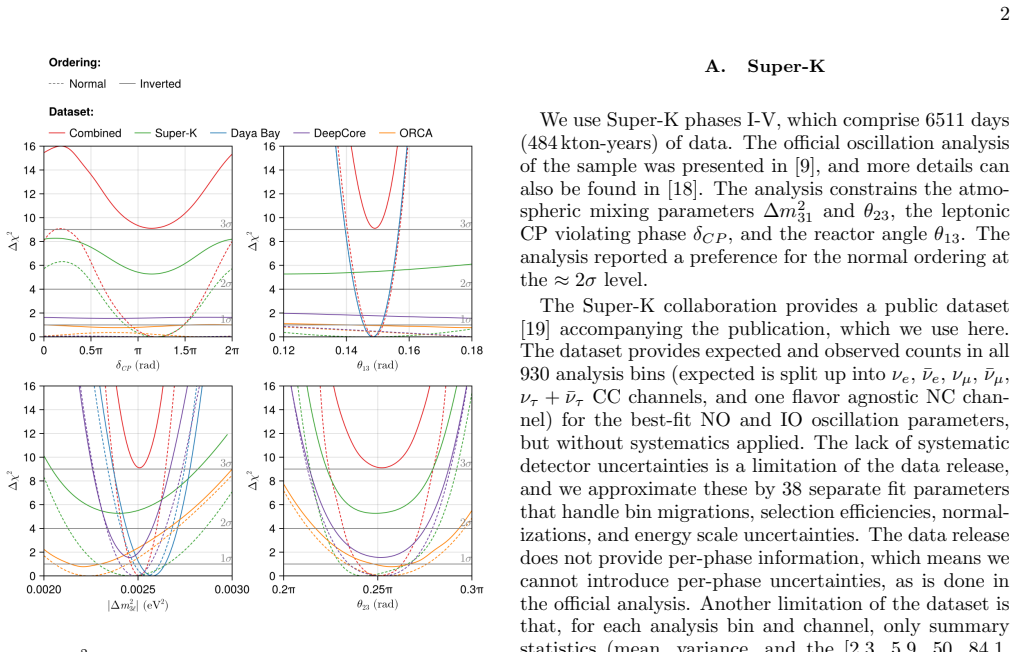
We present the first combined oscillation analysis of multiple atmospheric neutrino datasets, featuring data from Super-Kamiokande, IceCube-DeepCore, and KM3NeT/ORCA together with reactor data from Daya Bay. Such combinations have long been considered infeasible outside experimental collaborations; we demonstrate that a unified physics model can simultaneously describe all datasets with no significant parameter tensions. Fitting 839048 events across 1536 bins with 91 parameters, our combined analysis yields competitive measurements of the neutrino mixing parameters, and prefers the Normal over the Inverted Mass Ordering.
What carries the argument
The unified physics model using one shared set of oscillation parameters and common systematic uncertainties to describe all four datasets at the same time.
If this is right
- The joint fit delivers competitive constraints on neutrino mixing parameters from the combined data.
- The analysis prefers the normal neutrino mass ordering over the inverted ordering.
- No large parameter tensions appear when the datasets are analyzed together under the unified model.
- Combined analyses of this type can be performed without requiring a single experimental collaboration.
Where Pith is reading between the lines
- Future work could add data from additional neutrino experiments to tighten the constraints further.
- The demonstrated feasibility may encourage more global fits that mix atmospheric and reactor data routinely.
- If the normal ordering preference holds with more data, it would narrow the range of allowed models for neutrino mass generation.
Load-bearing premise
The four experiments' datasets can be described by one set of oscillation parameters and shared systematic uncertainties without significant tensions between them.
What would settle it
Finding statistically significant tensions or a poor overall fit quality when forcing all datasets into a single parameter set would show the unified model does not hold.
Figures
read the original abstract
We present the first combined oscillation analysis of multiple atmospheric neutrino datasets, featuring data from Super-Kamiokande, IceCube-DeepCore, and KM3NeT/ORCA together with reactor data from Daya Bay. Such combinations have long been considered infeasible outside experimental collaborations; we demonstrate that a unified physics model can simultaneously describe all datasets with no significant parameter tensions. Fitting 839048 events across 1536 bins with 91 parameters, our combined analysis yields competitive measurements of the neutrino mixing parameters, and prefers the Normal over the Inverted Mass Ordering.
Editorial analysis
A structured set of objections, weighed in public.
Referee Report
Summary. The paper presents the first combined oscillation analysis of atmospheric neutrino data from Super-Kamiokande, IceCube-DeepCore, and KM3NeT/ORCA together with reactor data from Daya Bay. It claims that a unified physics model with shared oscillation parameters and systematics simultaneously describes all datasets with no significant tensions. The global fit uses 839048 events across 1536 bins and 91 parameters, yielding competitive measurements of the neutrino mixing parameters and a preference for normal over inverted mass ordering.
Significance. If the no-tension claim and ordering preference are substantiated by the detailed fit results, this would represent a notable advance in neutrino oscillation physics by demonstrating the feasibility of multi-experiment global fits outside single collaborations. The large event sample and bin count, combined with the inclusion of reactor data to anchor key parameters, could tighten constraints on the PMNS matrix elements and mass ordering in a manner that individual experiments cannot achieve alone.
minor comments (2)
- The abstract asserts 'no significant parameter tensions' and a preference for normal ordering but does not quote the relevant Δχ² values or reference the section containing the combined-vs-separate fit comparisons; adding these numbers would strengthen the central claim without altering the analysis.
- Notation for the 91 fit parameters and the breakdown of systematic uncertainties shared across experiments should be tabulated early (e.g., near the description of the likelihood) to improve readability for readers outside the immediate collaboration.
Simulated Author's Rebuttal
We thank the referee for their positive assessment of the manuscript and for recommending minor revision. No specific major comments were listed in the report, so we will incorporate minor improvements to enhance clarity and presentation as appropriate.
Circularity Check
No significant circularity identified
full rationale
The paper reports a global statistical fit of a unified neutrino oscillation model (with shared parameters and systematics) to combined data from Super-Kamiokande, IceCube-DeepCore, KM3NeT/ORCA, and Daya Bay, totaling 839048 events in 1536 bins using 91 parameters. The central claim—that a single parameter set describes all datasets with no significant tensions—is the direct numerical outcome of this fit and the associated compatibility tests (pull distributions, separate-vs-combined chi-squared), not a quantity defined by construction from the inputs or renamed from a prior fit. No self-definitional loops, fitted inputs presented as independent predictions, or load-bearing self-citations appear in the derivation chain; the work is a standard data-driven analysis whose results are externally falsifiable against the input datasets.
Axiom & Free-Parameter Ledger
free parameters (1)
- 91 fit parameters
Reference graph
Works this paper leans on
-
[1]
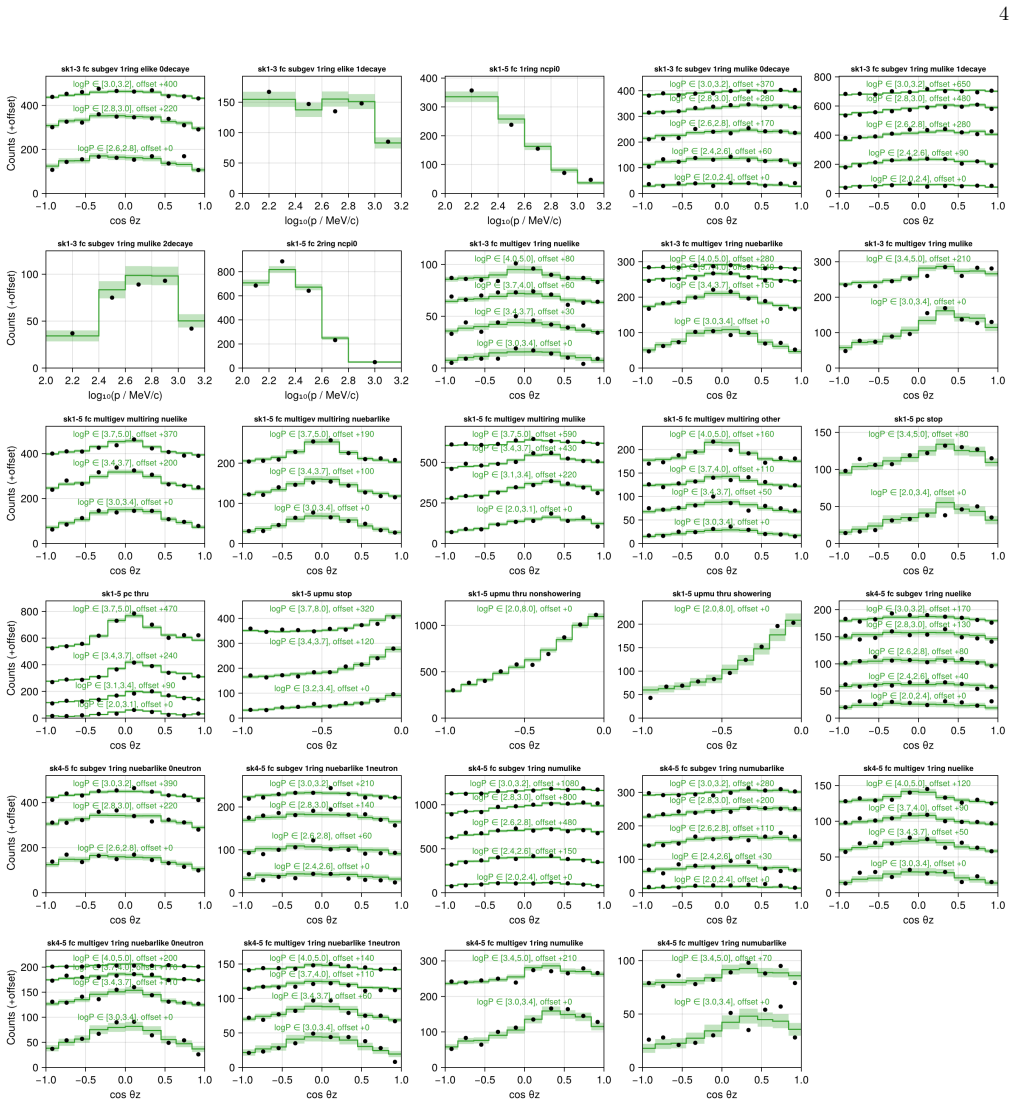
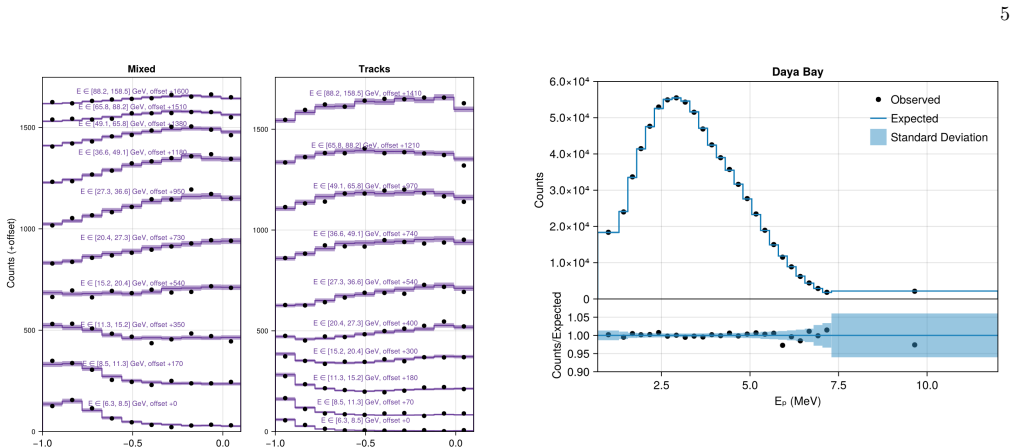
accompanying the publication, which we use here. The dataset provides expected and observed counts in all 930 analysis bins (expected is split up intoν e, ¯νe,ν µ, ¯νµ, ντ + ¯ντ CC channels, and one flavor agnostic NC chan- nel) for the best-fit NO and IO oscillation parameters, but without systematics applied. The lack of systematic detector uncertaintie...
2094
-
[2]
Fukudaet al.(Super-Kamiokande), Evidence for os- cillation of atmospheric neutrinos, Phys
Y. Fukudaet al.(Super-Kamiokande), Evidence for os- cillation of atmospheric neutrinos, Phys. Rev. Lett.81, 1562 (1998), arXiv:hep-ex/9807003
Pith/arXiv arXiv 1998
-
[3]
Q. R. Ahmadet al.(SNO), Direct evidence for neutrino flavor transformation from neutral current interactions in the Sudbury Neutrino Observatory, Phys. Rev. Lett.89, 011301 (2002), arXiv:nucl-ex/0204008
Pith/arXiv arXiv 2002
-
[4]
K. Eguchiet al.(KamLAND), First results from Kam- LAND: Evidence for reactor anti-neutrino disappear- ance, Phys. Rev. Lett.90, 021802 (2003), arXiv:hep- ex/0212021
arXiv 2003
-
[5]
K. Abeet al.(T2K), Results from the T2K Experi- ment on Neutrino Mixing Including a New Far Detec- torµ-like Sample, Phys. Rev. Lett.135, 261801 (2025), arXiv:2506.05889 [hep-ex]
arXiv 2025
-
[6]
S. Abubakaret al.(NOvA), Precision Measurement of Neutrino Oscillation Parameters with 10 Years of Data from the NOvA Experiment, Phys. Rev. Lett.136, 011802 (2026), arXiv:2509.04361 [hep-ex]
arXiv 2026
-
[7]
I. Esteban, M. C. Gonzalez-Garcia, M. Maltoni, T. Schwetz, and A. Zhou, The fate of hints: updated global analysis of three-flavor neutrino oscillations, JHEP 09, 178, arXiv:2007.14792 [hep-ph]
arXiv 2007
-
[8]
S. Abubakaret al.(T2K, NOvA), Joint neutrino oscil- lation analysis from the T2K and NOvA experiments, Nature646, 818 (2025), arXiv:2510.19888 [hep-ex]
arXiv 2025
-
[9]
A. Abuslemeet al.(JUNO), First measurement of reactor neutrino oscillations at JUNO, (2025), arXiv:2511.14593 8 Dataset Bins Events Individual Fit Combined Fit ∆χ2 IO−NOχ2 p-valueχ 2 p-value Daya Bay 26 752954 23.93 0.580 24.46 0.550 0.00 Super-K 880 58352 921.86 0.159 925.06 0.142 5.27 DeepCore 200 21914 210.95 0.284 215.80 0.211 1.55 ORCA 430 5828 475.4...
arXiv 2025
-
[10]
T. Westeret al.(Super-Kamiokande), Atmospheric neu- trino oscillation analysis with neutron tagging and an ex- panded fiducial volume in Super-Kamiokande I–V, Phys. Rev. D109, 072014 (2024), arXiv:2311.05105 [hep-ex]
arXiv 2024
-
[11]
K. Abeet al.(T2K, Super-Kamiokande), First Joint Os- cillation Analysis of Super-Kamiokande Atmospheric and T2K Accelerator Neutrino Data, Phys. Rev. Lett.134, 011801 (2025), arXiv:2405.12488 [hep-ex]
arXiv 2025
-
[12]
M. G. Aartsenet al.(IceCube), Development of an analy- sis to probe the neutrino mass ordering with atmospheric neutrinos using three years of IceCube DeepCore data, Eur. Phys. J. C80, 9 (2020), arXiv:1902.07771 [hep-ex]
arXiv 2020
-
[13]
M. V. P. Rodriguez,Measurement of the neutrino mass ordering with 9.28 years of icecube deepcore data, Ph.D. thesis, University of Wisconsin–Madison (2024)
2024
-
[14]
S. Aielloet al.(KM3NeT), Measurement of neutrino os- cillation parameters with the first six detection units of KM3NeT/ORCA, JHEP10, 206, [Addendum: JHEP 10, 041 (2025)], arXiv:2408.07015 [hep-ex]
arXiv 2025
-
[15]
I. Esteban, M. C. Gonzalez-Garcia, M. Maltoni, I. Martinez-Soler, and T. Schwetz, Updated fit to three neutrino mixing: exploring the accelerator-reactor com- plementarity, JHEP01, 087, arXiv:1611.01514 [hep-ph]
-
[16]
M. C. Gonzalez-Garcia, M. Maltoni, and T. Schwetz, Up- dated fit to three neutrino mixing: status of leptonic CP violation, JHEP11, 052, arXiv:1409.5439 [hep-ph]
-
[17]
I. Esteban, M. C. Gonzalez-Garcia, A. Hernandez- Cabezudo, M. Maltoni, and T. Schwetz, Global analy- sis of three-flavour neutrino oscillations: synergies and tensions in the determination ofθ 23,δ CP , and the mass ordering, JHEP01, 106, arXiv:1811.05487 [hep-ph]
-
[18]
F. Capozzi, W. Giar` e, E. Lisi, A. Marrone, A. Melchiorri, and A. Palazzo, Neutrino masses and mixing: Entering the era of subpercent precision, Phys. Rev. D111, 093006 (2025), arXiv:2503.07752 [hep-ph]
arXiv 2025
-
[19]
Wester,Discerning the Neutrino Mass Ordering using Atmospheric Neutrinos in Super-Kamiokande I-V, Ph.D
T. Wester,Discerning the Neutrino Mass Ordering using Atmospheric Neutrinos in Super-Kamiokande I-V, Ph.D. thesis, Boston University, Boston U. (2023)
2023
-
[20]
Super-Kamiokande Collaboration, Data release: Atmo- spheric neutrino oscillation analysis with neutron tagging and an expanded fiducial volume in Super-Kamiokande I-V, 10.5281/zenodo.8401262 (2023)
-
[21]
C. Jes´ us-Valls, Parametrizing the reconstruction perfor- mance of Super-Kamiokande in the Sub-GeV to TeV neu- trino energy range, (2025), arXiv:2505.20812 [hep-ex]
arXiv 2025
-
[22]
R. Abbasiet al.(IceCube), Measurement of atmospheric neutrino mixing with improved IceCube DeepCore cali- bration and data processing, Phys. Rev. D108, 012014 (2023), arXiv:2304.12236 [hep-ex]
arXiv 2023
-
[23]
IceCube Collaboration, Replication Data for: Measure- ment of atmospheric neutrino mixing with improved IceCube DeepCore calibration and data processing, 10.7910/DVN/B4RITM (2025)
-
[24]
R. Abbasiet al.((IceCube Collaboration)∥, IceCube), Measurement of Atmospheric Neutrino Oscillation Pa- rameters Using Convolutional Neural Networks with 9.3 Years of Data in IceCube DeepCore, Phys. Rev. Lett. 134, 091801 (2025), arXiv:2405.02163 [hep-ex]
arXiv 2025
-
[25]
KM3NeT Collaboration, Oscillation Analysis ORCA433kt-y / ORCA 6, 10.5072/FK2/Y0UXVW (2025)
-
[26]
F. P. Anet al.(Daya Bay), Precision Measurement of Re- actor Antineutrino Oscillation at Kilometer-Scale Base- lines by Daya Bay, Phys. Rev. Lett.130, 161802 (2023), arXiv:2211.14988 [hep-ex]
arXiv 2023
-
[27]
M. Honda, M. Sajjad Athar, T. Kajita, K. Kasahara, and S. Midorikawa, Atmospheric neutrino flux calculation us- ing the NRLMSISE-00 atmospheric model, Phys. Rev. D 92, 023004 (2015), arXiv:1502.03916 [astro-ph.HE]
Pith/arXiv arXiv 2015
-
[28]
Honda, M
M. Honda, M. Sajjad Athar, T. Kajita, K. Kasahara, and S. Midorikawa, Atmospheric Neutrino Flux Tables for One-Year-Average (HAKKM, 2014)., http://www- rccn.icrr.u-tokyo.ac.jp/mhonda/public/nflx2014 (2014)
2014
-
[29]
G. D. Barr, T. K. Gaisser, S. Robbins, and T. Stanev, Un- certainties in Atmospheric Neutrino Fluxes, Phys. Rev. D74, 094009 (2006), arXiv:astro-ph/0611266
Pith/arXiv arXiv 2006
-
[30]
A. M. Dziewonski and D. L. Anderson, Preliminary ref- erence earth model, Physics of the Earth and Planetary Interiors25, 297 (1981)
1981
-
[31]
M. Maltoni, From ray to spray: augmenting amplitudes and taming fast oscillations in fully numerical neutrino codes, JHEP11, 033, arXiv:2308.00037 [hep-ph]
-
[32]
C. Andreopoulos, C. Barry, S. Dytman, H. Gallagher, T. Golan, R. Hatcher, G. Perdue, and J. Yarba, The GENIE Neutrino Monte Carlo Generator: Physics and User Manual, (2015), arXiv:1510.05494 [hep-ph]
Pith/arXiv arXiv 2015
-
[33]
Elleret al., Newtrinos.jl (2026)
P. Elleret al., Newtrinos.jl (2026)
2026
-
[34]
Schulz, F
O. Schulz, F. Beaujean, A. Caldwell, C. Grunwald, V. Hafych, K. Kr¨ oninger, S. L. Cagnina, L. R¨ ohrig, and L. Shtembari, Bat.jl: A julia-based tool for bayesian in- ference, SN Computer Science2, 210 (2021)
2021
-
[35]
M. Ettengruber, A. Zander, and P. Eller, Testing the number of neutrino species with a global fit of neutrino data, Phys. Rev. D109, 095016 (2024), arXiv:2402.00490 [hep-ph]
arXiv 2024
-
[36]
T. Kozynets, P. Eller, A. Zander, M. Ettengruber, and D. J. Koskinen, Constraints on non-unitary neutrino mix- 9 ing in light of atmospheric and reactor neutrino data, JHEP05, 130, arXiv:2407.20388 [hep-ph]
- [37]
-
[38]
M. Blennow, P. Coloma, P. Huber, and T. Schwetz, Quantifying the sensitivity of oscillation experiments to the neutrino mass ordering, JHEP03, 028, arXiv:1311.1822 [hep-ph]
-
[39]
Abeet al.(Super-Kamiokande), Second gadolinium loading to Super-Kamiokande, Nucl
K. Abeet al.(Super-Kamiokande), Second gadolinium loading to Super-Kamiokande, Nucl. Instrum. Meth. A 1065, 169480 (2024), arXiv:2403.07796 [physics.ins-det]
arXiv 2024
-
[40]
R. Abbasiet al.(IceCube), Physics potential of the IceCube Upgrade for atmospheric neutrino oscillations, Phys. Rev. D113, 072009 (2026), arXiv:2509.13066 [hep- ex]
arXiv 2026
-
[41]
M. G. Aartsenet al.(IceCube-Gen2), Combined sensi- tivity to the neutrino mass ordering with JUNO, the Ice- Cube Upgrade, and PINGU, Phys. Rev. D101, 032006 (2020), arXiv:1911.06745 [hep-ex]
arXiv 2020
-
[42]
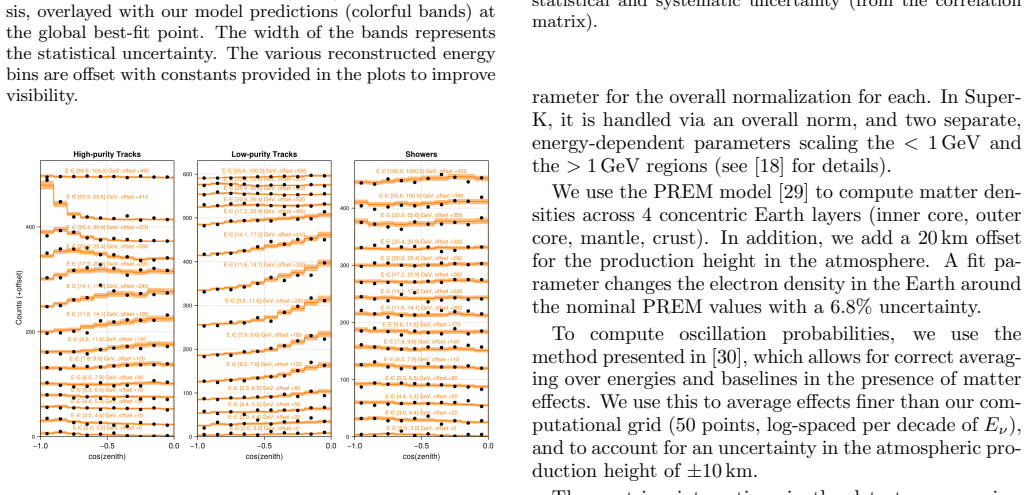
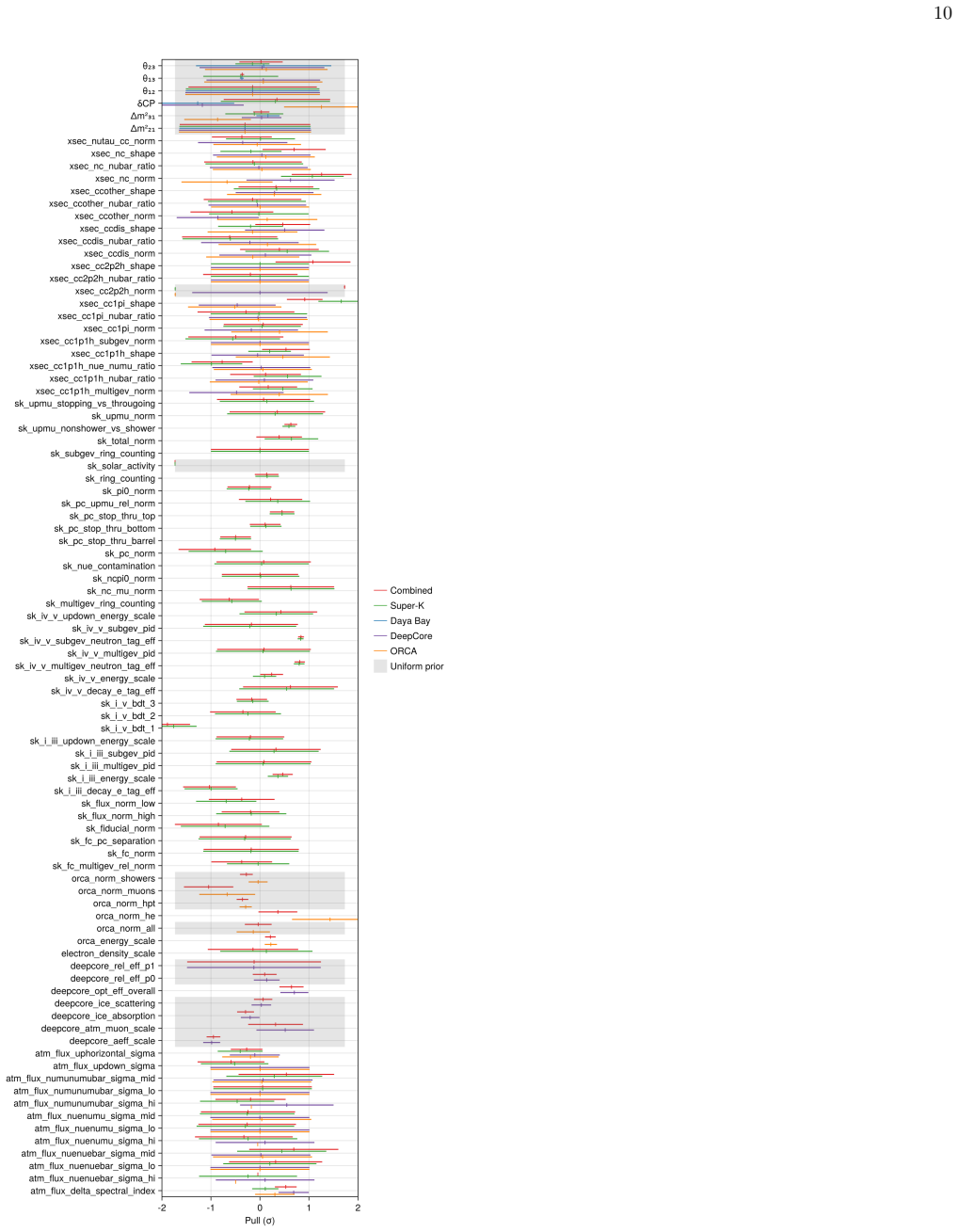
S. Aielloet al.(KM3NeT, JUNO), Combined sensitiv- ity of JUNO and KM3NeT/ORCA to the neutrino mass ordering, JHEP03, 055, arXiv:2108.06293 [hep-ex]. 10 FIG. 6. Best-fit parameter values and approximate uncer- tainty (see text) for the five different fits. The values are shown as pulls in the prior space. Uniform priors span ± √ 12/2, indicated by gray box...
discussion (0)
Sign in with ORCID, Apple, or X to comment. Anyone can read and Pith papers without signing in.