Perturbative Contrastive Physical Learning
Pith reviewed 2026-06-27 17:27 UTC · model grok-4.3
The pith
Learning in physical systems emerges from measurable contrasts between responses to controlled perturbations, without backpropagation or external processors.
A machine-rendered reading of the paper's core claim, the machinery that carries it, and where it could break.
Core claim
PCPL is a general framework in which learning emerges from measurable contrasts between physical states produced by controlled changes to inputs, boundary conditions, parameters, or interpreter functions. Contrast-driven updates can reflect either local sensitivities or global inverse-problem structure, yet do not require centralized gradient computation. Instead, effective learning geometry emerges implicitly from the system's own physical response, allowing learning behavior to arise without an external processor or explicit backpropagation.
What carries the argument
Perturbative Contrastive Physical Learning (PCPL), which produces learning signals from contrasts in physical responses to small controlled perturbations.
If this is right
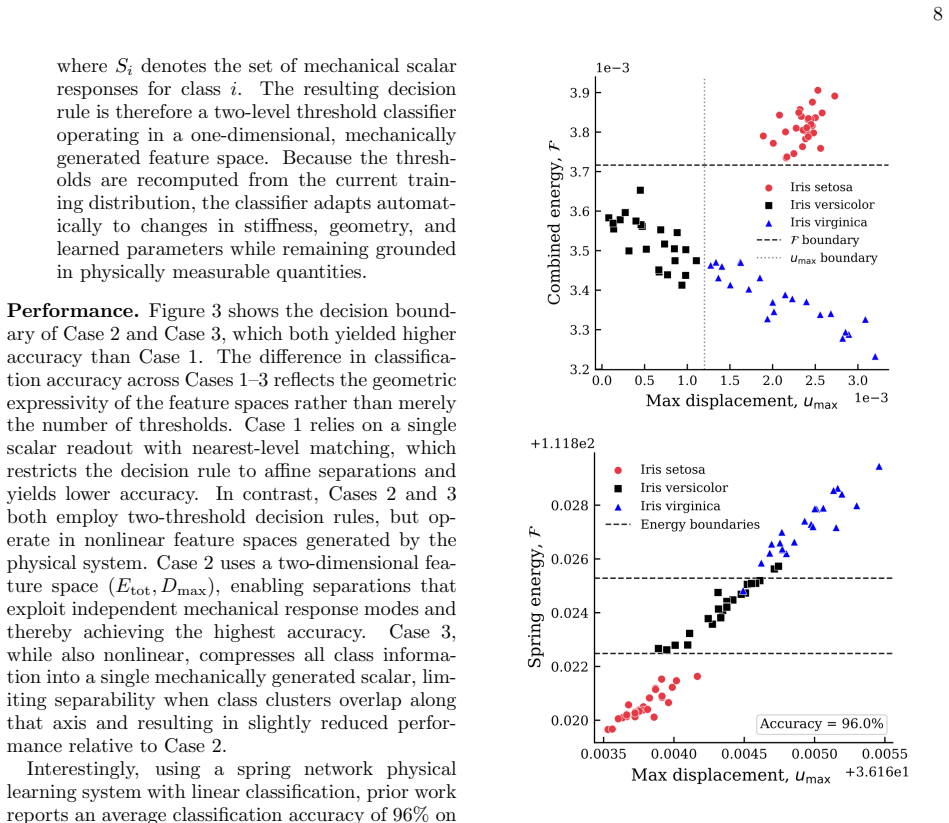
- Spring networks can classify inputs by adjusting bond stiffness values extracted from measured displacements and forces under perturbation.
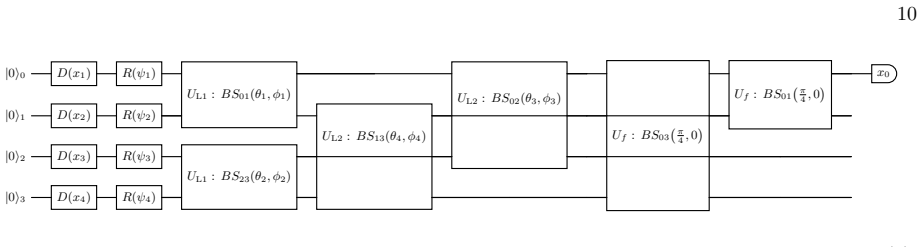
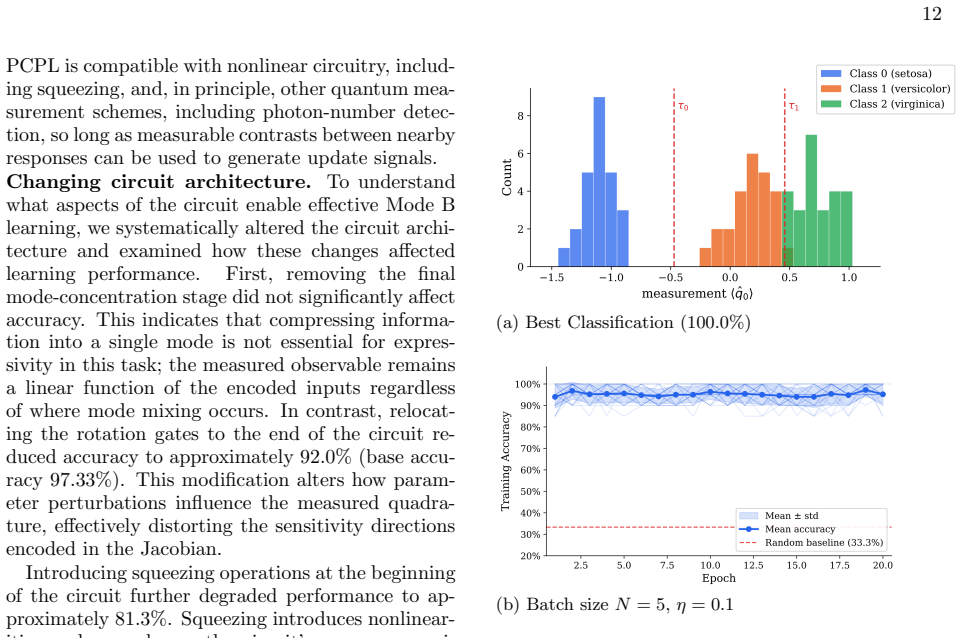
- Continuous-variable photonic circuits can learn classification tasks using only x-quadrature measurements and finite-difference estimates of the Jacobian.
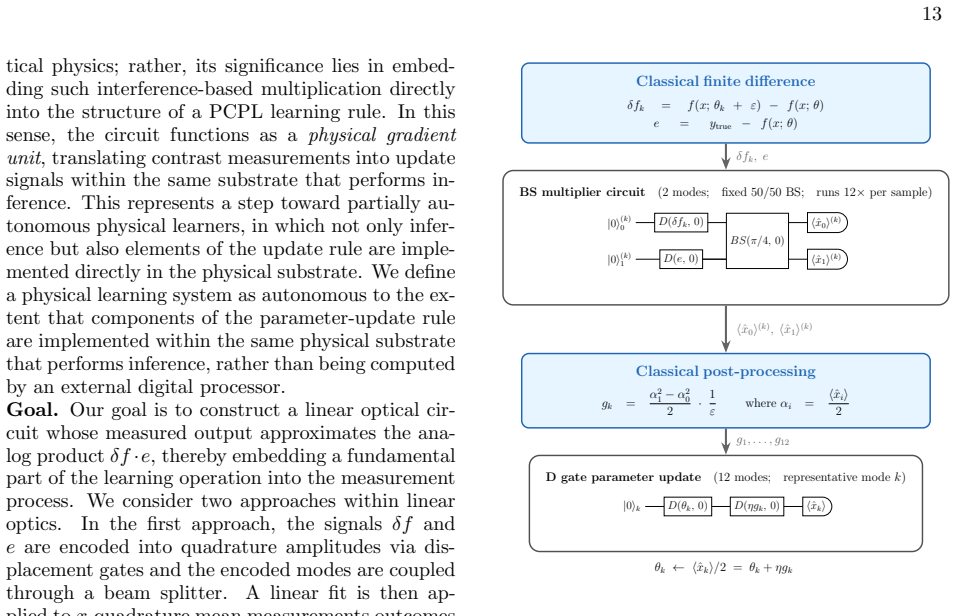
- The same photonic platform can be trained to perform analog multiplication as a concrete computational primitive.
Where Pith is reading between the lines
- The approach could apply to additional physical platforms where local perturbations and measurements are feasible, such as fluidic or electronic circuits.
- If measurement locality holds at larger scales, PCPL might reduce the need for digital interfaces in hybrid physical-digital learning setups.
- The link to inverse-problem structure suggests PCPL could implicitly solve certain optimization tasks that physical systems already encode through their dynamics.
Load-bearing premise
The physical contrasts between states can be measured with enough precision and locality to yield stable updates without any centralized computation or post-processing correction.
What would settle it
A controlled experiment on a spring network or photonic circuit in which measured perturbation contrasts produce learning updates that fail to converge on the target task when realistic measurement noise or limited spatial resolution is present.
Figures




read the original abstract
Responses to perturbations are key to understanding physical systems. The ability to contrast such responses by comparing how a system reacts under slightly different conditions provides a mechanism for learning. Here, we introduce Perturbative Contrastive Physical Learning (PCPL), a general framework in which learning emerges from measurable contrasts between physical states produced by controlled changes to inputs, boundary conditions, parameters, or interpreter functions. PCPL unifies and extends prior approaches: Equilibrium Propagation is rooted in contrasts between free and nudged equilibria in energy-based systems, while Frequency Propagation corresponds to contrasts extracted from sinusoidally driven, frequency-demodulated responses. We show that contrast-driven updates can reflect either local sensitivities or global inverse-problem structure, yet do not require centralized gradient computation. Instead, effective learning geometry emerges implicitly from the system's own physical response, allowing learning behavior to arise without an external processor or explicit backpropagation. We demonstrate PCPL in two platforms: (i) spring networks that update bond stiffness using measured displacements and forces, and (ii) continuous-variable photonic circuits trained via x quadrature measurements and finite-difference estimates of the Jacobian. Both platforms successfully learn classification tasks. We further show that a continuous-variable photonic circuit can be trained to implement analog multiplication, illustrating a step toward more autonomous physical learning systems.
Editorial analysis
A structured set of objections, weighed in public.
Referee Report
Summary. The paper introduces Perturbative Contrastive Physical Learning (PCPL) as a general framework in which learning emerges from measurable contrasts between physical states under controlled perturbations to inputs, boundary conditions, parameters, or interpreter functions. It unifies Equilibrium Propagation (contrasts between free and nudged equilibria) and Frequency Propagation (contrasts from sinusoidally driven responses), arguing that contrast-driven updates can reflect local sensitivities or global inverse-problem structure without requiring centralized gradient computation or an external processor. Demonstrations are provided in spring networks (updating bond stiffness from measured displacements/forces) and continuous-variable photonic circuits (using x-quadrature measurements and finite-difference Jacobian estimates) for classification tasks, plus an analog multiplication task in the photonic platform.
Significance. If the central claim holds—that effective learning geometry can emerge purely from physical responses without external processors or explicit backpropagation—this would provide a unifying perturbative perspective on physical learning systems and could support more autonomous hardware implementations. The unification of existing methods and the extension to photonic multiplication are potentially useful, but the absence of quantitative metrics, error bars, or implementation details in the provided abstract limits assessment of practical impact.
major comments (2)
- [Abstract] Abstract: The central claim that 'effective learning geometry emerges implicitly from the system's own physical response, allowing learning behavior to arise without an external processor or explicit backpropagation' is load-bearing, yet the same paragraph describes 'finite-difference estimates of the Jacobian' from quadrature measurements and 'measured displacements/forces' to produce updates. It is unclear whether these estimates or the subsequent application of parameter changes (bond stiffness, circuit parameters) can be realized without digital post-processing or an external controller; if any such step is required, the 'no external processor' condition fails even if local sensitivities are measured.
- [Abstract] Abstract: The demonstrations are described only as 'successfully learn classification tasks' and 'implement analog multiplication' with no reported accuracy, loss curves, error bars, number of trials, or comparison to baselines. Without these, it is impossible to evaluate whether the contrast-driven updates produce stable, competitive learning or merely demonstrate feasibility under idealized conditions.
minor comments (1)
- [Abstract] The abstract invokes 'global inverse-problem structure' without defining the term or showing how the contrast mechanism encodes it; a brief equation or schematic would clarify the distinction from local sensitivities.
Simulated Author's Rebuttal
We thank the referee for their detailed and constructive comments. We address each major comment below. We have revised the abstract to clarify the scope of the 'no external processor' claim and to include quantitative performance metrics from the demonstrations.
read point-by-point responses
-
Referee: [Abstract] Abstract: The central claim that 'effective learning geometry emerges implicitly from the system's own physical response, allowing learning behavior to arise without an external processor or explicit backpropagation' is load-bearing, yet the same paragraph describes 'finite-difference estimates of the Jacobian' from quadrature measurements and 'measured displacements/forces' to produce updates. It is unclear whether these estimates or the subsequent application of parameter changes (bond stiffness, circuit parameters) can be realized without digital post-processing or an external controller; if any such step is required, the 'no external processor' condition fails even if local sensitivities are measured.
Authors: We agree that the abstract phrasing risks overstating the autonomy of current implementations. The PCPL framework derives updates from physical contrasts without explicit backpropagation, and the learning geometry emerges from the system's response structure. However, the finite-difference Jacobian estimates in the photonic demonstration do require computational post-processing of measured quadratures. We have revised the abstract to state that while contrasts are obtained from physical measurements, some implementations involve limited external computation, and we discuss routes to more fully autonomous realizations in the main text. This revision preserves the core contribution while addressing the concern directly. revision: yes
-
Referee: [Abstract] Abstract: The demonstrations are described only as 'successfully learn classification tasks' and 'implement analog multiplication' with no reported accuracy, loss curves, error bars, number of trials, or comparison to baselines. Without these, it is impossible to evaluate whether the contrast-driven updates produce stable, competitive learning or merely demonstrate feasibility under idealized conditions.
Authors: We concur that the abstract should convey more quantitative evidence. The full manuscript reports classification accuracies, training dynamics, and comparisons to baselines for both platforms, along with error metrics for the analog multiplication task. We have updated the abstract to include representative quantitative results (e.g., achieved accuracies and stability indicators) while remaining within length constraints. revision: yes
Circularity Check
No significant circularity; framework is a conceptual unification with independent demonstrations
full rationale
The paper introduces PCPL as a general framework unifying Equilibrium Propagation and Frequency Propagation through measurable physical contrasts, with demonstrations on spring networks (using measured displacements/forces to update bond stiffness) and photonic circuits (using quadrature measurements and finite-difference Jacobian estimates) that successfully perform classification and analog multiplication. No equations or claims reduce the learning updates to quantities defined by the authors' own prior fits, and the central premise does not rely on load-bearing self-citations or uniqueness theorems imported from overlapping prior work. The derivation chain is self-contained as an organizational generalization supported by explicit physical implementations rather than tautological re-expression of inputs.
Axiom & Free-Parameter Ledger
invented entities (1)
-
Perturbative Contrastive Physical Learning (PCPL) framework
no independent evidence
Reference graph
Works this paper leans on
-
[1]
Gaussian CV photonic (using linear optical gates) circuit This example demonstrates how Mode B PCPL can be implemented in a CV photonic circuit to per- form Iris classification. Classical input features are encoded into Gaussian optical states, and learning proceeds through measurement contrasts that drive pseudoinverse (Gauss–Newton–like) parameter up- d...
-
[2]
(a) Best Classification (100.0%) (b) Batch sizeN= 5,η= 0.1 FIG
Tunable linear optical multiplier: Towards an Autonomous Physical Learner Mode B PCPL requires a local update signal pro- portional to the product of a sensitivity and an error. (a) Best Classification (100.0%) (b) Batch sizeN= 5,η= 0.1 FIG. 5.Classification accuracy via mini-batch pseudoin- verse nudging.(a) distribution of photonic measure- ment outcome...
-
[3]
How does one compute gradients?
The difference of squared direct detection then yields δf ε ·e= α2 1 −α 2 0 2·ε ≈g k,(47) whereg k is the gradient estimate weighted by the er- ror, obtained from intensity measurements or classi- cal post-processing ofx-quadrature outputs, scaled by the fixed perturbation sizeε, so the product (δf /ε)·ecan be recovered directly from the inten- sity measu...
-
[4]
Hebb.The Organization of Behavior: A Neuropsychological Theory
Donald O. Hebb.The Organization of Behavior: A Neuropsychological Theory. Wiley, New York, 1949
1949
-
[5]
Abbott.Theoretical Neu- roscience: Computational and Mathematical Model- ing of Neural Systems
Peter Dayan and Larry F. Abbott.Theoretical Neu- roscience: Computational and Mathematical Model- ing of Neural Systems. MIT Press, Cambridge, MA, 2001
2001
-
[6]
Reid, Tanya Latty, Audrey Dussutour, and Madeleine Beekman
Chris R. Reid, Tanya Latty, Audrey Dussutour, and Madeleine Beekman. Slime mold uses an external- ized spatial memory to navigate in complex envi- ronments.Proceedings of the National Academy of Sciences, 113(47):E7051–E7058, 2016
2016
-
[7]
MIT Press, 2016
Ian Goodfellow, Yoshua Bengio, and Aaron Courville.Deep Learning. MIT Press, 2016
2016
-
[8]
Equilibrium propagation: Bridging the gap between energy- based models and backpropagation.Frontiers in Computational Neuroscience, Volume 11 - 2017, 2017
Benjamin Scellier and Yoshua Bengio. Equilibrium propagation: Bridging the gap between energy- based models and backpropagation.Frontiers in Computational Neuroscience, Volume 11 - 2017, 2017
2017
-
[9]
Wright, Tatsuhiro Onodera, Martin M
Logan G. Wright, Tatsuhiro Onodera, Martin M. Stein, Tianyu Wang, Darren T. Schachter, Zoey Hu, and Peter L. McMahon. Deep physical neu- ral networks trained with backpropagation.Nature, 601(7894):549–555, 2022
2022
-
[10]
Learning without neurons in physical systems.Annual Re- view of Condensed Matter Physics, 14(Volume 14, 2023):417–441, 2023
Menachem Stern and Arvind Murugan. Learning without neurons in physical systems.Annual Re- view of Condensed Matter Physics, 14(Volume 14, 2023):417–441, 2023
2023
-
[11]
Wright, Peter L
Ali Momeni, Babak Rahmani, Benjamin Scellier, Logan G. Wright, Peter L. McMahon, Clara C. Wanjura, Yuhang Li, Anas Skalli, Natalia G. Berloff, Tatsuhiro Onodera, et al. Training of physi- cal neural networks.Nature, 645(8079):53–61, 2025
2025
-
[12]
The hardware is the soft- ware.Neuron, 112(2):180–183, 2024
J´ er´ emie Laydevant, Logan G Wright, Tianyu Wang, and Peter L McMahon. The hardware is the soft- ware.Neuron, 112(2):180–183, 2024
2024
-
[13]
Benjamin Scellier. A deep learning theory for neu- ral networks grounded in physics.arXiv preprint arXiv:2103.09985, 2021
-
[14]
Rocks, and Andrea J
Menachem Stern, Daniel Hexner, Jason W. Rocks, and Andrea J. Liu. Supervised learning in physical networks: From machine learning to learning ma- chines.Physical Review X, 11(2):021045, 2021
2021
-
[15]
Liu, and Vijay Balasubramanian
Menachem Stern, Marcelo Guzman, Felipe Martins, Andrea J. Liu, and Vijay Balasubramanian. Physi- cal networks become what they learn.Physical Re- view Letters, 134(14):147402, 2025
2025
-
[16]
Liu, and Douglas J
Sam Dillavou, Menachem Stern, Andrea J. Liu, and Douglas J. Durian. Demonstration of decentralized physics-driven learning.Physical Review Applied, 18(1):014040, 2022
2022
-
[17]
Altman, Menachem Stern, Andrea J
Lauren E. Altman, Menachem Stern, Andrea J. Liu, and Douglas J. Durian. Experimental demonstra- tion of coupled learning in elastic networks.Phys. Rev. Appl., 22:024053, Aug 2024
2024
-
[18]
Beyer, Menachem Stern, Andrea J
Sam Dillavou, Benjamin D. Beyer, Menachem Stern, Andrea J. Liu, Marc Z. Miskin, and Dou- glas J. Durian. Emergent learning in a nonlin- ear analog network.Proceedings of the National Academy of Sciences, 2024
2024
-
[19]
Vidyesh Rao Anisetti, Benjamin Scellier, and J. M. Schwarz. Learning by non-interfering feedback chemical signaling in physical networks.Physical Review Research, 5:023024, 2023
2023
-
[20]
Vidyesh Rao Anisetti, Ananth Kandala, Benjamin 16 Scellier, and J. M. Schwarz. Frequency propagation: Multimechanism learning in nonlinear physical net- works.Neural Computation, 36(4):596–620, 2024
2024
-
[21]
Falk, Adam T
Martin J. Falk, Adam T. Strupp, Benjamin Scel- lier, and Arvind Murugan. Temporal contrastive learning through implicit non-equilibrium memory. Nature Communications, 16(1):2163, 2025
2025
-
[23]
Wanjura and Florian Marquardt
Clara C. Wanjura and Florian Marquardt. Quan- tum equilibrium propagation for efficient training of quantum systems based on onsager reciprocity. Nature Communications, 16(1):6595, 2025
2025
-
[24]
Menicucci, Timothy C
Mile Gu, Christian Weedbrook, Nicolas C. Menicucci, Timothy C. Ralph, and Peter van Loock. Quantum computing with continuous-variable clus- ters.Physical Review A, 79:062318, 2009
2009
-
[25]
Menicucci, Steven T
Nicolas C. Menicucci, Steven T. Flammia, and Olivier Pfister. One-way quantum computing in the optical frequency comb.Physical Review Letters, 101:130501, 2008
2008
-
[26]
Continuous-variable quantum com- puting in the quantum optical frequency comb
Olivier Pfister. Continuous-variable quantum com- puting in the quantum optical frequency comb. Journal of Physics B: Atomic, Molecular and Op- tical Physics, 53(1):012001, 2020
2020
-
[27]
Bromley, Juan Miguel Arrazola, Maria Schuld, Nicol´ as Quesada, and Seth Lloyd
Nathan Killoran, Thomas R. Bromley, Juan Miguel Arrazola, Maria Schuld, Nicol´ as Quesada, and Seth Lloyd. Continuous-variable quantum neural net- works.Physical Review Research, 1:033063, 2019
2019
-
[28]
Evaluating ana- lytic gradients on quantum hardware.Physical Re- view A, 99:032331, 2019
Maria Schuld, Ville Bergholm, Christian Gogolin, Josh Izaac, and Nathan Killoran. Evaluating ana- lytic gradients on quantum hardware.Physical Re- view A, 99:032331, 2019
2019
-
[29]
Difference target propagation
Dong-Hyun Lee, Saizheng Zhang, Asja Fischer, and Yoshua Bengio. Difference target propagation. In Joint european conference on machine learning and knowledge discovery in databases, pages 498–515. Springer, 2015
2015
-
[30]
Training all- mechanical neural networks for task learning through in situ backpropagation.Nature Commu- nications, 15(1):10528, 2024
Shuailong Li and Xinqiao Mao. Training all- mechanical neural networks for task learning through in situ backpropagation.Nature Commu- nications, 15(1):10528, 2024
2024
-
[31]
Performance evaluation for class center- based missing data imputation algorithm
Heru Nugroho, Nugraha Priya Utama, and Kridanto Surendro. Performance evaluation for class center- based missing data imputation algorithm. InPro- ceedings of the 2020 9th International Conference on Software and Computer Applications, ICSCA ’20, page 36–40, New York, NY, USA, 2020. Association for Computing Machinery
2020
-
[32]
Benjamin Scellier. Quantum equilibrium propaga- tion: Gradient-descent training of quantum sys- tems.arXiv:2406.00879 [quant-ph], 2024
-
[33]
Training precise stress patterns.Soft Matter, 19:2120–2126, 2023
Daniel Hexner. Training precise stress patterns.Soft Matter, 19:2120–2126, 2023
2023
-
[34]
Shabeeb Ameen, Tao Zhang, and J. M. Schwarz. Training cell stress patterns in 3d cellular packings. arXiv preprint arXiv:2604.25439, 2026
work page internal anchor Pith review Pith/arXiv arXiv 2026
-
[35]
Wim Bogaerts, Daniel P´ erez, Jos´ e Capmany, David A. B. Miller, Joyce Poon, Dirk Englund, Francesco Morichetti, and Andrea Melloni. Programmable photonic circuits.Nature, 586(7828):207–216, 2020
2020
-
[36]
S. L. Braunstein and P. van Loock. Quantum infor- mation with continuous variables.Rev. Mod. Phys., 77(2):513, 2005
2005
-
[37]
Bromley, Juan Miguel Arrazola, Maria Schuld, Nicol´ as Quesada, and Seth Lloyd
Nathan Killoran, Thomas R. Bromley, Juan Miguel Arrazola, Maria Schuld, Nicol´ as Quesada, and Seth Lloyd. Continuous-variable quantum neural net- works.Phys. Rev. Res., 1:033063, Oct 2019
2019
-
[38]
Hybrid quantum-classical learning of nonlinear entanglement witnesses via continuous- variable quantum neural networks, 2025
Mohammad Rezaei Shokou and Hossein Davoodi Yeganeh. Hybrid quantum-classical learning of nonlinear entanglement witnesses via continuous- variable quantum neural networks, 2025
2025
-
[39]
Time-series forecasting using contin- uous variables-based quantum neural networks
Prabhat Anand, M Girish Chandra, and Ankit Khandelwal. Time-series forecasting using contin- uous variables-based quantum neural networks. In 2024 16th International Conference on COMmuni- cation Systems & NETworkS (COMSNETS), pages 994–999, 2024
2024
-
[40]
Amanuel Anteneh, Kyungeun Kim, J. M. Schwarz, Israel Klich, and Olivier Pfister. Laser interferome- try as a robust neuromorphic platform for machine learning.arXiv preprint arXiv:2601.18047, 2026. APPENDIX A: MODE B GRADIENT DESCENT VS. PSEUDOINVERSE PERFORMANCE COMP ARISON We compare gradient descent (GD) and the pseu- doinverse update rule on a linear ...
discussion (0)
Sign in with ORCID, Apple, or X to comment. Anyone can read and Pith papers without signing in.