Modified Teukolsky Formalism for Extreme Mass-Ratio Inspirals in Higher-Derivative Gravity
Pith reviewed 2026-06-27 15:37 UTC · model grok-4.3
The pith
A modified Teukolsky formalism computes gravitational wave fluxes from point-particle inspirals in higher-derivative gravity.
A machine-rendered reading of the paper's core claim, the machinery that carries it, and where it could break.
Core claim
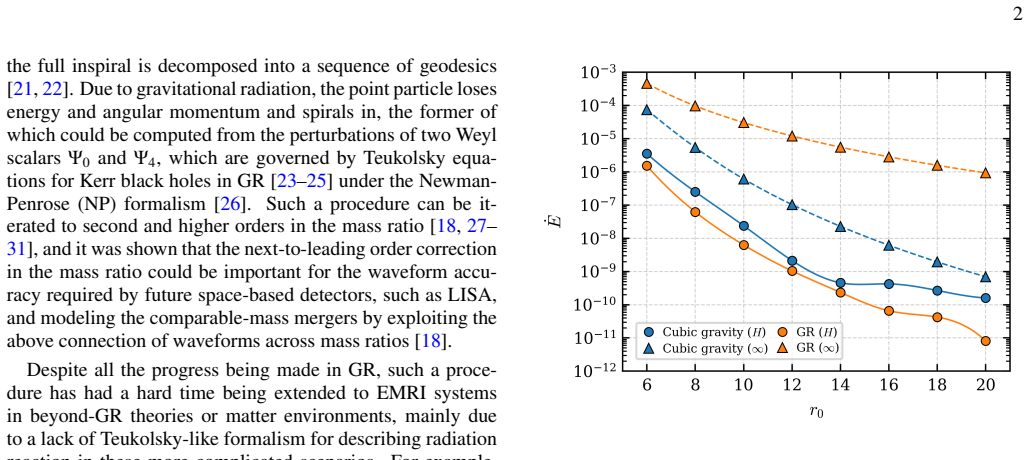
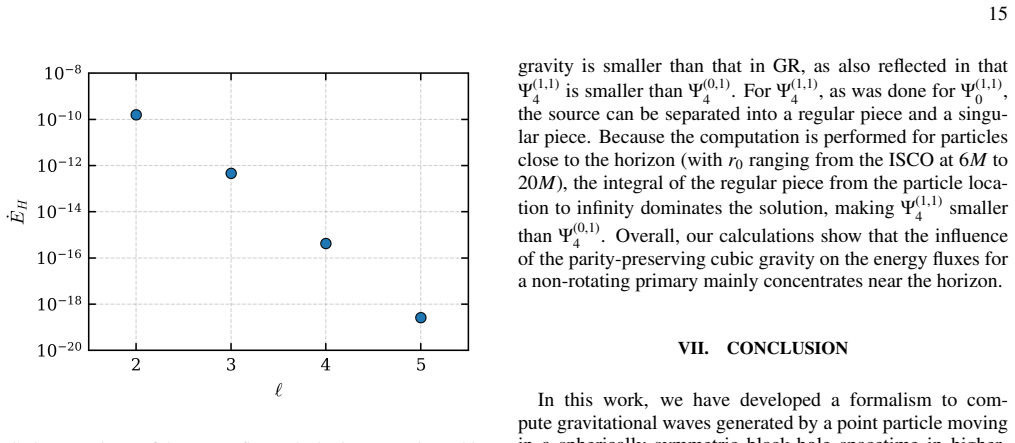
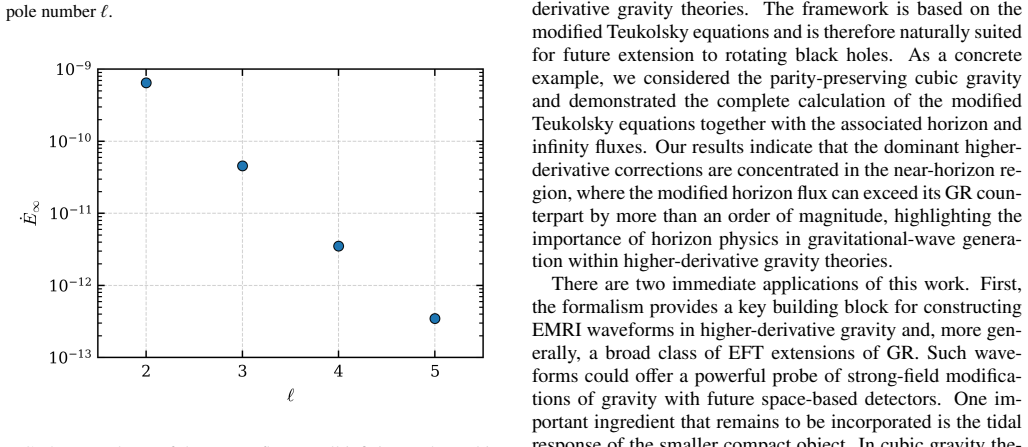
The authors construct a modified Teukolsky equation that remains separable for gravitational perturbations sourced by a point particle on a non-rotating black-hole background in higher-derivative gravity. With this equation they evaluate the resulting fluxes through the horizon and through null infinity for a cubic gravity model. The same framework is formulated so that it extends directly to the rotating case and supplies the essential ingredients for extreme-mass-ratio-inspiral waveforms in modified gravity.
What carries the argument
The modified Teukolsky equation, obtained by incorporating higher-derivative corrections into the wave operator while retaining separability for non-rotating backgrounds.
If this is right
- Energy fluxes to the horizon and to infinity become calculable for point-particle orbits in cubic gravity.
- The separated wave equation extends to rotating black holes without changing its overall structure.
- Extreme-mass-ratio-inspiral waveforms can be assembled in higher-derivative theories using the same perturbative ordering as in general relativity.
- The resulting waveforms admit rescaling to approximate comparable-mass binary signals.
Where Pith is reading between the lines
- LISA observations of extreme-mass-ratio inspirals could place direct bounds on the cubic coupling once these fluxes are converted into phase templates.
- The same modification procedure may apply to other higher-derivative terms beyond the cubic example.
- Comparison of the modified fluxes with general-relativity results would quantify how higher-derivative corrections alter the rate of energy loss.
Load-bearing premise
Higher-derivative gravity still allows a separable wave equation for metric perturbations around a non-rotating black-hole background that can be sourced by a point particle.
What would settle it
Numerical integration of the modified Teukolsky equation for a specific cubic gravity parameter set followed by direct comparison of the extracted horizon and infinity fluxes against an independent numerical-relativity evolution of the same point-particle trajectory.
Figures
read the original abstract
In this work, we study a model problem involving a point particle inspiraling into a non-rotating black hole in higher-derivative theories of gravity. In such theories, both the background spacetime and the generation and propagation of gravitational waves differ from those in General Relativity. We develop a modified Teukolsky formalism to describe gravitational waves sourced by the point particle and, as an illustrative example, compute the resulting fluxes to the black hole horizon and null infinity for a cubic gravity theory. The formalism is constructed in a way that can be naturally extended to rotating black holes. These results represent essential steps to build extreme mass-ratio-inspiral waveforms in modified gravity theories, which may also be rescaled to approximate waveforms from comparable-mass binary black hole systems, analogous to existing approaches in General Relativity.
Editorial analysis
A structured set of objections, weighed in public.
Referee Report
Summary. The manuscript develops a modified Teukolsky formalism for gravitational waves sourced by a point particle inspiraling into a non-rotating black hole in higher-derivative gravity. For a cubic gravity theory as an illustrative example, it derives a modified master equation, demonstrates separability in spherical coordinates, and computes the resulting energy fluxes to the horizon and null infinity. The construction is designed to extend naturally to rotating black holes and to support EMRI waveform modeling in modified gravity, with potential rescaling to comparable-mass binaries.
Significance. If the derivation holds, the work supplies a concrete, separable master equation and flux computation procedure that directly addresses the need for EMRI waveforms beyond GR. The explicit construction from the cubic action, retention of the standard point-particle sourcing, and absence of internal contradictions in the perturbative ordering constitute a load-bearing advance for testing gravity with future detectors.
minor comments (2)
- [§4] §4 (or equivalent section containing the flux integrals): the normalization of the modified radial functions relative to the GR Teukolsky case is not stated explicitly; adding a short comparison paragraph would clarify how the flux formulas reduce when the higher-derivative coefficients vanish.
- [Conclusions] The abstract states that the formalism 'can be naturally extended to rotating black holes,' yet the manuscript contains no explicit outline of the additional steps required; a brief roadmap paragraph in the conclusions would strengthen the claim without altering the non-rotating calculation.
Simulated Author's Rebuttal
We thank the referee for the positive assessment of our work and the recommendation for minor revision. No major comments were provided in the report.
Circularity Check
No significant circularity in the derivation chain
full rationale
The paper constructs a modified Teukolsky formalism directly from the higher-derivative gravity action for a non-rotating black hole with a point particle source. It derives the master equation, demonstrates separability in spherical coordinates, and computes energy fluxes without relying on fitted parameters or self-citations that reduce the central result to its inputs by construction. The illustrative computation for cubic gravity follows from the perturbative ordering in the theory, making the derivation self-contained against external benchmarks.
Axiom & Free-Parameter Ledger
Reference graph
Works this paper leans on
-
[1]
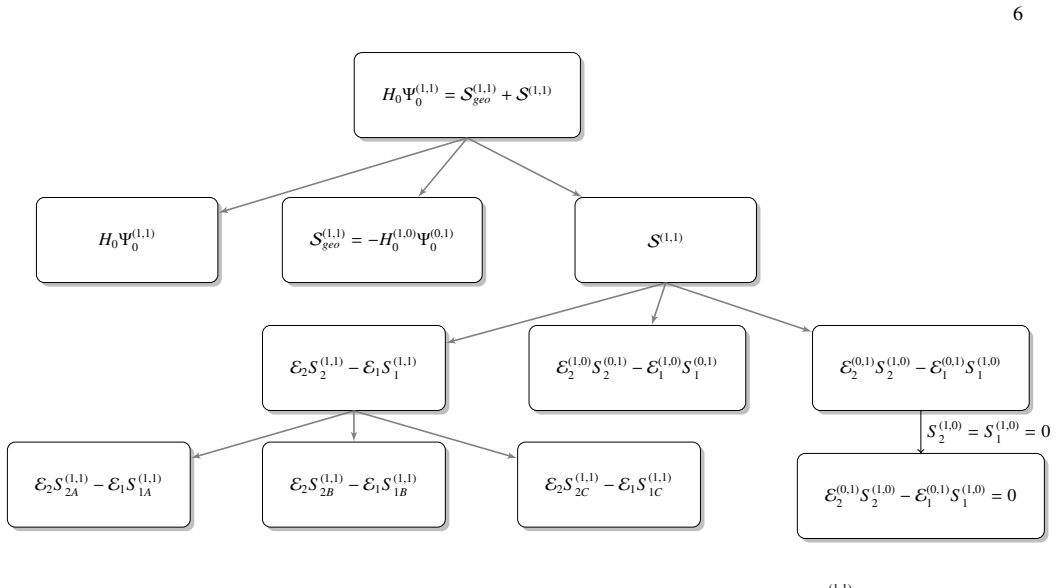
¯δ[−4] −δ [2] ¯δ(1,0) [−4] −3Ψ (1,0) 2 ,(A9) while different parts of the source termS(1,1) driven by the stress-energy tensor are E(1,0) 2 S (0,1) 2 − E(1,0) 1 S (0,1) 1 = h D(1,0) [−2,−2] −D Ψ−1 2 Ψ(1,0) 2 −Ψ −1 2 D(1,0)Ψ2 i δ[2]Φ(0,1) 01 −D [0,−1]Φ(0,1) 02 −δ (1,0) [2] δΦ(0,1) 00 −D [−2,−2]Φ(0,1) 01 ,(A10a) E2S (1,1) 2A − E1S (1,1) 1A =D [−5] −¯λ(0,1)Φ...
-
[2]
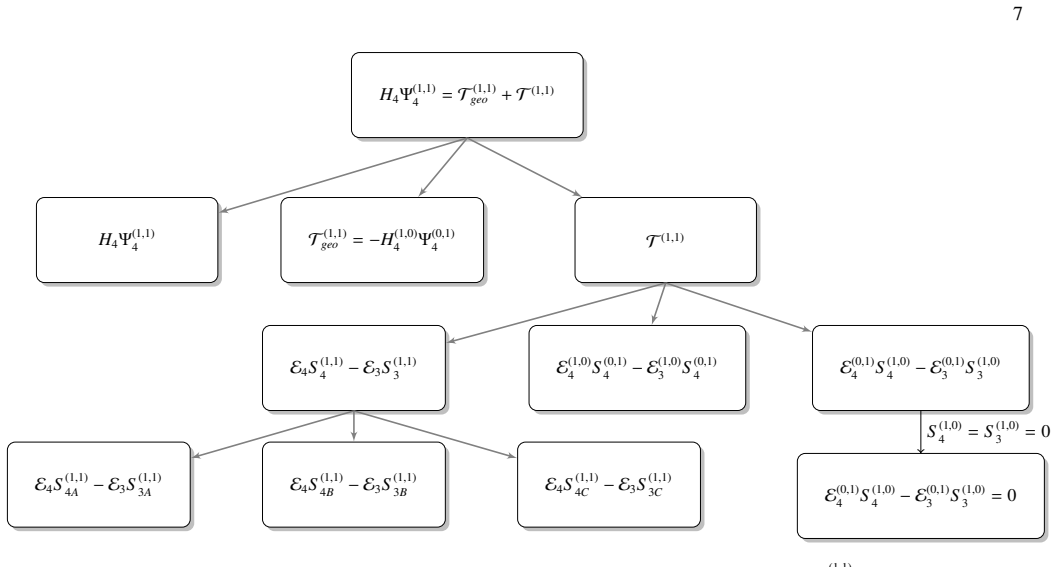
Φ(0,1) 01 −D (1,0) [−1]Φ(0,1) 02 −δ [2] δ(1,0)Φ(0,1) 00 −D (1,0) [−2]Φ(0,1) 01 ,(A10c) E2S (1,1) 2C − E1S (1,1) 1C =D [−5] δ[2]Φ(1,1) 01 −D [−1]Φ(1,1) 02 −δ [2] δΦ(1,1) 00 −D [−2]Φ(1,1) 01 .(A10d) Similarly, as illustrated in Fig. 3, the modified Teukolsky equation ofΨ(1,1) 4 is H4Ψ(1,1) 4 =T (1,1) geo +T (1,1) ,(A11) where the operatorH 4 is H4 = ∆[5]D[4...
-
[3]
−∆ Ψ−1 2 Ψ(1,0) 2 −Ψ −1 2 ∆(1,0)Ψ2 i D[4,−1] + ∆[5]D(1,0) [4,−1] − ¯δ(1,0)
-
[4]
δ[−4] − ¯δ[2]δ(1,0) [−4] −3Ψ (1,0) 2 .(A13) The different parts of the source termT(1,1) driven by the stress-energy tensor are E(1,0) 4 S (0,1) 4 − E(1,0) 3 S (0,1) 3 = h ∆(1,0)
-
[5]
−∆ Ψ−1 2 Ψ(1,0) 2 −Ψ −1 2 ∆(1,0)Ψ2 i ¯δ[2]Φ(0,1) 21 −∆ [1]Φ(0,1) 20 − ¯δ(1,0) [2] ¯δΦ(0,1) 22 −∆ [2]Φ(0,1) 21 ,(A14a) E4S (1,1) 4A − E3S (1,1) 3A = ∆[5] −2λ(0,1)Φ(1,0) 11 +¯σ(0,1)Φ(1,0) 22 − ¯δ[−4] ¯δ(0,1) [2,2,0,−1]Φ(1,0) 22 +2ν (0,1)Φ(1,0) 11 ,(A14b) E4S (1,1) 4B − E3S (1,1) 3B = ∆[5] ¯δ(1,0)
-
[6]
Φ(0,1) 20 − ¯δ[−4] ¯δ(1,0)Φ(0,1) 22 −∆ (1,0)
-
[7]
−r−2M 4M + (r−2M) 2 8M 2 − (r−2M) 3 16M 3 +O (r−2M) 4 # ∂2 r +
Φ(0,1) 21 ,(A14c) E4S (1,1) 4C − E3S (1,1) 3C = ∆[5] ¯δ[−4]Φ(1,1) 21 −∆ [1]Φ(1,1) 20 − ¯δ[−4] ¯δΦ(1,1) 22 −∆ [2]Φ(1,1) 21 .(A14d) 18 Appendix B: Logarithmic gauge artifacts in the asymptotic expansion In this appendix, we provide an intuitive explanation for the divergence of the source terms by examining the asymptotic structure of the modified Teukolsky...
-
[8]
G. Papallo and H. S. Reall, On the local well-posedness of Lovelock and Horndeski theories, Phys. Rev. D96, 044019 (2017), arXiv:1705.04370 [gr-qc]
Pith/arXiv arXiv 2017
-
[9]
J. L. Ripley and F. Pretorius, Hyperbolicity in Spherical Gravitational Collapse in a Horndeski Theory, Phys. Rev. D99, 084014 (2019), arXiv:1902.01468 [gr-qc]
arXiv 2019
-
[10]
Papallo, On the hyperbolicity of the most general Horndeski theory, Phys
G. Papallo, On the hyperbolicity of the most general Horndeski theory, Phys. Rev. D96, 124036 (2017), arXiv:1710.10155 [gr-qc]
Pith/arXiv arXiv 2017
-
[11]
J. Cayuso, N. Ortiz, and L. Lehner, Fixing extensions to general relativity in the nonlinear regime, Phys. Rev. D96, 084043 (2017), arXiv:1706.07421 [gr-qc]
Pith/arXiv arXiv 2017
-
[12]
´A. D. Kov´acs and H. S. Reall, Well-Posed Formulation of Scalar-Tensor Effective Field Theory, Phys. Rev. Lett.124, 221101 (2020), arXiv:2003.04327 [gr-qc]
arXiv 2020
-
[13]
W. E. East and J. L. Ripley, Evolution of Einstein-scalar-Gauss-Bonnet gravity using a modified harmonic formulation, Phys. Rev. D 103, 044040 (2021), arXiv:2011.03547 [gr-qc]
arXiv 2021
-
[14]
Latt `es and J.-L
R. Latt `es and J.-L. Lions,The Method of Quasi-Reversibility: Applications to Partial Differential Equations(Elsevier, 1969)
1969
-
[15]
Israel and J
W. Israel and J. M. Stewart, Transient relativistic thermodynamics and kinetic theory, Annals of Physics118, 341 (1979)
1979
-
[16]
Tr `eves,Topological Vector Spaces, Distributions and Kernels(Academic Press, 1967)
F. Tr `eves,Topological Vector Spaces, Distributions and Kernels(Academic Press, 1967)
1967
-
[17]
Gottlieb and S
D. Gottlieb and S. A. Orszag,Numerical Analysis of Spectral Methods: Theory and Applications(SIAM, 1977)
1977
-
[18]
J. P. Boyd,Chebyshev and Fourier Spectral Methods(Dover Publications, Mineola, New York, 2001) Chap. 11
2001
-
[19]
T. Damour, Gravitational Self Force in a Schwarzschild Background and the Effective One Body Formalism, Phys. Rev. D81, 024017 (2010), arXiv:0910.5533 [gr-qc]
Pith/arXiv arXiv 2010
-
[20]
A. Le Tiec, A. H. Mroue, L. Barack, A. Buonanno, H. P. Pfeiffer, N. Sago, and A. Taracchini, Periastron Advance in Black Hole Binaries, Phys. Rev. Lett.107, 141101 (2011), arXiv:1106.3278 [gr-qc]
Pith/arXiv arXiv 2011
-
[21]
S. Akcay, L. Barack, T. Damour, and N. Sago, Gravitational self-force and the effective-one-body formalism between the innermost stable circular orbit and the light ring, Phys. Rev. D86, 104041 (2012), arXiv:1209.0964 [gr-qc]
Pith/arXiv arXiv 2012
-
[22]
N. E. M. Rifat, S. E. Field, G. Khanna, and V . Varma, Surrogate model for gravitational wave signals from comparable and large-mass- ratio black hole binaries, Phys. Rev. D101, 081502 (2020), arXiv:1910.10473 [gr-qc]
arXiv 2020
-
[23]
M. van de Meent and H. P. Pfeiffer, Intermediate mass-ratio black hole binaries: Applicability of small mass-ratio perturbation theory, Phys. Rev. Lett.125, 181101 (2020), arXiv:2006.12036 [gr-qc]
arXiv 2020
-
[24]
T. Islam, S. E. Field, S. A. Hughes, G. Khanna, V . Varma, M. Giesler, M. A. Scheel, L. E. Kidder, and H. P. Pfeiffer, Surrogate model for gravitational wave signals from nonspinning, comparable-to large-mass-ratio black hole binaries built on black hole perturbation theory waveforms calibrated to numerical relativity, Phys. Rev. D106, 104025 (2022), arXi...
arXiv 2022
-
[25]
B. Wardell, A. Pound, N. Warburton, J. Miller, L. Durkan, and A. Le Tiec, Gravitational Waveforms for Compact Binaries from Second- Order Self-Force Theory, Phys. Rev. Lett.130, 241402 (2023), arXiv:2112.12265 [gr-qc]
arXiv 2023
-
[26]
K. Rink, R. Bachhar, T. Islam, N. E. M. Rifat, K. Gonzalez-Quesada, S. E. Field, G. Khanna, S. A. Hughes, and V . Varma, Gravitational wave surrogate model for spinning, intermediate mass ratio binaries based on perturbation theory and numerical relativity, Phys. Rev. D 110, 124069 (2024), arXiv:2407.18319 [gr-qc]
Pith/arXiv arXiv 2024
-
[27]
A. G. Abacet al.(LIGO Scientific, VIRGO, KAGRA), GWTC-4.0: Tests of General Relativity. I. Overview and General Tests (2026), arXiv:2603.19019 [gr-qc]
Pith/arXiv arXiv 2026
-
[28]
S. A. Hughes, The Evolution of circular, nonequatorial orbits of Kerr black holes due to gravitational wave emission, Phys. Rev. D61, 084004 (2000), [Erratum: Phys.Rev.D 63, 049902 (2001), Erratum: Phys.Rev.D 65, 069902 (2002), Erratum: Phys.Rev.D 67, 089901 (2003), Erratum: Phys.Rev.D 78, 109902 (2008), Erratum: Phys.Rev.D 90, 109904 (2014)], arXiv:gr-qc/9910091
Pith/arXiv arXiv 2000
-
[29]
T. Hinderer and E. E. Flanagan, Two timescale analysis of extreme mass ratio inspirals in Kerr. I. Orbital Motion, Phys. Rev. D78, 064028 (2008), arXiv:0805.3337 [gr-qc]
Pith/arXiv arXiv 2008
-
[30]
S. A. Teukolsky, Perturbations of a rotating black hole. 1. Fundamental equations for gravitational electromagnetic and neutrino field perturbations, Astrophys. J.185, 635 (1973)
1973
-
[31]
W. H. Press and S. A. Teukolsky, Perturbations of a Rotating Black Hole. II. Dynamical Stability of the Kerr Metric, Astrophys. J.185, 649 (1973)
1973
-
[32]
S. A. Teukolsky and W. H. Press, Perturbations of a rotating black hole. III - Interaction of the hole with gravitational and electromagnetic radiation, Astrophys. J.193, 443 (1974)
1974
-
[33]
Newman and R
E. Newman and R. Penrose, An Approach to gravitational radiation by a method of spin coefficients, J. Math. Phys.3, 566 (1962)
1962
-
[34]
M. Campanelli and C. O. Lousto, Second order gauge invariant gravitational perturbations of a Kerr black hole, Phys. Rev. D59, 124022 (1999), arXiv:gr-qc/9811019
Pith/arXiv arXiv 1999
-
[35]
L. Barack and C. O. Lousto, Perturbations of Schwarzschild black holes in the Lorenz gauge: Formulation and numerical implementa- tion, Phys. Rev. D72, 104026 (2005), arXiv:gr-qc/0510019
Pith/arXiv arXiv 2005
-
[36]
L. Barack and N. Sago, Gravitational self force on a particle in circular orbit around a Schwarzschild black hole, Phys. Rev. D75, 064021 (2007), arXiv:gr-qc/0701069
Pith/arXiv arXiv 2007
- [37]
-
[38]
R. Panosso Macedo, P. Bourg, A. Pound, and S. D. Upton, Multidomain spectral method for self-force calculations, Phys. Rev. D110, 084008 (2024), arXiv:2404.10083 [gr-qc]
arXiv 2024
-
[39]
A. Z. Petrov, The Classification of spaces defining gravitational fields, Gen. Rel. Grav.32, 1661 (2000)
2000
-
[40]
C. B. Owen, N. Yunes, and H. Witek, Petrov type, principal null directions, and Killing tensors of slowly rotating black holes in quadratic gravity, Phys. Rev. D103, 124057 (2021), arXiv:2103.15891 [gr-qc]
arXiv 2021
-
[41]
D. Li, P. Wagle, Y . Chen, and N. Yunes, Perturbations of Spinning Black Holes beyond General Relativity: Modified Teukolsky Equation, Phys. Rev. X13, 021029 (2023), arXiv:2206.10652 [gr-qc]
arXiv 2023
-
[42]
A. Hussain and A. Zimmerman, Approach to computing spectral shifts for black holes beyond Kerr, Phys. Rev. D106, 104018 (2022), arXiv:2206.10653 [gr-qc]
arXiv 2022
-
[43]
V . Cardoso, M. Kimura, A. Maselli, and L. Senatore, Black Holes in an Effective Field Theory Extension of General Relativity, Phys. Rev. Lett.121, 251105 (2018), arXiv:1808.08962 [gr-qc]
arXiv 2018
-
[44]
C. de Rham, J. Francfort, and J. Zhang, Black Hole Gravitational Waves in the Effective Field Theory of Gravity, Phys. Rev. D102, 024079 (2020), arXiv:2005.13923 [hep-th]
arXiv 2020
-
[45]
P. A. Cano and A. Ruip ´erez, Leading higher-derivative corrections to Kerr geometry, JHEP05, 189, [Erratum: JHEP 03, 187 (2020)], arXiv:1901.01315 [gr-qc]
arXiv 2020
-
[46]
P. A. Cano, K. Fransen, and T. Hertog, Ringing of rotating black holes in higher-derivative gravity, Phys. Rev. D102, 044047 (2020), arXiv:2005.03671 [gr-qc]
arXiv 2020
-
[47]
P. A. Cano, K. Fransen, T. Hertog, and S. Maenaut, Gravitational ringing of rotating black holes in higher-derivative gravity, Phys. Rev. D105, 024064 (2022), arXiv:2110.11378 [gr-qc]
arXiv 2022
-
[48]
P. A. Cano, K. Fransen, T. Hertog, and S. Maenaut, Universal Teukolsky equations and black hole perturbations in higher-derivative gravity, Phys. Rev. D108, 024040 (2023), arXiv:2304.02663 [gr-qc]
arXiv 2023
-
[49]
P. A. Cano, K. Fransen, T. Hertog, and S. Maenaut, Quasinormal modes of rotating black holes in higher-derivative gravity, Phys. Rev. D108, 124032 (2023), arXiv:2307.07431 [gr-qc]
arXiv 2023
-
[50]
Alty, The Generalized Gauss-Bonnet-Chern theorem, J.Math.Phys.36, 3094 (1995)
L. Alty, The Generalized Gauss-Bonnet-Chern theorem, J.Math.Phys.36, 3094 (1995)
1995
-
[51]
P. Pani and V . Cardoso, Are black holes in alternative theories serious astrophysical candidates? The Case for Einstein-Dilaton-Gauss- Bonnet black holes, Phys. Rev. D79, 084031 (2009), arXiv:0902.1569 [gr-qc]
Pith/arXiv arXiv 2009
-
[52]
J. L. Bl ´azquez-Salcedo, C. F. B. Macedo, V . Cardoso, V . Ferrari, L. Gualtieri, F. S. Khoo, J. Kunz, and P. Pani, Perturbed black holes in Einstein-dilaton-Gauss-Bonnet gravity: Stability, ringdown, and gravitational-wave emission, Phys. Rev. D94, 104024 (2016), arXiv:1609.01286 [gr-qc]
arXiv 2016
-
[53]
J. L. Bl ´azquez-Salcedo, F. S. Khoo, and J. Kunz, Quasinormal modes of Einstein-Gauss-Bonnet-dilaton black holes, Phys. Rev. D96, 064008 (2017), arXiv:1706.03262 [gr-qc]
Pith/arXiv arXiv 2017
-
[54]
A. K.-W. Chung and N. Yunes, Quasinormal mode frequencies and gravitational perturbations of black holes with any subextremal spin in modified gravity through METRICS: The scalar-Gauss-Bonnet gravity case, Phys. Rev. D110, 064019 (2024), arXiv:2406.11986 [gr-qc]
arXiv 2024
-
[55]
R. Jackiw and S. Y . Pi, Chern-Simons modification of general relativity, Phys. Rev. D68, 104012 (2003), arXiv:gr-qc/0308071
Pith/arXiv arXiv 2003
-
[56]
N. Yunes and C. F. Sopuerta, Perturbations of Schwarzschild Black Holes in Chern-Simons Modified Gravity, Phys. Rev. D77, 064007 (2008), arXiv:0712.1028 [gr-qc]
Pith/arXiv arXiv 2008
-
[57]
S. Alexander and N. Yunes, Chern-Simons Modified General Relativity, Phys. Rept.480, 1 (2009), arXiv:0907.2562 [hep-th]
Pith/arXiv arXiv 2009
-
[58]
N. Yunes and F. Pretorius, Dynamical Chern-Simons Modified Gravity. I. Spinning Black Holes in the Slow-Rotation Approximation, Phys. Rev. D79, 084043 (2009), arXiv:0902.4669 [gr-qc]
Pith/arXiv arXiv 2009
-
[59]
V . Cardoso and L. Gualtieri, Perturbations of Schwarzschild black holes in Dynamical Chern-Simons modified gravity, Phys. Rev. D 80, 064008 (2009), [Erratum: Phys.Rev.D 81, 089903 (2010)], arXiv:0907.5008 [gr-qc]
Pith/arXiv arXiv 2009
-
[60]
C. Molina, P. Pani, V . Cardoso, and L. Gualtieri, Gravitational signature of Schwarzschild black holes in dynamical Chern-Simons gravity, Phys. Rev. D81, 124021 (2010), arXiv:1004.4007 [gr-qc]
Pith/arXiv arXiv 2010
-
[61]
P. Pani, V . Cardoso, and L. Gualtieri, Gravitational waves from extreme mass-ratio inspirals in Dynamical Chern-Simons gravity, Phys. Rev. D83, 104048 (2011), arXiv:1104.1183 [gr-qc]
Pith/arXiv arXiv 2011
- [62]
-
[63]
M. Srivastava, Y . Chen, and S. Shankaranarayanan, Analytical computation of quasinormal modes of slowly rotating black holes in dynamical Chern-Simons gravity, Phys. Rev. D104, 064034 (2021), arXiv:2106.06209 [gr-qc]
arXiv 2021
- [64]
-
[65]
D. Li, P. Wagle, Y . Chen, and N. Yunes, Perturbations of spinning black holes in dynamical Chern-Simons gravity: Slow rotation quasinormal modes (2025), arXiv:2503.15606 [gr-qc]
arXiv 2025
-
[66]
D. Li, A. Hussain, P. Wagle, Y . Chen, N. Yunes, and A. Zimmerman, Isospectrality breaking in the Teukolsky formalism, Phys. Rev. D 109, 104026 (2024), arXiv:2310.06033 [gr-qc]
arXiv 2024
-
[67]
F. Aly, M. A. Mansour, L. Lehner, D. Stojkovic, D. Li, and P. Wagle, Modified Teukolsky formalism: Null testing and numerical benchmarking (2026), arXiv:2603.01456 [gr-qc]
arXiv 2026
-
[68]
D. Li, C. Weller, P. Bourg, M. LaHaye, N. Yunes, and H. Yang, Extreme mass-ratio inspiral within an ultralight scalar cloud: Scalar radiation, Phys. Rev. D112, 084057 (2025), arXiv:2507.02045 [gr-qc]
arXiv 2025
-
[69]
R. Keijzer, S. Maenaut, H. Inchausp´e, and T. Hertog, Relativistic signatures of scalar dark matter in extreme-mass-ratio inspirals (2026), arXiv:2604.11893 [gr-qc]
Pith/arXiv arXiv 2026
-
[70]
L. Polcar and V . Witzany, Toward relativistic inspirals into black holes surrounded by matter, Phys. Rev. D112, 104003 (2025), arXiv:2507.15720 [gr-qc]. 24
arXiv 2025
- [71]
-
[72]
S. W. Hawking and J. B. Hartle, Energy and angular momentum flow into a black hole, Commun. Math. Phys.27, 283 (1972)
1972
-
[73]
Black Hole Perturbation Toolkit, (bhptoolkit.org)
-
[74]
S. Aksteiner, L. Andersson, and T. B ¨ackdahl, New identities for linearized gravity on the Kerr spacetime, Phys. Rev. D99, 044043 (2019), arXiv:1601.06084 [gr-qc]
Pith/arXiv arXiv 2019
-
[75]
B. Wardell, C. Kavanagh, and S. R. Dolan, Sourced metric perturbations of Kerr spacetime in Lorenz gauge (2024), arXiv:2406.12510 [gr-qc]
arXiv 2024
-
[76]
S. R. Green, S. Hollands, and P. Zimmerman, Teukolsky formalism for nonlinear Kerr perturbations, Class. Quant. Grav.37, 075001 (2020), arXiv:1908.09095 [gr-qc]
arXiv 2020
-
[77]
V . Toomani, P. Zimmerman, A. Spiers, S. Hollands, A. Pound, and S. R. Green, New metric reconstruction scheme for gravitational self-force calculations, Class. Quant. Grav.39, 015019 (2022), arXiv:2108.04273 [gr-qc]
arXiv 2022
-
[78]
S. Hollands and V . Toomani, Metric reconstruction in Kerr spacetime, Class. Quant. Grav.43, 055001 (2026), arXiv:2405.18604 [gr-qc]
arXiv 2026
-
[79]
S. R. Dolan, C. Kavanagh, and B. Wardell, Gravitational Perturbations of Rotating Black Holes in Lorenz Gauge, Phys. Rev. Lett.128, 151101 (2022), arXiv:2108.06344 [gr-qc]
arXiv 2022
-
[80]
S. R. Dolan, L. Durkan, C. Kavanagh, and B. Wardell, Metric perturbations of Kerr spacetime in Lorenz gauge: circular equatorial orbits, Class. Quant. Grav.41, 155011 (2024), arXiv:2306.16459 [gr-qc]
arXiv 2024
discussion (0)
Sign in with ORCID, Apple, or X to comment. Anyone can read and Pith papers without signing in.