Distribution of Majorana modes in the extended-range Kitaev chain
Pith reviewed 2026-06-27 14:32 UTC · model grok-4.3
The pith
Extended Kitaev chains develop one distinct topological phase for each coupled neighboring site in truncated range.
A machine-rendered reading of the paper's core claim, the machinery that carries it, and where it could break.
Core claim
In the truncated-range scenario, there are as many distinct topological phases as the number of coupled neighboring sites. An explicit analytical formulation is provided to evaluate the topological invariant and the phase transitions that emerge in these systems. The spatial distribution of the edge modes, quantified by the Majorana average position, correlates directly with the occupation of edge-to-edge non-local fermion states and with changes in the ground-state fermion parity.
What carries the argument
The topological winding number (preserved under algebraic decay of pairing and hopping) together with the Majorana average position that measures the spatial spread of zero-energy edge modes.
If this is right
- The count of topological phases rises directly with the number of retained neighbors.
- Phase boundaries can be located by solving the analytical winding-number expression without diagonalizing the full Hamiltonian.
- The Majorana average position localizes or delocalizes exactly when the effective edge parity flips.
- Ground-state fermion parity switches are accompanied by measurable changes in edge-mode occupation numbers.
Where Pith is reading between the lines
- Varying the cutoff range offers a direct experimental knob to set the number of protected edge modes in a nanowire.
- The parity-position correlation could be used as an alternative signature of topological order when energy spectroscopy is noisy.
- The same counting and distribution analysis may apply to other one-dimensional models with power-law interactions once the winding number is preserved.
Load-bearing premise
The pairing and hopping terms decay algebraically with distance, and the winding number stays well-defined and unchanged when the range is extended.
What would settle it
A numerical diagonalization of a finite-range extended Kitaev chain that finds a number of topological phases different from the number of coupled neighbors would disprove the central counting claim.
Figures





read the original abstract
The topological properties of the Kitaev chain model with extended-range interactions are investigated, focusing on cases where the topological winding number is preserved. We assume that the pairing and hopping terms decay algebraically in space with exponents $\alpha$ and $\beta$, respectively. We show that in the truncated-range scenario, there are as many distinct topological phases as the number of coupled neighboring sites. In addition, an explicit analytical formulation is provided to evaluate the topological invariant and the phase transitions that emerge in these systems. Besides the analytical description, we introduce a new physical insight into the topological excitations of the ground-state by measuring the spatial distribution of the edge modes with the Majorana average position. Taking the next-nearest neighbor Kitaev chains as a probe, various numerical calculations of Majorana edge states were performed in finite-size clusters to determine the sensitivity of the topological zero energy modes to the parameters of interest. The occupation of edge-to-edge non-local fermion states is computed and defined as an effective parity. Such an effective parity exhibits new interesting features beyond the energetic exchange from the ground-state fermion parity switches, which are related to the distribution of the respective edge modes. Our calculations show a direct correlation between the ground-state fermion parity and the edge occupation numbers, which are translated into localization and delocalization of the Majorana average position.
Editorial analysis
A structured set of objections, weighed in public.
Referee Report
Summary. The manuscript studies the Kitaev chain with algebraically decaying hopping (exponent β) and pairing (exponent α) terms, restricting attention to parameter regimes in which the standard winding number remains the topological invariant. It claims that, in the truncated-range case, the number of distinct topological phases equals the number of coupled neighboring sites, supplies an explicit analytical expression for the invariant and the associated phase boundaries, and introduces the Majorana average position as a diagnostic of edge-mode localization. Numerical results on finite clusters for the next-nearest-neighbor truncation are used to relate ground-state fermion parity, effective edge parity, and the spatial distribution of the Majorana modes.
Significance. If the preservation of the winding number is placed on a firm footing with explicit bounds on α and β, the work would provide a systematic counting of topological phases in extended-range Kitaev models together with a new, physically motivated observable for Majorana edge-state distribution. The analytical formulation and the parity–localization correlation are potentially useful for both theory and numerics in long-range topological superconductors.
major comments (1)
- [Abstract] Abstract (and the central claim): the assertion that the truncated-range model supports exactly as many topological phases as the number of coupled neighbors rests on the preservation of the conventional winding number. No explicit bounds on the decay exponents α and β are supplied. For α, β ≲ 2 the long-range tails are known to alter correlation decay and can invalidate the standard bulk-boundary correspondence; without a stated range of validity the claimed phase count does not necessarily follow from the usual winding-number formula.
minor comments (2)
- The definition and normalization of the “Majorana average position” should be stated explicitly (including any averaging procedure over the two Majorana components) so that the numerical results can be reproduced.
- The manuscript should clarify whether the effective parity is computed from the full many-body ground state or from the single-particle BdG spectrum, and how finite-size effects are controlled when relating parity switches to the Majorana average position.
Simulated Author's Rebuttal
We thank the referee for the careful reading and for highlighting the need to strengthen the statement on the validity of the winding number. We agree that explicit bounds on α and β are required and will revise the manuscript to address this point directly.
read point-by-point responses
-
Referee: [Abstract] Abstract (and the central claim): the assertion that the truncated-range model supports exactly as many topological phases as the number of coupled neighbors rests on the preservation of the conventional winding number. No explicit bounds on the decay exponents α and β are supplied. For α, β ≲ 2 the long-range tails are known to alter correlation decay and can invalidate the standard bulk-boundary correspondence; without a stated range of validity the claimed phase count does not necessarily follow from the usual winding-number formula.
Authors: We agree that the central claim requires a clear statement of the regime in which the conventional winding number remains the topological invariant. The manuscript already restricts attention to cases where this invariant is preserved, but we did not supply explicit bounds. In the revised version we will (i) add a sentence to the abstract specifying the range of validity and (ii) insert a short paragraph (with citations) in the introduction that recalls the known conditions under which the bulk-boundary correspondence holds for algebraically decaying Kitaev chains (typically α, β > 2). For the truncated-range models that form the core of the work, the interactions are strictly finite-range after truncation, so the standard winding-number formula applies without qualification once the truncation is imposed. We will also clarify that the algebraic exponents α and β enter only through the choice of which neighbors are retained before truncation. revision: yes
Circularity Check
No circularity; derivation self-contained from standard winding number
full rationale
The paper asserts that the topological winding number remains the invariant under algebraic decay of interactions (with unspecified bounds on α, β) and derives an explicit analytical form for the invariant plus phase count equal to the number of coupled neighbors in the truncated-range case. No equations, self-citations, fitted parameters renamed as predictions, or ansatzes are visible in the provided text that reduce the central claims to their own inputs by construction. The Majorana average position and effective parity are presented as additional numerical insights without load-bearing self-reference. The derivation chain is therefore independent of the patterns that would trigger circularity flags.
Axiom & Free-Parameter Ledger
axioms (1)
- domain assumption Pairing and hopping terms decay algebraically in space with exponents α and β
invented entities (1)
-
Majorana average position
no independent evidence
Reference graph
Works this paper leans on
-
[1]
3(b), exhibits two distinct topological phases, both with a unitary topological index, distin- guished by opposite signs
Chiral Majorana modes The topological phase diagram in the limitβ→ ∞, shown in Fig. 3(b), exhibits two distinct topological phases, both with a unitary topological index, distin- guished by opposite signs. Looking through the Majo- rana basis framework, there is no simple combination of parameters to represent unpaired zero-energy modes at the edges of th...
-
[2]
circle of oscillations,
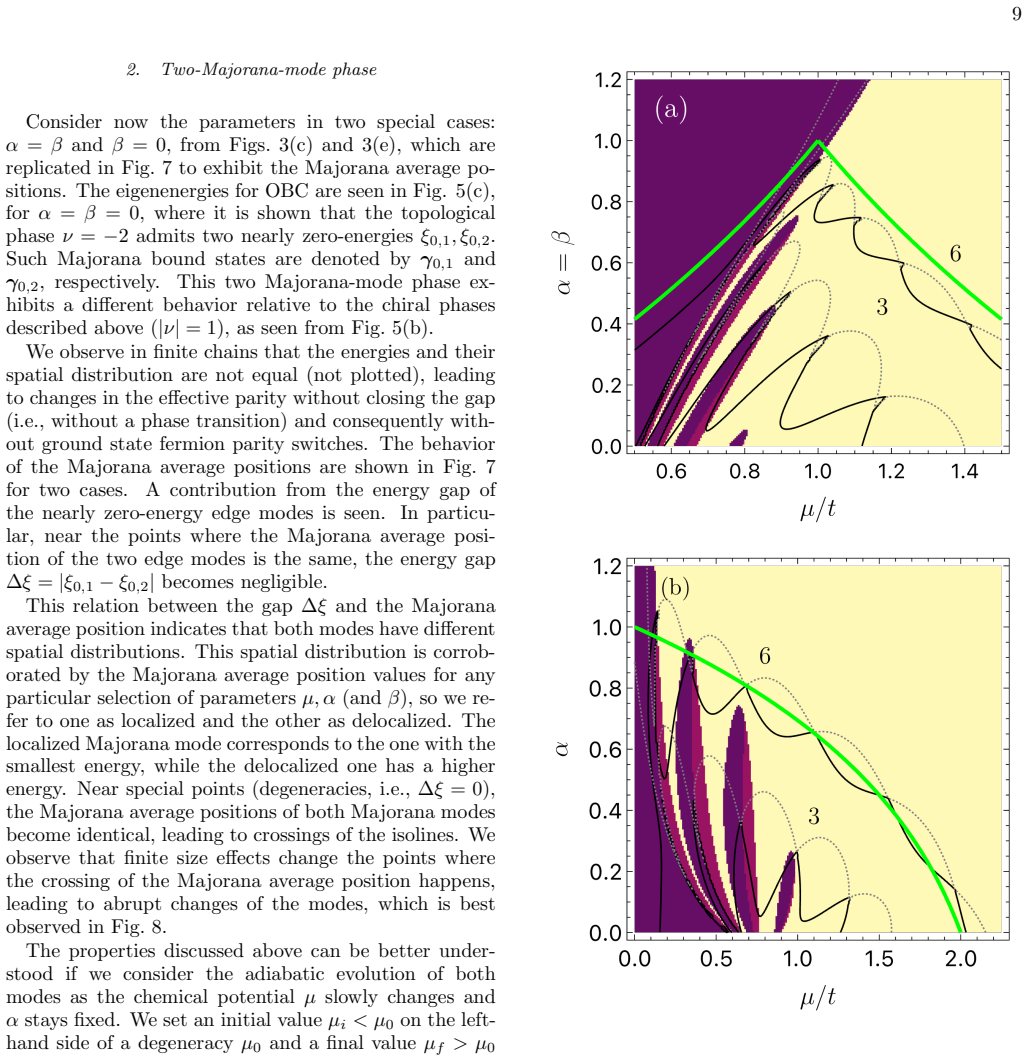
Two-Majorana-mode phase Consider now the parameters in two special cases: α=βandβ= 0, from Figs. 3(c) and 3(e), which are replicated in Fig. 7 to exhibit the Majorana average po- sitions. The eigenenergies for OBC are seen in Fig. 5(c), forα=β= 0, where it is shown that the topological phaseν=−2 admits two nearly zero-energiesξ 0,1, ξ0,2. Such Majorana bo...
-
[3]
von Klitzing, Rev
K. von Klitzing, Rev. Mod. Phys.58, 519 (1986)
1986
-
[4]
H. L. Stormer, D. C. Tsui, and A. C. Gossard, Rev. Mod. Phys.71, S298 (1999)
1999
-
[5]
B. A. Bernevig, T. L. Hughes, and S.-C. Zhang, Science 314, 1757 (2006)
2006
-
[6]
F. D. M. Haldane, Phys. Rev. Lett.61, 2015 (1988)
2015
-
[7]
A. Y. Kitaev, Physics-Uspekhi44, 131 (2001)
2001
-
[8]
Sigrist and K
M. Sigrist and K. Ueda, Rev. Mod. Phys.63, 239 (1991)
1991
-
[9]
M. Sato, Y. Tanaka, K. Yada, and T. Yokoyama, Phys. Rev. B83, 224511 (2011)
2011
-
[10]
C. W. J. Beenakker, Annu. Rev. Condens. Matter Phys. 4, 113 (2013)
2013
-
[11]
Leijnse and K
M. Leijnse and K. Flensberg, Semiconductor Science and Technology27, 124003 (2012)
2012
-
[12]
Fidkowski, J
L. Fidkowski, J. Alicea, N. H. Lindner, R. M. Lutchyn, and M. P. A. Fisher, Phys. Rev. B85, 245121 (2012)
2012
-
[13]
S. D. Sarma, M. Freedman, and C. Nayak, Npj Quantum Inf.1, 15001 (2015)
2015
-
[14]
S. B. Bravyi and A. Y. Kitaev, Annals of Physics298, 210 (2002)
2002
-
[15]
S. L. D. ten Haaf, Y. Zhang, Q. Wang, A. Bordin, C.-X. Liu, I. Kulesh, V. P. M. Sietses, C. G. Prosko, D. Xiao, C. Thomas, M. J. Manfra, M. Wimmer, and S. Goswami, Nature641, 890 (2025)
2025
-
[16]
Aghaee, A
M. Aghaee, A. Alcaraz Ramirez, Z. Alam, R. Ali, M. Andrzejczuk, A. Antipov, M. Astafev, A. Barze- gar, B. Bauer, J. Becker, U. K. Bhaskar, A. Bocharov, S. Boddapati, D. Bohn, J. Bommer, L. Bourdet, A. Bous- quet, S. Boutin, L. Casparis, B. J. Chapman, S. Cha- toor, A. W. Christensen, C. Chua, P. Codd, W. Cole, P. Cooper, F. Corsetti, A. Cui, P. Dalpasso, ...
2025
-
[17]
Kitaev, AIP Conference Proceedings1134, 22 (2009)
A. Kitaev, AIP Conference Proceedings1134, 22 (2009)
2009
-
[18]
S. Ryu, A. P. Schnyder, A. Furusaki, and A. W. W. Ludwig, New J. Phys.12, 065010 (2010)
2010
-
[19]
Bernevig and T
B. Bernevig and T. Hughes,Topological Insulators and Topological Superconductors(Princeton University Press, 2013)
2013
-
[20]
Naro˙ zniak, M
M. Naro˙ zniak, M. C. Dartiailh, J. P. Dowling, J. Shabani, and T. Byrnes, Phys. Rev. B103, 205429 (2021)
2021
-
[21]
Breckwoldt, T
N. Breckwoldt, T. Posske, and M. Thorwart, New Jour- nal of Physics24, 013033 (2022)
2022
-
[22]
Mascot, T
E. Mascot, T. Hodge, D. Crawford, J. Bedow, D. K. Morr, and S. Rachel, Phys. Rev. Lett.131, 176601 (2023)
2023
-
[23]
Altland and B
A. Altland and B. D. Simons,Condensed Matter Field Theory, 2nd ed. (Cambridge University Press, 2010)
2010
-
[24]
Kanehira and H
O. Kanehira and H. Tsuchiura, SciPost Phys. Proc.11, 014 (2023)
2023
-
[25]
Maiellaro, F
A. Maiellaro, F. Romeo, and R. Citro, Eur. Phys. J. Spec. Top.227, 1397 (2018)
2018
-
[26]
Nehra, D
R. Nehra, D. S. Bhakuni, A. Sharma, and A. Soori, J. Phys. Condens. Matter.31, 345304 (2019)
2019
-
[27]
Wakatsuki, M
R. Wakatsuki, M. Ezawa, Y. Tanaka, and N. Nagaosa, Phys. Rev. B90, 014505 (2014)
2014
-
[28]
S. Roy, S. N. Nabi, and S. Basu, Phys. Rev. B107, 014202 (2023)
2023
-
[29]
Ezawa, Phys
M. Ezawa, Phys. Rev. B96, 121105 (2017)
2017
-
[30]
R. M. Lutchyn, J. D. Sau, and S. Das Sarma, Phys. Rev. Lett.105, 077001 (2010)
2010
-
[31]
Alecce and L
A. Alecce and L. Dell’Anna, Phys. Rev. B95, 195160 (2017)
2017
-
[32]
Li, J.-R
X.-S. Li, J.-R. Li, S.-F. Zhang, L.-L. Zhang, and W.-J. Gong, Results in Physics30, 104837 (2021)
2021
-
[33]
DeGottardi, M
W. DeGottardi, M. Thakurathi, S. Vishveshwara, and D. Sen, Phys. Rev. B88, 165111 (2013)
2013
-
[34]
Cayssol and J.-N
J. Cayssol and J.-N. Fuchs, Journal of Physics: Materials 4, 034007 (2021)
2021
-
[35]
(3) is constrained to the (τy, τz) plane, generating the angleθ k = arctan(ny/nz)
The originalh k matrix in Eq. (3) is constrained to the (τy, τz) plane, generating the angleθ k = arctan(ny/nz). Instead, the angle defined here is rotated in the Pauli ma- trix space (τ x, τy, τz)7→(−τ z, τy, τx), so the components of the Anderson vector are now restricted to the (τ x, τy) plane
-
[36]
Fradkin,Quantum Field Theory: An Integrated Ap- proach(Princeton University Press, 2021)
E. Fradkin,Quantum Field Theory: An Integrated Ap- proach(Princeton University Press, 2021)
2021
-
[37]
Franchini,An Introduction to Integrable Techniques for One-Dimensional Quantum Systems(Springer Inter- national Publishing, 2017)
F. Franchini,An Introduction to Integrable Techniques for One-Dimensional Quantum Systems(Springer Inter- national Publishing, 2017)
2017
-
[38]
Nakahara,Geometry, Topology and Physics, 2nd ed., Graduate student series in physics (Hilger, Bristol, 1990)
M. Nakahara,Geometry, Topology and Physics, 2nd ed., Graduate student series in physics (Hilger, Bristol, 1990)
1990
-
[39]
V. V. Val’kov, M. S. Shustin, S. V. Aksenov, A. O. Zlot- nikov, A. D. Fedoseev, V. A. Mitskan, and M. Y. Kagan, Physics-Uspekhi65, 2 (2022)
2022
-
[40]
Surace and L
J. Surace and L. Tagliacozzo, SciPost Phys. Lect. Notes 54 (2022)
2022
-
[41]
Usually, the Majorana operators at the sitejare often labeled{b 2j−1, b2j}
-
[42]
S. S. Hegde and S. Vishveshwara, Phys. Rev. B94, 115166 (2016)
2016
-
[43]
P´ erez and G
M. P´ erez and G. Mart´ ınez, J. Phys.: Condens. Matter 29, 475503 (2017)
2017
-
[44]
Mart´ ınez and M
G. Mart´ ınez and M. P´ erez, Materials Today: Proceedings 14, 13 (2019)
2019
-
[45]
E. Lieb, T. Schultz, and D. Mattis, Annals of Physics 16, 407 (1961)
1961
-
[46]
Cozzini, P
M. Cozzini, P. Giorda, and P. Zanardi, Phys. Rev. B75, 014439 (2007)
2007
-
[47]
Grabsch, Y
A. Grabsch, Y. Cheipesh, and C. W. J. Beenakker, An- nalen der Physik531, 1900129 (2019)
2019
-
[48]
S. B. J¨ ager, L. Dell’Anna, and G. Morigi, Phys. Rev. B 102, 035152 (2020)
2020
-
[49]
Hegde, V
S. Hegde, V. Shivamoggi, S. Vishveshwara, and D. Sen, New J. Phys.17, 053036 (2015)
2015
-
[50]
DeGottardi, D
W. DeGottardi, D. Sen, and S. Vishveshwara, New J. Phys.13, 065028 (2011)
2011
-
[51]
Barouch and B
E. Barouch and B. M. McCoy, Phys. Rev. A3, 786 (1971)
1971
-
[52]
Jin and V
B.-Q. Jin and V. E. Korepin, J. Stat. Phys.116, 79–95 (2004)
2004
-
[53]
Fedoseev, JETP128, 125 (2019)
A. Fedoseev, JETP128, 125 (2019)
2019
-
[54]
Bena, Comptes Rendus Physique18, 349 (2017)
C. Bena, Comptes Rendus Physique18, 349 (2017)
2017
-
[55]
For the caseβ < α, ground- state fermion parity changes are expected
For inhomogeneous chains with decaying parametersα≲ β, there are no ground-state fermion parity changes in the topological phaseν=−2. For the caseβ < α, ground- state fermion parity changes are expected
-
[56]
Sachdev and J
S. Sachdev and J. Ye, Phys. Rev. Lett.70, 3339 (1993)
1993
-
[57]
Rosenhaus, J
V. Rosenhaus, J. Phys. A-Math. Theor.52, 323001 (2019)
2019
-
[58]
T. Reza, S. M. Frolov, and D. Pekker, SciPost Phys.13, 120 (2022)
2022
-
[59]
Pathak, V
V. Pathak, V. Mallya, and S. Sarkar, Journal of Physics: Condensed Matter38, 185401 (2026)
2026
-
[60]
Kokoska and D
S. Kokoska and D. Zwillinger,CRC Standard Probabil- ity and Statistics Tables and Formulae, Student Edition (1999)
1999
-
[61]
P. W. Anderson, Phys. Rev.109, 1492 (1958)
1958
-
[62]
D. J. Thouless, Journal of Physics C: Solid State Physics 5, 77 (1972)
1972
-
[63]
Kramer and A
B. Kramer and A. MacKinnon, Reports on Progress in Physics56, 1469 (1993)
1993
- [64]
-
[65]
Sticlet, C
D. Sticlet, C. Bena, and P. Simon, Phys. Rev. Lett.108, 096802 (2012)
2012
-
[66]
Sedlmayr and C
N. Sedlmayr and C. Bena, Phys. Rev. B92, 115115 (2015)
2015
discussion (0)
Sign in with ORCID, Apple, or X to comment. Anyone can read and Pith papers without signing in.