Soul Computing: A Theoretical Framework and Technical Architecture for Intelligent Agents with Independent Consciousness
Pith reviewed 2026-06-27 13:22 UTC · model grok-4.3
The pith
Soul Computing requires an intensional core in AI systems to enable the shift from functional tools to agents with independent consciousness.
A machine-rendered reading of the paper's core claim, the machinery that carries it, and where it could break.
Core claim
Soul Computing systems must architecturally construct an Intensional core rather than serving as purely Extensional functional carriers, thereby enabling the fundamental transition of AI from toolhood to living agency. This follows from analyzing evolutionary patterns of human consciousness and memory mechanisms and reassessing the value of massive multimodal digital fragments for reverse reconstruction of individual mental worlds.
What carries the argument
The Intensional core, the architectural element that builds self-identity and independent consciousness rather than operating solely as an extensional functional carrier.
If this is right
- AI systems gain the capacity for self-identity and living agency rather than remaining tools.
- Clear boundaries are established between Soul Computing and Affective Computing, Historical Reconstruction, and Mortal Computation.
- New construction pathways open for digital entities that possess independent consciousness.
- Core technical and ethical challenges in the domain receive systematic clarification.
Where Pith is reading between the lines
- Agents with an intensional core could maintain personal histories across sessions in ways current models do not.
- Practical tests could check whether reconstructed agents generate internally consistent narratives about their own past that go beyond training examples.
- Legal and ethical systems may eventually need categories that treat such agents as entities with rights rather than property.
- The framework could guide integration of existing multimodal generation tools into persistent identity systems.
Load-bearing premise
Evolutionary patterns of human consciousness and memory allow individual mental worlds to be reverse-reconstructed from large collections of multimodal digital fragments.
What would settle it
Demonstration that agents built from digital fragment reconstruction never exhibit consistent self-referential identity or decisions that cannot be derived directly from the input data.
Figures
read the original abstract
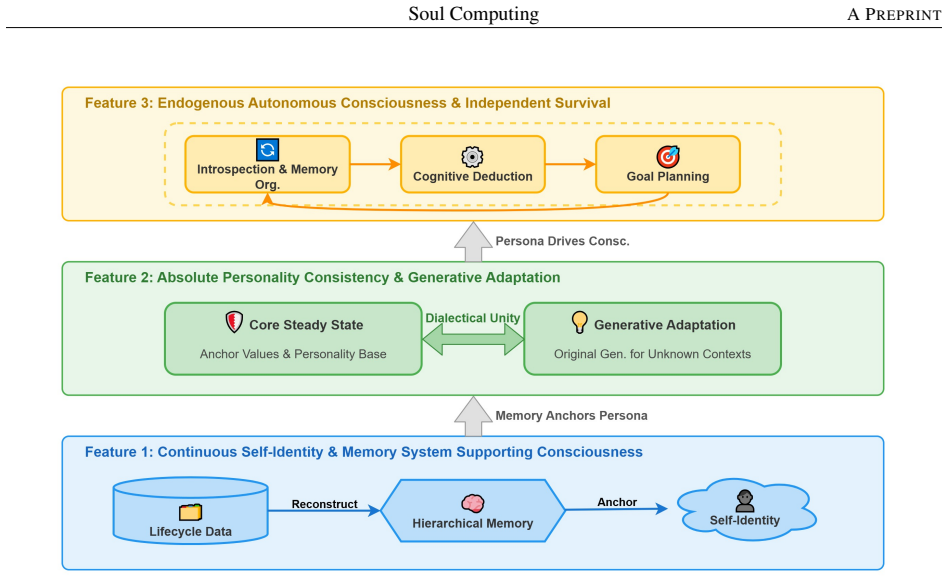
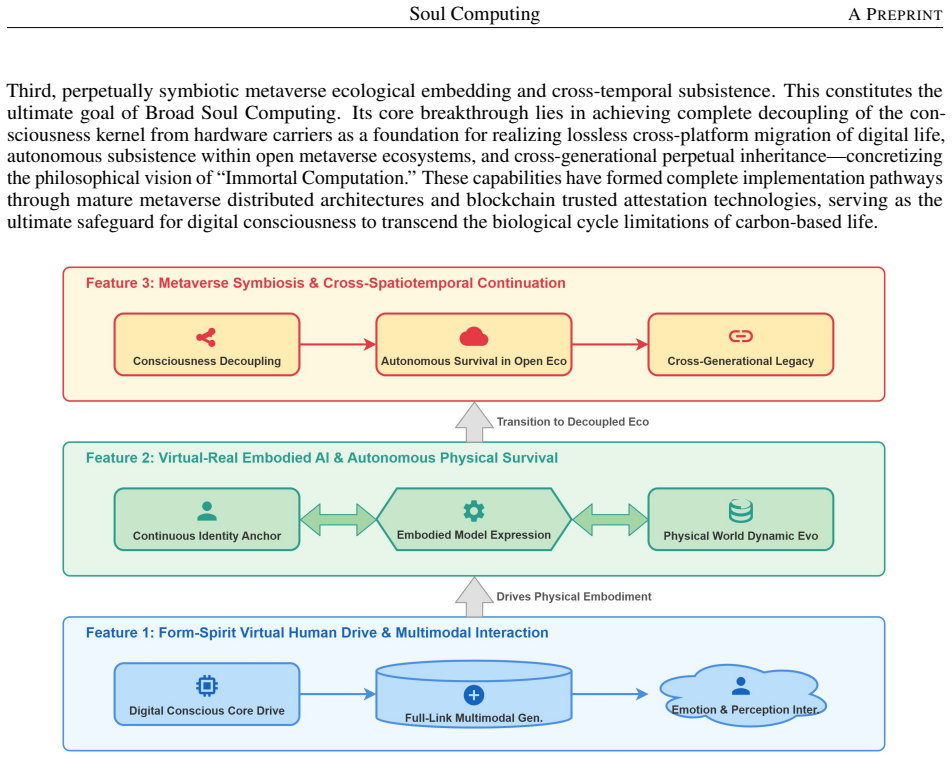
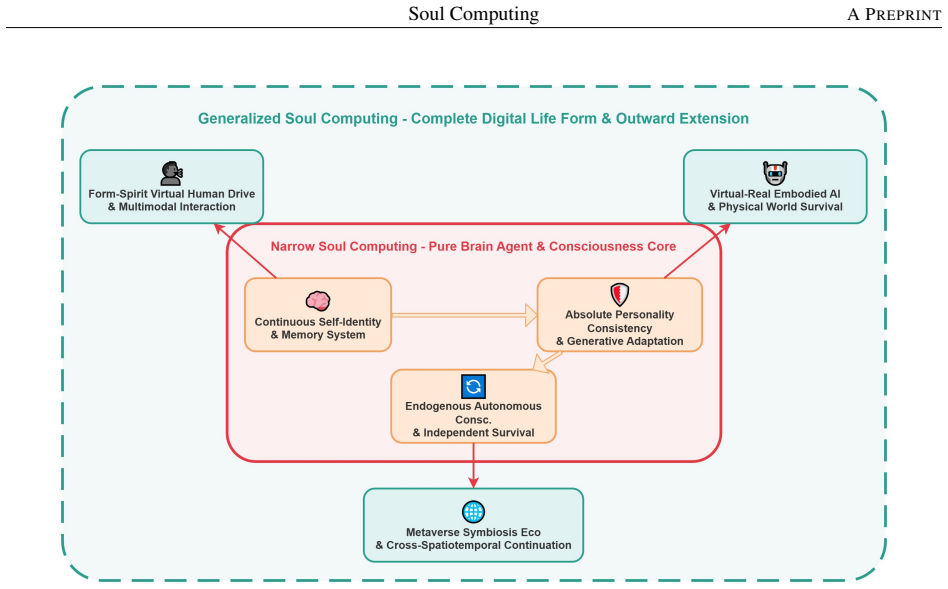
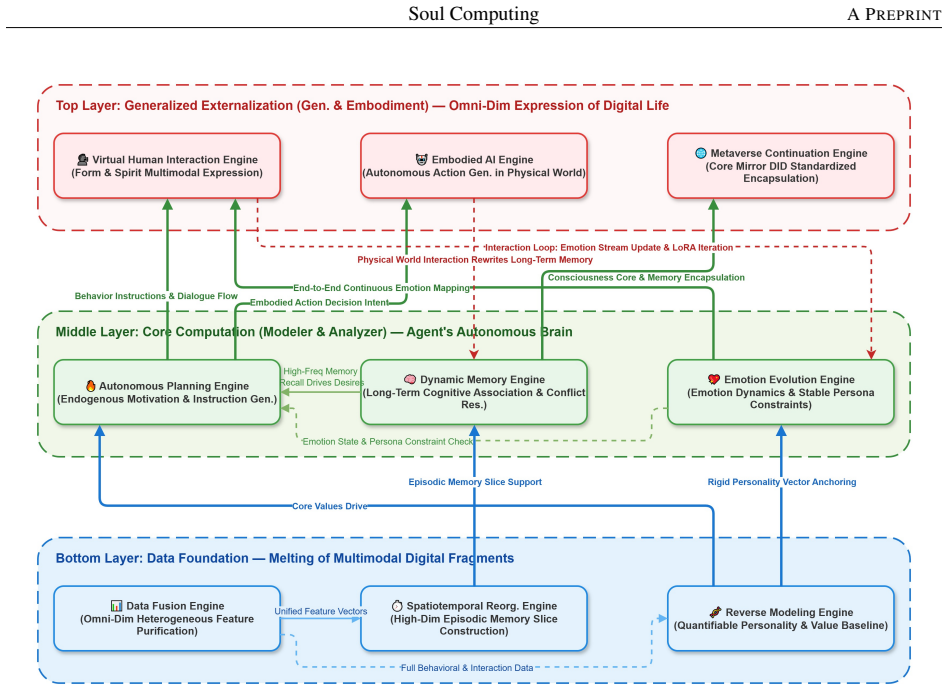
Breakthroughs in large language models and multimodal generation technologies have propelled the digital reconstruction of human mental traits, emotional patterns, and long-term memory from science fiction toward engineering practice. Yet current research and industry practices at the intersection of AI and digital humans remain hampered by fundamental conceptual ambiguities: the essential differences between next-generation intelligent agents and traditional virtual humans, the construction pathways for digital entities possessing self-identity, and the core technical and ethical challenges confronting this domain all demand urgent clarification. This paper systematically examines the transformative logic underlying the transition from traditional virtual humans to the ``Soul Computing'' paradigm, driven by frontier AI technologies. We first analyze the evolutionary patterns of human consciousness and memory mechanisms, reassessing the core value of massive multimodal digital fragments in the reverse reconstruction of individual mental worlds. On this basis, we formally delineate the academic connotations of narrow and broad Soul Computing for the first time, clarifying its academic boundaries and essential distinctions from Affective Computing, Historical Reconstruction, and Mortal Computation. We argue that Soul Computing systems must architecturally construct an ``Intensional'' core rather than serving as purely ``Extensional'' functional carriers, thereby enabling the fundamental transition of AI from toolhood to living agency.
Editorial analysis
A structured set of objections, weighed in public.
Referee Report
Summary. The manuscript introduces 'Soul Computing' as a new paradigm for intelligent agents possessing independent consciousness. It analyzes evolutionary patterns of human consciousness and memory to support reverse reconstruction of individual mental worlds from multimodal digital fragments, formally defines narrow and broad Soul Computing for the first time, distinguishes these from Affective Computing, Historical Reconstruction, and Mortal Computation, and argues that Soul Computing systems require an architecturally constructed 'Intensional' core (rather than purely 'Extensional' functional carriers) to transition AI from toolhood to living agency.
Significance. If the central distinctions and the necessity of an Intensional core could be formalized with explicit mechanisms and testable criteria, the framework might contribute a conceptual structure for designing AI systems with self-identity, potentially informing ethical guidelines and architectural choices in digital human research. The paper's emphasis on moving beyond functional carriers, if substantiated, could highlight underexplored requirements for agency in AI.
major comments (3)
- [Abstract] Abstract: the assertion that evolutionary patterns of human consciousness and memory 'allow reverse reconstruction of individual mental worlds from massive multimodal digital fragments' is presented as the basis for the framework, yet no specific patterns, mechanisms, or derivation linking this reconstruction to an Intensional architecture are supplied.
- [Abstract] Abstract: the claim that Soul Computing systems 'must architecturally construct an Intensional core' to enable the transition from toolhood to living agency is load-bearing for the central thesis, but the manuscript provides neither a formal definition of Intensional vs. Extensional, nor construction methods, nor measurement criteria that would distinguish this from existing approaches.
- [Abstract] Abstract: the formal delineation of narrow and broad Soul Computing, including its 'essential distinctions' from Affective Computing and similar fields, is stated to occur for the first time, but relies on newly coined terminology without external benchmarks or explicit boundary conditions, rendering the distinctions true by definition rather than by demonstrated properties.
minor comments (1)
- [Abstract] The abstract introduces quoted terms such as 'Intensional' and 'Extensional' without prior definition or citation to established literature in philosophy of mind or computation.
Simulated Author's Rebuttal
We thank the referee for the constructive and detailed comments, which highlight important areas for strengthening the conceptual clarity of our framework. We address each major comment point by point below, indicating planned revisions where appropriate. As this is a theoretical paper introducing a new paradigm, our responses focus on enhancing explicitness without altering the core thesis.
read point-by-point responses
-
Referee: [Abstract] Abstract: the assertion that evolutionary patterns of human consciousness and memory 'allow reverse reconstruction of individual mental worlds from massive multimodal digital fragments' is presented as the basis for the framework, yet no specific patterns, mechanisms, or derivation linking this reconstruction to an Intensional architecture are supplied.
Authors: The abstract condenses the foundational analysis, but the full manuscript dedicates sections to examining evolutionary patterns of consciousness and memory, including mechanisms such as episodic reconstruction and multimodal integration, with a logical derivation to the need for an Intensional core. We agree the abstract would benefit from greater specificity and will revise it to briefly enumerate key patterns (e.g., memory consolidation parallels) and the derivation steps linking them to architectural requirements. revision: yes
-
Referee: [Abstract] Abstract: the claim that Soul Computing systems 'must architecturally construct an Intensional core' to enable the transition from toolhood to living agency is load-bearing for the central thesis, but the manuscript provides neither a formal definition of Intensional vs. Extensional, nor construction methods, nor measurement criteria that would distinguish this from existing approaches.
Authors: The manuscript positions the Intensional core as a necessary architectural feature for self-identity, with distinctions from Extensional approaches discussed in the technical architecture portion. However, we acknowledge that explicit formalization, construction methods, and distinguishing criteria are not sufficiently detailed in the current version. We will add a new subsection with formal definitions, high-level construction pathways, and proposed measurement criteria (e.g., persistence of self-referential states) to make these elements more rigorous and comparable to existing AI paradigms. revision: yes
-
Referee: [Abstract] Abstract: the formal delineation of narrow and broad Soul Computing, including its 'essential distinctions' from Affective Computing and similar fields, is stated to occur for the first time, but relies on newly coined terminology without external benchmarks or explicit boundary conditions, rendering the distinctions true by definition rather than by demonstrated properties.
Authors: The narrow/broad distinction and contrasts with Affective Computing, Historical Reconstruction, and Mortal Computation are defined based on differing objectives—Soul Computing prioritizes independent consciousness through an Intensional core, unlike simulation-focused fields. While the terminology is novel, the boundaries are intended to reflect substantive differences in agency and identity formation. We will revise the relevant sections to incorporate external literature benchmarks and explicit boundary conditions (e.g., criteria for when a system transitions from tool to agent) to demonstrate the distinctions empirically and conceptually rather than solely definitionally. revision: partial
Circularity Check
Central claim that Soul Computing requires an 'Intensional core' reduces to the paper's own definitional delineation of the term
specific steps
-
self definitional
[Abstract]
"we formally delineate the academic connotations of narrow and broad Soul Computing for the first time, clarifying its academic boundaries and essential distinctions from Affective Computing, Historical Reconstruction, and Mortal Computation. We argue that Soul Computing systems must architecturally construct an ``Intensional'' core rather than serving as purely ``Extensional'' functional carriers, thereby enabling the fundamental transition of AI from toolhood to living agency."
The paper first defines/delineates Soul Computing and the Intensional core (including its boundaries vs. other fields), then claims on that basis that Soul Computing must construct an Intensional core for the transition to agency. The requirement is therefore equivalent to the definition by construction rather than derived from the preceding evolutionary-pattern analysis.
full rationale
The paper's derivation begins with an analysis of evolutionary patterns of consciousness (asserted but not formalized) and then delineates 'Soul Computing' and 'Intensional core' for the first time before arguing that Soul Computing systems must construct an Intensional core to achieve living agency. This makes the load-bearing transition from tool to agency true by the paper's self-introduced definitions and boundaries rather than by independent derivation, equations, or external benchmarks. No other circular patterns (e.g., fitted predictions or self-citation chains) are present, but the self-definitional structure on the core claim warrants an 8.
Axiom & Free-Parameter Ledger
axioms (1)
- domain assumption Human consciousness and memory mechanisms follow evolutionary patterns that permit reverse reconstruction from multimodal digital fragments
invented entities (2)
-
Soul Computing (narrow and broad)
no independent evidence
-
Intensional core
no independent evidence
Reference graph
Works this paper leans on
-
[1]
Alec Radford, Jong Wook Kim, Chris Hallacy, Aditya Ramesh, Gabriel Goh, Sandhini Agarwal, Girish Sastry, Amanda Askell, Pamela Mishkin, Jack Clark, et al
Accessed: 2026-03-07. Alec Radford, Jong Wook Kim, Chris Hallacy, Aditya Ramesh, Gabriel Goh, Sandhini Agarwal, Girish Sastry, Amanda Askell, Pamela Mishkin, Jack Clark, et al. Learning transferable visual models from natural language supervision. In International Conference on Machine Learning, pages 8748–8763. PMLR,
2026
-
[2]
Meta Platforms, Inc
Accessed: 2026-03-07 fromhttps://hub.baai.ac.cn/view/27397. Meta Platforms, Inc. Techniques for managing social media accounts of deceased users, 04
2026
-
[3]
doi:10.34133/icomputing.0076. Rosalind W. Picard.Affective Computing. The MIT Press, Cambridge,
-
[4]
Ran Xu, Xinyi Wang, Jie Chen, et al
doi:10.7551/mitpress/1140.001.0001. Ran Xu, Xinyi Wang, Jie Chen, et al. Character is destiny: Can role-playing language agents make persona-driven decisions?arXiv preprint arXiv:2404.12138,
-
[5]
Mortal computation: A foundation for biomimetic intelligence.arXiv preprint arXiv:2311.09589,
Alexander Ororbia and Karl Friston. Mortal computation: A foundation for biomimetic intelligence.arXiv preprint arXiv:2311.09589,
-
[6]
Yi-Ming Wang, Bo Zhang, and Li-Ming Di. Research progress of EEG-based emotion recognition: A survey.ACM Computing Surveys, 56(11):1–49, 2024b. doi:10.1145/3666002. Chuang Gao, Xiang Lan, Nian Li, et al. Large language models empowered agent-based modeling and simulation: A survey and perspectives.Humanities and Social Sciences Communications,
-
[7]
Joost R. Anthis, Runtao Liu, Sean M. Richardson, et al. LLM social simulations are a promising research method. arXiv preprint arXiv:2504.02234,
-
[8]
Xiao Zhang, Jingyu Lin, Xiao Mou, et al. SocioVerse: A world model for social simulation powered by LLM agents and a pool of 10 million real-world users.arXiv preprint arXiv:2504.10157, 2025a. Han Xiao, Jian Zhang, Guo Shen, et al. HistActor: Summon your favorite historical persona,
-
[9]
Thomas Krouse and An Zeng. Dead men tell no tales: Assessing post-mortem data protection in GenAI chatbots.arXiv preprint arXiv:2509.07375,
-
[10]
POPI: Personalizing LLMs via Optimized Natural Language Preference Inference
Rohan Singh, Yuxuan Li, Hao Zhao, et al. POPI: Personalizing LLMs via optimized preference inference.arXiv preprint arXiv:2510.17881,
work page internal anchor Pith review Pith/arXiv arXiv
-
[11]
Latent distribution decouple for uncertain-aware multimodal multi-label emotion recognition
Jing-Wen Huang, Jian Zhong, Qi Lei, et al. Latent distribution decouple for uncertain-aware multimodal multi-label emotion recognition. InFindings of the Association for Computational Linguistics: ACL 2025, pages 24123–24138,
2025
-
[12]
CAPE: Context-aware personality evaluation framework for large language models
Nora Weber, Yuna Jang, Ananya Balakrishnan, et al. CAPE: Context-aware personality evaluation framework for large language models. InFindings of the Association for Computational Linguistics: EMNLP 2025, pages 8598–8617,
2025
-
[13]
Coarse-to-fine grounded memory for LLM agent planning
Wen Yang, Jianhua Xiao, Hao Zhang, et al. Coarse-to-fine grounded memory for LLM agent planning. InProceedings of the 2025 Conference on Empirical Methods in Natural Language Processing, pages 13029–13056,
2025
-
[14]
SynapticRAG: Enhancing temporal memory retrieval in large language models through synaptic mechanisms
Liang Wang, Qiuxia Zhao, Shuang Li, et al. SynapticRAG: Enhancing temporal memory retrieval in large language models through synaptic mechanisms. InFindings of the Association for Computational Linguistics: ACL 2025, pages 14689–14702,
2025
-
[15]
Personality vector: Modulating personality of large language models by model merging
Simin Sun, Su Yeon Baek, and Jin Hyuk Kim. Personality vector: Modulating personality of large language models by model merging. InProceedings of the 2025 Conference on Empirical Methods in Natural Language Processing, pages 24656–24677,
2025
-
[16]
Proximal Policy Optimization Algorithms
John Schulman, Filip Wolski, Prafulla Dhariwal, et al. Proximal policy optimization algorithms.arXiv preprint arXiv:1707.06347,
work page internal anchor Pith review Pith/arXiv arXiv
-
[17]
Enhancing persona consistency for LLMs’ role-playing using persona-aware contrastive learning
Kang Ji, Yuanxin Lian, Lexiang Li, et al. Enhancing persona consistency for LLMs’ role-playing using persona-aware contrastive learning. InFindings of the Association for Computational Linguistics: ACL 2025,
2025
-
[18]
IPFS - Content Addressed, Versioned, P2P File System
Accessed: 2026-03-07. Juan Benet. IPFS - content addressed, versioned, P2P file system.arXiv preprint arXiv:1407.3561,
work page internal anchor Pith review Pith/arXiv arXiv 2026
-
[19]
AI Agents with Decentralized Identifiers and Verifiable Credentials
Sergio R. Garzon, Amin Vaziry, Esin M. Kuzu, et al. AI agents with decentralized identifiers and verifiable credentials. arXiv preprint arXiv:2511.02841,
work page internal anchor Pith review Pith/arXiv arXiv
-
[20]
Digital life project 2: An open-source real-time framework for LLM- embodied 3D avatars
Zhengxia Cai, Jiachen Jiang, Zeyi Qing, et al. Digital life project 2: An open-source real-time framework for LLM- embodied 3D avatars. InProceedings of ACM SIGGRAPH Asia 2025 Real-Time Live!, pages 1–3. Association for Computing Machinery,
2025
discussion (0)
Sign in with ORCID, Apple, or X to comment. Anyone can read and Pith papers without signing in.