Edge slip stabilizes confined active vortices by suppressing localized instabilities
Pith reviewed 2026-06-27 11:56 UTC · model grok-4.3
The pith
Increasing boundary slip stabilizes confined active vortices by suppressing localized instabilities.
A machine-rendered reading of the paper's core claim, the machinery that carries it, and where it could break.
Core claim
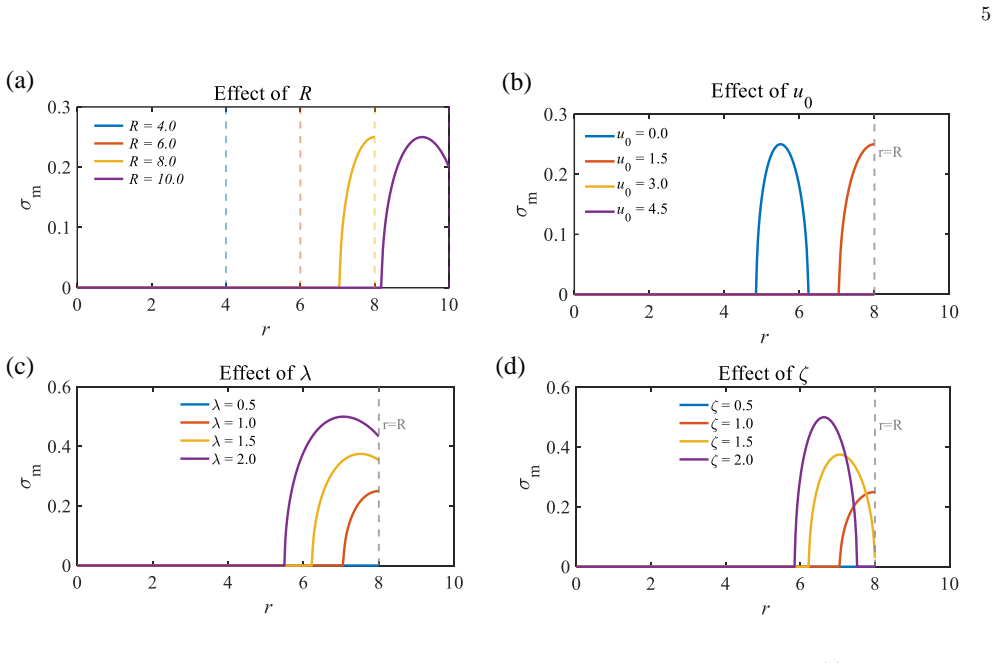
In a circularly confined active nematic modeled in the flow-dominated regime, the steady vortex state is stabilized by increasing slip velocity at the boundary, as an explicit stability criterion derived from linear analysis shows that higher slip suppresses localized instabilities by limiting flow-induced reorientation.
What carries the argument
Linear stability analysis around the steady vortex solution, performed on a continuum model of active nematics subject to slip boundary conditions that link internal stresses to flow and orientation changes.
If this is right
- Higher slip velocity promotes persistence of the steady single-vortex state.
- The derived criterion explicitly ties stability to slip velocity and the flow-alignment coupling.
- Boundary slip functions as a hydrodynamic control parameter that can engineer stable active flows.
- Relaxing boundary friction depresses the reorientation mechanism that typically destroys single-vortex states.
Where Pith is reading between the lines
- The same slip dependence may appear in other confined geometries that support coherent active structures.
- Surface engineering to increase slip could be tested as a route to sustain vortices in microfluidic active-matter devices.
- The mechanism suggests that stability criteria could be checked in regimes beyond the flow-dominated limit used here.
Load-bearing premise
The continuum model restricted to the flow-dominated regime and the linear stability analysis around the steady vortex fully determine how slip velocity affects the vortex state's dynamical stability.
What would settle it
An experiment that varies surface slip in a confined active nematic, measures the onset and growth rates of perturbations to the vortex, and checks whether those rates decrease as slip velocity increases.
Figures
read the original abstract
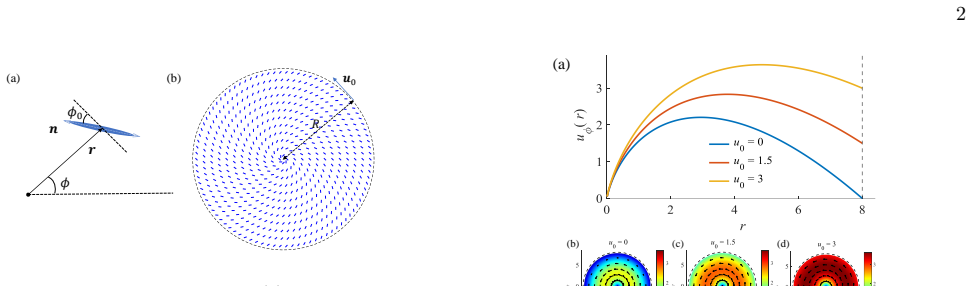
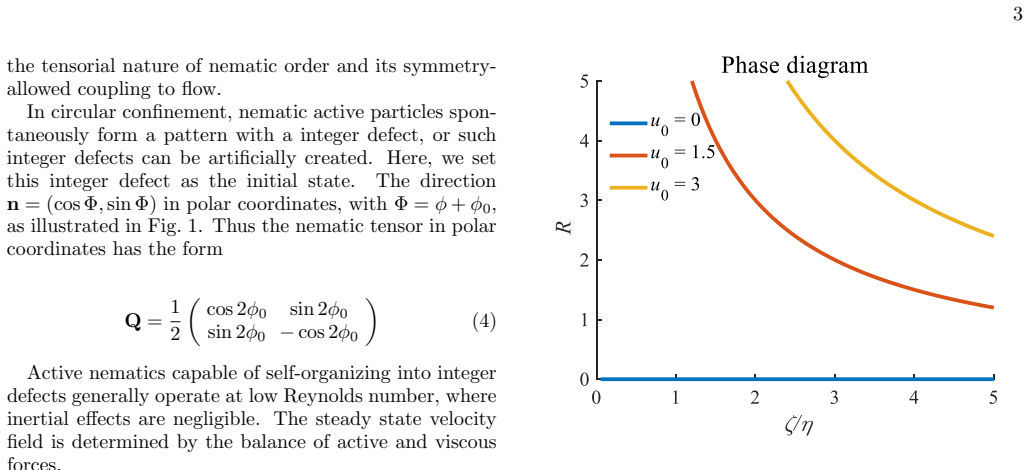
Confined active systems can sustain persistent vortical flows whose stability is strongly influenced by boundary conditions. At the individual level, active units generate internal stresses that drive spontaneous flows, which in turn advect and reorient the particles. This nonlinear coupling between active flow and orientational order is significantly mediated by the system's boundaries, where the specific slip condition governs how these internal stresses generate active flow then rearrange the local orientations. However, a quantitative understanding of how boundary slip dictates their dynamical stability remains lacking. Here, we study how the slip boundary condition controls the stability of a steady vortex state in a circularly confined active nematic system. Using a continuum model in a flow-dominated regime, we perform a linear stability analysis and derive an explicit criterion incorporating the slip velocity and flow-alignment coupling. We find that increasing slip velocity suppresses localized linear instabilities, thereby promoting the persistence of the steady vortex state. This reveals a relaxing the boundary friction actually stabilizes the macroscopic coherent structure by depressing flow induced reorientation that typically destroys single-vortex states. Our findings establish boundary slip as a nontrivial hydrodynamic control parameter for engineering stable active flows.
Editorial analysis
A structured set of objections, weighed in public.
Referee Report
Summary. The paper examines how slip boundary conditions affect the stability of a steady vortex in a circularly confined active nematic fluid. In a continuum model restricted to the flow-dominated regime, the authors perform a linear stability analysis around the base vortex state and derive an explicit criterion involving slip velocity and flow-alignment coupling. They conclude that increasing slip velocity suppresses localized linear instabilities and thereby promotes persistence of the single-vortex state, establishing boundary slip as a control parameter for stable active flows.
Significance. If the derived linear criterion controls long-term behavior, the result supplies a concrete, parameter-explicit handle on vortex stability in confined active matter. The explicit incorporation of slip velocity into the stability threshold is a strength, as is the focus on a standard continuum description without additional ad-hoc parameters.
major comments (2)
- [Abstract and methods/results paragraph] Abstract and methods/results paragraph: The central claim that the criterion 'promotes the persistence of the steady vortex state' rests solely on linear stability analysis. In active nematics the orientational dynamics are nonlinear; the manuscript provides no nonlinear simulations, subcritical bifurcation analysis, or basin-volume estimates to show that suppression of linear modes is sufficient to prevent finite-amplitude destabilization under realistic perturbations.
- [Abstract] Abstract: The statement that the analysis is performed 'in a flow-dominated regime' is used to justify the model, yet no quantitative bounds on the regime (e.g., relative magnitudes of active stress, viscous dissipation, and flow-alignment terms) are supplied, making it impossible to assess how restrictive the assumption is for the derived criterion.
minor comments (1)
- [Abstract] Abstract, final sentence: 'This reveals a relaxing the boundary friction' contains a grammatical error and should read 'that relaxing'.
Simulated Author's Rebuttal
We thank the referee for the constructive comments on our manuscript. We address each major comment point by point below.
read point-by-point responses
-
Referee: [Abstract and methods/results paragraph] Abstract and methods/results paragraph: The central claim that the criterion 'promotes the persistence of the steady vortex state' rests solely on linear stability analysis. In active nematics the orientational dynamics are nonlinear; the manuscript provides no nonlinear simulations, subcritical bifurcation analysis, or basin-volume estimates to show that suppression of linear modes is sufficient to prevent finite-amplitude destabilization under realistic perturbations.
Authors: We agree that the analysis is strictly linear and does not address nonlinear destabilization mechanisms such as subcritical bifurcations or finite-amplitude perturbations. The derived criterion and the abstract statement are therefore limited to the suppression of localized linear instabilities. This constitutes a necessary (though not sufficient) condition for persistence of the vortex. We have revised the abstract and added a clarifying sentence in the discussion to emphasize the linear nature of the result and to note that nonlinear validation lies beyond the present scope. revision: partial
-
Referee: [Abstract] Abstract: The statement that the analysis is performed 'in a flow-dominated regime' is used to justify the model, yet no quantitative bounds on the regime (e.g., relative magnitudes of active stress, viscous dissipation, and flow-alignment terms) are supplied, making it impossible to assess how restrictive the assumption is for the derived criterion.
Authors: We accept that explicit bounds would strengthen the presentation. In the revised manuscript we have inserted a short paragraph in the methods section that supplies order-of-magnitude estimates using representative parameter values from the active-nematics literature (activity number, viscosity, and flow-alignment coefficient). These estimates delineate the regime in which active stress dominates viscous dissipation and thereby justify the model reduction used to obtain the stability criterion. revision: yes
Circularity Check
Linear stability analysis yields independent criterion; no reduction to inputs or self-citations
full rationale
The derivation rests on a standard linear stability analysis of a continuum model around the steady vortex state in the flow-dominated regime. The abstract states that an explicit criterion is derived incorporating slip velocity and flow-alignment coupling, with the result that increasing slip suppresses localized instabilities. No quoted step equates a prediction to a fitted input by construction, invokes a self-citation as the sole justification for a uniqueness theorem, or renames a known result. The central claim follows directly from the model equations and analysis without circular reduction, making the derivation self-contained against external benchmarks.
Axiom & Free-Parameter Ledger
Reference graph
Works this paper leans on
-
[1]
te Vrugt, B
M. te Vrugt, B. Liebchen, and M. E. Cates, What exactly is ’active matter’?, arXiv2507, 21621 (2025)
2025
-
[2]
M. C. Marchetti, J. F. Joanny, S. Ramaswamy, T. B. Liverpool, J. Prost, M. Rao, and R. A. Simha, Hydrody- namics of soft active matter, Rev. Mod. Phys.85, 1143 (2013)
2013
-
[3]
Alert, J
R. Alert, J. Casademunt, and J.-F. Joanny, Active turbu- lence, Annu. Rev. Condens. Matter Phys.13, 143 (2022)
2022
-
[4]
Bechinger, R
C. Bechinger, R. D. Leonardo, H. L¨ owen, C. Reichhardt, G. Volpe, and G. Volpe, Active particles in complex and crowded environments, Rev. Mod. Phys.88, 045006 (2016)
2016
-
[5]
Thampi and J
S. Thampi and J. Yeomans, Active turbulence in active nematics, Eur. Phys. J. Spec. Top.225, 651–662 (2016)
2016
-
[6]
Saintillan and M
D. Saintillan and M. J. Shelley, Instabilities and pattern formation in active particle suspensions: kinetic theory and continuum simulations, Phys. Rev. Lett.100, 178103 (2008)
2008
-
[7]
Saintillan and M
D. Saintillan and M. J. Shelley, Instabilities, pattern for- mation, and mixing in active suspensions, Physics of Flu- ids20, 123304 (2008)
2008
-
[8]
Subramanian and D
G. Subramanian and D. Koch, Critical bacterial concen- tration for the onset of collective swimming, J. Fluid Mech.632, 359 (2009)
2009
-
[9]
R. A. Simha and S. Ramaswamy, Hydrodynamic fluc- tuations and instabilities in ordered suspensions of self- propelled particles, Phys. Rev. Lett.89, 058101 (2002)
2002
-
[10]
T´ oth, C
G. T´ oth, C. Denniston, and J. M. Yeomans, Hydrody- namics of topological defects in nematic liquid crystals, Phys. Rev. Lett88, 105504 (2002)
2002
-
[11]
Doostmohammadi, J
A. Doostmohammadi, J. Ign´ es-Mullol, J. M. Yeomans, and F. Sagu´ es, Active nematics, Nat. Commun.9, 3246 (2018)
2018
-
[12]
Shankar, A
S. Shankar, A. Souslov, M. J. Bowick, M. C. Marchetti, and V. Vitelli, Topological active matter, Nat. Rev. Phys. 4, 380–398 (2022)
2022
-
[13]
Copenhagen, R
K. Copenhagen, R. Alert, N. S. Wingreen, and J. W. Shaevitz, Topological defects promote layer formation in myxococcus xanthus colonies, Nat. Phys.17, 211–215 (2021)
2021
-
[14]
Schaller and A
V. Schaller and A. R. Bausch, Topological defects and density fluctuations in collectively moving systems, Proc. Natl. Acad. Sci. U.S.A.110, 4488 (2013)
2013
-
[15]
F. C. Keber, E. Loiseau, T. Sanchez, S. J. DeCamp, L. Giomi, M. J. Bowick, M. C. Marchetti, Z. Dogic, and A. R. Bausch, Topology and dynamics of active nematic vesicles, Science345, 1135 (2014)
2014
-
[16]
Giomi, Geometry and topology of turbulence in active nematics, Phys
L. Giomi, Geometry and topology of turbulence in active nematics, Phys. Rev. X5, 031003 (2015)
2015
-
[17]
H. H. Wensink, J. Dunkel, K. D. Sebastian Heidenreich, R. E. Goldstein, H. L¨ owen, and J. M. Yeomans, Meso- scale turbulence in living fluids, PNAS109, 14308–14313 (2012)
2012
-
[18]
L. A. Hoffmann, L. N. Carenza, J. Eckert, and L. Giomi1, Theory of defect-mediated morphogenesis, Sci. Adv.8, eabk2712 (2022)
2022
-
[19]
Gr´ egoire and H
G. Gr´ egoire and H. Chat´ e, Onset of collective and cohe- sive motion, Phys. Rev. Lett.92, 025702 (2004)
2004
-
[20]
M. E. Cates and J. Tailleur, Motility-induced phase sep- aration, Annu. Rev. Condens. Matter Phys. , 219–44 (2015)
2015
-
[21]
Rønning, J
J. Rønning, J. Renaud, A. Doostmohammadi, and L. Angheluta, Spontaneous flows and dynamics of full- integer topological defects in polar active matter, Soft matter19, 7513 (2023)
2023
-
[22]
C. Peng, T. Turiv, Y. Guo, Q.-H. Wei, and O. D. Lavren- tovich†, Command of active matter by topological defects and patterns, Science354, 882 (2016)
2016
-
[23]
Z. Zhao, Y. Yao, H. Li, Y. Zhao, Y. Wang, H. Zhang, H. Chat´ e, and M. Sano, Integer topological defects re- veal anti-symmetric forces in active nematics, Phys. Rev. Lett.133, 268301 (2024)
2024
-
[24]
ZHANG, J
R. ZHANG, J. J. D. PABLO, and M. L. GARDEL, Tun- able structure and dynamics of active liquid crystals, Sci. 8 Adv.4, eaat7779 (2018)
2018
-
[25]
Koizumi, T
R. Koizumi, T. Turiv, M. M. Genkin, R. J. Lastowski, H. Yu, I. Chaganava, Q.-H. Wei, I. S. Aranson, and O. D. Lavrentovich, Control of microswimmers by spiral ne- matic vortices: Transition from individual to collective motion and contraction, expansion, and stable circula- tion of bacterial swirls, Phys. Rev. Lett.2, 033060 (2020)
2020
-
[26]
S. Liu, S. Shankar, M. C. Marchetti, and Y. Wu, Vis- coelastic control of spatiotemporal order in bacterial ac- tive matter, Nature590, 80 (2021)
2021
-
[27]
Caballero, Z
F. Caballero, Z. You, and M. C. Marchetti, Vorticity phase separation and defect lattices in the isotropic phase of active liquid crystals, Soft Matter19, 7828 (2023)
2023
-
[28]
Wioland, F
H. Wioland, F. G. Woodhouse, J. Dunkel, J. O. Kessler, and R. E. Goldstein, Confinement stabilizes a bacterial suspension into a spiral vortex, Phys. Rev. Lett110, 268102 (2013)
2013
-
[29]
Lushi, H
E. Lushi, H. Wioland, and R. E. Goldstein, Fluid flows created by swimming bacteria drive self-organization in confined suspensions, PNAS111, 9733–9738 (2014)
2014
-
[30]
Beppu, Z
K. Beppu, Z. Izri, T. Sato, Y. Yamanishi, Y. Sumino, and Y. T. Maeda, Edge current and pairing order transition in chiral bacterial vortex, PNAS118, 39 (2021)
2021
-
[31]
Zhang, H
B. Zhang, H. Yuan, A. Sokolov, M. O. de la Cruz, and A. Snezhko, Polar state reversal in active fluids, Nat. Phys.18, 154–159 (2022)
2022
-
[32]
H. Li, H. Chat´ e, M. Sano, X. qing Shi, and H. Zhang, Robust edge flows in swarming bacterial colonies, Phys. Rev. X.14, 041006 (2024)
2024
-
[33]
M. R. Nejad and J. M. Yeomans, Spontaneous rotation of active droplets in two and three dimensions, PRX Life 1, 023008 (2023)
2023
-
[34]
Rappel, A
W.-J. Rappel, A. Nicol, A. Sarkissian, H. Levine, and W. F. Loomis, Self-organized vortex state in two- dimensional dictyostelium dynamics, Phys. Rev. Lett. 83, 1247 (1999)
1999
-
[35]
Blanch-Mercader, P
C. Blanch-Mercader, P. Guillamat, A. Roux, and K. Kruse, Integer topological defects of cell monolayers: Mechanics and flows, Phys. Rev. E103, 012405 (2021)
2021
-
[36]
Theillard, R
M. Theillard, R. Alonso-Matilla, and D. Saintillan, Ge- ometric control of active collective motion, Soft Matter 13, 363 (2016)
2016
-
[37]
Beppu, Z
K. Beppu, Z. Izri, J. Gohya, K. Eto, M. Ichikawab, and Y. T. Maeda, Geometry-driven collective ordering of bac- terial vortices, Soft Matter13, 5038 (2017)
2017
-
[38]
Nishiguchi, S
D. Nishiguchi, S. Shiratani, K. A. Takeuchi, and I. S. Aranson, Vortex reversal is a precursor of confined bac- terial turbulence, PNAS122, 11 (2025)
2025
-
[39]
Opathalage, M
A. Opathalage, M. M. Norton, M. P. N. Juniper, and Z. Dogic, Self-organized dynamics and the transition to turbulence of confined active nematics, PNAS116, 4788 (2019)
2019
-
[40]
Perez-Estay, V
B. Perez-Estay, V. Martinez, C. Douarche, J. Schwarz- Linek, J. Arlt, P.-H. Delville, G. McConnell, W. C. K. Poon, A. Lindner, and E. Clement, Bacteria collective motion is scale-free, arxiv2509, 15918 (2025)
2025
-
[41]
Metselaar, A
L. Metselaar, A. Doostmohammadi, and J. M. Yeomans, Topological states in chiral active matter: Dynamic blue phases and active half-skyrmions, J. Chem. Phys.150, 064909 (2019)
2019
-
[42]
S. P. Thampi, A. Doostmohammadi, R. Golestanian, and J. M. Yeomans, Intrinsic free energy in active nematics, EPL112, 28004 (2015)
2015
-
[43]
Marenduzzo, E
D. Marenduzzo, E. Orlandini, and J. M. Yeomans, Hy- drodynamics and rheology of active liquid crystals: A nu- merical investigation, Phys. Rev. Lett.98, 118102 (2007)
2007
-
[44]
H. M. L´ opez, J. Gachelin, C. Douarche, H. Auradou, and E. Cl´ ement, Turning bacteria suspensions into superflu- ids, Phys. Rev. Lett.115, 028301 (2015)
2015
-
[45]
Leibovich, Vortex stability and breakdown: Survey and extension, AIAA J.22, 1192 (1984)
S. Leibovich, Vortex stability and breakdown: Survey and extension, AIAA J.22, 1192 (1984)
1984
-
[46]
Puggioni, G
L. Puggioni, G. Boffetta, and S. Musacchio, Giant vortex dynamics in confined bacterial turbulence, Phys. Rev. E 106, 055103 (2022)
2022
discussion (0)
Sign in with ORCID, Apple, or X to comment. Anyone can read and Pith papers without signing in.