A Deployment-Oriented Framework for Explainable AI-Assisted eBPF/XDP Mitigation at the IoT Edge
Pith reviewed 2026-06-27 12:47 UTC · model grok-4.3
The pith
A framework separates AI reasoning in user space from eBPF packet decisions for IoT edge mitigation
A machine-rendered reading of the paper's core claim, the machinery that carries it, and where it could break.
Core claim
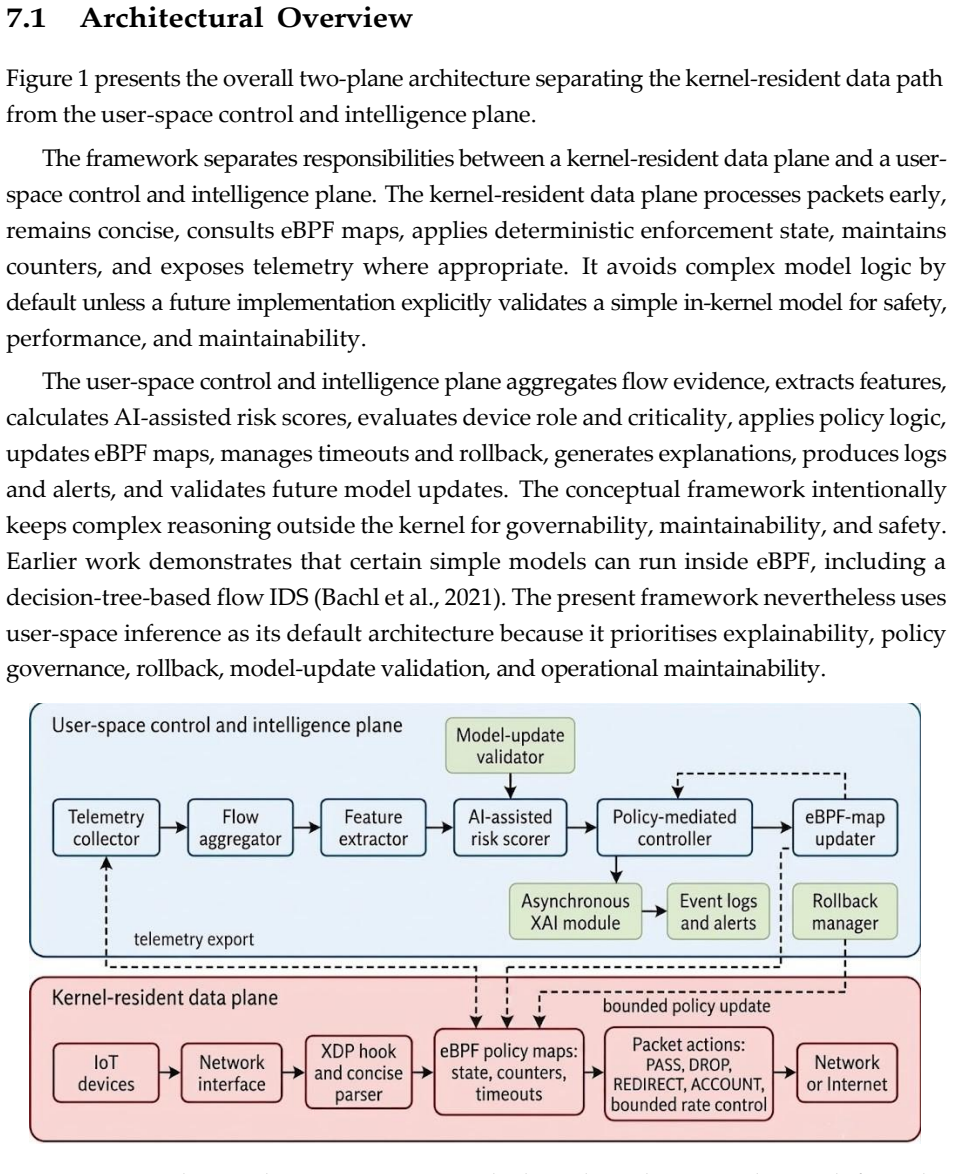
The paper claims that an IoT edge gateway can combine resource-aware flow-level AI-assisted risk scoring, event-level explainability, and bounded mitigation through eBPF/XDP. The controller applies reversible, time-limited actions subject to critical-device safeguards, updates packet-level enforcement state, and records structured logs. The architecture separates complex reasoning and policy control in user space from concise packet-handling decisions in the kernel and defines a future hardware-aware evaluation pathway.
What carries the argument
The controller architecture that separates complex reasoning and policy control in user space from concise packet-handling decisions in the kernel using eBPF/XDP for reversible mitigation.
If this is right
- Resource-aware scoring allows risk-based decisions without exceeding the limits of constrained IoT devices.
- Reversible time-limited actions enable rollback when needed while protecting critical devices.
- Event-level explainability produces structured logs that support auditing of mitigation decisions.
- The evaluation pathway requires future checks on detection quality, resource cost, response timing, and legitimate-traffic preservation.
Where Pith is reading between the lines
- The same separation of reasoning from enforcement could be tested with other kernel-level packet technologies beyond eBPF.
- The framework's safeguards for critical devices might generalize to other safety-critical edge deployments with long device lifecycles.
- Structured logging of reversible actions could feed into automated policy refinement loops if integrated with existing IoT management systems.
Load-bearing premise
That the separation of user-space AI reasoning from kernel-space packet decisions, together with resource-aware scoring and reversible actions, will prove operationally deployable in heterogeneous IoT environments.
What would settle it
A testbed measurement in which the proposed controller either exceeds device resource limits, fails to preserve legitimate traffic, or cannot apply reversible actions within required timing bounds under realistic heterogeneous IoT loads.
Figures
read the original abstract
Internet of Things (IoT) deployments combine heterogeneous, resource-constrained devices with weak security configurations, exposed services, limited logging, patching constraints, and long lifecycles. Signature- and threshold-based controls remain useful baselines, but they are insufficient as standalone mechanisms in dynamic IoT networks. Likewise, offline artificial intelligence (AI) benchmark performance alone does not establish operational deployability. This article presents a conceptual framework and research agenda for a Linux-based IoT edge gateway that combines resource-aware flow-level AI-assisted risk scoring, event-level explainability, and bounded mitigation through eBPF/XDP. The controller applies reversible, time-limited actions subject to critical-device safeguards, updates packet-level enforcement state, and records structured logs. The architecture separates complex reasoning and policy control in user space from concise packet-handling decisions in the kernel. It also defines a future hardware-aware evaluation pathway covering detection quality, resource cost, response timing, rollback behaviour, and legitimate-traffic preservation. The paper does not report new experimental measurements or claim measured superiority or completed real-time performance.
Editorial analysis
A structured set of objections, weighed in public.
Referee Report
Summary. The manuscript presents a conceptual framework and research agenda for a Linux-based IoT edge gateway that integrates resource-aware flow-level AI-assisted risk scoring, event-level explainability, and bounded mitigation via eBPF/XDP. The architecture separates complex reasoning and policy control in user space from concise packet-handling in the kernel, with the controller applying reversible time-limited actions subject to critical-device safeguards, updating enforcement state, and recording structured logs. It explicitly defines a future hardware-aware evaluation pathway covering detection quality, resource cost, response timing, rollback behaviour, and legitimate-traffic preservation, while stating that no new experimental measurements, superiority claims, or real-time performance results are provided.
Significance. If the proposed high-level architecture proves operationally viable, it could provide a structured template for combining AI-driven risk assessment with efficient kernel-level enforcement in resource-constrained IoT settings, potentially improving upon standalone signature- or threshold-based controls. The explicit framing as a research agenda with deferred empirical validation is appropriate and avoids overclaiming.
minor comments (3)
- The description of the 'resource-aware' scoring mechanism would benefit from an explicit high-level diagram or pseudocode sketch showing how device constraints feed into the flow-level risk score (e.g., in the architecture section).
- Clarify the precise interface between the user-space controller and the eBPF/XDP program (e.g., map structures or tail-call mechanisms) to make the separation of concerns more concrete for implementers.
- The evaluation pathway paragraph lists five metrics; adding a brief note on how each would be measured in a heterogeneous testbed would strengthen the agenda without requiring new data.
Simulated Author's Rebuttal
We thank the referee for the constructive review and for recognizing the manuscript as a conceptual framework and research agenda without experimental claims. The positive assessment of potential utility and the recommendation for minor revision are appreciated. No specific major comments were raised in the report.
Circularity Check
No significant circularity
full rationale
The manuscript is a conceptual framework and research agenda describing a high-level architecture (user-space AI/policy control separated from kernel eBPF/XDP enforcement, resource-aware scoring, reversible actions). No equations, fitted parameters, quantitative predictions, or derivation chains exist. No self-citations are load-bearing for any claimed result, as no results are claimed beyond the proposal itself. The contribution is self-contained as an architectural outline with future evaluation deferred.
Axiom & Free-Parameter Ledger
axioms (3)
- domain assumption IoT deployments combine heterogeneous, resource-constrained devices with weak security configurations, exposed services, limited logging, patching constraints, and long lifecycles
- domain assumption Signature- and threshold-based controls remain useful baselines but are insufficient as standalone mechanisms in dynamic IoT networks
- domain assumption Offline artificial intelligence benchmark performance alone does not establish operational deployability
Reference graph
Works this paper leans on
-
[1]
Alsaedi, A., Moustafa, N., Tari, Z., Mahmood, A., & Anwar, A. (2020). TON_IoT telemetry dataset: A new generation dataset of IoT and IIoT for data-driven intrusion detection systems. IEEE Access, 8, 165130–165150. https://doi.org/10.1109/ACCESS.2020.3022862. Antonakakis, M., April, T., Bailey, M., Bernhard, M., Bursztein, E., Cochran, J., Durumeric, Z., H...
-
[2]
García-Teodoro, P., Díaz-Verdejo, J., Maciá-Fernández, G., & Vázquez, E
https://doi.org/10.1145/2523813. García-Teodoro, P., Díaz-Verdejo, J., Maciá-Fernández, G., & Vázquez, E. (2009). Anomaly- based network intrusion detection: Techniques, systems and challenges. Computers & Security, 28 (1–2), 18–28. https://doi.org/10.1016/j.cose.2008.08.003. Gregg, B. (2019). BPF performance tools: Linux system and application observabil...
-
[3]
Khraisat, A., Alazab, A., Singh, S., Jan, T., & Gomez, A
https://doi.org/10.1145/3281411.3281443. Khraisat, A., Alazab, A., Singh, S., Jan, T., & Gomez, A. J. (2024). Survey on federated learning for intrusion detection system: Concept, architectures, aggregation strategies, challenges, and future directions. ACM Computing Surveys , 57 (1), Article 7, 1 –38. https://doi.org/10.1145/3687124. Khraisat, A., Gondal...
-
[4]
https://doi.org/10.1186/s42400-019-0038-7. Kolias, C., Kambourakis, G., Stavrou, A., & Voas, J. (2017). DDoS in the IoT: Mirai and other botnets. Computer, 50 (7), 80–84. https://doi.org/10.1109/MC.2017.201. Koroniotis, N., Moustafa, N., Sitnikova, E., & Turnbull, B. (2019). Towards the devel - opment of realistic botnet dataset in the Internet of Things ...
-
[5]
McAuley, D., Chen, J., Lodge, T., Mortier, R., Piasecki, S., Popescu, D. A., & Urquhart, L. (2022). Human-centred home network security. arXiv preprint arXiv:2203.14109 . https://doi.org/10.48550/arXiv.2203.14109. McMahan, B., Moore, E., Ramage, D., Hampson, S., & y Arcas, B. A. (2017). Communication- efficient learning of deep networks from decentralized...
-
[6]
https://doi.org/10.3390/s23135941. Ribeiro, M. T., Singh, S., & Guestrin, C. (2016). “why should i trust you?”: Explain- ing the predictions of any classifier. Proceedings of the 22nd ACM SIGKDD International Conference on Knowledge Discovery and Data Mining , 1135 –1144. https://doi.org/10.1145/2939672.2939778. Ring, M., Wunderlich, S., Scheuring, D., La...
discussion (0)
Sign in with ORCID, Apple, or X to comment. Anyone can read and Pith papers without signing in.