Precision measurements at the interface between unitary and non-unitary encoding
Pith reviewed 2026-06-27 13:15 UTC · model grok-4.3
The pith
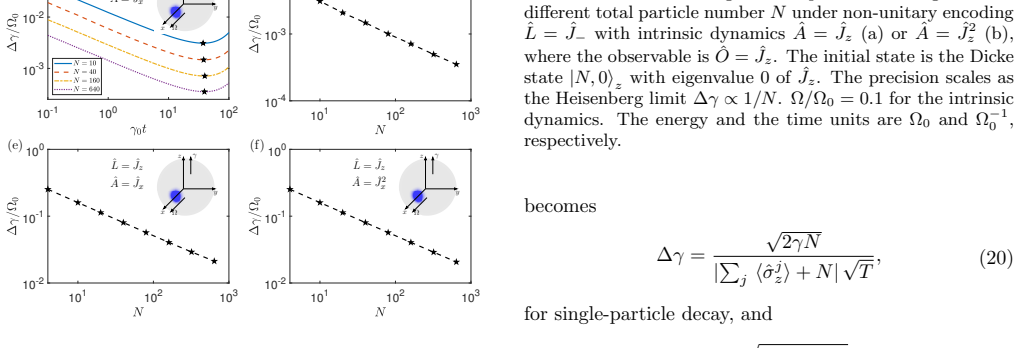
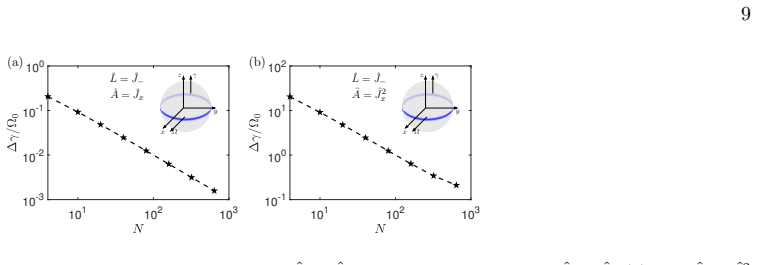
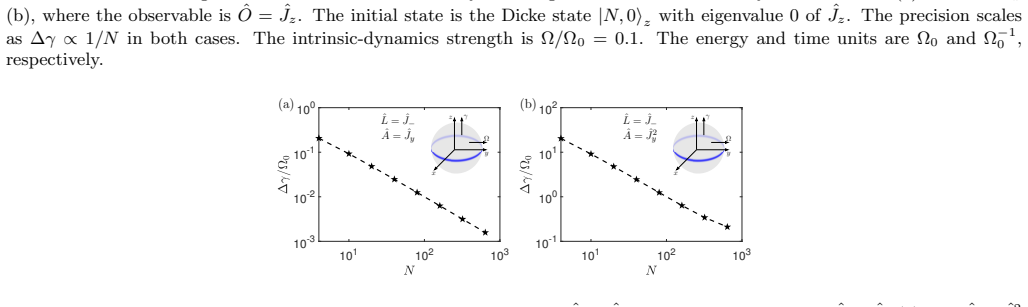
Dicke states reach the Heisenberg limit for estimating collective decay rates via non-unitary encoding.
A machine-rendered reading of the paper's core claim, the machinery that carries it, and where it could break.
Core claim
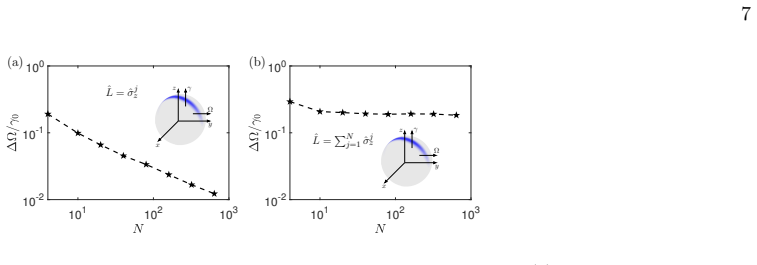
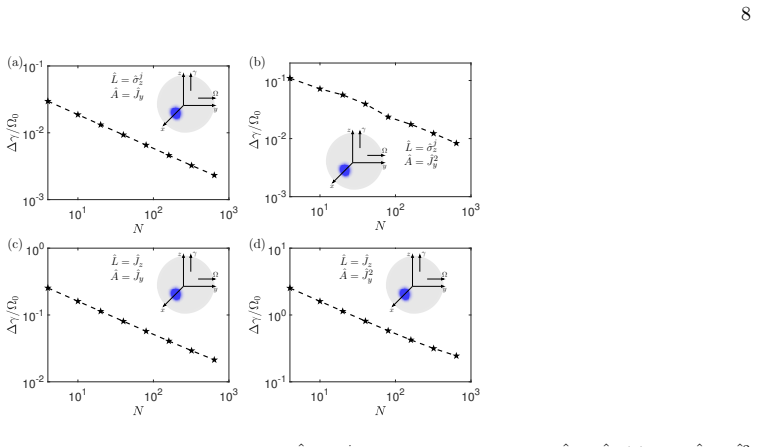
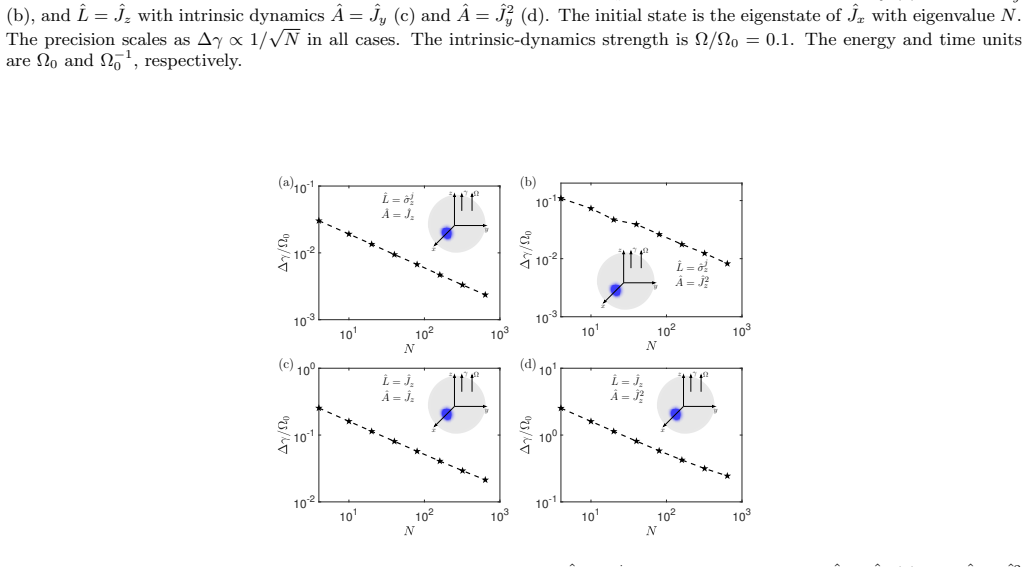
Using linear response theory and the error propagation formula, analytic precision expressions are obtained for both the unitary parameter Ω and the dissipation strength γ. For unitary encoding, when the observable commutes with a Hermitian noise operator the optimal encoding time is independent of N and yields ΔΩ ∝ 1/N; otherwise precision degrades to the standard quantum limit or ceases to improve with N. For non-unitary encoding, when [Â, Ô] = 0 the precision is insensitive to intrinsic dynamics and encoding time, scaling as Δγ ∝ √(γ / ⟨L̂† L̂⟩). Notably, for collective decay the Dicke state reaches the Heisenberg limit Δγ ∝ 1/N, demonstrating that entanglement can enhance non-unitary e
What carries the argument
Linear response theory together with the error propagation formula applied across unitary and non-unitary encodings under single-particle versus collective noise, with the Dicke state providing the entangled resource that recovers 1/N scaling specifically for collective decay.
If this is right
- Unitary encoding reaches Heisenberg scaling only when the observable commutes with the noise operator; otherwise scaling is at best standard quantum limit.
- Non-unitary encoding of γ yields time-independent precision scaling as the square root of γ over the relevant expectation value whenever the relevant operators commute.
- Collective decay is the only noise model among those considered in which an entangled state recovers Heisenberg scaling for the non-unitary parameter.
- The results supply explicit expressions that can be used to choose encoding time and initial state for a given noise type.
Where Pith is reading between the lines
- Metrology protocols could deliberately switch between unitary and non-unitary encoding depending on whether the dominant noise is dephasing or decay.
- Similar entangled-state advantages may appear when estimating other open-system parameters such as jump rates in quantum optics or transport coefficients in many-body systems.
- The commutation condition that makes non-unitary precision insensitive to dynamics suggests searching for observables that satisfy it in new physical platforms.
Load-bearing premise
Linear response theory and the error propagation formula remain valid when deriving the stated analytic precision expressions under the listed noise models.
What would settle it
An experiment that prepares a Dicke state, lets it undergo collective decay, estimates the decay rate γ, and measures a precision scaling worse than 1/N would falsify the claim that this state reaches the Heisenberg limit.
Figures
read the original abstract
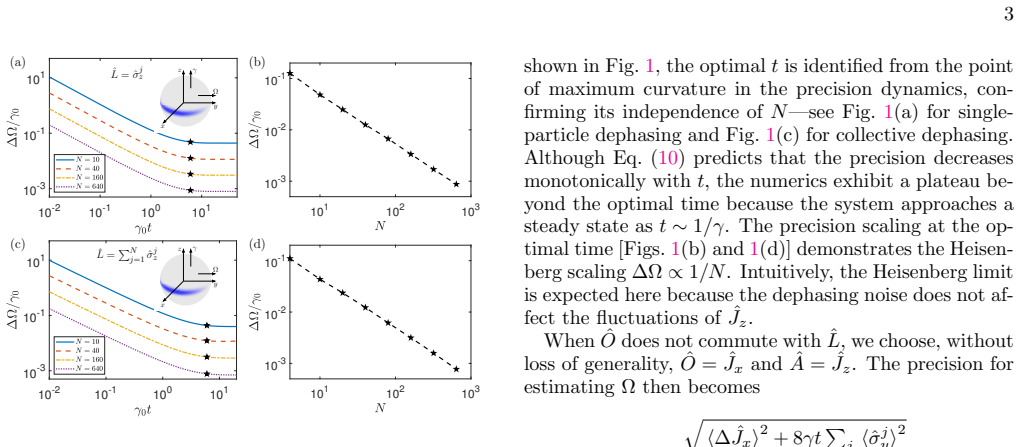
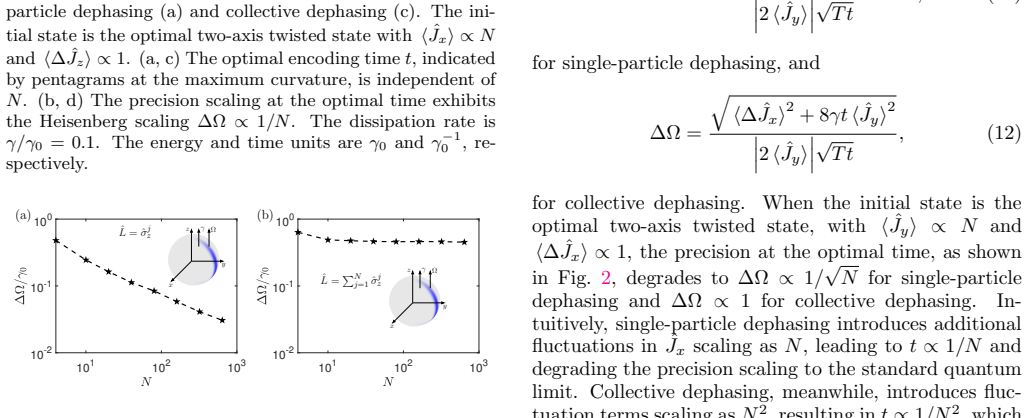
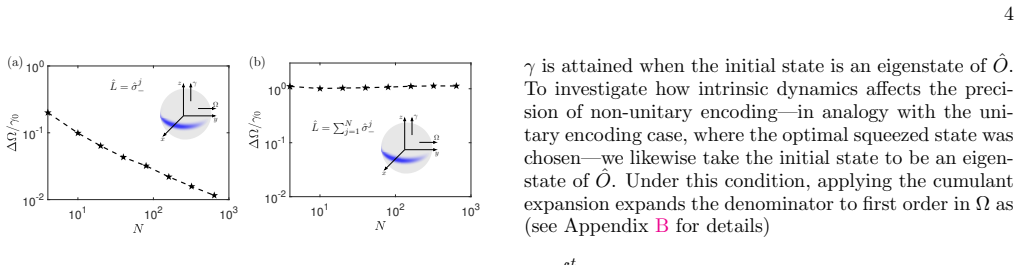
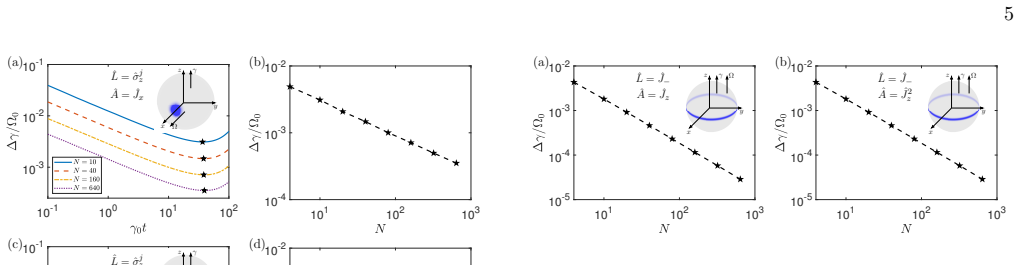
We investigate precision scaling at the interface between unitary and non-unitary encoding under generalized noise including single-particle and collective dephasing and decay. Using linear response theory and the error propagation formula, we derive analytic precision expressions for both the unitary parameter $\Omega$ and the dissipation strength $\gamma$. For unitary encoding, when the observable commutes with a Hermitian noise operator, the optimal encoding time is independent of $N$, yielding the Heisenberg limit $\Delta \Omega \propto 1 / N$; otherwise the precision degrades to the standard quantum limit or ceases to improve with $N$. For non-unitary encoding, when $[\hat{A}, \hat{O}] = 0$, the precision is insensitive to intrinsic dynamics and encoding time, scaling as $\Delta \gamma \propto \sqrt{\gamma / \expval*{\hat{L}^\dagger \hat{L}}}$. Notably, for collective decay, the Dicke state reaches the Heisenberg limit $\Delta \gamma \propto 1 / N$, demonstrating that entanglement can enhance non-unitary estimation. Our results provide a unified framework and practical guidance for designing quantum metrology protocols in noisy environments.
Editorial analysis
A structured set of objections, weighed in public.
Referee Report
Summary. The manuscript analyzes precision scaling for estimating a unitary parameter Ω and a non-unitary dissipation strength γ under single-particle and collective dephasing/decay noise. It employs linear response theory combined with the error propagation formula to obtain analytic expressions for the uncertainties ΔΩ and Δγ. For unitary encoding, commutation of the observable with the noise operator determines whether the Heisenberg limit ΔΩ ∝ 1/N is retained or the scaling reverts to the standard quantum limit. For non-unitary encoding, when [Â, Ô] = 0 the precision becomes independent of intrinsic dynamics and encoding time, scaling as Δγ ∝ √(γ / ⟨L̂†L̂⟩); notably, the Dicke state under collective decay is reported to achieve the Heisenberg limit Δγ ∝ 1/N.
Significance. If the linear-response derivations remain valid, the work supplies a compact analytic framework that unifies unitary and non-unitary metrology under generalized noise and shows that entanglement can improve precision for dissipative parameter estimation—an observation with potential implications for quantum sensing protocols that exploit or mitigate dissipation.
major comments (2)
- [non-unitary encoding / collective decay paragraph] The headline non-unitary result (Dicke state reaching Δγ ∝ 1/N under collective decay) is obtained exclusively from the linear-response signal and the error-propagation formula applied to the unperturbed state. For collective jump operators acting on fully symmetric entangled states, the first-order master-equation expansion may miss non-commuting higher-order contributions that alter the effective sensitivity; the manuscript does not provide an explicit check of the approximation’s range of validity or a comparison with the exact short-time dynamics.
- [unitary encoding / commutation condition] The claim that the optimal encoding time is independent of N when [Â, Ô] = 0 for unitary encoding rests on the linear-response expressions; however, the manuscript does not quantify the regime in which the first-order response remains accurate relative to the noise strength and the collective coupling, leaving open whether the reported N-independence survives beyond the linear regime.
minor comments (2)
- [abstract] The abstract states that analytic expressions are derived but supplies neither the explicit forms nor the intermediate steps; including the key intermediate expressions (even in an appendix) would allow readers to verify the commutation conditions and the origin of the √γ scaling.
- [introduction / methods] Notation for the noise operators (L̂, Â, Ô) is introduced without an explicit table or paragraph defining their action on the N-particle Hilbert space for the collective versus single-particle cases.
Simulated Author's Rebuttal
We thank the referee for the careful reading and constructive comments regarding the validity of our linear-response derivations. We respond to each major comment below and will incorporate clarifications in the revised manuscript.
read point-by-point responses
-
Referee: [non-unitary encoding / collective decay paragraph] The headline non-unitary result (Dicke state reaching Δγ ∝ 1/N under collective decay) is obtained exclusively from the linear-response signal and the error-propagation formula applied to the unperturbed state. For collective jump operators acting on fully symmetric entangled states, the first-order master-equation expansion may miss non-commuting higher-order contributions that alter the effective sensitivity; the manuscript does not provide an explicit check of the approximation’s range of validity or a comparison with the exact short-time dynamics.
Authors: Our derivations employ linear-response theory to extract the leading-order scalings in the small-parameter regime, which is the standard approach for analytic metrology bounds. For the fully symmetric Dicke states under collective decay, the commutation structure within the symmetric subspace ensures the first-order term governs the Heisenberg scaling. We agree an explicit validity discussion would strengthen the presentation and will add a paragraph specifying the regime γt ≪ 1 together with a brief numerical comparison to exact short-time evolution for small N. revision: yes
-
Referee: [unitary encoding / commutation condition] The claim that the optimal encoding time is independent of N when [Â, Ô] = 0 for unitary encoding rests on the linear-response expressions; however, the manuscript does not quantify the regime in which the first-order response remains accurate relative to the noise strength and the collective coupling, leaving open whether the reported N-independence survives beyond the linear regime.
Authors: Within the linear-response framework the analytic expressions indeed yield an N-independent optimal time when [Â, Ô] = 0. We will revise the text to explicitly delineate the validity window (Ωt ≪ 1 and γt ≪ 1 relative to the collective coupling strength), thereby clarifying that the reported N-independence and scalings are guaranteed inside this regime, which is the domain of the compact analytic framework presented. revision: yes
Circularity Check
No circularity; analytic expressions follow directly from standard linear response and error propagation applied to noise operators
full rationale
The paper derives its precision scalings (including Δγ ∝ 1/N for collective decay on the Dicke state) by applying linear response theory and the error propagation formula to the given unitary and dissipative generators. These are external, standard techniques whose validity is assumed rather than derived within the paper; the resulting expressions for ΔΩ and Δγ are obtained by direct substitution of the commutators and expectation values of the noise operators L̂ without any parameter fitting, self-definition of the target quantity, or load-bearing self-citation. No equation reduces the claimed Heisenberg scaling to an input by construction, and the abstract and derivation outline present the results as consequences of the external approximations rather than tautological renamings.
Axiom & Free-Parameter Ledger
axioms (2)
- domain assumption Linear response theory applies to the unitary and dissipative dynamics under the stated noise channels.
- domain assumption The error propagation formula gives the correct uncertainty for the chosen observables.
Reference graph
Works this paper leans on
-
[1]
C. L. Degen, F. Reinhard, and P. Cappellaro, Quantum sensing, Rev. Mod. Phys.89, 035002 (2017)
2017
-
[2]
Braun, G
D. Braun, G. Adesso, F. Benatti, R. Floreanini, U. Marzolino, M. W. Mitchell, and S. Pirandola, Quantum-enhanced measurements without entanglement, Rev. Mod. Phys.90, 035006 (2018)
2018
-
[3]
Pezz` e, A
L. Pezz` e, A. Smerzi, M. K. Oberthaler, R. Schmied, and P. Treutlein, Quantum metrology with nonclassical states of atomic ensembles, Rev. Mod. Phys.90, 035005 (2018)
2018
-
[4]
Montenegro, C
V. Montenegro, C. Mukhopadhyay, R. Yousefjani, S. Sarkar, U. Mishra, M. G. Paris, and A. Bayat, Quantum metrology and sensing with many-body systems, Phys. Rep.1134, 1 (2025)
2025
-
[5]
Xu and G
P. Xu and G. Chen, Precision measurement for open systems by the non-hermitian linear response, Phys. Rev. A111, 022220 (2025)
2025
-
[6]
B. P. Abbott, R. Abbott, T. D. Abbott,et al.(LIGO Scientific Collaboration and Virgo Collaboration), Gw150914: The advanced ligo detectors in the era of first discoveries, Phys. Rev. Lett.116, 131103 (2016)
2016
-
[7]
W. J. Eckner, N. Darkwah Oppong, A. Cao, A. W. Young, W. R. Milner, J. M. Robinson, J. Ye, and A. M. Kaufman, Realizing spin squeezing with rydberg interactions in an optical clock, Nature621, 734 (2023)
2023
-
[8]
A. Cao, W. J. Eckner, T. Lukin Yelin, A. W. Young, S. Jandura, L. Yan, K. Kim, G. Pupillo, J. Ye, N. Darkwah Oppong, et al., Multi-qubit gates and schr¨ odinger cat states in an optical clock, Nature634, 315 (2024). 10
2024
-
[9]
J. M. Robinson, M. Miklos, Y. M. Tso, C. J. Kennedy, T. Bothwell, D. Kedar, J. K. Thompson, and J. Ye, Direct comparison of two spin-squeezed optical clock ensembles at the 10 −17 level, Nat. Phys.20, 208 (2024)
2024
-
[10]
Zaporski, Q
L. Zaporski, Q. Liu, G. Velez, M. Radzihovsky, Z. Li, S. Colombo, E. Pedrozo-Pe˜ nafiel, and V. Vuleti´ c, Quantum-amplified global-phase spectroscopy on an optical clock transition, Nature646, 309 (2025)
2025
-
[11]
R. J. Sewell, M. Koschorreck, M. Napolitano, B. Dubost, N. Behbood, and M. W. Mitchell, Magnetic sensitivity beyond the projection noise limit by spin squeezing, Phys. Rev. Lett.109, 253605 (2012)
2012
-
[12]
Ding, Z.-K
D.-S. Ding, Z.-K. Liu, B.-S. Shi, G.-C. Guo, K. Mølmer, and C. S. Adams, Enhanced metrology at the critical point of a many-body rydberg atomic system, Nat. Phys.18, 1447 (2022)
2022
-
[13]
T.-W. Mao, Q. Liu, X.-W. Li, J.-H. Cao, F. Chen, W.-X. Xu, M. K. Tey, Y.-X. Huang, and L. You, Quantum-enhanced sensing by echoing spin-nematic squeezing in atomic bose–einstein condensate, Nat. Phys.19, 1585 (2023)
2023
-
[14]
L. J. I. Moon, P. M. Schindler, R. J. Smith, E. Druga, Z.-R. Zhang, M. Bukov, and A. Ajoy, Sensing with discrete time crystals, Nat. Phys.22, 367 (2026)
2026
-
[15]
L. Jiao, W. Wu, S.-Y. Bai, and J.-H. An, Quantum metrology in the noisy intermediate-scale quantum era, Adv. Quantum Technol.8, 2300218 (2025)
2025
-
[16]
S. F. Huelga, C. Macchiavello, T. Pellizzari, A. K. Ekert, M. B. Plenio, and J. I. Cirac, Improvement of frequency standards with quantum entanglement, Phys. Rev. Lett.79, 3865 (1997)
1997
-
[17]
Escher, R
B. Escher, R. L. de Matos Filho, and L. Davidovich, General framework for estimating the ultimate precision limit in noisy quantum-enhanced metrology, Nat. Phys.7, 406 (2011)
2011
-
[18]
Demkowicz-Dobrza´ nski, J
R. Demkowicz-Dobrza´ nski, J. Ko lody´ nski, and M. Gut ¸˘ a, The elusive heisenberg limit in quantum-enhanced metrology, Nat. Commun.3, 1063 (2012)
2012
-
[19]
D¨ ur, M
W. D¨ ur, M. Skotiniotis, F. Fr¨ owis, and B. Kraus, Improved quantum metrology using quantum error correction, Phys. Rev. Lett.112, 080801 (2014)
2014
-
[20]
E. M. Kessler, I. Lovchinsky, A. O. Sushkov, and M. D. Lukin, Quantum error correction for metrology, Phys. Rev. Lett. 112, 150802 (2014)
2014
-
[21]
D. A. Herrera-Mart´ ı, T. Gefen, D. Aharonov, N. Katz, and A. Retzker, Quantum error-correction-enhanced magnetometer overcoming the limit imposed by relaxation, Phys. Rev. Lett.115, 200501 (2015)
2015
-
[22]
E. L. Hahn, Spin echoes, Phys. Rev.80, 580 (1950)
1950
-
[23]
H. Y. Carr and E. M. Purcell, Effects of diffusion on free precession in nuclear magnetic resonance experiments, Phys. Rev. 94, 630 (1954)
1954
-
[24]
Meiboom and D
S. Meiboom and D. Gill, Modified spin-echo method for measuring nuclear relaxation times, Rev. Sci. Instrum.29, 688 (1958)
1958
-
[25]
Khodjasteh and D
K. Khodjasteh and D. A. Lidar, Fault-tolerant quantum dynamical decoupling, Phys. Rev. Lett.95, 180501 (2005)
2005
-
[26]
G. S. Uhrig, Keeping a quantum bit alive by optimizedπ-pulse sequences, Phys. Rev. Lett.98, 100504 (2007)
2007
-
[27]
G. S. Uhrig, Concatenated control sequences based on optimized dynamic decoupling, Phys. Rev. Lett.102, 120502 (2009)
2009
-
[28]
Q. Yao, J. Zhang, X.-F. Yi, L. You, and W. Zhang, Uniaxial dynamical decoupling for an open quantum system, Phys. Rev. Lett.122, 010408 (2019)
2019
-
[29]
Xu and J
P. Xu and J. Zhang, Floquet dynamical decoupling at zero bias, Phys. Rev. B108, 174310 (2023)
2023
-
[30]
Zhang, P
J. Zhang, P. Du, L. Jing, P. Xu, L. You, and W. Zhang, Enhanced measurement precision with continuous interrogation during dynamical decoupling, Chinese Physics B33, 030301 (2024)
2024
-
[31]
Goldstein, P
G. Goldstein, P. Cappellaro, J. R. Maze, J. S. Hodges, L. Jiang, A. S. Sørensen, and M. D. Lukin, Environment-assisted precision measurement, Phys. Rev. Lett.106, 140502 (2011)
2011
-
[32]
Cappellaro, G
P. Cappellaro, G. Goldstein, J. S. Hodges, L. Jiang, J. R. Maze, A. S. Sørensen, and M. D. Lukin, Environment-assisted metrology with spin qubits, Phys. Rev. A85, 032336 (2012)
2012
-
[33]
Cooper, W
A. Cooper, W. K. C. Sun, J.-C. Jaskula, and P. Cappellaro, Environment-assisted quantum-enhanced sensing with elec- tronic spins in diamond, Phys. Rev. Appl.12, 044047 (2019)
2019
-
[34]
Gammelmark and K
S. Gammelmark and K. Mølmer, Fisher information and the quantum cram´ er-rao sensitivity limit of continuous measure- ments, Phys. Rev. Lett.112, 170401 (2014)
2014
-
[35]
Hirose and P
M. Hirose and P. Cappellaro, Coherent feedback control of a single qubit in diamond, Nature532, 77 (2016)
2016
-
[36]
Bai and J.-H
S.-Y. Bai and J.-H. An, Floquet engineering to overcome no-go theorem of noisy quantum metrology, Phys. Rev. Lett. 131, 050801 (2023)
2023
-
[37]
Matsuzaki, S
Y. Matsuzaki, S. C. Benjamin, and J. Fitzsimons, Magnetic field sensing beyond the standard quantum limit under the effect of decoherence, Phys. Rev. A84, 012103 (2011)
2011
-
[38]
A. W. Chin, S. F. Huelga, and M. B. Plenio, Quantum metrology in non-markovian environments, Phys. Rev. Lett.109, 233601 (2012)
2012
-
[39]
Alipour, M
S. Alipour, M. Mehboudi, and A. T. Rezakhani, Quantum metrology in open systems: Dissipative cram´ er-rao bound, Phys. Rev. Lett.112, 120405 (2014)
2014
-
[40]
Macieszczak, Zeno limit in frequency estimation with non-markovian environments, Phys
K. Macieszczak, Zeno limit in frequency estimation with non-markovian environments, Phys. Rev. A92, 010102 (2015)
2015
-
[41]
Smirne, J
A. Smirne, J. Ko lody´ nski, S. F. Huelga, and R. Demkowicz-Dobrza´ nski, Ultimate precision limits for noisy frequency estimation, Phys. Rev. Lett.116, 120801 (2016)
2016
-
[42]
J. F. Haase, A. Smirne, J. Ko lody´ nski, R. Demkowicz-Dobrza´ nski, and S. F. Huelga, Fundamental limits to frequency estimation: a comprehensive microscopic perspective, New Journal of Physics20, 053009 (2018)
2018
-
[43]
J.-X. Peng, B. Zhu, W. Zhang, and K. Zhang, Enhanced quantum metrology with non-phase-covariant noise, Phys. Rev. Lett.133, 090801 (2024). 11
2024
-
[44]
Chaves, J
R. Chaves, J. B. Brask, M. Markiewicz, J. Ko lody´ nski, and A. Ac´ ın, Noisy metrology beyond the standard quantum limit, Phys. Rev. Lett.111, 120401 (2013)
2013
-
[45]
J. B. Brask, R. Chaves, and J. Ko lody´ nski, Improved quantum magnetometry beyond the standard quantum limit, Phys. Rev. X5, 031010 (2015)
2015
-
[46]
De Pasquale, D
A. De Pasquale, D. Rossini, P. Facchi, and V. Giovannetti, Quantum parameter estimation affected by unitary disturbance, Phys. Rev. A88, 052117 (2013)
2013
-
[47]
W. Ding, X. Wang, and S. Chen, Fundamental sensitivity limits for non-hermitian quantum sensors, Phys. Rev. Lett.131, 160801 (2023)
2023
-
[48]
M. O. Scully and M. S. Zubairy,Quantum optics(Cambridge university press, 1997)
1997
-
[49]
L. Pan, X. Chen, Y. Chen, and H. Zhai, Non-hermitian linear response theory, Nat. Phys.16, 767 (2020)
2020
-
[50]
The error propagation formula is ∆ϕ= ∆ ˆOH(t)√ M|∂⟨ ˆO(t)⟩/∂ϕ|
-
[51]
Yoneya, K
T. Yoneya, K. Fujimoto, and Y. Kawaguchi, Path-integral formulation of truncated wigner approximation for bosonic markovian open quantum systems, Ann. Phys.479, 170072 (2025)
2025
discussion (0)
Sign in with ORCID, Apple, or X to comment. Anyone can read and Pith papers without signing in.