ChartLens: A Dual-Branch Framework for Chart Data Correction and Factual Summary Refinement
Pith reviewed 2026-06-27 13:56 UTC · model grok-4.3
The pith
A dual-branch system corrects chart data extraction and refines factual summaries from images.
A machine-rendered reading of the paper's core claim, the machinery that carries it, and where it could break.
Core claim
ChartLens consists of a Structure-Aware CSV Verification and Correction module that checks and fixes extracted chart data for structural consistency and a Text-Retention-Guided Summary Refinement module that preserves critical evidence during summary generation; together with model adaptation and OCR grounding these steps improve both structured data accuracy and summary factuality on chart images.
What carries the argument
Dual-branch framework with SAVC (Structure-Aware CSV Verification and Correction) for data reliability and TRSR (Text-Retention-Guided Summary Refinement) for evidence preservation.
If this is right
- Structured chart data becomes more consistent after verification and correction steps.
- Summaries retain more of the original numerical and textual evidence from the chart image.
- The combined pipeline outperforms single-branch baselines on both data recovery and factuality metrics.
- OCR-assisted grounding reduces hallucinated values in the final output.
Where Pith is reading between the lines
- The same correction-and-retention pattern could apply to other image-to-text tasks that require both structured output and narrative fidelity.
- Performance may depend on the quality of the initial OCR step; weaker OCR would limit how much evidence TRSR can retain.
- If the test distribution shifts away from the training charts, the correction modules might require retraining to maintain the reported score.
Load-bearing premise
The SAVC and TRSR modules produce reliable corrections on the challenge test distribution without adding new factual errors.
What would settle it
Independent re-evaluation of the released system on the same test charts yields a score below 69.10 or shows introduced factual mismatches in the generated summaries.
Figures


read the original abstract
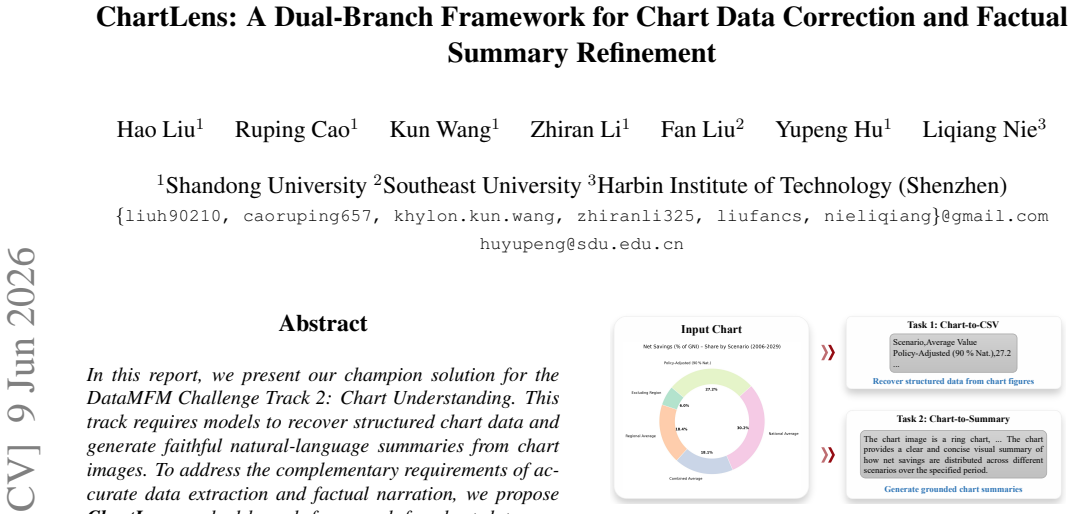
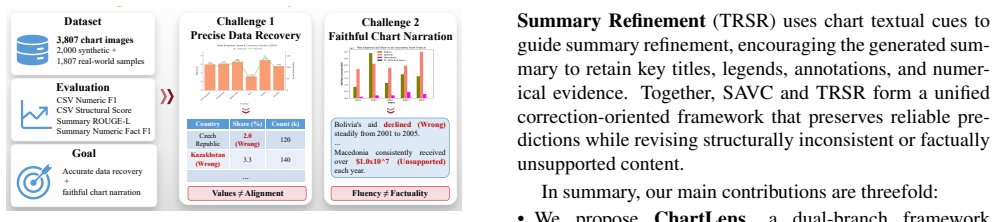
In this report, we present our champion solution for the DataMFM Challenge Track 2: Chart Understanding. This track requires models to recover structured chart data and generate faithful natural-language summaries from chart images. To address the complementary requirements of accurate data extraction and factual narration, we propose ChartLens, a dual-branch framework for chart data correction and summary refinement. ChartLens consists of two key modules: Structure-Aware CSV Verification and Correction (SAVC) and Text-Retention-Guided Summary Refinement (TRSR). SAVC improves the reliability of structured data extraction through verification and correction, while TRSR enhances summary generation by preserving critical textual and numerical evidence from charts. By combining model adaptation, correction-based generation, and OCR-assisted evidence grounding, ChartLens improves both structured data recovery and summary factuality. On the test set, our final system achieves an overall score of 69.10 and ranks first in Track 2, demonstrating its effectiveness for accurate chart understanding. Our code will be released at: https://github.com/iLearn-Lab/CVPRW26-ChartLens.
Editorial analysis
A structured set of objections, weighed in public.
Referee Report
Summary. The manuscript presents ChartLens, a dual-branch framework for the DataMFM Challenge Track 2 on chart understanding. It consists of Structure-Aware CSV Verification and Correction (SAVC) and Text-Retention-Guided Summary Refinement (TRSR) modules, combined with model adaptation, correction-based generation, and OCR-assisted evidence grounding. The central claim is that this approach improves structured data recovery and summary factuality, achieving an overall score of 69.10 and first place on the test set.
Significance. If substantiated with detailed evidence, the result would indicate that targeted verification/correction and evidence-preservation modules can enhance both data extraction accuracy and factual consistency in chart-to-text tasks. The stated intention to release code at the provided GitHub link supports reproducibility.
major comments (2)
- [Abstract] Abstract: The claim that ChartLens 'improves both structured data recovery and summary factuality' and achieves first place with score 69.10 is unsupported by any quantitative results, ablation studies, baseline comparisons, error analysis, or module-specific metrics within the manuscript.
- [Abstract] Abstract: The descriptions of SAVC ('verification and correction') and TRSR ('preserving critical textual and numerical evidence') provide no error rates, failure cases, or evidence that the modules avoid introducing new factual inaccuracies on the held-out test distribution, which is required to attribute the reported score to the dual-branch framework.
Simulated Author's Rebuttal
We thank the referee for the constructive feedback on our manuscript. We agree that the current version lacks sufficient quantitative support for the claims and will revise it to include additional analyses and evidence.
read point-by-point responses
-
Referee: [Abstract] Abstract: The claim that ChartLens 'improves both structured data recovery and summary factuality' and achieves first place with score 69.10 is unsupported by any quantitative results, ablation studies, baseline comparisons, error analysis, or module-specific metrics within the manuscript.
Authors: We acknowledge that the provided manuscript text focuses primarily on the high-level description and final challenge score. To substantiate the claims of improvement, the revised manuscript will incorporate ablation studies, baseline comparisons, and module-specific metrics evaluated on the validation set. revision: yes
-
Referee: [Abstract] Abstract: The descriptions of SAVC ('verification and correction') and TRSR ('preserving critical textual and numerical evidence') provide no error rates, failure cases, or evidence that the modules avoid introducing new factual inaccuracies on the held-out test distribution, which is required to attribute the reported score to the dual-branch framework.
Authors: We agree that error rates, failure cases, and evidence against introducing new inaccuracies are needed for proper attribution. The revision will add an error analysis section with validation-set metrics and examples demonstrating the modules' contributions. However, detailed analysis on the held-out test distribution is constrained by the unavailability of per-instance ground truth beyond the aggregate score. revision: partial
- Detailed per-instance error rates and failure case analysis specifically on the held-out test distribution, due to the challenge setup not providing public ground-truth labels for individual test examples.
Circularity Check
No significant circularity; empirical competition report with no derivations
full rationale
The paper is a systems description of a dual-branch framework (SAVC and TRSR modules) for a data challenge, reporting an empirical test score of 69.10 and first-place ranking. No equations, derivations, fitted parameters, predictions, or self-citations appear in the provided text. The central claim rests on external challenge evaluation rather than any internal reduction to inputs by construction. This is the most common honest finding for competition reports.
Axiom & Free-Parameter Ledger
Forward citations
Cited by 1 Pith paper
-
ParseFixer: An Agentic Framework for Document Parsing via Selective Multimodal Correction
ParseFixer combines full-page backbone parsing with agentic selective multimodal correction to reach third place (score 61.78) in the DataMFM Challenge Track 1.
Reference graph
Works this paper leans on
-
[1]
PaddleOCR 3.0 Technical Report
Cheng Cui, Ting Sun, Manhui Lin, Tingquan Gao, Yubo Zhang, Jiaxuan Liu, Xueqing Wang, Zelun Zhang, Changda Zhou, Hongen Liu, et al. Paddleocr 3.0 technical report. arXiv preprint arXiv:2507.05595, 2025. 4, 6
work page internal anchor Pith review Pith/arXiv arXiv 2025
-
[2]
Doc-researcher: A unified system for multi- modal document parsing and deep research
Kuicai Dong, Shurui Huang, Fangda Ye, Wei Han, Zhi Zhang, Dexun Li, Wenjun Li, Qu Yang, Gang Wang, Yichao Wang, et al. Doc-researcher: A unified system for multi- modal document parsing and deep research. InProceedings of the ACM Web Conference 2026, pages 2349–2360, 2026. 1
2026
-
[3]
Gemini 3.5 flash model card.https: / / deepmind
Google DeepMind. Gemini 3.5 flash model card.https: / / deepmind . google / models / model - cards / gemini-3-5-flash/, 2026. Accessed: 2026-06-06. 3, 6
2026
-
[4]
Lora: Low- rank adaptation of large language models
Edward J Hu, Phillip Wallis, Zeyuan Allen-Zhu, Yuanzhi Li, Shean Wang, Lu Wang, Weizhu Chen, et al. Lora: Low- rank adaptation of large language models. InInternational Conference on Learning Representations, pages 1–20, 2022. 3, 4, 6
2022
-
[5]
Video moment localization via deep cross-modal hash- ing.IEEE Transactions on Image Processing, 30:4667– 4677, 2021
Yupeng Hu, Meng Liu, Xiaobin Su, Zan Gao, and Liqiang Nie. Video moment localization via deep cross-modal hash- ing.IEEE Transactions on Image Processing, 30:4667– 4677, 2021. 1
2021
-
[6]
Coarse-to-fine semantic align- ment for cross-modal moment localization.IEEE Transac- tions on Image Processing, 30:5933–5943, 2021
Yupeng Hu, Liqiang Nie, Meng Liu, Kun Wang, Yinglong Wang, and Xian-Sheng Hua. Coarse-to-fine semantic align- ment for cross-modal moment localization.IEEE Transac- tions on Image Processing, 30:5933–5943, 2021
2021
-
[7]
Semantic collaborative learning for cross-modal mo- ment localization.ACM Transactions on Information Sys- tems, 42(2):1–26, 2023
Yupeng Hu, Kun Wang, Meng Liu, Haoyu Tang, and Liqiang Nie. Semantic collaborative learning for cross-modal mo- ment localization.ACM Transactions on Information Sys- tems, 42(2):1–26, 2023. 1
2023
-
[8]
Visual self-paced iterative learning for un- supervised temporal action localization.ACM Transactions on Multimedia Computing, Communications and Applica- tions, 2026
Yupeng Hu, Han Jiang, Hao Liu, Kun Wang, Haoyu Tang, and Liqiang Nie. Visual self-paced iterative learning for un- supervised temporal action localization.ACM Transactions on Multimedia Computing, Communications and Applica- tions, 2026. 1
2026
-
[9]
From a glance to a boundary: Uncertainty- aware distillation for glance-supervised video moment local- ization.IEEE Transactions on Multimedia, 2026
Yupeng Hu, Hao Liu, Kun Wang, Ruping Cao, Yinwei Wei, and Liqiang Nie. From a glance to a boundary: Uncertainty- aware distillation for glance-supervised video moment local- ization.IEEE Transactions on Multimedia, 2026. 1
2026
-
[10]
From pixels to insights: A survey on automatic chart understanding in the era of large foundation models.IEEE Transactions on Knowledge and Data Engineering, 37(5): 2550–2568, 2024
Kung-Hsiang Huang, Hou Pong Chan, May Fung, Haoyi Qiu, Mingyang Zhou, Shafiq Joty, Shih-Fu Chang, and Heng Ji. From pixels to insights: A survey on automatic chart understanding in the era of large foundation models.IEEE Transactions on Knowledge and Data Engineering, 37(5): 2550–2568, 2024. 1
2024
-
[11]
Granite 4.1 language models.https:// huggingface.co/blog/ibm- granite/granit- 4-1, 2026
IBM Research. Granite 4.1 language models.https:// huggingface.co/blog/ibm- granite/granit- 4-1, 2026. Accessed: 2026-04-28. 3, 4, 6
2026
-
[12]
Chartnet: A million-scale, high-quality multimodal dataset for robust chart understanding
Jovana Kondic, Pengyuan Li, Dhiraj Joshi, Isaac Sanchez, Ben Wiesel, Shafiq Abedin, Amit Alfassy, Eli Schwartz, Daniel Caraballo, Yagmur Gizem Cinar, et al. Chartnet: A million-scale, high-quality multimodal dataset for robust chart understanding. InProceedings of the IEEE/CVF Con- ference on Computer Vision and Pattern Recognition, pages 15922–15932, 202...
2026
-
[13]
Blip: Bootstrapping language-image pre-training for unified vision-language understanding and generation
Junnan Li, Dongxu Li, Caiming Xiong, and Steven Hoi. Blip: Bootstrapping language-image pre-training for unified vision-language understanding and generation. InInterna- tional conference on machine learning, pages 12888–12900. PMLR, 2022. 1
2022
-
[14]
Blip-2: Bootstrapping language-image pre-training with frozen image encoders and large language models
Junnan Li, Dongxu Li, Silvio Savarese, and Steven Hoi. Blip-2: Bootstrapping language-image pre-training with frozen image encoders and large language models. InIn- ternational conference on machine learning, pages 19730– 19742. PMLR, 2023. 1
2023
-
[15]
Efficient document parsing via parallel token prediction
Lei Li, Ze Zhao, Meng Li, Zhongwang Lun, Yi Yuan, Xingjing Lu, Zheng Wei, Jiang Bian, and Zang Li. Efficient document parsing via parallel token prediction. InProceed- ings of the IEEE/CVF Conference on Computer Vision and Pattern Recognition, pages 2763–2772, 2026. 1
2026
-
[16]
Dcount: Decoupled spatial perception and attribute discrimination for referring expression counting
Ming Li, Yupeng Hu, Yinwei Wei, Hao Liu, Haocong Wang, and Weili Guan. Dcount: Decoupled spatial perception and attribute discrimination for referring expression counting. In Proceedings of the 33rd ACM International Conference on Multimedia, pages 5306–5315, 2025. 1
2025
-
[17]
Mist: Towards multi-dimensional implicit bias and stereotype evaluation of llms via theory of mind.arXiv e- prints, pages arXiv–2506, 2025
Yanlin Li, Hao Liu, Huimin Liu, Yinwei Wei, and Yupeng Hu. Mist: Towards multi-dimensional implicit bias and stereotype evaluation of llms via theory of mind.arXiv e- prints, pages arXiv–2506, 2025. 1
2025
-
[18]
Unim: A unified any-to- any interleaved multimodal benchmark
Yanlin Li, Minghui Guo, Kaiwen Zhang, Shize Zhang, Yiran Zhao, Haodong Li, Congyue Zhou, Weijie Zheng, Yushen Yan, Shengqiong Wu, et al. Unim: A unified any-to- any interleaved multimodal benchmark. InProceedings of the IEEE/CVF Conference on Computer Vision and Pattern Recognition, pages 15902–15911, 2026. 1
2026
-
[19]
Gaming for boundary: Elastic localization for frame- supervised video moment retrieval
Hao Liu, Yupeng Hu, Kun Wang, Yinwei Wei, and Liqiang Nie. Gaming for boundary: Elastic localization for frame- supervised video moment retrieval. InProceedings of the 48th International ACM SIGIR Conference on Research and Development in Information Retrieval, pages 917–926,
-
[20]
Curmim: Curricu- lum masked image modeling
Hao Liu, Kun Wang, Yudong Han, Haocong Wang, Yupeng Hu, Chunxiao Wang, and Liqiang Nie. Curmim: Curricu- lum masked image modeling. InICASSP 2025-2025 IEEE International Conference on Acoustics, page 2041, 2025. 1
2025
-
[21]
GPT-5.5 System Card.https://openai
OpenAI. GPT-5.5 System Card.https://openai. com/index/gpt- 5- 5- system- card/, 2026. Ac- cessed: 2026-06-06. 4, 6
2026
-
[22]
Omnidocbench: Benchmarking di- verse pdf document parsing with comprehensive annotations
Linke Ouyang, Yuan Qu, Hongbin Zhou, Jiawei Zhu, Rui Zhang, Qunshu Lin, Bin Wang, Zhiyuan Zhao, Man Jiang, Xiaomeng Zhao, et al. Omnidocbench: Benchmarking di- verse pdf document parsing with comprehensive annotations. InProceedings of the IEEE/CVF Conference on Computer Vision and Pattern Recognition, pages 24838–24848, 2025. 1
2025
-
[23]
Learning transferable visual models from natural language supervi- sion
Alec Radford, Jong Wook Kim, Chris Hallacy, Aditya Ramesh, Gabriel Goh, Sandhini Agarwal, Girish Sastry, Amanda Askell, Pamela Mishkin, Jack Clark, et al. Learning transferable visual models from natural language supervi- sion. InInternational conference on machine learning, pages 8748–8763. PMLR, 2021. 1
2021
-
[24]
Explicit granularity and implicit scale corre- spondence learning for point-supervised video moment lo- calization
Kun Wang, Hao Liu, Lirong Jie, Zixu Li, Yupeng Hu, and Liqiang Nie. Explicit granularity and implicit scale corre- spondence learning for point-supervised video moment lo- calization. InProceedings of the 32nd ACM International Conference on Multimedia, pages 9214–9223, 2024. 1
2024
-
[25]
Redundancy mitigation: Towards accurate and efficient image-text retrieval.IEEE Transactions on Circuits and Sys- tems for Video Technology, 2025
Kun Wang, Yupeng Hu, Hao Liu, Lirong Jie, and Liqiang Nie. Redundancy mitigation: Towards accurate and efficient image-text retrieval.IEEE Transactions on Circuits and Sys- tems for Video Technology, 2025. 1
2025
-
[26]
Cross-modal representation shift refinement for point- supervised video moment retrieval.ACM Transactions on Information Systems, 44(3):1–30, 2026
Kun Wang, Yupeng Hu, Hao Liu, Jiang Shao, and Liqiang Nie. Cross-modal representation shift refinement for point- supervised video moment retrieval.ACM Transactions on Information Systems, 44(3):1–30, 2026. 1
2026
-
[27]
Charxiv: Charting gaps in realistic chart understanding in multimodal llms.Advances in Neural In- formation Processing Systems, 37:113569–113697, 2024
Zirui Wang, Mengzhou Xia, Luxi He, Howard Chen, Yitao Liu, Richard Zhu, Kaiqu Liang, Xindi Wu, Haotian Liu, Sad- hika Malladi, et al. Charxiv: Charting gaps in realistic chart understanding in multimodal llms.Advances in Neural In- formation Processing Systems, 37:113569–113697, 2024. 1
2024
-
[28]
Dkdm: Data-free knowledge dis- tillation for diffusion models with any architecture
Qianlong Xiang, Miao Zhang, Yuzhang Shang, Jianlong Wu, Yan Yan, and Liqiang Nie. Dkdm: Data-free knowledge dis- tillation for diffusion models with any architecture. InPro- ceedings of the IEEE/CVF Conference on Computer Vision and Pattern Recognition, pages 2955–2965, 2025. 1
2025
-
[29]
Tina: Text-free inversion at- tack for unlearned text-to-image diffusion models
Qianlong Xiang, Miao Zhang, Haoyu Zhang, Kun Wang, Junhui Hou, and Liqiang Nie. Tina: Text-free inversion at- tack for unlearned text-to-image diffusion models. InPro- ceedings of the IEEE/CVF Conference on Computer Vision and Pattern Recognition, pages 30076–30086, 2026. 1
2026
-
[30]
Chartmoe: Mixture of di- versely aligned expert connector for chart understanding
Zhengzhuo Xu, Bowen Qu, Yiyan Qi, Sinan Du, Chengjin Xu, Chun Yuan, and Jian Guo. Chartmoe: Mixture of di- versely aligned expert connector for chart understanding. InInternational Conference on Learning Representations, pages 78550–78572, 2025. 1
2025
-
[31]
Cogcn: co-occurring item- aware gcn for recommendation.Neural computing and ap- plications, 35(36):25107–25120, 2023
Xinxiao Zhao, Fan Liu, Hao Liu, Mingzhu Xu, Haoyu Tang, Xueqing Li, and Yupeng Hu. Cogcn: co-occurring item- aware gcn for recommendation.Neural computing and ap- plications, 35(36):25107–25120, 2023. 1
2023
-
[32]
Chartcoder: Advancing multimodal large language model for chart-to-code gener- ation
Xuanle Zhao, Xianzhen Luo, Qi Shi, Chi Chen, Shuo Wang, Zhiyuan Liu, and Maosong Sun. Chartcoder: Advancing multimodal large language model for chart-to-code gener- ation. InProceedings of the 63rd Annual Meeting of the Association for Computational Linguistics (Volume 1: Long Papers), pages 7333–7348, 2025. 1 ChartLens: A Dual-Branch Framework for Chart ...
2025
-
[33]
Variables enclosed by braces, such as imagename,baseline csv, andocr reference, are replaced with instance-specific inputs during inference
Prompt Details This supplementary material provides the prompt templates used in ChartLens. Variables enclosed by braces, such as imagename,baseline csv, andocr reference, are replaced with instance-specific inputs during inference. 1.1. Direct Generation Prompt Direct Generation Prompt You are a chart understanding assistant. You will receive one chart i...
-
[34]
A structured CSV table that recovers the chart data
-
[35]
csv": "
A concise natural-language summary grounded in the chart. CSV requirements: * The CSV must have a header row. * Preserve visible categories, legends, series, and numerical values. * Use plain numeric cells whenever possible. * Put units in column names when needed. * Do not invent invisible rows, columns, labels, sources, or values. Summary requirements: ...
-
[36]
Compare every candidate CSV against the image
-
[37]
Select the candidate that best matches the image
-
[38]
Improve the selected CSV when it has small or moderate mistakes
-
[39]
csv": "
If all candidates are clearly inconsistent with the image, regenerate a new CSV from the image. Important decision rules: * Do NOT simply copy the best candidate. * If a candidate has the right table structure but a few values or labels are wrong, keep its structure and correct those values or labels. * If a candidate misses visible categories or visible ...
-
[40]
Make the smallest possible edits to the original summary
-
[41]
Preserve the original sentence order, paragraph structure, chart type, main trend descriptions, and numeric content unless the image clearly shows they are wrong
-
[42]
If the chart contains visible text such as title, subtitle, axis label, legend label, category label, source, note, or publisher, use the exact wording from the chart
-
[43]
Do NOT replace visible chart text with synonyms or expanded paraphrases
-
[44]
Trust the image over OCR when they conflict
-
[45]
Do not add invisible facts, invisible labels, or unsupported numeric values
-
[46]
summary":
Do not rewrite the whole summary unnecessarily. Return only one valid JSON object: { "summary": "..." } Final output requirements: * The summary must be a single paragraph string. * No Markdown. * No code fence. * No explanation outside JSON
discussion (0)
Sign in with ORCID, Apple, or X to comment. Anyone can read and Pith papers without signing in.