Isospin-symmetry in pp and AA collisions
Pith reviewed 2026-06-27 12:24 UTC · model grok-4.3
The pith
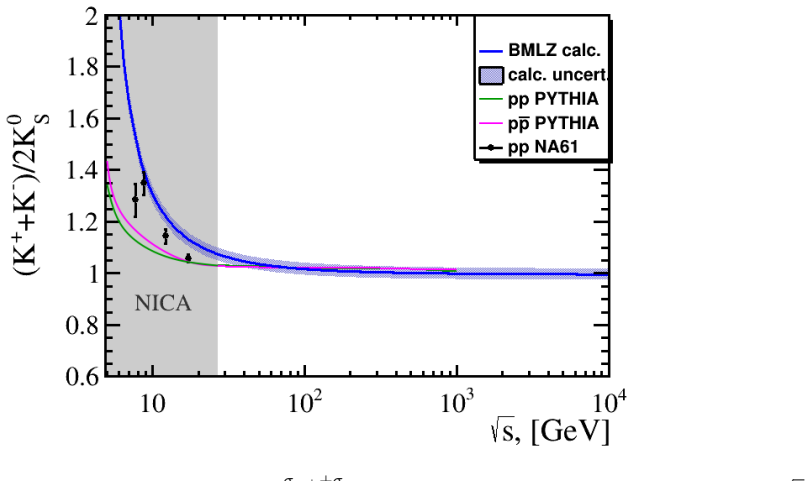
Even with conserved isospin symmetry the ratio of charged-to-neutral kaon cross sections exceeds one at energies up to 20 GeV.
A machine-rendered reading of the paper's core claim, the machinery that carries it, and where it could break.
Core claim
The ratio R_K = (σ_{K^+} + σ_{K^-}) / (2 σ_{K^0_S}) is greater than 1 at √s up to 20 GeV even when isospin symmetry is conserved, and it decreases to 1 at energies of a few TeV. This energy dependence stems from the dynamics of kaon production and is independent of the beam or target type.
What carries the argument
The similarity approach combined with gluon TMD at low QCD scales and the Lund string model implemented in PYTHIA, which models kaon production while maintaining isospin symmetry.
If this is right
- The ratio R_K decreases towards unity as collision energy increases to TeV scales.
- This energy behavior of R_K is the same regardless of whether the collisions are pp or AA.
- The observed deviation from unity at lower energies does not require violation of isospin symmetry.
- Data from ALICE at high energies align with the calculation under isospin conservation.
Where Pith is reading between the lines
- Similar ratios for other particles might exhibit energy-dependent deviations without symmetry violation.
- Experiments at intermediate energies could test the transition point where R_K reaches 1.
- The model suggests that production mechanisms dominate over symmetry considerations at lower energies.
- This could affect interpretations of data in heavy-ion collisions regarding symmetry breaking.
Load-bearing premise
The similarity approach with gluon TMD and PYTHIA's Lund model accurately captures the energy dependence of kaon cross sections under isospin symmetry.
What would settle it
A measurement showing R_K equal to 1 at √s = 10 GeV in pp collisions would contradict the predicted energy dependence from production dynamics.
Figures


read the original abstract
The hypothesis of a violation of isospin-symmetry in pp and AA collisions is discussed. We show that the ratio of charged-to-neutral kaon cross sections, $R_K~=~\frac{\sigma_{K^+}+\sigma_{K^-}}{2\sigma_{K^0_S}}$, calculated within the similarity approach, including the gluon transverse momentum dependence (TMD) at low QCD scales, and using the Lund model in the form of the MC generator PYTHIA, is above 1 at energies $\sqrt{s}$ up to 20 GeV, even in the case of isospin-symmetry conservation. It decreases to 1, when the energy rises to a few TeV (ALICE data). The reason for this is related to the dynamics of kaon production. This energy behavior of $R_K$ does practically not depend on the sort of beam or target.
Editorial analysis
A structured set of objections, weighed in public.
Referee Report
Summary. The paper claims that the ratio R_K = (σ_{K^+} + σ_{K^-}) / (2 σ_{K^0_S}) exceeds 1 at √s up to ~20 GeV in pp and AA collisions even under exact isospin symmetry conservation. This is obtained via the similarity approach incorporating gluon TMD at low scales together with the Lund string fragmentation in PYTHIA; R_K falls to 1 at a few TeV (consistent with ALICE), and the energy dependence is asserted to be essentially independent of beam or target species. The deviation from unity is attributed to production dynamics rather than symmetry violation.
Significance. If the central numerical result holds and is shown to arise strictly inside an isospin-symmetric implementation, the work would provide a concrete dynamical explanation for apparent isospin breaking in kaon yields at moderate energies, reducing the need to invoke explicit symmetry violation in interpretations of heavy-ion data. The claimed beam/target independence would further strengthen the result if demonstrated across multiple collision systems.
major comments (3)
- [Abstract / Methods description] The manuscript states that calculations were performed inside the similarity approach plus PYTHIA Lund model and yielded R_K > 1 while preserving isospin symmetry, yet supplies neither the explicit implementation steps (e.g., how leading-particle or string-endpoint assignments are made isospin-symmetric) nor any verification that the chosen TMD parametrization and fragmentation parameters do not introduce effective isospin breaking. This verification is load-bearing for the claim that the observed R_K > 1 does not require symmetry violation.
- [Results section (implied)] No table, figure, or equation set is referenced that quantifies the isospin-symmetric limit (e.g., by comparing runs with and without explicit isospin-breaking terms) or that shows the numerical stability of R_K under variations of the low-scale TMD parameters. Without such controls the energy dependence cannot be cleanly separated from prior tuning of the same model to kaon data.
- [Abstract claim] The assertion that the energy behavior of R_K “does practically not depend on the sort of beam or target” is presented without a systematic scan across at least pp, pA, and AA systems at fixed √s; the single-model result therefore remains an internal property rather than a demonstrated universality.
minor comments (1)
- [Abstract] The abstract refers to “ALICE data” at a few TeV without citing the specific reference or quoting the measured R_K value used for comparison.
Simulated Author's Rebuttal
We thank the referee for the thorough review and valuable suggestions. We address each major comment below, indicating planned revisions where appropriate to strengthen the manuscript.
read point-by-point responses
-
Referee: [Abstract / Methods description] The manuscript states that calculations were performed inside the similarity approach plus PYTHIA Lund model and yielded R_K > 1 while preserving isospin symmetry, yet supplies neither the explicit implementation steps (e.g., how leading-particle or string-endpoint assignments are made isospin-symmetric) nor any verification that the chosen TMD parametrization and fragmentation parameters do not introduce effective isospin breaking. This verification is load-bearing for the claim that the observed R_K > 1 does not require symmetry violation.
Authors: We agree that additional explicit details are required to make the isospin-symmetric implementation fully transparent. In the revised manuscript we will insert a new subsection under Methods that specifies: (i) the symmetric u/d quark distributions and TMD parametrization used in the similarity approach, (ii) the isospin-symmetric assignment of leading particles and string endpoints in the PYTHIA Lund fragmentation (equal probabilities for u and d at string ends, no explicit charge asymmetry), and (iii) confirmation that the chosen low-scale TMD parameters contain no isospin-breaking terms. This will directly demonstrate that the R_K > 1 result arises from production dynamics alone. revision: yes
-
Referee: [Results section (implied)] No table, figure, or equation set is referenced that quantifies the isospin-symmetric limit (e.g., by comparing runs with and without explicit isospin-breaking terms) or that shows the numerical stability of R_K under variations of the low-scale TMD parameters. Without such controls the energy dependence cannot be cleanly separated from prior tuning of the same model to kaon data.
Authors: We will add a new figure (or table) in the Results section that explicitly shows R_K obtained in the pure isospin-symmetric configuration. We will also include a brief sensitivity study (new panel or appendix) demonstrating that R_K remains stable under modest variations of the low-scale TMD parameters around the central values. These additions will separate the reported energy dependence from any prior tuning effects. revision: yes
-
Referee: [Abstract claim] The assertion that the energy behavior of R_K “does practically not depend on the sort of beam or target” is presented without a systematic scan across at least pp, pA, and AA systems at fixed √s; the single-model result therefore remains an internal property rather than a demonstrated universality.
Authors: The similarity approach employs universal TMDs and fragmentation functions whose functional form is independent of the colliding system; the same PYTHIA settings are used for all cases. Consequently the energy dependence of R_K is expected to be the same. Nevertheless, to convert this expectation into an explicit demonstration we will add, in the revised manuscript, R_K results for at least one additional system (pA or AA) at a fixed √s value below 20 GeV, thereby illustrating the claimed independence. revision: partial
Circularity Check
No significant circularity; model calculation presented as-is
full rationale
The paper computes R_K inside the similarity approach + low-scale gluon TMD + PYTHIA Lund strings and reports that this yields R_K > 1 at √s ≲ 20 GeV while exactly preserving isospin symmetry. No equation or section is shown that defines the target ratio in terms of itself, fits a parameter to kaon data and then renames the output a prediction, or imports a uniqueness theorem from the same authors' prior work. The result is simply the numerical output of the chosen phenomenological framework under the stated symmetry assumption; the energy dependence is attributed to production dynamics internal to that framework. This is a standard model study rather than a derivation that reduces to its inputs by construction.
Axiom & Free-Parameter Ledger
Reference graph
Works this paper leans on
-
[1]
Heisenberg, Z.phys.,77, 1 (1932)
W. Heisenberg, Z.phys.,77, 1 (1932)
1932
-
[2]
Wigner, Phys.Rev.51, 106 (1937)
E. Wigner, Phys.Rev.51, 106 (1937). 6
1937
-
[3]
Werner, M.A
D.D. Werner, M.A. Bentley, P.V. Isacker, Nature Physics,2, 311(2006)
2006
-
[4]
Kaidalov, Phys.Lett., B116, 459(1982)
A.B. Kaidalov, Phys.Lett., B116, 459(1982)
1982
-
[5]
T.Sjoestrand, Comp. Phys. Commun,82, 4 (1994)
1994
-
[6]
The NA61/SHINE Collaboration, F. Giacosa, M. Gorenstein,R. Poberezhniuk, S. Samanta, Nature Communications,16, 2849 (2025). arXiv:2312.06572v6 [nucl- ex]
-
[7]
Baldin, A.I
A.M. Baldin, A.I. Malakhov. JINR Rapid Communications, No.1(87), pp.5-12 (1998)
1998
-
[8]
M.Baldin, A
A. M.Baldin, A. A. Baldin. Phys. Particles and Nuclei,29No.3, 232 (1998)
1998
-
[9]
Lykasov, A.I
G.I. Lykasov, A.I. Malakhov, Eur. Phys. J. A54, 187 (2018)
2018
-
[10]
Malakhov, G.I
A.I. Malakhov, G.I. Lykasov, Eur. Phys. J. A56, 114 (2020)
2020
-
[11]
Lykasov, A.I
G.I. Lykasov, A.I. Malakhov, A.A. Zaitsev, Eur.Phys. J. A57, 91 (2021)
2021
-
[12]
Lykasov, A.I
G.I. Lykasov, A.I. Malakhov, A.A. Zaitsev, Eur.Phys. J. A60, 239 (2024)
2024
-
[13]
Baldin, JINR Rapid Comm
A.A. Baldin, JINR Rapid Comm. No. 4(78), pp.61-68 (1996)
1996
-
[14]
Bednyakov, A.A
V.A. Bednyakov, A.A. Grinyuk, G.I. Lykasov, M. Pogosyan, Int.J.Mod.Phys.,A27, 1250042 (2012)
2012
-
[15]
Grinyuk, G.I
A.A. Grinyuk, G.I. Lykasov, A.V. Lipatov, N.P. Zotov, Phys.Rev.D87, 074017 (2013)
2013
-
[16]
Lipatov, G.I
A.V. Lipatov, G.I. Lykasov, M.A. Malyshev, Phys.Rev. D107, 014022 (2023)
2023
-
[17]
Lipatov, G.I
A.V. Lipatov, G.I. Lykasov, M.A. Malyshev, Phys.Lett.B839, 137780 (2023)
2023
-
[18]
Lipatov, G.I
A.V. Lipatov, G.I. Lykasov, M.A. Malyshev, Phys.Lett.B848, 137390 (2024)
2024
-
[19]
Aduszkiewicz, NA61/SHINE, Eur.Phys
A. Aduszkiewicz, NA61/SHINE, Eur.Phys. J.C77, 671 (2017)
2017
-
[20]
´Cirkovi´ c M., NA61/SHINE Collaboration, International Journal of Modern Physics A.38, 32 (2023)
2023
-
[21]
NA61/SHINE collaboration et al. Eur. Phys. J.C.84, 8 (2024)
2024
-
[22]
Butenko, et al., Phys
A.V. Butenko, et al., Phys. Part. Nucl. Lett.,21, 212 (2024). 7
2024
discussion (0)
Sign in with ORCID, Apple, or X to comment. Anyone can read and Pith papers without signing in.