Gender-based discrepancies in the algorithmic delivery of political ads on social media
Pith reviewed 2026-06-27 11:35 UTC · model grok-4.3
The pith
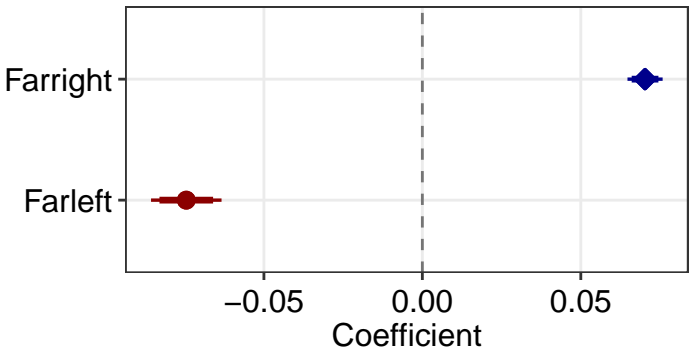
Political ads from populist parties reach a 6 percentage point higher share of men than women on social media.
A machine-rendered reading of the paper's core claim, the machinery that carries it, and where it could break.
Core claim
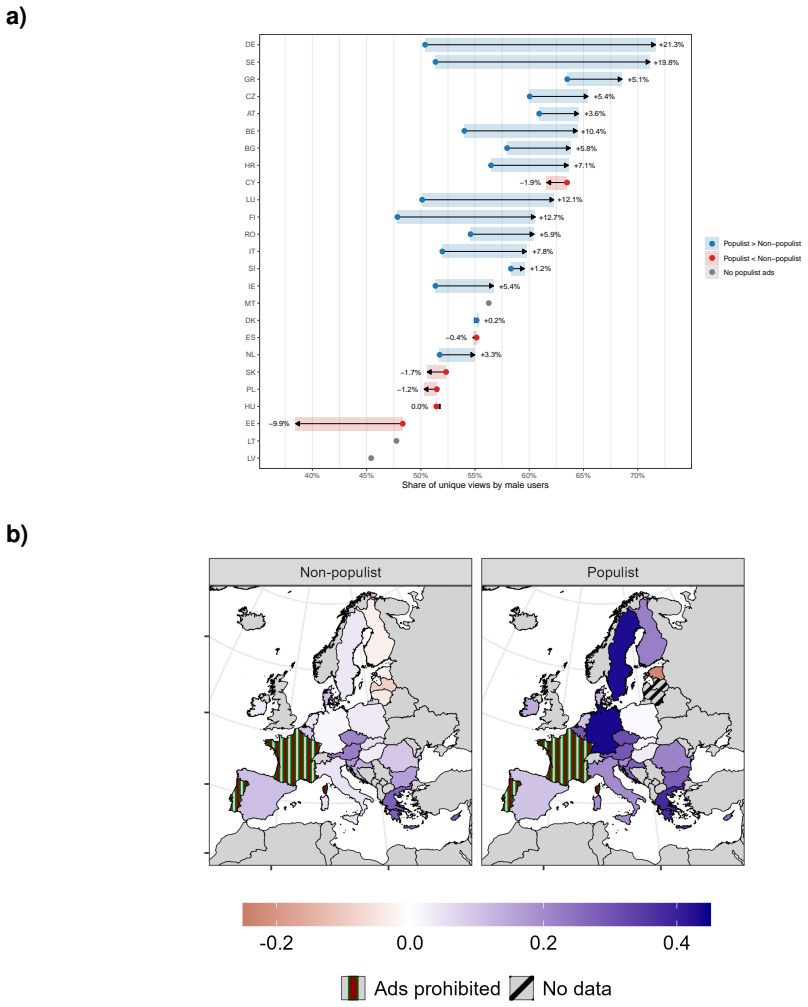
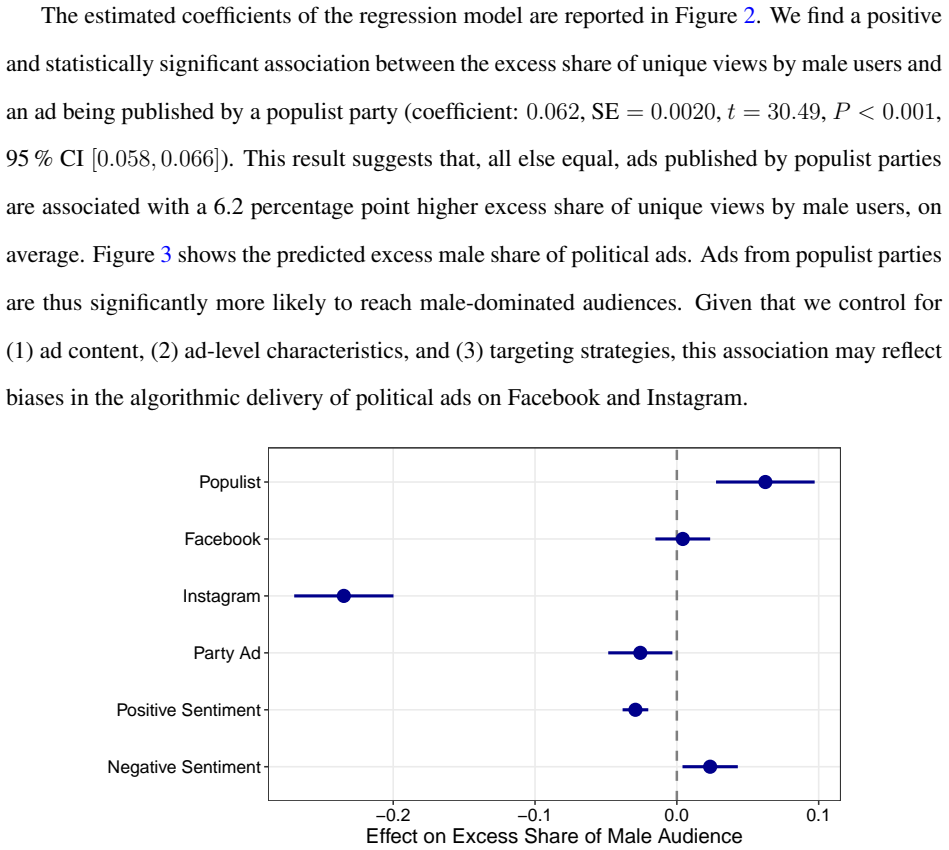
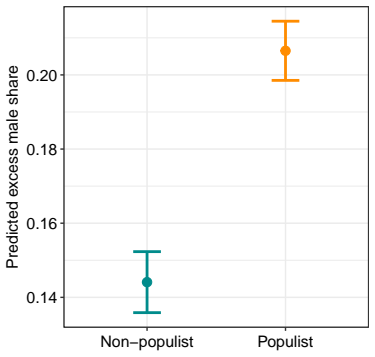
After statistical controls for ad content, platform-level competition, and targeting strategies, ads by populist parties reach on average a 6 percentage point higher male share of impressions than would be expected otherwise.
What carries the argument
Large-scale observational dataset of ad impressions paired with regression adjustments that isolate residual gender differences in delivery.
Load-bearing premise
The adjustments for ad content, competition, and targeting fully capture every factor besides the delivery algorithm itself.
What would settle it
A re-run of the same models that adds direct measures of user engagement rates or party-level optimization choices and finds the 6-point gap disappears.
Figures
read the original abstract
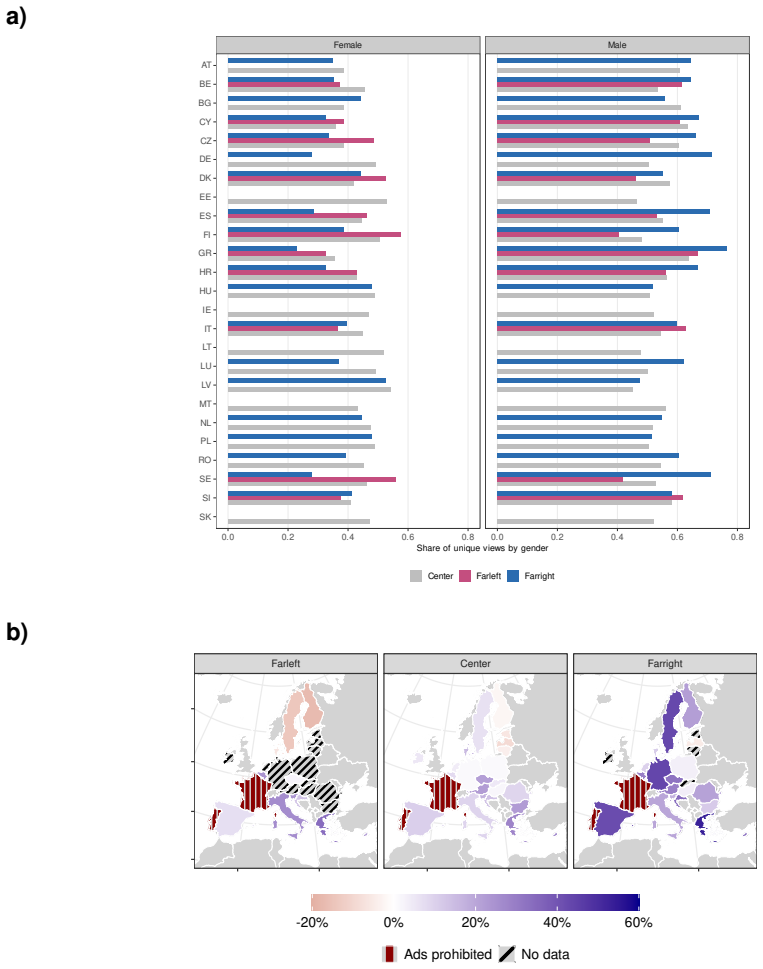
Social media has become a key channel for political advertising during election campaigns. However, algorithmic biases in the delivery of these ads may distort the public's exposure to political messaging. This can hinder citizens' ability to make informed choices and undermine equal access to political discourse, raising concerns about the integrity of electoral processes. In this study, we examine gender-based discrimination in the delivery of political ads during the 2024 European Parliament elections. Using a large-scale dataset of over 110000 ads from 453 political parties and 968 candidates that generated over 7 billion impressions across 25 EU countries, we find that men were significantly more likely to be shown ads from populist and far-right parties than women -- even after accounting for ad content, platform-level competition, and targeting strategies. All else equal, ads by populist parties reach, on average, a 6 percentage point higher male share. Such imbalances restrict the ability of parties to reach diverse audiences and prevent voters from engaging equally with the full range of political viewpoints. This pattern is particularly concerning given that far-right and populist ads may reinforce political polarization and widen existing gender gaps in political engagement. Our findings underscore the need for platforms and policymakers to audit algorithmic ad delivery in political campaigns on social media and to implement safeguards that ensure fairness and protect democratic processes.
Editorial analysis
A structured set of objections, weighed in public.
Referee Report
Summary. The manuscript analyzes a dataset of over 110,000 political ads from 453 parties across 25 EU countries during the 2024 European Parliament elections, generating 7 billion impressions. It reports that, after controlling for ad content, platform-level competition, and targeting strategies, ads from populist and far-right parties reach audiences with a 6 percentage point higher male share than other parties, attributing this to algorithmic delivery discrepancies.
Significance. If the identification strategy holds, the result would document a substantively large gender imbalance in exposure to populist political messaging on social media, with implications for polarization and equal access to political information. The scale of the impression-level data across multiple countries provides substantial power and geographic breadth, which is a clear empirical strength for an observational study in this domain.
major comments (2)
- [Methods] The central claim that the 6pp male-share gap for populist ads is attributable to algorithmic delivery (rather than unmeasured advertiser optimization or engagement) is load-bearing on the controls for targeting strategies. The manuscript provides no details on the regression specification, the exact operationalization of targeting variables, or inclusion of engagement metrics such as click-through or dwell time, leaving open whether residual differences reflect platform algorithms or other channels.
- [Results] No robustness checks are described that test sensitivity of the 6pp estimate to alternative explanations, such as gender-specific bid adjustments by parties or baseline differences in user engagement patterns that affect auction outcomes. Without these, the attribution to algorithmic delivery cannot be isolated from the alternatives raised in the identification discussion.
minor comments (1)
- [Abstract] The abstract states the main finding but does not preview the exact econometric model or sample restrictions used to generate the 6pp estimate.
Simulated Author's Rebuttal
We thank the referee for the constructive and detailed comments, which highlight important areas for improving the transparency and robustness of our analysis on gender discrepancies in political ad delivery. We address each major comment below.
read point-by-point responses
-
Referee: [Methods] The central claim that the 6pp male-share gap for populist ads is attributable to algorithmic delivery (rather than unmeasured advertiser optimization or engagement) is load-bearing on the controls for targeting strategies. The manuscript provides no details on the regression specification, the exact operationalization of targeting variables, or inclusion of engagement metrics such as click-through or dwell time, leaving open whether residual differences reflect platform algorithms or other channels.
Authors: We agree that the manuscript requires substantially more detail on the empirical strategy to support the attribution to algorithmic delivery. In the revised version, we will expand the Methods section to report the full regression specification (including functional form, fixed effects, and clustering), the precise operationalization of all targeting controls drawn from the ad metadata (e.g., demographic targeting flags, interest categories, geographic reach, and budget parameters), and how platform-level competition was measured. Our dataset, obtained from public ad libraries and impression aggregates, does not contain click-through rates or dwell-time metrics; we will therefore explicitly note this limitation and discuss the extent to which the available controls address advertiser-side optimization. We will also add a dedicated subsection on identification assumptions and remaining threats. revision: yes
-
Referee: [Results] No robustness checks are described that test sensitivity of the 6pp estimate to alternative explanations, such as gender-specific bid adjustments by parties or baseline differences in user engagement patterns that affect auction outcomes. Without these, the attribution to algorithmic delivery cannot be isolated from the alternatives raised in the identification discussion.
Authors: We acknowledge the absence of reported robustness checks and will add them in revision. The revised manuscript will include a new subsection (or appendix) presenting sensitivity analyses: alternative party classifications, country- and platform-specific subsamples, models with additional party-level covariates (e.g., size, incumbency), and specifications that interact targeting variables with party type. Direct observation of bidding behavior or gender-specific bid adjustments is not possible with the available data; we will therefore discuss this as a limitation while providing indirect tests, such as examining whether the gap varies with observable ad performance proxies or party resources. We will also test for differential engagement patterns using any available aggregate impression and reach statistics. revision: yes
Circularity Check
No circularity: observational regression on impression data
full rationale
The paper is a purely empirical observational study that estimates gender differences in ad impressions via statistical controls on a large dataset of 110k+ ads and 7B impressions. The central 6pp male-share gap for populist ads is obtained from regression coefficients after including covariates for ad content, competition, and targeting; this quantity is not defined in terms of itself, is not a fitted parameter renamed as a prediction, and does not rely on any self-citation chain or uniqueness theorem. No derivation reduces to its inputs by construction, satisfying the default expectation that most empirical papers exhibit no circularity.
Axiom & Free-Parameter Ledger
axioms (2)
- domain assumption The dataset of over 110000 ads is representative of political advertising on the platforms during the election period.
- domain assumption Statistical controls for content, competition, and targeting isolate algorithmic delivery effects from user behavior and party strategies.
Reference graph
Works this paper leans on
-
[1]
elections.Communication Research47, 988–1009 (2020)
Bright, J.et al.Does campaigning on social media make a difference? Evidence from can- didate use of Twitter during the 2015 and 2017 U.K. elections.Communication Research47, 988–1009 (2020)
2015
-
[2]
F., Franz, M
Fowler, E. F., Franz, M. M., Martin, G. J., Peskowitz, Z. & Ridout, T. N. Political advertising online and offline.American Political Science Review115, 130–149 (2021)
2021
-
[3]
L., Mallapragada, G
Fossen, B. L., Mallapragada, G. & De, A. Impact of political television advertisements on viewers’ response to subsequent advertisements.Marketing Science40, 305–324 (2021)
2021
-
[4]
R., Janakiraman, R., Kumar, S
Mallipeddi, R. R., Janakiraman, R., Kumar, S. & Gupta, S. The effects of social media content created by human brands on engagement: Evidence from Indian general election 2014.Information Systems Research32, 212–237 (2021)
2014
-
[5]
& Feuerriegel, S
Bär, D., Pierri, F., de Francisci Morales, G. & Feuerriegel, S. Systematic discrepancies in the delivery of political ads on Facebook and Instagram.PNAS Nexus3(2024)
2024
-
[6]
& Feuerriegel, S
Bär, D., Pröllochs, N. & Feuerriegel, S. The role of social media ads for election outcomes: Evidence from the 2021 German election.PNAS Nexus4(2025)
2021
-
[7]
V otta, F.et al.Who does(n’t) target you? Mapping the worldwide usage of online political microtargeting.Journal of Quantitative Description: Digital Media4(2024)
2024
-
[8]
Vandewalker, I.Do Small Donors Cause Political Dysfunction?(Brennan Center for Justice at New York University School of Law, 2024)
2024
-
[9]
GLES Kandidierendenstudie 2021 (2022)
GLES. GLES Kandidierendenstudie 2021 (2022)
2021
-
[10]
InCHI(2021)
Capozzi, A.et al.Clandestino or rifugiato? Anti-immigration Facebook ad targeting in Italy. InCHI(2021). 33
2021
-
[11]
Do online ads influence vote choice?Political Communication36, 376–393 (2019)
Hager, A. Do online ads influence vote choice?Political Communication36, 376–393 (2019)
2019
-
[12]
Coppock, A., Green, D. P. & Porter, E. Does digital advertising affect vote choice? Evidence from a randomized field experiment.Research & Politics9(2022)
2022
-
[13]
Aggarwal, M.et al.A 2 million-person, campaign-wide field experiment shows how digital advertising affects voter turnout.Nature Human Behaviour7, 332–341 (2023)
2023
-
[14]
InCSCW(2019)
Ali, M.et al.Discrimination through optimization: How Facebook’s ad delivery can lead to biased outcomes. InCSCW(2019)
2019
-
[15]
& Tucker, C
Lambrecht, A. & Tucker, C. Algorithmic bias? An empirical study of apparent gender-based discrimination in the display of STEM career ads.Management Science65, 2966–2981 (2019)
2019
-
[16]
& Heidemann, J
Imana, B., Korolova, A. & Heidemann, J. Auditing for discrimination in algorithms deliver- ing job ads. InWWW(2021)
2021
-
[17]
& Rieke, A
Ali, M., Sapiezynski, P., Korolova, A., Mislove, A. & Rieke, A. Ad delivery algorithms: The hidden arbiters of political messaging. InWSDM(2021)
2021
-
[18]
Edelson, L., Sakhuja, S., Dey, R. & McCoy, D. An analysis of United States online political advertising transparency.arXiv1902.04385 (2019)
Pith/arXiv arXiv 2019
-
[19]
& McCoy, D
Edelson, L., Lauinger, T. & McCoy, D. A security analysis of the Facebook Ad Library. In Symposium on Security and Privacy(2020)
2020
-
[20]
InUSENIX Security Symposium(2022)
Le Pochat, V .et al.An audit of Facebook’s political ad policy enforcement. InUSENIX Security Symposium(2022). 34
2022
-
[21]
InInternational Conference on Social Informatics(2020)
Capozzi, A.et al.Facebook ads: Politics of migration in Italy. InInternational Conference on Social Informatics(2020)
2020
-
[22]
Privacy violations using microtargeted ads: A case study
Korolova, A. Privacy violations using microtargeted ads: A case study. InInternational Conference on Data Mining Workshops(2011)
2011
-
[23]
54% of Americans say social media companies shouldn’t allow any political ads
Auxier, B. 54% of Americans say social media companies shouldn’t allow any political ads. Pew Research Center(2020)
2020
-
[24]
G., Cuevas, Á., Arrate, A
Cabañas, J. G., Cuevas, Á., Arrate, A. & Cuevas, R. Does Facebook use sensitive data for advertising purposes?Communications of the ACM64, 62–69 (2021)
2021
-
[25]
InF AccT(2018)
Speicher, T.et al.Potential for discrimination in online targeted advertising. InF AccT(2018)
2018
-
[26]
Ali, M., Goetzen, A., Mislove, A., Redmiles, E. M. & Sapiezynski, P. Problematic advertising and its disparate exposure on Facebook. InUSENIX Security Symposium(2023)
2023
-
[27]
& O’Reilly, U.-M
Sankaranarayanan, A., Sapiezynski, P. & O’Reilly, U.-M. Facebook algorithm’s active role in climate advertisement delivery.Nature Climate Change15, 719–724 (2025)
2025
-
[28]
& Heidemann, J
Imana, B., Korolova, A. & Heidemann, J. Auditing for racial discrimination in the delivery of education ads. InF AccT(2024)
2024
-
[29]
& Hawkins, K
Davis, B., Goodliffe, J. & Hawkins, K. The two-way effects of populism on affective polar- ization.Comparative Political Studies58, 122–154 (2025)
2025
-
[30]
& Loxton, J
Levitsky, S. & Loxton, J. Populism and competitive authoritarianism in latin america. In Routledge handbook of global populism, 334–350 (Routledge, 2018)
2018
-
[31]
The dictators’ last stand.F oreign Affairs98, 138–149 (2019)
Mounk, Y . The dictators’ last stand.F oreign Affairs98, 138–149 (2019). 35
2019
-
[32]
Ruth-Lovell, S. P. & Grahn, S. Threat or corrective to democracy? The relationship between populism and different models of democracy.European Journal of Political Research62, 677–698 (2023)
2023
-
[33]
& Panisson, A
Capozzi, A., de Francisci Morales, G., Mejova, Y ., Monti, C. & Panisson, A. The thin ideology of populist advertising on Facebook during the 2019 EU elections. InWWW(2023)
2019
-
[34]
Vachudova, M. A. Populism, democracy, and party system change in Europe.Annual Review of Political Science24, 471–498 (2021)
2021
-
[35]
& Kustov, A
Dai, Y . & Kustov, A. When do politicians use populist rhetoric? populism as a campaign gamble.Political Communication39, 383–404 (2022)
2022
-
[36]
& Esser, F
Ernst, N., Blassnig, S., Engesser, S., Büchel, F. & Esser, F. Populists prefer social media over talk shows: An analysis of populist messages and stylistic elements across six countries. Social media+ society5, 2056305118823358 (2019)
2019
-
[37]
Winter, N. J. Masculine republicans and feminine democrats: Gender and Americans’ explicit and implicit images of the political parties.Political Behavior32, 587–618 (2010)
2010
-
[38]
Zingher, J. N. Polarization, demographic change, and white flight from the democratic party. The Journal of Politics80, 860–872 (2018)
2018
-
[39]
Guth, J. L. & Nelsen, B. F. Party choice in europe: Social cleavages and the rise of populist parties.Party Politics27, 453–464 (2021)
2021
-
[40]
Key facts about european parliament election 2024 (2024)
Reuters. Key facts about european parliament election 2024 (2024). URL https://www. reuters.com/world/europe/key-facts-about-european-parliament-election-2024-06-03/. Ac- cessed: 2026-04-17. 36
2024
-
[41]
Rooduijn, M.et al.The popuList: A database of populist, far-left, and far-right parties using expert-informed qualitative comparative classification (EiQCC).British Journal of Political Science54, 969–978 (2024)
2024
-
[42]
Ethnopopulism and democratic backsliding in central europe.East European Politics36, 318–340 (2020)
Anna Vachudova, M. Ethnopopulism and democratic backsliding in central europe.East European Politics36, 318–340 (2020)
2020
-
[43]
& Eckles, D
Aral, S. & Eckles, D. Protecting elections from social media manipulation.Science365, 858–861 (2019)
2019
-
[44]
& Hertwig, R
Lorenz-Spreen, P., Oswald, L., Lewandowsky, S. & Hertwig, R. A systematic review of worldwide causal and correlational evidence on digital media and democracy.Nature Human Behaviour(2022)
2022
-
[45]
M., Dahlke, R., Song, H
Kim, Y . M., Dahlke, R., Song, H. & Heinrich, R. Targeted digital voter suppression ef- forts likely decrease voter turnout.Proceedings of the National Academy of Sciences123, e2519944123 (2026)
2026
-
[46]
Regulating online political advertising
Turkel, E. Regulating online political advertising. InWWW(2022)
2022
-
[47]
Council of the European Union. Proposal for a regulation of the European Pariament and of the Council on the transparency and targeting of political advertising: Latest state of play of the interinstitutional negotiations (2023). URL https://www.asktheeu.org/de/request/12988/ response/45245/attach/5/st09184.en23.pdf?cookie_passthrough=1
2023
-
[48]
Social Media Stats Europe (2025)
Statcounter GlobalStats. Social Media Stats Europe (2025). URL https://gs.statcounter.com/ social-media-stats/all/europe
2025
-
[49]
M.et al.A 61-million-person experiment in social influence and political mobiliza- tion.Nature489, 295–298 (2012)
Bond, R. M.et al.A 61-million-person experiment in social influence and political mobiliza- tion.Nature489, 295–298 (2012). 37
2012
-
[50]
& Raynauld, V
Lalancette, M. & Raynauld, V . The power of political image: Justin Trudeau, Instagram, and celebrity politics.American Behavioral Scientist63, 888–924 (2019)
2019
-
[51]
10th European Parliament election on 9 June 2024 (2024)
Bundeswahlleiter. 10th European Parliament election on 9 June 2024 (2024). URL https: //www.bundeswahlleiterin.de/en/europawahlen/2024.html
2024
-
[52]
Ad Library (2022)
Meta. Ad Library (2022). URL https://www.facebook.com/ads/library/
2022
-
[53]
InWebSci(2023)
Bär, D.et al.Analyzing social media activities at Bellingcat. InWebSci(2023)
2023
-
[54]
C.et al.The impact of visual attributes on online image diffusion
Totti, L. C.et al.The impact of visual attributes on online image diffusion. InProceedings of the 2014 ACM conference on Web science, 42–51 (2014)
2014
-
[55]
& Kessels, R
Gitu, P.-A., Cerina, R., Vandevijvere, S. & Kessels, R. Addownloader: Automating the retrieval of advertisements and their media content from the meta online ad library.SoftwareX 28, 101919 (2024)
2024
-
[56]
Ad Targeting Dataset (2023)
Meta. Ad Targeting Dataset (2023). URL https://developers.facebook.com/docs/ fort-ads-targeting-dataset
2023
-
[57]
The dsa, disinformation and european elections: Solutions through recommender systems (2024)
Doris Buijs. The dsa, disinformation and european elections: Solutions through recommender systems (2024). URL https://dsa-observatory.eu/2024/06/17/ the-dsa-disinformation-and-european-elections-solutions-through-recommender-systems/. Accessed: 2026-04-20
2024
-
[58]
Zulianello, M. Varieties of populist parties and party systems in Europe: From state-of-the-art to the application of a novel classification scheme to 66 parties in 33 countries.Government and Opposition55, 327–347 (2020)
2020
-
[59]
Measuring populism worldwide.Party Politics26, 697–717 (2020)
Norris, P. Measuring populism worldwide.Party Politics26, 697–717 (2020). 38
2020
-
[60]
& Espinosa-Anke, L
Barbieri, F., Camacho-Collados, J., Neves, L. & Espinosa-Anke, L. TweetEval: Unified benchmark and comparative evaluation for tweet classification. InEMNLP Findings(2020)
2020
-
[61]
Oquab, M.et al.Dinov2: Learning robust visual features without supervision (2023)
2023
-
[62]
The digital architectures of social media: Comparing political campaigning on Facebook, Twitter, Instagram, and Snapchat in the 2016 U.S
Bossetta, M. The digital architectures of social media: Comparing political campaigning on Facebook, Twitter, Instagram, and Snapchat in the 2016 U.S. election.Journalism & Mass Communication Quarterly95, 471–496 (2018)
2016
-
[63]
& Karjaluoto, H
Salonen, A., Mero, J., Munnukka, J., Zimmer, M. & Karjaluoto, H. Digital content marketing on social media along the B2B customer journey: The effect of timely content delivery on customer engagement.Industrial Marketing Management118, 12–26 (2024)
2024
-
[64]
Social media users in Spain (2024)
NapoleonCat. Social media users in Spain (2024). URL https://napoleoncat.com/stats/ social-media-users-in-spain/2024/
2024
-
[65]
Stock-taking of the 2024 European Parliament Elections
Austin, P. C. An introduction to propensity score methods for reducing the effects of con- founding in observational studies.Multivariate behavioral research46, 399–424 (2011). 39 Supplementary Materials Contents A The 2024 European Elections 41 B Robustness checks 44 B.1 Alternative dependent variable . . . . . . . . . . . . . . . . . . . . . . . . . . ....
2011
discussion (0)
Sign in with ORCID, Apple, or X to comment. Anyone can read and Pith papers without signing in.