Modular2Simple: A Tool for Modular Scenario Creation Based on the OpenSCENARIO Format
Pith reviewed 2026-06-27 12:31 UTC · model grok-4.3
The pith
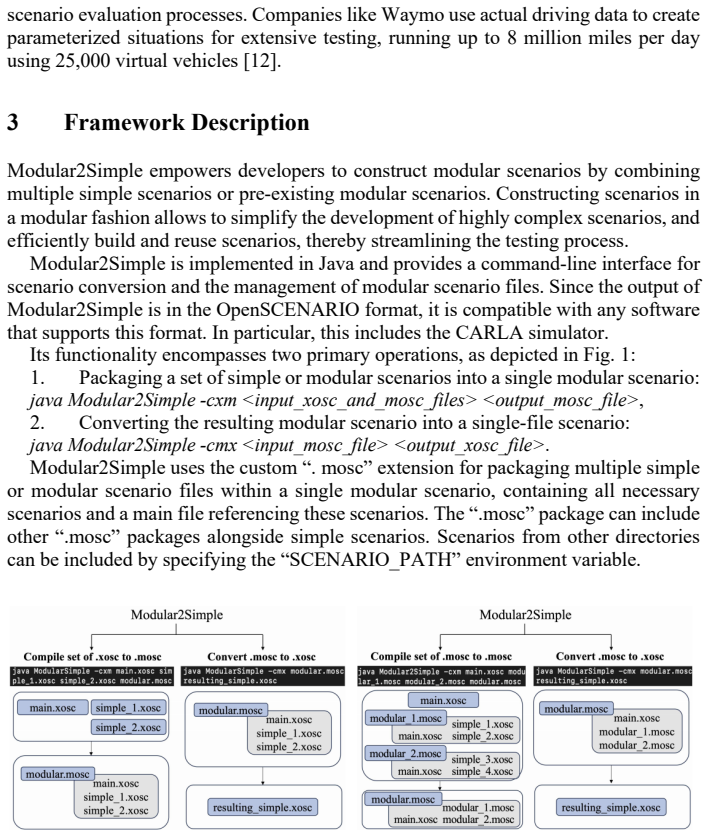
Modular2Simple lets developers build complex ADS test scenarios by combining simple OpenSCENARIO ones, cutting code complexity.
A machine-rendered reading of the paper's core claim, the machinery that carries it, and where it could break.
Core claim
By leveraging existing simple scenarios in the OpenSCENARIO format, the tool enables developers to create easily customizable modular scenarios through the combination of multiple simple or modular scenarios, significantly simplifying the scenario creation process while maintaining flexibility in scenario design and leading to a significant reduction in code complexity and enhanced efficiency.
What carries the argument
The combination mechanism that merges multiple OpenSCENARIO scenarios into one modular scenario, integrated with the CARLA simulator and compatible with any OpenSCENARIO-supporting software.
If this is right
- Complex scenarios become feasible with far less manual coding by reusing simple building blocks.
- Development time and effort for ADS testing drop because scenarios can be assembled rather than written from scratch.
- Scenario reuse across projects increases, allowing customization without rewriting core elements.
- Efficiency gains appear in both scenario design and subsequent testing runs.
- The same approach applies to any tool or simulator that reads OpenSCENARIO files.
Where Pith is reading between the lines
- Shared libraries of basic scenarios could emerge so teams assemble tests without each writing everything anew.
- Future tools might automatically verify that assembled scenarios stay consistent and realistic.
- The method could transfer to other driving simulators once the combination logic is ported.
- Entry barrier for creating test scenarios lowers, letting more people contribute without mastering the full format.
Load-bearing premise
That combining scenarios this way will preserve intended behaviors and always produce valid, realistic complex scenarios without introducing inconsistencies.
What would settle it
A side-by-side run in CARLA where the same complex test written manually versus assembled modularly produces measurably different vehicle trajectories or simulator errors.
Figures
read the original abstract
The rapid advancement of autonomous driving systems (ADS) has introduced significant challenges, particularly in the creation of realistic and complex scenarios for testing and validation. This paper introduces Modular2Simple, a tool designed to address these challenges by simplifying and enhancing the process of creating complex ADS scenarios. Modular2Simple seamlessly integrates with the CARLA simulator and is applicable to any software that supports the OpenSCENARIO format. By leveraging existing simple scenarios in the OpenSCENARIO format, the tool enables developers to create easily customizable modular scenarios through the combination of multiple simple or modular scenarios, significantly simplifying the scenario creation process while maintaining flexibility in scenario design. This approach not only facilitates the development of complex scenarios, reducing both development time and effort, but also promotes scenario reuse and customization, which leads to a significant reduction in code complexity and enhanced efficiency in scenario design and testing compared to traditional scenario development methods.
Editorial analysis
A structured set of objections, weighed in public.
Referee Report
Summary. The manuscript introduces Modular2Simple, a tool that integrates with the CARLA simulator and supports the OpenSCENARIO format. It enables creation of complex scenarios by combining multiple simple or modular scenarios, with the stated goals of simplifying scenario development for autonomous driving systems, reducing development time and code complexity, promoting reuse and customization, and maintaining flexibility.
Significance. If the tool performs as described and the asserted efficiency gains are realized in practice, it could support more efficient construction of test scenarios for ADS validation. The current manuscript, however, supplies only an architectural description and integration details with no empirical evaluation, metrics, case studies, or validation of behavior preservation, so the practical significance of the contribution cannot be determined.
major comments (2)
- [Abstract] Abstract: the claim that the approach 'leads to a significant reduction in code complexity and enhanced efficiency in scenario design and testing compared to traditional scenario development methods' is unsupported; the manuscript provides no quantitative metrics, before/after code comparisons, runtime data, or user studies.
- [Abstract] Abstract: the assertion that modular combinations 'preserve intended behaviors and produce valid, realistic complex scenarios without introducing inconsistencies' is presented without any validation results, example combined scenarios, or analysis of potential conflicts that may arise during composition.
minor comments (1)
- The paper would be strengthened by the addition of at least one worked example showing input simple scenarios, the modular composition step, and the resulting OpenSCENARIO output.
Simulated Author's Rebuttal
We thank the referee for the constructive comments regarding the abstract. We agree that several claims require qualification or removal since the manuscript provides an architectural description without empirical evaluation. We will revise the abstract accordingly in the next version.
read point-by-point responses
-
Referee: [Abstract] Abstract: the claim that the approach 'leads to a significant reduction in code complexity and enhanced efficiency in scenario design and testing compared to traditional scenario development methods' is unsupported; the manuscript provides no quantitative metrics, before/after code comparisons, runtime data, or user studies.
Authors: We acknowledge that the manuscript contains no quantitative metrics, code comparisons, or user studies to support the claim of significant reduction in code complexity. The paper focuses on the tool architecture, integration with CARLA, and the modular composition mechanism. We will revise the abstract to remove the assertion of 'significant reduction' and instead describe the design intent of promoting reuse without claiming measured efficiency gains. revision: yes
-
Referee: [Abstract] Abstract: the assertion that modular combinations 'preserve intended behaviors and produce valid, realistic complex scenarios without introducing inconsistencies' is presented without any validation results, example combined scenarios, or analysis of potential conflicts that may arise during composition.
Authors: The current manuscript describes the composition approach but supplies no validation results, combined scenario examples, or conflict analysis. We will revise the abstract to qualify the statement, indicating that the tool is intended to support behavior preservation through modular construction while noting that empirical validation of these properties is outside the scope of the present work. revision: yes
Circularity Check
No circularity: tool-description paper with no derivations or predictions
full rationale
The manuscript is a pure tool-description paper. It introduces Modular2Simple, describes its architecture and integration with CARLA/OpenSCENARIO, and states functional claims about scenario combination. No equations, fitted parameters, predictions, or uniqueness theorems appear anywhere in the text. Consequently there are no load-bearing steps that could reduce by construction to the paper's own inputs. The reader's circularity score of 0.0 is confirmed; the paper is self-contained against external benchmarks because it makes no internal mathematical claims that require validation via derivation.
Axiom & Free-Parameter Ledger
Reference graph
Works this paper leans on
-
[1]
On-line: https://releases.asam.net/OpenSCENARIO/1.0.0/ASAM_OpenSCENARIO_BS-1-2_User-Guide_V1-0-0
ASAM OpenSCENARIO: User Guide. On-line: https://releases.asam.net/OpenSCENARIO/1.0.0/ASAM_OpenSCENARIO_BS-1-2_User-Guide_V1-0-0. html, Accessed: 20/11/2023
2023
-
[2]
Geoscenario: An open dsl for autonomous driving scenario representation
Queiroz R., Berger T., and Czarnecki K. Geoscenario: An open dsl for autonomous driving scenario representation. In Proceedings of 2019 IEEE Intelligent Vehicles Symposium (IV), pages 287–294, Paris, France,
2019
-
[3]
and German R
Bock F., Sippl C., Heinzz A., Lauerz C. and German R. Advantageous usage of textual domain-specific languages for scenariodriven development of automated driving functions. In Proceedings of the 2019 IEEE International Systems Conference (SysCon), pages 1-8, Orlando, FL, USA,
2019
-
[4]
and Akbaş M
Goss Q., AlRashidi Y. and Akbaş M. I. Generation of Modular and Measurable Validation Scenarios for Autonomous Vehicles Using Accident Data. In Proceedings of the 2021 IEEE Intelligent Vehicles Symposium (IV), page 251-257, Nagoya, Japan,
2021
-
[5]
and Rogic B
Nalic D., Eichberger A., Hanzl., Fellendorf M. and Rogic B. Development of a Co-Simulation Framework for Systematic Generation of Scenarios for Testing and Validation of Automated Driving Systems. In Proceeedings of IEEE Intelligent Transportation Systems Conference (ITSC), page 1895-1901, Auckland, New Zealand,
1901
-
[6]
On-line: https://waymo.com/safety/, Accessed: 20/11/2023
Waymo L, On the road to fully self-driving. On-line: https://waymo.com/safety/, Accessed: 20/11/2023
2023
discussion (0)
Sign in with ORCID, Apple, or X to comment. Anyone can read and Pith papers without signing in.