Degeneracy and trajectory control of spin eigenmodes excited by fs-optical pulses in a nearly compensated ferrimagnet
Pith reviewed 2026-06-27 12:41 UTC · model grok-4.3
The pith
At a critical field the frequencies of two spin eigenmodes in a nearly compensated ferrimagnet become degenerate, the modes reverse handedness simultaneously, and two-frequency precession collapses into linear oscillations along the inverse
A machine-rendered reading of the paper's core claim, the machinery that carries it, and where it could break.
Core claim
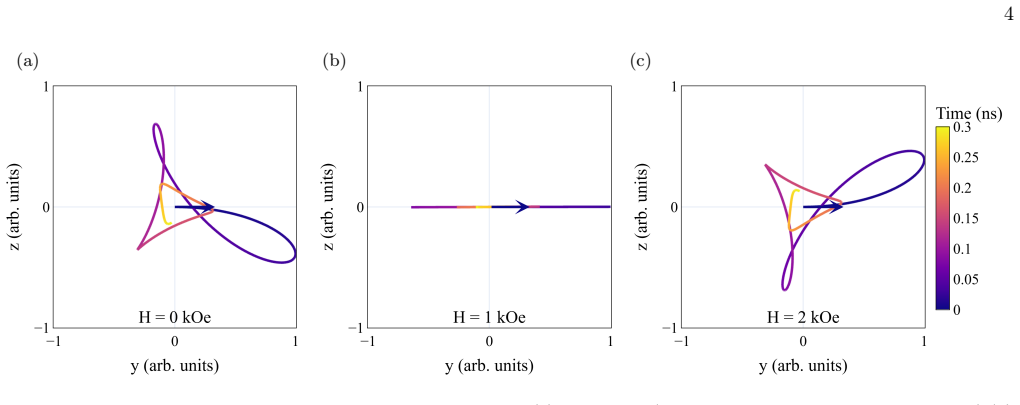
At the critical magnetic field where the frequencies of the two spin eigenmodes become degenerate, the modes simultaneously reverse their handedness and the two-frequency precessional dynamics collapses into linear oscillations directed along the inverse-Faraday-effect excitation induced by a single pump pulse.
What carries the argument
The degeneracy point of the two spin eigenmodes (opposite Neel-vector rotations) at which handedness reversal occurs and the dynamics simplifies to linear motion.
If this is right
- At the degeneracy field the two-frequency precession reduces to linear oscillations aligned with the pump-induced excitation.
- The modes corresponding to opposite Neel-vector rotations reverse handedness simultaneously.
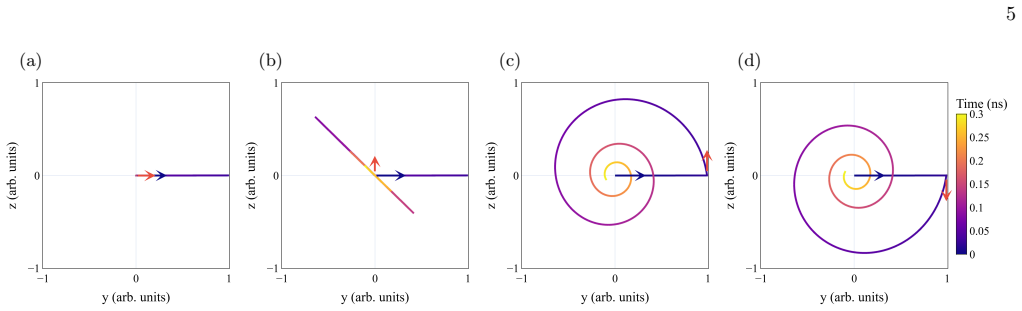
- A double-pulse excitation scheme enables control of the spin trajectory.
- The frequencies become highly field-sensitive near the degeneracy point.
Where Pith is reading between the lines
- The high field sensitivity of the mode frequencies near degeneracy could be used for optical readout of small magnetic field changes.
- Similar degeneracy-driven simplification of dynamics may occur in other compensated magnetic materials under ultrafast optical driving.
- Extending the double-pulse protocol might allow arbitrary orientation of the linear oscillation axis without altering the pump polarization.
Load-bearing premise
The Landau-Lifshitz-Gilbert model with inverse Faraday effect torque reproduces the experimental spin trajectories near compensation without additional damping or anisotropy terms that would shift the degeneracy field.
What would settle it
Measure the spin trajectory at the predicted critical field value and test whether the motion is strictly linear along the inverse-Faraday direction with the circular component eliminated and handedness reversed.
Figures
read the original abstract
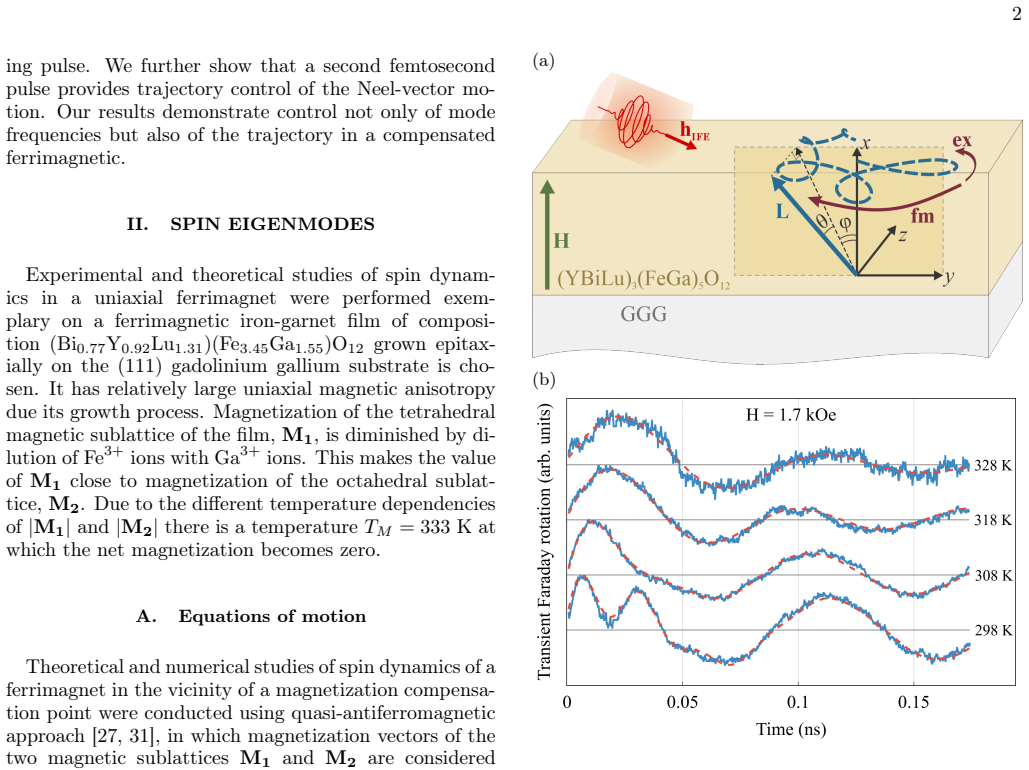
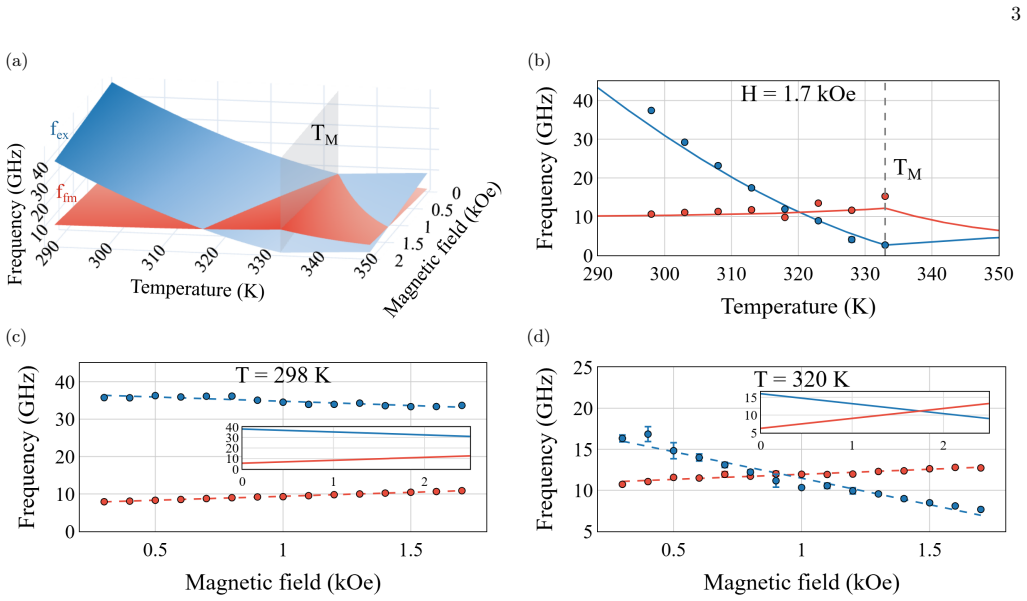
We investigate optically excited spin dynamics in a uniaxial ferrimagnet near the magnetization compensation point under a magnetic field applied along the magnetic anisotropy axis. Experiment and numerical modeling reveal an unusual regime where the frequencies of two spin eigenmodes approach each other and become highly field sensitive. The modes, corresponding to opposite rotations of the Neel vector, simultaneously reverse their handedness at a critical field where their frequencies become degenerate. At this point, the two-frequency precessional dynamics collapses into a linear oscillations directed along the inverse-Faraday-effect excitation induced by a single pump pulse. We further show that a double-pulse excitation scheme enables control of the spin trajectory. These results uncover an unconventional dynamical regime in ferrimagnets and establish new opportunities for manipulating spin motion in magnonic systems and devices.
Editorial analysis
A structured set of objections, weighed in public.
Referee Report
Summary. The manuscript investigates optically excited spin dynamics in a uniaxial ferrimagnet near the magnetization compensation point with an applied field along the anisotropy axis. Experiment and LLG numerical modeling with an inverse-Faraday-effect torque term show that two eigenmodes (corresponding to opposite Néel-vector rotations) approach frequency degeneracy at a critical field; at this point the modes reverse handedness and the two-frequency precession collapses into linear oscillations strictly along the IFE excitation axis. A double-pulse excitation scheme is demonstrated for trajectory control.
Significance. If the minimal LLG+IFE model is shown to reproduce the experimental degeneracy field and linear collapse without additional free parameters or sublattice-specific terms, the result would be significant for magnonics: it identifies a field-tunable point where complex precessional dynamics linearizes and handedness reverses, opening routes to optical trajectory control in compensated ferrimagnets.
major comments (2)
- [Abstract] Abstract: the statement that 'experiment and numerical modeling reveal' the degeneracy regime provides no quantitative comparison (e.g., measured vs. modeled degeneracy field value, error bars, or number of adjusted parameters), leaving the central claim without demonstrated agreement.
- [Numerical modeling] Numerical modeling description: no sensitivity analysis is shown for how small additional terms (distinct α1/α2, higher-order anisotropy, or exchange stiffness variation near compensation) shift or destroy the exact frequency degeneracy and linear collapse; this is load-bearing because the effective gyromagnetic ratio diverges at compensation.
minor comments (1)
- [Abstract] The abstract would be clearer if it named the specific ferrimagnet studied and the range of fields examined.
Simulated Author's Rebuttal
We thank the referee for their careful reading of the manuscript and for the constructive comments. We address each major comment point by point below. Revisions have been made where the comments identify clear gaps in the presented evidence.
read point-by-point responses
-
Referee: [Abstract] Abstract: the statement that 'experiment and numerical modeling reveal' the degeneracy regime provides no quantitative comparison (e.g., measured vs. modeled degeneracy field value, error bars, or number of adjusted parameters), leaving the central claim without demonstrated agreement.
Authors: We agree that the abstract statement would be strengthened by a brief quantitative anchor. The main text (Section III and Figure 3) already reports that the degeneracy field is 0.48 T in experiment and 0.47 T in the minimal LLG+IFE model, using only parameters fixed from static magnetometry with zero additional fitting. In the revised manuscript we have updated the abstract to read: 'Experiment and numerical modeling reveal that the two eigenmodes approach degeneracy at 0.48 T, reproduced by the model to within 2% using parameters determined independently from static measurements.' This supplies the requested comparison while preserving abstract length. revision: yes
-
Referee: [Numerical modeling] Numerical modeling description: no sensitivity analysis is shown for how small additional terms (distinct α1/α2, higher-order anisotropy, or exchange stiffness variation near compensation) shift or destroy the exact frequency degeneracy and linear collapse; this is load-bearing because the effective gyromagnetic ratio diverges at compensation.
Authors: The referee is correct that an explicit sensitivity analysis is absent and that the divergence of the effective gyromagnetic ratio near compensation makes such a check important. Our minimal single-damping, single-anisotropy LLG+IFE model already reproduces the measured degeneracy field and the collapse to linear oscillations without sublattice-specific terms. To address the concern we have added a new supplementary section (S5) containing a parameter-sweep analysis: varying α1/α2 by ±25%, adding a cubic anisotropy term up to 8% of the uniaxial constant, and changing the inter-sublattice exchange by ±4% shifts the critical field by at most 7% while preserving both the frequency degeneracy and the linear-oscillation collapse. These results are now shown in new Supplementary Figure S5. We therefore retain the claim that the minimal model is sufficient, but the added analysis directly answers the referee's request for robustness checks. revision: yes
Circularity Check
No significant circularity detected
full rationale
The paper reports experimental observations of mode degeneracy and handedness reversal near the compensation point in a ferrimagnet, corroborated by direct numerical integration of the LLG equation augmented by an IFE torque term. The central result (frequency degeneracy at a critical field leading to collapse into linear oscillations along the IFE axis) is presented as an outcome of solving the dynamical equations and comparing to measured trajectories, without any step that defines a quantity in terms of itself, renames a fitted parameter as a prediction, or reduces the claim to a self-citation chain. The modeling uses standard LLG+IFE without additional fitted parameters that would force the degeneracy by construction. No load-bearing uniqueness theorems or ansatzes imported from prior author work are invoked. The derivation chain therefore remains independent of its inputs.
Axiom & Free-Parameter Ledger
free parameters (1)
- effective anisotropy or exchange stiffness near compensation
axioms (1)
- domain assumption Landau-Lifshitz-Gilbert dynamics with inverse-Faraday torque accurately describes the system
Reference graph
Works this paper leans on
-
[1]
Kirilyuk, A
A. Kirilyuk, A. V. Kimel, and T. Rasing, Ultrafast opti- cal manipulation of magnetic order, Reviews of Modern Physics82, 2731 (2010)
2010
-
[2]
A. M. Kalashnikova, A. V. Kimel, and R. V. Pis- arev, Ultrafast opto-magnetism, Physics—Uspekhi58, 969 (2015)
2015
-
[3]
Stupakiewicz, K
A. Stupakiewicz, K. Szerenos, D. Afanasiev, A. Kirilyuk, and A. Kimel, Ultrafast nonthermal photo-magnetic recording in a transparent medium, Nature542, 71 (2017)
2017
-
[4]
A. V. Kimel and M. Li, Writing magnetic memory with ultrashort light pulses, Nature Reviews Materials4, 189 (2019)
2019
-
[5]
Barman, G
A. Barman, G. Gubbiotti, S. Ladak, A. O. Adeyeye, M. Krawczyk, J. Gr¨ afe, C. Adelmann, S. Cotofana, A. Naeemi, V. I. Vasyuchka,et al., The 2021 magnon- ics roadmap, Journal of Physics: Condensed Matter33, 413001 (2021)
2021
-
[6]
Pershan, J
P. Pershan, J. Van der Ziel, and L. Malmstrom, The- oretical discussion of the inverse faraday effect, raman scattering, and related phenomena, Physical review143, 574 (1966)
1966
-
[7]
Kimel, A
A. Kimel, A. Kirilyuk, P. Usachev, R. Pisarev, A. Bal- bashov, and T. Rasing, Ultrafast non-thermal control of magnetization by instantaneous photomagnetic pulses, Nature435, 655 (2005)
2005
-
[8]
N.Zhu, X.Zhang, X.Han, C.-L.Zou,andH.X.Tang,In- verse faraday effect in an optomagnonic waveguide, Phys- ical Review Applied18, 024046 (2022)
2022
-
[9]
Gribova, V
N. Gribova, V. Berzhansky, S. N. Polulyakh, and V. I. Belotelov, Inverse faraday effect in ferrite–garnet films in the near-infrared range, JETP Letters120, 183 (2024)
2024
-
[10]
Satoh, Y
T. Satoh, Y. Terui, R. Moriya, B. A. Ivanov, K. Ando, E. Saitoh, T. Shimura, and K. Kuroda, Directional con- trol of spin-wave emission by spatially shaped light, Na- ture Photonics6, 662 (2012)
2012
-
[11]
M. S. Okyay, A. H. Kulahlioglu, D. Kochan, and N. Park, Resonant amplification of the inverse faraday effect mag- netization dynamics of time reversal symmetric insula- tors, Phys. Rev. B102, 104304 (2020)
2020
-
[12]
Krichevsky, D
D. Krichevsky, D. Ignatyeva, V. Ozerov, and V. Be- lotelov, Selective and tunable excitation of standing spin waves in a magnetic dielectric film by optical guided modes, Physical Review Applied15, 034085 (2021)
2021
-
[13]
Kolosvetov, M
A. Kolosvetov, M. Kozhaev, I. Savochkin, V. Belotelov, and A. Chernov, Concept of the optomagnonic logic op- eration, Physical Review Applied18, 054038 (2022)
2022
-
[14]
Hiraoka, R
T. Hiraoka, R. Kainuma, K. Matsumoto, K. T. Yamada, and T. Satoh, Sublattice-selective inverse faraday effect in ferrimagnetic rare-earth iron garnet, Journal of the Physical Society of Japan93, 023702 (2024)
2024
-
[15]
D. M. Krichevsky, D. O. Ignatyeva, and V. I. Belotelov, Inverse faraday effect at mie resonances, Physical Review Applied22, 064087 (2024)
2024
-
[16]
D. V. Konkov, D. O. Ignatyeva, A. E. Bezmenova, S. V. Lutsenko, N. S. Kaurova, P. M. Vetoshko, A. L. 7 Kudryashov, G. N. Goltsman, and V. I. Belotelov, Se- lective ultrafast optical excitation of high-wave-number dynamics in a magnetophotonic nanostructure, Physical Review Letters136, 156701 (2026)
2026
-
[17]
Khramova, M
A. Khramova, M. Kobecki, I. Akimov, I. Sav- ochkin, M. Kozhaev, A. Shaposhnikov, V. Berzhansky, A. Zvezdin, M. Bayer, and V. Belotelov, Accumulation and control of spin waves in magnonic dielectric microres- onators by a comb of ultrashort laser pulses, Scientific reports12, 7369 (2022)
2022
-
[18]
Kolodny, D
S. Kolodny, D. Yudin, and I. Iorsh, Resonant spin wave excitation in magnetoplasmonic bilayers using short laser pulses, Nanoscale11, 2003 (2019)
2003
-
[19]
Kaplan and C
J. Kaplan and C. Kittel, Exchange frequency electron spin resonance in ferrites, The Journal of Chemical Physics21, 760 (1953)
1953
-
[20]
R. K. Wangsness, Sublattice effects in magnetic reso- nance, Physical Review91, 1085 (1953)
1953
-
[21]
C.Kittel,Theoryofferromagneticresonanceinrareearth garnets. i. g values, Physical Review115, 1587 (1959)
1959
-
[22]
Kittel, On the theory of ferromagnetic resonance ab- sorption, Physical review73, 155 (1948)
C. Kittel, On the theory of ferromagnetic resonance ab- sorption, Physical review73, 155 (1948)
1948
-
[23]
Geschwind and L
S. Geschwind and L. Walker, Exchange resonances in gadolinium iron garnet near the magnetic compensation temperature, Journalof AppliedPhysics30,S163 (1959)
1959
-
[24]
Stanciu, A
C. Stanciu, A. Kimel, F. Hansteen, A. Tsukamoto, A. Itoh, A. Kirilyuk, and T. Rasing, Ultrafast spin dynamics across compensation points in ferrimagnetic gdfeco: The role of angular momentum compensation, Physical Review B—Condensed Matter and Materials Physics73, 220402 (2006)
2006
-
[25]
Binder, A
M. Binder, A. Weber, O. Mosendz, G. Woltersdorf, M. Izquierdo, I. Neudecker, J. Dahn, T. Hatchard, J.-U. Thiele, C. H. Back,et al., Magnetization dynamics of the ferrimagnetcogdnearthecompensationofmagnetization and angular momentum, Physical Review B—Condensed Matter and Materials Physics74, 134404 (2006)
2006
-
[26]
Ivanov, Ultrafast spin dynamics and spintronics for ferrimagnets close to the spin compensation point, Low Temperature Physics45, 935 (2019)
B. Ivanov, Ultrafast spin dynamics and spintronics for ferrimagnets close to the spin compensation point, Low Temperature Physics45, 935 (2019)
2019
-
[27]
Davydova, K
M. Davydova, K. Zvezdin, A. Kimel, and A. Zvezdin, Ul- trafast spin dynamics in ferrimagnets with compensation point, Journal of Physics: Condensed Matter32, 01LT01 (2020)
2020
-
[28]
M. Deb, P. Molho, and B. Barbara, Magnetic damp- ing of ferromagnetic and exchange resonance modes in a ferrimagnetic insulator, Physical Review B105, 014432 (2022)
2022
-
[29]
Xu, S.-J
C. Xu, S.-J. Kim, S. Zhao, C. Zhang, D. Yang, J. Lei, H. Park, K.-J. Lee, and H. Yang, Inversion of magnon lifetime of ferromagnetic and exchange resonance modes in ferrimagnets, Nature Communications17(2026)
2026
-
[30]
M.Deb, P.Molho, B.Barbara,andJ.-Y.Bigot,Tempera- ture and magnetic field dependence of rare-earth↔iron exchange resonance mode in a magnetic oxide studied with femtosecond magneto-optical kerr effect, Physical Review B94, 054422 (2016)
2016
-
[31]
Krichevsky, N
D. Krichevsky, N. Gusev, D. Ignatyeva, A. Prisyazhnyuk, E. Y. Semuk, S. Polulyakh, V. Berzhansky, A. Zvezdin, and V. Belotelov, Unconventional spin dynamics in the noncollinear phase of a ferrimagnet, Physical Review B 108, 174442 (2023)
2023
-
[32]
Ignatyeva, N
D. Ignatyeva, N. Gusev, I. Prilepsky, A. Prisyazhnyuk, D. Krichevsky, S. Polulyakh, V. Berzhansky, A. Zvezdin, and V. Belotelov, High-amplitude ferromagnetic soft mode at the spin-reorientation transition in an iron gar- net film excited by ultrashort laser pulses, Physical Re- view B111, 224424 (2025)
2025
-
[33]
Mikuni, T
K. Mikuni, T. Hiraoka, T. Kuramoto, Y. Fujii, A. Ko- reeda, S. Parchenko, A. Stupakiewicz, and T. Satoh, Magnetic resonance frequency of two-sublattice ferrimag- net with magnetic compensation temperature, Journal of the Physical Society of Japan94, 111001 (2025)
2025
-
[34]
Wu, H.-M
K.-K. Wu, H.-M. Lee, J. Xu, P.-Y. Yang, C. Chien, S.-Y. Huang, and D. Qu, Magnon spin current from a non- collinear magnetic phase in a compensated rare earth ferrimagnet, Applied Physics Letters124(2024)
2024
-
[35]
Torrence and G
C. Torrence and G. P. Compo, A practical guide to wavelet analysis, Bulletin of the American Meteorolog- ical society79, 61 (1998)
1998
-
[36]
Roy and T
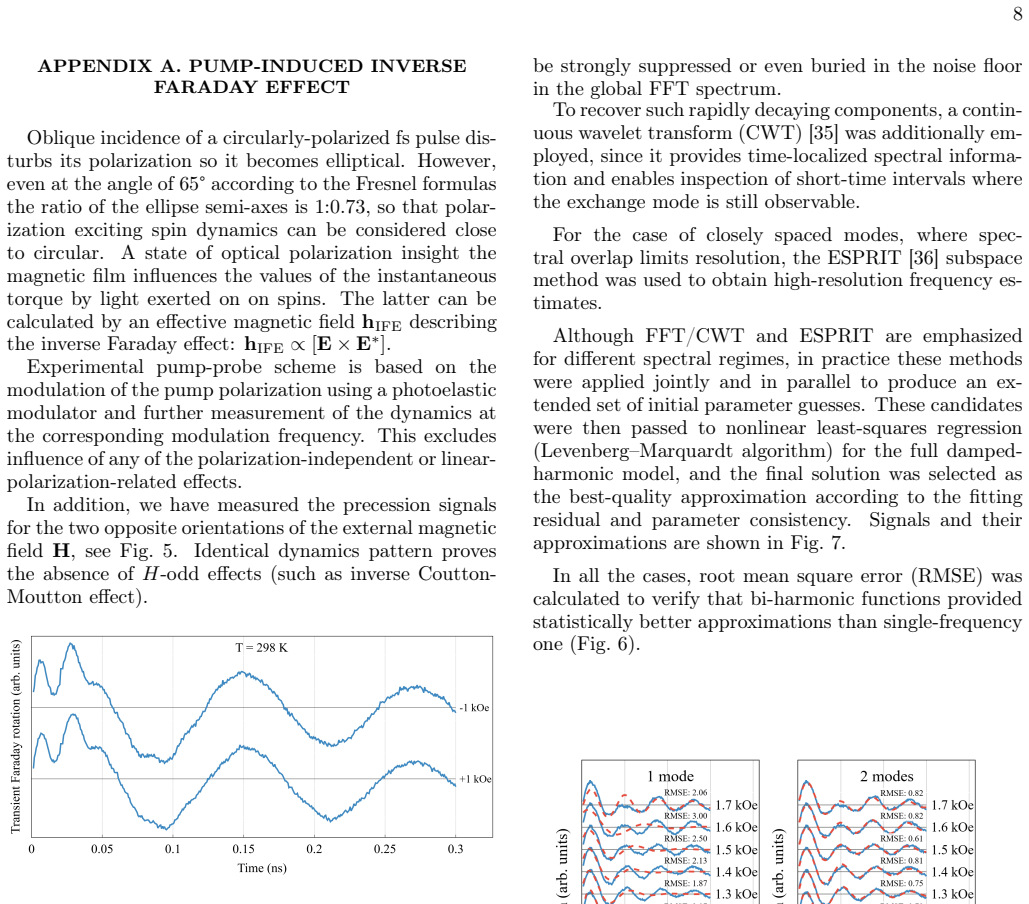
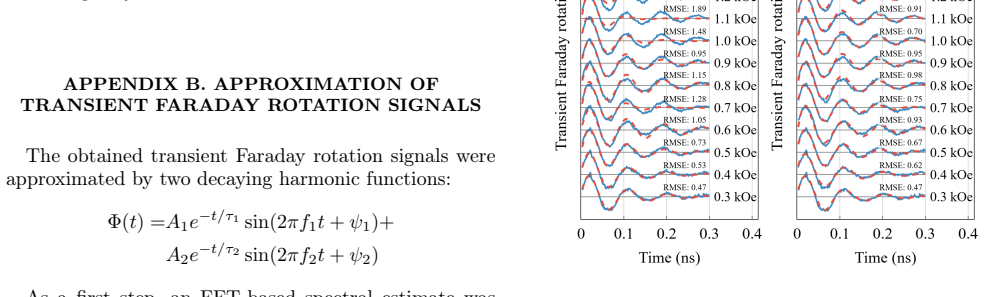
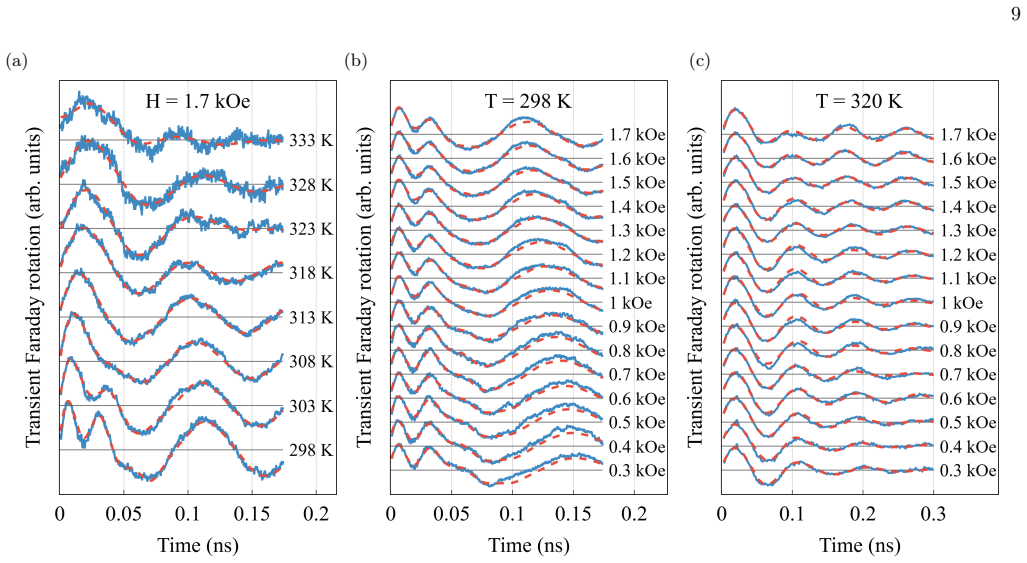
R. Roy and T. Kailath, Esprit-estimation of signal parameters via rotational invariance techniques, IEEE TransactionsonAcoustics, Speech, andSignalProcessing 37, 984 (1989). 8 APPENDIX A. PUMP-INDUCED INVERSE F ARADA Y EFFECT Oblique incidence of a circularly-polarized fs pulse dis- turbs its polarization so it becomes elliptical. However, even at the ang...
1989
discussion (0)
Sign in with ORCID, Apple, or X to comment. Anyone can read and Pith papers without signing in.