Adaptive identification of low-degree polynomials in quantum singular value transformation: application to nonlinear quantum properties estimation
Pith reviewed 2026-06-27 13:25 UTC · model grok-4.3
The pith
A two-stage algorithm adaptively determines low-degree polynomials for QSVT to estimate nonlinear quantum properties at lower cost.
A machine-rendered reading of the paper's core claim, the machinery that carries it, and where it could break.
Core claim
The paper claims that by truncating the negligible eigenvalue tail with a task- and state-dependent spectral cutoff, the degree of the polynomial in QSVT can be significantly lowered, and this cutoff can be identified directly from the state using a search algorithm in a two-stage procedure, leading to better estimation costs for properties like von Neumann and Rényi entropy compared to existing bounds.
What carries the argument
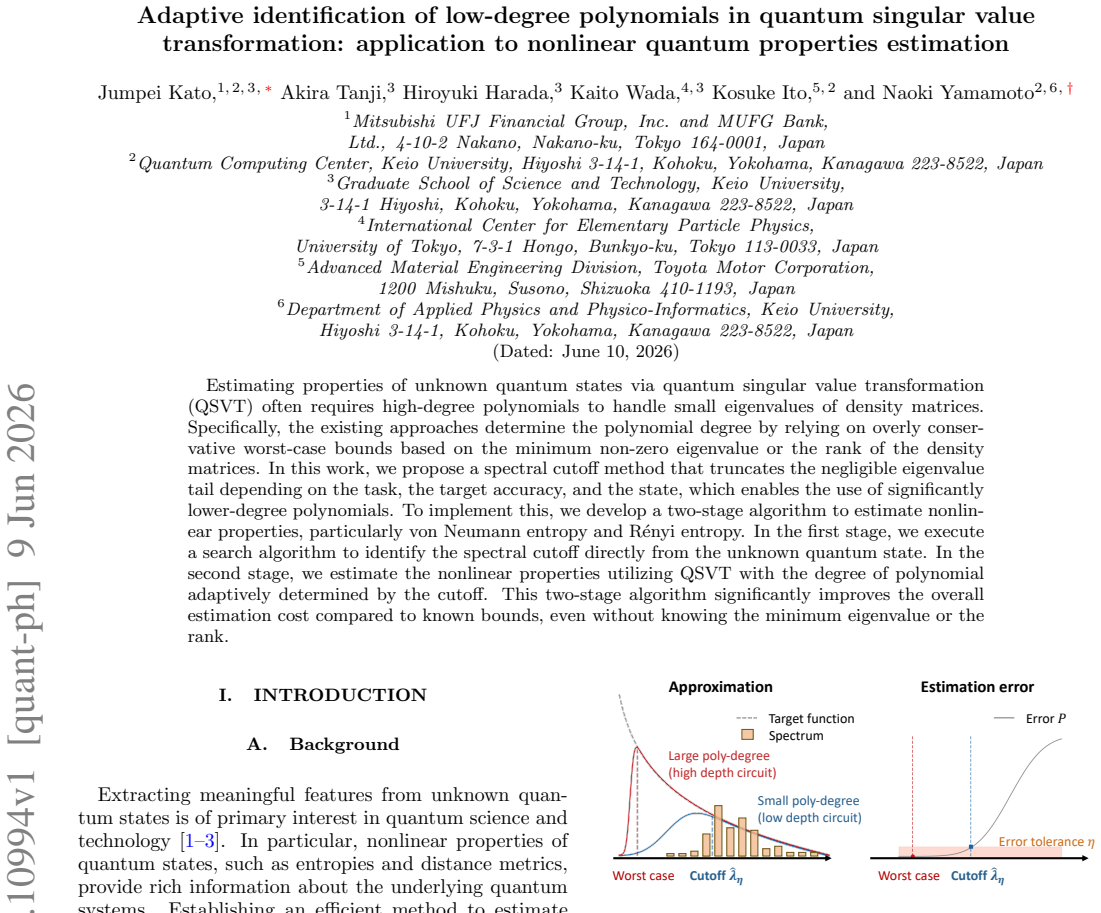
The spectral cutoff method, which truncates the eigenvalue tail depending on the task, target accuracy, and state to enable lower-degree polynomials in QSVT.
If this is right
- Estimation of von Neumann entropy and Rényi entropy can be done with significantly lower cost.
- The method does not require knowledge of the minimum non-zero eigenvalue or the rank.
- The polynomial degree adapts to the specific quantum state and desired accuracy.
- Negligible parts of the spectrum can be ignored without sacrificing accuracy.
Where Pith is reading between the lines
- The approach may apply to other QSVT-based estimations of functions of quantum states.
- Hardware implementations could benefit if the search stage cost scales favorably.
- Further work might optimize the search algorithm for even lower overhead.
- Similar adaptive techniques could appear in related quantum algorithms.
Load-bearing premise
The first-stage search algorithm can identify a suitable spectral cutoff directly from the unknown quantum state at modest additional cost while preserving the target accuracy for the subsequent QSVT stage.
What would settle it
Demonstration that the total query complexity or gate cost of the two-stage procedure is not lower than that of standard methods using conservative bounds for equivalent accuracy and states.
Figures

read the original abstract
Estimating properties of unknown quantum states via quantum singular value transformation (QSVT) often requires high-degree polynomials to handle small eigenvalues of density matrices. Specifically, the existing approaches determine the polynomial degree by relying on overly conservative worst-case bounds based on the minimum non-zero eigenvalue or the rank of the density matrices. In this work, we propose a spectral cutoff method that truncates the negligible eigenvalue tail depending on the task, the target accuracy, and the state, which enables the use of significantly lower-degree polynomials. To implement this, we develop a two-stage algorithm to estimate nonlinear properties, particularly von Neumann entropy and R{\'e}nyi entropy. In the first stage, we execute a search algorithm to identify the spectral cutoff directly from the unknown quantum state. In the second stage, we estimate the nonlinear properties utilizing QSVT with the degree of polynomial adaptively determined by the cutoff. This two-stage algorithm significantly improves the overall estimation cost compared to known bounds, even without knowing the minimum eigenvalue or the rank.
Editorial analysis
A structured set of objections, weighed in public.
Referee Report
Summary. The manuscript proposes a two-stage algorithm for estimating nonlinear properties (von Neumann and Rényi entropy) of unknown quantum states via QSVT. Stage 1 runs a search to identify a task-dependent spectral cutoff directly from the state; Stage 2 then applies QSVT with a lower-degree polynomial whose degree is set by that cutoff. The central claim is that this yields significantly lower overall query cost than existing worst-case bounds that depend on the minimum nonzero eigenvalue or matrix rank, without requiring prior knowledge of those quantities.
Significance. If the first-stage search cost is provably subdominant and the induced approximation error remains within target accuracy, the approach would meaningfully tighten resource estimates for entropy estimation on quantum hardware, especially for states with rapidly decaying spectra. The paper supplies no machine-checked proofs, reproducible code, or explicit end-to-end complexity expressions, so these strengths are not yet realized.
major comments (2)
- [Abstract, §4] Abstract and §4 (two-stage algorithm description): the headline claim that the two-stage procedure 'significantly improves the overall estimation cost' rests on the unproven assertion that the Stage-1 search cost is o(the savings realized by the lower-degree QSVT in Stage 2) while preserving end-to-end error. No query-complexity bound, failure-probability analysis, or explicit comparison to the conservative bounds being beaten is supplied.
- [§3] §3 (spectral cutoff method): the truncation threshold is described as depending on 'the task, the target accuracy, and the state,' yet no concrete rule, algorithm, or error-propagation lemma is given showing that the chosen cutoff keeps the polynomial approximation error below the target accuracy for von Neumann/Rényi entropy. This is load-bearing for the correctness of the adaptive degree selection.
minor comments (2)
- Notation for the spectral cutoff threshold is introduced without a dedicated symbol or equation reference, making it difficult to track through the complexity arguments.
- [Abstract] The abstract states the improvement holds 'even without knowing the minimum eigenvalue or the rank,' but the manuscript does not clarify whether the search algorithm itself implicitly recovers equivalent information at comparable cost.
Simulated Author's Rebuttal
We thank the referee for the constructive feedback on our manuscript. We address each major comment below, indicating planned revisions where appropriate to strengthen the presentation of the two-stage algorithm.
read point-by-point responses
-
Referee: [Abstract, §4] Abstract and §4 (two-stage algorithm description): the headline claim that the two-stage procedure 'significantly improves the overall estimation cost' rests on the unproven assertion that the Stage-1 search cost is o(the savings realized by the lower-degree QSVT in Stage 2) while preserving end-to-end error. No query-complexity bound, failure-probability analysis, or explicit comparison to the conservative bounds being beaten is supplied.
Authors: We agree that the manuscript does not supply a full asymptotic query-complexity bound or failure-probability analysis establishing that Stage-1 cost is strictly subdominant. The current work emphasizes the algorithmic construction and provides numerical demonstrations of net cost reduction for states whose spectra decay faster than the worst-case bounds. In revision we will add a dedicated subsection with a heuristic cost comparison (under the assumption of exponentially decaying eigenvalues) and an explicit statement of the conditions under which the overall procedure improves upon the conservative bounds. revision: partial
-
Referee: [§3] §3 (spectral cutoff method): the truncation threshold is described as depending on 'the task, the target accuracy, and the state,' yet no concrete rule, algorithm, or error-propagation lemma is given showing that the chosen cutoff keeps the polynomial approximation error below the target accuracy for von Neumann/Rényi entropy. This is load-bearing for the correctness of the adaptive degree selection.
Authors: The spectral cutoff is located by the Stage-1 search procedure described in §4, which is intended to be task-specific for entropy estimation. We acknowledge that §3 currently lacks both an explicit algorithmic rule for cutoff selection and a formal error-propagation lemma. In the revised manuscript we will expand §3 to include (i) a precise description of the search-based cutoff rule and (ii) a lemma that bounds the truncation-induced error in the von Neumann and Rényi entropy functionals, showing that the error can be kept below the target accuracy when the cutoff is chosen appropriately. revision: yes
Circularity Check
No circularity: adaptive cutoff is an algorithmic proposal, not a definitional reduction
full rationale
The paper describes a two-stage procedure in which stage 1 searches for a task-dependent spectral cutoff from the unknown state and stage 2 then applies a lower-degree QSVT polynomial whose degree is set by that cutoff. No equations, fitted parameters, or self-citations are exhibited that would make the claimed cost improvement equivalent to its own inputs by construction. The derivation therefore remains self-contained against external complexity bounds; the skeptic concern about stage-1 cost is an assumption-validity issue, not a circularity reduction.
Axiom & Free-Parameter Ledger
free parameters (1)
- spectral cutoff threshold
axioms (1)
- domain assumption QSVT can implement polynomial functions of the singular values of a quantum state or density matrix
Reference graph
Works this paper leans on
-
[1]
Bravyi, A
S. Bravyi, A. W. Harrow, and A. Hassidim, Quantum algorithms for testing properties of distributions, IEEE Transactions on Information Theory57, 3971 (2011)
2011
-
[2]
Montanaro and R
A. Montanaro and R. d. Wolf, A survey of quantum 12 property testing, Theory of Computing Graduate Sur- veys Graduate Surveys, 1 (2016)
2016
-
[3]
Anshu and S
A. Anshu and S. Arunachalam, A survey on the complex- ity of learning quantum states, Nature Reviews Physics 6, 59 (2024)
2024
-
[4]
J. Haah, A. W. Harrow, Z. Ji, X. Wu, and N. Yu, Sample- optimal tomography of quantum states, inProceedings of the Forty-Eighth Annual ACM Symposium on Theory of Computing, STOC ’16 (Association for Computing Ma- chinery, New York, NY, USA, 2016) p. 913–925
2016
-
[5]
O’Donnell and J
R. O’Donnell and J. Wright, Efficient quantum tomog- raphy, inProceedings of the Forty-Eighth Annual ACM Symposium on Theory of Computing, STOC ’16 (Asso- ciation for Computing Machinery, New York, NY, USA,
-
[6]
A. Pelecanos, J. Spilecki, E. Tang, and J. Wright, Mixed state tomography reduces to pure state tomography, arXiv:2511.15806 (2025)
-
[7]
S. Aaronson, Shadow tomography of quantum states, in Proceedings of the 50th Annual ACM SIGACT Sympo- sium on Theory of Computing, STOC 2018 (Association for Computing Machinery, New York, NY, USA, 2018) p. 325–338
2018
-
[8]
Aaronson and G
S. Aaronson and G. N. Rothblum, Gentle measurement of quantum states and differential privacy, inProceedings of the 51st Annual ACM SIGACT Symposium on Theory of Computing, STOC 2019 (Association for Computing Machinery, New York, NY, USA, 2019) p. 322–333
2019
-
[9]
Huang, R
H.-Y. Huang, R. Kueng, and J. Preskill, Predicting many properties of a quantum system from very few measure- ments, Nature Physics16, 1050 (2020)
2020
-
[10]
Acharya, I
J. Acharya, I. Issa, N. V. Shende, and A. B. Wagner, Estimating quantum entropy, IEEE Journal on Selected Areas in Information Theory1, 454 (2020)
2020
-
[11]
Cerezo, A
M. Cerezo, A. Poremba, L. Cincio, and P. J. Coles, Vari- ational Quantum Fidelity Estimation, Quantum4, 248 (2020)
2020
-
[12]
K. C. Tan and T. Volkoff, Variational quantum algo- rithms to estimate rank, quantum entropies, fidelity, and fisher information via purity minimization, Phys. Rev. Res.3, 033251 (2021)
2021
-
[13]
Goldfeld, D
Z. Goldfeld, D. Patel, S. Sreekumar, and M. M. Wilde, Quantum neural estimation of entropies, Phys. Rev. A 109, 032431 (2024)
2024
-
[14]
W. J. Huggins, K. Wan, J. McClean, T. E. O’Brien, N. Wiebe, and R. Babbush, Nearly optimal quantum al- gorithm for estimating multiple expectation values, Phys. Rev. Lett.129, 240501 (2022)
2022
-
[15]
K. Wada, N. Yamamoto, and N. Yoshioka, Heisenberg- limited adaptive gradient estimation for multiple observ- ables, PRX Quantum6, 020308 (2025)
2025
-
[16]
Koizumi, K
Y. Koizumi, K. Wada, W. Mizukami, and N. Yoshioka, Faster quantum algorithm for multiple observables esti- mation, Phys. Rev. Lett.136, 080605 (2026)
2026
-
[17]
Gily´ en, Y
A. Gily´ en, Y. Su, G. H. Low, and N. Wiebe, Quantum singular value transformation and beyond: exponential improvements for quantum matrix arithmetics, inPro- ceedings of the 51st Annual ACM SIGACT Symposium on Theory of Computing, STOC 2019 (Association for Computing Machinery, New York, NY, USA, 2019) p. 193–204
2019
-
[18]
G. H. Low and I. L. Chuang, Hamiltonian Simulation by Qubitization, Quantum3, 163 (2019)
2019
-
[19]
Gily´ en and T
A. Gily´ en and T. Li, Distributional Property Testing in a Quantum World, in11th Innovations in Theoretical Computer Science Conference (ITCS 2020), Leibniz In- ternational Proceedings in Informatics (LIPIcs), Vol. 151, edited by T. Vidick (Schloss Dagstuhl – Leibniz-Zentrum f¨ ur Informatik, Dagstuhl, Germany, 2020) pp. 25:1–25:19
2020
- [20]
-
[21]
Li and X
T. Li and X. Wu, Quantum query complexity of entropy estimation, IEEE Transactions on Information Theory 65, 2899 (2019)
2019
-
[22]
Subramanian and M.-H
S. Subramanian and M.-H. Hsieh, Quantum algorithm for estimatingα-Renyi entropies of quantum states, Phys. Rev. A104, 022428 (2021)
2021
-
[23]
Q. Wang, J. Guan, J. Liu, Z. Zhang, and M. Ying, New quantum algorithms for computing quantum entropies and distances, IEEE Transactions on Information Theory 70, 5653 (2024)
2024
-
[24]
X. Wang, S. Zhang, and T. Li, A quantum algorithm framework for discrete probability distributions with ap- plications to R´ enyi entropy estimation, IEEE Transac- tions on Information Theory70, 3399–3426 (2024)
2024
-
[25]
N. A. Nghiem and T.-C. Wei, Estimation of nonlinear physical quantities by measuring ancillas, Phys. Rev. A 112, 062412 (2025)
2025
-
[26]
Wang and Z
Q. Wang and Z. Zhang, Time-efficient quantum entropy estimator via samplizer, IEEE Transactions on Informa- tion Theory71, 9569 (2025)
2025
-
[27]
Wang and Z
Q. Wang and Z. Zhang, Fast quantum algorithms for trace distance estimation, IEEE Transactions on Infor- mation Theory70, 2720 (2024)
2024
-
[28]
A. Gily´ en and A. Poremba, Improved quantum algo- rithms for fidelity estimation, arXiv:2203.15993 (2022)
-
[29]
Q. Wang, Z. Zhang, K. Chen, J. Guan, W. Fang, J. Liu, and M. Ying, Quantum algorithm for fidelity estima- tion, IEEE Transactions on Information Theory69, 273 (2023)
2023
- [30]
-
[31]
Gily´ en, S
A. Gily´ en, S. Lloyd, I. Marvian, Y. Quek, and M. M. Wilde, Quantum algorithm for Petz recovery channels and pretty good measurements, Phys. Rev. Lett.128, 220502 (2022)
2022
-
[32]
N. Liu, Q. Wang, M. M. Wilde, and Z. Zhang, Quantum algorithms for matrix geometric means, npj Quantum In- formation11, 101 (2025)
2025
-
[33]
O. E. Barndorff-Nielsen and R. D. Gill, Fisher informa- tion in quantum statistics, Journal of Physics A: Mathe- matical and General33, 4481 (2000)
2000
-
[34]
Y. Wang, B. Zhao, and X. Wang, Quantum algorithms for estimating quantum entropies, Phys. Rev. Appl.19, 044041 (2023)
2023
- [35]
- [36]
-
[37]
Lloyd, M
S. Lloyd, M. Mohseni, and P. Rebentrost, Quantum prin- cipal component analysis, Nature physics10, 631 (2014)
2014
-
[38]
Kimmel, C
S. Kimmel, C. Y.-Y. Lin, G. H. Low, M. Ozols, and T. J. Yoder, Hamiltonian simulation with optimal sample com- plexity, npj Quantum Information3, 13 (2017). 13
2017
-
[39]
Lin and Y
L. Lin and Y. Tong, Heisenberg-limited ground-state en- ergy estimation for early fault-tolerant quantum comput- ers, PRX Quantum3, 010318 (2022)
2022
-
[40]
K. Wan, M. Berta, and E. T. Campbell, Randomized quantum algorithm for statistical phase estimation, Phys. Rev. Lett.129, 030503 (2022). 14 Appendix A: Fourier series approximation of the Heaviside step function We review the Fourier series approximation of the Heaviside step function Θ(x) proposed by Wan et al. [40]. The Fourier coefficientsF j,d are exp...
2022
-
[41]
We construct the polynomialF(x) as a product of the step function andx α−1, similar to the method in Ref
Preparation First, in the preparation stage, we determine a bounding functionP α(δ) and a target value of the error tolerance η. We construct the polynomialF(x) as a product of the step function andx α−1, similar to the method in Ref. [24]. 15 From Ref. [28, Corollary 15], there exists an even real polynomialH(x) of degreeO δ−1 log (1/εpoly) , which provi...
-
[42]
Lemma 5(Search algorithm for (η, P α)-spectral cutoff).Letρbe an unknown but accessible quantum state
Identification Here we introduce a search algorithm for the (η, P α)-spectral cutoff. Lemma 5(Search algorithm for (η, P α)-spectral cutoff).Letρbe an unknown but accessible quantum state. LetH be a Hamiltonian s.t.∥H∥ ≤1, and we have access to controlled Hamiltonian evolutione −iH. Letη∈(0,1/2]be a target value andϑ∈(0,1)be a failure probability. Forα >1...
-
[43]
Lemma 6(R´ enyi entropy (α >1) estimation).Letρbe anN-dimensional quantum state
Estimation and total copy requirement Combining with the previous discussion, we finally obtain the complexity for estimating R´ enyi entropy. Lemma 6(R´ enyi entropy (α >1) estimation).Letρbe anN-dimensional quantum state. For a fixedα >1, ε∈(0,1/(α−1)]andϑ∈(0,1), R´ enyi entropy 1 1−α log(tr[ρα])can be estimated within additive errorεwith a success prob...
discussion (0)
Sign in with ORCID, Apple, or X to comment. Anyone can read and Pith papers without signing in.