Defect Tolerance in Trigonal Selenium Photovoltaics
Pith reviewed 2026-06-27 12:11 UTC · model grok-4.3
The pith
Trigonal selenium is intrinsically defect tolerant because large lattice reorganizations and energy releases suppress recombination despite deep defect levels.
A machine-rendered reading of the paper's core claim, the machinery that carries it, and where it could break.
Core claim
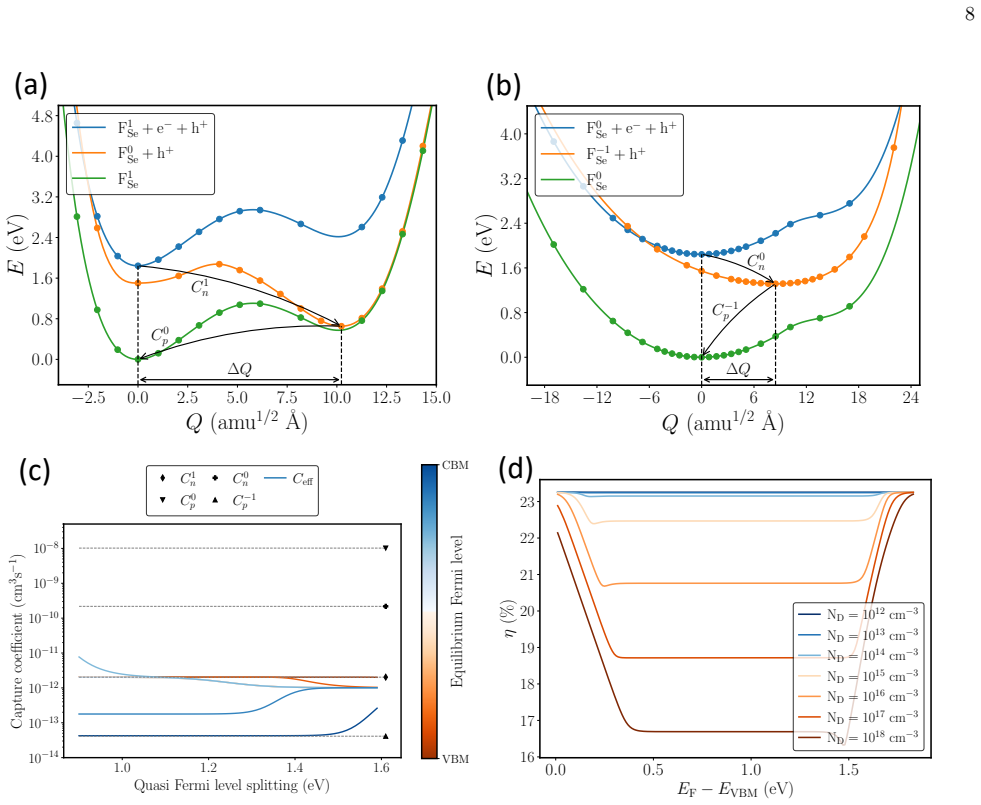
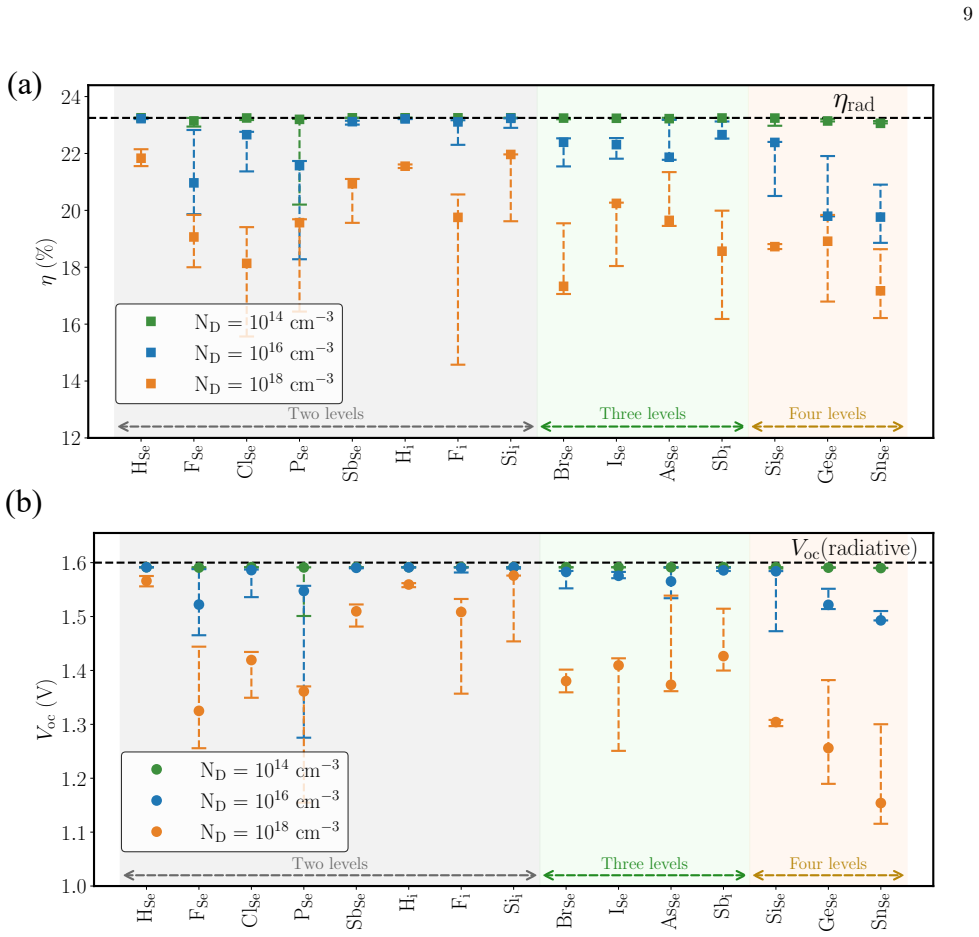
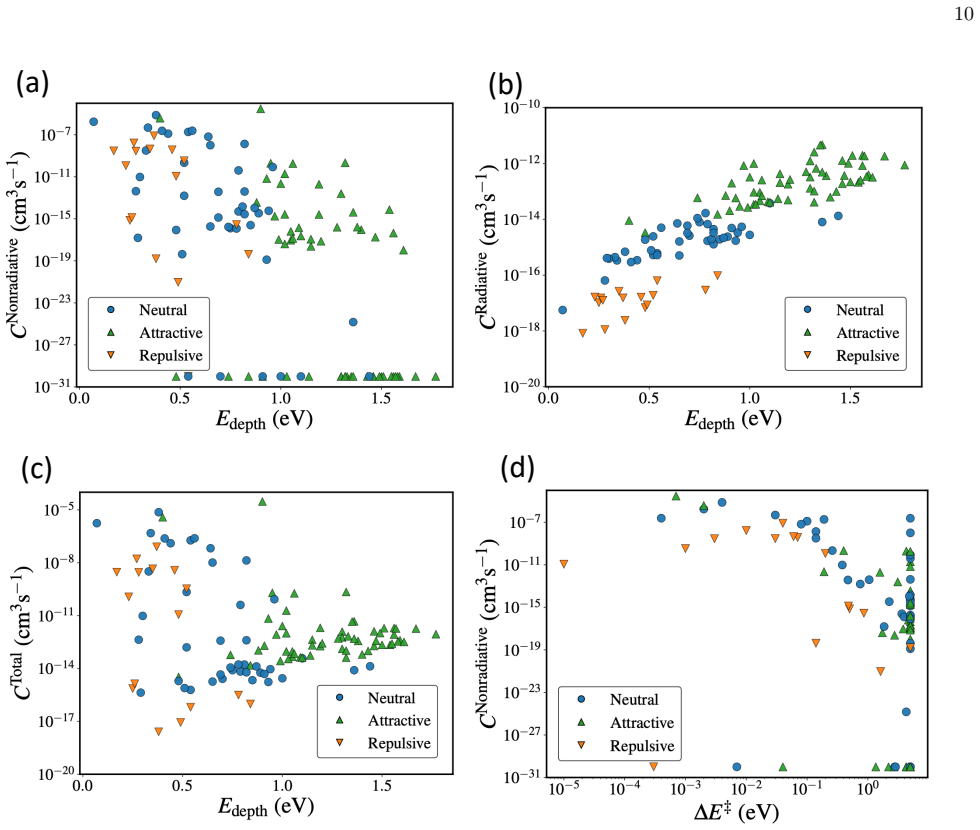
Our results suggest that t-Se is intrinsically defect tolerant. Despite the presence of multiple deep levels in the gap, recombination via nonradiative multi-phonon emission processes is strongly suppressed by large lattice reorganizations and large energy releases of at least 0.5 EG per recombination event, while radiative defect-assisted capture also remains too small to account for the observed device losses. Consequently, SRH recombination mediated by realistic concentrations of point defects cannot account for the observed efficiency limitations in selenium photovoltaics.
What carries the argument
First-principles calculations of defect transition levels, lattice relaxation energies, and resulting multi-phonon emission rates across many point defects.
If this is right
- SRH recombination from point defects does not limit efficiency in t-Se photovoltaics.
- Trends in lattice relaxation and energy release can guide design of other defect-tolerant wide-band-gap materials.
- Other loss mechanisms besides defect-mediated SRH must be identified to improve selenium cells.
- t-Se qualifies as a defect-tolerant absorber for tandem and indoor photovoltaic applications.
Where Pith is reading between the lines
- Materials with similar large relaxation energies around defects may also show suppressed recombination even with gap states.
- Device studies could test whether surface or interface effects, rather than bulk point defects, dominate losses in t-Se.
- The approach of checking both radiative and nonradiative rates together could apply to screening other emerging absorbers.
Load-bearing premise
The computed defect levels, relaxation energies, and emission rates match the actual recombination behavior in real trigonal selenium samples.
What would settle it
A measurement showing that lowering point defect density in t-Se devices raises efficiency in proportion to the calculated SRH rates would contradict the claim.
Figures
read the original abstract
Understanding how point defects fundamentally influence photovoltaic performance remains a central question for emerging wide-band gap absorbers. Trigonal selenium (t-Se) has recently re-emerged as a promising photovoltaic material due to its near-optimal band gap for tandem and indoor applications. Here we quantify defect-assisted Shockley-Read-Hall (SRH) recombination in t-Se using first principles calculations across a large and chemically diverse set of point defects. Our results suggest that t-Se is intrinsically defect tolerant. Despite the presence of multiple deep levels in the gap, recombination via nonradiative multi-phonon emission processes is strongly suppressed by large lattice reorganizations and large energy releases of at least 0.5 EG per recombination event, while radiative defect-assisted capture also remains too small to account for the observed device losses. Consequently, SRH recombination mediated by realistic concentrations of point defects cannot account for the observed efficiency limitations in selenium photovoltaics. We explore trends in both radiative and nonradiative SRH recombination rates across the defect data set, highlighting their complex dependence on defect level position, lattice relaxation, charge state, and doping conditions. These findings establish trigonal selenium as a defect-tolerant wide-band-gap absorber and provide transferable design principles for optimizing next-generation photovoltaic materials for tandem and indoor applications.
Editorial analysis
A structured set of objections, weighed in public.
Referee Report
Summary. The manuscript uses first-principles defect calculations across a chemically diverse set of point defects in trigonal selenium (t-Se) to quantify defect-assisted SRH recombination. It concludes that t-Se is intrinsically defect tolerant: deep levels exist but nonradiative multi-phonon emission is suppressed by large lattice reorganizations and energy releases ≥ 0.5 E_G, radiative capture is negligible, and realistic defect concentrations cannot explain observed efficiency losses. Trends in radiative and nonradiative rates are analyzed as functions of level position, relaxation, charge state, and doping.
Significance. If the computed rates hold, the work establishes t-Se as a defect-tolerant wide-gap absorber suitable for tandem and indoor PV, supplies transferable design rules based on relaxation and energy-release criteria, and demonstrates the value of surveying many defects rather than a few canonical ones. The absence of fitted parameters and direct derivation from first-principles defect energetics and relaxation energies are strengths.
major comments (2)
- [Section describing quantification of defect-assisted SRH recombination (abstract and methods)] The SRH rate model (including the explicit formula linking transition levels, relaxation energies, and multi-phonon emission rates) is not presented with sufficient detail or convergence tests; without these the central claim that computed rates remain too low to explain device losses cannot be evaluated quantitatively.
- [Results section on SRH rates and conclusions] No direct comparison is shown between the computed SRH lifetimes (or capture coefficients) and measured carrier lifetimes or device performance metrics in t-Se; this comparison is required to substantiate that point-defect SRH cannot account for observed losses.
minor comments (2)
- Notation for charge states and transition levels should be standardized across figures and tables for clarity.
- The abstract states 'large energy releases of at least 0.5 E_G'; the precise definition of E_G used and the distribution of values across the defect set should be stated explicitly in the main text.
Simulated Author's Rebuttal
We thank the referee for their thorough review and constructive feedback on our manuscript. We address each of the major comments below and will revise the manuscript accordingly to improve clarity and strengthen the presentation of our results.
read point-by-point responses
-
Referee: [Section describing quantification of defect-assisted SRH recombination (abstract and methods)] The SRH rate model (including the explicit formula linking transition levels, relaxation energies, and multi-phonon emission rates) is not presented with sufficient detail or convergence tests; without these the central claim that computed rates remain too low to explain device losses cannot be evaluated quantitatively.
Authors: We agree with this assessment. The revised manuscript will include the full SRH rate equations, detailing how transition levels, relaxation energies, and energy releases enter the multi-phonon emission rates. We will also add convergence tests for the key parameters such as supercell size and k-point sampling to allow quantitative evaluation of the computed rates. revision: yes
-
Referee: [Results section on SRH rates and conclusions] No direct comparison is shown between the computed SRH lifetimes (or capture coefficients) and measured carrier lifetimes or device performance metrics in t-Se; this comparison is required to substantiate that point-defect SRH cannot account for observed losses.
Authors: We recognize the value of an explicit side-by-side comparison. Although our analysis already demonstrates that even at high defect concentrations the SRH rates are too low to explain the observed efficiency losses, we will add a new subsection or figure in the results that directly compares our computed lifetimes to experimental reports of carrier lifetimes and device metrics in t-Se. This will include estimates of the defect concentrations needed to match experimental losses. revision: yes
Circularity Check
No significant circularity detected
full rationale
The paper derives its central claim—that t-Se is intrinsically defect tolerant because computed SRH rates are too low to explain observed losses—directly from first-principles defect calculations of transition levels, relaxation energies, and multi-phonon emission rates across a chemically diverse defect set. No load-bearing step reduces by construction to a fitted parameter, self-referential equation, or self-citation chain; the argument is a standard computational prediction from DFT inputs without renaming known results or smuggling ansatzes. The derivation remains self-contained against external benchmarks.
Axiom & Free-Parameter Ledger
axioms (1)
- domain assumption Density functional theory accurately predicts defect formation energies, transition levels, and lattice relaxation energies in trigonal selenium.
Reference graph
Works this paper leans on
-
[1]
Smith, The action of light on selenium, Journal of the Society of Telegraph Engineers2, 31 (1873)
W. Smith, The action of light on selenium, Journal of the Society of Telegraph Engineers2, 31 (1873)
-
[2]
W. Lu, Z. Li, M. Feng, L. Zheng, S. Liu, B. Yan, J. S. Hu, and D. J. Xue, Structure of amorphous selenium: Small ring, big controversy, Journal of the American Chemical Society146, 6345 (2024)
2024
-
[3]
Cherin and P
P. Cherin and P. Unger, Refinement of the crystal struc- ture ofα-monoclinic se, Acta Crystallographica Section B: Structural Crystallography and Crystal Chemistry 28, 313 (1972)
1972
-
[4]
Marsh, L
R. Marsh, L. Pauling, and J. McCullough, The crystal structure ofβselenium, Acta Crystallographica6, 71 (1953)
1953
-
[5]
Foss and V
O. Foss and V. Janickis, Crystal structure ofγ- monoclinic selenium, Journal of the Chemical Society, Dalton Transactions , 624 (1980)
1980
-
[6]
Keller, W
R. Keller, W. Holzapfel, and H. Schulz, Effect of pressure on the atom positions in se and te, Physical Review B 16, 4404 (1977)
1977
-
[7]
H. Moustafa, J. Kangsabanik, F. Bertoldo, S. Manti, K. S. Thygesen, K. W. Jacobsen, and T. Olsen, Sele- nium and the role of defects for photovoltaic applications, Physical Review Materials8, 10.1103/PhysRevMateri- als.8.015402 (2024)
-
[8]
R. Li, X. Chen, S. Bai, W. Xu, C. Xia, B. Zhang, Z. Jia, Y. Liu, H. Liu, X. Tian, Q. Cui, and Q. Lin, Efficient se- lenium photodiodes based on an inverted p-i-n structure, Chemistry of Materials36, 5846 (2024)
2024
-
[9]
I. Hadar, T. B. Song, W. Ke, and M. G. Kanatzidis, Modern processing and insights on selenium solar cells: The world’s first photovoltaic device, Advanced Energy Materials9, 10.1002/aenm.201802766 (2019)
-
[10]
T. H. Youngman, R. Nielsen, A. Crovetto, B. Seger, O. Hansen, I. Chorkendorff, and P. C. Vesborg, Semi- transparent selenium solar cells as a top cell for tan- dem photovoltaics, Solar RRL5, 10.1002/solr.202100111 (2021)
-
[11]
R. Nielsen, A. Crovetto, A. Assar, O. Hansen, I. Chork- endorff, and P. C. Vesborg, Monolithic selenium/silicon tandem solar cells, PRX Energy3, 10.1103/prxen- ergy.3.013013 (2024)
-
[12]
T. K. Todorov, S. Singh, D. M. Bishop, O. Gunawan, Y. S. Lee, T. S. Gershon, K. W. Brew, P. D. Antunez, and R. Haight, Ultrathin high band gap solar cells with improved efficiencies from the world’s oldest photovoltaic material, Nature Communications8, 10.1038/s41467- 017-00582-9 (2017)
-
[13]
B. Yan, X. Liu, W. Lu, M. Feng, H.-J. Yan, Z. Li, S. Liu, C. Wang, J.-S. Hu, and D.-J. Xue, Indoor photovoltaics awaken the world’s first solar cells (2022)
2022
-
[14]
Nielsen, T
R. Nielsen, T. H. Youngman, H. Moustafa, S. Levcenco, H. Hempel, A. Crovetto, T. Olsen, O. Hansen, I. Chork- endorff, T. Unold, and P. C. K. Vesborg, Origin of pho- tovoltaic losses in selenium solar cells with open-circuit voltages approaching 1 V, J. Mater. Chem. A10, 24199 (2022)
2022
-
[15]
Almora, C
O. Almora, C. I. Cabrera, S. Erten-Ela, K. Forberich, K. Fukuda, F. Guo, J. Hauch, A. W. Ho-Baillie, T. J. Jacobsson, R. A. Janssen, T. Kirchartz, M. A. Loi, X. Mathew, D. B. Mitzi, M. K. Nazeeruddin, U. W. Paetzold, B. P. Rand, U. Rau, T. Someya, E. Unger, L. Vaillant-Roca, and C. J. Brabec, Device performance of emerging photovoltaic materials (version ...
2024
-
[16]
W. Lu, M. Feng, Z. Li, B. Yan, S. Wang, X. Wen, X. An, S. Liu, J. S. Hu, and D. J. Xue, Ordering one-dimensional chains enables efficient selenium photovoltaics, Joule8, 1430 (2024)
2024
-
[17]
Nakada and A
T. Nakada and A. Kunioka, Polycrystalline thin-film tio2/se solar cells, Japanese journal of applied physics 24, L536 (1985)
1985
-
[18]
K. Shen, X. Wang, B. Xiao, F. Bao, Y. Xie, J. Wu, F. Guo, H. Zhu, Z. Li, and Y. Mai, Oxygen-assisted high- temperature deposition of high-efficiency trigonal sele- nium solar cells, Advanced Energy Materials15, 2501930 (2025)
2025
-
[19]
X. Wen, Z. Li, W. Lu, J. Li, W. Xie, Z. Wei, S. Liu, Q. Liu, X. An, M. Feng,et al., Illumination-assisted annealing enables selenium solar cells with open-circuit voltage over 1 v and efficiency exceeding 10%, Nature Energy11, 274 (2026)
2026
-
[20]
Y.-S. Xia, H. Li, S. Chen, J.-R. Cai, G. Huang, J.-C. Yu, Z.-P. Huang, L.-M. Lin, S.-Y. Chen, and G.-L. Chen, A vapor pressure-mediated annealing strategy for vertically oriented trigonal selenium films enabling efficient solar cells, Advanced Functional Materials , e74418 (2026)
2026
-
[21]
Shockley and H
W. Shockley and H. J. Queisser, Detailed balance limit of efficiency of p-n junction solar cells, Journal of applied physics32, 510 (1961)
1961
-
[22]
Freysoldt, B
C. Freysoldt, B. Grabowski, T. Hickel, J. Neugebauer, G. Kresse, A. Janotti, and C. G. V. D. Walle, First- principles calculations for point defects in solids, Reviews of Modern Physics86, 253 (2014)
2014
-
[23]
J. S. Park, S. Kim, Z. Xie, and A. Walsh, Point defect engineering in thin-film solar cells (2018)
2018
-
[24]
J. Kangsabanik and K. S. Thygesen, Defect-assisted re- combination in semiconductors and photovoltaic device parameters from first principles, Journal of the Ameri- can Chemical Society148, 316 (2026), pMID: 41469189, https://doi.org/10.1021/jacs.5c12981
-
[25]
S. Kim, J. A. M´ arquez, T. Unold, and A. Walsh, Upper limit to the photovoltaic efficiency of imperfect crystals from first principles, Energy & Environmental Science 13, 1481 (2020)
2020
-
[26]
Alkauskas, Q
A. Alkauskas, Q. Yan, and C. G. Van de Walle, First- principles theory of nonradiative carrier capture via mul- tiphonon emission, Physical Review B90, 075202 (2014)
2014
-
[27]
S. R. Kavanagh, R. S. Nielsen, J. L. Hansen, R. S. David- sen, O. Hansen, A. E. Samli, P. C. Vesborg, D. O. Scan- lon, and A. Walsh, Intrinsic point defect tolerance in se- lenium for indoor and tandem photovoltaics, Energy & Environmental Science18, 4431 (2025). 17
2025
-
[28]
J. Heyd, G. E. Scuseria, and M. Ernzerhof, Hybrid func- tionals based on a screened coulomb potential, The Jour- nal of chemical physics118, 8207 (2003)
2003
-
[29]
Bagraev and V
N. Bagraev and V. t. Mashkov, A mechanism for two- electron capture at deep level defects in semiconductors, Solid state communications65, 1111 (1988)
1988
-
[30]
X. Chen, S. Bai, R. Li, Y. Yang, and Q. Lin, Re- solving the trap levels of se and se1-xtex via deep- level transient spectroscopy, Physical Review Materials 8, 10.1103/PhysRevMaterials.8.033805 (2024)
-
[31]
Alkauskas, C
A. Alkauskas, C. E. Dreyer, J. L. Lyons, and C. G. Van de Walle, Role of excited states in shockley-read-hall recom- bination in wide-band-gap semiconductors, Physical Re- view B93, 201304(R) (2016)
2016
-
[32]
Kohn and L
W. Kohn and L. J. Sham, Self-consistent equations in- cluding exchange and correlation effects, Physical review 140, A1133 (1965)
1965
-
[33]
J. J. Mortensen, A. H. Larsen, M. Kuisma, A. V. Ivanov, A. Taghizadeh, A. Peterson, A. Haldar, A. O. Dohn, C. Sch¨ afer, E.¨O. J´ onsson,et al., Gpaw: An open python package for electronic structure calculations, The Journal of Chemical Physics160(2024)
2024
-
[34]
A. H. Larsen, J. J. Mortensen, J. Blomqvist, I. E. Castelli, R. Christensen, M. Du lak, J. Friis, M. N. Groves, B. Hammer, C. Hargus,et al., The atomic sim- ulation environment—a python library for working with atoms, Journal of Physics: Condensed Matter29, 273002 (2017)
2017
-
[35]
J. P. Perdew, K. Burke, and M. Ernzerhof, General- ized gradient approximation made simple, Physical re- view letters77, 3865 (1996)
1996
-
[36]
Kangsabanik, M
J. Kangsabanik, M. K. Svendsen, A. Taghizadeh, A. Crovetto, and K. S. Thygesen, Indirect band gap semi- conductors for thin-film photovoltaics: High-throughput calculation of phonon-assisted absorption, Journal of the American Chemical Society144, 19872 (2022)
2022
-
[37]
Mosquera-Lois, S
I. Mosquera-Lois, S. R. Kavanagh, A. Walsh, and D. O. Scanlon, Shakenbreak: Navigating the defect configura- tional landscape, Journal of Open Source Software7, 4817 (2022)
2022
-
[38]
Freysoldt, J
C. Freysoldt, J. Neugebauer, and C. G. Van de Walle, Fully ab initio finite-size corrections for charged- defect supercell calculations, Physical review letters102, 016402 (2009)
2009
-
[39]
Gjerding, T
M. Gjerding, T. Skovhus, A. Rasmussen, F. Bertoldo, A. H. Larsen, J. J. Mortensen, and K. S. Thygesen, Atomic simulation recipes: A python framework and li- brary for automated workflows, Computational Materi- als Science199, 110731 (2021)
2021
-
[40]
J. J. Mortensen, M. Gjerding, and K. S. Thygesen, Myqueue: Task and workflow scheduling system, Journal of Open Source Software5, 1844 (2020)
2020
-
[41]
M. E. Turiansky, A. Alkauskas, M. Engel, G. Kresse, D. Wickramaratne, J.-X. Shen, C. E. Dreyer, and C. G. Van de Walle, Nonrad: Computing nonradiative capture coefficients from first principles, Computer Physics Com- munications267, 108056 (2021)
2021
-
[42]
S. Kim, S. N. Hood, P. Van Gerwen, L. D. Whalley, and A. Walsh, Carriercapture. jl: Anharmonic carrier capture, Journal of Open Source Software5, 2102 (2020) 1 Supplementary Material: Defect T olerance in T rigonal Selenium Photovoltaics Jiban Kangsabanik∗1,2, Kasper Tolborg2, Thomas Olsen 1, Kristian S. Thygesen †1 1CAMD, Computational Atomic-Scale Mater...
2020
-
[43]
Single CTL For a defect with one CTL, (1/0), the SRH recombination rate is RSRH = NDC1 nC0 p(np−n 1p1) C1n(n+n 1) +C 0p(p+p 1) = NDC1 nC0 p(np−n 2 i ) C1n(n+n 1) +C 0p(p+p 1) .(S2)
-
[44]
Two CTLs For a defect with two CTLs, (1/0|0/−1), the SRH recombination rate becomes RSRH = ND G " C0 nC −1 p (np−n 0p0) C −1p p+C 0nn0 + C0 p C1 n(np−n 1p1) C1nn+C 0p p1 # ,(S3) with G= 1 + C0 p p+C 1 nn1 C1nn+C 0p p1 + C0 nn+C −1 p p0 C −1p p+C 0nn0 .(S4) Similarly, for a defect with CTLs (2/1|1/0), RSRH = ND G " C1 nC0 p(np−n 1p1) C0p p+C 1nn1 + C1 p C2...
-
[45]
Three CTLs For a defect with three CTLs, (1/0|0/−1| −1/−2), the SRH recombination rate reads RSRH = ND G " C −1 p C0 p C1 n(npp−n 1p1p) +C 0 nC0 p C1 n(npn0 −n 1p1n0) (C0nn+C −1p p0)(C1nn+C 0p p1) + C0 nC −1 p (np−n 0p0) C0nn+C −1p p0 + C −1 n C −2 p (np−n −1p−1) C −2p p+C −1n n−1 # , (S7) with G= 1 + C −1 p p+C 0 nn0 C0nn+C −1p p0 + C −1 n n+C −2 p p−1 C...
-
[46]
(S12) The above expressions provide the working formulas used in the present study for defects with multiple CTLs
Four CTLs For a defect with four CTLs, (2/1|1/0|0/−1| −1/−2), the SRH recombination rate is RSRH = ND G " C0 p C1 p C2 n(npp−n 2p2p) +C 1 nC1 p C2 n(npn1 −n 2p2n1) (C1nn+C 0p p1)(C2nn+C 1p p2) + C1 nC0 p(np−n 1p1) C1nn+C 0p p1 + C0 nC −1 p (np−n 0p0) C −1p p+C 0nn0 + C0 nC −1 n C −2 p (npn−n −1p−1n) +C −1 p C −1 n C −2 p (npp0 −n −1p−1p0) (C −1p p+C 0nn0)...
-
[47]
Kangsabanik and K
J. Kangsabanik and K. S. Thygesen, Defect-assisted recombination in semiconductors and photovoltaic device parameters from first principles,Journal of the American Chemical Society148, 316–329 (2026)
2026
discussion (0)
Sign in with ORCID, Apple, or X to comment. Anyone can read and Pith papers without signing in.