Comisso-Asenjo Mechanism in Rotating mathcal{N}=2,U(1)² Gauged Supergravity Black Holes: Extended Comparison With Kerr Black Hole
Pith reviewed 2026-06-27 09:16 UTC · model grok-4.3
The pith
Certain rotating supergravity black holes allow magnetic reconnection to extract energy with efficiency above the Kerr extremal limit even at moderate spins.
A machine-rendered reading of the paper's core claim, the machinery that carries it, and where it could break.
Core claim
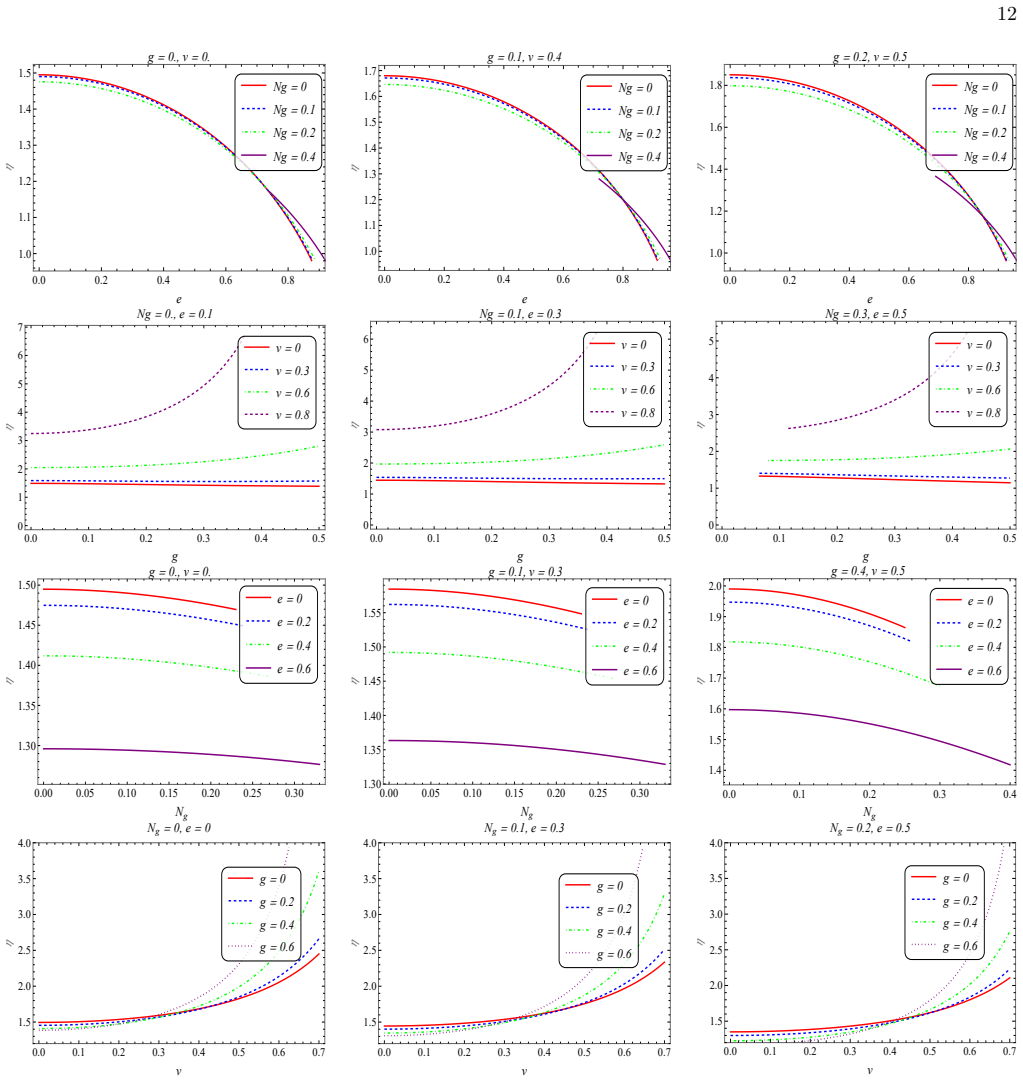
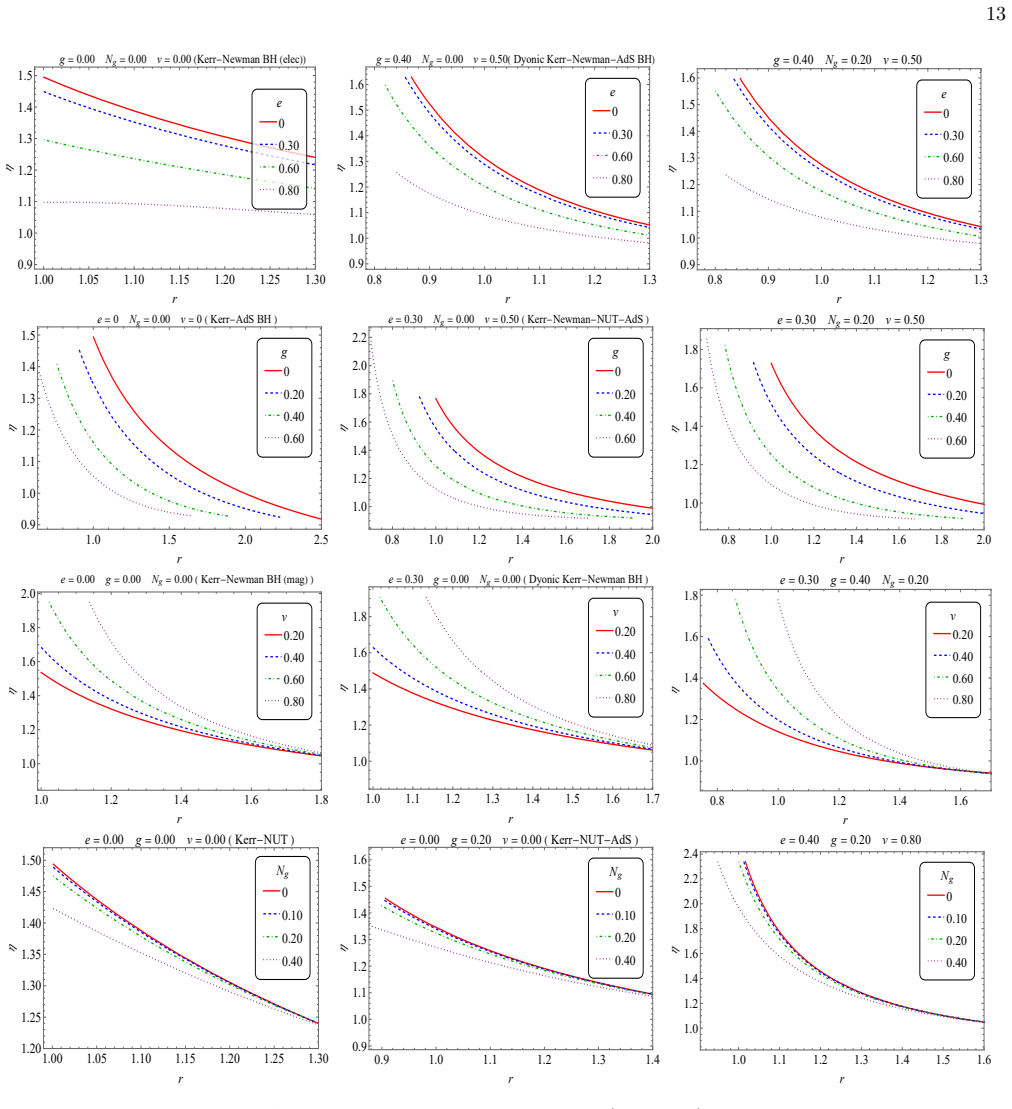
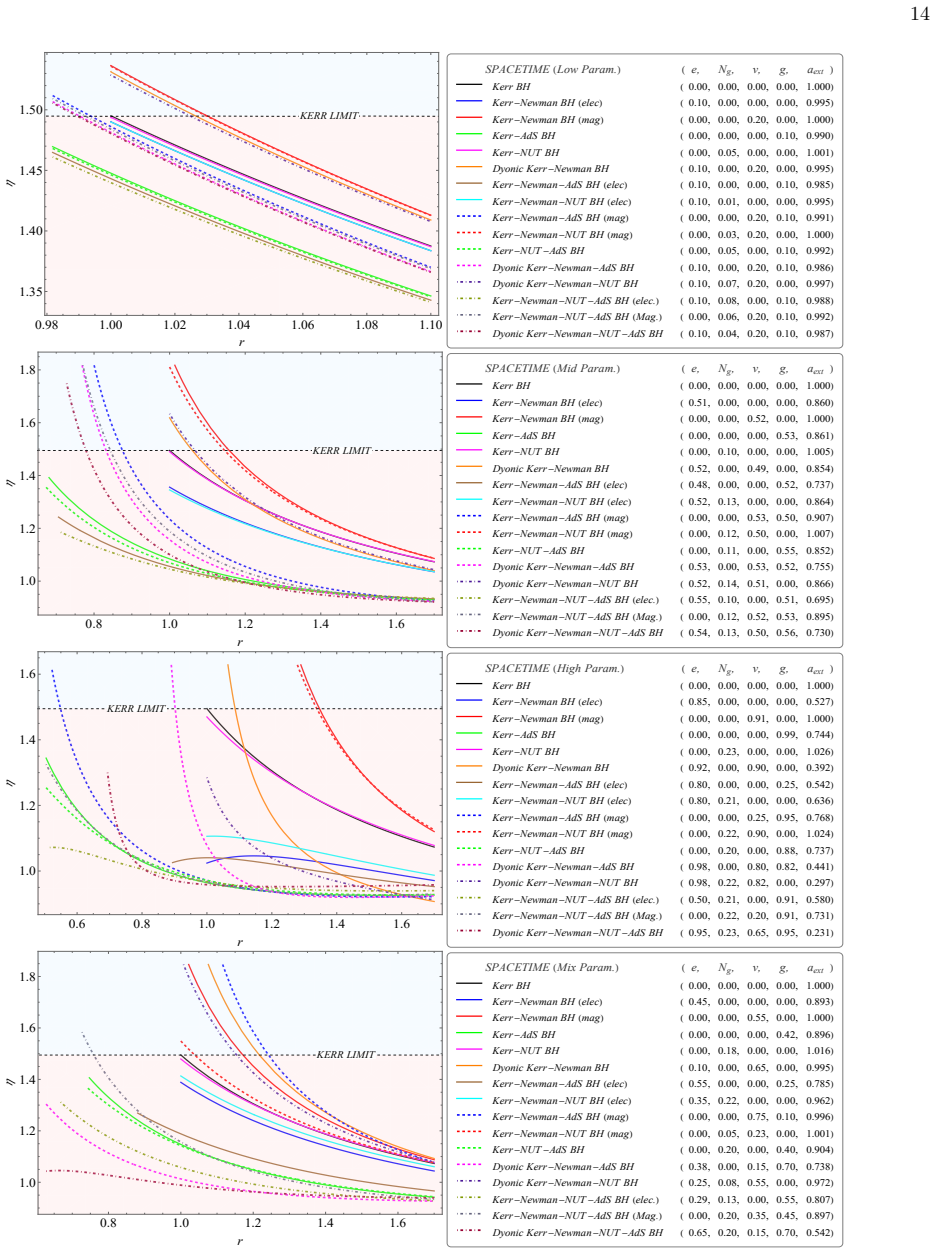
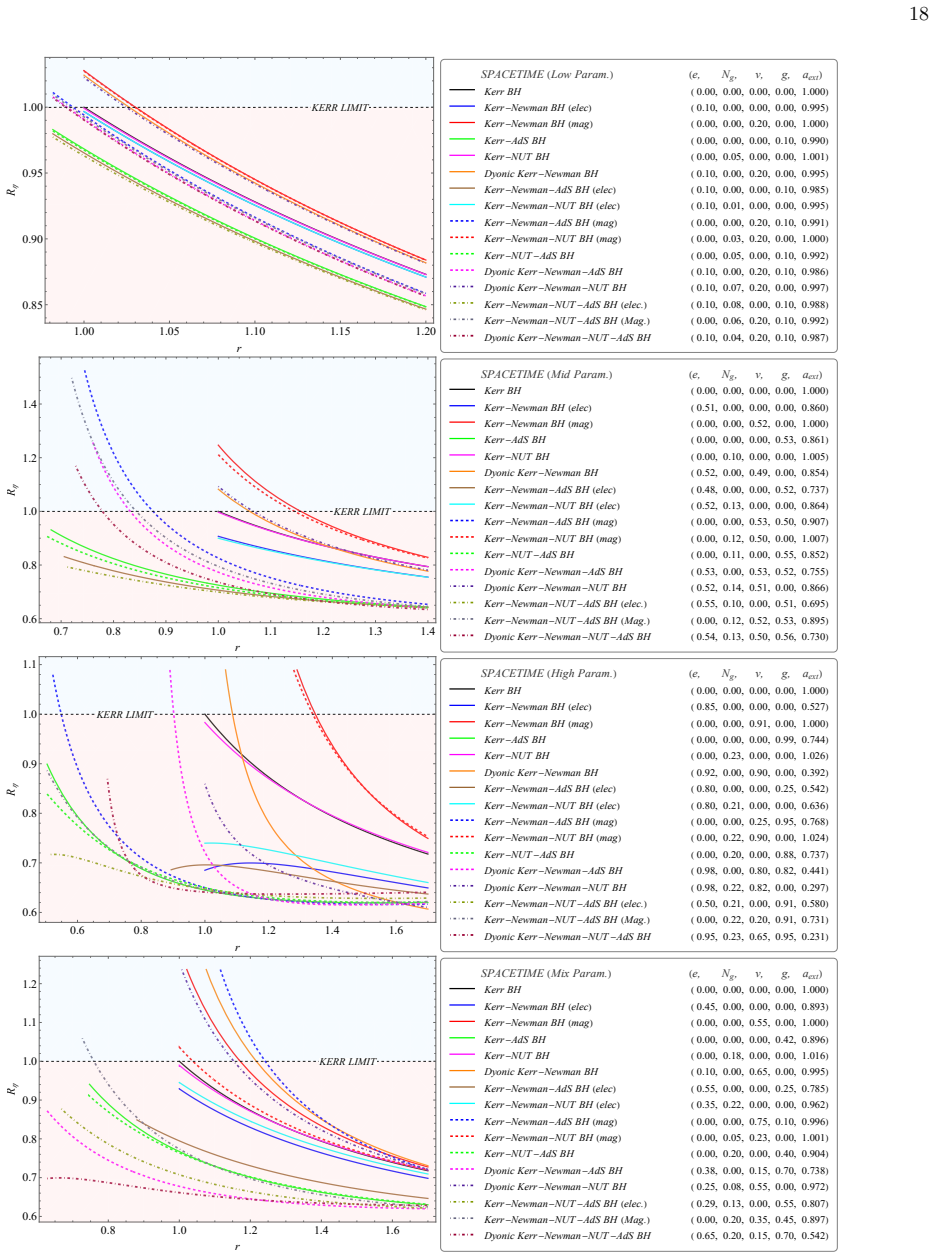
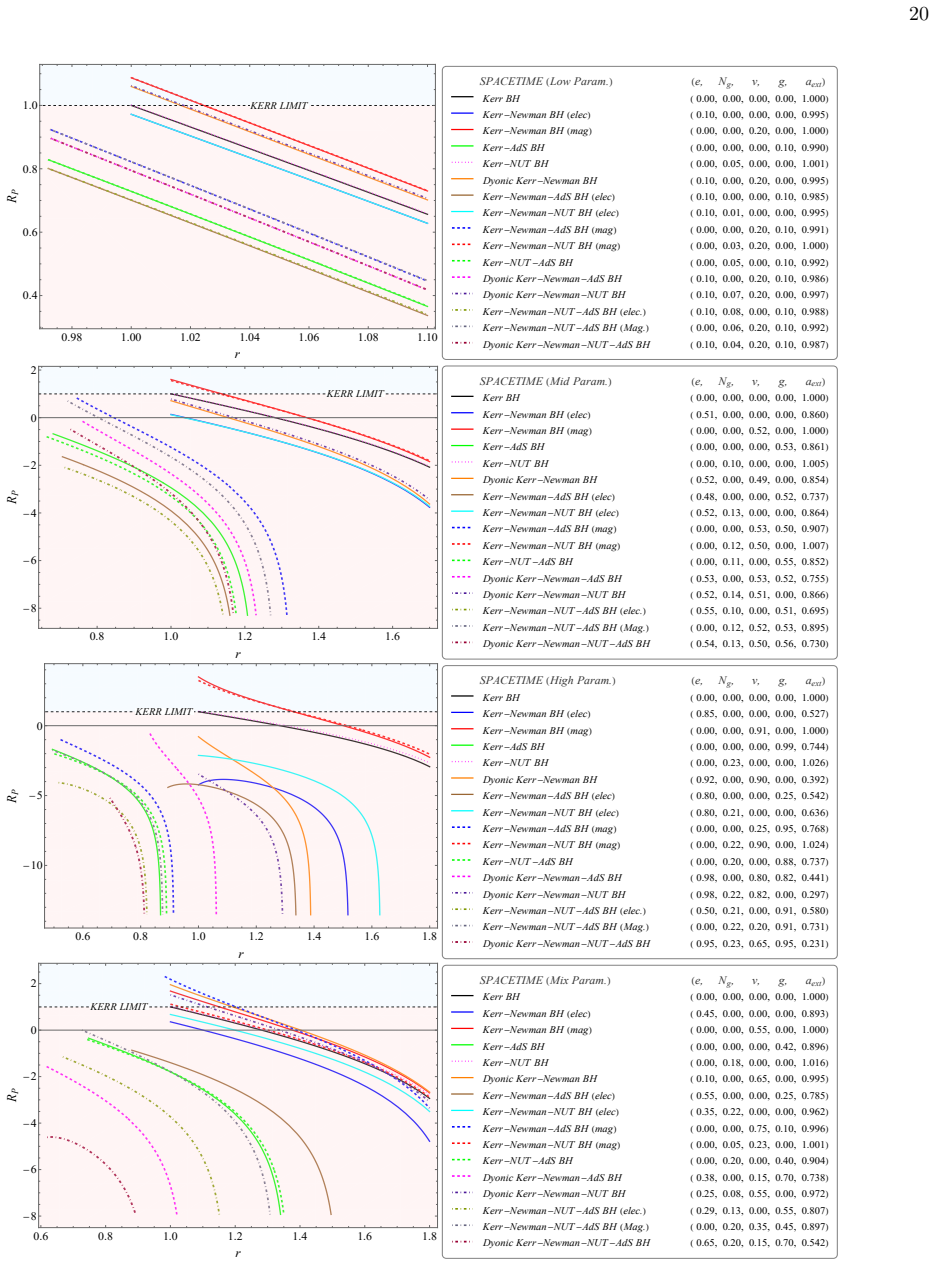
In extremal N=2 U(1)^2 gauged supergravity black holes, the Comisso-Asenjo reconnection process yields energy extraction efficiency η that can exceed the Kerr extremal limit η>1.495 for selected parameter sets, including cases at lower spin than the Kerr extremal value, while the model parameters act as boosters or dampers on the outputs.
What carries the argument
Comisso-Asenjo magnetic reconnection efficiency and power formulas evaluated on the rotating N=2 U(1)^2 gauged supergravity metric with parameters (N_g, g, v, e, a).
If this is right
- Efficiency and power can be higher than in Kerr at spins a approximately 0.39 for low, mid, high, and mixed parameter regimes.
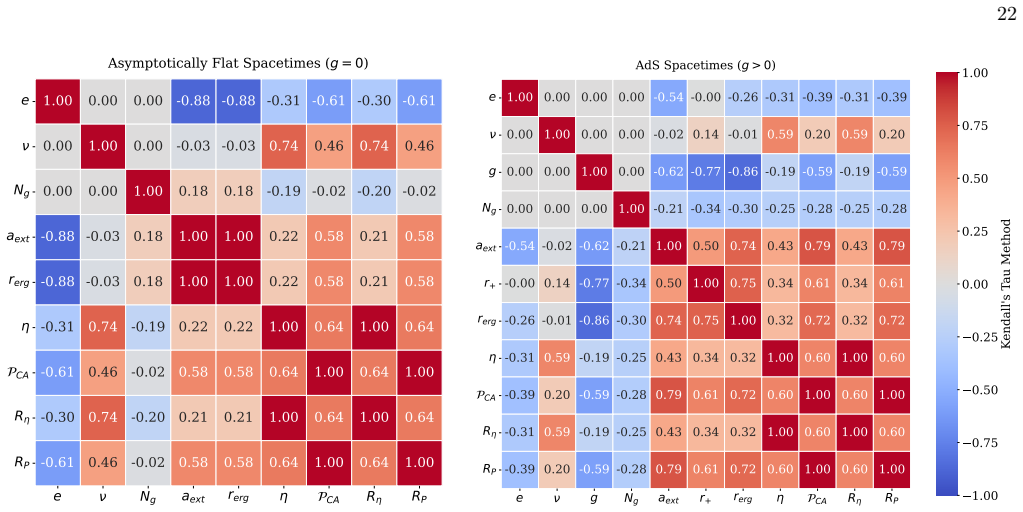
- The parameters N_g, g, v, e act as statistical boosters or dampers on efficiency, power, and related radii via Kendall's Tau correlations.
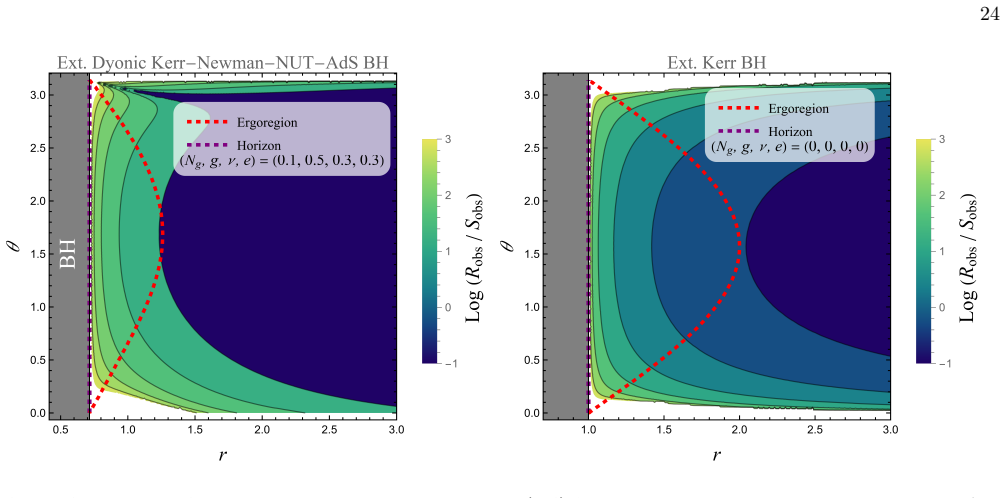
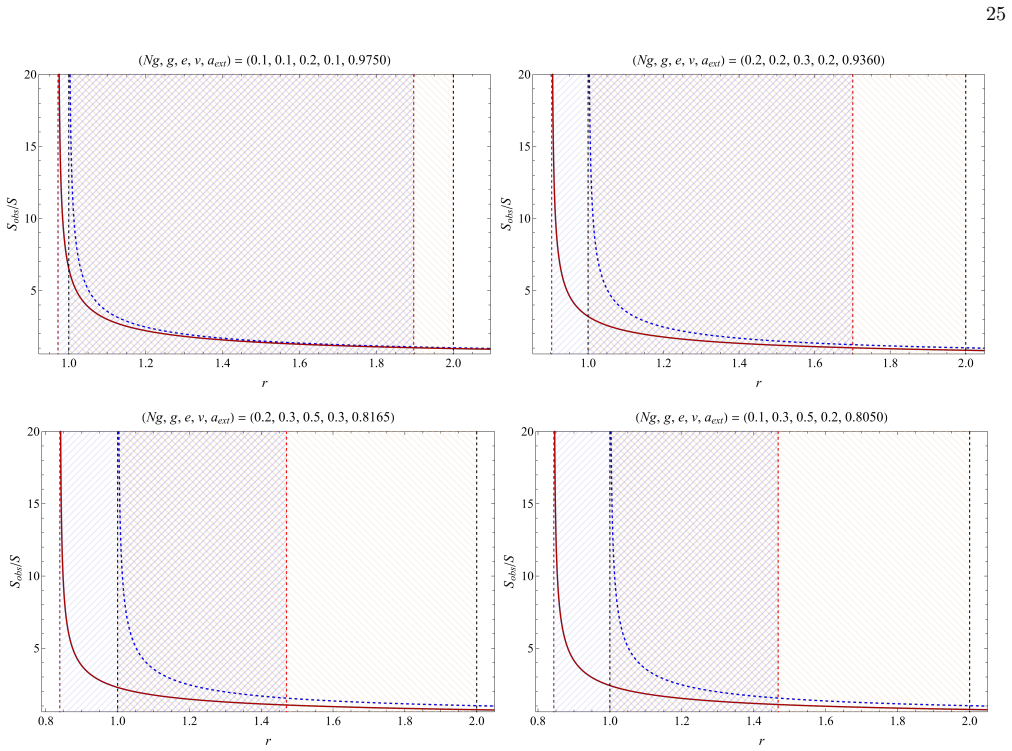
- The observable Lundquist number S_obs acquires observer-dependent angular dependence through the lapse function alpha, deviating from standard Sweet-Parker scaling.
- Orientation angle xi and magnetization sigma_0 modulate both efficiency and extracted power.
Where Pith is reading between the lines
- If the efficiency gain persists in non-extremal cases, it could widen the range of astrophysical black holes capable of powering high-energy jets via reconnection.
- The angular dependence of S_obs suggests that observed reconnection rates in inclined systems would differ from face-on predictions.
- Parameter combinations that boost efficiency at lower spin might relax the need for near-extremal rotation in models of active galactic nuclei.
Load-bearing premise
The Comisso-Asenjo reconnection model and its efficiency formulas derived for Kerr spacetime apply without modification to the N=2 U(1)^2 gauged supergravity metrics for the chosen extremal parameter sets.
What would settle it
A measurement or simulation showing that the extracted energy fraction or efficiency in a supergravity black hole with the listed parameter values stays below or reaches exactly the Kerr limit 1.495 would falsify the claim that the limit is exceeded.
Figures
read the original abstract
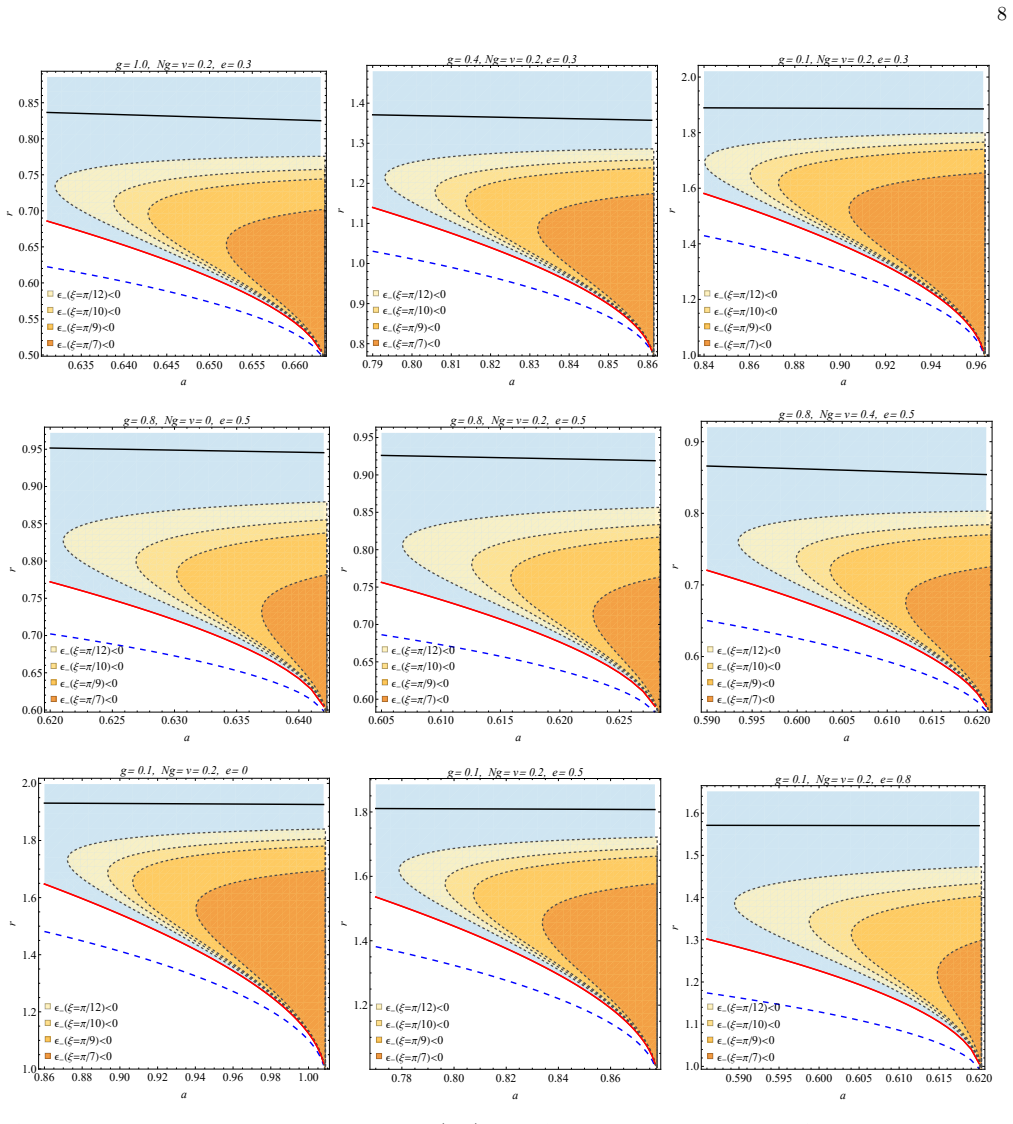
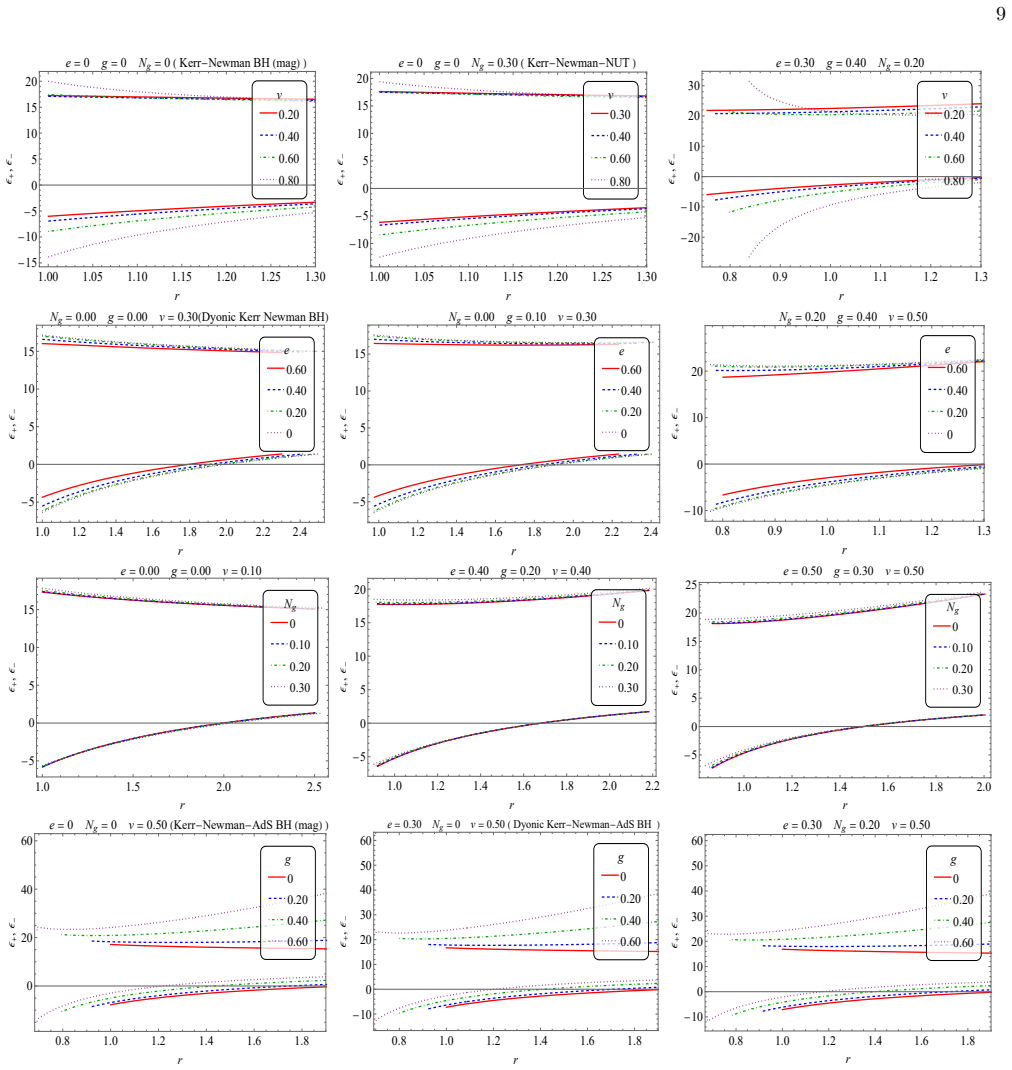
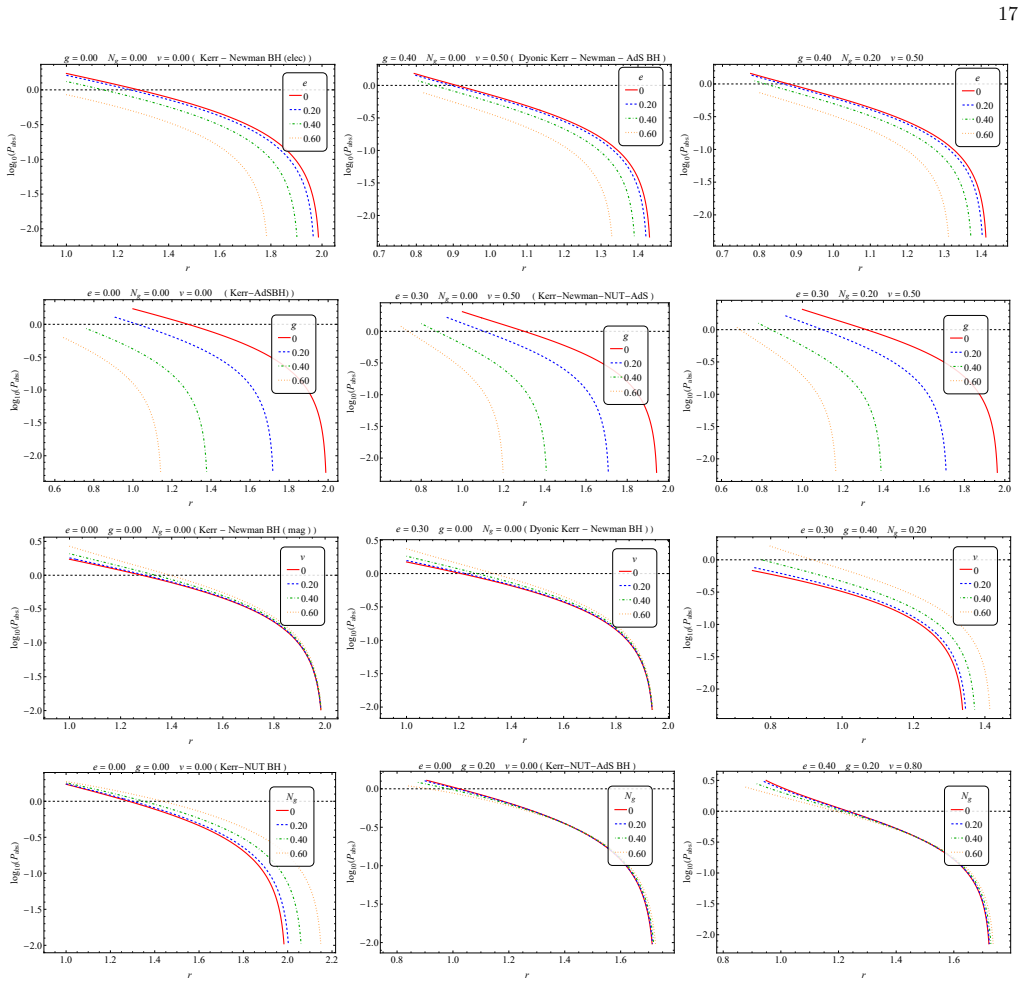
In this paper, we investigate energy extraction via the Comisso-Asenjo (CA) magnetic reconnection process near a coupled $\mathcal{N}=2,\,U(1)^2$ gauged supergravity Black Hole (BH). Our study focuses on the combined impact of the independent parameter set $p_i\in(N_g,g,v,e)$ with the spin parameter $a$ on the extracted energy ($\epsilon_{\pm}$), efficiency ($\eta$), and extracted power ($\mathcal{P}_{CA}$), aiming to identify optimal combinations where energy can be extracted with higher efficiency in certain cases at lower spin $(a\sim0.39)$ than the Kerr extremal case $(a\sim1)$. Using the spacetime parameters, we explore various cases leading to distinct spacetimes and provide an extended comparison with the Kerr Black Hole (KBH). We also examine the influence of the orientation angle ($\xi$) and magnetization parameter ($\sigma_0$) on both efficiency and extracted power. Investigating low $[\,\forall p_i<0.2 \land N_g<0.08\,]$, mid $[\,\exists p_i\ge0.5 \land N_g\in(0.08,0.15)\,]$, high $[\,\exists p_i>0.7 \land N_g\in(0.16,0.23)\,]$, and mixed $[\,\forall p_i\in(0,1) \land N_g\in(0,0.23)\,]$ parameter combinations, we explore only extremal cases for all spacetime parameters and demonstrate that the extremal Kerr efficiency limit ($\eta>1.495$) can be exceeded. The statistical Kendall's Tau approach allows us to identify the key independent parameters acting as boosters or dampers in the energy extraction process and to visualize the relationship between $(N_g,g,v,e)$ and the physical outputs $(a_{\rm ext},r_E,r_{\rm ergo},\epsilon_{\pm},\eta,\mathcal{P}_{CA},R_{\eta},R_{\mathcal{P}})$. Furthermore, we show that the observable Lundquist number $S_{\rm obs}$ in rotating BH spacetimes acquires an observer-dependent angular dependence through the lapse function $(\alpha)$. This leads to deviations from the standard Sweet-Parker scaling when expressed in terms of observable quantities.
Editorial analysis
A structured set of objections, weighed in public.
Referee Report
Summary. The paper investigates energy extraction via the Comisso-Asenjo magnetic reconnection process in rotating N=2 U(1)^2 gauged supergravity black holes. It explores the combined effects of parameters Ng, g, v, e with spin a across low/mid/high/mixed regimes (restricted to extremal slices), computes ε±, η, and P_CA by direct substitution into Kerr-derived formulas, applies Kendall's Tau correlation analysis, and claims that the Kerr extremal efficiency bound η > 1.495 can be exceeded at lower spins a ~ 0.39; it also notes an observer-dependent angular dependence in the observable Lundquist number S_obs via the lapse function α.
Significance. If the transfer of the CA formulas is justified, the work would demonstrate that gauged supergravity corrections permit higher reconnection efficiencies than Kerr at moderate spins, with the Kendall Tau analysis providing a systematic way to identify booster/damper parameters; this could inform energy extraction models in modified-gravity spacetimes.
major comments (2)
- [Abstract and efficiency calculations] The central claim that η > 1.495 is exceeded rests on substituting the supergravity metric functions (with independent parameters Ng, g, v, e) directly into the Comisso-Asenjo expressions for ε±, η, and P_CA. Those expressions were derived for the Kerr ergosphere using its specific Boyer-Lindquist components and frame-dragging velocity; the gauged supergravity line element modifies g_tt, g_tφ, and g_φφ, yet no re-derivation of the relativistic MHD reconnection outflow or energy balance is supplied for the new metric. This is load-bearing for the headline result reported in the abstract.
- [Results and statistical analysis] Extremal slices are selected post-hoc across parameter regimes with no reported convergence tests, error bars, or sensitivity analysis on the numerical values of ε±, η, and P_CA; the Kendall Tau correlations are performed on the same free parameters used to generate the exceedances, introducing partial dependence.
minor comments (2)
- [Abstract] The definitions of the low/mid/high/mixed regimes (e.g., ∀ p_i < 0.2 and Ng < 0.08) are stated but would benefit from an explicit table listing the exact bounds and example parameter sets used for each case.
- [Methods] Notation for the orientation angle ξ and magnetization σ0 is introduced without a dedicated methods subsection clarifying how they enter the efficiency formulas.
Simulated Author's Rebuttal
We thank the referee for the constructive feedback on our manuscript. We address each major comment below with clarifications and proposed revisions. The work applies the Comisso-Asenjo framework to a new class of spacetimes by direct substitution of metric components, which we believe is justified but will be better supported in revision.
read point-by-point responses
-
Referee: [Abstract and efficiency calculations] The central claim that η > 1.495 is exceeded rests on substituting the supergravity metric functions (with independent parameters Ng, g, v, e) directly into the Comisso-Asenjo expressions for ε±, η, and P_CA. Those expressions were derived for the Kerr ergosphere using its specific Boyer-Lindquist components and frame-dragging velocity; the gauged supergravity line element modifies g_tt, g_tφ, and g_φφ, yet no re-derivation of the relativistic MHD reconnection outflow or energy balance is supplied for the new metric. This is load-bearing for the headline result reported in the abstract.
Authors: The Comisso-Asenjo expressions for ε±, η, and P_CA are written in terms of the metric components g_tt, g_tφ, g_φφ and the angular velocity Ω_F at the reconnection site. These quantities are defined for any stationary, axisymmetric spacetime possessing an ergosphere, and the N=2 U(1)^2 gauged supergravity metric belongs to this class with the same Killing vectors. The local energy balance follows from the conserved quantities along the reconnection outflow, which remain valid under the same assumptions on the magnetic field and plasma. Nevertheless, we agree that an explicit justification paragraph is warranted. In the revised manuscript we will insert a new subsection (likely §3.2) that (i) recalls the general form of the CA energy-extraction formulas, (ii) verifies that the supergravity line element satisfies the required stationarity and axisymmetry, and (iii) notes that the outflow four-velocity is still normalized with respect to the local static observers defined by the lapse α. This is a partial revision; a complete re-derivation of the relativistic MHD equations in the new coordinates lies beyond the scope of the present parametric study. revision: partial
-
Referee: [Results and statistical analysis] Extremal slices are selected post-hoc across parameter regimes with no reported convergence tests, error bars, or sensitivity analysis on the numerical values of ε±, η, and P_CA; the Kendall Tau correlations are performed on the same free parameters used to generate the exceedances, introducing partial dependence.
Authors: Extremal slices (a = a_ext) were chosen to enable a direct, apples-to-apples comparison with the extremal Kerr bound η > 1.495; for sub-extremal spins the efficiency drops monotonically in both Kerr and the supergravity family. We accept that the manuscript would be strengthened by explicit checks. In the revision we will add (i) a supplementary figure showing η(a) for a = a_ext ± 0.01 across representative (Ng,g,v,e) points, (ii) error bands obtained by propagating the numerical precision of the metric functions, and (iii) a short convergence statement confirming that the reported exceedances persist under these variations. Regarding Kendall’s Tau, the analysis is performed precisely to rank the monotonic influence of the input parameters on the outputs; the dependence is therefore by design and is standard in multi-parameter surveys. We will clarify this motivation in §4 and note that the booster/damper classification remains robust under bootstrap resampling of the parameter grid. These additions constitute a full revision of the statistical section. revision: yes
Circularity Check
No significant circularity in derivation chain
full rationale
The paper applies the Comisso-Asenjo efficiency and power expressions (derived for Kerr) by direct substitution of the new metric functions involving parameters (N_g, g, v, e) and explores their ranges to identify cases exceeding η=1.495. This is a parametric application of an external model rather than a self-contained derivation. No steps reduce outputs to inputs by construction: the Kendall Tau analysis is a post-hoc correlation on explored parameters, not a fit that forces predictions; there are no self-definitional equations, load-bearing self-citations, uniqueness theorems imported from the authors, or ansatz smuggling. The chain is self-contained as an extension study, with the applicability assumption being a separate validity question outside circularity analysis.
Axiom & Free-Parameter Ledger
free parameters (3)
- N_g, g, v, e
- a (spin)
- ξ, σ_0
axioms (2)
- domain assumption The Comisso-Asenjo magnetic reconnection efficiency formulas derived in Kerr spacetime remain valid when the metric is replaced by the N=2 U(1)^2 gauged supergravity solution.
- ad hoc to paper Extremal slices of the parameter space are representative for comparing energy extraction limits.
Reference graph
Works this paper leans on
-
[1]
Analytical Determination of the Horizon Roots Starting from the depressed quartic equation r4 +ζr 2 +βr+ Υ = 0,(A1) Ferrari’s method introduces an auxiliary parameterysat- isfying the resolvent cubic y3 −ζy 2 −4Υy+ (4ζΥ−β 2) = 0.(A2) whose real solution isy 0. Now, in order to calculatey 0, we start by defining y=z+ ζ 3 ,(A3) the cubic reduces to the depr...
-
[2]
Extremality Condition The extremal configuration is determined by imposing Rg(rE) = 0, R ′ g(rE) = 0.(A11) Writing the radial function in compact form Rg(r) =g 2r4 +Br 2 −2M r+C,(A12) with B= 1 +g 2(a2 + 6N2 g −2ν 2),(A13) C=a 2 +e 2 −N 2 g + 3g2N2 g (a2 −N 2 g ),(A14) its derivative is R′ g(r) = 4g2r3 + 2Br−2M.(A15) FromR ′ g(rE) = 0, we obtain ME = 2g2r...
2023
-
[3]
B.P.A. et al.,Ligo: The laser interferometer gravitational-wave observatory,Reports on Progress in Physics72(2009) 076901 [0711.3041]
Pith/arXiv arXiv 2009
-
[4]
et al.,Virgo: a laser interferometer to detect gravitational waves,Journal of Instrumentation7 (2012) P03012
T.A. et al.,Virgo: a laser interferometer to detect gravitational waves,Journal of Instrumentation7 (2012) P03012
2012
-
[5]
et al.,First m87 event horizon telescope results
K.A. et al.,First m87 event horizon telescope results. ii. array and instrumentation,Astrophysical Journal Letters875(2019) L2 [1906.11239]
Pith/arXiv arXiv 2019
-
[6]
et al.,Observation of gravitational waves from a binary black hole merger,Phys
B.P.A. et al.,Observation of gravitational waves from a binary black hole merger,Phys. Rev. Lett.116 (2016) 061102
2016
-
[7]
et al.,Tests of general relativity with gw150914, Phys
B.P.A. et al.,Tests of general relativity with gw150914, Phys. Rev. Lett.116(2016) 221101
2016
-
[8]
et al.,Gw170817: Observation of gravitational waves from a binary neutron star inspiral,Phys
B.P.A. et al.,Gw170817: Observation of gravitational waves from a binary neutron star inspiral,Phys. Rev. Lett.119(2017) 161101
2017
-
[9]
F. Combes,Active Galactic Nuclei: Fueling and Feedback, IOP Publishing (2021), 10.1088/978-0-7503-3835-3
-
[11]
Bardeen, W.H
J.M. Bardeen, W.H. Press and S.A. Teukolsky, Rotating black holes: Locally nonrotating frames, energy extraction, and scalar synchrotron radiation, Astrophysical Journal178(1972) 347
1972
-
[12]
Blandford and R.L
R.D. Blandford and R.L. Znajek,Electromagnetic extraction of energy from kerr black holes,Mon. Not. Roy. Astron. Soc.179(1977) 433
1977
-
[13]
Blandford and D.G
R.D. Blandford and D.G. Payne,Hydromagnetic flows from accretion discs and the production of radio jets, Mon. Not. Roy. Astron. Soc.199(1982) 883
1982
-
[15]
Penrose,Gravitational collapse: The role of general relativity,Riv
R. Penrose,Gravitational collapse: The role of general relativity,Riv. Nuovo Cim.1(1969) 252
1969
-
[16]
Penrose and R.M
R. Penrose and R.M. Floyd,Extraction of rotational energy from a black hole,Nature229(1971) 177
1971
-
[17]
Wald,Energy limits on the penrose process, Astrophysical Journal191(1974) 231
R.M. Wald,Energy limits on the penrose process, Astrophysical Journal191(1974) 231
1974
-
[18]
Bardeen, W.H
J.M. Bardeen, W.H. Press and S.A. Teukolsky, Rotating black holes: Locally nonrotating frames, energy extraction, and scalar synchrotron radiation, Astrophys. J.178(1972) 347
1972
-
[20]
Schnittman,Revised upper limit to energy extraction from a kerr black hole,Phys
J.D. Schnittman,Revised upper limit to energy extraction from a kerr black hole,Phys. Rev. Lett.113 (2014) 261102
2014
-
[21]
Berti, V
E. Berti, V. Cardoso and L. Gualtieri,Comment on extreme kerr black holes and particle acceleration, Phys. Rev. Lett.103(2009) 239001
2009
-
[22]
Teukolsky and W.H
S.A. Teukolsky and W.H. Press,Perturbations of a rotating black hole. iii - interaction of the hole with gravitational and electromagnetic radiation, Astrophysical Journal193(1974) 443
1974
-
[23]
Starobinsky and S.M
A.A. Starobinsky and S.M. Churilov,Amplification of electromagnetic and gravitational waves scattered by a rotating black hole,Sov. Phys. JETP38(1974) 1
1974
-
[24]
Press and S.A
W.H. Press and S.A. Teukolsky,Floating orbits, superradiant scattering and the black-hole bomb, Nature238(1972) 211
1972
-
[25]
Brito, V
R. Brito, V. Cardoso and P. Pani,Superradiance,Lect. Notes Phys.906(2015) 1
2015
-
[26]
Daughton, V
W. Daughton, V. Roytershteyn, B.J. Albright and H. Karimabadi,Transition from collisional to kinetic regimes in large-scale reconnection layers,Phys. Rev. Lett.103(2009) 065004. 27
2009
-
[27]
Piran, J
T. Piran, J. Shaham and J. Katz,High efficiency of the penrose mechanism for particle collisions, Astrophys. J. Lett.196(1975) L107
1975
-
[28]
Ba˜ nados, J
M. Ba˜ nados, J. Silk and S.M. West,Kerr black holes as particle accelerators to arbitrarily high energy,Phys. Rev. Lett.103(2009) 111102
2009
-
[29]
Blandford and R.L
R.D. Blandford and R.L. Znajek,Electromagnetic extraction of energy from kerr black holes,Monthly Notices of the Royal Astronomical Society179(1977) 433
1977
-
[30]
S.S. Komissarov,Electrodynamics of black hole magnetospheres,Monthly Notices of the Royal Astronomical Society350(2004) 407 [astro-ph/0402403]
Pith/arXiv arXiv 2004
-
[31]
Tchekhovskoy, R
A. Tchekhovskoy, R. Narayan and J.C. McKinney, Efficient generation of jets from magnetically arrested accretion on a rapidly spinning black hole,Mon. Not. Roy. Astron. Soc.418(2011) L79
2011
-
[33]
Komissarov,Direct numerical simulations of the blandford–znajek effect,Mon
S.S. Komissarov,Direct numerical simulations of the blandford–znajek effect,Mon. Not. Roy. Astron. Soc. 326(2001) L41
2001
-
[34]
Wagh, S.V
S.M. Wagh, S.V. Dhurandhar and N. Dadhich,Revival of penrose process for astrophysical applications, Astrophysical Journal301(1986) 1018
1986
-
[35]
Wagh, S.V
S.M. Wagh, S.V. Dhurandhar and N. Dadhich,Revival of the penrose process for astrophysical applications, Astrophys. J.290(1985) 12
1985
-
[36]
Parthasarathy, S.V
S. Parthasarathy, S.V. Dhurandhar and N. Dadhich, On the efficiency of the magnetic penrose process, Astrophys. J.307(1986) 38
1986
-
[37]
Dadhich,Energy extraction from black holes,Curr
N. Dadhich,Energy extraction from black holes,Curr. Sci.81(2001) 1418
2001
-
[38]
A. Tursunov and N. Dadhich,Fifty years of energy extraction from rotating black hole: revisiting magnetic Penrose process,Universe5(2019) 125 [1905.05321]
Pith/arXiv arXiv 2019
-
[39]
S. Shaymatov,Efficiency of magnetic Penrose process in higher dimensional Myers-Perry black hole spacetimes,Phys. Rev. D110(2024) 044042 [2402.02471]
arXiv 2024
-
[40]
S. Shaymatov, N. Dadhich and A. Tursunov, Energetics of Buchdahl stars and the magnetic Penrose process,Eur. Phys. J. C84(2024) 1015 [2404.06870]
arXiv 2024
-
[41]
S. Shaymatov, P. Sheoran, R. Becerril, U. Nucamendi and B. Ahmedov,Efficiency of Penrose process in spacetime of axially symmetric magnetized Reissner-Nordstr¨ om black hole,Phys. Rev. D106 (2022) 024039 [2204.02026]
arXiv 2022
-
[42]
T. Xamidov, P. Sheoran, S. Shaymatov and T. Zhu, Energy extraction from Loop Quantum Black Holes: the role of magnetic Penrose process and quantum gravity effects with astrophysical insights,J. Cosmol. Astropart. Phys.2025(2025) 053 [2412.03885]
arXiv 2025
-
[43]
J.C. McKinney and C.F. Gammie,A measurement of the electromagnetic luminosity of a kerr black hole, Astrophysical Journal611(2004) 977 [astro-ph/0404512]
Pith/arXiv arXiv 2004
-
[44]
J.F. Hawley and J.H. Krolik,Magnetically driven jets in the kerr metric,Astrophysical Journal641(2006) 103 [astro-ph/0512227]
Pith/arXiv arXiv 2006
-
[45]
A. Tchekhovskoy, J.C. McKinney and R. Narayan, Simulations of ultrarelativistic magnetodynamic jets from gamma-ray burst engines,Monthly Notices of the Royal Astronomical Society388(2008) 551 [0803.3807]
Pith/arXiv arXiv 2008
-
[46]
H.K. Lee, R. Narayan and J.C. McKinney,The blandford–znajek process as a central engine for a gamma-ray burst,Physics Reports325(2000) 83 [astro-ph/9906213]
Pith/arXiv arXiv 2000
-
[47]
S.S. Komissarov and M.V. Barkov,Activation of the blandford–znajek mechanism in collapsing stars, Monthly Notices of the Royal Astronomical Society 397(2009) 1153 [0902.2881]
Pith/arXiv arXiv 2009
-
[48]
Comisso and F.A
L. Comisso and F.A. Asenjo,Magnetic reconnection as a mechanism for energy extraction,Phys. Rev. D103 (2021) 023014
2021
-
[50]
W. Liu,Energy extraction via magnetic reconnection in the ergosphere of a rotating non-kerr black hole, Astrophysical Journal925(2022) 202 [2204.07338]
arXiv 2022
- [51]
-
[52]
Wei and Y
S. Wei and Y. Liu,Energy extraction by magnetic reconnection in a deformed rotating black hole,Phys. Rev. D105(2022) 104003
2022
-
[53]
Zhou and J
M. Zhou and J. Chen,Magnetic reconnection in parametrically deformed kerr spacetimes,Eur. Phys. J. C83(2023) 512
2023
-
[54]
Wang and Y
H. Wang and Y. Chen,Energy extraction from johannsen black holes via magnetic reconnection,Phys. Lett. B842(2023) 137945
2023
-
[55]
Zhang and S
X. Zhang and S. Wei,Magnetic reconnection around deformed rotating black holes,Phys. Rev. D107 (2023) 064059
2023
-
[56]
I. Eshtursunov and S. Shaymatov,Energy extraction from a rotating Buchdahl star via magnetic reconnection,2603.17928
-
[57]
S.-J. Zhang,Energy extraction via magnetic reconnection in konoplya-rezzolla-zhidenko parametrized black holes,Physical Review D109 (2024) 084066 [2402.15050]
arXiv 2024
-
[58]
Yang and J
S. Yang and J. Jiang,Magnetic reconnection and energy extraction in magnetised kerr black holes,Phys. Rev. D106(2022) 084021
2022
-
[59]
Chen and H
Y. Chen and H. Wang,Energy extraction via magnetic reconnection in a kerr black hole immersed in wald magnetic field,Eur. Phys. J. C83(2023) 782
2023
-
[60]
Liu and S
Y. Liu and S. Wei,Magnetic reconnection in nonlinearly magnetized rotating black holes,Phys. Lett. B846(2023) 138219
2023
-
[61]
Zhou and X
J. Zhou and X. Wang,Magnetic reconnection around magnetized kerr–ads black holes,Phys. Rev. D109 (2024) 044065
2024
-
[62]
S. Shaymatov, M. Alloqulov, B. Ahmedov and A. Wang,Kerr-Newman-modified-gravity black hole’s impact on the magnetic reconnection,Phys. Rev. D 110(2024) 044005 [2307.03012]
arXiv 2024
-
[63]
Wu and Y
X. Wu and Y. Huang,Energy extraction via magnetic reconnection in kerr–newman black holes,Phys. Rev. D 106(2022) 084012
2022
-
[64]
Zhang and H
Y. Zhang and H. Chen,Magnetic reconnection in charged rotating ads black holes,Eur. Phys. J. C83 28 (2023) 1015
2023
-
[65]
Li and S
B. Li and S. Wei,Magnetic reconnection around rotating black holes with nonlinear electrodynamics, Phys. Lett. B850(2024) 138520
2024
-
[66]
Huang and J
Y. Huang and J. Jiang,Energy extraction in modified kerr–newman spacetimes via magnetic reconnection, Phys. Rev. D108(2023) 104041
2023
-
[67]
M. Khodadi,Magnetic reconnection and energy extraction from a spinning black hole with broken lorentz symmetry,Phys. Rev. D105(2022) 023025 [2201.02765]
arXiv 2022
-
[68]
Wei and Y
S. Wei and Y. Liu,Magnetic reconnection in rotating hairy black holes,Phys. Rev. D108(2023) 044014
2023
-
[69]
Zhou and H
M. Zhou and H. Chen,Energy extraction from rotating einstein–gauss–bonnet black holes via magnetic reconnection,Phys. Lett. B841(2023) 137931
2023
-
[70]
Wang and Y
H. Wang and Y. Chen,Magnetic reconnection around rotating dilaton black holes,Eur. Phys. J. C83(2023) 874
2023
-
[71]
Jiang and Y
J. Jiang and Y. Huang,Energy extraction from rotating string-inspired black holes via magnetic reconnection,Phys. Rev. D109(2024) 084058
2024
-
[72]
I. Eshtursunov and S. Shaymatov,Magnetic reconnection in five-dimensional Kerr black hole, 2604.27797
-
[73]
Shen,How to describe the sweet-parker model in general relativity,Physical Review D110(2024) 084013
Y. Shen,How to describe the sweet-parker model in general relativity,Physical Review D110(2024) 084013
2024
-
[74]
Pearson,Mathematical contributions to the theory of evolution
K. Pearson,Mathematical contributions to the theory of evolution. iii. regression, heredity, and panmixia, Philosophical Transactions of the Royal Society of London. Series A, containing papers of a mathematical or physical character187(1896) 253
-
[75]
Spearman,The proof and measurement of association between two things,The American Journal of Psychology15(1904) 72
C. Spearman,The proof and measurement of association between two things,The American Journal of Psychology15(1904) 72
1904
-
[76]
Kendall,A new measure of rank correlation, Biometrika30(1938) 81
M.G. Kendall,A new measure of rank correlation, Biometrika30(1938) 81
1938
-
[77]
Kendall and J.D
M.G. Kendall and J.D. Gibbons,Rank correlation methods, Oxford University Press, 5th ed. (1990)
1990
-
[78]
Chow and G
D.D.K. Chow and G. Comp ˘A¨re,Dyonic ads black holes inn= 2supergravity,Phys. Rev. D89(2014) 065003
2014
- [79]
-
[80]
Minkowski,Die grundgleichungen f¨ ur die elektromagnetischen vorg¨ ange in bewegten k¨ orpern, Nachr
H. Minkowski,Die grundgleichungen f¨ ur die elektromagnetischen vorg¨ ange in bewegten k¨ orpern, Nachr. Ges. Wiss. G¨ ottingen(1908)
1908
-
[81]
Schwarzschild, ¨Uber das gravitationsfeld eines massenpunktes nach der einsteinschen theorie, Sitzungsberichte der K¨ oniglich Preussischen Akademie der Wissenschaften(1916)
K. Schwarzschild, ¨Uber das gravitationsfeld eines massenpunktes nach der einsteinschen theorie, Sitzungsberichte der K¨ oniglich Preussischen Akademie der Wissenschaften(1916)
1916
-
[82]
de Sitter,On the relativity of inertia
W. de Sitter,On the relativity of inertia. remarks concerning einstein’s latest hypothesis,Proc. Koninklijke Nederlandse Akademie van Wetenschappen 19(1917) 1217
1917
-
[83]
Taub,Empty space-times admitting a three parameter group of motions,Annals of Mathematics (1951)
A.H. Taub,Empty space-times admitting a three parameter group of motions,Annals of Mathematics (1951)
1951
-
[84]
T.U. E. Newman, L. Tamburino,Empty-space generalization of the schwarzschild metric,J. Math. Phys.4(1963) 915
1963
-
[85]
Kerr,Gravitational field of a spinning mass as an example of algebraically special metrics,Phys
R.P. Kerr,Gravitational field of a spinning mass as an example of algebraically special metrics,Phys. Rev. Lett.11(1963) 237
1963
discussion (0)
Sign in with ORCID, Apple, or X to comment. Anyone can read and Pith papers without signing in.