A stochastic model for elastoplastic contact of rough surfaces incorporating scale-dependent hardness
Pith reviewed 2026-06-27 08:23 UTC · model grok-4.3
The pith
Stochastic theory with compounded Chapman-Kolmogorov equations models elastoplastic contact of rough surfaces with scale-dependent hardness.
A machine-rendered reading of the paper's core claim, the machinery that carries it, and where it could break.
Core claim
The paper claims that a novel stochastic process framework based on compounded Chapman-Kolmogorov equations can solve elastoplastic contact problems involving scale-dependent hardness by formulating three integral equations for the evolution of probability density functions of elastic contact pressure, relative plastic contact area, and relative non-contact area across geometrical scales.
What carries the argument
Compounded Chapman-Kolmogorov equations applied to probability density functions describing the scale evolution of contact pressure and areas.
If this is right
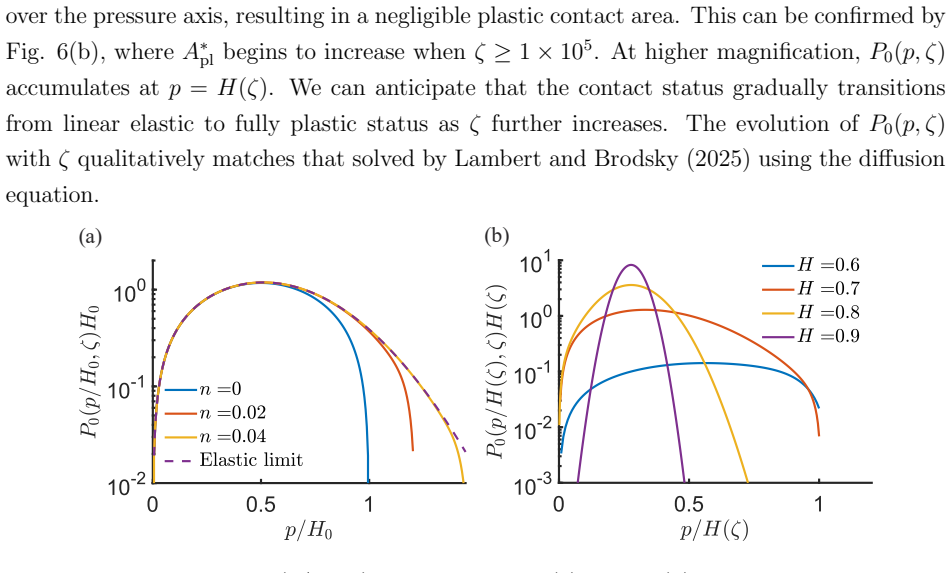
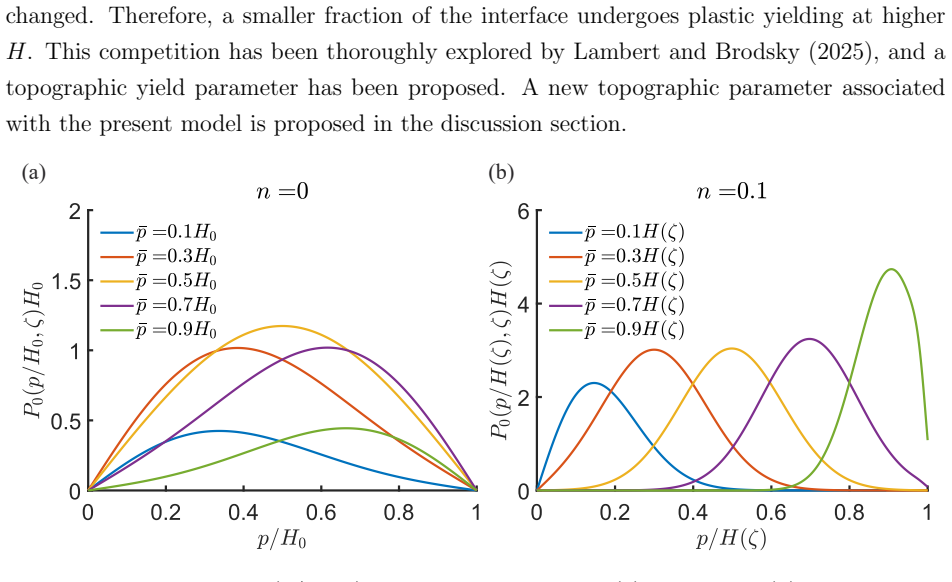
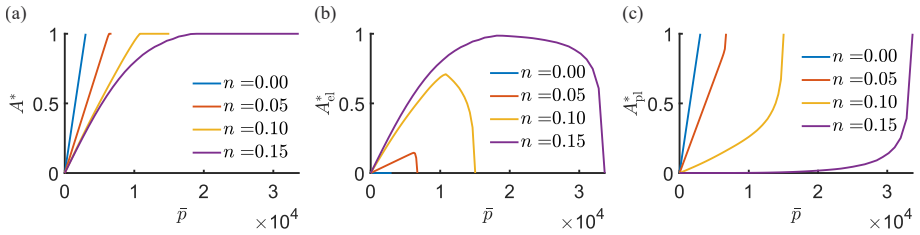
- The model predicts smooth transitions from linear elasticity to elastic-plastic behavior and finally to full plasticity when adjusting mechanical and material properties.
- A new topographic yield parameter incorporating a wider range of material and geometrical properties is derived to aid identification of contact status.
- Numerical solutions enable highly precise determination of elastic and plastic limits via curve-fitting.
- A new diagram is provided for rapid identification of contact status.
Where Pith is reading between the lines
- If valid, this framework could be adapted to model other multiscale phenomena involving roughness, such as in earthquake mechanics or electrical contacts.
- Testing the model's predictions against direct numerical simulations of specific surface topographies would provide a check on the stochastic representation.
Load-bearing premise
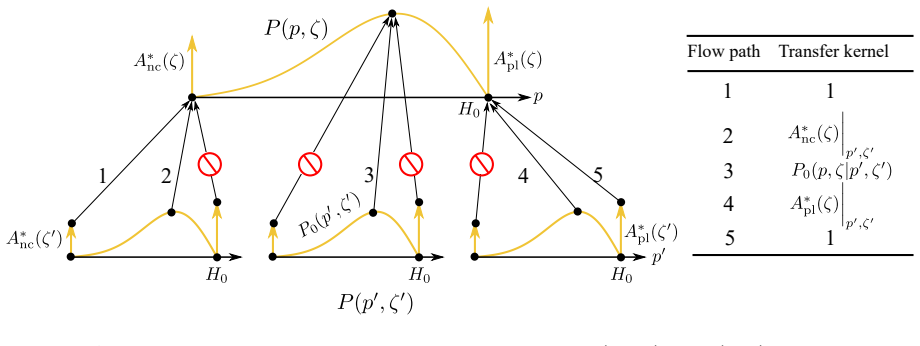
The elastoplastic contact problem with scale-dependent hardness is accurately captured by three integral equations obtained from compounded Chapman-Kolmogorov equations on the probability densities of pressure and areas evolving across scales.
What would settle it
Experimental measurements of contact area as a function of load for a rough surface with characterized scale-dependent hardness, if they deviate from the model's predictions, would falsify the approach.
Figures





read the original abstract
The stress concentrations caused by inherent roughness of natural and manufactured surfaces often induce plastic deformation at contact interfaces, a challenge compounded by competing influences of the size effect of plastic deformation and self-affine rough surface topography. To address this, we developed a novel methodology based on stochastic theory using compounded Chapman-Kolmogorov equations, for the first time, to solve elastoplastic contact problems involving scale-dependent hardness. Our approach formulates three integral equations describing the evolution of probability density functions of elastic contact pressure, relative plastic contact area, and relative non-contact area across geometrical scales. We thoroughly investigate the effects of scale-dependent hardness on contact pressure distribution, relative elastic and plastic contact areas, and the area-to-load relationship. By adjusting various mechanical and material properties, our model predicts a smooth transition from linear elasticity to elastic-plastic behavior and finally to full plasticity. A key advancement is the derivation of a new topographic yield parameter incorporating a wider range of material and geometrical properties, aiding identification of contact status. Numerical solutions enable highly precise determination of elastic and plastic limits via curve-fitting, and we also provide a new diagram for rapid identification of contact status. This study pioneers a stochastic process framework for applying the compounded Chapman-Kolmogorov equation to rough surface contact analysis, and the integral equations characterizing how interfacial properties evolve with scale could offer valuable insights for other multidisciplinary fields where multiscale roughness is critical, such as earthquakes, electrical contact, and contact electrification.
Editorial analysis
A structured set of objections, weighed in public.
Referee Report
Summary. The paper claims to introduce a novel stochastic framework based on compounded Chapman-Kolmogorov equations for modeling elastoplastic contact of self-affine rough surfaces with scale-dependent hardness. It formulates three integral equations governing the scale evolution of the probability density functions for elastic contact pressure, relative plastic contact area, and relative non-contact area. The work examines the influence of scale-dependent hardness on pressure distributions, contact area fractions, and area-load relations; derives a new topographic yield parameter; and uses numerical solutions plus curve-fitting to identify elastic/plastic limits and produce a contact-status diagram.
Significance. If the mapping from deterministic elastoplastic mechanics to the claimed Markov process across scales is rigorously justified and the integral equations recover known limits while matching independent simulations, the approach would constitute a new probabilistic tool for multiscale contact problems. The incorporation of scale-dependent hardness and the topographic yield parameter could extend to related fields involving roughness, such as tribology or geomechanics. The manuscript supplies no machine-checked proofs, reproducible code, or falsifiable predictions in the supplied text.
major comments (2)
- [Abstract] Abstract and introduction: the central claim that the deterministic elastoplastic contact problem with scale-dependent hardness is faithfully captured by three integral equations derived from compounded Chapman-Kolmogorov equations on the PDFs is not demonstrated. No derivation, transition kernel construction, or proof that scale-to-scale increments are independent (despite continuous hardness variation and asperity interactions) is supplied; this mapping is load-bearing for the novelty assertion.
- [Abstract] Abstract: the statement that numerical solutions enable 'highly precise determination of elastic and plastic limits via curve-fitting' lacks accompanying validation data, error analysis, or comparison against known analytic limits (constant hardness, purely elastic, or fully plastic cases). Without these, the reported contact-status predictions cannot be assessed for internal consistency.
minor comments (1)
- The abstract mentions 'adjusting various mechanical and material properties' and 'a new diagram for rapid identification of contact status' but provides no explicit parameter ranges, fitting procedure details, or figure captions in the supplied text.
Simulated Author's Rebuttal
We thank the referee for their careful reading and constructive comments on our manuscript. We address each major comment below and indicate where revisions will be made to strengthen the presentation.
read point-by-point responses
-
Referee: [Abstract] Abstract and introduction: the central claim that the deterministic elastoplastic contact problem with scale-dependent hardness is faithfully captured by three integral equations derived from compounded Chapman-Kolmogorov equations on the PDFs is not demonstrated. No derivation, transition kernel construction, or proof that scale-to-scale increments are independent (despite continuous hardness variation and asperity interactions) is supplied; this mapping is load-bearing for the novelty assertion.
Authors: We acknowledge that the mapping from the deterministic elastoplastic mechanics to the stochastic process requires explicit justification in the text. While the manuscript formulates the three integral equations, we agree that a detailed derivation of the transition kernels and discussion of the independence assumption (including treatment of asperity interactions and continuous hardness) should be added. The revised manuscript will expand the methods section with this step-by-step construction. revision: yes
-
Referee: [Abstract] Abstract: the statement that numerical solutions enable 'highly precise determination of elastic and plastic limits via curve-fitting' lacks accompanying validation data, error analysis, or comparison against known analytic limits (constant hardness, purely elastic, or fully plastic cases). Without these, the reported contact-status predictions cannot be assessed for internal consistency.
Authors: We agree that the claims on precision and the contact-status diagram require supporting validation to allow assessment of consistency. The revised version will add comparisons against known analytic limits (constant hardness, elastic, and fully plastic cases), error analysis of the numerical solutions, and quantitative assessment of the curve-fitting results. revision: yes
Circularity Check
Curve-fitting of elastic/plastic limits feeds back into claimed transition predictions
specific steps
-
fitted input called prediction
[Abstract]
"By adjusting various mechanical and material properties, our model predicts a smooth transition from linear elasticity to elastic-plastic behavior and finally to full plasticity. [...] Numerical solutions enable highly precise determination of elastic and plastic limits via curve-fitting, and we also provide a new diagram for rapid identification of contact status."
Elastic and plastic limits are determined by curve-fitting the numerical solutions of the three integral equations; the same model is then asserted to predict the smooth transition between precisely those fitted limits, so the reported predictions incorporate the fitted quantities by construction rather than emerging independently from the stochastic derivation.
full rationale
The paper's central methodology derives three integral equations from compounded Chapman-Kolmogorov equations on PDFs of pressure and areas. This derivation chain is presented as first-principles stochastic modeling. However, the abstract explicitly states that elastic and plastic limits are obtained via curve-fitting to the numerical solutions of the model itself, after which the model is claimed to predict the smooth transition across those limits. This constitutes a fitted-input-called-prediction pattern. No other circular steps (self-definitional, self-citation load-bearing, etc.) are identifiable from the supplied text, and the core stochastic construction does not reduce to its inputs by definition. The finding is therefore partial circularity rather than full equivalence.
Axiom & Free-Parameter Ledger
free parameters (2)
- scale-dependent hardness function parameters
- mechanical and material properties
axioms (2)
- domain assumption Compounded Chapman-Kolmogorov equations govern the evolution of the probability density functions of contact pressure and areas across geometrical scales.
- domain assumption Rough surfaces exhibit self-affine topography that produces stress concentrations leading to plastic deformation.
invented entities (1)
-
topographic yield parameter
no independent evidence
Reference graph
Works this paper leans on
-
[1]
On the dry elasto-plastic contact of nominally flat surfaces
Almqvist, A., Sahlin, F., Larsson, R., Glavatskih, S., 2007. On the dry elasto-plastic contact of nominally flat surfaces. Tribology international 40, 574–579
2007
-
[2]
Deterministic elastic-plastic modelling of rough surface contact including spectral interpolation and comparison to theoretical models
An, B., Wang, X., Xu, Y., Jackson, R.L., 2019. Deterministic elastic-plastic modelling of rough surface contact including spectral interpolation and comparison to theoretical models. Tribology International 135, 246–258. 32
2019
-
[3]
Elastic deformation and the laws of friction
Archard, J., 1957. Elastic deformation and the laws of friction. Proceedings of the Royal Society of London. Series A. Mathematical and Physical Sciences 243, 190–205
1957
-
[4]
Scale effects in friction using strain gradient plasticity and dislocation-assisted sliding (microslip)
Bhushan, B., Nosonovsky, M., 2003. Scale effects in friction using strain gradient plasticity and dislocation-assisted sliding (microslip). Acta materialia 51, 4331–4345
2003
-
[5]
Constraints from fault roughness on the scale-dependent strength of rocks
Brodsky, E.E., Kirkpatrick, J.D., Candela, T., 2016. Constraints from fault roughness on the scale-dependent strength of rocks. Geology 44, 19–22
2016
-
[6]
The persistence of roughness between surfaces in static contact
Childs, T., 1977. The persistence of roughness between surfaces in static contact. Proceedings of the Royal Society of London. A. Mathematical and Physical Sciences 353, 35–53
1977
-
[7]
A new plasticity index including size-effects in the contact of rough surfaces
Ciavarella, M., 2024. A new plasticity index including size-effects in the contact of rough surfaces. Lubricants 12, 83
2024
-
[8]
Linear elastic contact of the weierstrass profile
Ciavarella, M., Demelio, G., Barber, J., Jang, Y.H., 2000. Linear elastic contact of the weierstrass profile. Proceedings of the Royal Society of London. Series A: Mathematical, Physical and Engineering Sciences 456, 387–405
2000
-
[9]
An incremental contact model for rough surfaces of strain-hardening solids
Ding, Y., Liang, X., Wang, G., 2022. An incremental contact model for rough surfaces of strain-hardening solids. International Journal of Applied Mechanics 14, 2250088
2022
-
[10]
Fluid leakage in metallic seals
Fischer, F., Schmitz, K., Tiwari, A., Persson, B.N., 2020. Fluid leakage in metallic seals. Tribology Letters 68, 125. Fr´ erot, L., Bonnet, M., Molinari, J.F., Anciaux, G., 2019. A fourier-accelerated volume integral method for elastoplastic contact. Computer Methods in Applied Mechanics and Engineering 351, 951–976
2020
-
[11]
Elastic–plastic contact of a rough surface with weierstrass profile
Gao, Y.F., Bower, A., 2006. Elastic–plastic contact of a rough surface with weierstrass profile. Proceedings of the Royal Society A: Mathematical, Physical and Engineering Sciences 462, 319–348
2006
-
[12]
A review of elastic–plastic contact mechanics
Ghaednia, H., Wang, X., Saha, S., Xu, Y., Sharma, A., Jackson, R.L., 2017. A review of elastic–plastic contact mechanics. Applied mechanics reviews 69, 060804
2017
-
[13]
Contact of nominally flat surfaces
Greenwood, J.A., Williamson, J.P., 1966. Contact of nominally flat surfaces. Proceedings of the royal society of London. Series A. Mathematical and physical sciences 295, 300–319
1966
-
[14]
Asperity pressures in elastic–plastic rough surface contacts
Inose, K., Kadiric, A., 2025. Asperity pressures in elastic–plastic rough surface contacts. Journal of Tribology 147, 111503
2025
-
[15]
Which asperity scales matter for true contact area? a multi- scale and statistical investigation
Jackson, R., Jacobs, T., 2023. Which asperity scales matter for true contact area? a multi- scale and statistical investigation. Mechanics of Materials 184, 104746
2023
-
[16]
The effect of scale-dependent hardness on elasto-plastic asperity contact between rough surfaces
Jackson, R.L., 2006. The effect of scale-dependent hardness on elasto-plastic asperity contact between rough surfaces. Tribology Transactions 49, 135–150. 33
2006
-
[17]
A finite element study of elasto-plastic hemispherical contact against a rigid flat
Jackson, R.L., Green, I., 2005. A finite element study of elasto-plastic hemispherical contact against a rigid flat. J. Trib. 127, 343–354
2005
-
[18]
A statistical model of elasto-plastic asperity contact between rough surfaces
Jackson, R.L., Green, I., 2006. A statistical model of elasto-plastic asperity contact between rough surfaces. Tribology international 39, 906–914
2006
-
[19]
A multi-scale model for contact between rough surfaces
Jackson, R.L., Streator, J.L., 2006. A multi-scale model for contact between rough surfaces. Wear 261, 1337–1347
2006
-
[20]
Quantitative characterization of surface topog- raphy using spectral analysis
Jacobs, T.D., Junge, T., Pastewka, L., 2017. Quantitative characterization of surface topog- raphy using spectral analysis. Surface Topography: Metrology and Properties 5, 013001
2017
-
[21]
Development of a three-dimensional semi-analytical elastic-plastic contact code
Jacq, C., Ne´ lias, D., Lormand, G., Girodin, D., 2002. Development of a three-dimensional semi-analytical elastic-plastic contact code. J. Trib. 124, 653–667
2002
-
[22]
Competition between roughness and strength for scale- dependent surfaces
Lambert, V., Brodsky, E.E., 2025. Competition between roughness and strength for scale- dependent surfaces. Physical Review E 111, 065502
2025
-
[23]
An improved elastic–plastic contact model with asperity interactions based on greenwood–williamson theory
Li, C.Y., Ding, Y., Liang, X.M., Wang, G.F., 2023. An improved elastic–plastic contact model with asperity interactions based on greenwood–williamson theory. Acta Mechanica 234, 5187–5201
2023
-
[24]
Elastic-perfectly plastic contact of rough surfaces: An incremental equivalent circular model
Liang, X.M., Ding, Y., Duo, Y., Yuan, W., Wang, G., 2022. Elastic-perfectly plastic contact of rough surfaces: An incremental equivalent circular model. Journal of Tribology 144, 051501
2022
-
[25]
Role of Fractal Geometry in Roughness Characterization and Contact Mechanics of Surfaces
Majumdar, A., Bhushan, B., 1990. Role of Fractal Geometry in Roughness Characterization and Contact Mechanics of Surfaces. Journal of Tribology 112, 205–216
1990
-
[26]
Indentation size effects in crystalline materials: a law for strain gradient plasticity
Nix, W.D., Gao, H., 1998. Indentation size effects in crystalline materials: a law for strain gradient plasticity. Journal of the Mechanics and Physics of Solids 46, 411–425
1998
-
[27]
Finite element modeling of elasto- plastic contact between rough surfaces
Pei, L., Hyun, S., Molinari, J.F., Robbins, M.O., 2005. Finite element modeling of elasto- plastic contact between rough surfaces. Journal of the Mechanics and Physics of Solids 53, 2385–2409. P´ erez-R` afols, F., Larsson, R., Almqvist, A., 2016. Modelling of leakage on metal-to-metal seals. Tribology International 94, 421–427
2005
-
[28]
Elastoplastic contact between randomly rough surfaces
Persson, B., 2001. Elastoplastic contact between randomly rough surfaces. Physical Review Letters 87, 116101. 34
2001
-
[29]
Contact mechanics for randomly rough surfaces
Persson, B.N., 2006. Contact mechanics for randomly rough surfaces. Surface science reports 61, 201–227
2006
-
[30]
The surface-topography challenge: A multi- laboratory benchmark study to advance the characterization of topography
Algieri, L., Ali, N., Almqvist, A., et al., 2025. The surface-topography challenge: A multi- laboratory benchmark study to advance the characterization of topography. Tribology letters 73, 110
2025
-
[31]
On the contact area and mean gap of rough, elastic contacts: dimensional analysis, numerical corrections, and reference data
Prodanov, N., Dapp, W.B., M¨ user, M.H., 2014. On the contact area and mean gap of rough, elastic contacts: dimensional analysis, numerical corrections, and reference data. Tribology Letters 53, 433–448
2014
-
[32]
A mixed lubrication model incorporating measured surface topography
Sahlin, F., Larsson, R., Almqvist, A., Lugt, P.M., Marklund, P., 2010. A mixed lubrication model incorporating measured surface topography. part 1: theory of flow factors. Proceed- ings of the Institution of Mechanical Engineers, Part J: Journal of Engineering Tribology 224, 335–351
2010
-
[33]
Spontaneous ordering of identical materials into a triboelectric series
Sobarzo, J.C., Pertl, F., Balazs, D.M., Costanzo, T., Sauer, M., Foelske, A., Ostermann, M., Pichler, C.M., Wang, Y., Nagata, Y., et al., 2025. Spontaneous ordering of identical materials into a triboelectric series. Nature 638, 664–669
2025
-
[34]
Strain gradient plasticity analysis of elasto- plastic contact between rough surfaces
Song, H., Van der Giessen, E., Liu, X., 2016. Strain gradient plasticity analysis of elasto- plastic contact between rough surfaces. Journal of the Mechanics and Physics of Solids 96, 18–28
2016
-
[35]
Statistical model of rough surface contact accounting for size-dependent plasticity and asperity interaction
Song, H., Vakis, A., Liu, X., Van der Giessen, E., 2017. Statistical model of rough surface contact accounting for size-dependent plasticity and asperity interaction. Journal of the Mechanics and Physics of Solids 106, 1–14
2017
-
[36]
The correlation of the indentation size effect measured with indenters of various shapes
Swadener, J., George, E., Pharr, G., 2002. The correlation of the indentation size effect measured with indenters of various shapes. Journal of the Mechanics and Physics of Solids 50, 681–694
2002
-
[37]
Plastic contact of self-affine surfaces: Persson’s theory versus discrete dislocation plasticity
Venugopalan, S., Irani, N., Nicola, L., 2019. Plastic contact of self-affine surfaces: Persson’s theory versus discrete dislocation plasticity. Journal of the Mechanics and Physics of Solids 132, 103676
2019
-
[38]
Green’s function molecular dynamics meets discrete dislocation plasticity
Venugopalan, S.P., M¨ user, M.H., Nicola, L., 2017. Green’s function molecular dynamics meets discrete dislocation plasticity. Modelling and Simulation in Materials Science and Engineering 25, 065018
2017
-
[39]
The effect of resolution on the deterministic finite element elastic-plastic rough surface contact under combined normal and tangential loading
Wang, X., An, B., Xu, Y., Jackson, R.L., 2020. The effect of resolution on the deterministic finite element elastic-plastic rough surface contact under combined normal and tangential loading. Tribology International 144, 106141
2020
-
[40]
Theoretical and finite element analysis of static friction between multi-scale rough surfaces
Wang, X., Xu, Y., Jackson, R.L., 2018. Theoretical and finite element analysis of static friction between multi-scale rough surfaces. Tribology Letters 66, 146. 35
2018
-
[41]
Persson’s theory of purely normal elastic rough surface contact: A tutorial based on stochastic process theory
Xu, Y., Li, X., Chen, Q., Zhou, Y., 2024. Persson’s theory of purely normal elastic rough surface contact: A tutorial based on stochastic process theory. International Journal of Solids and Structures , 112684
2024
-
[42]
Revisiting the persson theory of elastoplastic contact: A simpler closed-form solution and a rigorous proof of boundary conditions
Xu, Y., Li, X., Mulvihill, D.M., 2022. Revisiting the persson theory of elastoplastic contact: A simpler closed-form solution and a rigorous proof of boundary conditions. Tribology Letters 70, 1–7
2022
-
[43]
Experimental and finite element analyses of contact behaviors between non-transparent rough surfaces
Zhang, F., Liu, J., Ding, X., Wang, R., 2019. Experimental and finite element analyses of contact behaviors between non-transparent rough surfaces. Journal of the Mechanics and Physics of Solids 126, 87–100
2019
-
[44]
On contact spots details of rough surface contact using morphologic image processing
Zhang, H., Liu, S., Wang, W., 2024. On contact spots details of rough surface contact using morphologic image processing. Mechanism and Machine Theory 192, 105546. Appendix A. Boundary condition In this appendix we derive an approximate boundary condition forP 0(p=H 2, ζ|p′, ζ′) within the small-step formulation introduced in Eq. (32), namelydV /dζ≈∆V /∆ζ...
2024
discussion (0)
Sign in with ORCID, Apple, or X to comment. Anyone can read and Pith papers without signing in.