Super-Heisenberg Non-Equilibrium Quantum Sensing with Waveguide-Coupled Emitters
Pith reviewed 2026-06-27 09:49 UTC · model grok-4.3
The pith
Positioning quantum emitters in a waveguide pushes quantum Fisher information beyond the Heisenberg limit during transient dynamics.
A machine-rendered reading of the paper's core claim, the machinery that carries it, and where it could break.
Core claim
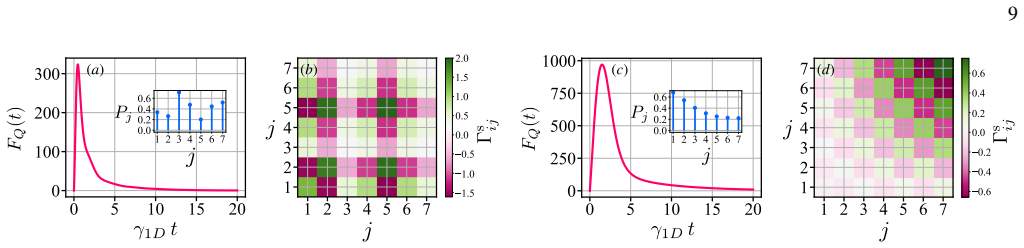
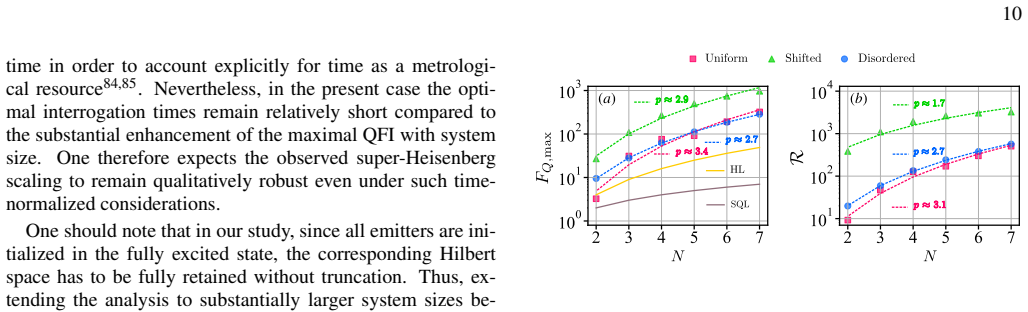
Arrays of quantum emitters coupled to a waveguide serve as non-equilibrium probes for estimating its wave number through transient dynamics after initial excitation. Careful positioning enhances the quantum Fisher information by suppressing waveguide-mediated cross-decay, which stabilizes the single-excitation subspace and lengthens both the magnitude and lifetime of the QFI. Randomized configurations confirm that vanishing cross-decay maximizes achievable sensitivity and the temporal interval over which parameter information remains accessible. For multipartite probes the maximum QFI and its temporal integral scale with system size and exceed the Heisenberg limit under all positioning strat
What carries the argument
Emitter positioning that drives waveguide-mediated cross-decay to zero, thereby stabilizing populations and coherences inside the single-excitation subspace so that QFI grows and persists longer.
If this is right
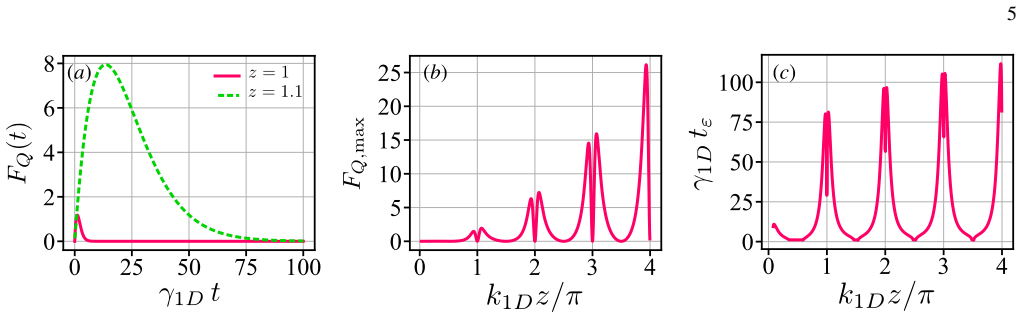
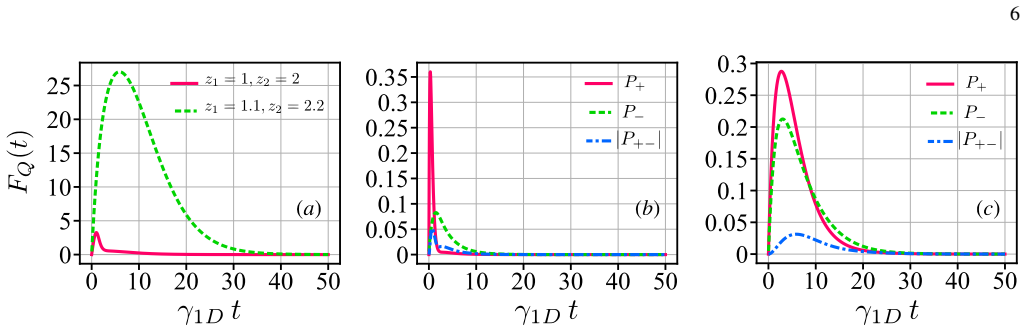
- Optimal spacing for two emitters suppresses super-radiant decay and extends both the size and duration of QFI.
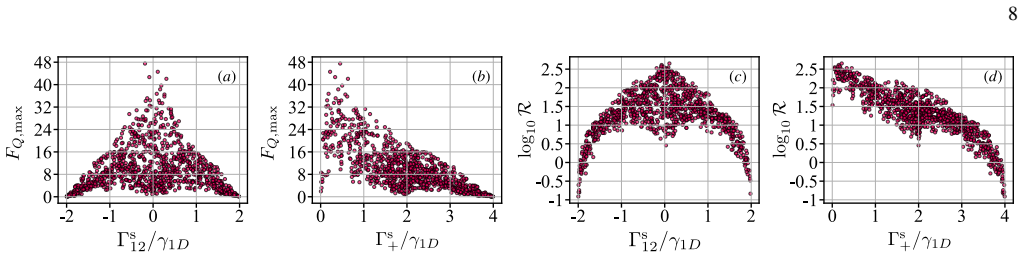
- Randomized placements that null cross-decay maximize sensitivity and the time window during which the parameter remains readable.
- In larger arrays the peak QFI scales with emitter number beyond the Heisenberg limit for any positioning choice.
- The time-integrated QFI likewise exceeds linear scaling with system size under every strategy.
- Waveguide-coupled arrays function as tunable sensors that harness collective decay for long-lived, enhanced precision.
Where Pith is reading between the lines
- The same positioning principle might be used to sense other waveguide parameters such as group velocity or loss rate.
- Arrays of quantum dots or atoms in photonic structures could test the predicted scaling in the laboratory.
- The non-equilibrium protocol may reduce the need for continuous driving fields, lowering technical noise in real devices.
- Similar cross-decay engineering could be applied to other open-system metrology tasks where transient coherence is the resource.
Load-bearing premise
Optimal or randomized emitter positioning can suppress waveguide-mediated cross-decay enough to keep populations and coherences stable inside the single-excitation subspace throughout the transient window.
What would settle it
A simulation or experiment in which even the best positioning leaves residual cross-decay that prevents the QFI peak or its time integral from scaling faster than linearly with emitter number.
Figures
read the original abstract
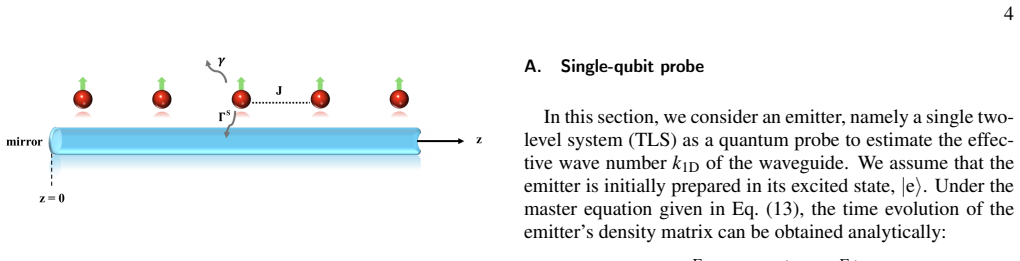
We explore an array of quantum emitters as non-equilibrium probes, coupled to a one-dimensional photonic waveguide, aiming to estimate its properties such as wave number which encodes the waveguide frequency and dispersive characteristics. By considering transient dynamics following initial excitation, we show that the quantum Fisher information (QFI) can be significantly enhanced through careful emitter positioning. For two-emitter probes, optimal spacing stabilizes populations and coherences in the single-excitation subspace, suppressing super radiant decay and extending both the magnitude and longevity of QFI. Randomized emitter configurations also reveal that vanishing waveguide-mediated cross decay maximizes both achievable sensitivity and the temporal duration over which information about the parameter remains accessible. Extending to multipartite probes, we demonstrate that the maximum QFI and its temporal integral scale with system size, exceeding the Heisenberg limit for all positioning strategies. Our results highlight the potential of waveguide-coupled emitter arrays as versatile quantum sensors, where collective radiative dynamics can be harnessed to achieve tunable, long-lived, and enhanced precision.
Editorial analysis
A structured set of objections, weighed in public.
Referee Report
Summary. The paper investigates arrays of quantum emitters coupled to a 1D photonic waveguide as non-equilibrium probes for estimating waveguide properties such as wave number. It focuses on transient dynamics after initial excitation, claiming that emitter positioning enhances the quantum Fisher information (QFI) by stabilizing populations and coherences in the single-excitation subspace through suppression of waveguide-mediated cross-decay. For two-emitter cases, both optimal and randomized configurations are analyzed; the work then extends to multipartite probes, asserting that the maximum QFI and its temporal integral scale with system size N and exceed the Heisenberg limit for all positioning strategies.
Significance. If the central scaling result holds with the claimed generality, the work would demonstrate a route to super-Heisenberg quantum sensing that harnesses collective radiative effects in waveguide systems, offering tunable sensitivity and extended coherence windows beyond equilibrium approaches. The absence of any machine-checked proofs, reproducible code, or parameter-free derivations in the presented material limits the immediate strength of this assessment.
major comments (2)
- [Abstract] Abstract (multipartite extension paragraph): the claim that 'the maximum QFI and its temporal integral scale with system size, exceeding the Heisenberg limit for all positioning strategies' is load-bearing for the paper's title and conclusions yet rests on unshown calculations; no derivation steps, numerical methods, master-equation solutions retaining all γ_ij terms, or error analysis are supplied to verify that cross-decay suppression occurs for arbitrary N>2 configurations.
- [Multipartite probes section] The modeling premise that vanishing or suppressed waveguide-mediated cross-decay rates γ_ij confine dynamics to the single-excitation manifold long enough for transient QFI to accumulate super-Heisenberg scaling is invoked for the 'all positioning strategies' assertion, but the text provides no independent numerical check (e.g., full master-equation runs for generic placements) that would confirm the integrated QFI remains above N² when γ_ij are non-zero.
minor comments (1)
- Notation for the waveguide wave number and the precise definition of the temporal integral of QFI should be introduced explicitly before the multipartite claims.
Simulated Author's Rebuttal
We thank the referee for their careful reading of the manuscript and for identifying points where additional detail would strengthen the multipartite claims. We address each major comment below.
read point-by-point responses
-
Referee: [Abstract] Abstract (multipartite extension paragraph): the claim that 'the maximum QFI and its temporal integral scale with system size, exceeding the Heisenberg limit for all positioning strategies' is load-bearing for the paper's title and conclusions yet rests on unshown calculations; no derivation steps, numerical methods, master-equation solutions retaining all γ_ij terms, or error analysis are supplied to verify that cross-decay suppression occurs for arbitrary N>2 configurations.
Authors: The multipartite scaling results are obtained from direct numerical integration of the master equation (retaining the full set of γ_ij terms computed from the waveguide Green's function) for N up to 5, with the maximum QFI and its time integral extracted for both optimized and random placements. The two-emitter analytic treatment is given in the main text; the N>2 cases rely on the same Liouvillian construction. To make the evidence explicit, the revised manuscript will add a dedicated paragraph in the multipartite section describing the numerical solver, time-stepping method, and ensemble averaging over random configurations, together with a new figure that plots peak QFI and integrated QFI versus N (including error bands) for several representative placements. revision: yes
-
Referee: [Multipartite probes section] The modeling premise that vanishing or suppressed waveguide-mediated cross-decay rates γ_ij confine dynamics to the single-excitation manifold long enough for transient QFI to accumulate super-Heisenberg scaling is invoked for the 'all positioning strategies' assertion, but the text provides no independent numerical check (e.g., full master-equation runs for generic placements) that would confirm the integrated QFI remains above N² when γ_ij are non-zero.
Authors: Randomized placements already constitute generic configurations in which γ_ij are generically non-zero. The manuscript reports that, for these placements, the transient dynamics still yield integrated QFI > N². We agree, however, that additional explicit checks would be helpful. The revision will therefore include supplementary master-equation trajectories for four additional non-special N=4 and N=5 placements (distinct from the randomized ensemble already shown), with the time-integrated QFI normalized by N² plotted to confirm that the super-Heisenberg regime persists when cross-decay is only partially suppressed. revision: yes
Circularity Check
No circularity: scaling claim arises from transient dynamics model without reduction to inputs
full rationale
The paper presents the super-Heisenberg scaling of maximum QFI and its temporal integral as emerging from the transient dynamics following initial excitation in the single-excitation subspace, with emitter positioning affecting cross-decay. No equations, fitted parameters, or self-citations are quoted that would make the N-scaling a definition, a renamed fit, or a load-bearing self-citation chain. The modeling premise on vanishing cross-decay is an assumption entering the dynamics, not a self-referential construction that forces the result by construction. The derivation chain remains self-contained against external benchmarks.
Axiom & Free-Parameter Ledger
axioms (2)
- domain assumption Single-excitation subspace approximation for the emitter-waveguide dynamics
- domain assumption One-dimensional lossless photonic waveguide with position-dependent coupling
Reference graph
Works this paper leans on
-
[1]
Physical Review E—Statistical, Nonlinear, and Soft Matter Physics , volume=
Entanglement boost for extractable work from ensembles of quantum batteries , author=. Physical Review E—Statistical, Nonlinear, and Soft Matter Physics , volume=. 2013 , publisher=
2013
-
[2]
Thermodynamics in the Quantum Regime: Fundamental Aspects and New Directions , pages=
Quantum batteries , author=. Thermodynamics in the Quantum Regime: Fundamental Aspects and New Directions , pages=. 2018 , publisher=
2018
-
[3]
Reviews of Modern Physics , volume=
Colloquium: quantum batteries , author=. Reviews of Modern Physics , volume=. 2024 , publisher=
2024
-
[4]
The European Physical Journal B , volume=
Quantum thermal machines and batteries , author=. The European Physical Journal B , volume=. 2021 , publisher=
2021
-
[5]
Frontiers of Physics , volume=
Highly efficient charging and discharging of three-level quantum batteries through shortcuts to adiabaticity , author=. Frontiers of Physics , volume=. 2022 , publisher=
2022
-
[6]
Physical Review A , volume=
Reliable quantum advantage in quantum battery charging , author=. Physical Review A , volume=. 2025 , publisher=
2025
-
[7]
Applied Physics Letters , volume=
Efficient charging and discharging of a superconducting quantum battery through frequency-modulated driving , author=. Applied Physics Letters , volume=. 2023 , publisher=
2023
-
[8]
Physical Review B , volume=
Quantum versus classical many-body batteries , author=. Physical Review B , volume=. 2019 , publisher=
2019
-
[9]
Physical Review E , volume=
Enhancing the performance of an open quantum battery via environment engineering , author=. Physical Review E , volume=. 2021 , publisher=
2021
-
[10]
Physical Review E , volume=
Stable and charge-switchable quantum batteries , author=. Physical Review E , volume=. 2020 , publisher=
2020
-
[11]
Quantum Science and Technology , volume=
Micromasers as quantum batteries , author=. Quantum Science and Technology , volume=. 2022 , publisher=
2022
-
[12]
Physical review letters , volume=
Enhancing the charging power of quantum batteries , author=. Physical review letters , volume=. 2017 , publisher=
2017
-
[13]
New Journal of Physics , volume=
Quantacell: powerful charging of quantum batteries , author=. New Journal of Physics , volume=. 2015 , publisher=
2015
-
[14]
Physical Review Letters , volume=
Genuine Quantum Advantage in Anharmonic Bosonic Quantum Batteries , author=. Physical Review Letters , volume=. 2025 , publisher=
2025
-
[15]
Physical Review Letters , volume=
Quantum advantage in the charging process of Sachdev-Ye-Kitaev batteries , author=. Physical Review Letters , volume=. 2020 , publisher=
2020
-
[16]
Physical Review Letters , volume=
Quantum charging advantage cannot be extensive without global operations , author=. Physical Review Letters , volume=. 2022 , publisher=
2022
-
[17]
Physical review letters , volume=
High-power collective charging of a solid-state quantum battery , author=. Physical review letters , volume=. 2018 , publisher=
2018
-
[18]
Physical Review A , volume=
Performance of quantum batteries with correlated and uncorrelated chargers , author=. Physical Review A , volume=. 2022 , publisher=
2022
-
[19]
Physical Review Letters , volume=
Entanglement, coherence, and extractable work in quantum batteries , author=. Physical Review Letters , volume=. 2022 , publisher=
2022
-
[20]
Physical Review E , volume=
Entanglement, coherence, and charging process of quantum batteries , author=. Physical Review E , volume=. 2020 , publisher=
2020
-
[21]
AVS Quantum Science , volume=
Beneficial and detrimental entanglement for quantum battery charging , author=. AVS Quantum Science , volume=. 2024 , publisher=
2024
-
[22]
Physical Review A , volume=
Work fluctuations and entanglement in quantum batteries , author=. Physical Review A , volume=. 2023 , publisher=
2023
-
[23]
Physical Review E , volume=
Entanglement-assisted charging of quantum batteries within optomechanical framework , author=. Physical Review E , volume=. 2025 , publisher=
2025
-
[24]
Physical Review A , volume=
Collective effects and quantum coherence in dissipative charging of quantum batteries , author=. Physical Review A , volume=. 2022 , publisher=
2022
-
[25]
Physical Review E , volume=
Localization effects in disordered quantum batteries , author=. Physical Review E , volume=. 2023 , publisher=
2023
-
[26]
Physical Review Research , volume=
Quick charging of a quantum battery with superposed trajectories , author=. Physical Review Research , volume=. 2024 , publisher=
2024
-
[27]
Physical Review B , volume=
Many-body localized quantum batteries , author=. Physical Review B , volume=. 2019 , publisher=
2019
-
[28]
Physical Review A , volume=
Analytically solvable many-body Rosen-Zener quantum battery , author=. Physical Review A , volume=. 2024 , publisher=
2024
-
[29]
Physical Review A , volume=
Spin-chain model of a many-body quantum battery , author=. Physical Review A , volume=. 2018 , publisher=
2018
-
[30]
Europhysics Letters , volume=
Maximal work extraction from finite quantum systems , author=. Europhysics Letters , volume=. 2004 , publisher=
2004
-
[31]
Physical Review E , volume=
Ergotropy from coherences in an open quantum system , author=. Physical Review E , volume=. 2020 , publisher=
2020
-
[32]
Physical Review Letters , volume=
Quantum coherence and ergotropy , author=. Physical Review Letters , volume=. 2020 , publisher=
2020
-
[33]
Communications in Mathematical Physics , volume=
Passive states and KMS states for general quantum systems , author=. Communications in Mathematical Physics , volume=. 1978 , publisher=
1978
-
[34]
Physical Review E , volume=
Quantum advantage of two-level batteries in the self-discharging process , author=. Physical Review E , volume=. 2021 , publisher=
2021
-
[35]
Physical Review Letters , volume=
Self-Discharging Mitigated Quantum Battery , author=. Physical Review Letters , volume=. 2025 , publisher=
2025
-
[36]
Physical Review Letters , volume=
Anomalous discharging of quantum batteries: the ergotropic Mpemba effect , author=. Physical Review Letters , volume=. 2025 , publisher=
2025
-
[37]
Physical Review E , volume=
Enhancing self-discharging process with disordered quantum batteries , author=. Physical Review E , volume=. 2022 , publisher=
2022
-
[38]
The Journal of Physical Chemistry C , volume=
Loss-free excitonic quantum battery , author=. The Journal of Physical Chemistry C , volume=. 2019 , publisher=
2019
-
[39]
Physical Review Applied , volume=
Using dark states to charge and stabilize open quantum batteries , author=. Physical Review Applied , volume=. 2020 , publisher=
2020
-
[40]
New Journal of Physics , volume=
Non-Markovian effects on charging and self-discharging process of quantum batteries , author=. New Journal of Physics , volume=. 2020 , publisher=
2020
-
[41]
Physical Review E , volume=
Inhibiting the self-discharging process of quantum batteries in non-Markovian noises , author=. Physical Review E , volume=. 2024 , publisher=
2024
-
[42]
Physical Review Letters , volume=
Work extraction processes from noisy quantum batteries: The role of nonlocal resources , author=. Physical Review Letters , volume=. 2023 , publisher=
2023
-
[43]
Physical Review A , volume=
Quantum work extraction efficiency for noisy quantum batteries: the role of coherence , author=. Physical Review A , volume=. 2025 , publisher=
2025
-
[44]
2010 , publisher=
Quantum computation and quantum information , author=. 2010 , publisher=
2010
-
[45]
2008 , publisher=
Quantum computing explained , author=. 2008 , publisher=
2008
-
[46]
California institute of technology , volume=
Lecture notes for physics 229: Quantum information and computation , author=. California institute of technology , volume=
-
[47]
Annals of Physics , volume=
General state changes in quantum theory , author=. Annals of Physics , volume=. 1971 , publisher=
1971
-
[48]
1983 , publisher=
States, effects, and operations fundamental notions of quantum theory: Lectures in mathematical physics at the university of Texas at Austin , author=. 1983 , publisher=
1983
-
[49]
Barnett , title =
Stephen M. Barnett , title =. 2009 , publisher =
2009
-
[50]
Physical Review A , volume =
Ryszard Horodecki and Michał Horodecki , title =. Physical Review A , volume =. 1996 , doi =
1996
-
[51]
Lang and Carlton M
Matthias D. Lang and Carlton M. Caves , title =. Physical Review Letters , volume =. 2010 , doi =
2010
-
[52]
Physical Review Letters , volume =
Kavan Modi and Tomasz Paterek and Wonmin Son and Vlatko Vedral and Mark Williamson , title =. Physical Review Letters , volume =. 2010 , doi =
2010
-
[53]
Physical Review Letters , volume =
Borivoje Dakić and Vlatko Vedral and Časlav Brukner , title =. Physical Review Letters , volume =. 2010 , doi =
2010
-
[54]
Annals of Physics , volume =
Kevin Araya-Sossa and Douglas Mundarain , title =. Annals of Physics , volume =. 2019 , doi =
2019
-
[55]
F. M. Paula and J. D. Montealegre and A. Saguia and Thiago R. de Oliveira and M. S. Sarandy , title =. Europhysics Letters , volume =. 2013 , doi =
2013
-
[56]
science , volume=
Quantum state engineering and precision metrology using state-insensitive light traps , author=. science , volume=. 2008 , publisher=
2008
-
[57]
Science , volume=
Frequency ratio of Al+ and Hg+ single-ion optical clocks; metrology at the 17th decimal place , author=. Science , volume=. 2008 , publisher=
2008
-
[58]
Physical Review A , volume=
Optimal frequency measurements with maximally correlated states , author=. Physical Review A , volume=. 1996 , publisher=
1996
-
[59]
Physical Review Letters , volume=
Improvement of frequency standards with quantum entanglement , author=. Physical Review Letters , volume=. 1997 , publisher=
1997
-
[60]
Nature , volume=
An elementary quantum network of entangled optical atomic clocks , author=. Nature , volume=. 2022 , publisher=
2022
-
[61]
Nature Communications , volume=
Prospects and challenges for squeezing-enhanced optical atomic clocks , author=. Nature Communications , volume=. 2020 , publisher=
2020
-
[62]
Nature communications , volume=
Joint estimation of phase and phase diffusion for quantum metrology , author=. Nature communications , volume=. 2014 , publisher=
2014
-
[63]
Physical review letters , volume=
Quantum limits on precision measurements of phase , author=. Physical review letters , volume=. 1992 , publisher=
1992
-
[64]
Science , volume=
Quantum-enhanced measurements: beating the standard quantum limit , author=. Science , volume=. 2004 , publisher=
2004
-
[65]
Science , volume=
Submillihertz magnetic spectroscopy performed with a nanoscale quantum sensor , author=. Science , volume=. 2017 , publisher=
2017
-
[66]
science , volume=
Magnetic field sensing beyond the standard quantum limit using 10-spin NOON states , author=. science , volume=. 2009 , publisher=
2009
-
[67]
Physical Review Letters , volume=
Entanglement-enhanced magnetic induction tomography , author=. Physical Review Letters , volume=. 2023 , publisher=
2023
-
[68]
Applied Physics Letters , volume=
Nanoscale nuclear magnetic resonance with a 1.9-nm-deep nitrogen-vacancy sensor , author=. Applied Physics Letters , volume=. 2014 , publisher=
2014
-
[69]
Nature , volume=
Nanoscale magnetic sensing with an individual electronic spin in diamond , author=. Nature , volume=. 2008 , publisher=
2008
-
[70]
Nature communications , volume=
Quantum metrology for gravitational wave astronomy , author=. Nature communications , volume=. 2010 , publisher=
2010
-
[71]
Physical Review X , volume=
Gravitational-wave detector for postmerger neutron stars: Beyond the quantum loss limit of the Fabry-Perot-Michelson interferometer , author=. Physical Review X , volume=. 2023 , publisher=
2023
-
[72]
Physical Review D , volume=
Gravitational wave detection with optical lattice atomic clocks , author=. Physical Review D , volume=. 2016 , publisher=
2016
-
[73]
Physical review letters , volume=
New method for gravitational wave detection with atomic sensors , author=. Physical review letters , volume=. 2013 , publisher=
2013
-
[74]
Physical review letters , volume=
Overcoming the standard quantum limit in gravitational wave detectors using spin systems with a negative effective mass , author=. Physical review letters , volume=. 2018 , publisher=
2018
-
[75]
Physical Review Letters , volume=
Quantum-enhanced advanced LIGO detectors in the era of gravitational-wave astronomy , author=. Physical Review Letters , volume=. 2019 , publisher=
2019
-
[76]
Nature communications , volume=
Imaging with a small number of photons , author=. Nature communications , volume=. 2015 , publisher=
2015
-
[77]
Journal of the Optical Society of America B , volume=
Quantum imaging and metrology with undetected photons: tutorial , author=. Journal of the Optical Society of America B , volume=. 2022 , publisher=
2022
-
[78]
Nature , volume=
Quantum-enhanced nonlinear microscopy , author=. Nature , volume=. 2021 , publisher=
2021
-
[79]
Nature photonics , volume=
Advances in quantum metrology , author=. Nature photonics , volume=. 2011 , publisher=
2011
-
[80]
Physical review letters , volume=
Quantum metrology , author=. Physical review letters , volume=. 2006 , publisher=
2006
discussion (0)
Sign in with ORCID, Apple, or X to comment. Anyone can read and Pith papers without signing in.