An Electric Potential-Augmented Benchmark Dataset for Physics-Guided Image Reconstruction of Electrical Capacitance Tomography
Pith reviewed 2026-06-27 10:21 UTC · model grok-4.3
The pith
Including electric potential maps in ECT training data improves deep learning reconstruction accuracy and robustness.
A machine-rendered reading of the paper's core claim, the machinery that carries it, and where it could break.
Core claim
The paper presents an electric potential-augmented benchmark dataset that supplies eight excitation-wise full-field potential maps together with conventional capacitance vectors and permittivity images. Comprehensive evaluation on both in-distribution and out-of-distribution scenarios demonstrates that models using the added potential information produce more accurate and more robust reconstructions of permittivity distributions than models trained on capacitance data alone.
What carries the argument
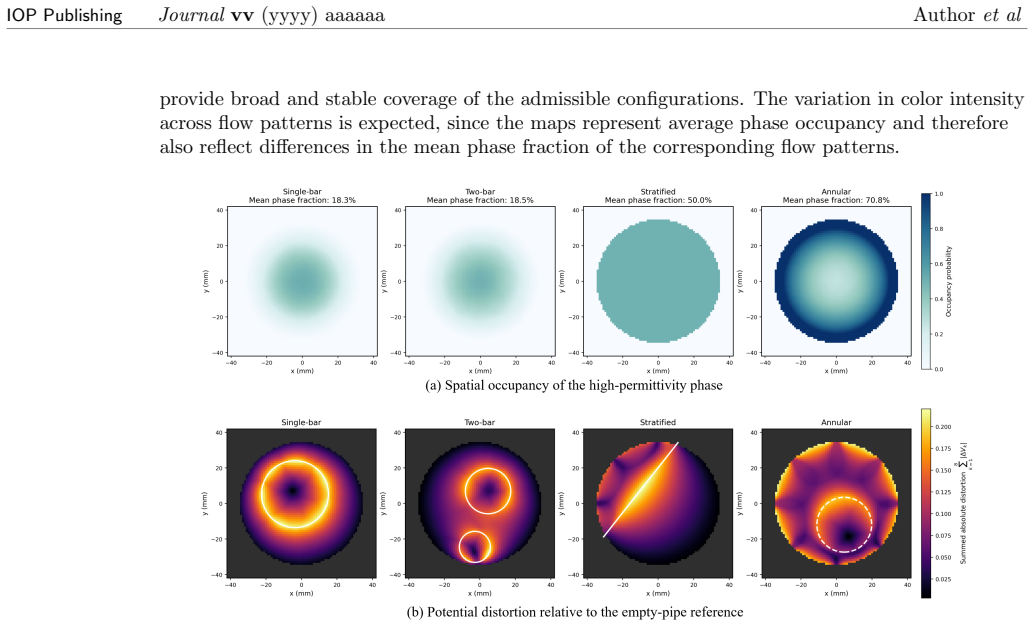
The electric potential-augmented dataset, which preserves eight full-field potential maps per sample as the explicit physical link between capacitance measurements and permittivity distributions.
If this is right
- Models that receive potential maps achieve higher reconstruction accuracy than capacitance-only baselines.
- Robustness improves under out-of-distribution flow patterns when potential information is supplied.
- The dataset supplies standardized evaluation protocols for both the forward and inverse problems of ECT.
- Explicit field data reduces the effort required to embed physical constraints into machine-learning models for ECT.
Where Pith is reading between the lines
- The same augmentation approach could be applied to other tomographic modalities that rely on soft-field measurements.
- Hybrid architectures could use the supplied potential maps to enforce consistency with Maxwell's equations during training.
- Extending the dataset with experimental measurements from real sensors would test whether simulation-derived gains transfer to hardware.
Load-bearing premise
Simulations of the eight-electrode sensor generate potential maps and capacitance values that match the latent physics of real ECT systems.
What would settle it
Train identical networks on the dataset both with and without the potential maps, then measure reconstruction error on measurements collected from physical ECT hardware.
Figures

read the original abstract
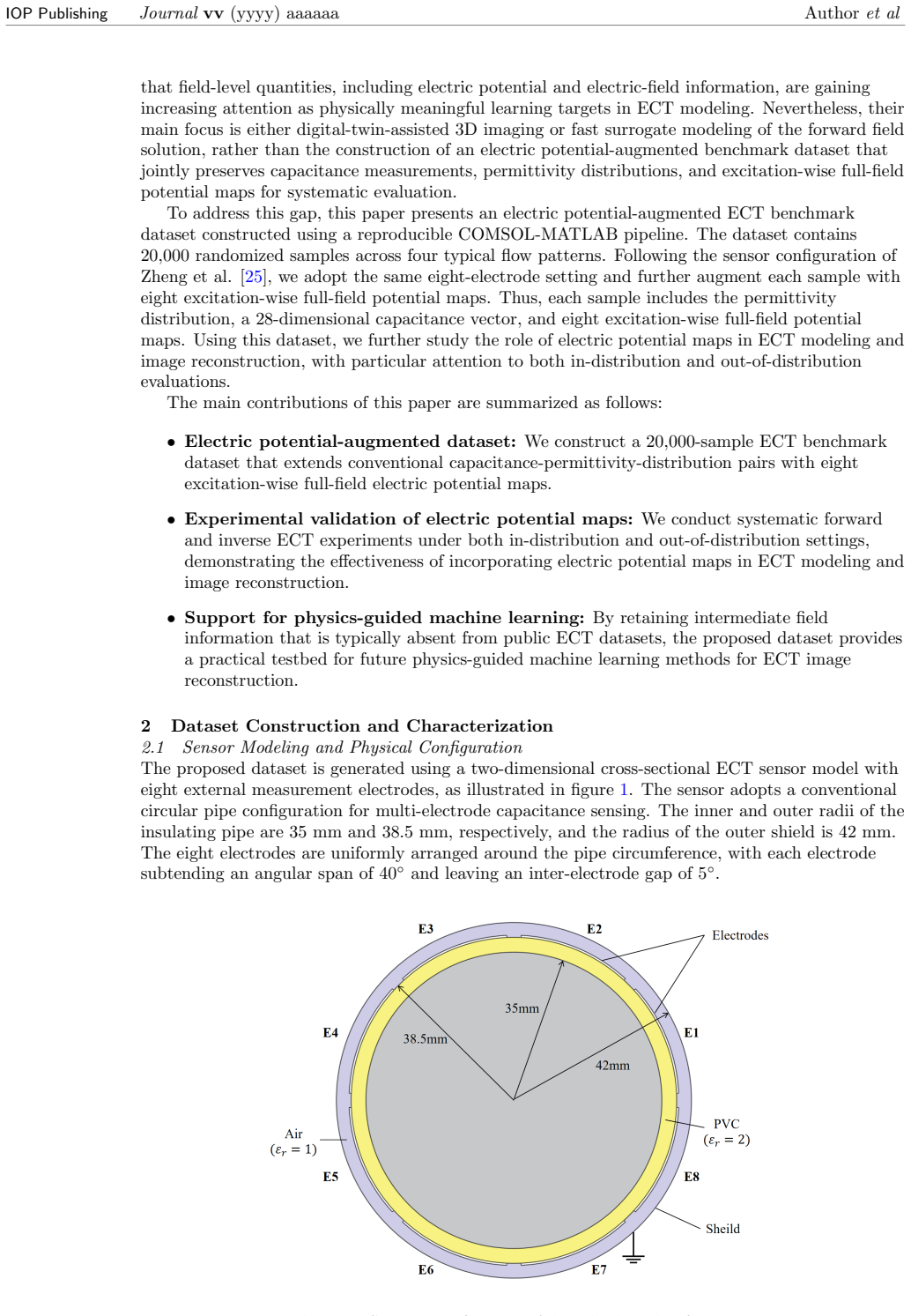
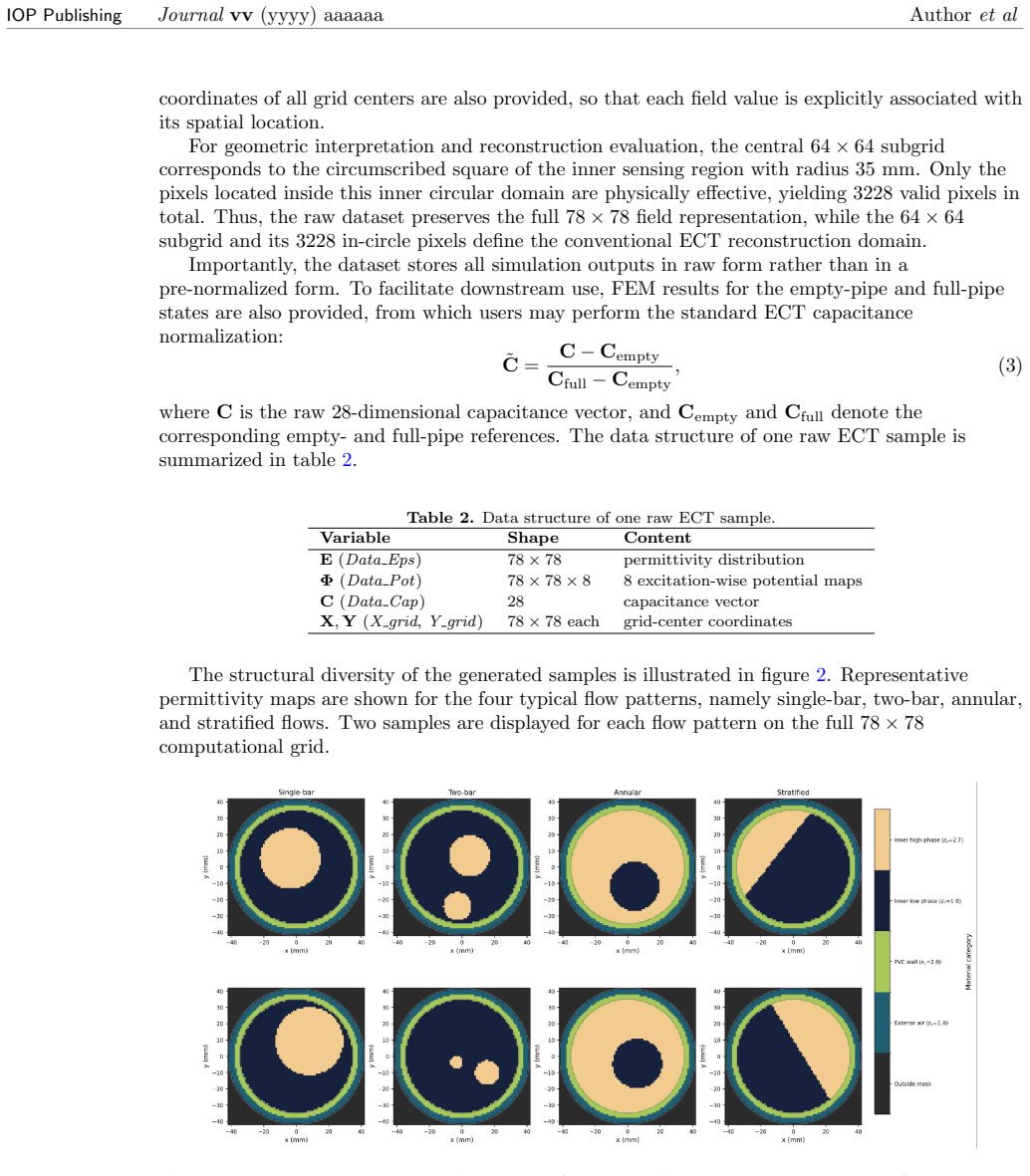
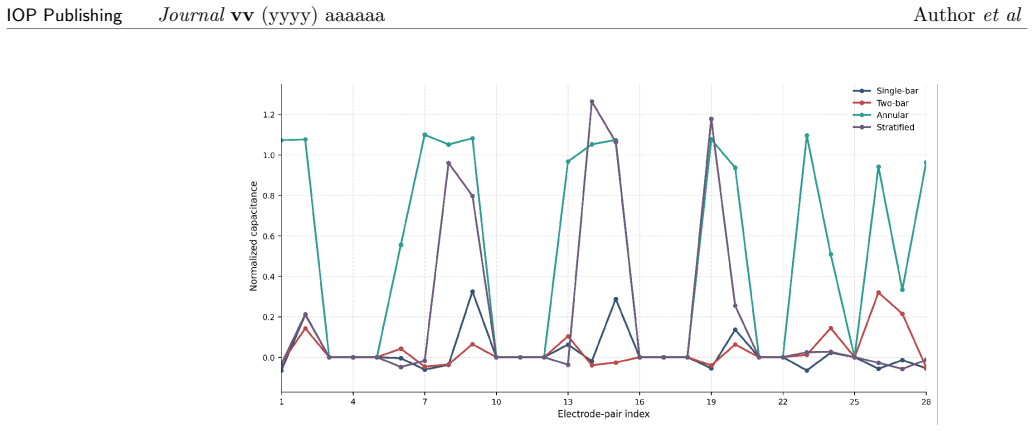
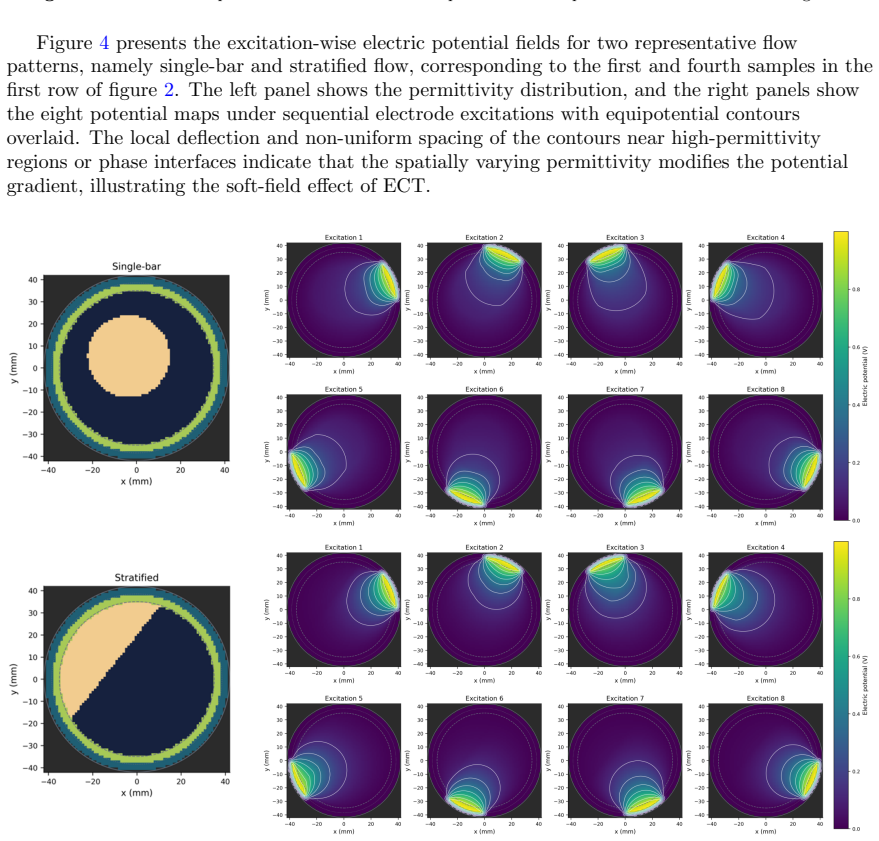
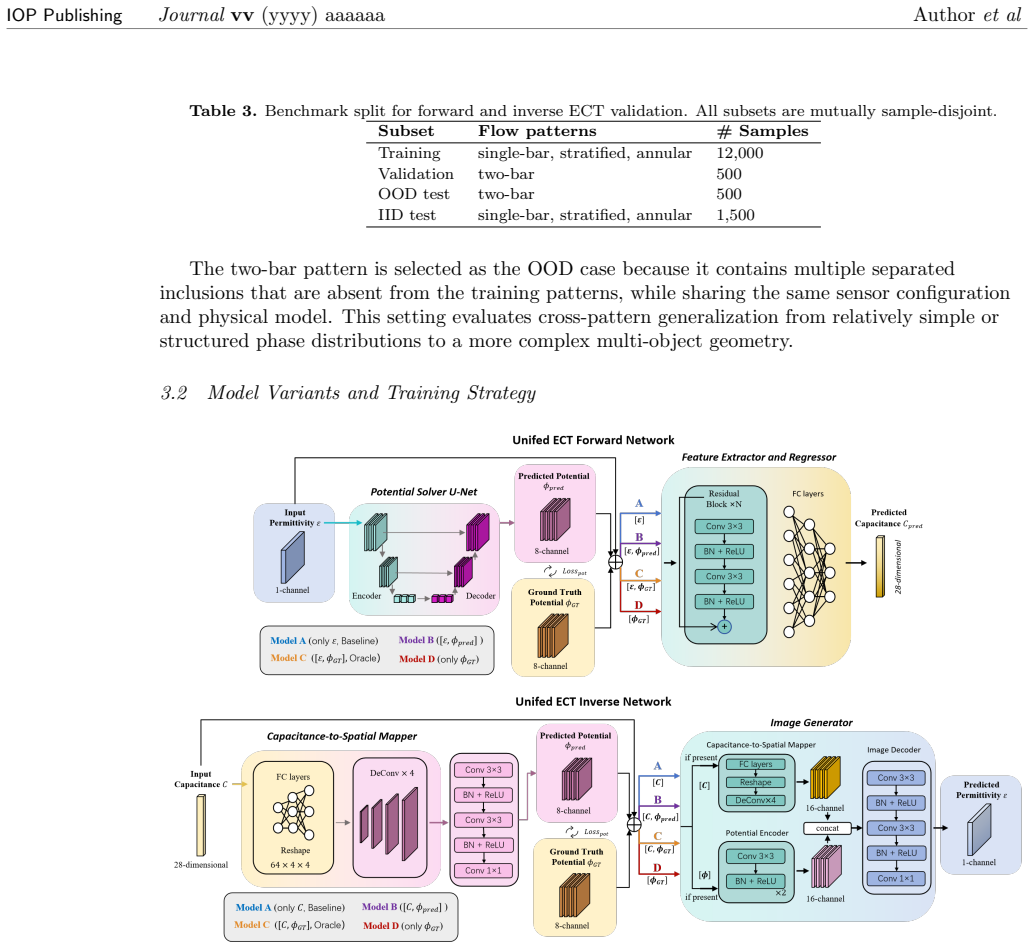
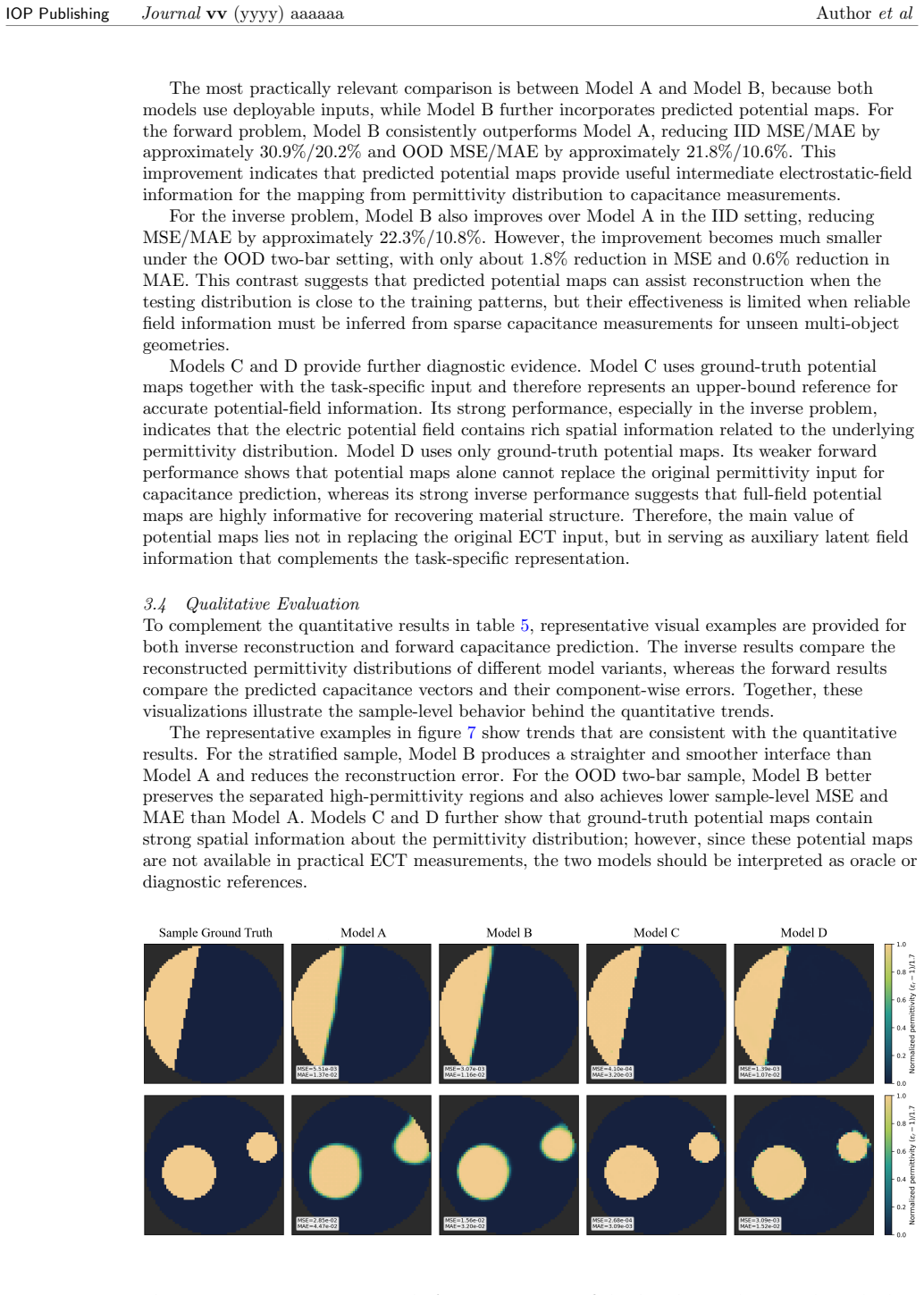
While deep learning has significantly advanced image reconstruction of Electrical Capacitance Tomography (ECT), most data-driven methods map directly between capacitance and permittivity distribution, treating the sensor as a black box. This overlooks the electric potential field -- the fundamental physical link governing the nonlinear and ill-posed ``soft-field'' effect. To address this, we propose an electric potential-augmented ECT benchmark dataset designed to explicitly integrate latent physics behind ECT into the learning process. Generated via a COMSOL-MATLAB pipeline for an eight-electrode sensor as an example, the dataset comprises 20,000 randomized samples across four typical flow patterns. Crucially, alongside the conventional capacitance vectors and permittivity distributions depicted as images, each sample preserves eight excitation-wise full-field potential maps. Beyond data release, we provide illustrative evaluation protocols for both forward and inverse problems of ECT. Through comprehensive testing on both in-distribution (IID) and out-of-distribution (OOD) scenarios, we systematically demonstrate how the inclusion of electric potential maps enhances modeling accuracy and robustness. Fundamentally, the explicit inclusion of latent field information significantly lowers the barrier to integrating physical laws into ECT modeling, thereby establishing a standardized foundation for future physics-guided machine learning of ECT image reconstruction.
Editorial analysis
A structured set of objections, weighed in public.
Referee Report
Summary. The manuscript introduces an electric potential-augmented benchmark dataset for Electrical Capacitance Tomography (ECT) image reconstruction. Using a COMSOL-MATLAB pipeline for an eight-electrode sensor, it generates 20,000 randomized samples across four typical flow patterns, including capacitance vectors, permittivity distributions, and eight excitation-wise full-field potential maps. The paper provides illustrative evaluation protocols for forward and inverse problems and demonstrates through IID and OOD testing that including electric potential maps enhances modeling accuracy and robustness.
Significance. If the simulation pipeline faithfully represents real ECT physics and the reported improvements are reproducible, this dataset establishes a standardized foundation for physics-guided machine learning in ECT by explicitly incorporating the latent electric potential field. This could significantly advance the integration of physical laws into data-driven models for this ill-posed inverse problem.
major comments (1)
- [Abstract] Abstract: The central claim that 'the inclusion of electric potential maps enhances modeling accuracy and robustness' is asserted without quantitative results, model architectures, error bars, statistical tests, or exclusion criteria. This renders the strength of the IID/OOD demonstration unverifiable from the summary and places the load-bearing evidence entirely on the (unseen here) evaluation protocols section.
minor comments (2)
- The four typical flow patterns are referenced but not named or illustrated; adding a brief description or figure would improve clarity for readers unfamiliar with ECT.
- The COMSOL-MATLAB pipeline is described at a high level; a short paragraph on mesh convergence or boundary condition choices would help users assess simulation fidelity without requiring them to re-run the code.
Simulated Author's Rebuttal
We thank the referee for the constructive review and the recommendation of minor revision. We address the single major comment below.
read point-by-point responses
-
Referee: [Abstract] Abstract: The central claim that 'the inclusion of electric potential maps enhances modeling accuracy and robustness' is asserted without quantitative results, model architectures, error bars, statistical tests, or exclusion criteria. This renders the strength of the IID/OOD demonstration unverifiable from the summary and places the load-bearing evidence entirely on the (unseen here) evaluation protocols section.
Authors: The abstract serves as a high-level summary of the manuscript contributions and key findings, consistent with standard scientific writing conventions. The full quantitative results—including specific accuracy and robustness metrics with error bars, the model architectures employed, statistical tests, and detailed evaluation protocols for both IID and OOD scenarios—are presented in the evaluation protocols and results sections of the manuscript. We acknowledge that incorporating select quantitative highlights into the abstract could improve immediate verifiability of the central claim. We will therefore revise the abstract to include key numerical results demonstrating the reported improvements. revision: yes
Circularity Check
No significant circularity
full rationale
The paper is a data-release manuscript whose core contribution is a COMSOL-MATLAB-generated benchmark dataset of 20,000 samples that includes capacitance vectors, permittivity images, and eight excitation-wise potential maps. No derivation chain, fitted parameters, or uniqueness theorems appear in the provided text. The claimed benefit of including potential maps is shown via internal IID/OOD evaluation protocols on the released data itself; these protocols do not reduce to self-referential equations or self-citations that would force the result. The work is therefore self-contained against external benchmarks and receives the default non-circularity finding.
Axiom & Free-Parameter Ledger
axioms (1)
- domain assumption The COMSOL-MATLAB pipeline for an eight-electrode sensor generates potential maps and capacitance values that are representative of physical ECT behavior.
Reference graph
Works this paper leans on
-
[1]
Huang S M, Plaskowski A B, Xie C G and Beck M S 1989 Tomographic imaging of two-component flow using capacitance sensorsJ. Phys. E: Sci. Instrum.22173–177 (doi: 10.1088/0022-3735/22/3/009)
-
[2]
Xie C G, Huang S M, Beck M S, Hoyle B S, Thorn R, Lenn C and Snowden D 1992 Electrical capacitance tomography for flow imaging: system model for development of image reconstruction algorithms and design of primary sensorsIEE Proc. G: Circuits Devices Syst. 13989–98 (doi: 10.1049/ip-g-2.1992.0015)
-
[3]
Reinecke N and Mewes D 1996 Recent developments and industrial/research applications of capacitance tomographyMeas. Sci. Technol.7233–246 (doi: 10.1088/0957-0233/7/3/004)
-
[4]
Marashdeh Q, Fan L-S, Du B and Warsito W 2008 Electrical capacitance tomography – a perspectiveInd. Eng. Chem. Res.473708–3719 (doi: 10.1021/ie0713590)
-
[5]
Yang W 2010 Design of electrical capacitance tomography sensorsMeas. Sci. Technol.21 042001 (doi: 10.1088/0957-0233/21/4/042001)
-
[6]
Isaksen Ø 1996 A review of reconstruction techniques for capacitance tomographyMeas. Sci. Technol.7325–337 (doi: 10.1088/0957-0233/7/3/013)
-
[7]
Yang W Q and Peng L 2003 Image reconstruction algorithms for electrical capacitance tomographyMeas. Sci. Technol.14R1–R13 (doi: 10.1088/0957-0233/14/1/201)
-
[8]
Yang W Q, Spink D M, York T A and McCann H 1999 An image-reconstruction algorithm based on Landweber’s iteration method for electrical-capacitance tomographyMeas. Sci. Technol.101065–1069 (doi: 10.1088/0957-0233/10/11/315)
-
[9]
Peng L, Merkus H and Scarlett B 2000 Using regularization methods for image reconstruction of electrical capacitance tomographyPart. Part. Syst. Charact.1796–104 (doi: 10.1002/1521-4117(200010)17:3<96::AID-PPSC96>3.0.CO;2-8)
-
[10]
Fang W 2004 A nonlinear image reconstruction algorithm for electrical capacitance tomographyMeas. Sci. Technol.152124–2132 (doi: 10.1088/0957-0233/15/10/023)
-
[11]
Soleimani M and Lionheart W R B 2005 Nonlinear image reconstruction for electrical capacitance tomography using experimental dataMeas. Sci. Technol.161987–1996 (doi: 10.1088/0957-0233/16/10/014)
-
[12]
Li Y and Yang W Q 2008 Image reconstruction by nonlinear Landweber iteration for complicated distributionsMeas. Sci. Technol.19094014 (doi: 10.1088/0957-0233/19/9/094014)
-
[13]
Watzenig D and Fox C 2009 A review of statistical modelling and inference for electrical capacitance tomographyMeas. Sci. Technol.20052002 (doi: 10.1088/0957-0233/20/5/052002)
-
[14]
Zhao J, Xu Y, Tan C and Dong F 2014 A fast sparse reconstruction algorithm for electrical tomographyMeas. Sci. Technol.25085401 (doi: 10.1088/0957-0233/25/8/085401)
-
[15]
Ye J, Wang H and Yang W 2015 Image reconstruction for electrical capacitance tomography based on sparse representationIEEE Trans. Instrum. Meas.6489–102 (doi: 10.1109/TIM.2014.2329738) 12 IOP PublishingJournalvv(yyyy) aaaaaa Authoret al
-
[16]
Nooralahiyan A Y and Hoyle B S 1997 Three-component tomographic flow imaging using artificial neural network reconstructionChem. Eng. Sci.522139–2148 (doi: 10.1016/S0009-2509(97)00040-7)
-
[17]
J.185464–5474 (doi: 10.1109/JSEN.2018.2836337)
Zheng J and Peng L 2018 An autoencoder-based image reconstruction for electrical capacitance tomographyIEEE Sens. J.185464–5474 (doi: 10.1109/JSEN.2018.2836337)
-
[18]
Zheng J, Ma H and Peng L 2019 A CNN-based image reconstruction for electrical capacitance tomography2019 IEEE International Conference on Imaging Systems and Techniques (IST)(doi: 10.1109/IST48021.2019.9010096)
-
[19]
J.204879–4890 (doi: 10.1109/JSEN.2020.2965731)
Zheng J and Peng L 2020 A deep learning compensated back projection for image reconstruction of electrical capacitance tomographyIEEE Sens. J.204879–4890 (doi: 10.1109/JSEN.2020.2965731)
-
[20]
Yang X, Zhao C, Chen B, Zhang M and Li Y 2019 Big data driven U-Net based electrical capacitance image reconstruction algorithm2019 IEEE International Conference on Imaging Systems and Techniques (IST)(doi: 10.1109/IST48021.2019.9010423)
-
[21]
Zhu H, Sun J, Xu L, Tian W and Sun S 2020 Permittivity reconstruction in electrical capacitance tomography based on visual representation of deep neural networkIEEE Sens. J. 204803–4815 (doi: 10.1109/JSEN.2020.2964559)
-
[22]
Deabes W, Abdel-Hakim A E, Bouazza K E and Althobaiti H 2022 Adversarial resolution enhancement for electrical capacitance tomography image reconstructionSensors223142 (doi: 10.3390/s22093142)
-
[23]
Wanta D, Smolik A, Smolik W T, Midura M and Wr´ oblewski P 2025 Image reconstruction using machine-learned pseudoinverse in electrical capacitance tomographyEng. Appl. Artif. Intell.142109888 (doi: 10.1016/j.engappai.2024.109888)
-
[24]
Peng L, Yang Y, Li Y, Zhang M, Wang H and Yang W 2025 Deep learning-based image reconstruction for electrical capacitance tomographyMeas. Sci. Technol.36062003 (doi: 10.1088/1361-6501/add8ad)
-
[25]
Zheng J, Li J, Li Y and Peng L 2018 A benchmark dataset and deep learning-based image reconstruction for electrical capacitance tomographySensors183701 (doi: 10.3390/s18113701)
-
[26]
Data(doi: 10.1038/s41597-026-07433-7)
Shi D, Wang Y, Li X, Sun T, Liu H and Guo D 2026 An electrical capacitance tomography dataset for image reconstruction benchmarkingSci. Data(doi: 10.1038/s41597-026-07433-7)
-
[27]
Jin Y, Li Y, Zhang M and Peng L 2024 A physics-constrained deep learning-based image reconstruction for electrical capacitance tomographyIEEE Trans. Instrum. Meas.73 4500612 (doi: 10.1109/TIM.2023.3338673)
-
[28]
Soft Comput.155111436 (doi: 10.1016/j.asoc.2024.111436)
Lei J and Liu Q 2024 Data and measurement mechanism integrated imaging method for electrical capacitance tomographyAppl. Soft Comput.155111436 (doi: 10.1016/j.asoc.2024.111436)
-
[29]
Loser T, Wajman R and Mewes D 2001 Electrical capacitance tomography: image reconstruction along electrical field linesMeas. Sci. Technol.121083–1091 (doi: 10.1088/0957-0233/12/8/314)
-
[30]
Wang S, Li Y, Chen Z, Kong M and Yang Y 2024 Digital twin-assisted 3-D electrical capacitance tomography for multiphase flow imagingIEEE Trans. Instrum. Meas.73 4507612 (doi: 10.1109/TIM.2024.3440409)
-
[31]
Banasiak R, Stawska Z and Fabija´ nska A 2025 Direct estimation of electric field distribution in circular ECT sensors using graph convolutional networksSensors256371 (doi: 10.3390/s25206371) 13
discussion (0)
Sign in with ORCID, Apple, or X to comment. Anyone can read and Pith papers without signing in.